
Building a one-off or custom yacht is a very delicate and exciting undertaking. As you are free to choose how your boat should be like, inside and outside, all you have to do is to balance your dreams, wishes and demands with technical feasibility and, of course, your wallet. But every decision comes with a consequence: This article delves into the aftermath of my simple wish … to have an open, bulkhead-less saloon.
So, many people have asked me in the comments or in conversations if my decision to cancel the main bulkhead wouldn´t weaken the structural integrity of my boat. Especially the stiffness of the deck structure around the region where the bulkhead got removed is in question. As well as possible “squeezing” of the boat through lateral forces.
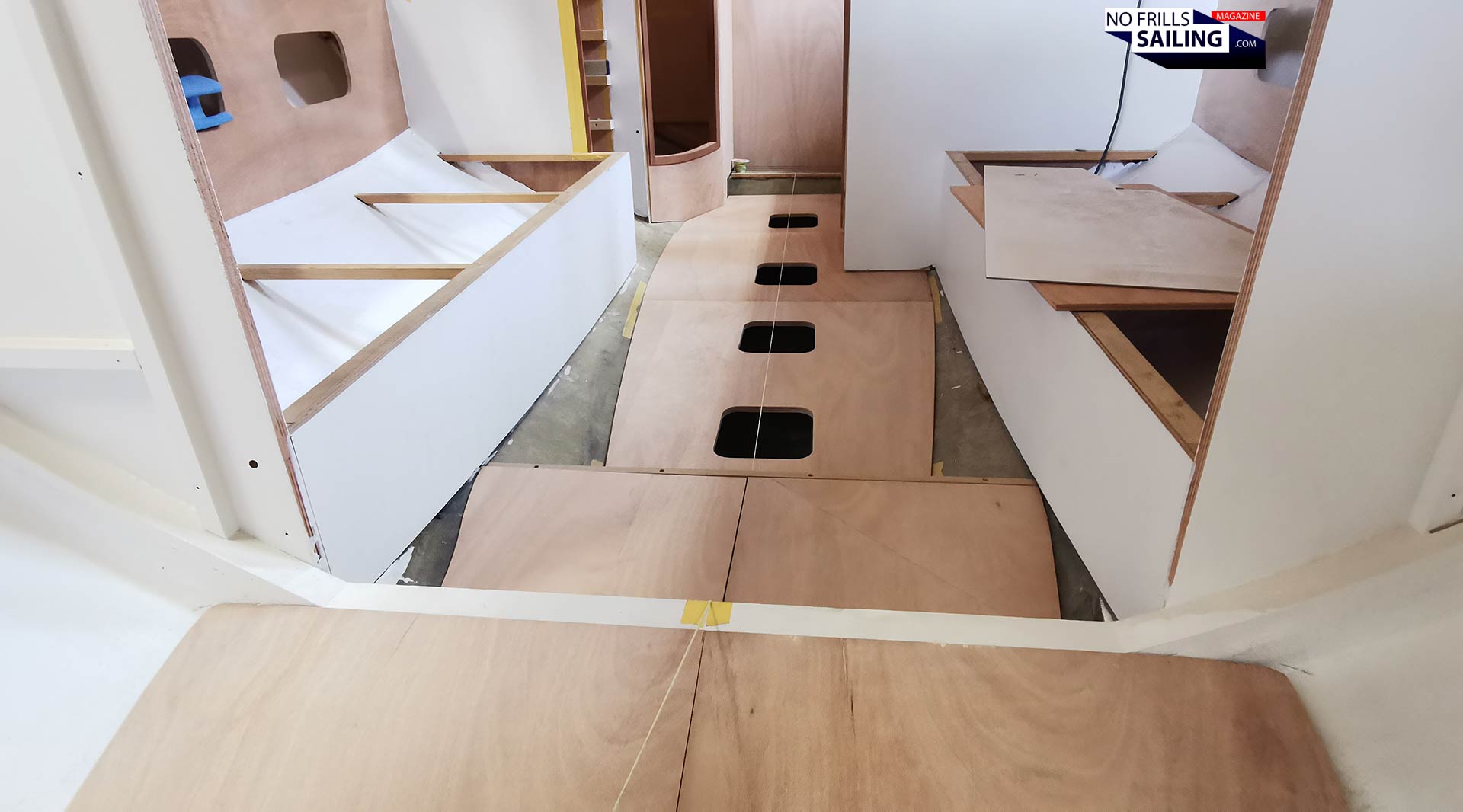
Another concern was the forces introduced by the mast into the deck surrounding it would also not be counter-balanced by the bulkhead that was now missing. Well, at first, be assured that of course any change we do – and you, if you decide to opt for a one-off or custom changes in your new sailboat – is carefully considered by master boatbuilders, thought through and calculated to take into account any eventualities and outcomes of every single change. Calm down, guys, the boat will sail as stiff and robust as she would with the classic bulkhead layout. But let´s delve a bit deeper here …
Why I want an open saloon in the first place

You may remember one of my very first Omega 42 articles when I visited the boat right after I had signed the purchase contract and the shipyard hauled the then still completely empty hull onto its building cradles to commence work. I was sitting on the bottom of the boat and was captivated by her sheer lines and the breathtaking view through her sleek, pointy hull. I decided that I´d wanted to conserve as much of this view as possible in the later finished yacht. And secondly, there was my impression from hull #001, which is an exceptionally beautiful boat, but …
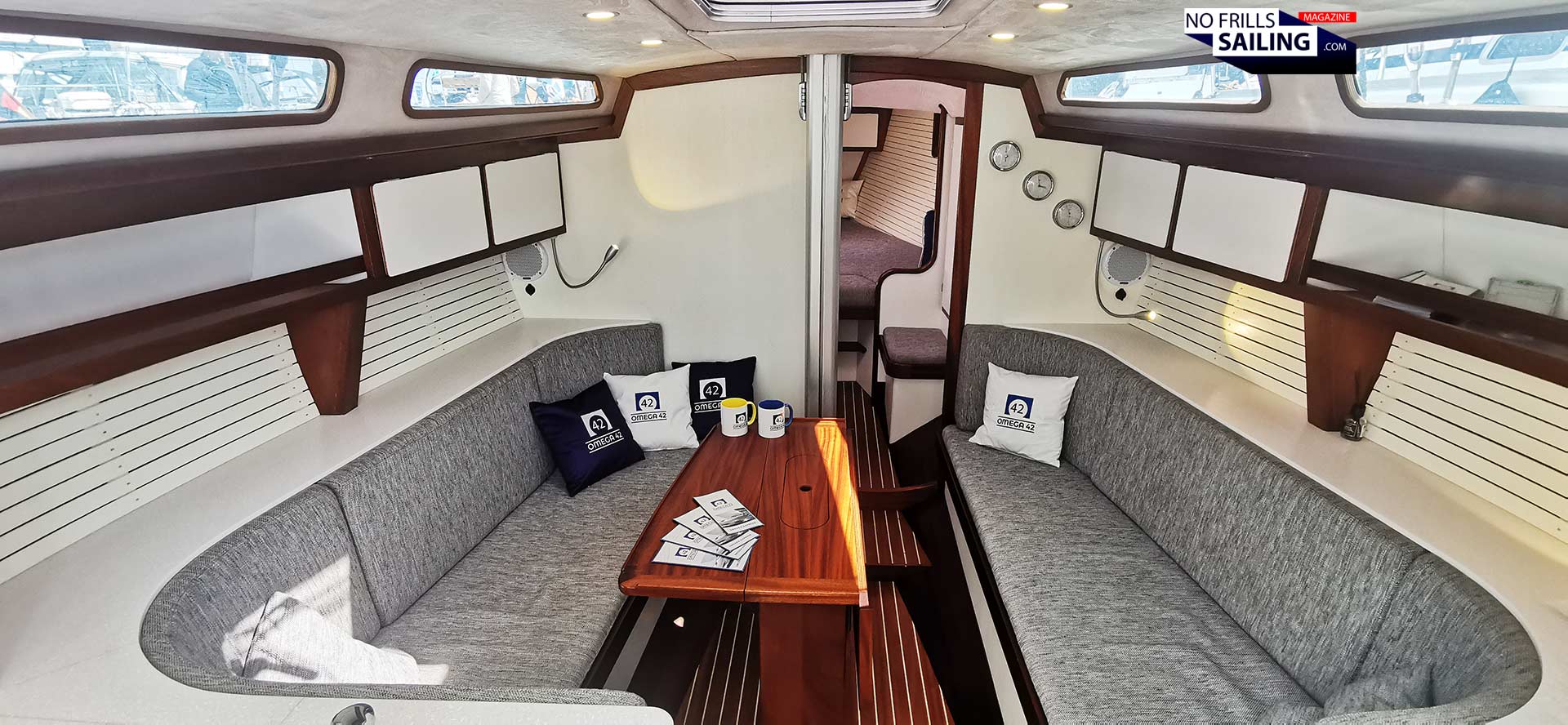
… but I really didn´t like the idea of having to squeeze myself through slim cabin doors anytime I wanted to enter the fore or aft cabins. Also, as the Omega 42 may be 13 meters long, she is only 3.10 meters at her widest. The hull is very pointy so from her chainplates onward to both bow and stern she is getting slimmer and slimmer by the meter. “Opening up” the saloon by removing the front main bulkhead and skipping all doors aboard (except for the bathroom) was an idea I quickly introduced to the shipbuilders in the yard.
The structural challenges of cancelling a bulkhead
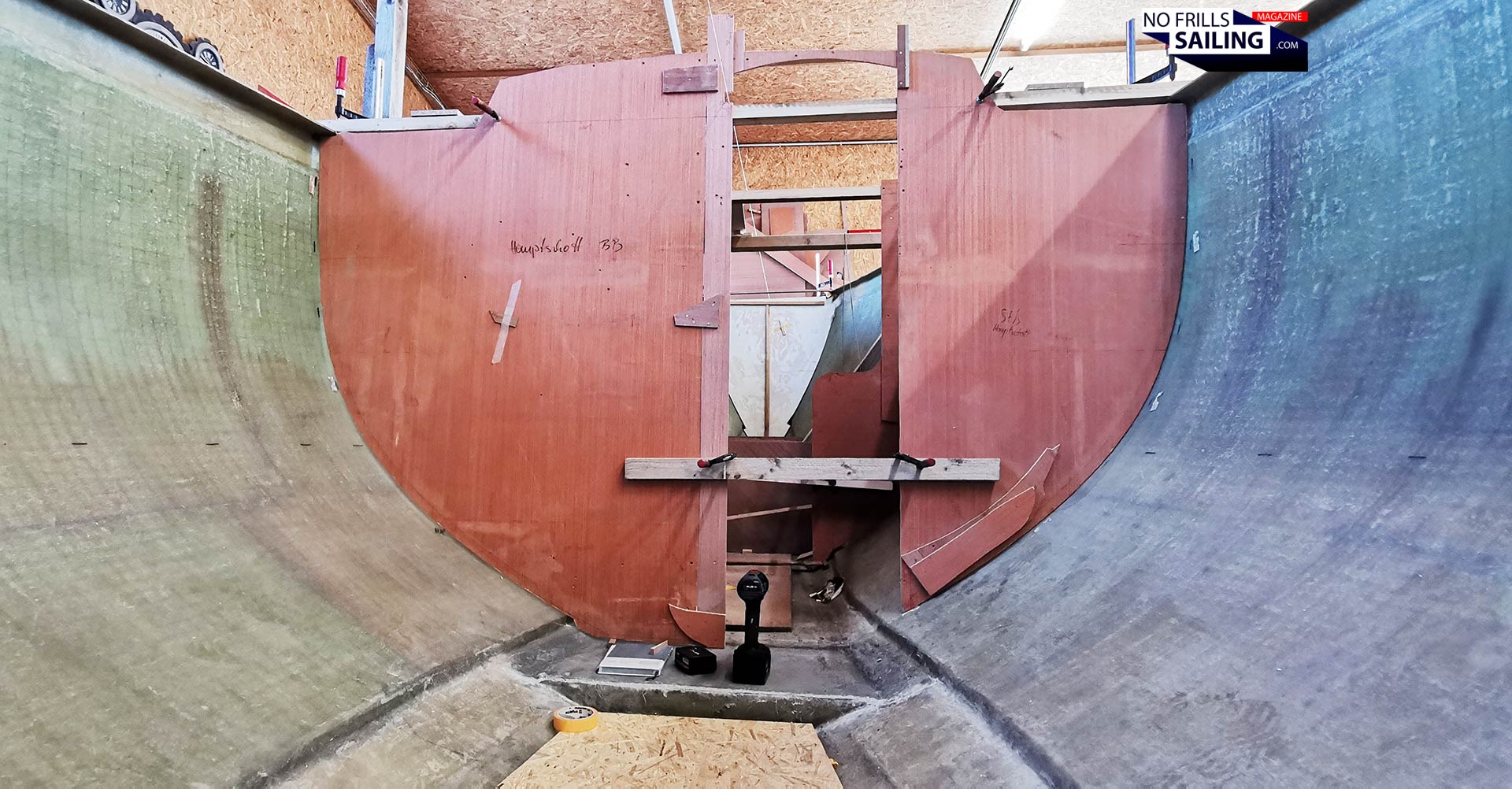
That´s were it started to become a bit complicated. As you can see in the picture below, the main bulkhead is located just a few centimeters in front of the mast. Here´s the first all-clear message: As an Omega 42 mast is keel stepped, the bulk of the rigging forces are induced right into the keel structure and the chainplates. So there´s less stresses on the deck. But of course, as the mock-up bulkhead gauges inserted into my hull indicate, the construction of the Omega 42 is meant to feature a fully closed main bulkhead with only a slim admission for a cabin door. So the task was to calculate and confirm the largest possible opening here for a much wider passage without compromising stiffness and integrity.
In this, we did not remove a whole bulkhead indeed, but carved off as much material as we could. As you can see in the other picture below, just when the raw bulkheads and cabin walls had been fitted for a complete dress rehearsal, the main bulkhead did not vanish at all. It was rather the portside part that was reduced significantly – it kind of mirrors the dimensions of its starboard-side counterpart. And then there´s another nice little detail in the picture. I noted it, but never dared to think about it. Up until now:
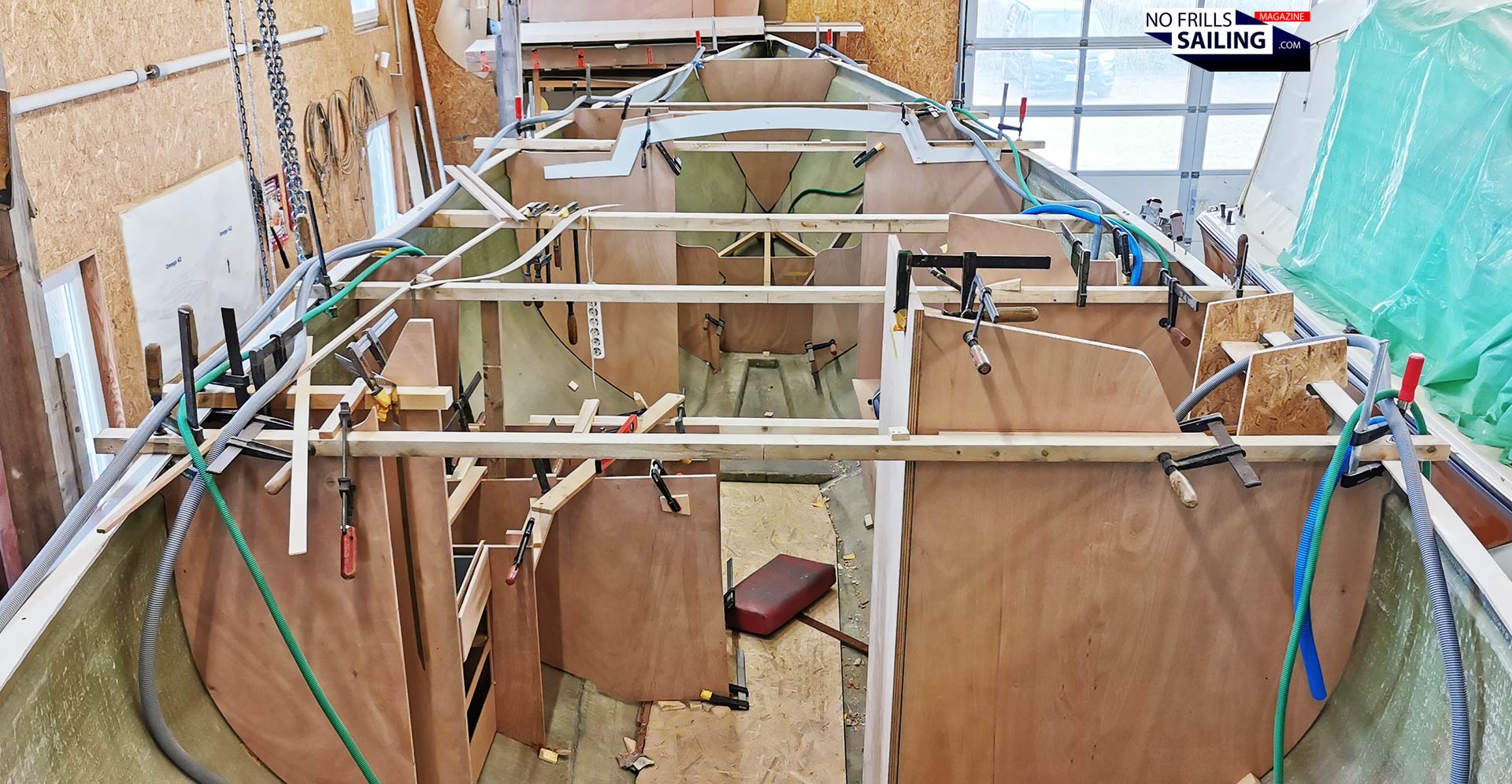
You can see a white cardboard part loosely attached to the main bulkhead overhead? Even right back at that time the guys had the plan how to solve the “missing material”-problem. With a crossbeam! Because, taking off material means to weaken the area it used to support. To substitute this missing material, the crossbeam became a big item in the to do-list for many months. And now it had been made and got fitted.
Making a thick, stiff – but beautiful – crossbeam
In fact, I have witnessed one of the carpenters working on this thick crossbeam for days, but couldn´t make the connection to my boat. I simply wasn´t aware of the fact that this man was manufacturing this part, as there are many other boats under construction in the shed next to mine at all time. So, unfortunately, I haven´t made any pictures. Which is a shame because otherwise you would be able to admire the clean, neat lines of this massive and beautiful piece of dense, heavy oak tree timber! On the picture below, it is already hidden underneath a number of GRP-layers.
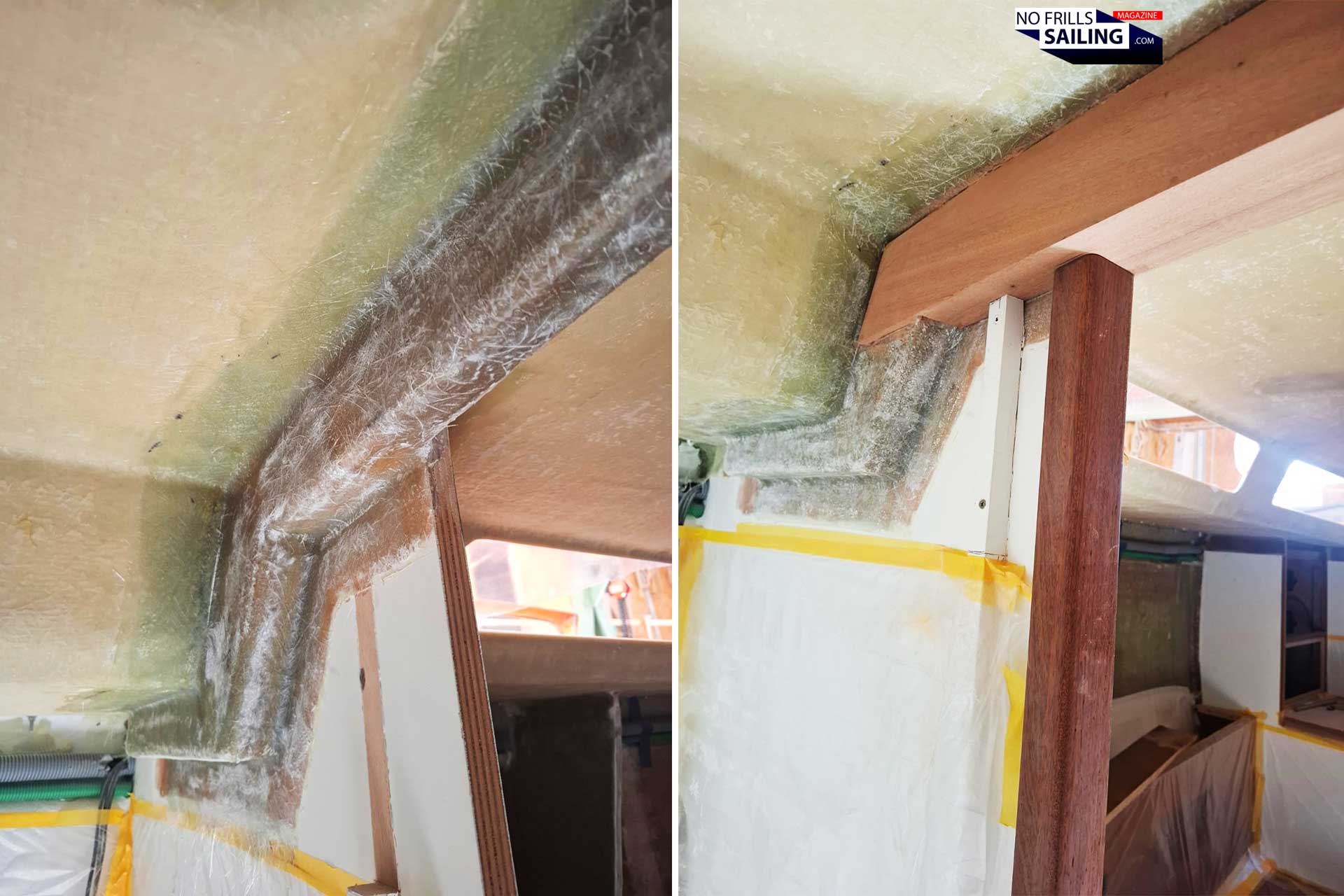
So that´s unfortunate, but let´s work with what we have. On the picture above you can see how the crossbeam had been mounted to the bulkhead and inseparably laminated with lots of epoxy and several layers of glassfiber to the GRP-structure of the deck, the attachment points with the hull and of course to the bulkhead. The wooden part of the crossbeam is approximately 6-7 centimeters thick. Together with the GRP-layers that´s roughly 8 mills surplus material.
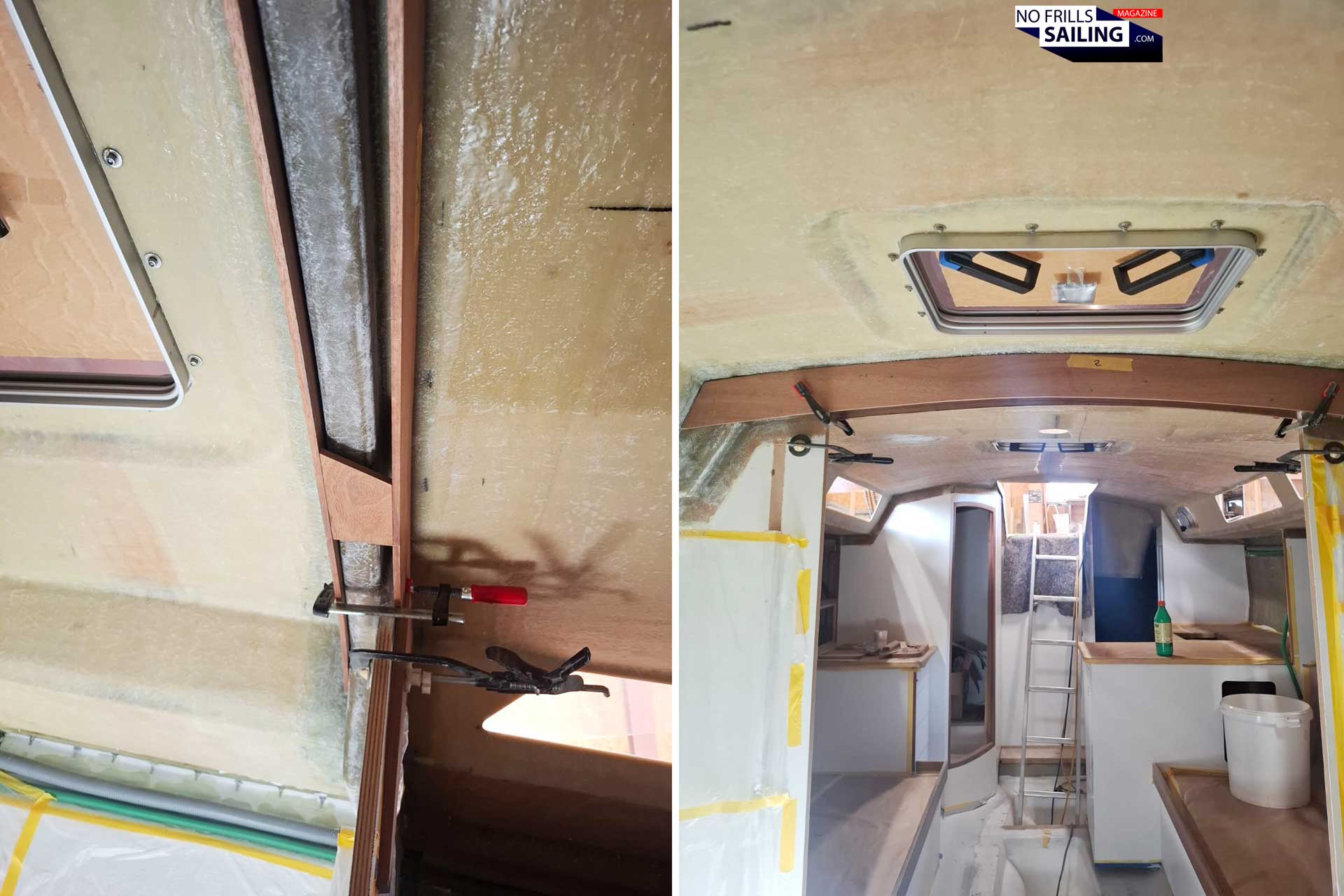
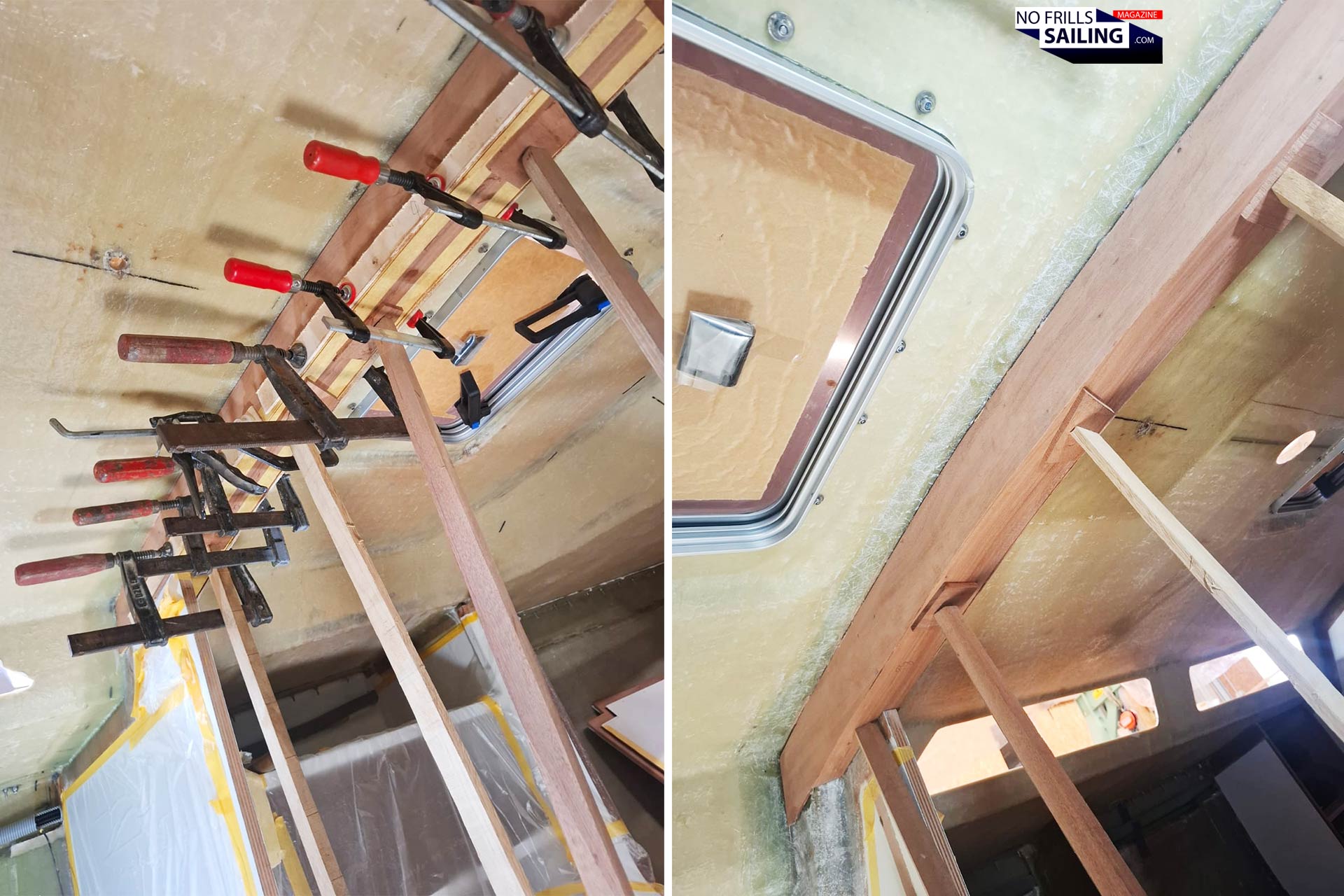
Of course they couldn´t let it this way and just paint it over, so the joiners custom made a facing from plywood that had been meticulously adjusted in many man hours to fit the shape of the ceiling. After attaching the three covers to the structure, it will now be lacquered white and thus seamlessly integrate itself into the overall design of the saloon. In the end, I am sure, you won´t even notice that there is such a thick part mounted here in the first place.
Next steps of the Omega 42 build
So I am very happy with the outcome and also noticed a slight decrease of the “deck wobble” when walking on her deck, which is a trade mark for all Omega 42 boats and merely an inconvenience, than a real downside. The crossbeam significantly strengthened up the whole structural stiffness in the mast-surrounding area as planned. And it neither obstructs the atmosphere down below in the saloon nor hinders it the still open, breathtaking view throughout the whole length of the ship. Well done, guys!

By the way, if you do not wish to miss any new of the roughly three articles per week, why don´t you just quickly click here to subscribe to my monthly free newsletter? Every single new article is mentioned here, together with all new videos uploaded onto my new YouTube channel. It´s really convenient and – promised – only once a month! Back to the Omega 42 build: What´s up next?
I hope to being able to show you in real detail the fitting of the two-color felt to the ship´s sides and roofing soon. Also, electric and electronics will be fitted along with my (also very, very reduced) onboard fresh water system. The mattresses will enter production in September/October as well and … well, so is the rest. The plan is still to have her finished by October/November. So stay tuned, guys!
You might as well check out these articles:
All building progress-articles (currently 33) by clicking the hashtag #buildingreport
Sailing the Omega 42 is an unforgettable experience!
Open saloon design on small boats: Role model Oceanis 30.1