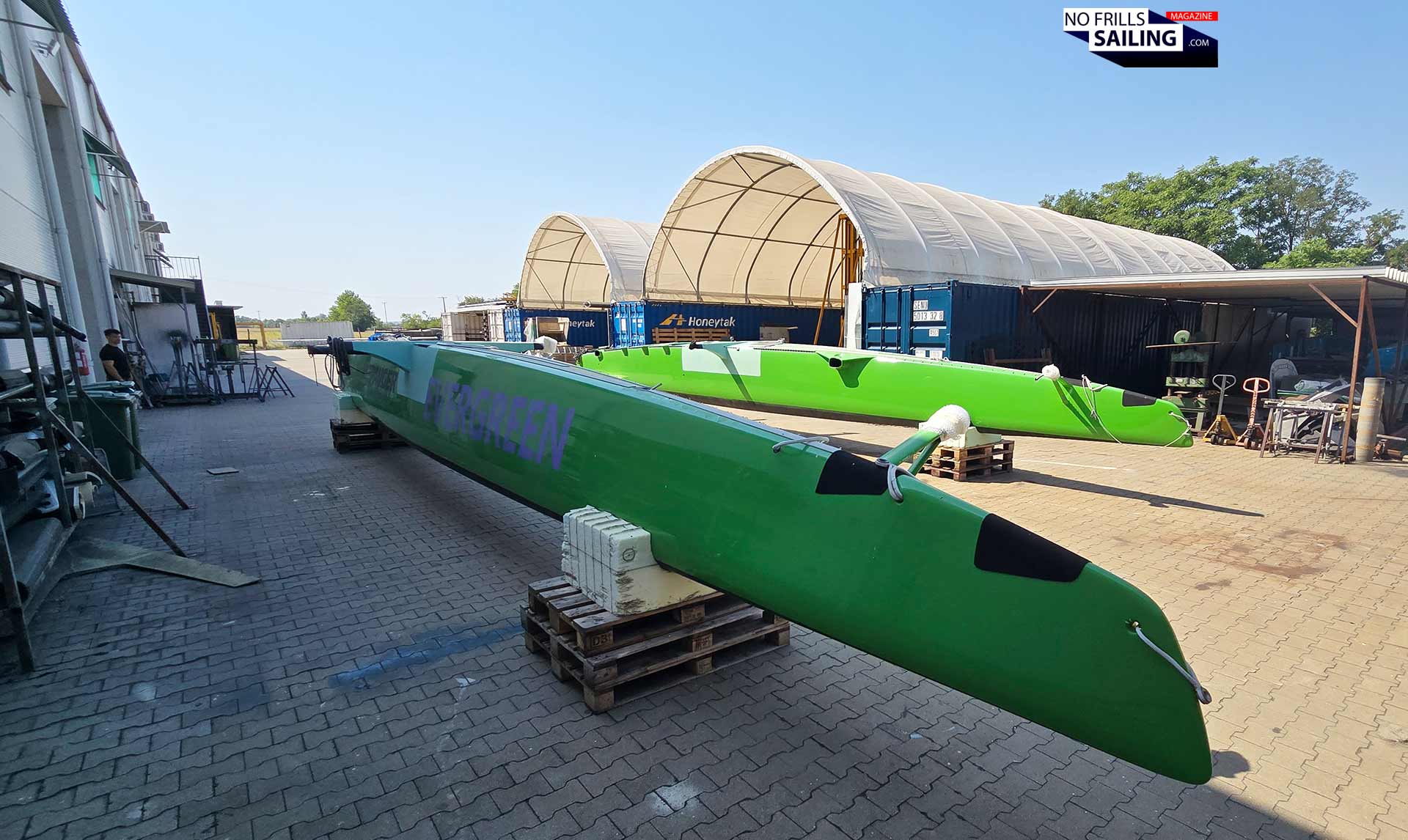
Owners of high performance racing yachts or sailors interested in driving their boats right on the edge of what´s possible in terms of weight, strength and power are indeed seeking highest quality, rigidity and safety. Especially when it comes to the masts, standing rigging and rigging parts of their powerful boats – be it a small dinghy or a full-grown IMOCA. This article takes you on a full tour through the Pauger Composites factory – where dreams in carbon are made.
Driving south-west on the E71 from Hungary´s beautiful and captivating capital city, Budapest, towards their large national inshore ocean, the Lake Balaton, you come past an even smaller lake, Velence. This is missed by many people since this lake is almost completely overgrown. The nice beaches and budding night life is a 45 minute drive away. That said, most will miss what this area has also to offer. Pauger Composites for example.
Welcome to Pauger, Hungary!
I used to be in Hungary a week ago anyway and – of course – we tagged a few days vacation at Lake Balaton on to my business trip here. But instead of driving past Lake Velence, knowing that Pauger has its factory here, I arranged a meeting and stopped for a visit. Little had I known, that be said first, because I thought this might just be a quick drive-by visit, no more than 45 minutes. Well, buckle up, dear readers – there was much, much more to see here! This is going to be a long one to read …
A complete factory tour at Pauger
Advertisement
When I arrived I was greeted by Ördög. This guard dog – luckily he was inside his cage – already began barking like hell when my car pulled up on the parking lot. Passing the dog, he almost freaked out and I am sure Ördög would have fucked me up completely would he not be caged … So I couldn´t even take a proper picture from the Pauger factory´s outside as Ördög´s barking was so intimidating, that I preferred to proceed inside as fast as I could.
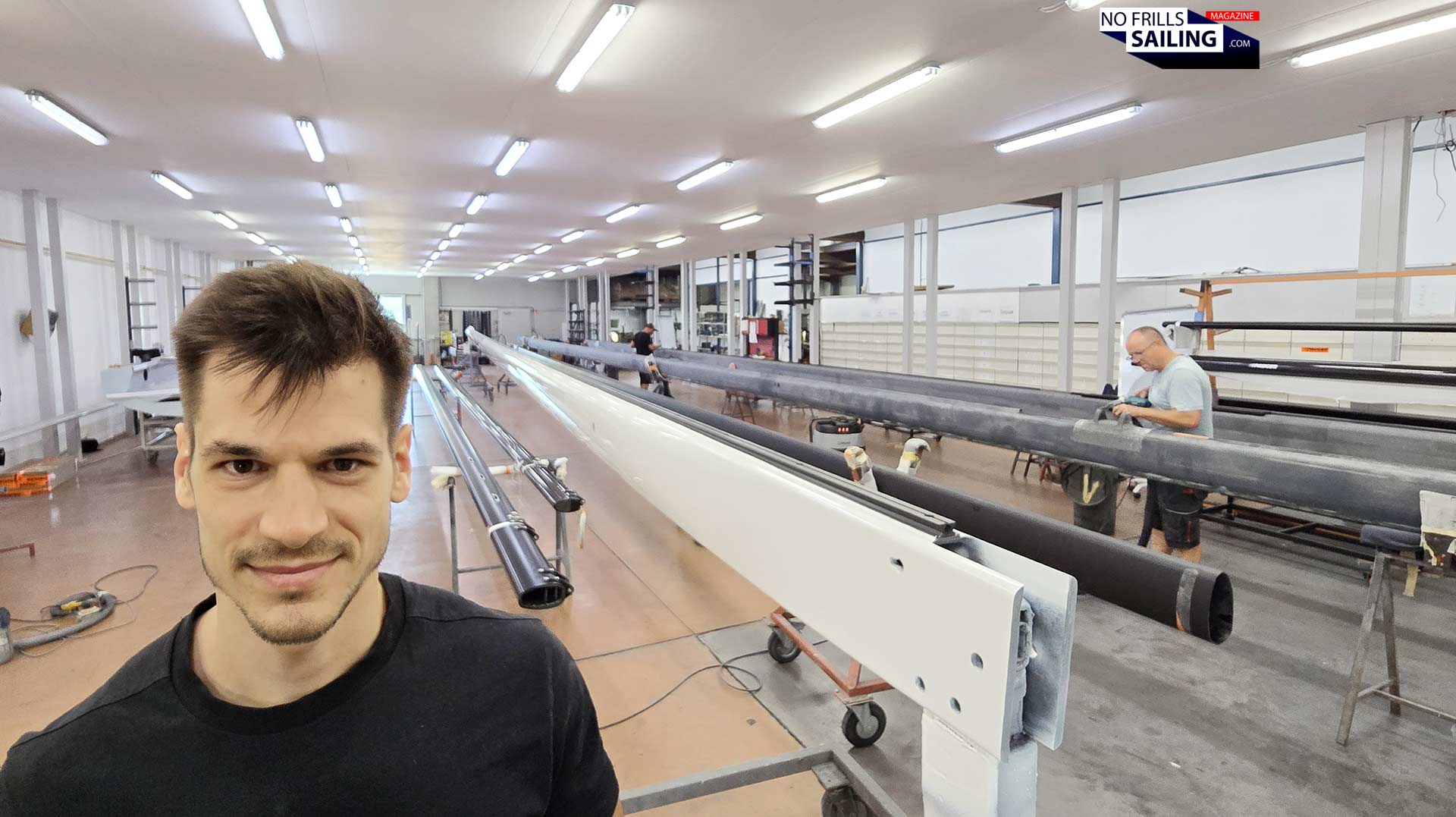
Balint Paulovits shows me around
Here, Balint Paulovits greets me (and discloses the name of their watchdog-hellhound to me with a smile …). Balint is the Production and Sales Manager at Pauger, and as it turns out, the son of the company founder, Denes Paulovits. As Ördög was freaking out and it indeed had been over 40 degrees Celsius outside in the relentlessly burning sun of the Puszta, we proceeded into the production halls which were nicely climatized. “What do you want to see?”, Balint asked me. Well, I said: Everything, if this is possible? It was.
Carbon masts and rigging – the high end market
Pauger is one of the very, very few brands in the boating industry specialized in composite parts for sailing yachts. The market is small, but very lucrative: If you want to have your racing yacht performing at the very top end of the fields, no matter in which class you compete, no matter if Corinthian or professional, you need to have carbon parts. Because, as we know: Only lightweight yachts have a chance to win the prestigious regattas, world championships or racing series. In this, Pauger, from the start, aimed for these top performers, not so much the wider market. Which may be the reason why you probably thought of Axxon, Seldén or Marstrom in the first place.
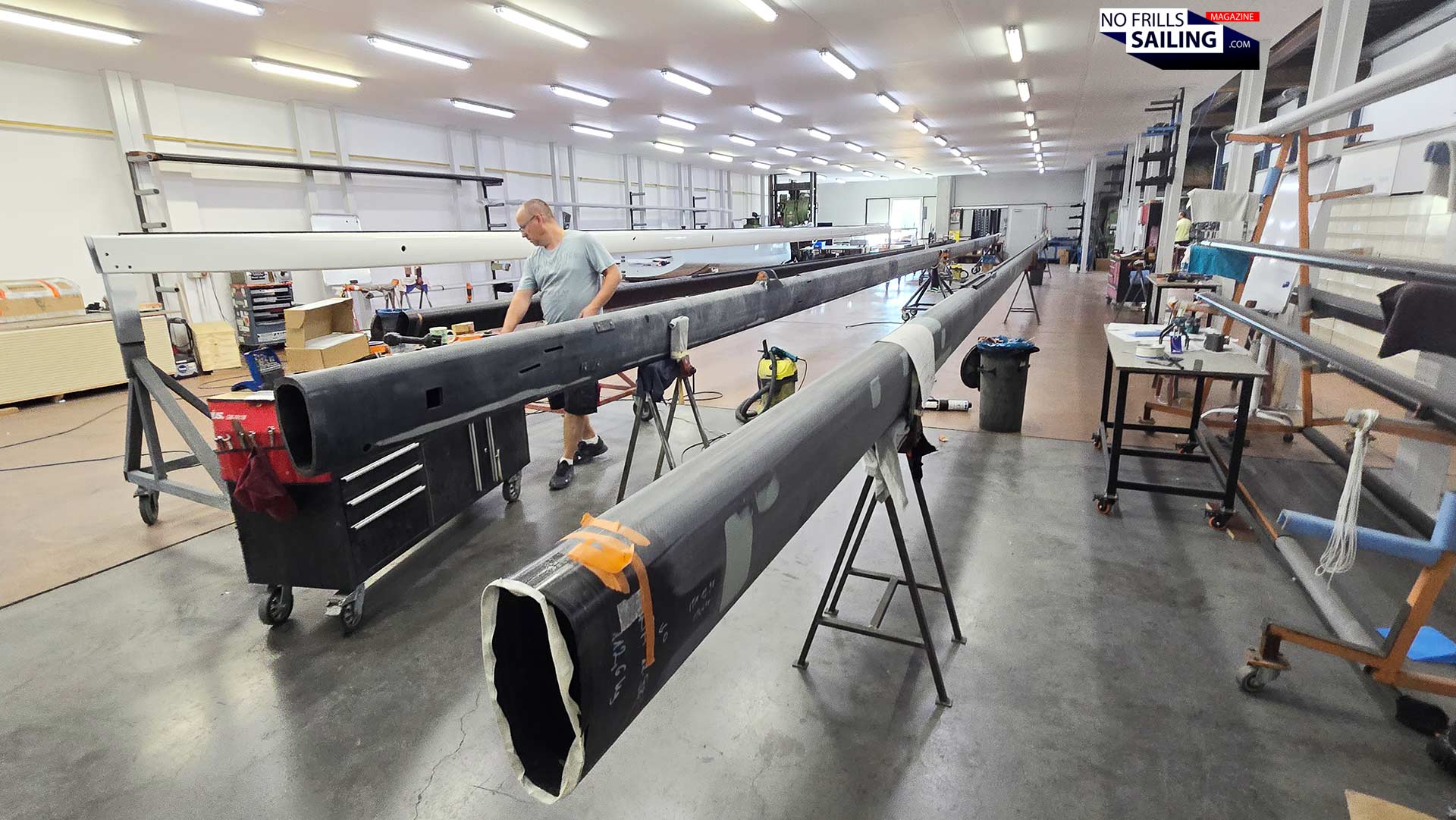
Look at these massive masts!
Pauger is far from being new to the game. The company had been founded by Balint´s father – a highly distinguished Finn Dinghy sailor and talented engineer – right after the fall of the Iron Curtain in 1990. Back then, they started with glassfiber yachts and boatbuilding, switching to carbon as their prime material about 10 years later. Now Pauger is a worldwide renowned manufacturer of both series rigging parts and individual one-off custom riggings for all kinds of sailboats of all classes and sizes. This I can see in the fitting workshop, where masts for dinghies are in the final processing, as well as a huge TP 52-mast, which impressively shows the wide range of products made here.
Pauger in Hungary: Speechless!
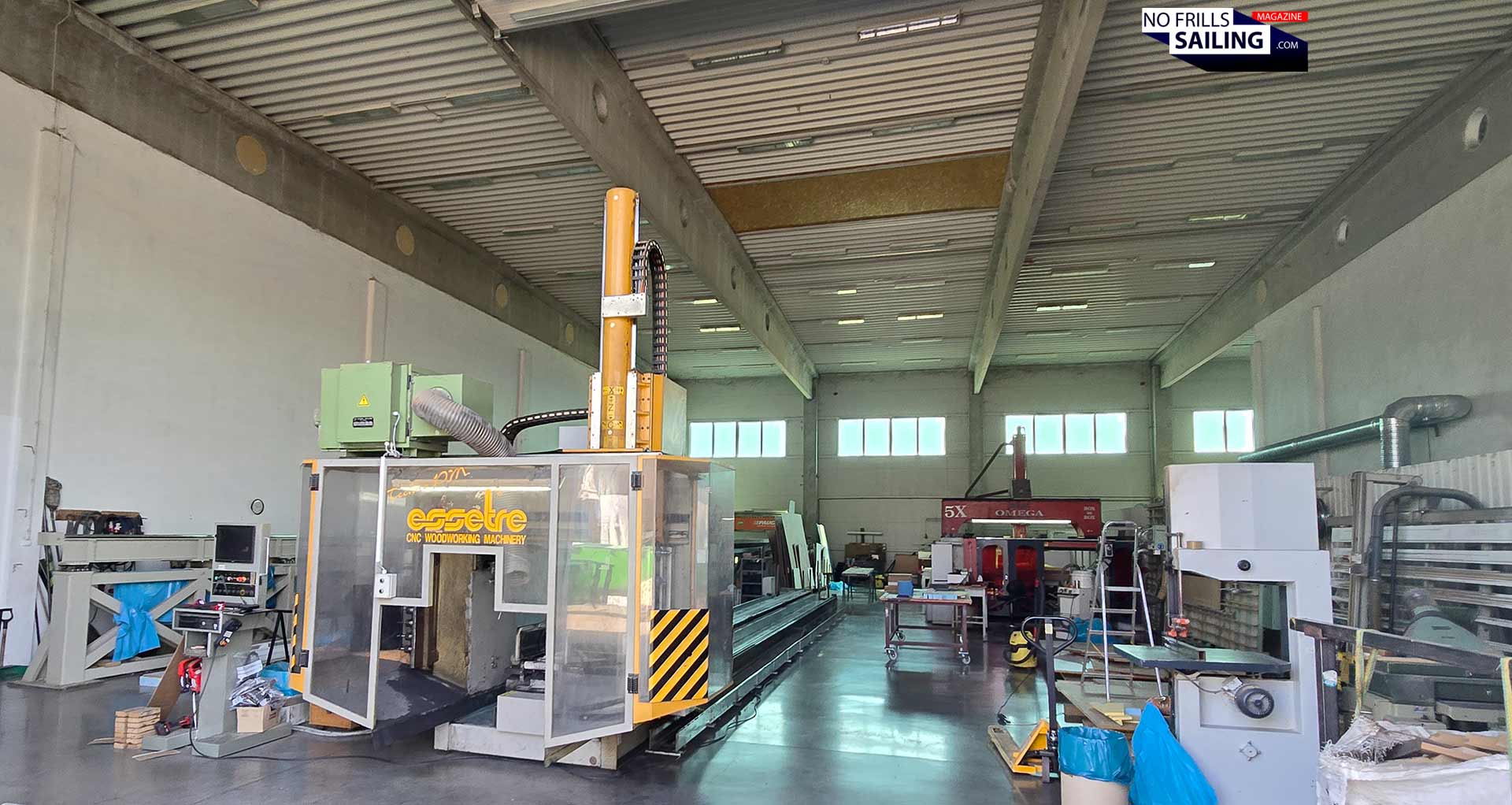
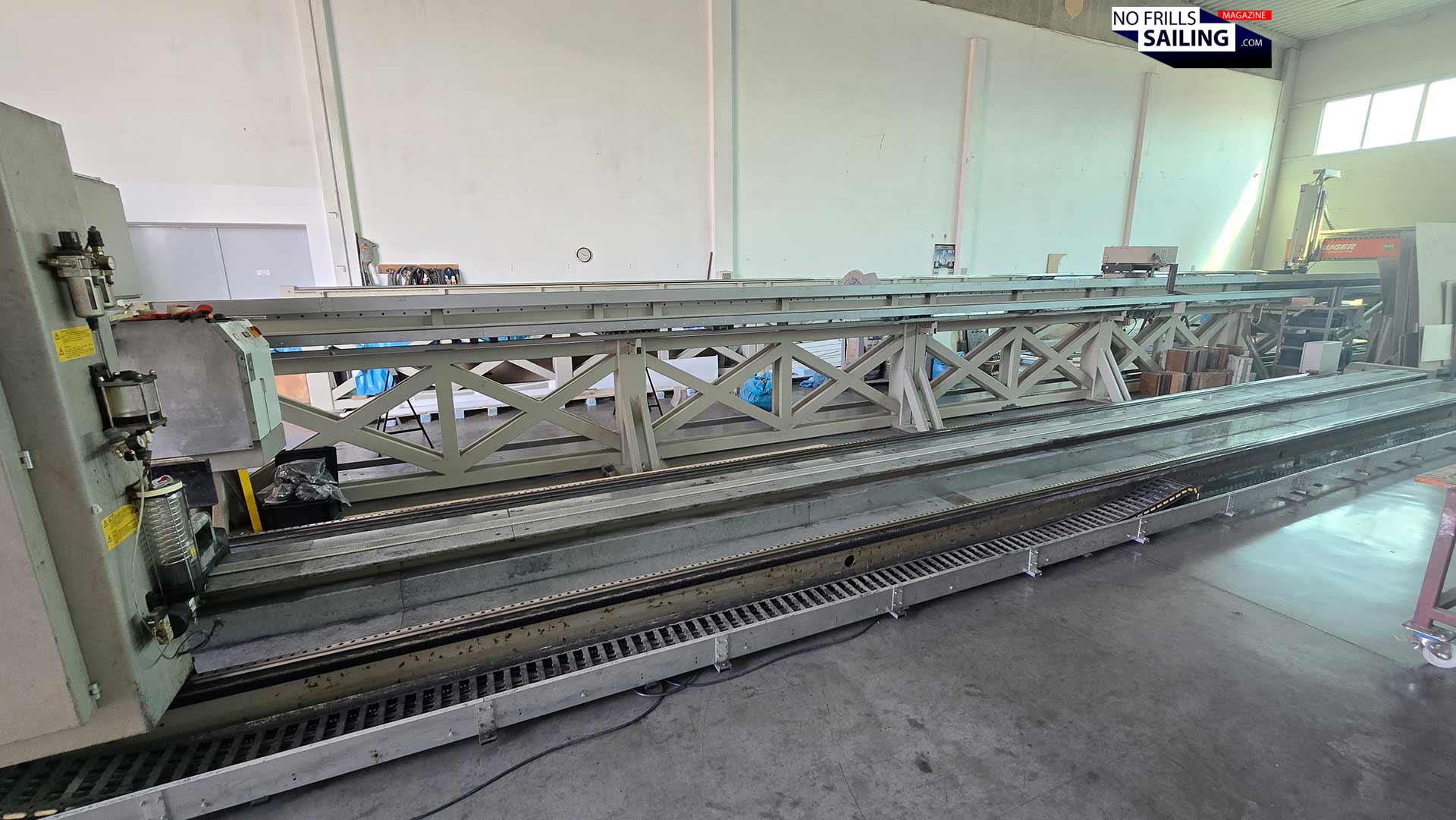
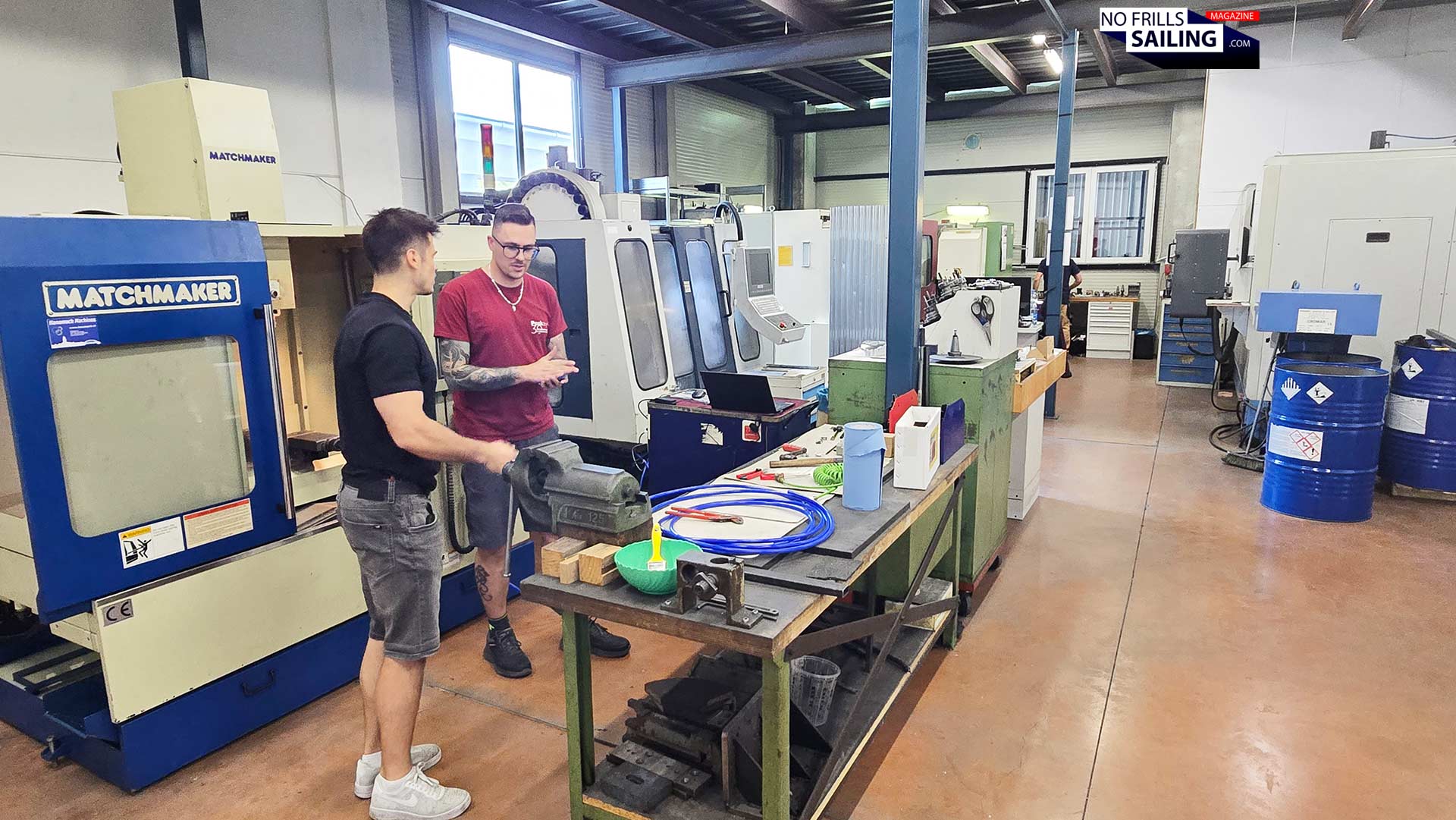
Balint first took me to the large production hall first. Here, my breath stopped, literally! I wouldn´t have ever guessed seeing so many – so big! – machines in here! There were two oversized CNC-machines capable of dealing with parts exceeding 20, 25 meters, as well as a smaller robots, utilized for prototyping and mold-making. Now, in hindsight, it´s completely logical, but at that stage I wouldn´t have expected to see such a mass if heavy machinery here!
Raw processing machinery
But yes, if you want to make masts for 70, 80-footer yachts, and possibly even larger boats, you need to have the tools to process the raw materials into part which can be used for production. This cannot be done by hand, obviously, because in high-end boatbuilding absolute accuracy and weight saving is key. Also, the expensive raw materials need to being utilized with a minimum of waste offcut.
This is a huge machine
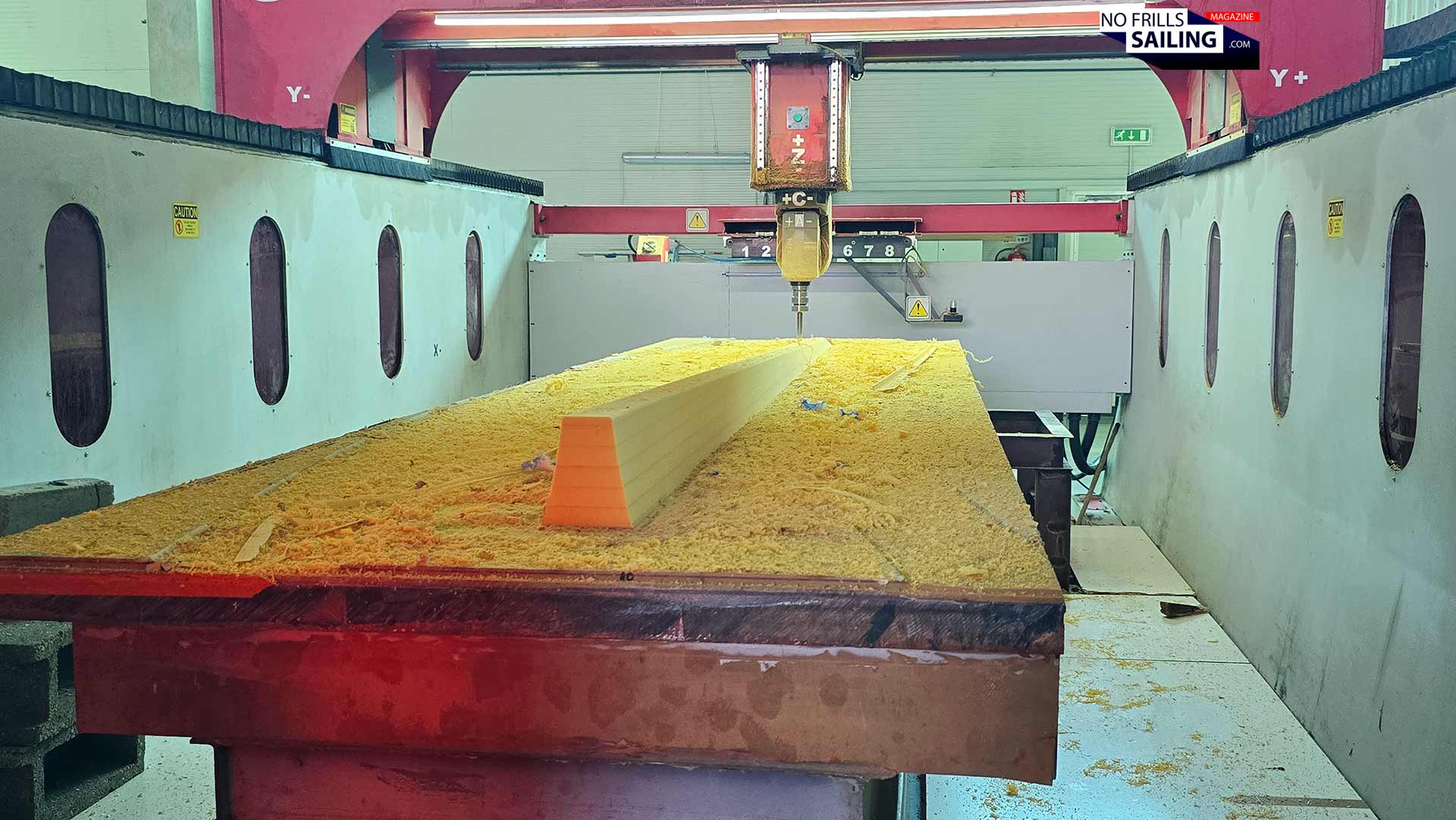
One of the multi-axis CNC-milling robots used to be in action so I was able to watch for a couple of minutes how the tool milled a hard foam brute into form. As we will see later in production, many parts made here can be derived from already prepared standard molds, but many more need individual molds: This is how the make them here.
CNC-precision milling, of course!
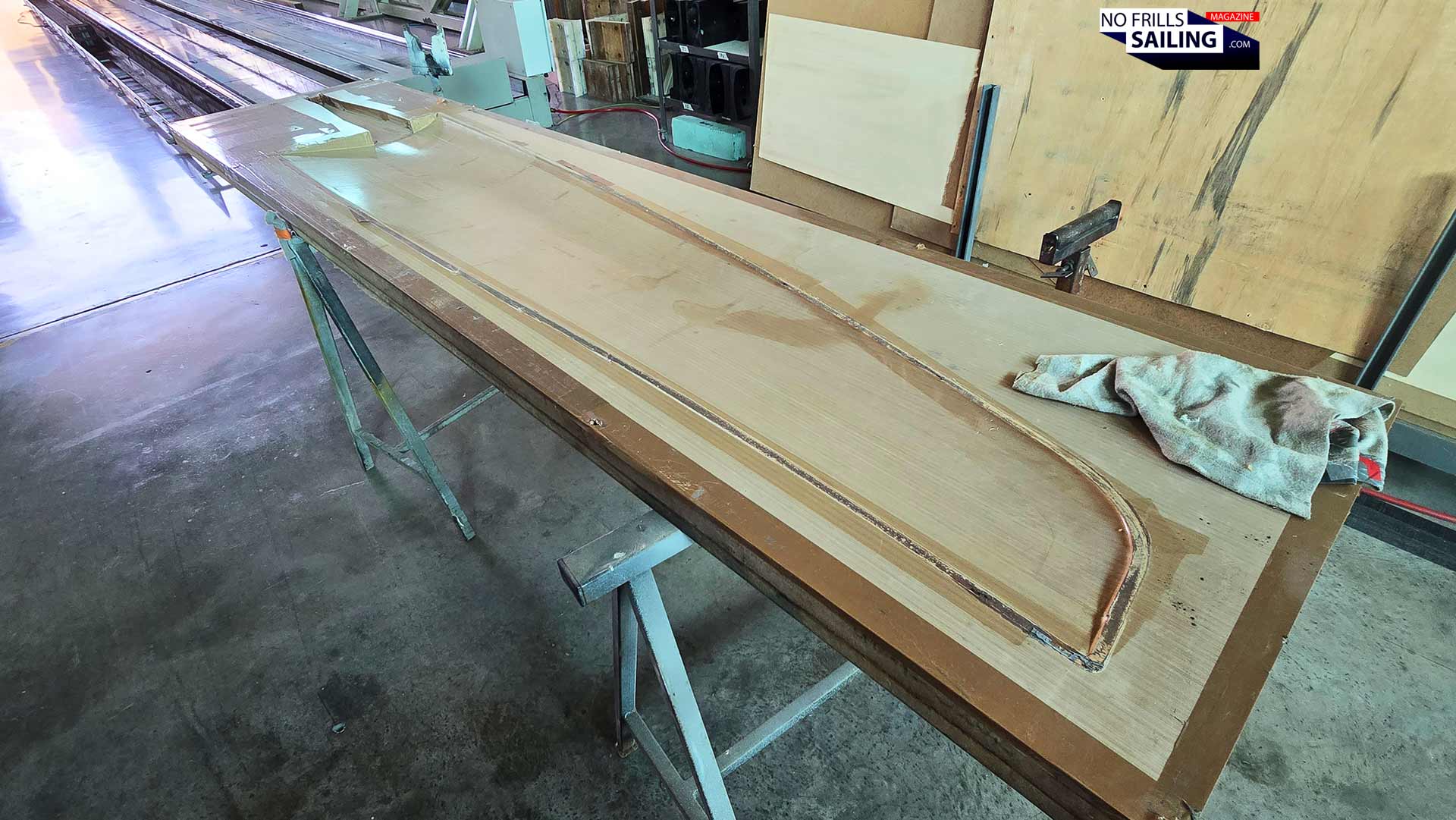
That said, it´s by far not just rigging parts, like masts, spars, spinnaker-booms, booms in general or the boom-vangs which make up the range of products, they also manufacture rudders here at Pauger. One half of a composite rudder-mold has already been taken out of one another milling robot, whilst its counterpart was currently in the making. I was astonished to see so many different of those high precision machinery here. Why?
Rudder blade mold, one half.
Because those indeed cost a lot of money! The investment needed (and constant turnaround produced by them) is staggering. The fact that Pauger manages to acquire and apparently pay for so many of those high precision tools underlines the apparent success they must have in the market. Which is a good sign! Pauger clients are, for example, some of my beloved Berckemeyer Yachts, the famous IMOCA 60 “SPIRIT OF HUNGARY”, Solaris offers a dedicated performance pack for their Solaris 40 by Pauger, the Black Pepper Code 3 is Pauger rigged … only to name a few. So, business apparently is great. And I can see clearly, why.
Making of a Carbon Mast
So how is a carbon mast made then? I had already been able to gain some insight into composite carbon mast making when I visited Seldén in France, where a brand new production line for carbon masts had just started production, so I was keen on seeing how they make it here in Hungary. Balint was seemingly proud to show me the individual production steps in another factory compound on the Pauger venue.
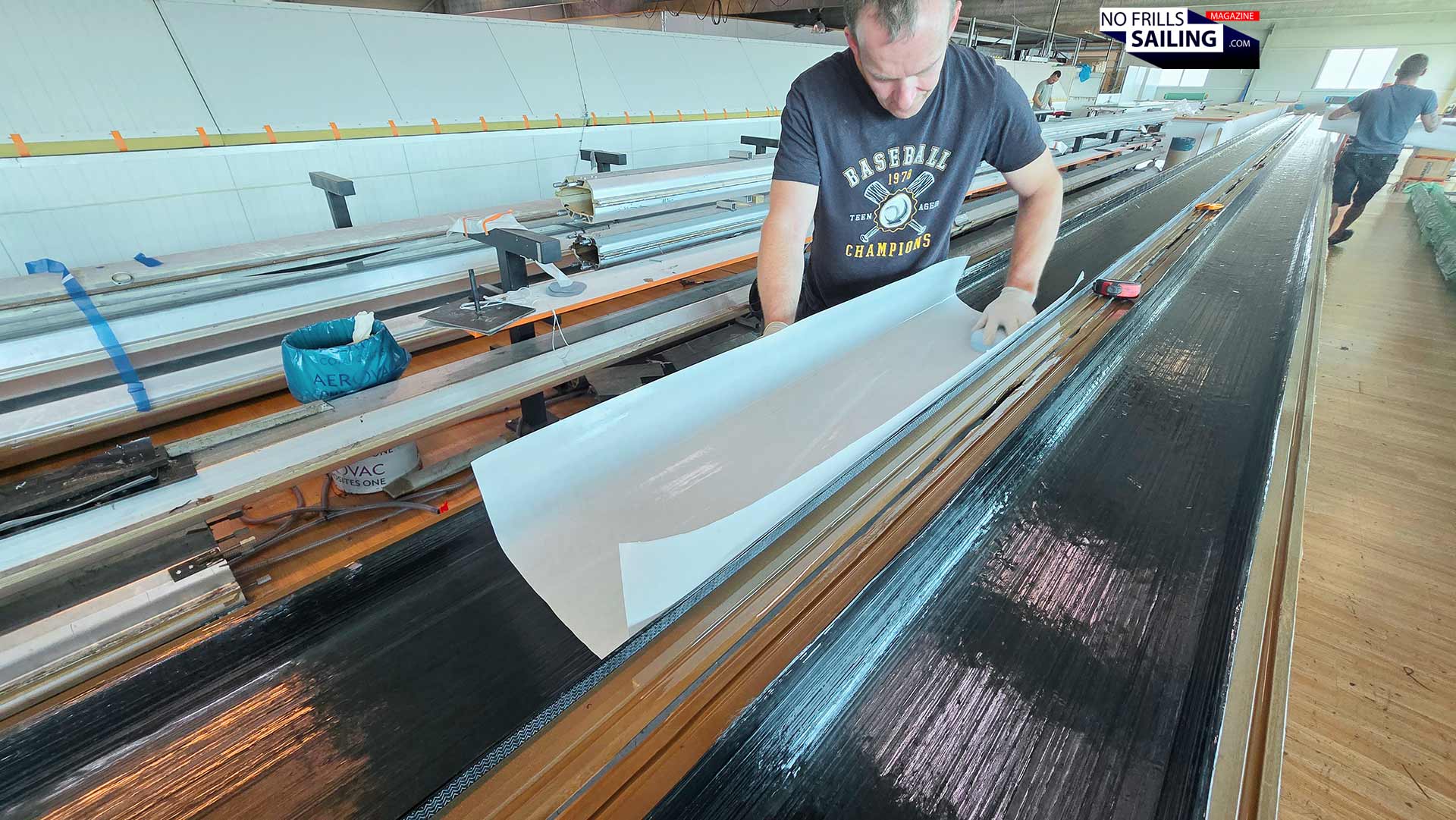
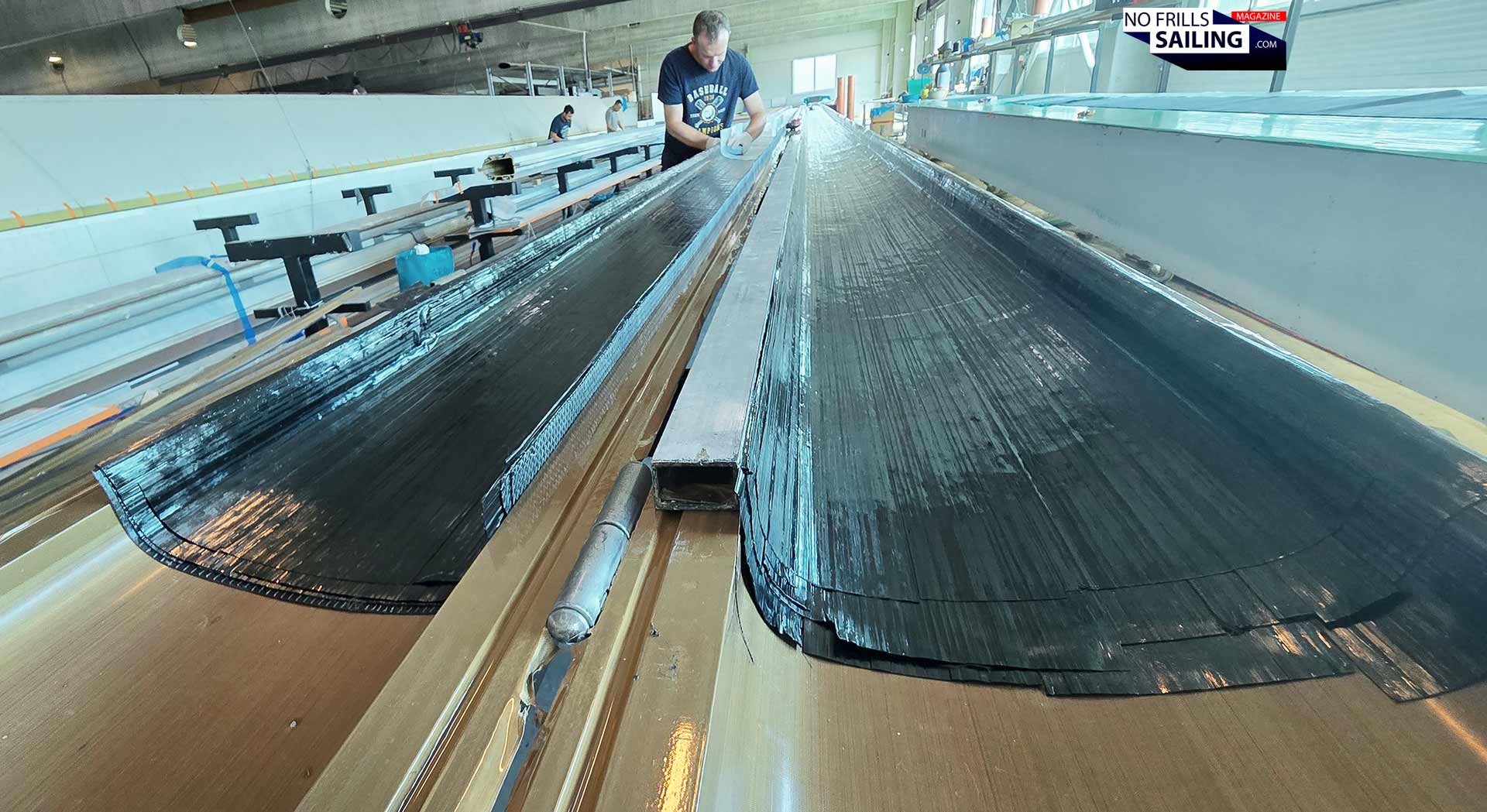
Handcrafting the prepreg carbon layup
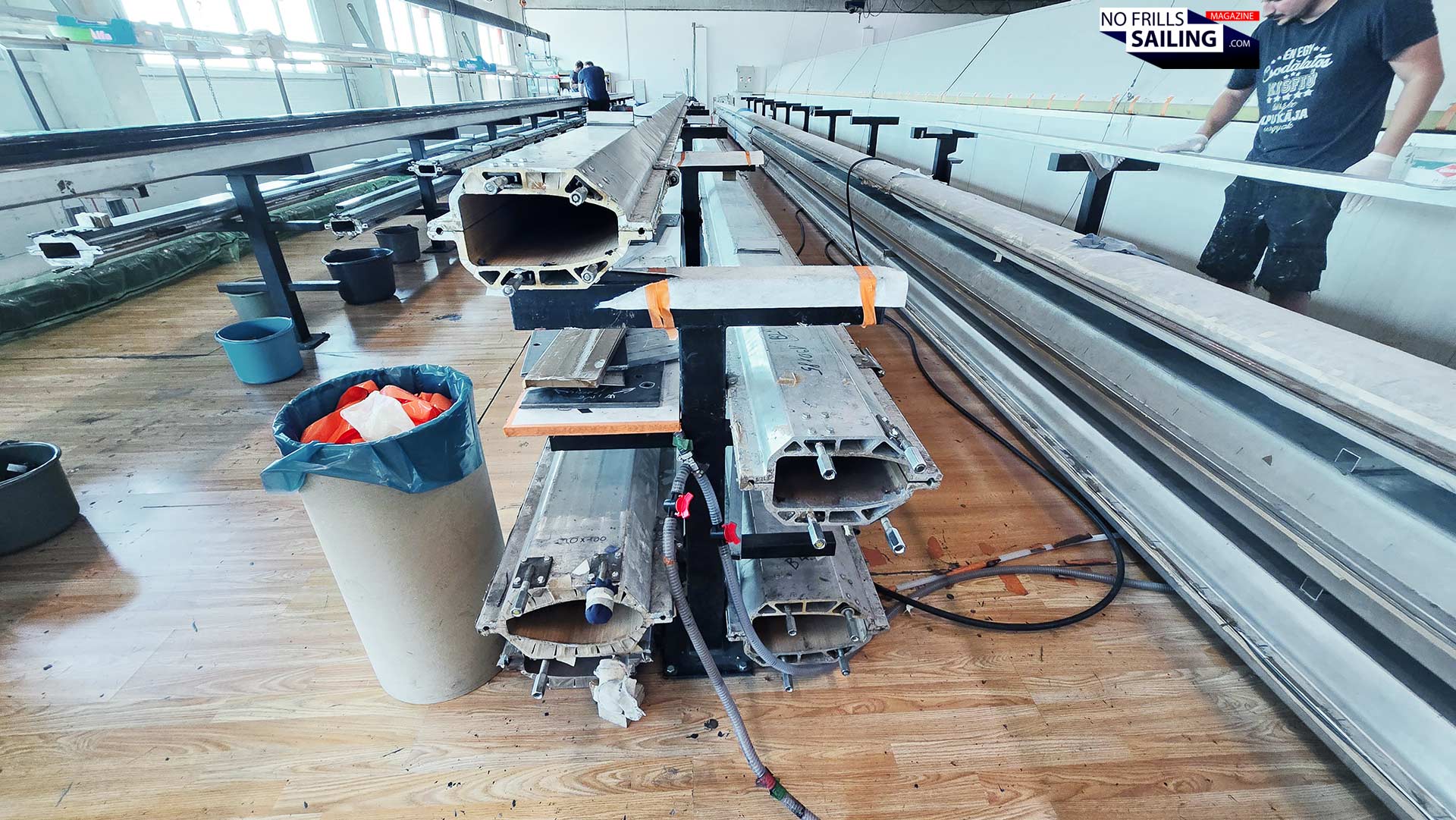
At first, the professionals start to apply pre-preg carbon mats into the half-molds for the masts. As any yacht needs a certain profile, Pauger has metal molds for every mast profile for any size of yacht. As I had already seen a carbon mast in the finishing-fitting workshop, I am sure there is an upper limit for the maximum length here, about 30 meters, but this is rarely approached.
The different layers …
Pre-preg carbon (short for “pre-impregnated”) may be considered as the pinnacle in carbon boatbuilding. It comes in various sizes and fiber types and braid, but the advantage is that these mats are already saturated with the exact amount of resin that is later needed to cure (“bake”) the carbon and make it solid. It has the exact fiber-to-resin ratio so that neither material is wasted, nor material is absent – exactly pre-calculated and hence perfect for high-end applications.
Mast molds for any profile you want
The workers will carefully place each mat to its exact position: Lasers project data right into the mold so that the placement can be done with staggering accuracy. Unfortunately my camera wasn´t able to capture this amazing feature, so you have to trust me: Glaring green projections showed exactly where to put what, where a connector would later be or more material was needed for details. If done, the two molds are brought together, closing in on each other.
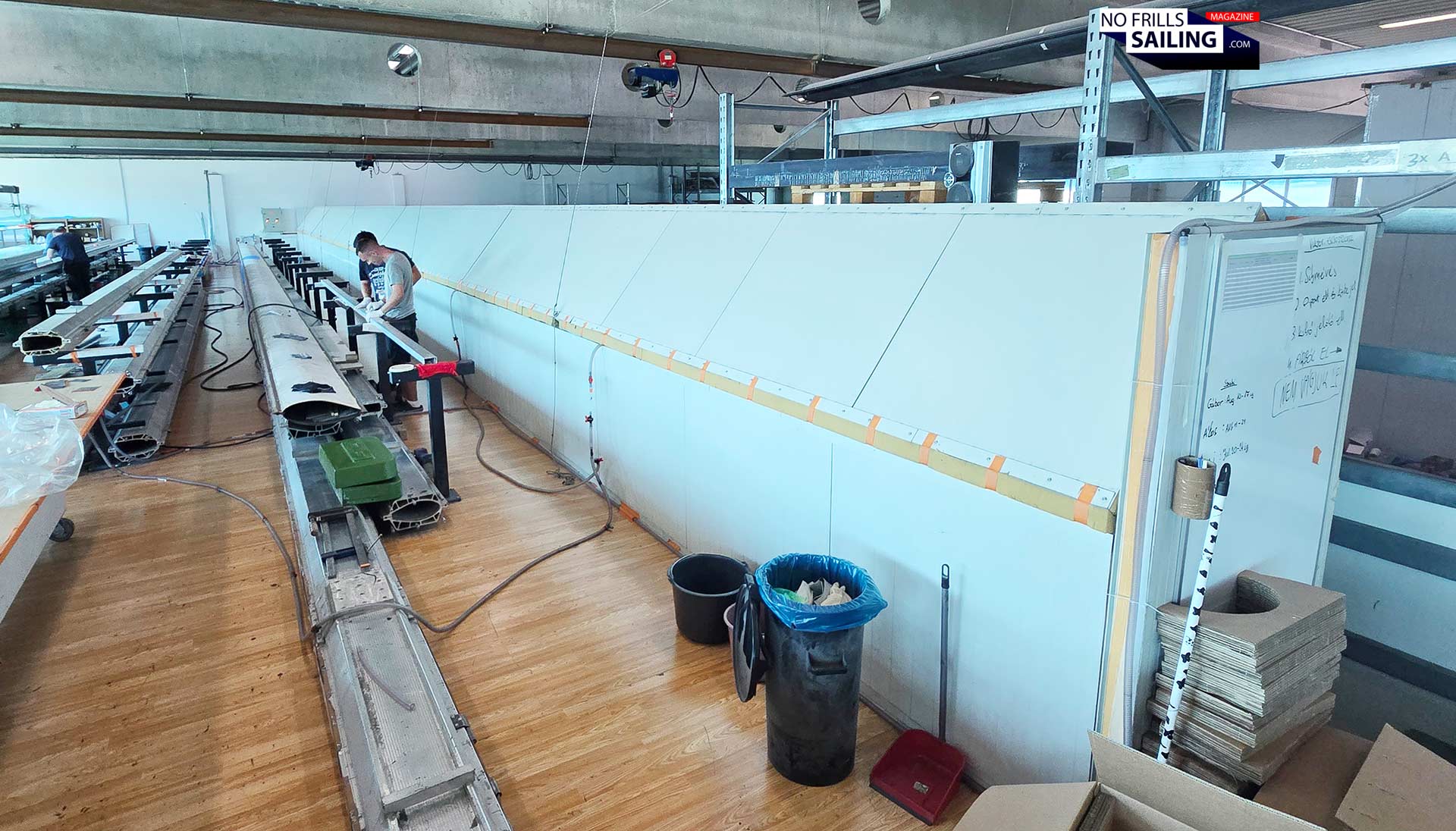
The huge 30 m autoclave
Then an inflating device is inserted, highly compressed air will make it balloon. With up to four atmospheres of pressure this inflation device will push from the inside out, compressing the carbon fiber layers even more. The mold is then put into this huge, long autoclave. It´s basically an oven, if you will. Here, between 80 and 120 degrees Celsius, the masts will cure and the layers will bond. Prepreg-made masts feature unmatched lightweight properties as well as a robust rigidity.
It´s in the details …
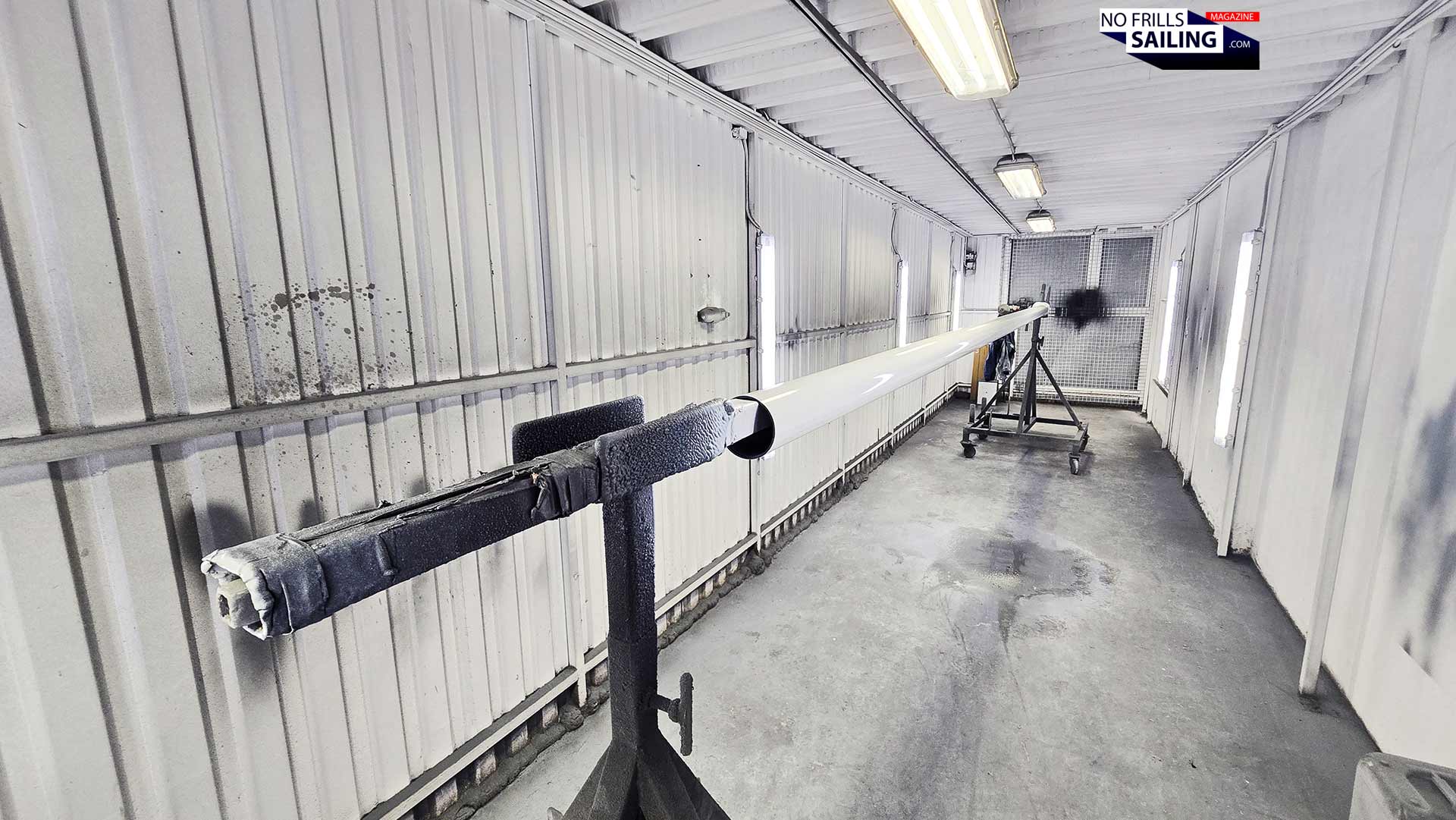
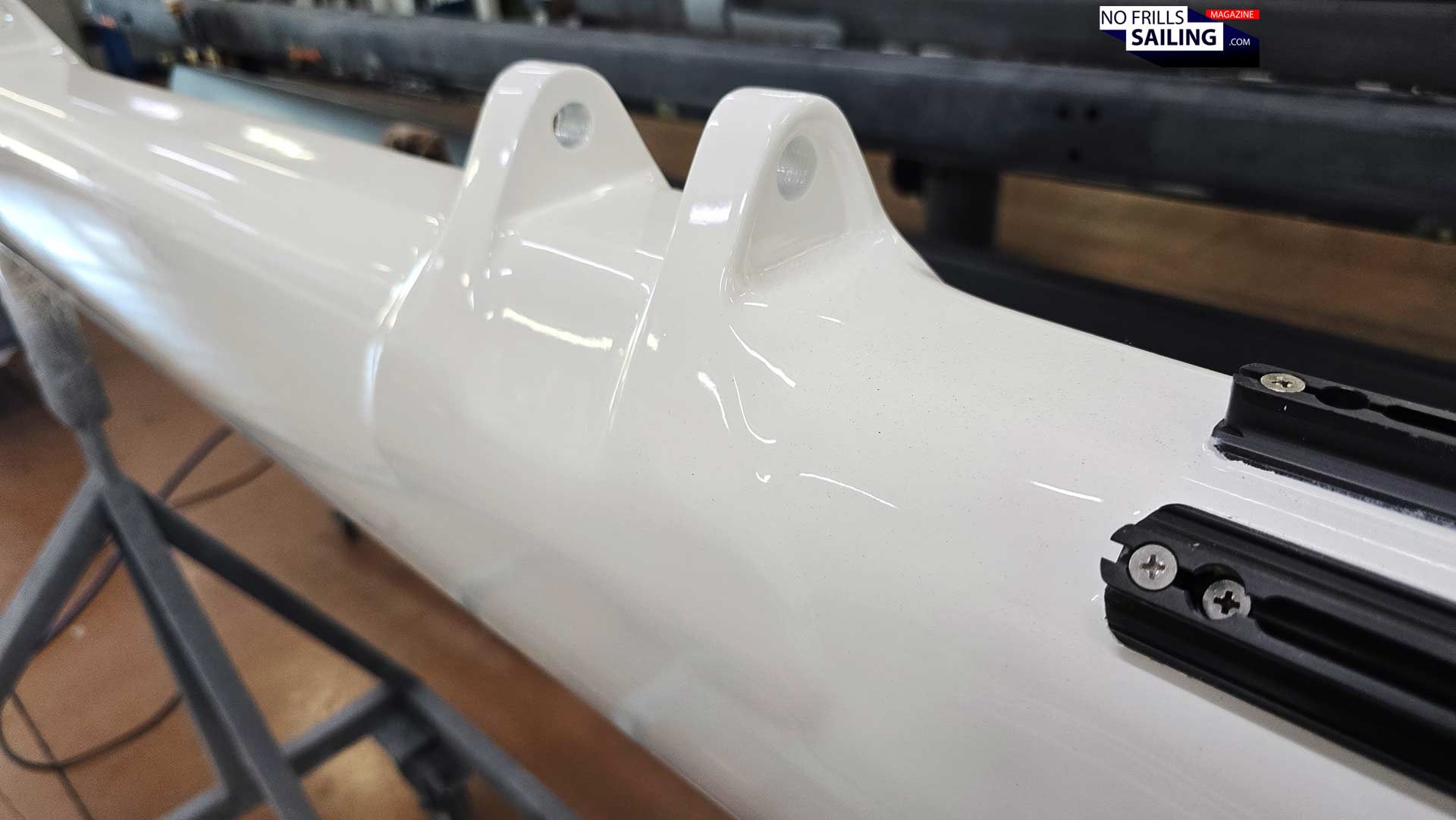
After the carbon parts had been manufactured, the fine trimming starts. That´s a lot of sanding and of course constant quality checking. Many parts are painted. Mostly it´s a UV-resistant glossy paint which will reveal the sleek and sexy looks of the visible carbon. Other clients prefer a plain white for understatement – in fact, any color is possible. For that, Pauger has a modern paint shop with fume venting, paint collection and climate control.
A spi-boom is painted
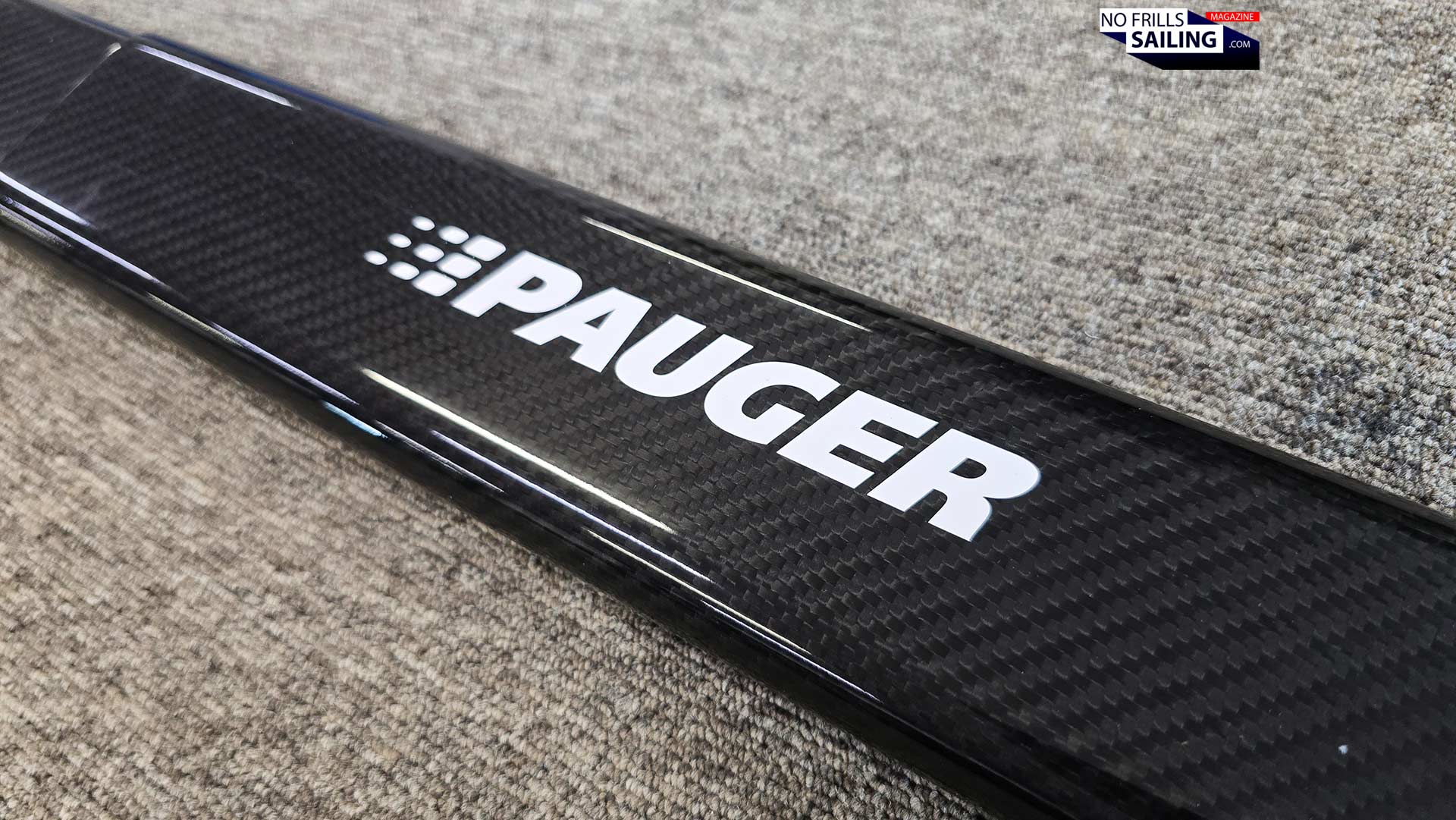
I remember my days as proud owner of a First 27 SE. The rigging on that boat had been full carbon fiber, at least mast and boom, and I really appreciated the neat looks of glossy-painted carbon. Balint confirms that the vast majority of parts nowadays is sent out painted that way, with visible carbon. Their boom-vangs, produced in serial production, are among the most sold products and widely used by many regatta- and racing-oriented boat owners, taking out the heavier standard vangs.
Beautiful: A Pauger boom-vang
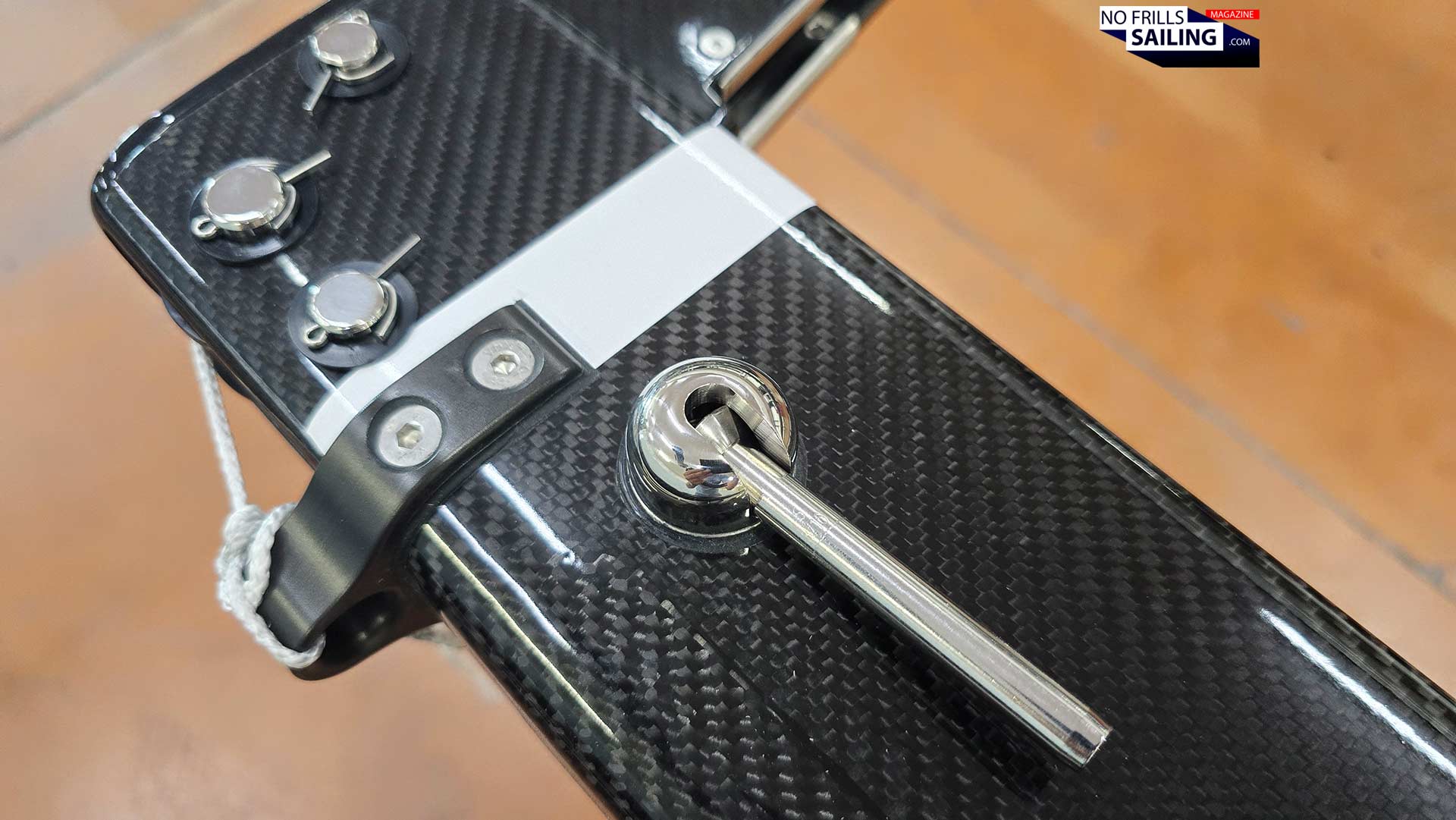
But there´s more to a mast than “just” the mast itself. It´s in the details. If you imagine the forces a mast will have to tackle in the course of its life, it becomes clear that details like attachment points are absolutely vivid and deciding. The structure “underneath” these attachment points often need a stronger layout in terms of layers used and even different braids or types of carbon fibers utilized.
Look at these details …
That´s something you won´t be able to tell later, as it is hidden underneath the glossy paint, buried deep in the structure of the part. Balint will later show a cross section of a mast (and so you will be able to see what I mean). End-caps are mounted seamlessly and just beautifully, as well as spreader brackets, top-caps or rope-thrus. If you know where to look for, you cannot react other than appreciating the beauty of this work! Just look at this wonderfully carved gooseneck backet:
This. Is. Art.
I am an aesthete, as you know, and this makes my heart beats so much faster! I believe in Balint when he tells me how much stronger, stiffer and durable their products are. But since I will never ever drive my boat to its limits, I´m more appealed by the sheer beauty of the handcraft here at Pauger: This stuff looks just awesome! I mean, I am happy and very proud about my brand new custom made aluminum mast by Seldén for sure, but seeing this … is just pure eye-candy!
Carbon standing rigging, of course.
As stainless steel rod rigging is considered the lower most standard choice for a carbon mast at least, Pauger specialized in carbon standing rigging as well. We proceed to the second floor of another hall (and for a change Balint asked me not to show what´s produced in here, and of course I comply) where the carbon standing rigging is prepared for delivery and shipping.
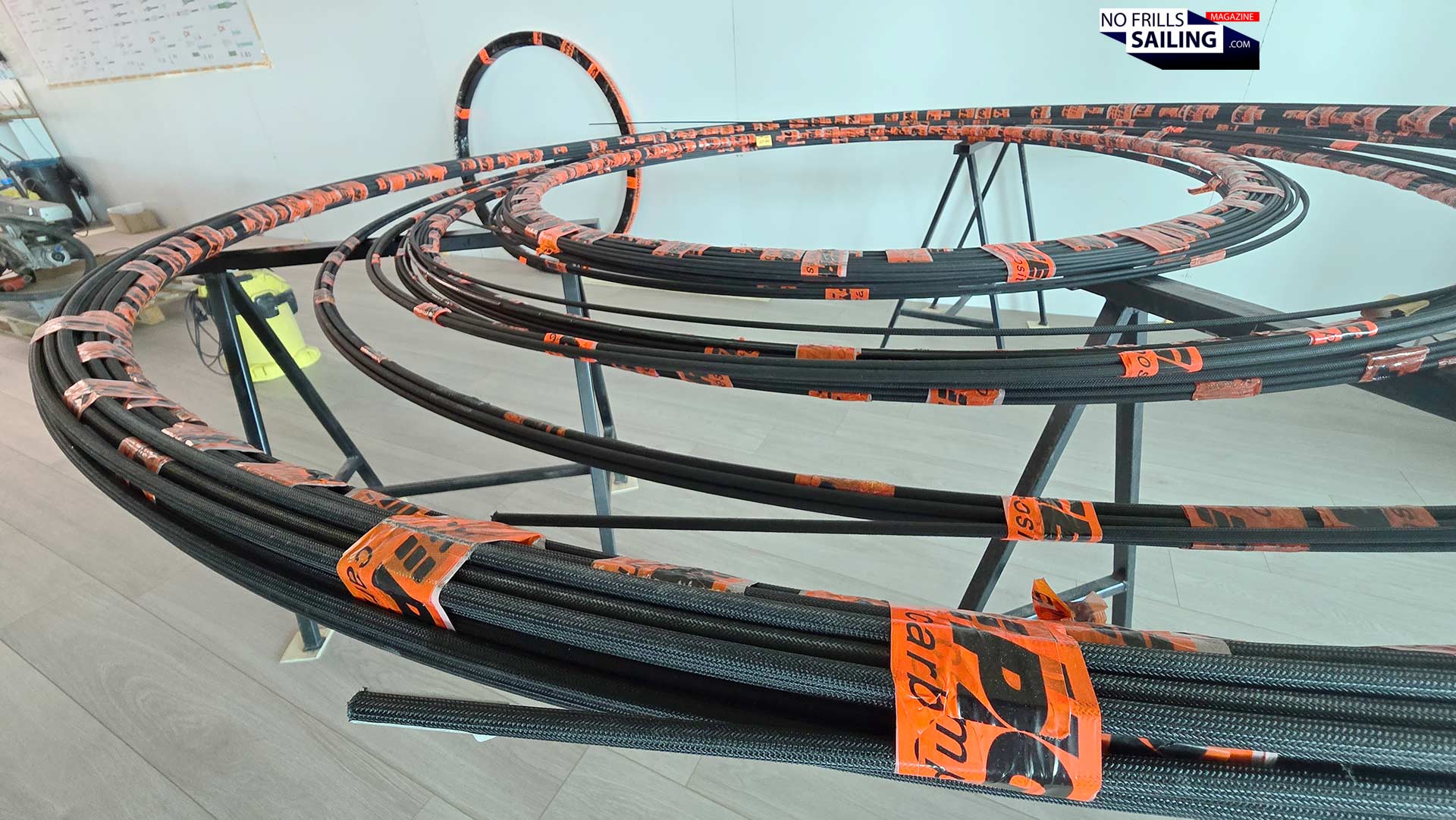
Large diameter coils of carbon shrouds
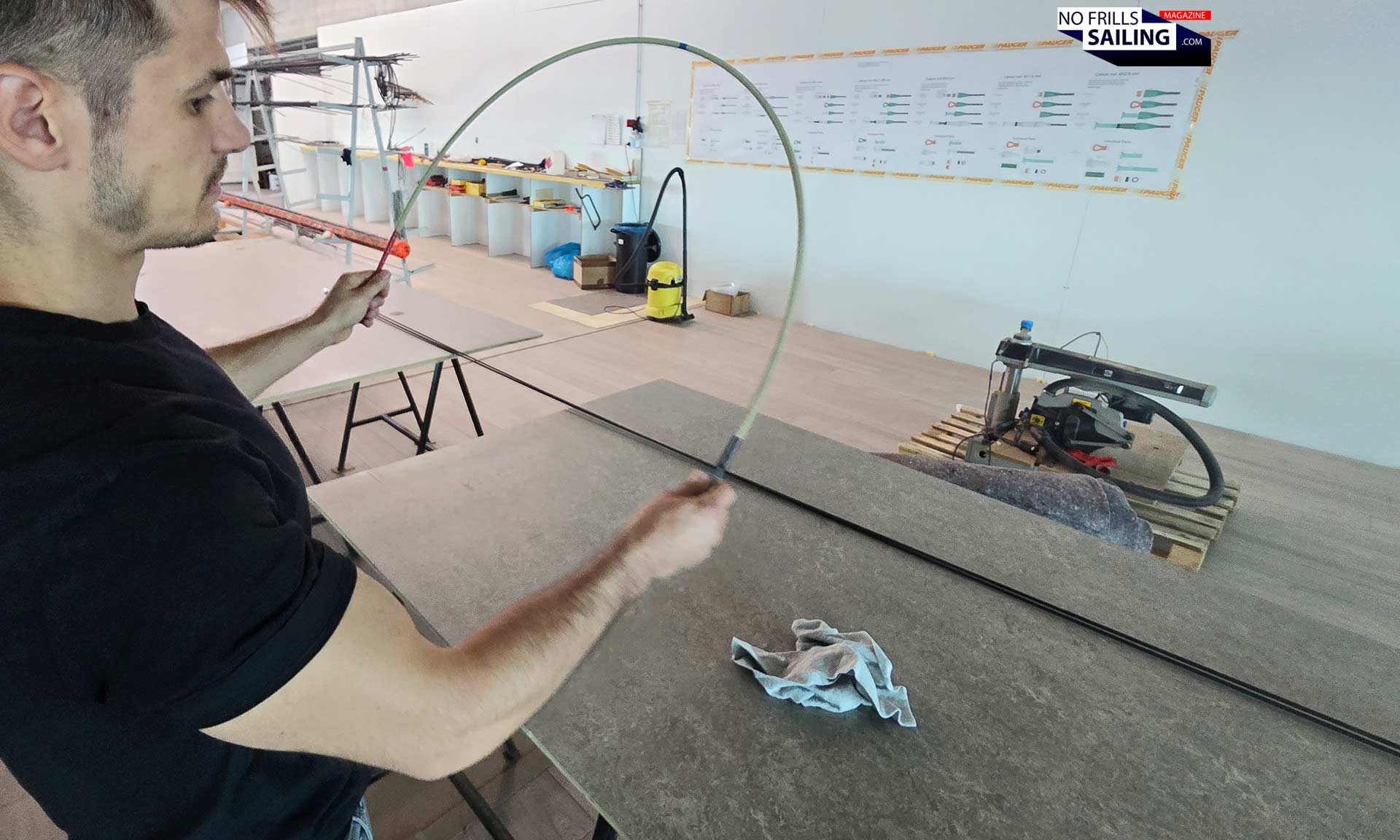
The RC 44-elite racing class, which Pauger equips exclusively for example, and more and more other pro-racing teams switch to carbon shrouds. Why? Because these are massively lighter than their steel counterparts: Up to 80 percent (!) weight saving is possible! Balint hands me a cable, and I can balance it literally with my pinkie! These are round shaped shrouds, but elliptical and even airfoil profiles are possible, further reducing drag. As carbon has almost no stretch, there´s no creep – it´s rock solid. Once trimmed, it stays that way.
New: Flexible carbon shrouds in the making!
Of course, on the other hand, carbon doesn´t like slamming as we all know, so these parts are vulnerable. When failing, these will fail almost every time in a catastrophic manner and their lifetime is limited. So it´s surely only a choice for the top-notch racing teams. Nevertheless, it´s the absolute pinnacle of what sailing at the top can be – and I am delighted and fascinated to being able to see it here at the source!
Individual and one-off projects at Pauger
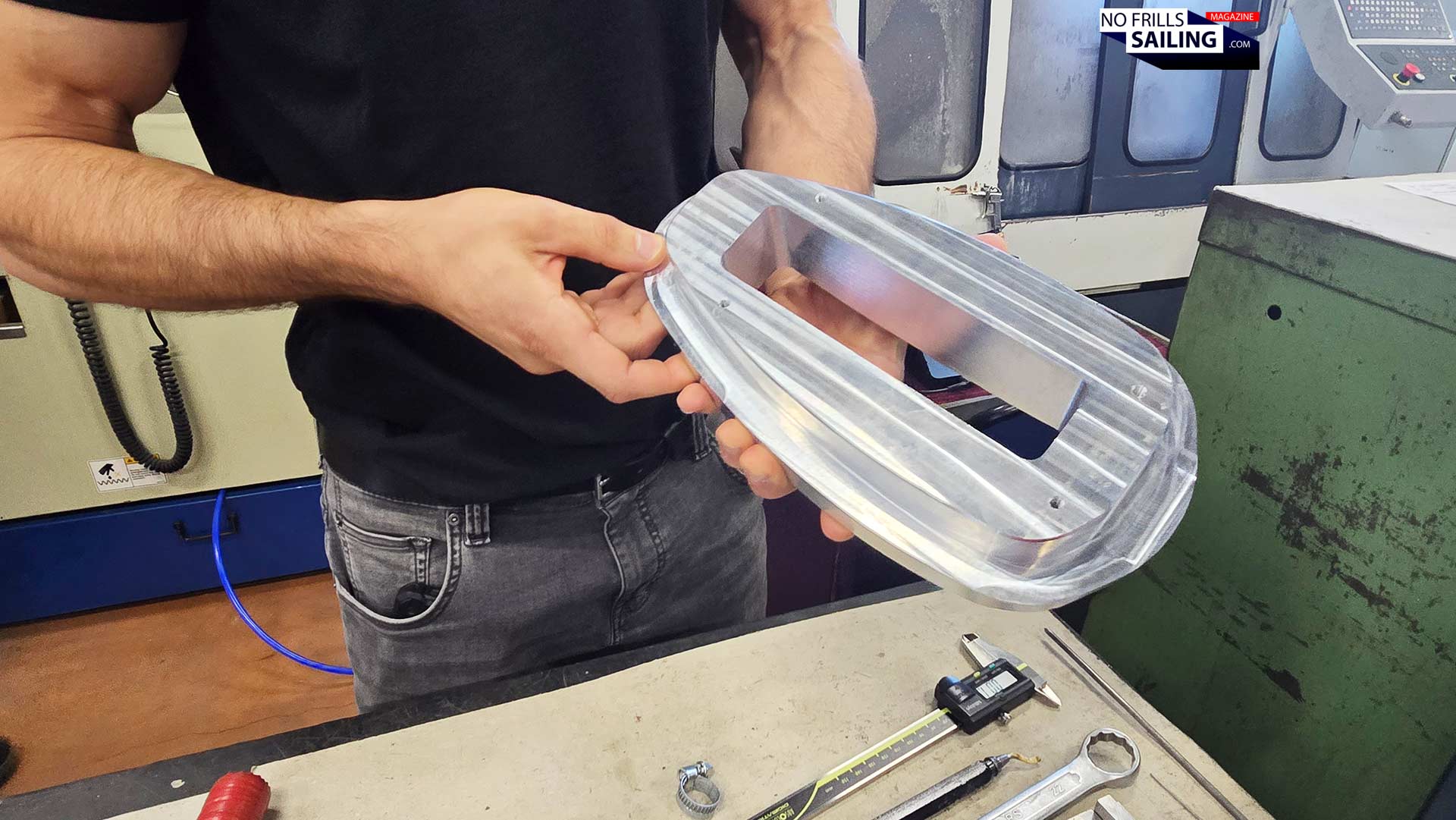
We proceed to another hall where I instantly notice a familiar noise, yet, I wouldn´t have expected it here. It´s the sound of a metal-processing machine. Apparently, Pauger is also into alloy?! Indeed, as Balint shows me, Pauger can and will as well manufacture metal parts: They halt one of the CNC-milling robots and take out a solid aluminum part: This is going to be a massive alu mast footing for a rigging project currently in the works.
Balint with a metal worker
The aim here at Pauger seems to cover as much of the product- and production chain as possible. By doing so, they are less dependent on third-party deliveries and of course can further optimize both the design and the properties of the parts. Take this mast foot for example: I am sure that they not only make this thing work in connection with its corresponding mast, but they carved off as much material as possible and shaved the shape so that the finished part will meet their own aspirations completely.
This will be an aluminum mast foot
I wonder how many people work here – around 50, as Balint discloses – and then I wonder how many different professions are needed to being able to make these products? Engineers, boatbuilders, metal workers, composite specialists, lamination and fitting people, rigging experts … it´s a complex venture, for sure.
It´s more than “just” Rigging parts … much more!
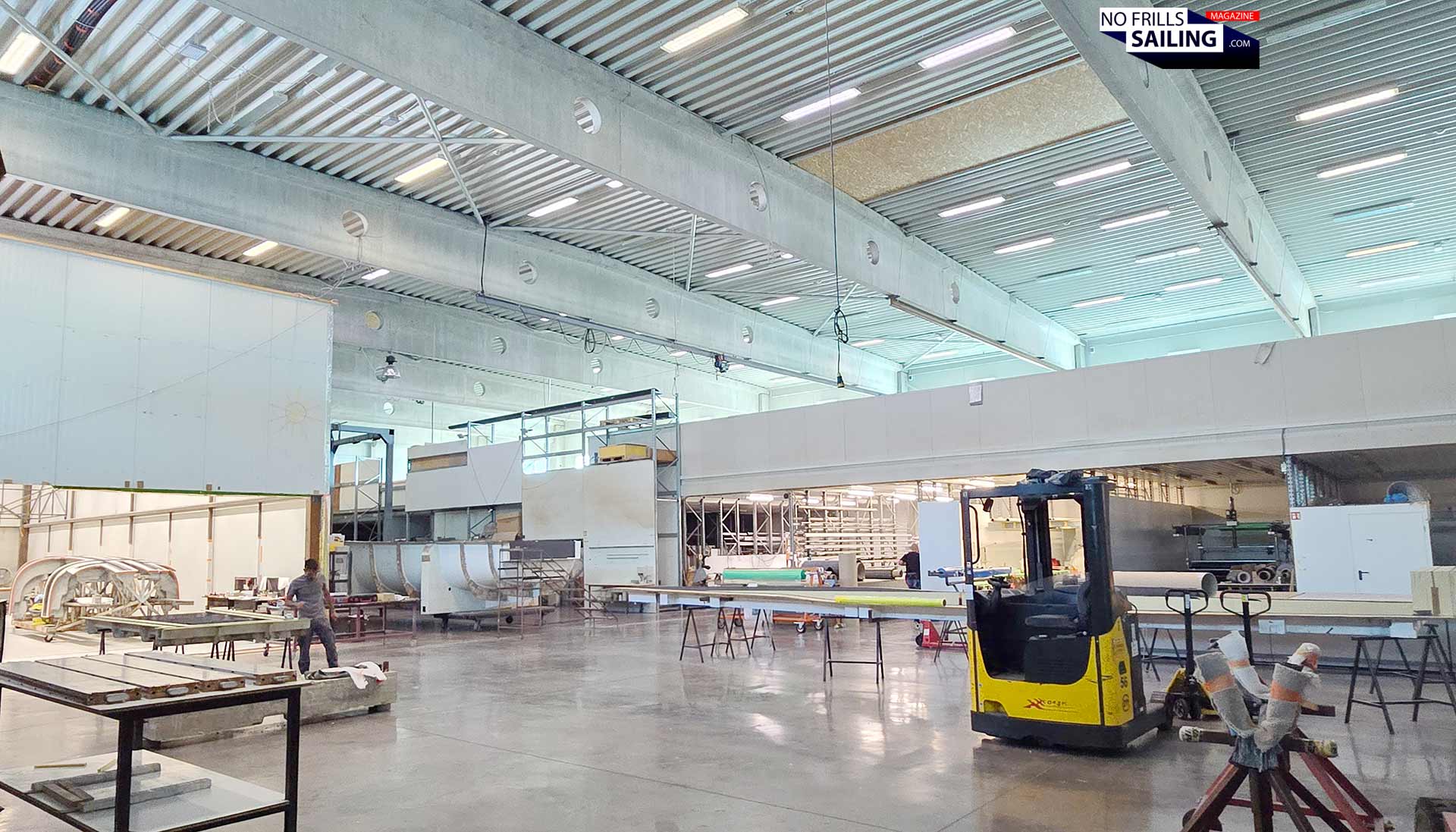
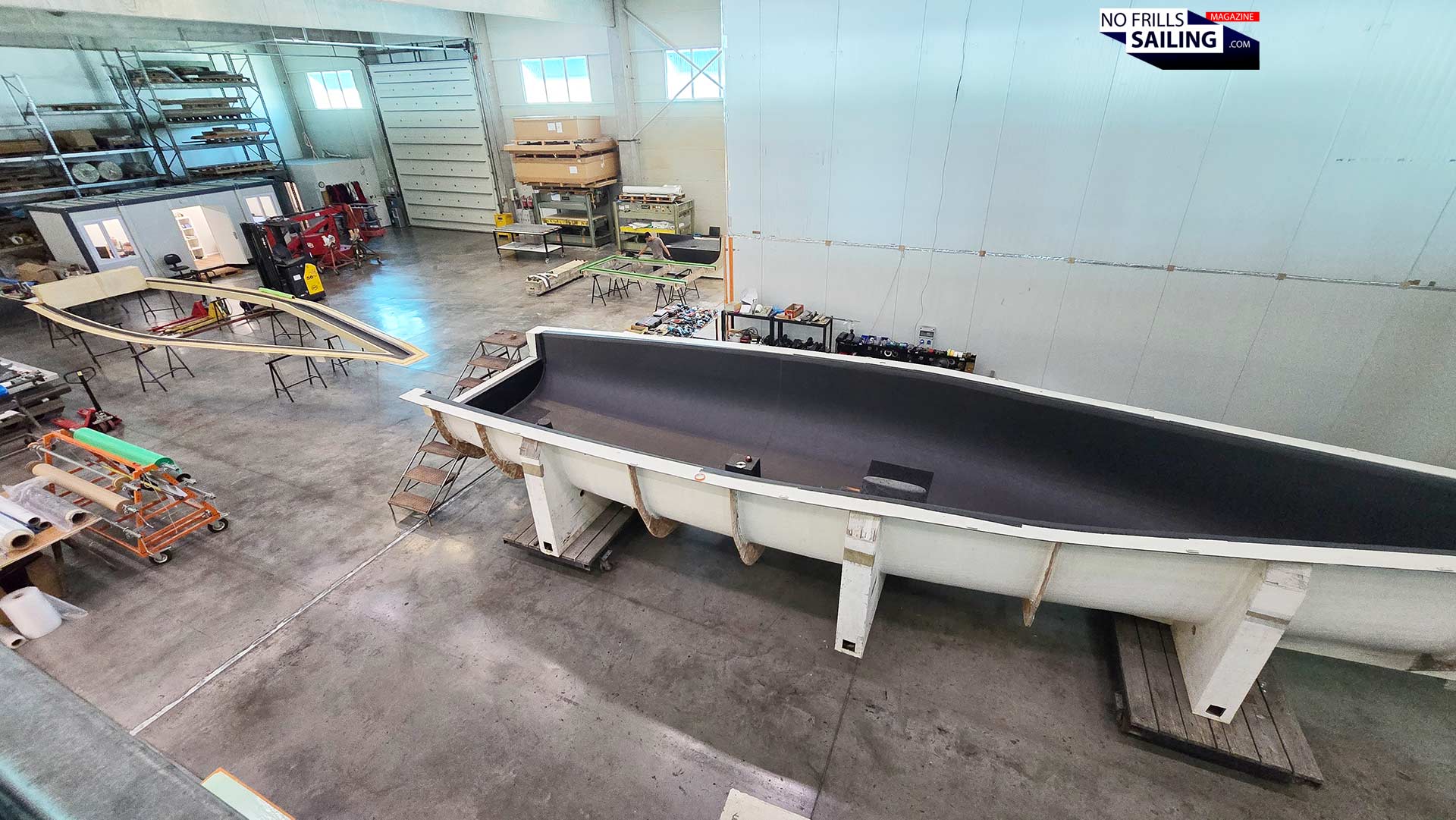
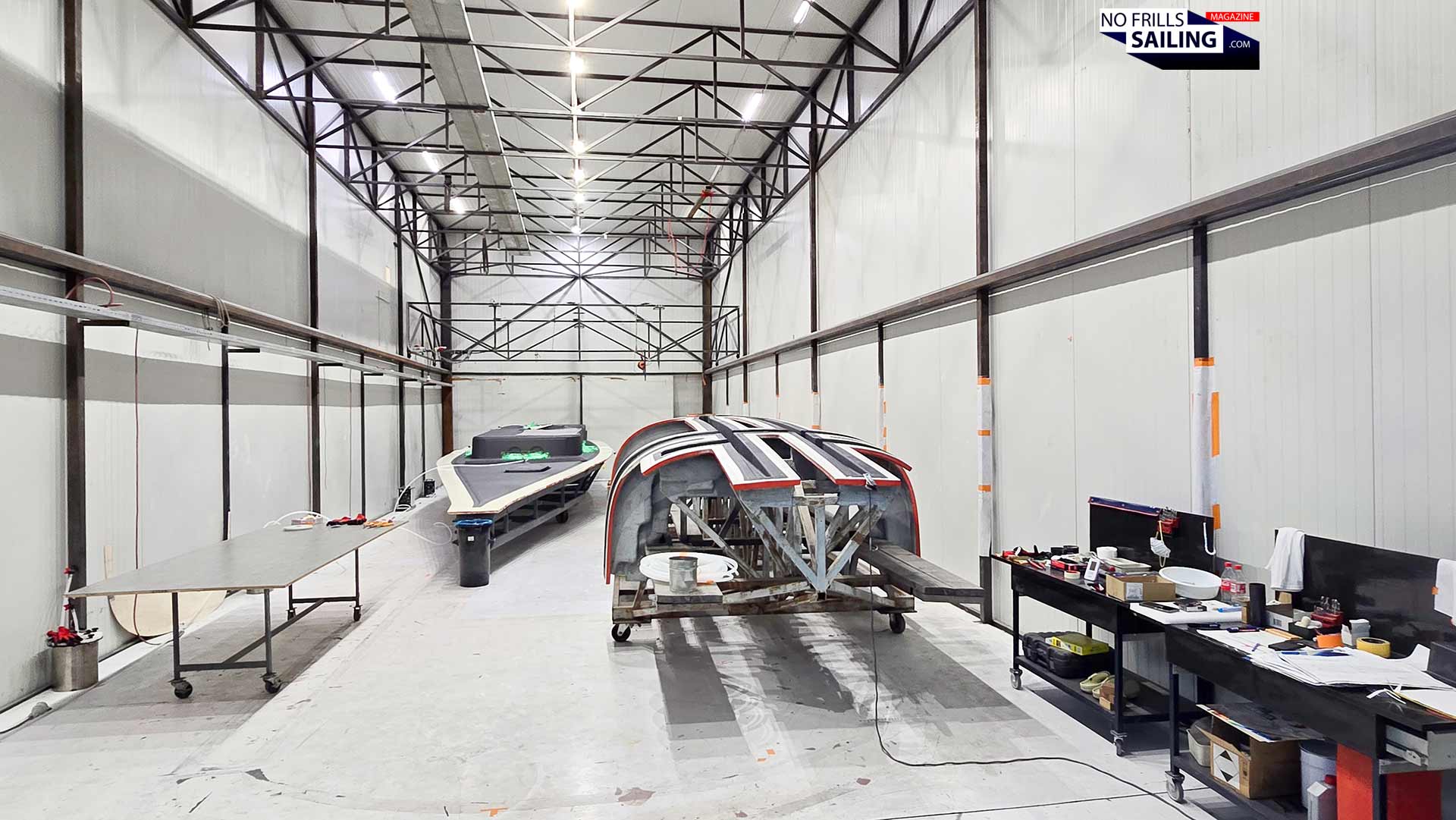
Save the best for last, right? Well, here we go. After having seen the mast- and parts production in a whole, Balint takes me to the by far biggest production hall here at Pauger. It has the size of a mid-sized airport terminal and I am puzzled, standing there in awe. This is a very large, modular, two story building where whole boats can be built. Yepp, you´ve read it correctly: The are building boats here!
Just. Wow!
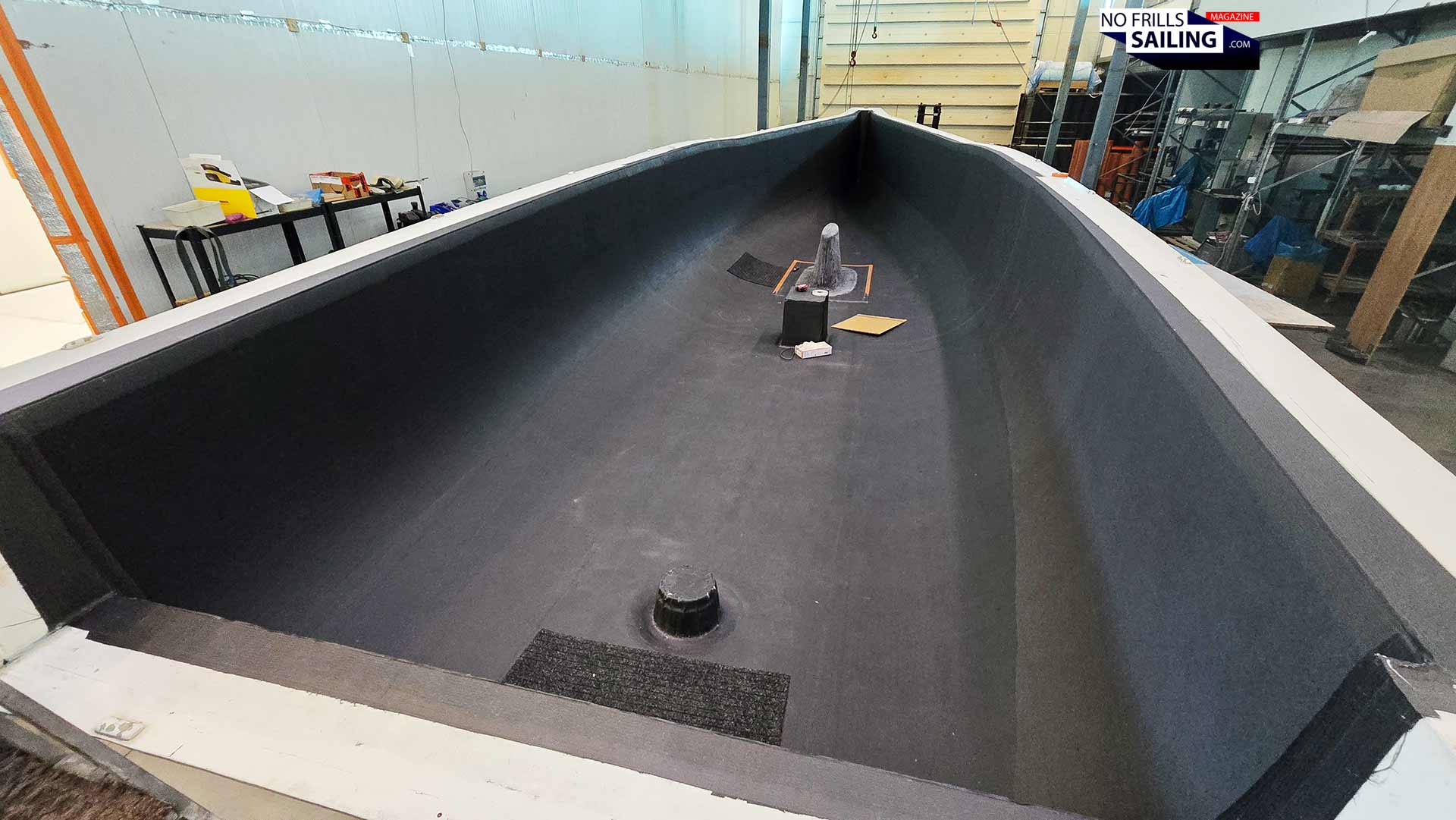
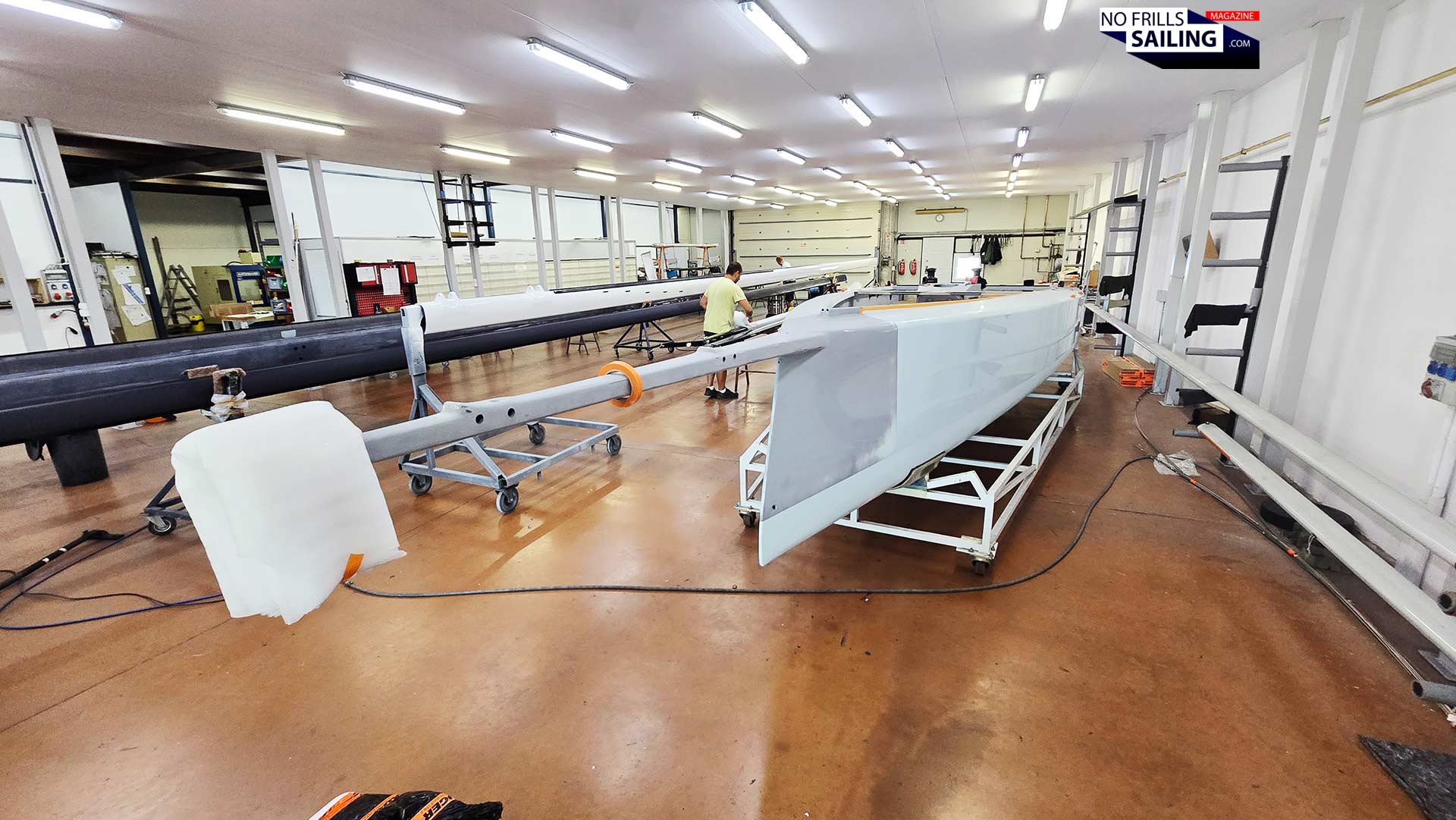
I have already mentioned the IMOCA or Black Pepper-builds. Pauger is the exclusive builder of the famed high-end RC44 class. These all-carbon 44-footers had been designed by America´s Cup winner Russell Coutts and naval architect Andrej Justin. It is indeed one of the fastest and most extreme monohull one-design classes with a very vivid and exclusive owner´s scene. If you haven´t heard of the RC44 class yet, delve deeper into it!
Another RC44 in the making
These boats measure 13.35 meters, 44 feet, and are 2.75 meters wide. The design dates back to the year 2005. Currently a fleet of 29 boats is on the water, with hull #030 here in the shipyard under construction. The nice thing about RC44 class is that in order to take part in official races, there is a strict owner-helmsman-rule: Any boat must be crewed by its amateur owner! The racing calendar comprises five races in Europe where mostly 10 to 12 boats are on the starting line.
Carbon: Darn sexy!
The all-carbon yachts are meticulously made following even stricter one-design class-rules. As you know, in one-design racing each boat must be identical to the others. There´s very little margin for weight or design deviations. But, you know, having seen so much precision already, I am absolutely sure that Pauger will meet all requirements within a fraction of a margin here …
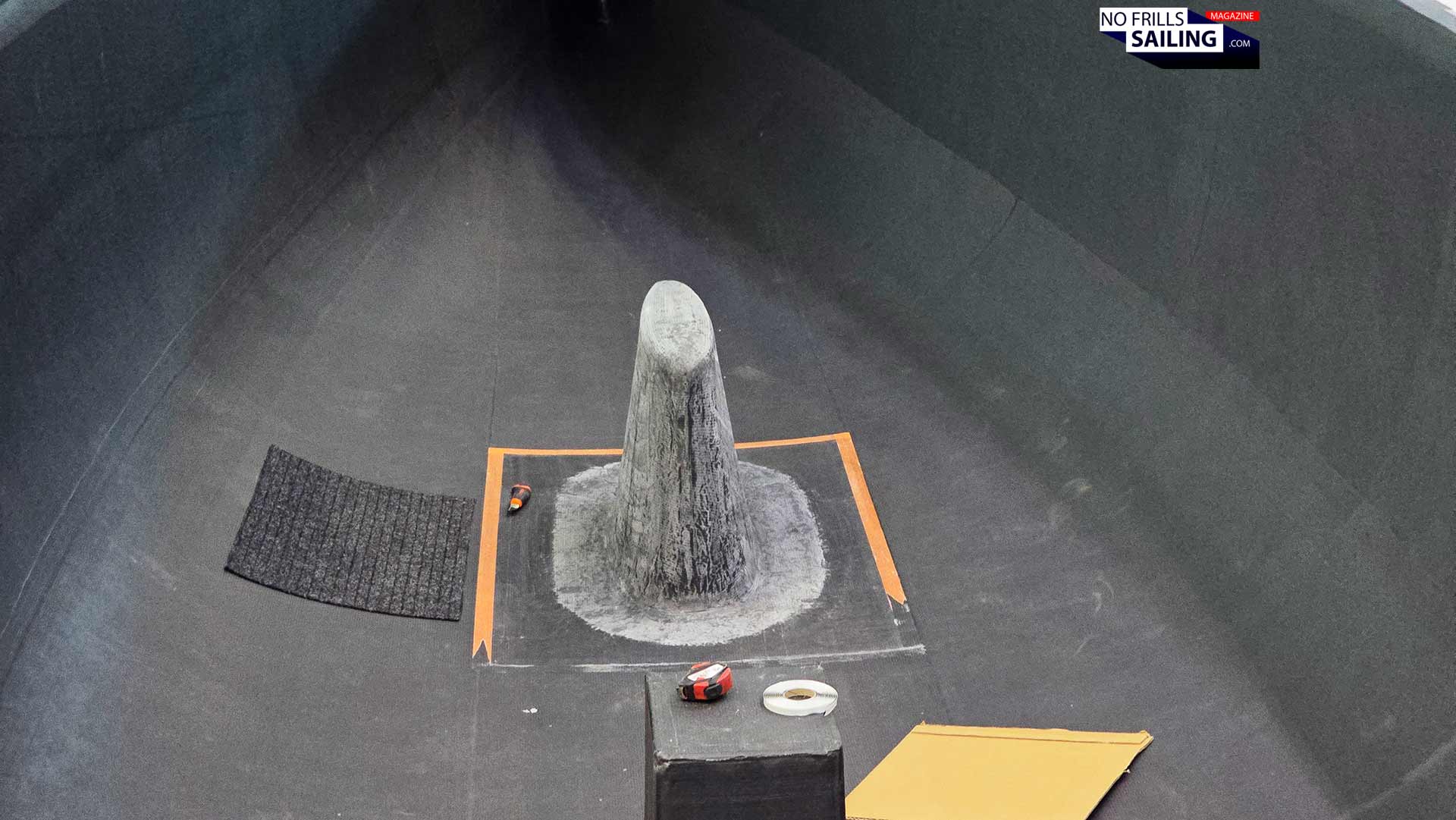
Look at the keel flange!
I´d love to sail one of these, at least in “cruising mode”, just to try out the other peculiarity of the RC44: The trim tab an the keel. This is a unique feature of this boat which is said to minimize leeway of the yacht in extreme upwind courses. Also, their bowsprit can pivot up to 10 degrees to leeward side to achieve the maximum in wind angle utilization. The RC44 is definitely worth some more articles … I take notes for the future here.
Full carbon boat building „Made in Hungary”
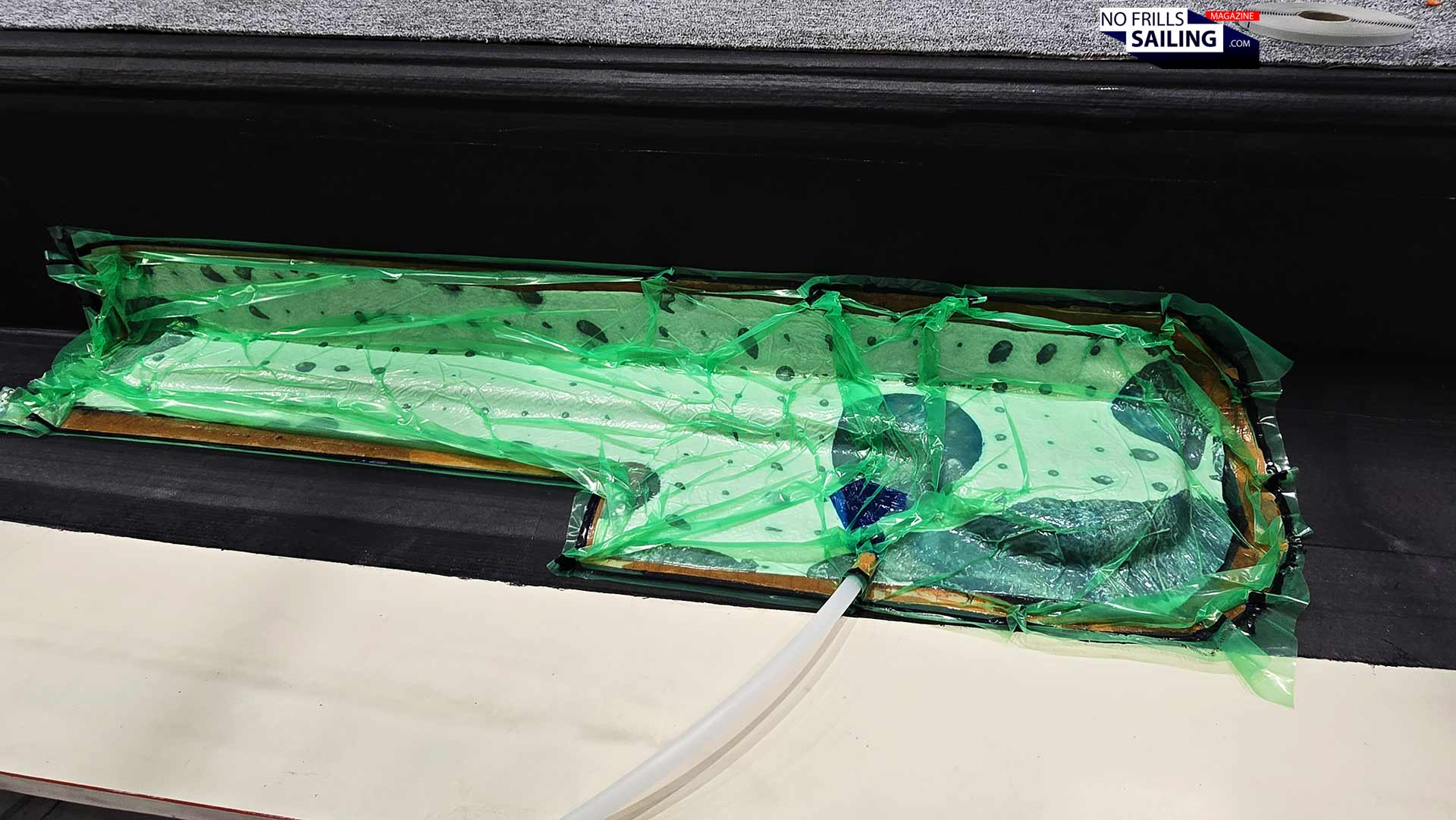
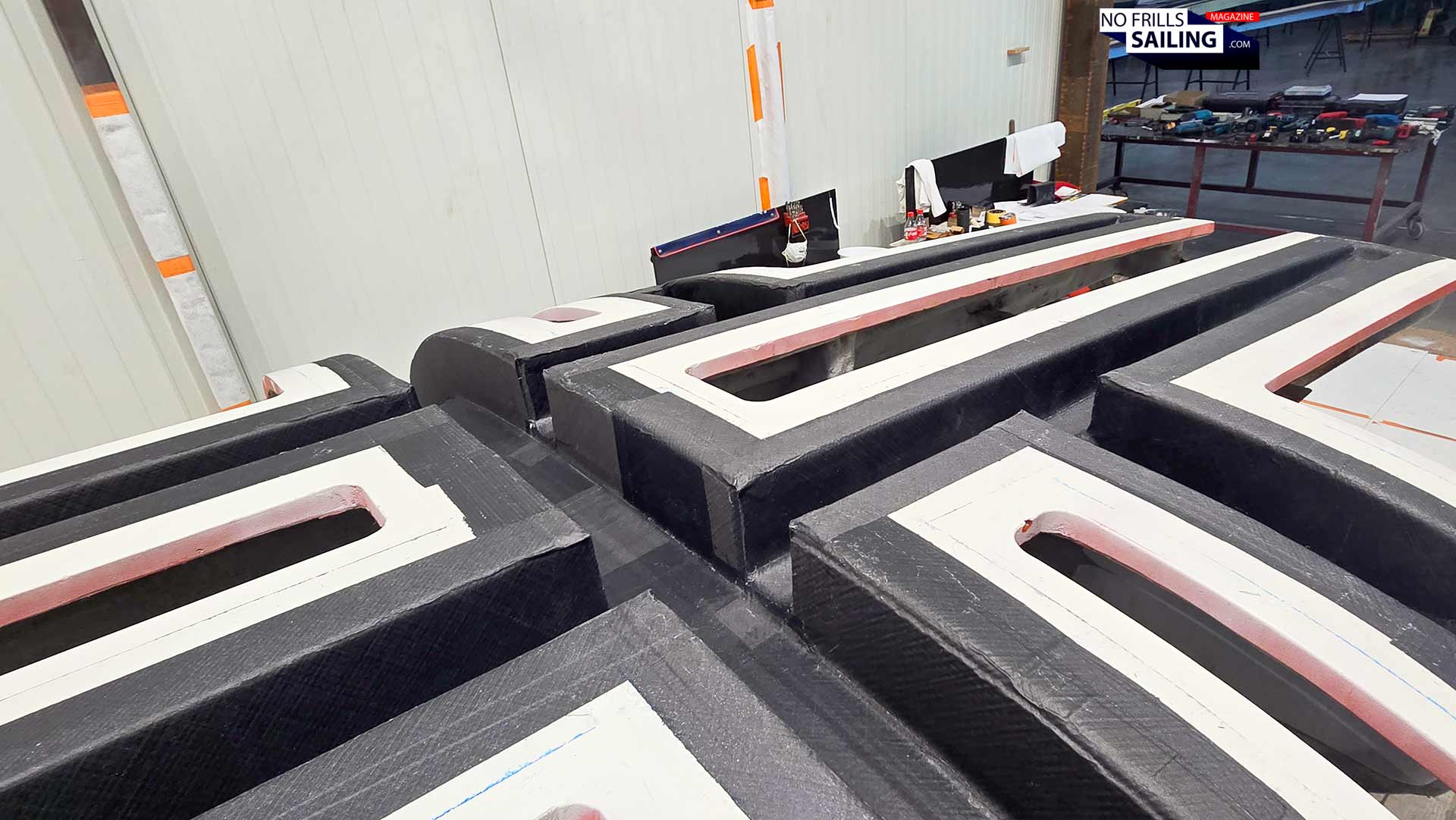
In this, Pauger celebrates the full range of boatbuilding techniques needed to make a boat. Hand layup, vacuum-infusion and prepreg-curing. What´s more to ask for? I am allowed to walk in between the large parts of this new RC44 and take a closer look: There is no secret and nothing to hide here. The workplace is absolute spotlessly clean, there is no scent or stink in the air – what a difference to GRP boatbuilding!
Vacuum infusing a part
The RC44 is made up of just 30 principal molded parts. This is significantly less than comparably sized yachts. It shows on the one hand the simplicity of the concept (and we all love simple stuff, because less stuff – less can break) and on the other hand the level of engineering and thought that went into designing these boats. In the end, if taken apart after a race, an RC44 fits inside a standard 40-foot container. Hence, even overseas transport of these boats is cheaper and safer. Nice!
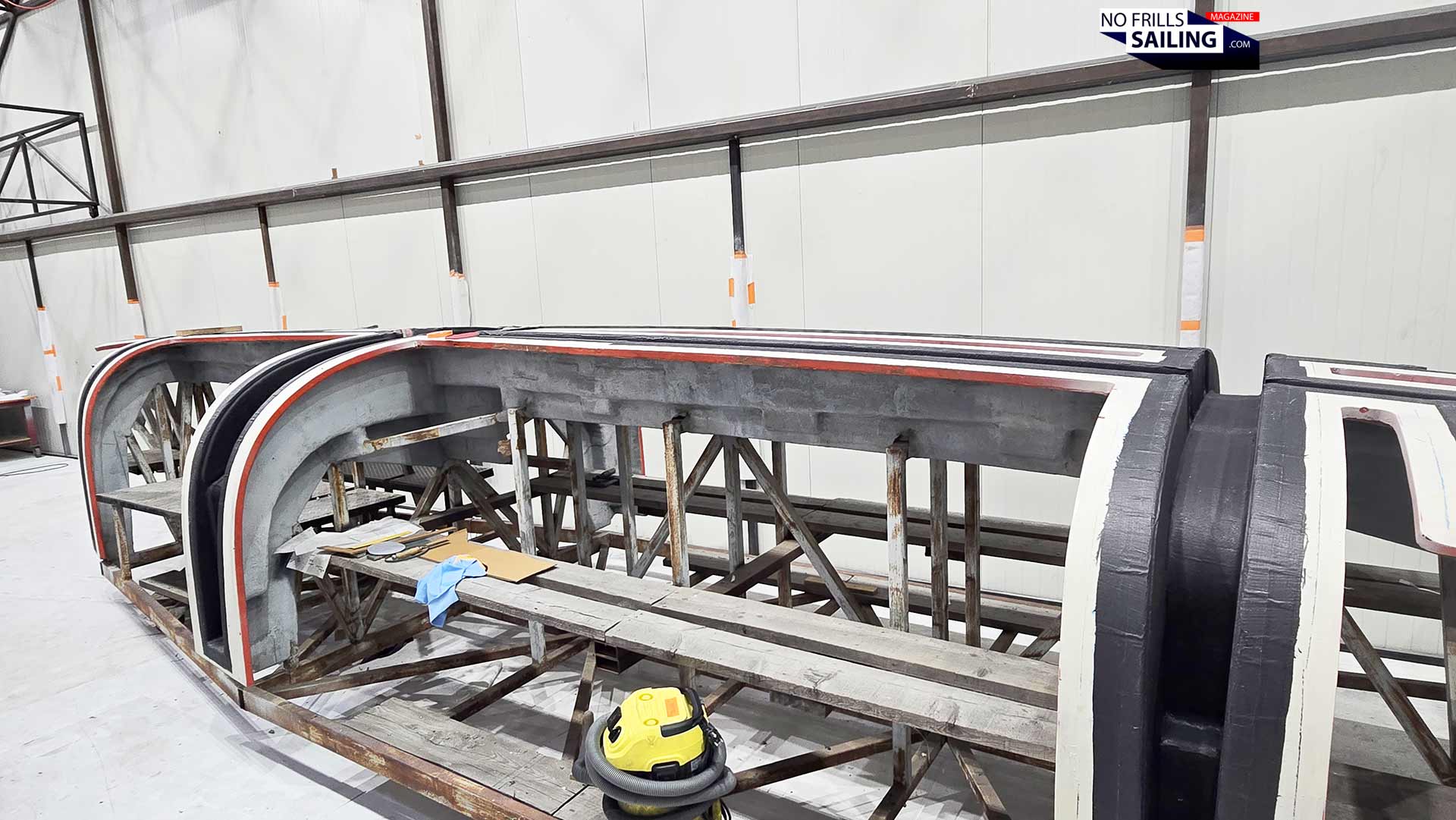
Deck and frame in the works
Looking at the massive carbon frame currently in build for this RC44, I understand that the principle building methods of this carbon yacht is the same as it is for a glassfiber-boat: Mats of fibers, soaked in resin, are placed inside a mold. Either by hand lamination or the power of a vacuum created underneath an airtight plastic wrap, it hardens.
The massive (lightweight) frame of an RC44
Later the said part will be demolded – something I´d love to document in an article, and much more in a video some day! – and then treated. Usually, much more material than needed is applied, later removed by cutting it away with a saw or by CNC-machinery. The edges will be fettled, sealed and the part can be fitted. In this, this frame will later be glued (and possibly laminated) into the hull you´ve already seen.
Carbon in the mold
Why all that hustle? Well, just take these numbers: A finished RC44 weighs no more than 3.460 kilograms. Of which a staggering 2.010 kilograms is the weight of the keel! That means, the whole carbon-hull construction clocks out with no more than a mere 1.450 kilograms! 1.4 tons of hull! I mean, a First 44 that has almost the same size weighs 10.3 tons, a Solaris 44 will displace 9.8 tons and even the smaller (!) latest generation Lift 4 Class 40 brings on 4 tons. Any more questions as to why carbon is used?
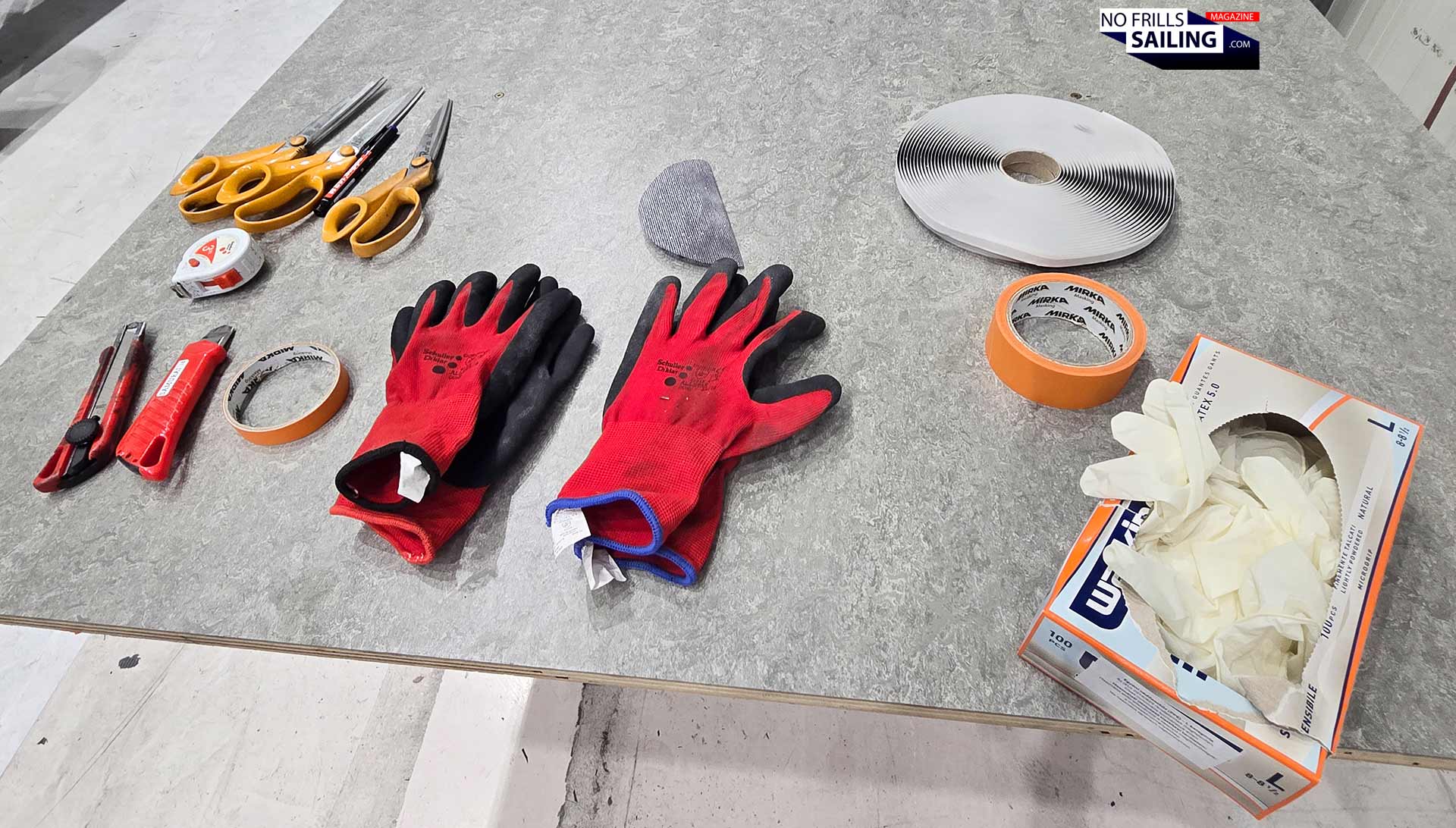
How clean and neat this is!
In all of this, I am puzzled by the sheer cleanliness and organization of work here at Pauger. Everything is neat and tidy. Tools are placed exactly to their designated areas, there´s no dirt, no offcut, no stuff around. Even the ready tools for the lamination guys, as photographed above, are arranged as if these all employers were persons with autism. The German in me really likes and appreciates it: It shows the dedication and seriousness of the people who work here – they really care. And take pride in their work.
Carbon and composite masts for racing yachts of all sizes
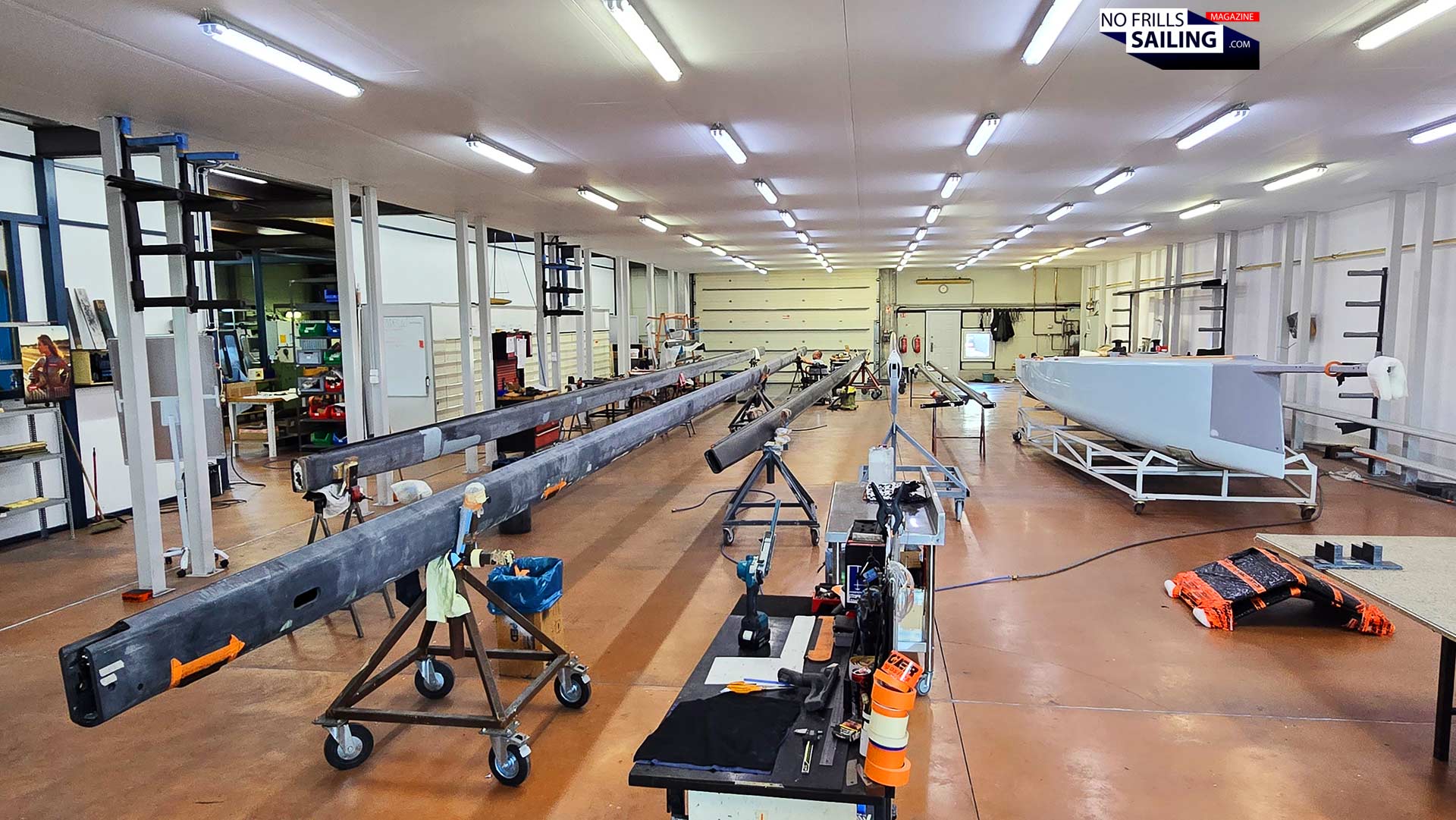
“So that´s basically it …”, Balint says as we arrive back right where we had started: In the finishing workshop where the masts receive their final finish, the fittings and all installations. In fact, the “little no more than 45 minutes”-tour I had initially thought of turned out to become a full-fledged almost 3-hours in depth visit to all the interesting corners here at Pauger! Amazing! Because, when time flies at that rate, you can be sure you experienced quite something.
Back in the finishing workshop
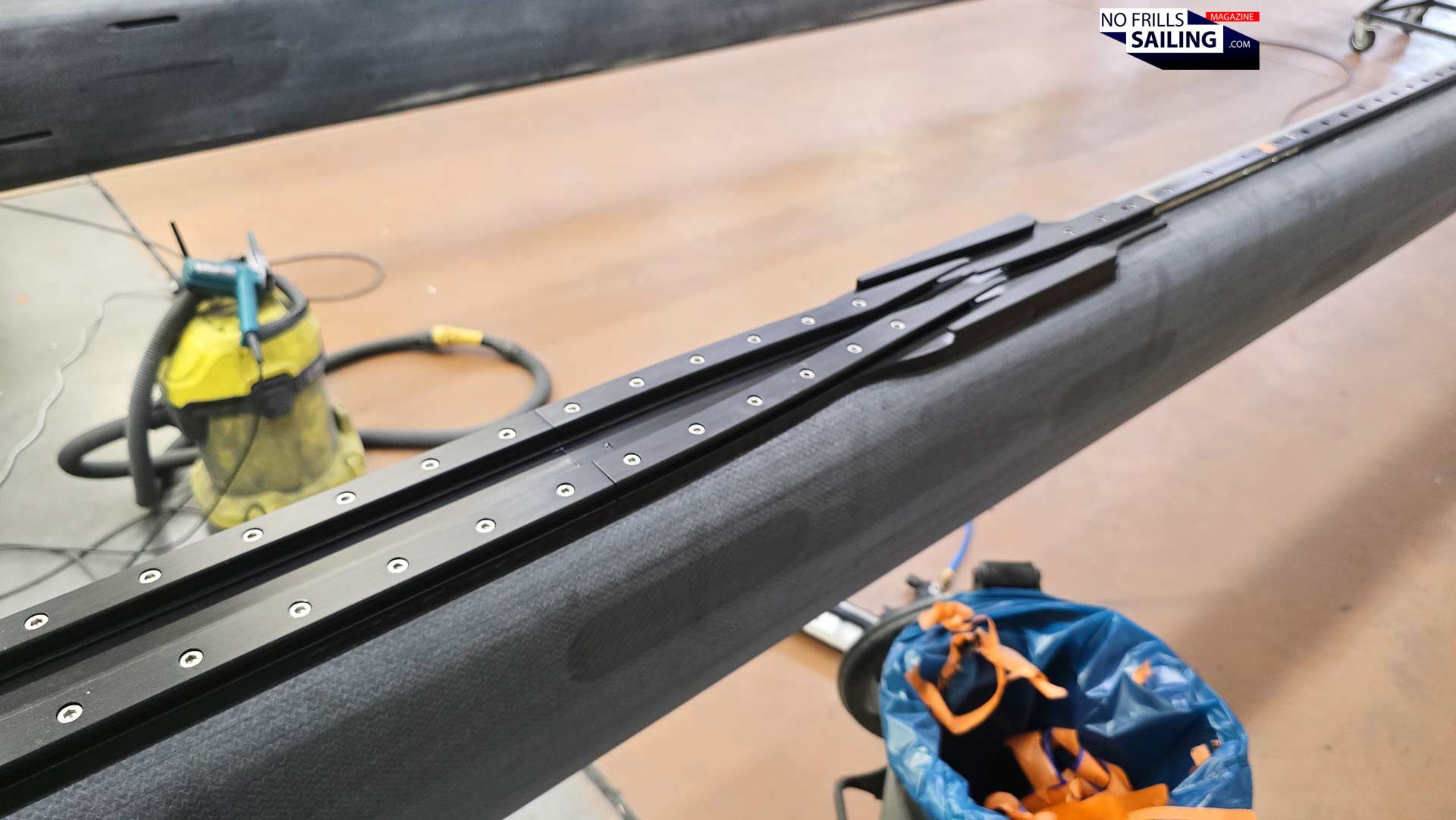
After being processed through the whole production, the masts eventually will arrive here in this workshop. The workers will fit the surplus equipment, like attachment points for the spreaders, the shrouds or ducts for lines and wires. The rails for the sail tracks are mounted and if whished, gooseneck-brackets for spinnaker-poles and other equipment as well.
Mounting mast fittings
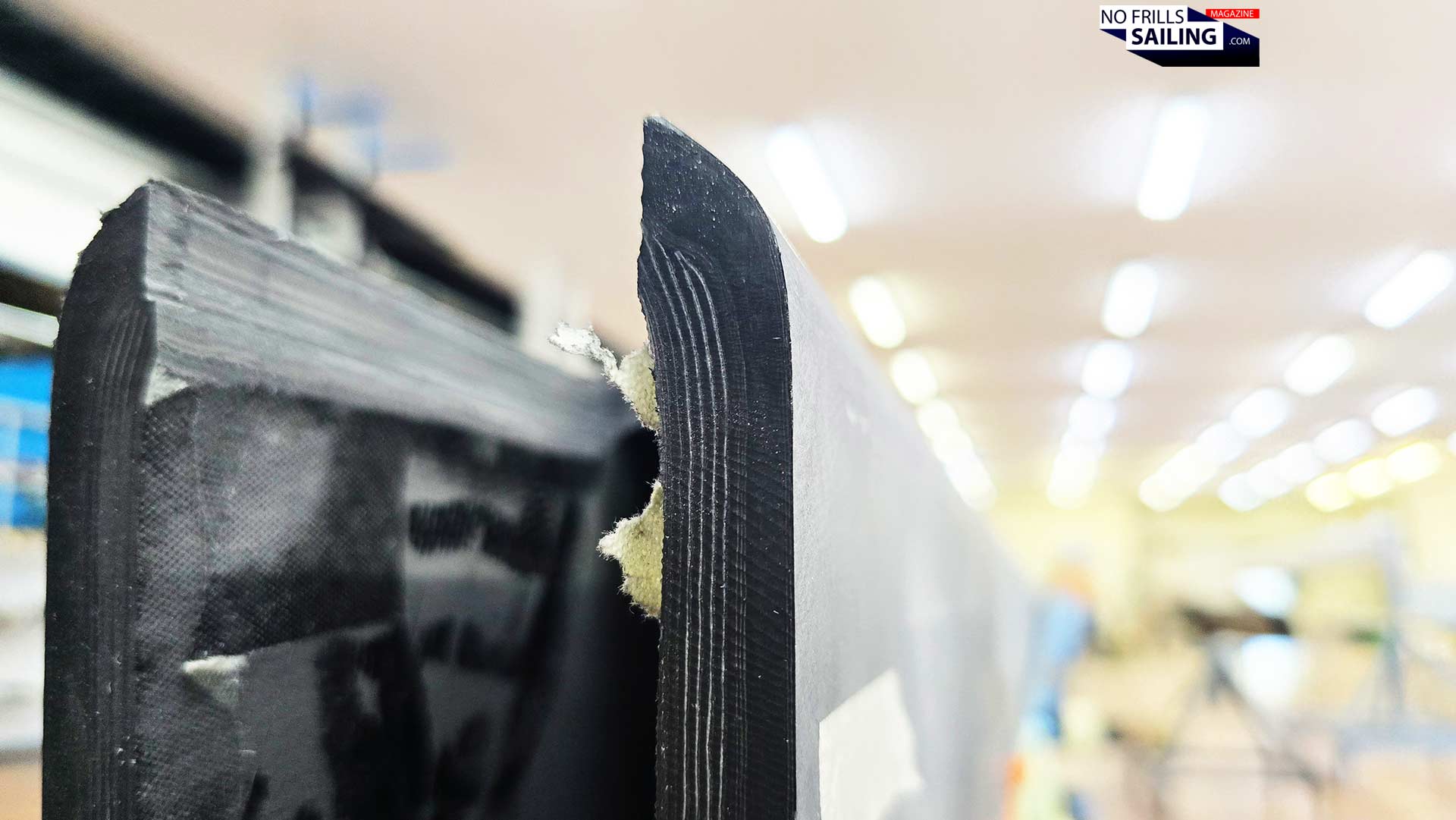
I can also take a look at yet uncovered cross-section of a carbon-mast: Here I can clearly distinguish the different layers of the carbon mats. These are perfectly visible. Revealing the intricate mace of different thicknesses, plaids, fiber-types and directions in which these are laid up inside the mast. All “baked” together to make a monolithic, strong single piece that will take on the immense loads of a sailboat under full canvas, driven hard by a pro-crew determined to win.
Close-up of the carbon layup
I know, I know: This is all top-notch stuff which most of us “ordinary” sailors will never be able to fit to our own boats. But that´s indeed a misconception: A Pauger boom-vang as shown for a 42-footer like my Omega 42 costs a little more than 2.500 Euros exVAT – checking my hardware-list, my Rodkicker comes in at around 600 Euros. Yes, Pauger is expensive, but it´s definitely not completely out of reach. At least if it comes to serial production parts. And that´s the nice thing about it: You can go for the exclusive custom mast or RC44 racer, or have a bit of this Hungarian high-grade carbon fitted to your boat as well.
Advertisement
A full surprise for me, indeed!
Concluding my tour at Pauger, I ask what´s it all about with this other sailboat I can see in the workshop. Balint hunches his shoulders and smiles: “It´s one of the after-work projects of my father … he likes to try out things.” And he smiles. Now, isn´t that nice?! It is! I thank Balint so much for taking his time to show me around, it was an absolute pleasure and such a big surprise to learning how much bigger Pauger really is than I had imagined.
Dad´s afternoon project …
As I leave, Ördög the watchdog is violently biting his cage in blood rage … well, having seen how much valuable machinery and material is on the premises, I probably would have hired a bloodhound like him as well! Ah, by the way, Ördög means “Devil” in Hungarian … definitely a fitting name for this little, hellish guard dog, who is roaming freely on the property after closing time. Still, I did not dared to take a picture of him … thanks Balint, that was awesome!