
Now during winter time many skippers might think of renewing their boat´s safety equipment. Maybe after five or even ten years you decide that the good old lifejacket – albeit always maintained properly by a certified supplier – may make way for a brand new one. Often these decisions come with new boats or when something else changes significantly: You get married, kids grow older or your belly increases its presence aboard. Then it´s a great idea to utilize Christmas offers, cash in on the (otherwise awful trend of) “Black Friday” or even bargain during the last weekend of upcoming Boot Duesseldorf boat show. Which way ever you choose, the same question arises: What is the best lifejacket for me?
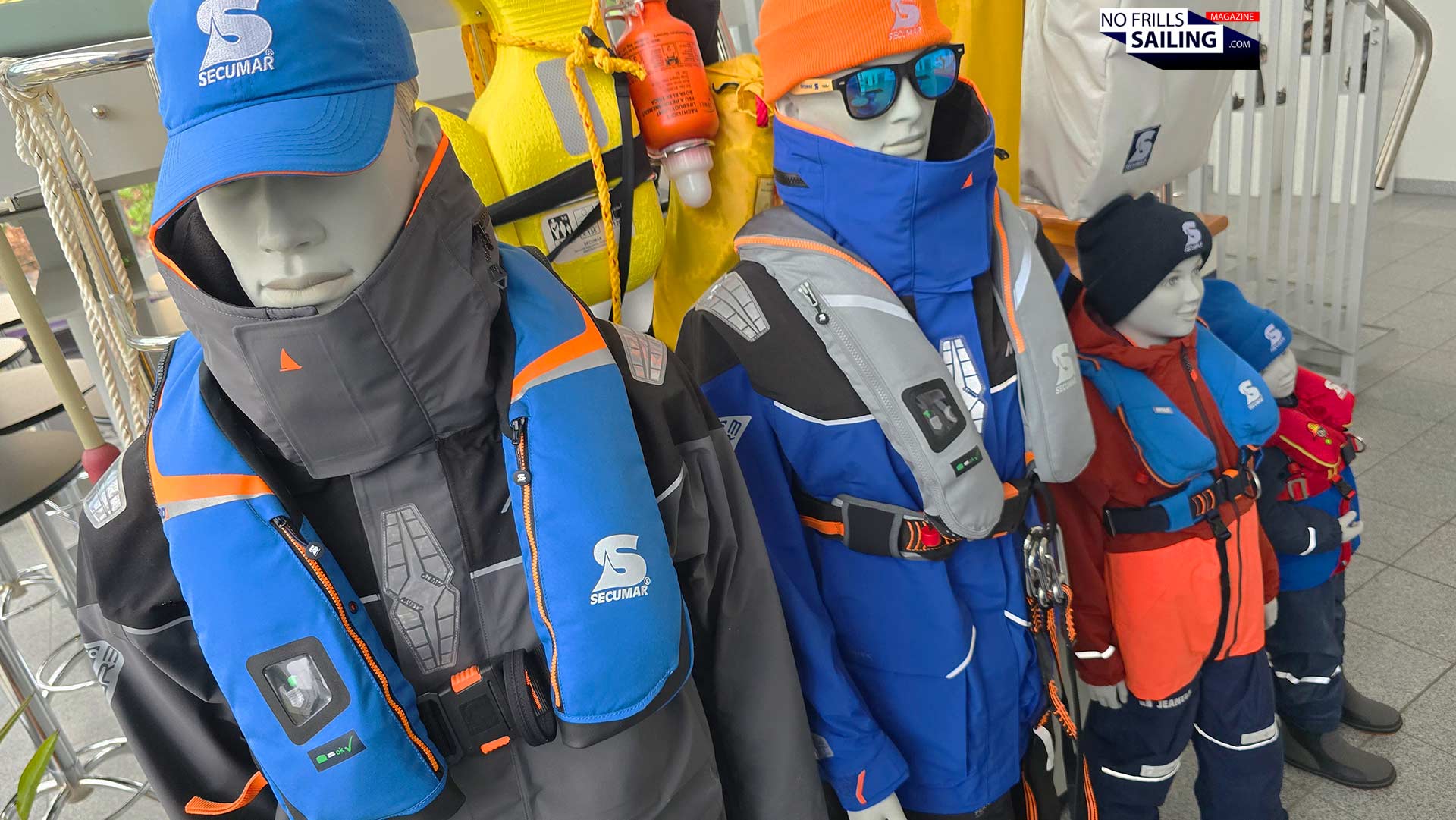
In this article I´d like to tackle one of the big-time myths and misunderstandings about lifejackets, we will tackle the question of how many Newton are sufficient enough for you and what makes a lifejacket actually saving your life in the first place. Let´s start with this big urban myth that is so common amongst many sailors that I regularly stumble upon it. It goes like this: “I weigh 140 kilograms. I need the biggest lifejacket with as many Newton I can get!” Well, sorry. This is just plainly wrong!
Learning from the professionals: At Secumar near Hamburg
In order to get my information directly from the source, as it happens, I take one Autobahn-exit earlier before entering Hamburg and park my car at the Secumar headquarter and production site. You may have already read my various articles about this European market leader in terms of lifejackets and safety devices both for private and pleasure use and for commercial as well as military applications. I am directly rubberstamped to the testing complex at Secumar, where I interrupt Olivier Christen, sales manager for pleasure- and sports-products of the company.
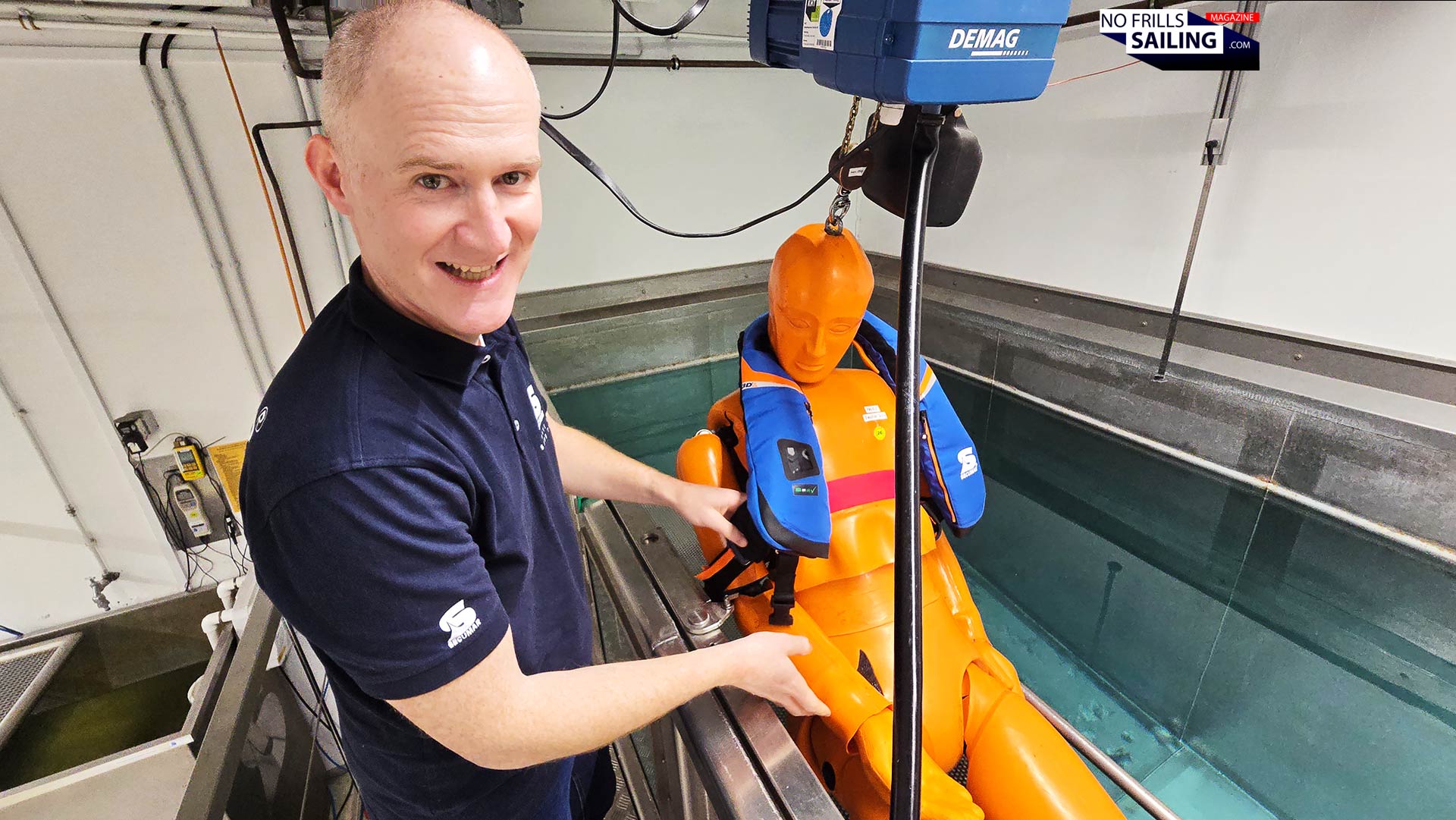
As it seems, the Swiss-French expat now living in Germany was just about to throw Scotty, a life-sized dummy for adult-products testing into the pool. Something we will profit from later. When I told Olivier about my aim of writing this article, he instantly smiles, roles with his eyes and nods: Yes, if every time Olivier had to listen to the “I am so and so heavy and therefore I need as many Newtons as I can get!”-story somebody had given him a Euro, he´d be Millionaire by now. But honestly, how can we get rid of this fallacy.
What is a Newton? And why does it make me float?
Olivier takes me to a desk and fills up a little glass container with water. In his pocket he finds a plastic figure of a penguin. “I forgot to give it back to my kids …”, he mumbles but holds it up and goes: “Let´s do a little experiment, shall we?” He positions the figurine just above the waterline and lets it go. Of course it plummets into the water and immediately sinks down to the bottom. Sad fate for the little penguin. “As you can see, it drowned. Why? Because it is denser than the water. Only stuff that is less dense as water will float.” So what does our penguin need? A floating aide.
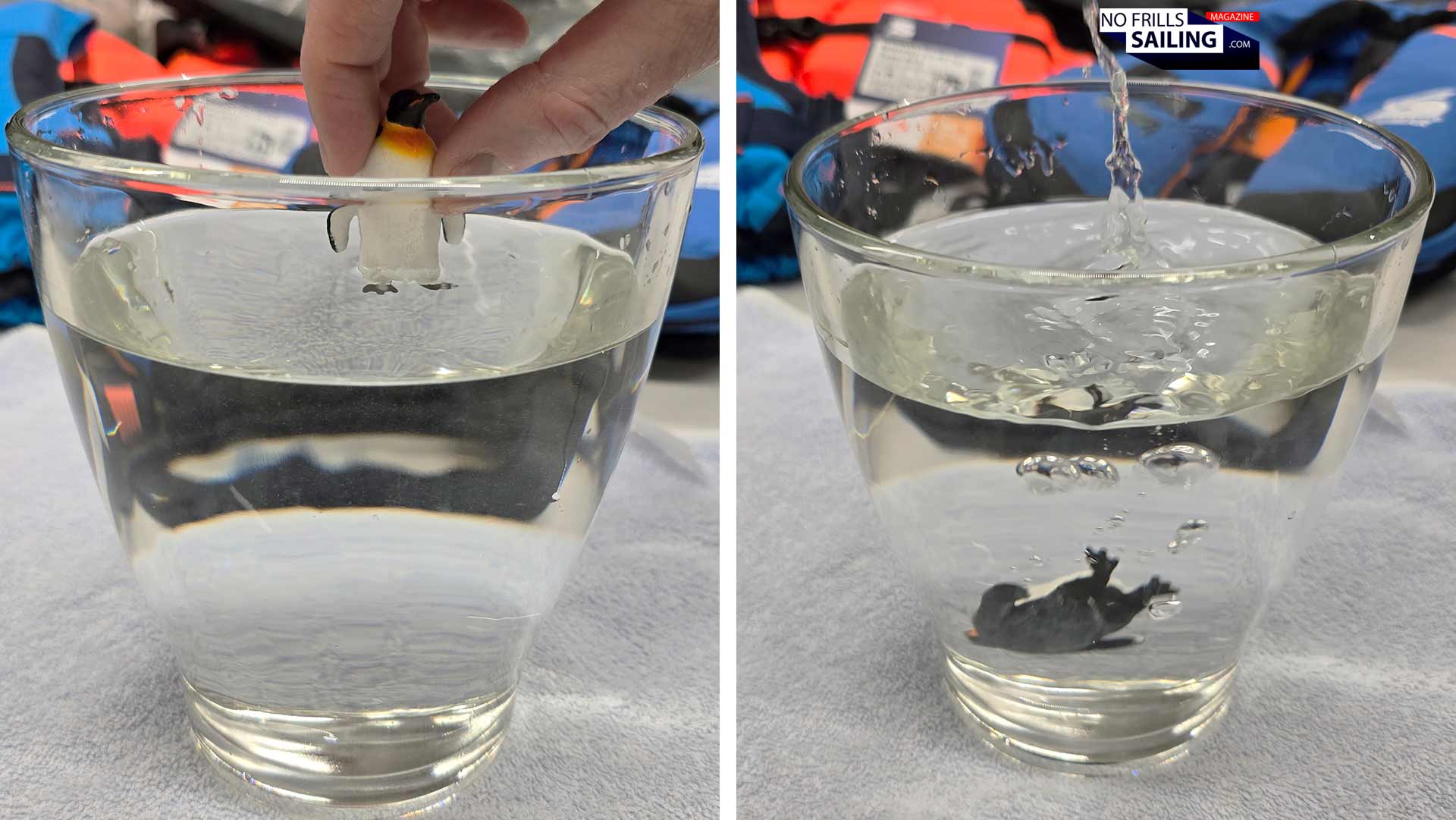
He rummages his rucksack and finds a little Tupperware-style plastic container. It just fits our penguin inside. “It doesn´t matter if the floating device is attached to the thing that needs to float or if it is inside of it”, he explains and puts the figurine inside the breakfast box, like in a submarine. Of course, it floats now. Having marked the level of the water before and after inserting the floating device with the penguin inside, I can clearly see the difference at the glass. “This is Archimedes´ principle”, Olivier explains: “Every body displaces as much water as its mass.”
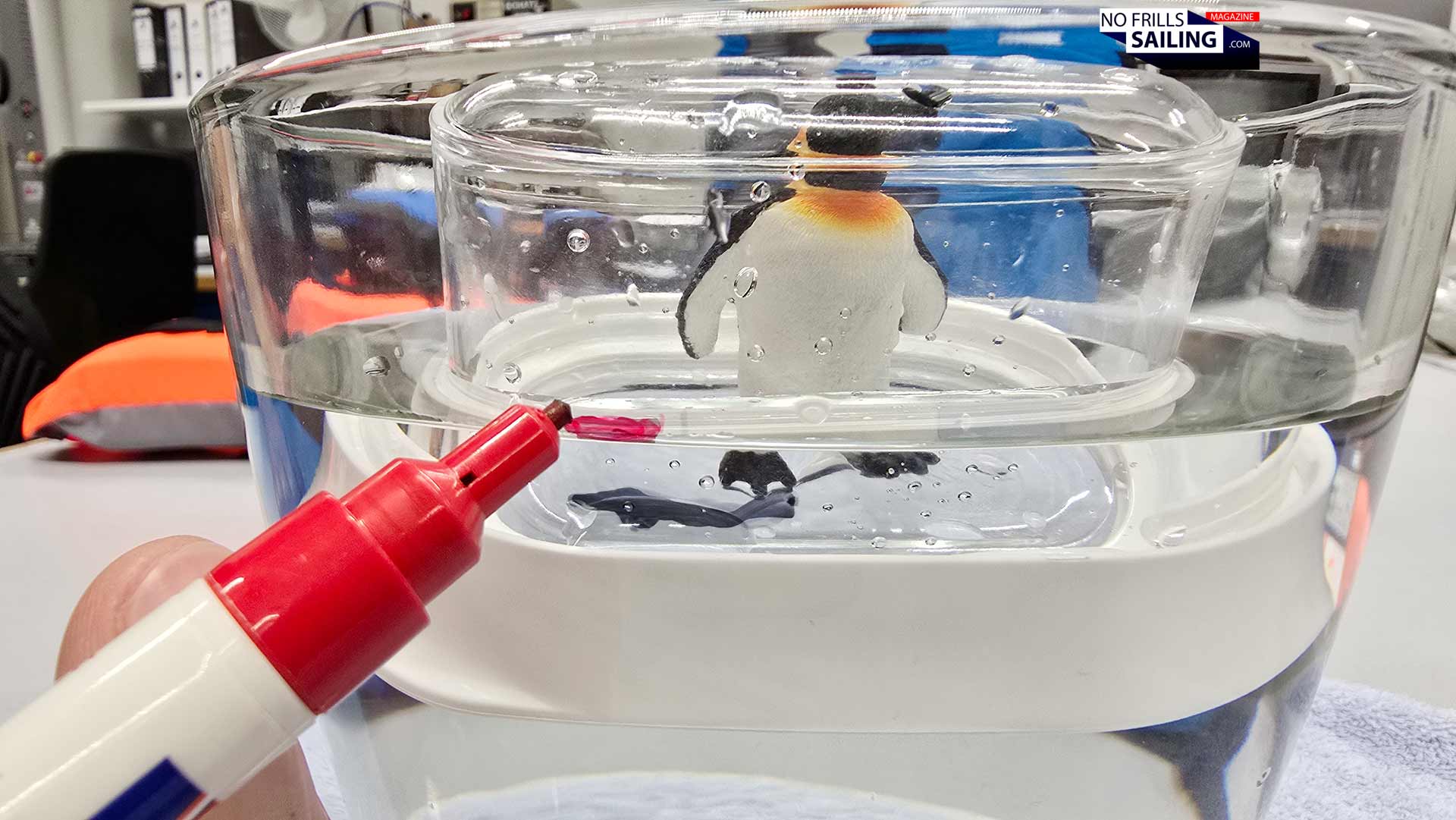
This little sweet experiment shows two basic things. First, the more mass enters the water, the more buoancy is needed to lift it up again. Secondly, if a body is less dense than water, it will drown. “But isn´t this exactly confirming the fallacy that you need a bigger lifejacket the heavier you are?!?”, I am replying. No so much, as it turns out …
The big myth about „I am heavy – I need a powerful lifejacket!”
Secumar will celebrate their 100th birthday in a few weeks. As a matter of fact, three generations ago the grand-grandfather of Secumar´s current CEO Benjamin Bernhardt, engineer Karl Bernhardt, was so appalled by the ongoing much too high losses of life at see, mainly after the loss of the German five-masted PAMIR with 80 of 86 mostly young crew members dying, that he started to scientifically and methodically researching this topic. In the end, Karl produced a paper called “The human body with the medium water” in 1959.
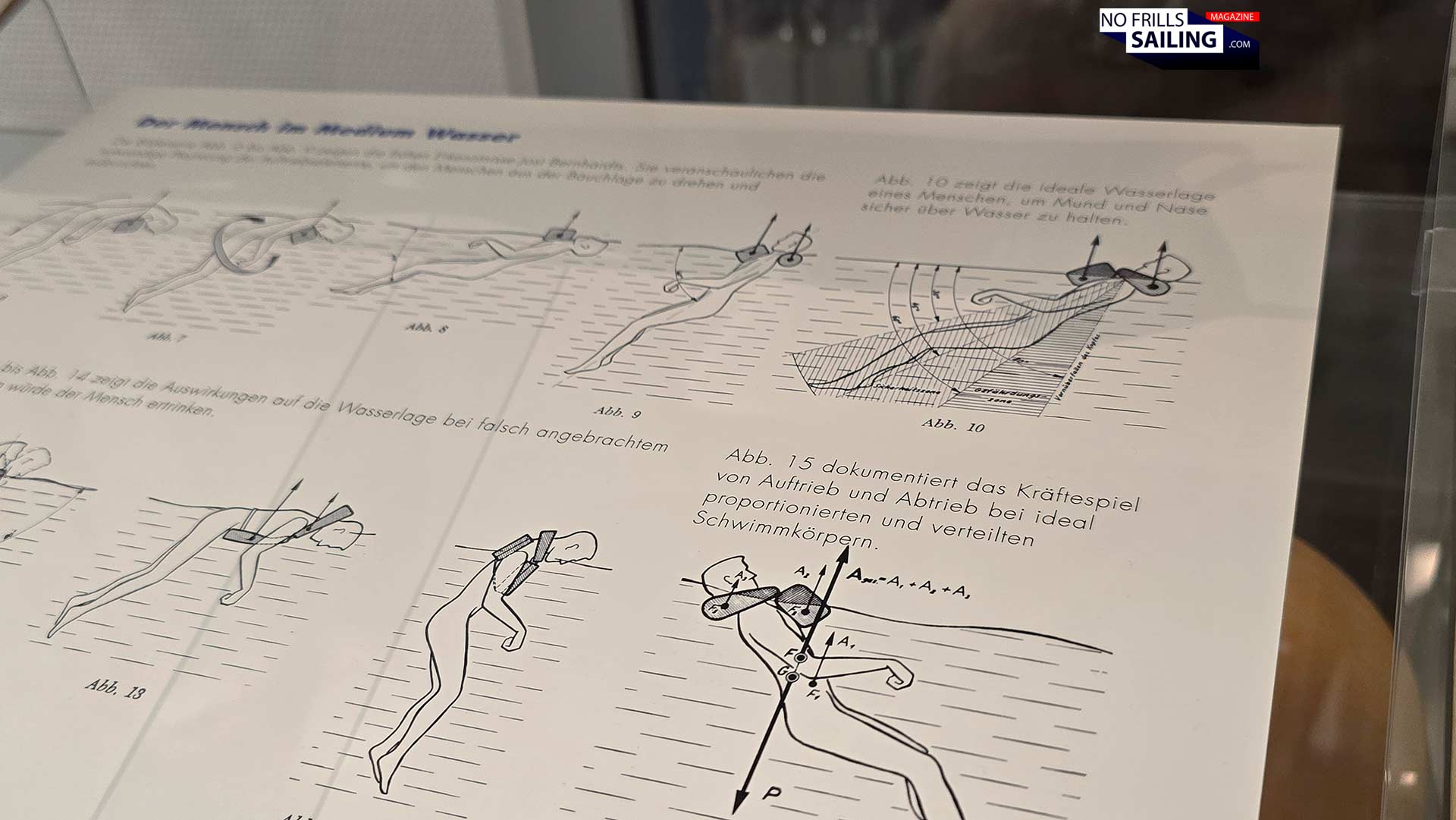
There is one original copy being kept in Secumar´s own little museum (which by the way is absolutely worth a visit should you ever come to Hamburg!). Olivier shows it to me. Going through the pages it becomes clear how much effort and meticulous research went into this topic. Moreover, what kind of skills and deep insight into both the fields of physics and human biology it needs to come up with solutions. But the most interesting insight was one particular sketch, which is mirrored by another showcase in the museum: “All it takes to survive is your head.”, Olivier says and points toward a dummy-head being held up by one of the old 50ies-test floating device.
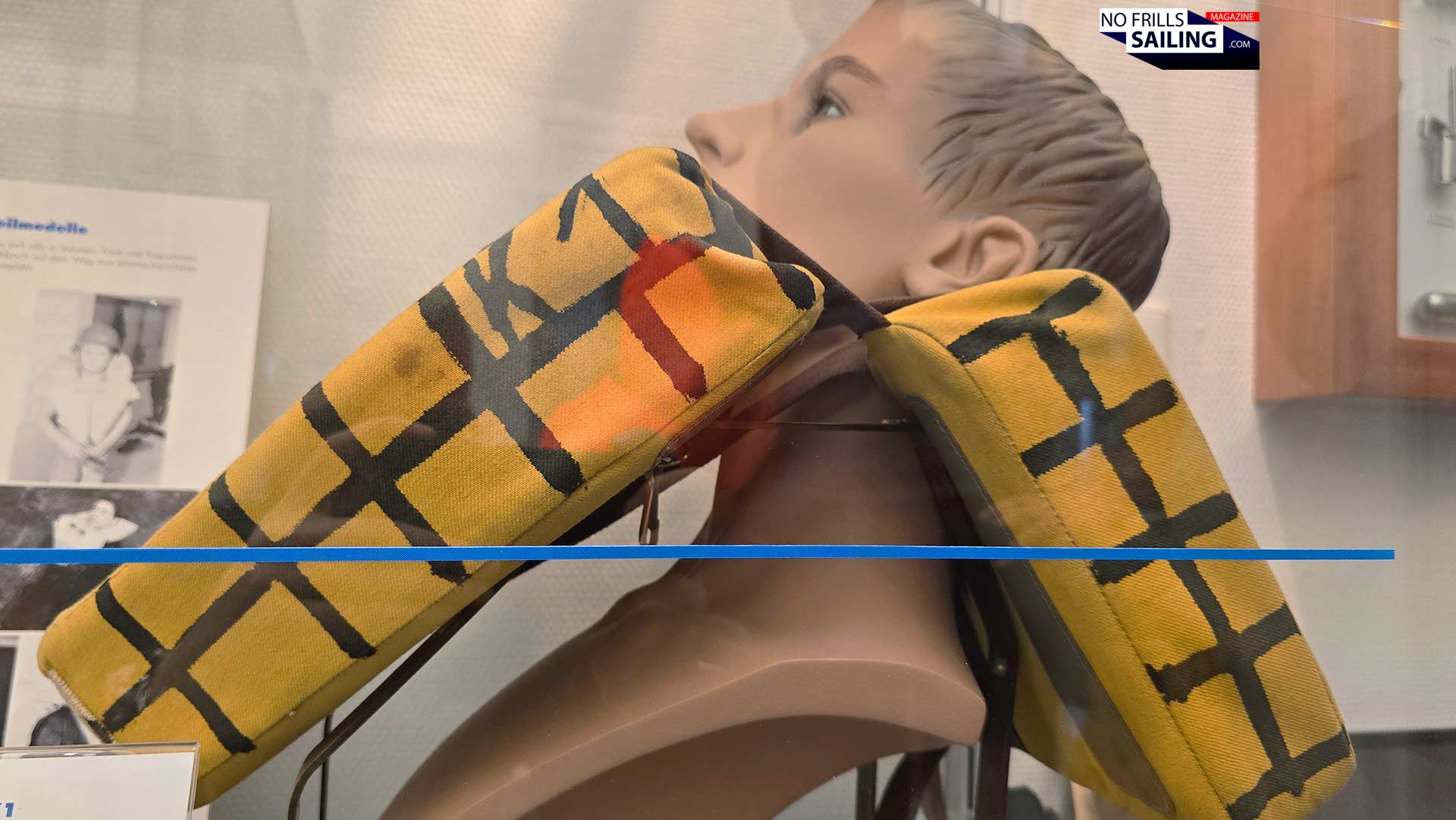
This is important now: “Because the human body has nearly the same density like water, it tends to float.”, Olivier explains. “People do not go down in the water! Unless you are wearing lead shoes or you are attached to an anchor of course. The body will float. Our blood has almost the same level of salt, as the saltwater of the ocean.” This means, usually, after falling overboard, the body hovers shortly beneath the surface of the ocean – all it takes is to bring your head out of the water. “Stay with me here!”, Olivier says … “Remember, all it takes is to lift the head out of the water – not the whole body!”
About Newton and lifejackets: A lot of safety margin
Which brings us now to the “Newton”. Maybe you remember vaguely what your physics teacher was trying to get into your head back then in sixth grade. One Newton is the force needed to accelerate 1 kilogram of mass to 1 meter per second. But you may forget this rather dry definition, as Olivier demonstrates what a Newton does in reality in lifejackets. “First of all, there is a little rule of thumb. It says that you need approximately 10 Newton to lift up 1 kilogram or 1 liter of volume out of the water.” Okay, that´s convenient: 10 Newton equals 1 kilogram.
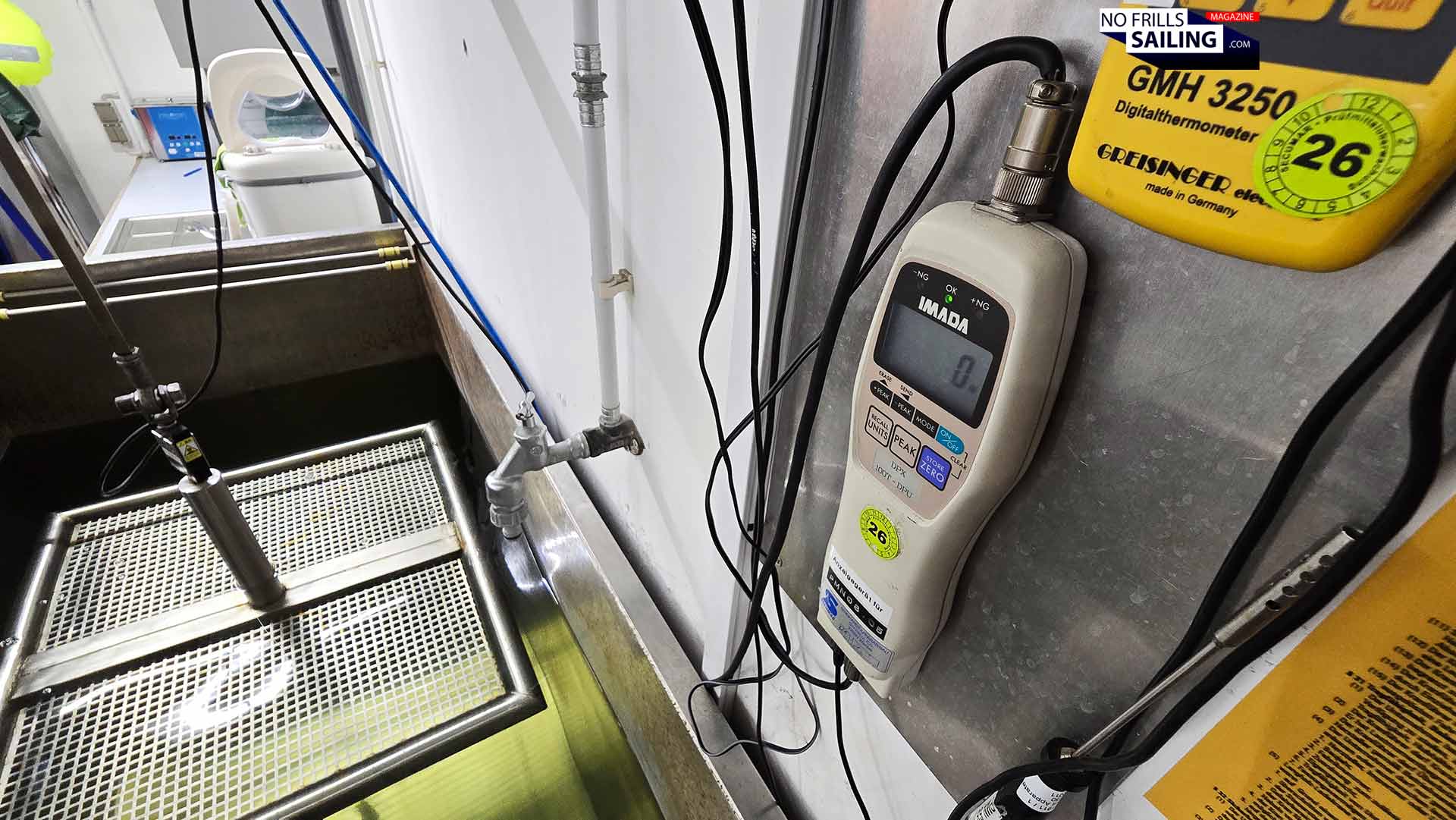
Secumar´s testing laboratory has a little basin filled with water. Above it a metal grid is welded onto an arm that is able to glide up and down. Attached to this lever is a sensor that measures the force that is pushing up the arm: You guessed it, this force is the Newton, pushing upward. Olivier activates the testing device, the gauge lights up. As there is currently an equilibrium within the basin, it shows a zero. To make this easier, Olivier takes out one of the solid lifejackets (rather: floating aides) out of the product range of Secumar as this experiment is not about automatic or floating (later more on that!). He places the life vest in the water, of course, it floats.
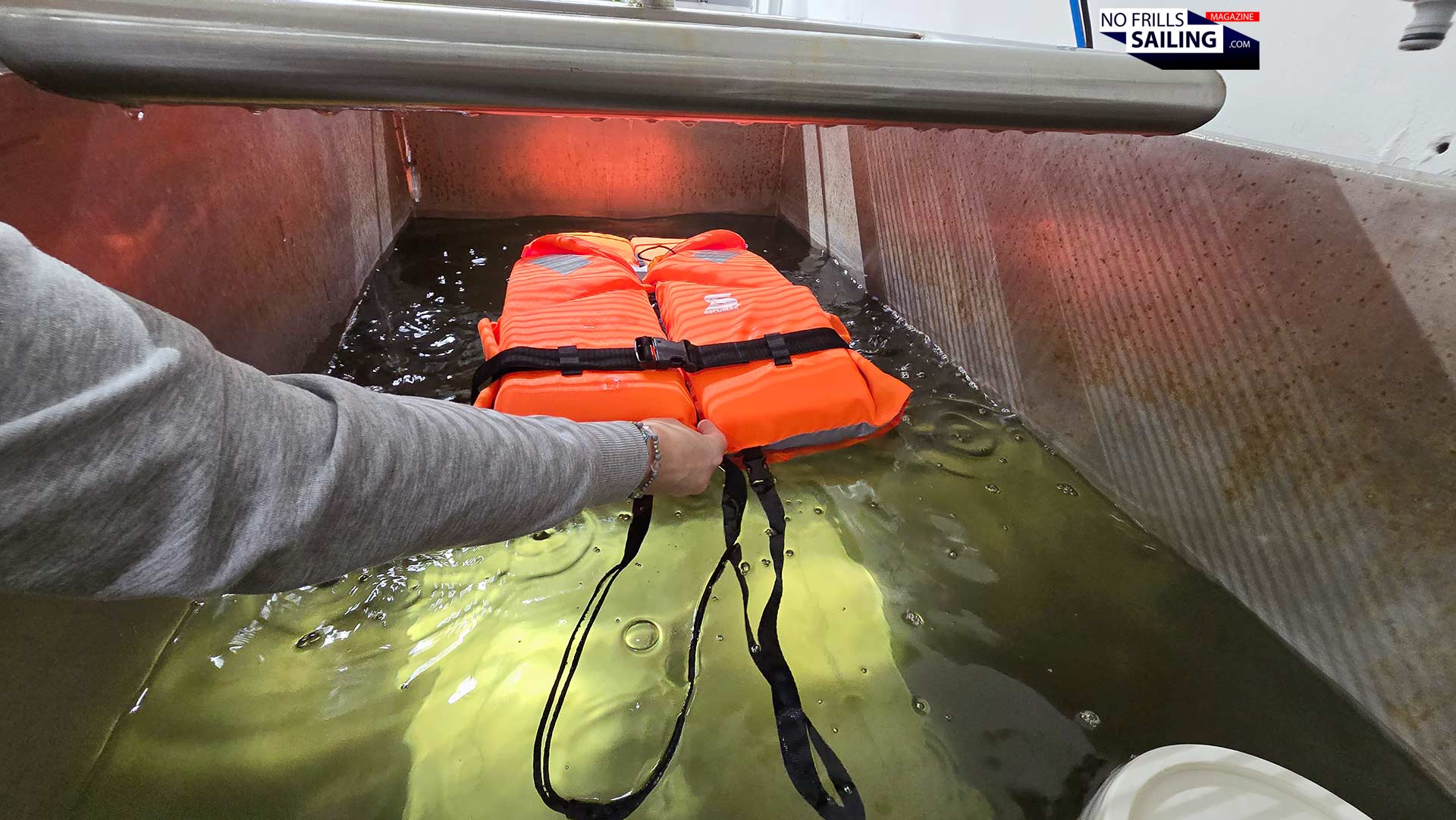
Now he pushes a button. By means of compressed air, the metal arm presses the grid downwards until the solid life-vest is completely submerged. As the foam inside the vest is less dense than the water it surrounds, it has the tendency to return to the surface – upwards. The resulting force, measured in Newton, is therefore displayed on the gauge. It reads 134 and slowly goes down by the time. 130 Newton, 129, 128 … I can clearly see little bubble of air venting to the surface, exiting the life-vest all over the place.
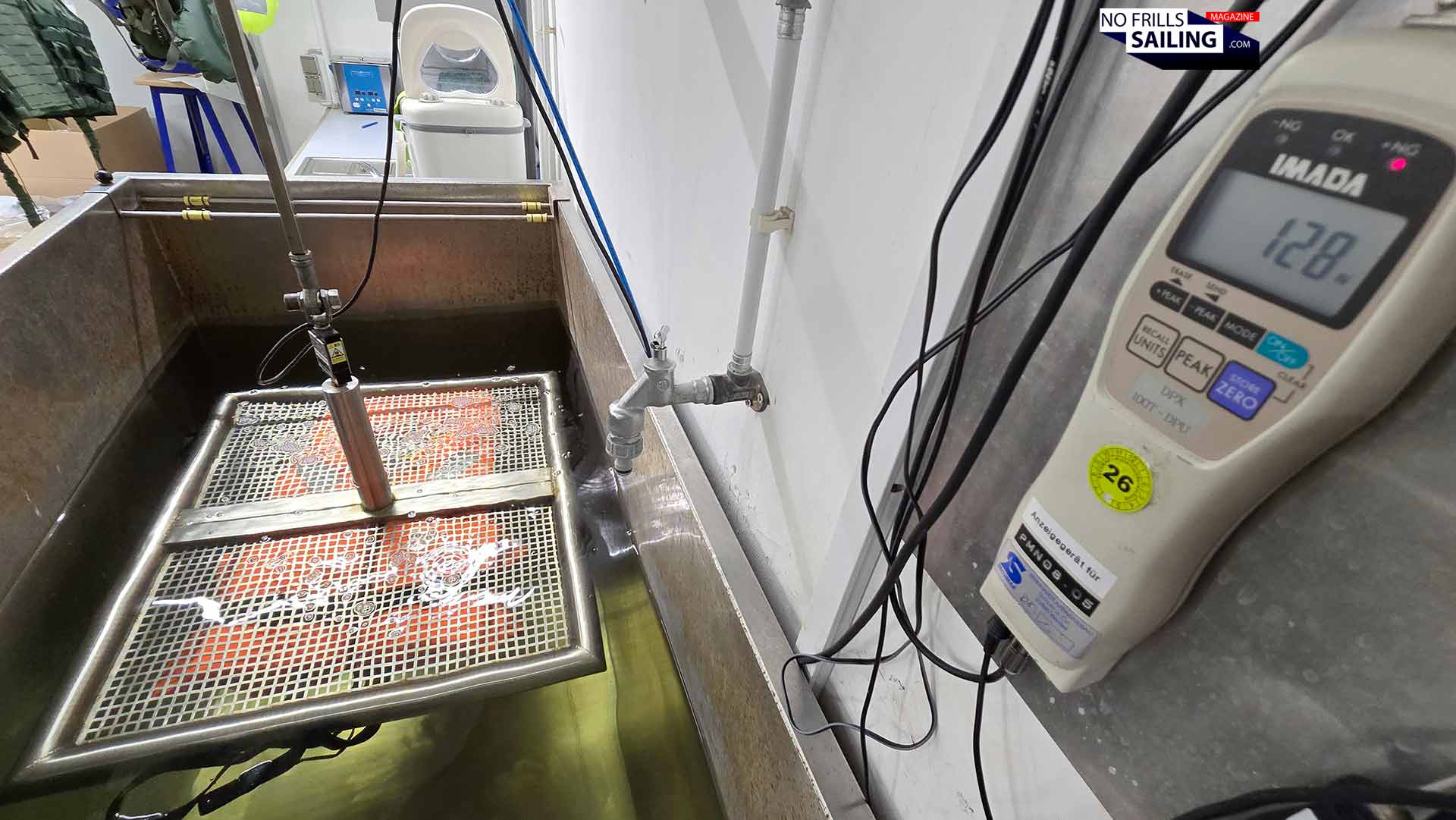
“These bubbles are trapped air within the garment of the life-vest.”, Olivier explains. “The foam inside that is creating the uplift is impenetrable by water, but of course the fabric is not.” This also explains another myth: Sailors often think that heavy sailing gear will somehow soak and pull you down when you go overboard. This is a fallacy too: It´s rather the opposite way, Olivier says: “Mostly, sailing gear, will trap large amounts of air that will prevent you from going under. This may sound good, but is a large obstacle in reality as it makes it much more complicated to construct lifejackets!” We will talk about this later. For now: For most part, if you go overboard, your clothing will much like the fabric of this life-vest soak and therefore float just like you. Normal clothing doesn´t add to drowning.
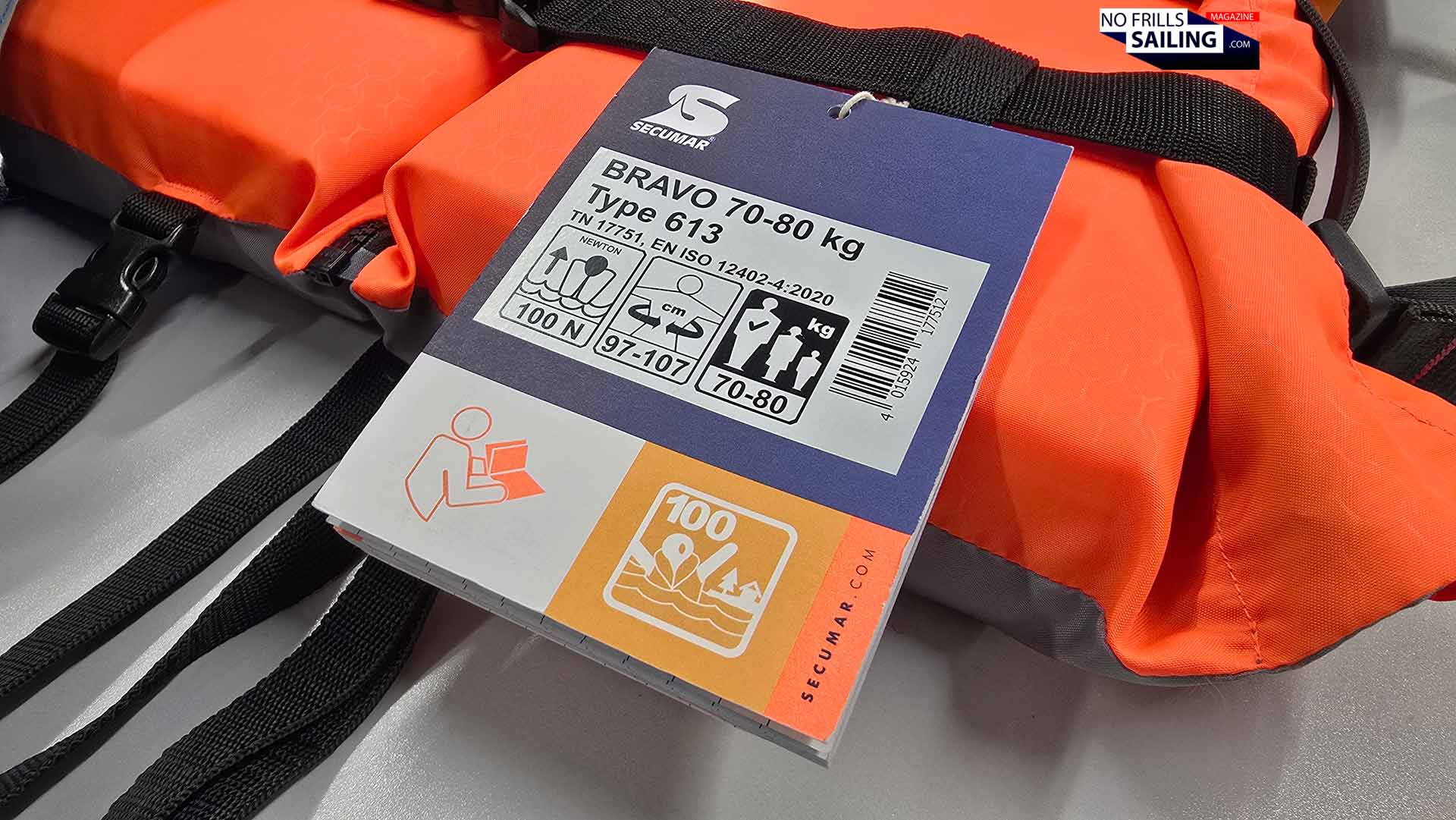
The gauge display is continuously counting down – but it eventually stops at 113 Newton. Olivier smiles: But I do not get it. He shows me the little cardboard info-brochure that was attached to the brand new floating aide. I am honest here: I never really read those or put too much attention on those. It shows a “100 Newton”-picture, a lot of certification numbers, a maximum waistline of 97 to 107 centimeters and that it is suitable for adults. I look at Olivier. He smiles with his eyes wide open. I still don´t get it …
Watch out for the buoyancy classes!
Pointing to the display which still reads 110 Newton, he explains that the real buoyancy created by the product does not necessarily comply with the buoyancy class each lifejacket belongs to. Lifejackets may have more and also less Newton than their class actually shows. If you are a bit puzzled now, no problem, I was too. As a pro he quickly understands my confusion: “Let´s step back for a moment.” And so he explains the buoyancy classes.
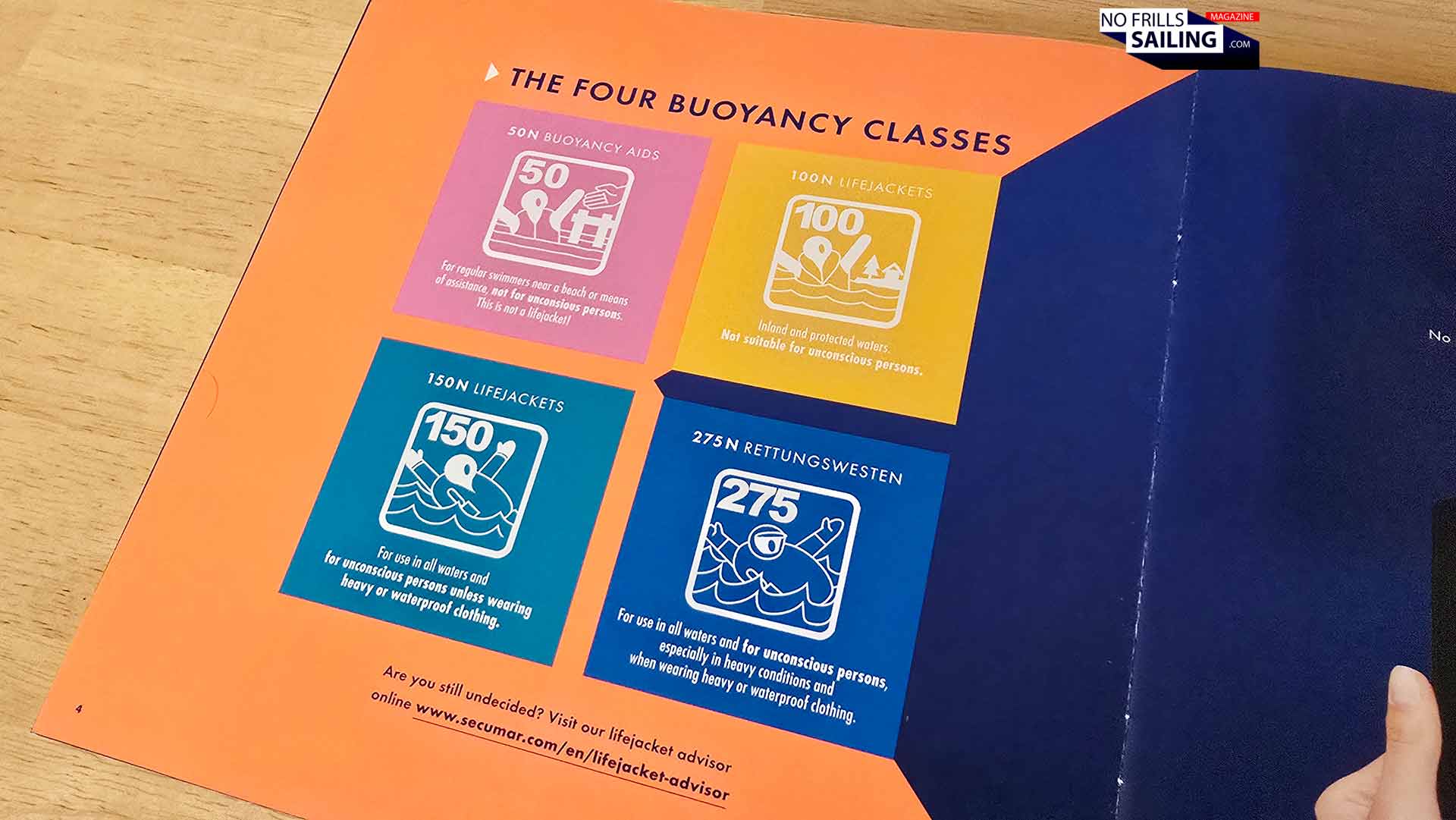
As for most European lifejacket manufacturers, there are four classes of buoyancy: 50 Newton, the already shown 100 N, 150 N and finally the “biggest”, 275 Newton. The bare numbers – as we have already established – show that the less Newton a lifejacket has, the less “powerful” it can lift up mass out of the water. With our rule of thumb I can quickly calculate: 50 N will lift up 5 kilograms, 100 N does 10 kilograms, 150 N and 275 N 15 and 27 kilograms. But there´s more to the classes: The little pictures (and color-codes) also show what this lifejacket is good for (and what not). A 50 N buoyancy aide is for swimmers near a beach or jetty. 100 N for protected waters and also not suitable for blacked-out persons. Only 150 N and 275 N are suitable for offshore-usage and unconscious people. All right, but what about the “more” and “less” literal Newton than actually displayed in the class?
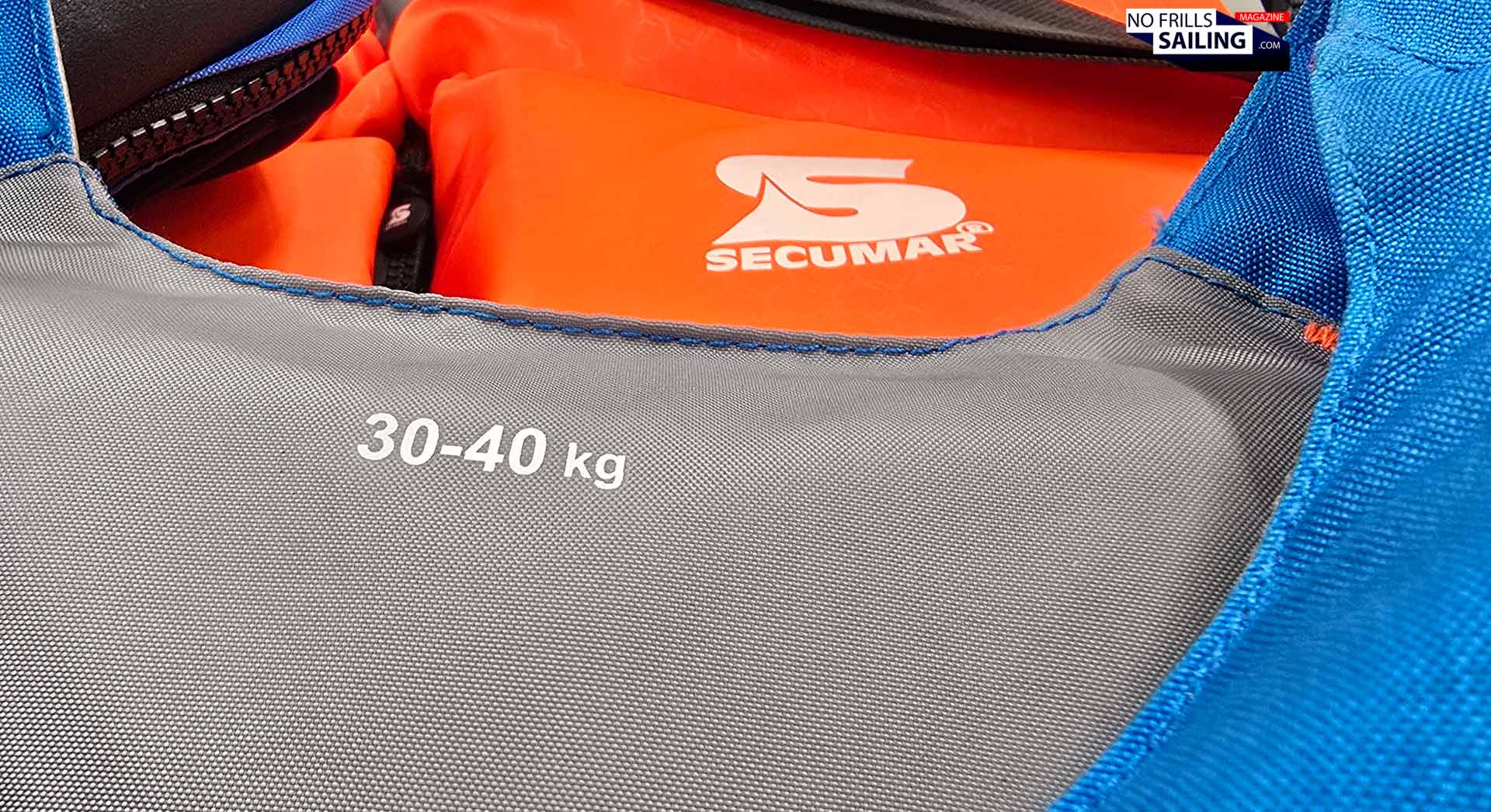
Olivier takes out a solid buoyancy for kids. To be precise, for a 30-40 kg heavy child. “This life-vest is rated in the 50 N-buoyancy class but has only 35 Newton in reality. That´s obviously less, right?” I nod. “Likewise, the “Junior” automatic lifejacket you tested with your kids are rated in the 150 N-class but also only have 110 Newton.” Why? A little kid doesn´t need the full 50 Newtons to get its head lifted out of the water. It works the same way around for adults as well: “You favorite jacket, our “Scout”, is rated in the 275 N-class but it has actually 290 Newton of buoyancy.” Olivier points to the basin: “This is why this jacket also has 110 N, and not 100 N as rated.” Oh boy …
Floating is just the beginning: The trick of surviving a MOB at sea
But if we just need to get up the MOB-victim´s head, why so many Newton? A human head weighs approximately 4.5 kilograms, give or take. Olivier nods: “It´s comparable to a literal head of white cabbage.” So, applying the rule of thumb, 45 Newton – with a little safety margin – 50 Newton indeed is the absolute minimum required in life-vests and buoancy aides. “This is the reason why it makes no sense to have classes with less Newton! But as you have already notices, only two classes – 150 and 275 – are really suitable for sailors.” 50 and 100 N are therefore also officially not called “lifejackets” but only “aides” that help you to keep afloat.
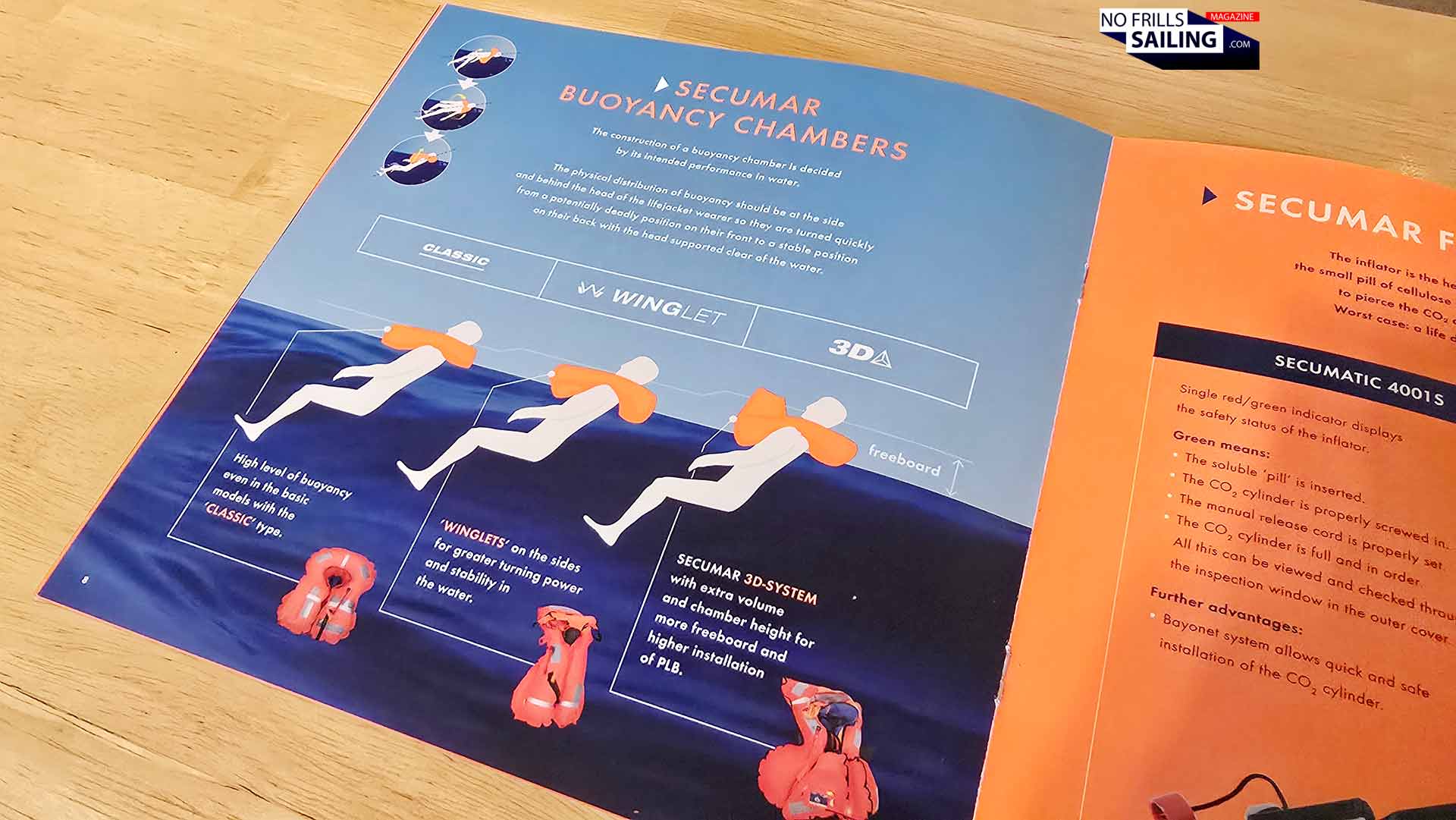
Olivier shows another chart. The “art” of saving life at sea just starts at lifting out the head of the water. It is indeed just the first step any lifejacket must accomplish. Because after this, it gets very complicated. “The human body, especially our spine with the attached head, tends to tilt forward.”, Olivier explains. It´s far easier to nod forward than to keep your head up or backward. “Big time problem! This is why so many people drown: Because even if you manage to create constant 50 Newton by swimming – which is easy – or by clinging to something floating, if fatigue sets in or you become unconscious … your head will tilt forward. And you will drown.”
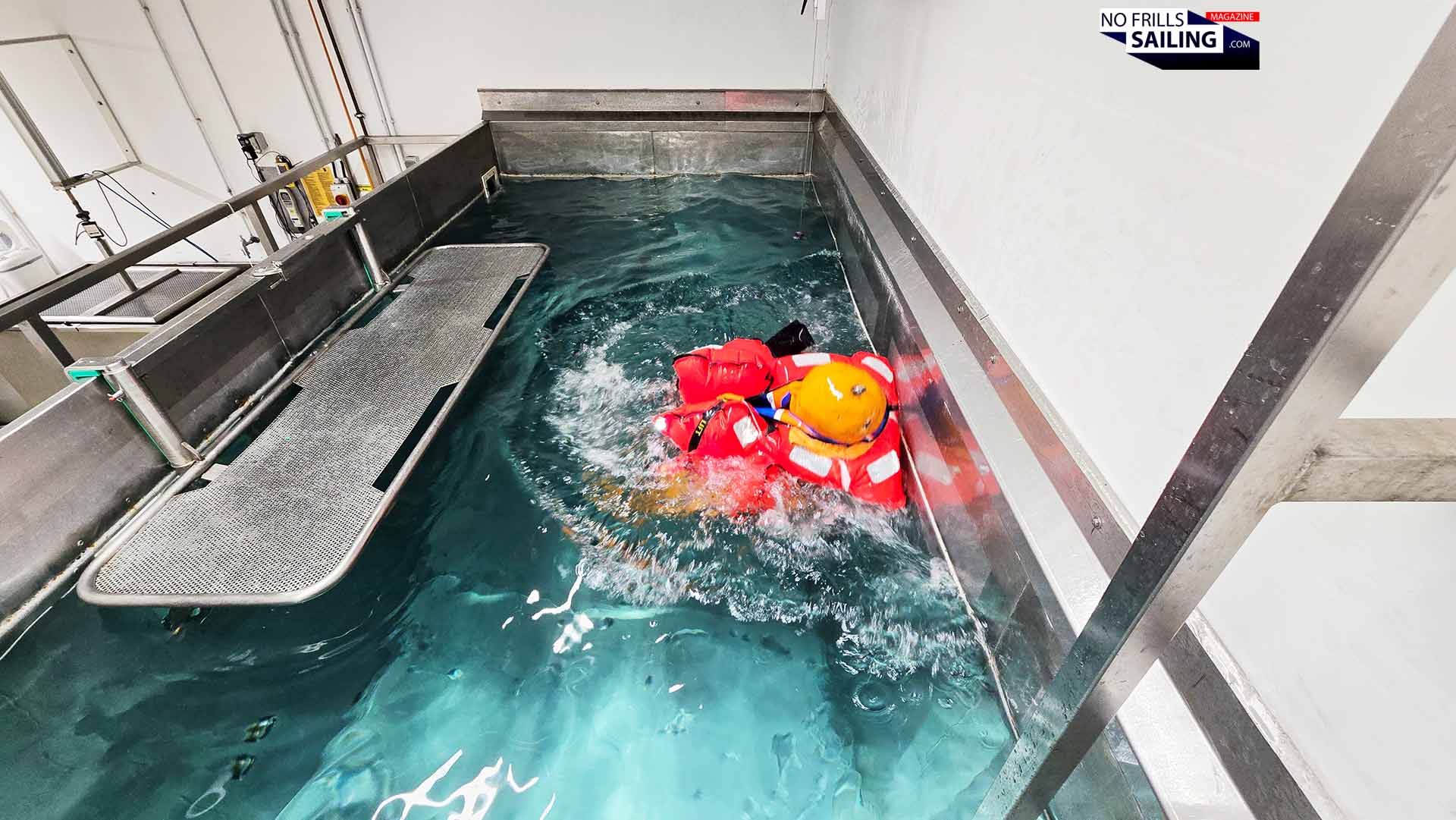
Modern lifejackets – or their floating devices, to be precise – must therefore be constructed in a way that they first of all keep the head up and slightly tilted back. They must also prevent the head from falling over – hence closing the front gap. Olivier takes me to the big test pool where dummy Scotty is already suited up with a lifejacket – and he just kicks him into the water. As I have done many times myself and also showed in real life to my kids, Scotty sank and just after a few seconds the trigger released the CO2 into the fiery red floating device.
The worst that can happen: MOB + unconsciousness
Like a Champaign cork Scotty shot back to the surface. As the foaming water settled down and the dummy floated around in the basin, Olivier became a bit more serious: “The worst that can happen in a case of MOB is that the person becomes unconscious.” This can happen because he had been hit by the boom in a Chinese Gybe (the tragic classic) or he hit the boat´s side when falling out. Also, in cold water hypothermia can set in after literal minutes, resulting in your body shutting down. Blackout. Even in warm waters in high season summer, fatigue or shock can result in unconsciousness.
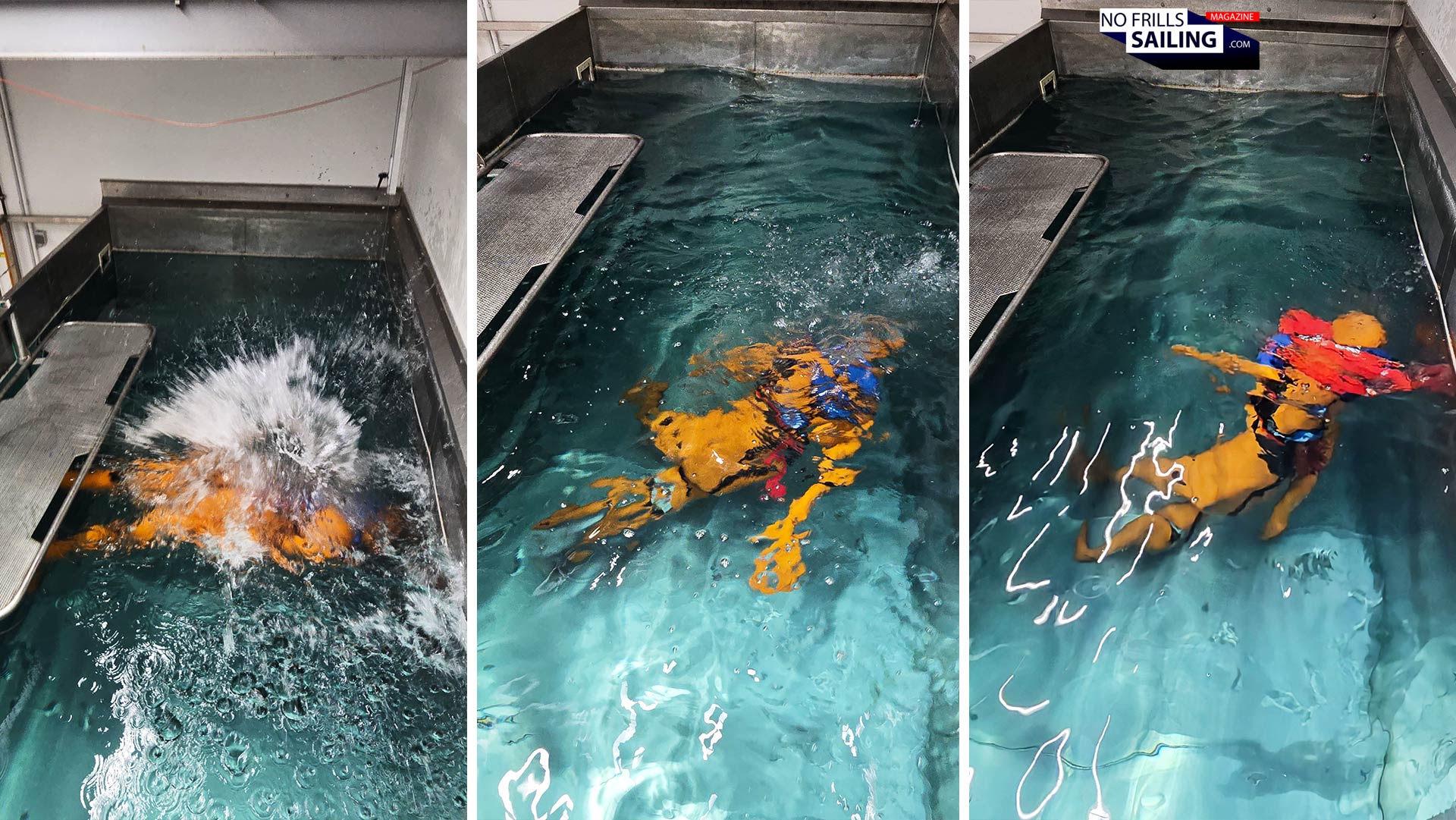
“This is why our floating devices are constructed in such a way that most of the Newton, if you will, are placed in front of the head.” Olivier reaches out to floating Scotty and turns him so that I can see the inflated red device. Indeed – most of the “balloon” is in front of him. “This construction also makes sure that a person is always turned up – and help up this way – by the device, even if you fall head-first into the water.” This is what happened to my first born son almost 10 years ago when he had his inaugural MOB: He was floating, but he didn´t turn!
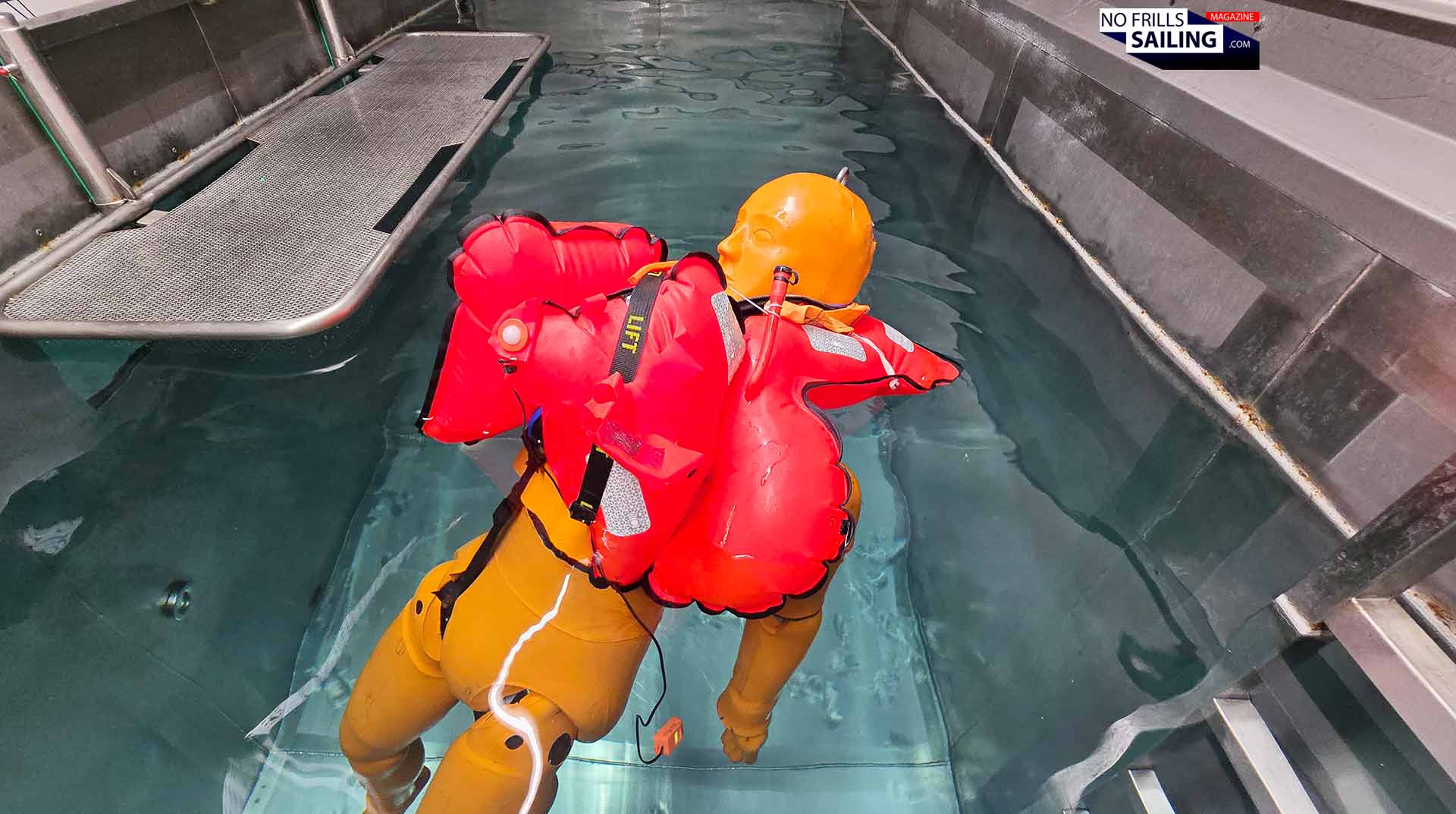
“Imagine you go overboard in the Atlantic Ocean, in a storm setting. Waves of three, four meters, breaking. A violent swirl of aggressive water. You absolutely need to stay upright! You must not be overturned and capsized by the waves!” And this is finally the solution to my Newton-paradox: Although it only needs 50 N to get a head above water, it needs much more to keep it stable, upright and slightly tilted backwards. This is the reason why Secumar suggests to wear at least 150 Newton lifejackets when sailing. “When going offshore or sailing in “serious” waters, indeed more is better!” But not because you weigh too much …
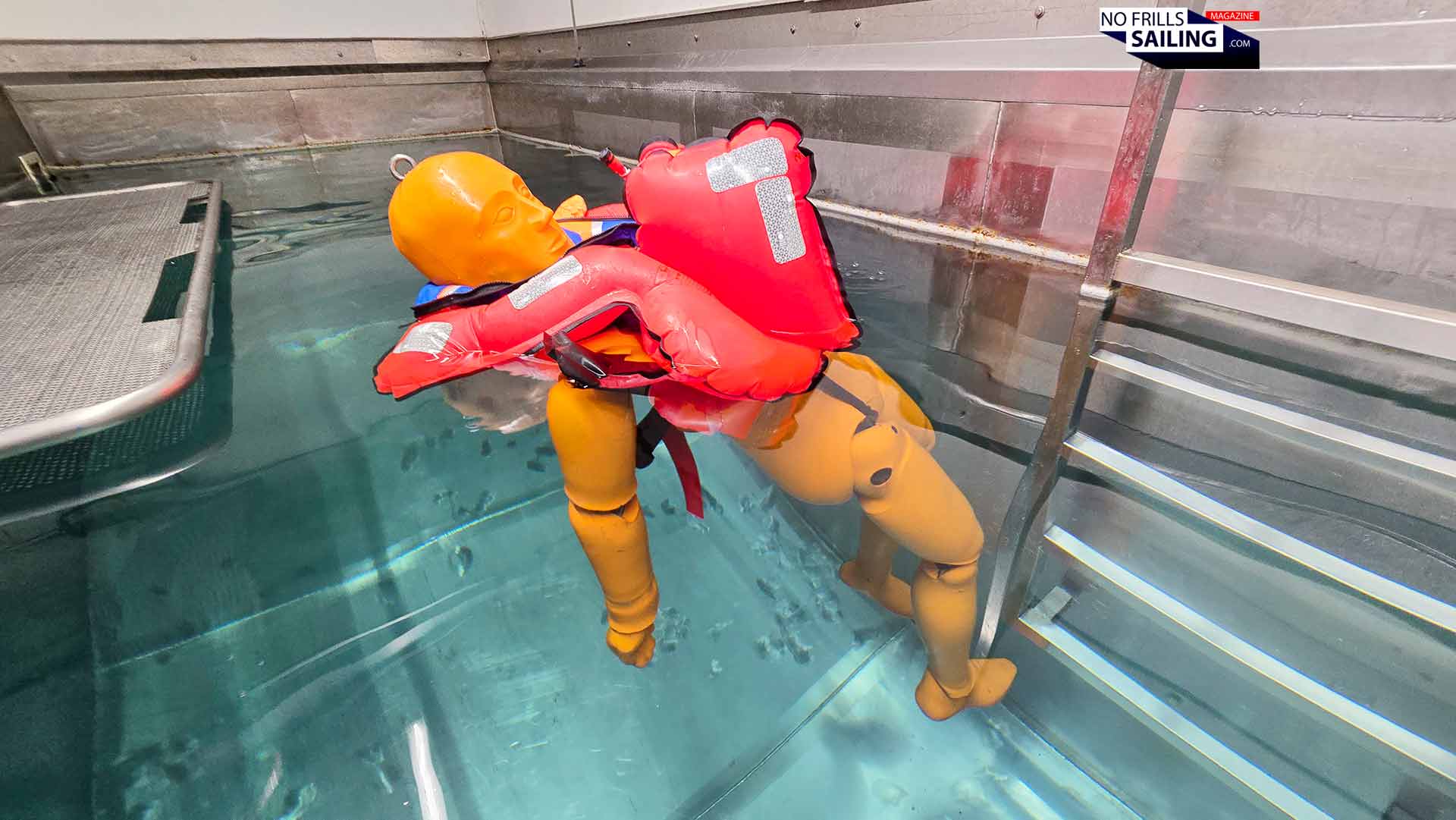
Secumar´s testing laboratory is a childhood´s dream come true for anyone fancying engineering! It has side windows so that I can look at Scotty´s underwater position as well. Olivier explains that a good lifejacket always creates a stable 45-degree position of the body underwater. And indeed, Scotty, weighing exactly as much as an ordinary adult person and his joints working exactly the way real joints do in our bodies, is tilted 45 degrees. Even if he would pass out, even in high waves – with this lifejacket his chance of survival is increased manifold.
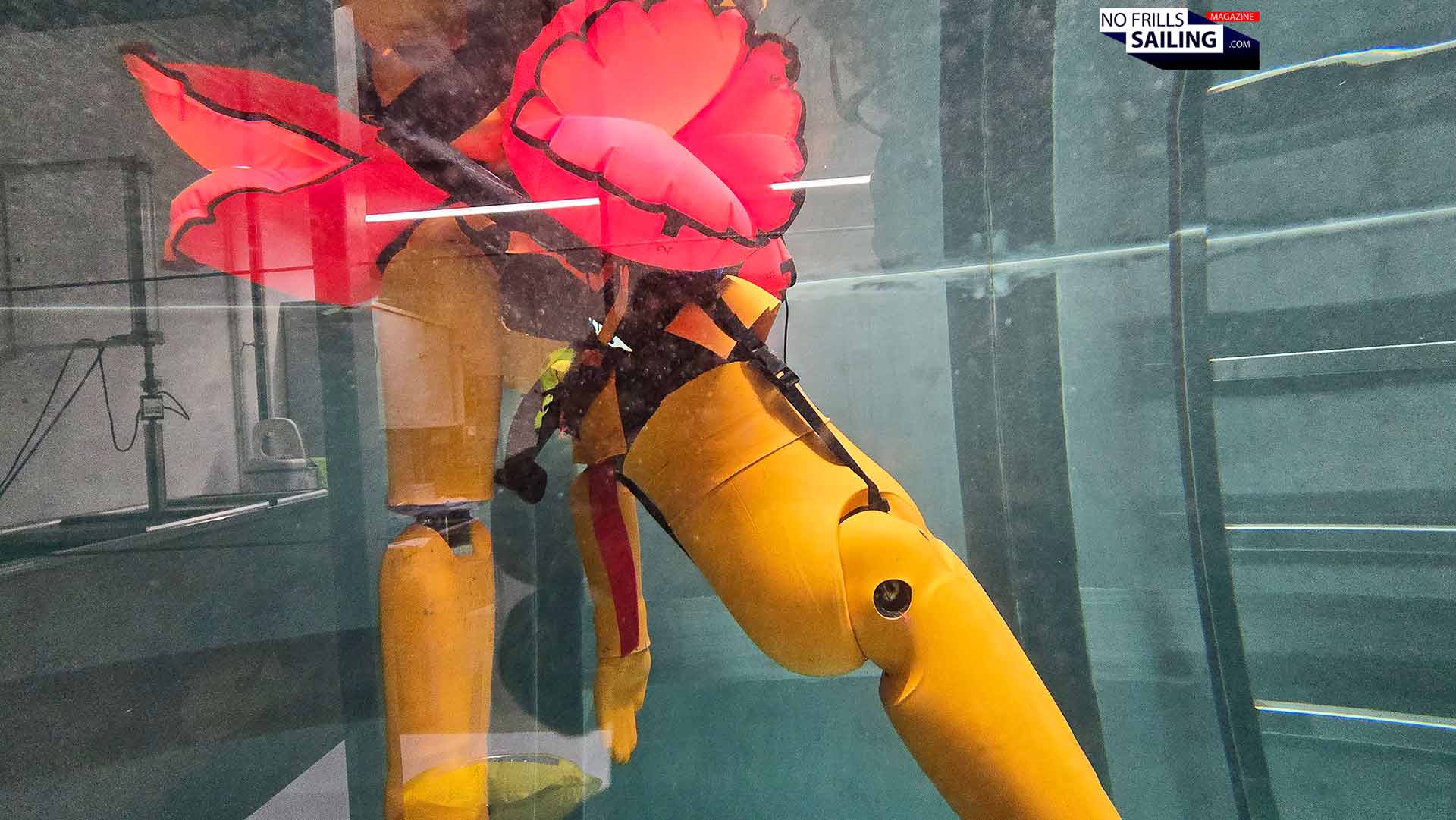
“But of course, this magic can only happen, when a lifejacket is fastened and secured properly”, Olivier adds. He points to the crotch-strap that secures and keeps the lifejacket near to the body. “Many sailors do not fasten this little belt, I don´t know for which reason. If not secured or pulled tight, it reduces significantly the efficiency of the lifejacket up to a point where it can fail completely!” Scotty can be happy, as he wears it tightly secured …
„Keep your head up!” – as high as you can!
It doesn´t stop here. A lifejacket has many more features, most of them regulated and certified. Such as the number, position and covered area of reflective pads, the color and aggressiveness of the floating devices, the signal lamps and even the loudness and tone of the whistle needs to be taken into account. “All of our suppliers need to adhere to strict rules”, he explains: For example, the fabric garment of the jacket´s enclosure must withstand open fire for a certain set of time without harming or hampering the function of the life jackets. And the efforts undertaken to make sure that the triggering device can be read in this dedicated article.
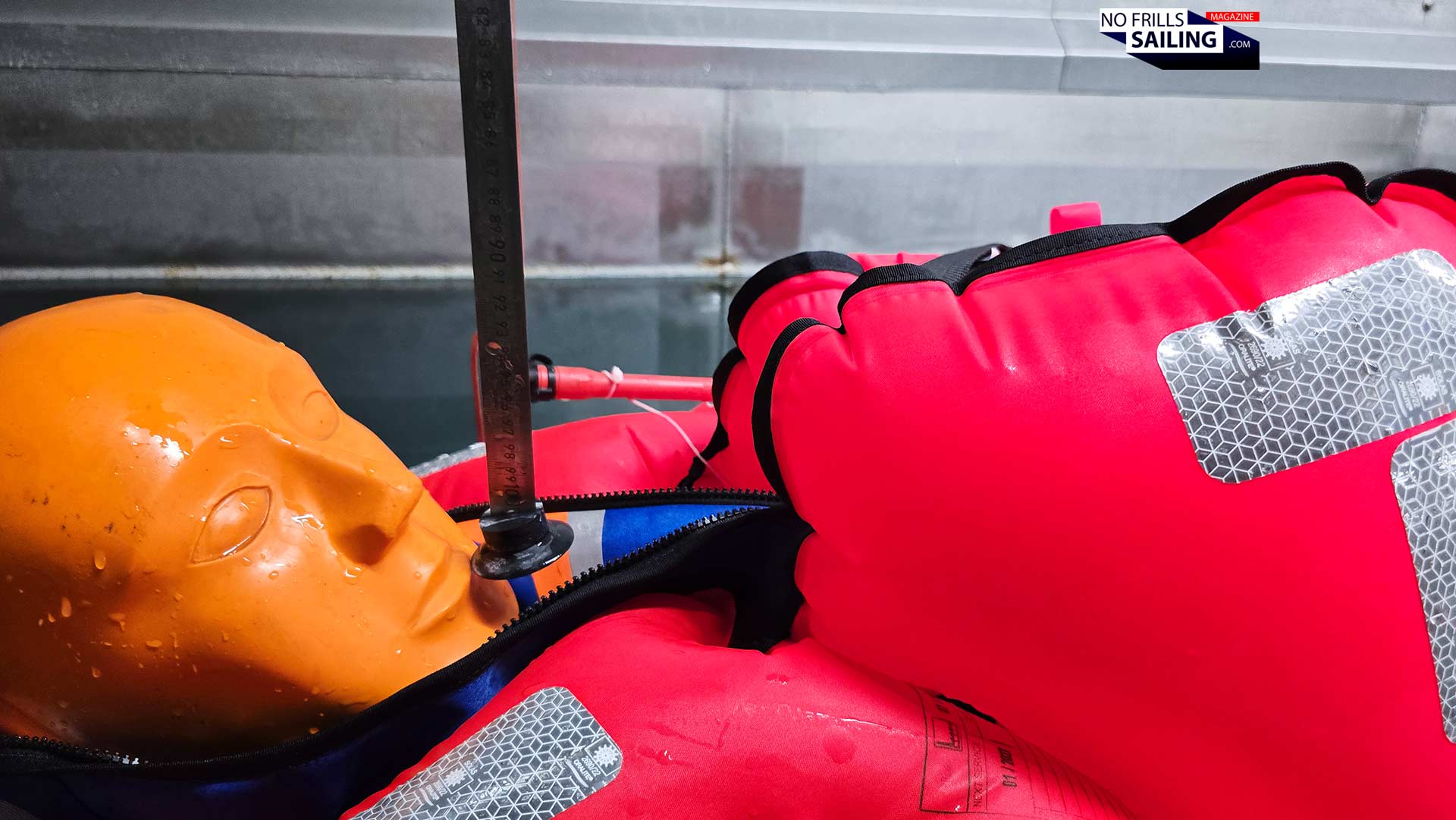
As a keen sailor, you want a low freeboard for your boat, right? This is why so many people find the Omega 42 for example so beautiful, or reject the modern high-volume cruiser-designs for their high freeboards. In terms of lifejackets, “freeboard” is another metric that is very important. Olivier pulls down a gauge until it reaches the bottom lip of Scotty: “This is how we measure and test the freeboard of our lifejackets.”, he says.
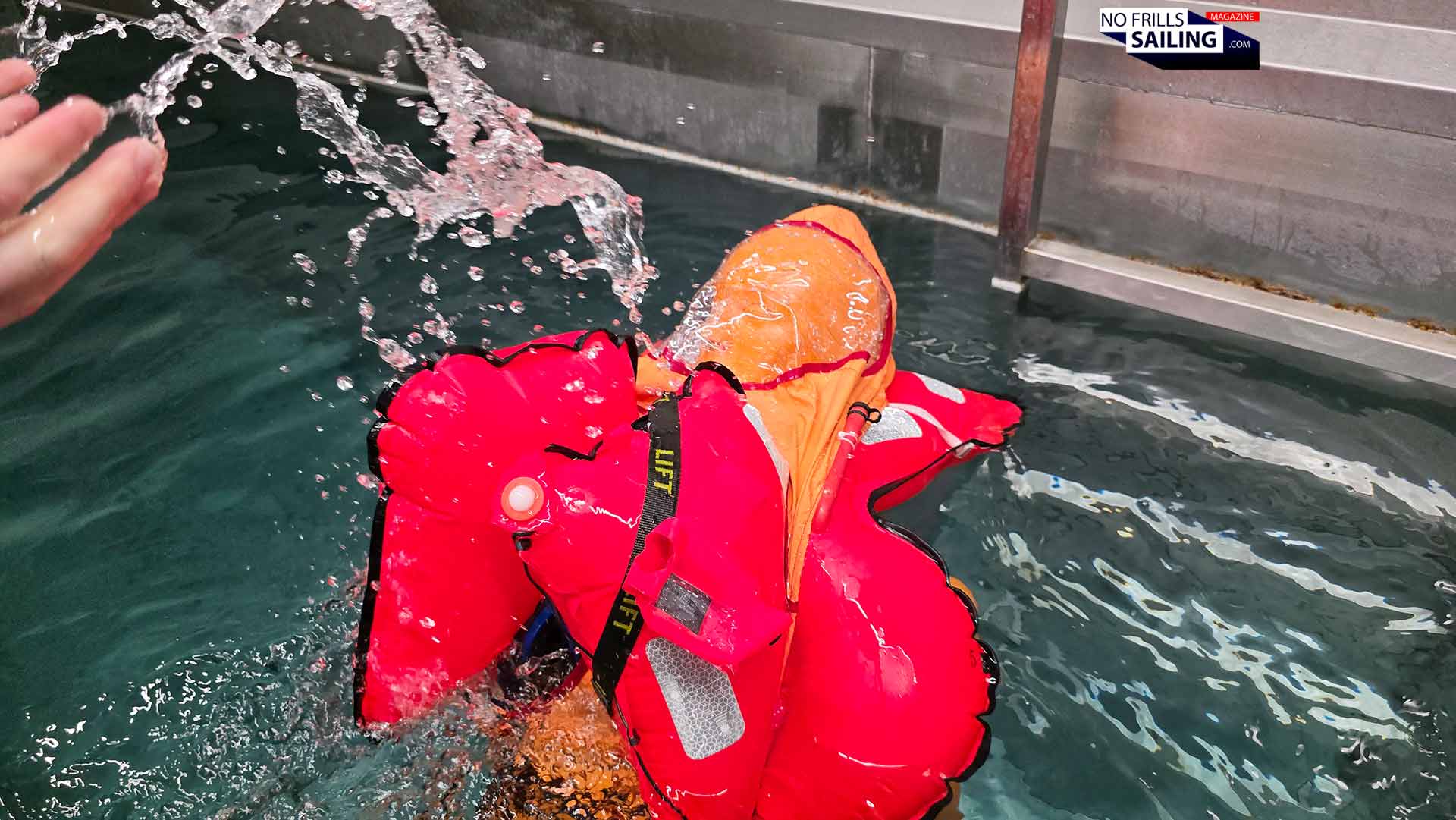
Of course, a higher freeboard is appreciated as it determines how high up above waterline a MOB-victim´s head is. The higher up, the less waves and spray has the chance to get into the mouth. For offshore lifejackets, Olivier also suggests to have one with a spray cap. It takes him a few seconds to unpack it, just like a hoodie but from the front, and pulling it over the face of Scotty. Olivier simulates wild spray with his hands: No chance for spray.
What about USCG-certified lifejackets?
That´s all very interesting, you might think now, but what about US-rated lifejackets? Secumar does not sell to the United States of America actively: That´s because US Coast Guard-certification is different from EU-standards. Olivier also emphasizes that the legal system in the US is very complex so that Secumar focuses on the European market and areas where EU- and ISO-norms are accepted. “Nevertheless, we of course incorporate US-products into our constant research”, he says. Not because they want to copy anything, but because things change ever so slightly and these may be fruitful as well in Europe.
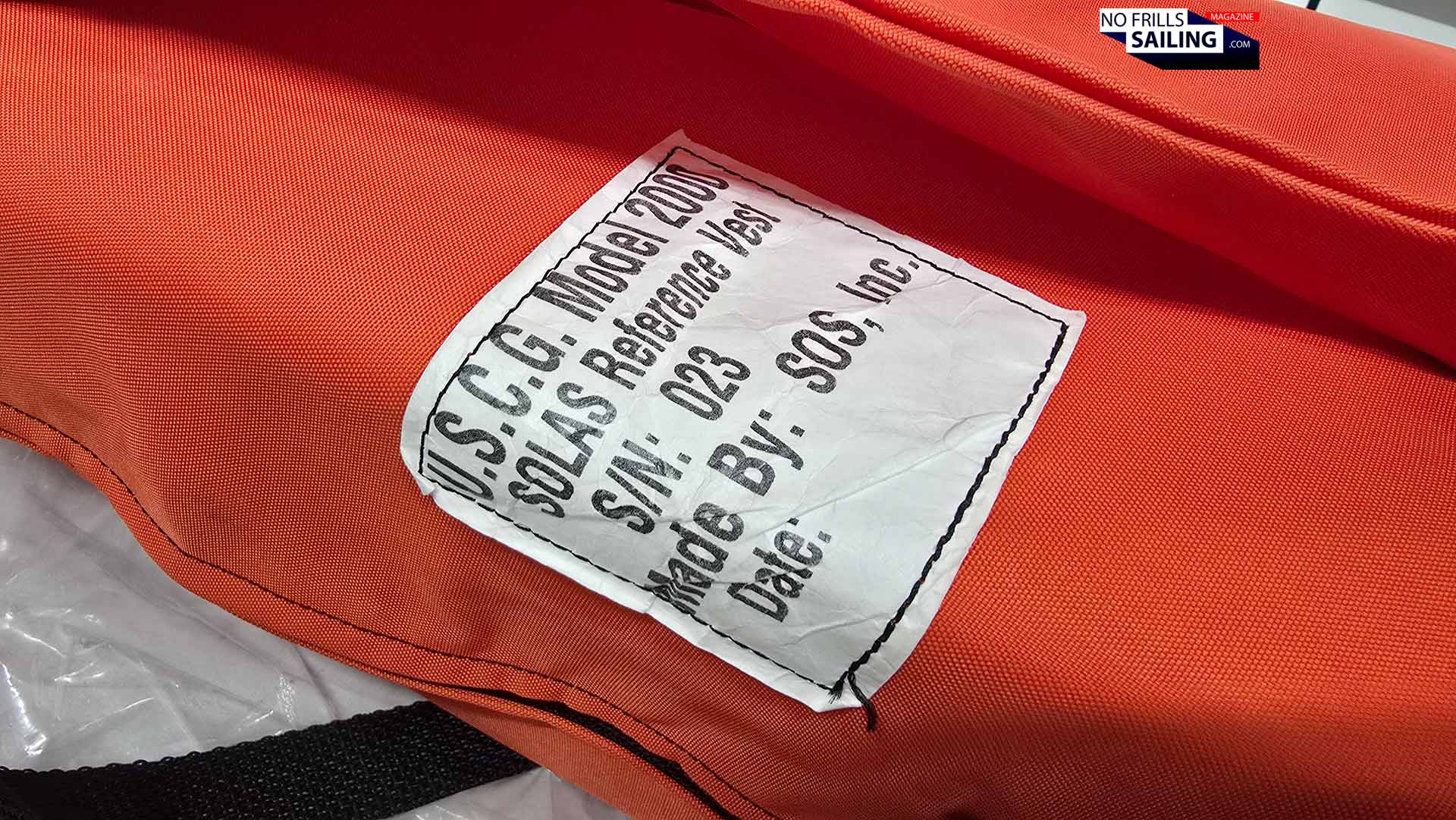
“But in essence for your American readers, the system isn´t all too different from ours”, Olivier states. In the US, lifejackets are called “PFDs”, “personal floatation devices” and must meet USCG-standards in order to be accepted. There are also buoyancy classes, called “levels”, ranging from 50, 70, 100 and 150 to 275 Newton. “No matter what the differences in certification details and processes may be, my suggestion is the same: I consider 150 Newton to be the minimum for coastal and offshore sailing and would rather emphasize to choose 220 or 275 for serious sailing.”
Solid versus automatic/inflating lifejackets
This is how we conclude this absolutely interesting day at Secumar: I´ve learned so many things today and I hope, so did you: What is a Newton? How many Newton does it need to pull up a human head out of the water? Buoyancy classes and the intricate workings of modern lifejackets. So, back to where we started this article: How can you choose wisely when purchasing your next life jacket? Because there´s still the “solid vs. automatic”-discussion. Maybe the last myth …
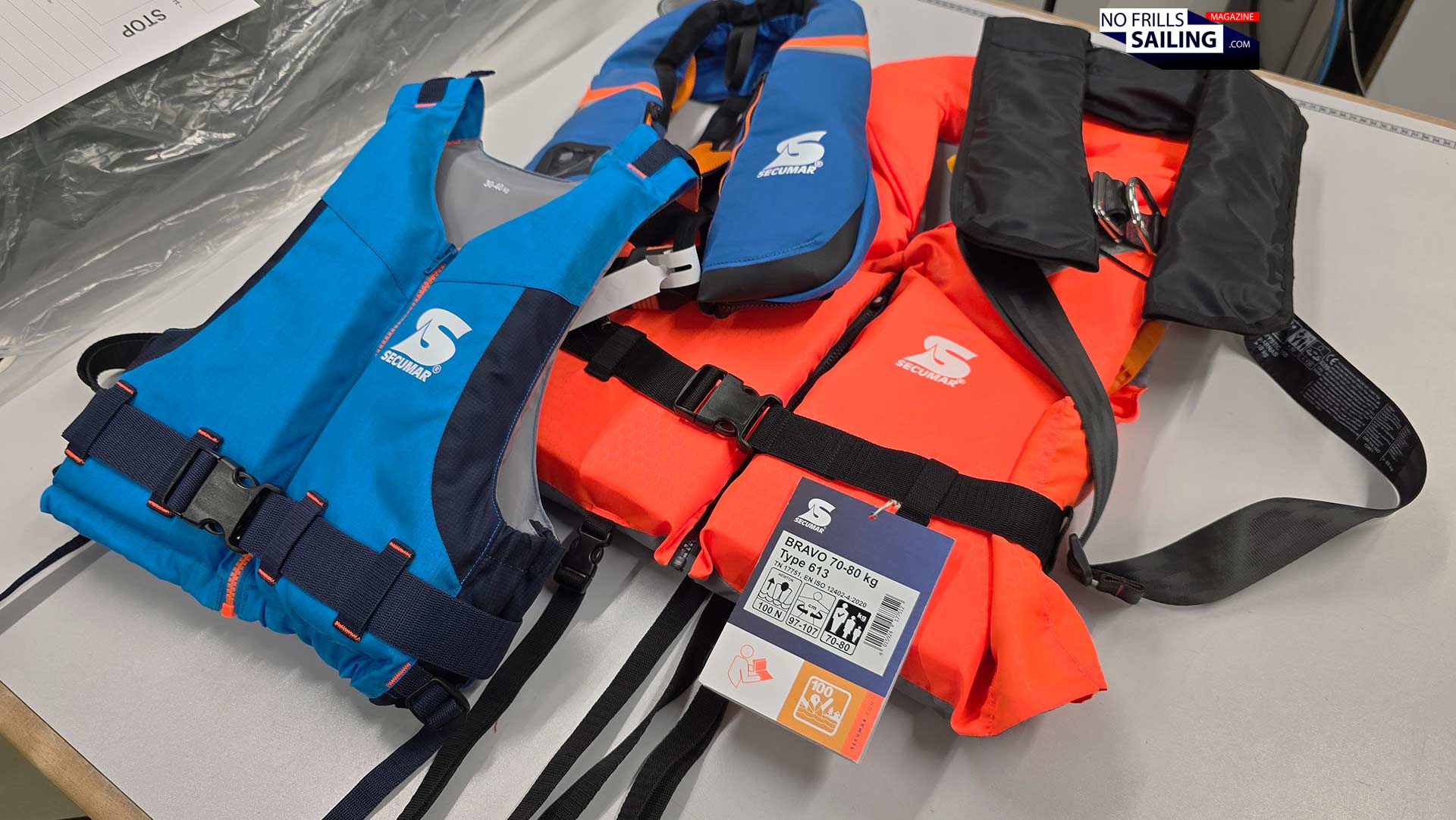
“Solid life-vests, or floating aides as we call them, should not be used when sailing”, Olivier insists. “These are more for a kayaking, rowing sports or surfers. On a sailing yacht only automatic lifejackets should be part of the equipment.” And this especially applies to sailing children as well, he adds. Solid life-vests are also meticulously tested and as well constructed to provide maximum “floating power” (by making the front foam thicker – hence more buoyant – than the back) but this is really nothing for sailing, even not in coastal waters.
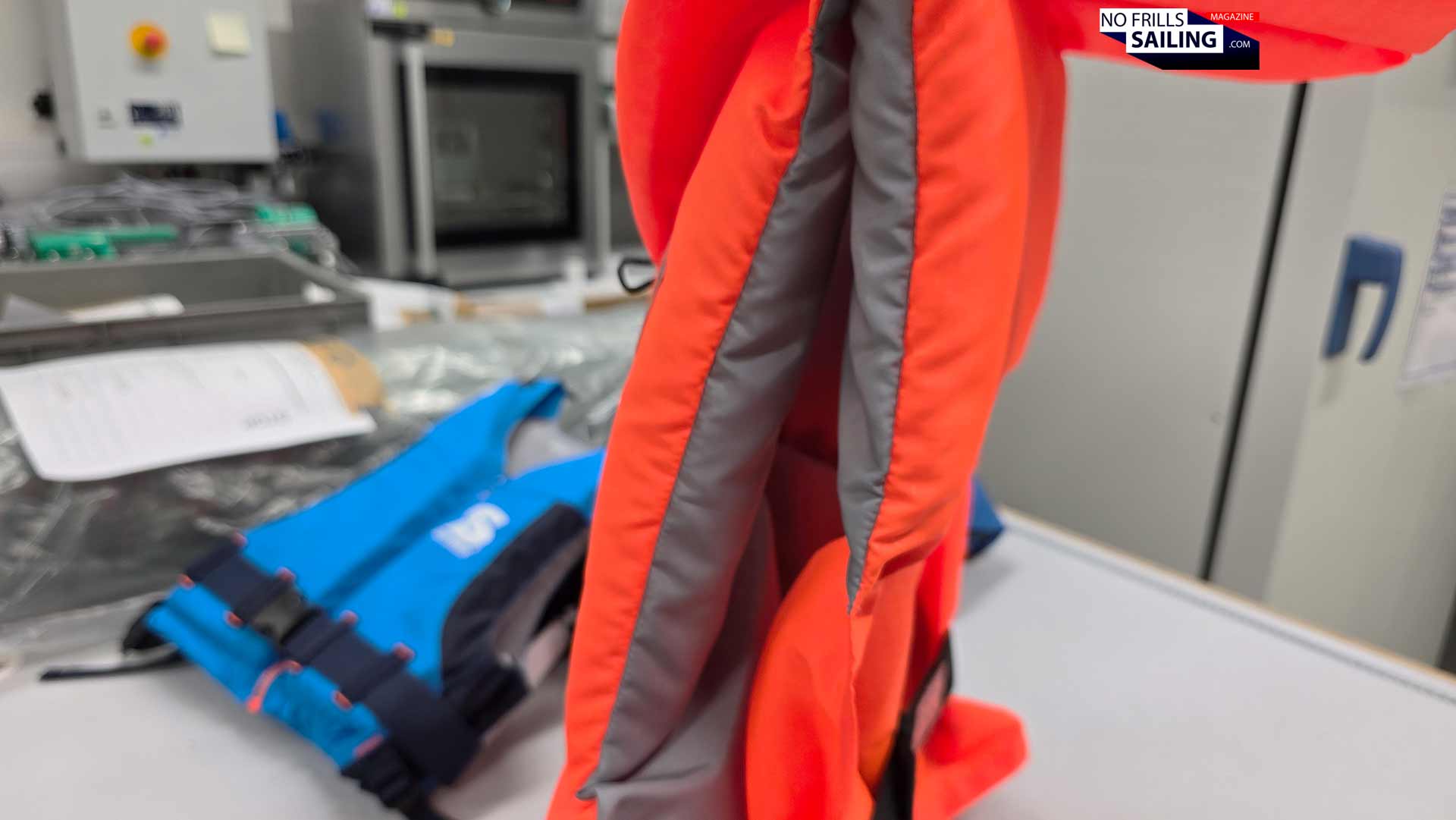
“Remember: What you need is not just the uplift to float. What you need is blackout-safe construction and the highest possible freeboard.” Maybe one or two solid live-vests for a quick dash ashore when at anchor or for your kids when they roam about in the marina, but active sailing, even if it is coastal cruising demands for automatic lifejackets, no doubt about this.
My conclusion: I know now how many Newton I need
Thanking Olivier for this great day at Secumar headquarter, I leave the premises with a lot of new knowledge. It´s not my weight that is crucially determining how “big” my lifejacket should be, but what I do and where I do it. As for me personally, my purchasing decision in terms of PFDs for my new yacht is fixed: I will go for two 220 N “Survival” lifejackets by Secumar for me and my partner and another set of 150 N lifejackets for occasional guests. Also, I will have to check my kids who are now in their boosted growth phases for new and fitting automatic lifejackets as well. As I said, a good occasion to maybe get a nice bargain on those is the upcoming boat show in Duesseldorf – I am sure that the season will provide for similar events in your vicinity as well.
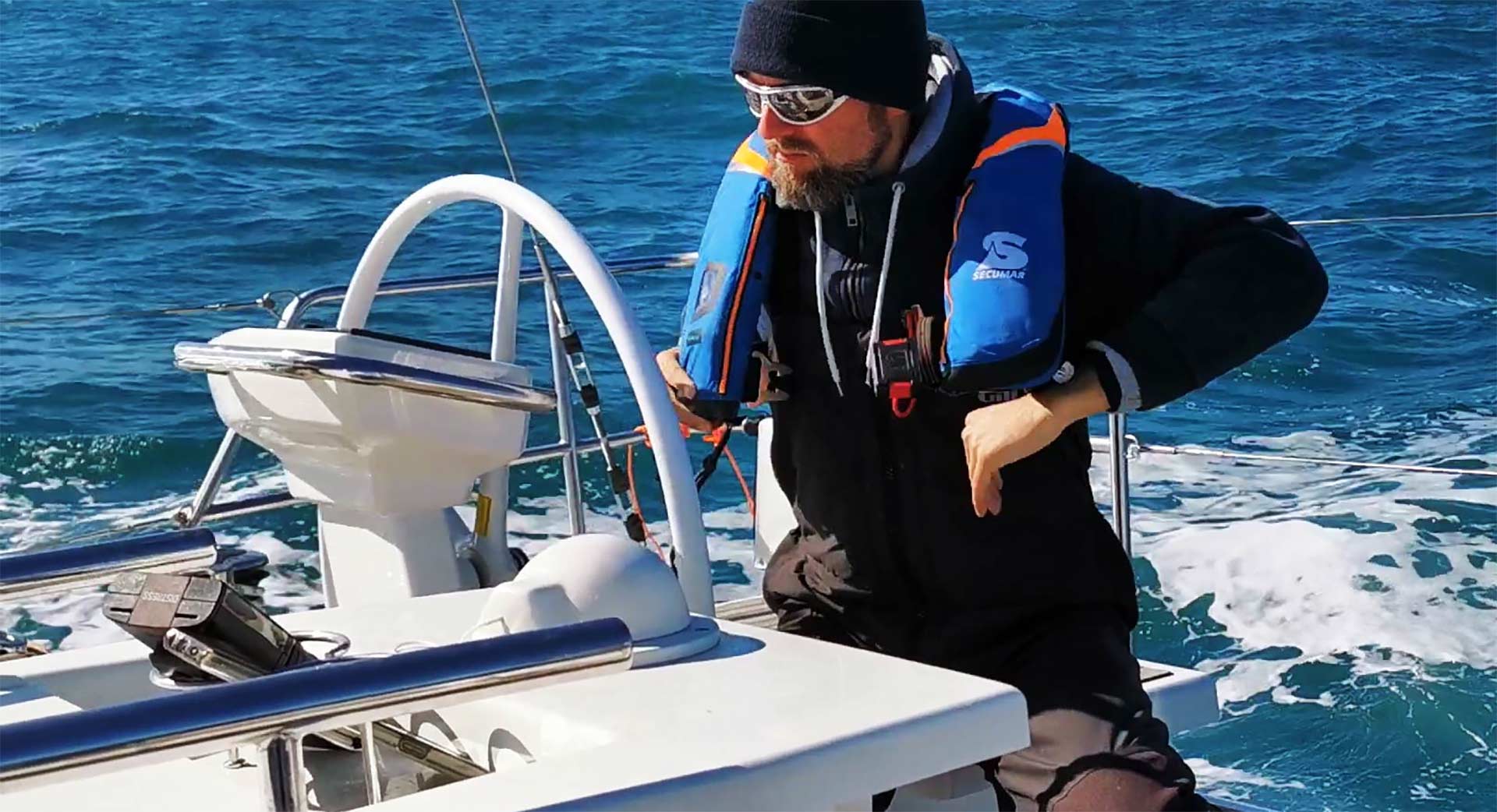
Which brings us to the last suggestion. This may sound implicit and as a matter of fact, but it sadly isn´t: Do not save on the safety of your crew, your kids, your guests and yourself! I know that high-class products like Secumar are very expensive – my “Survival 220” comes with a price tag attached asking for 300 Euros. There are many cheap brands out there. Knowing about the history, the elaborate science, the meticulous testing, the almost 100% self-manufactured production and the constant strive for improvement, I am sure why this money is well invested.
More articles on this interesting topic:
Browse all Secumar-related articles here
Life jacket drills with sailing kids
First aid after rescuing a drowned kid: How to handle this situation properly