If you follow me on my private social media accounts you may have seen that I treated myself and my fiancé lately with a little three-day city trip to the capital of Great Britain. Having been there just for changing flights, we found it was time to pay this wonderful city some more respect: Being a big NYC-fan myself, London to me has indeed some serious Brooklyn vibes as well as a glimpse of millionaire´s row. Anyway, apart from tasty treats and lots of sightseeing locations, London is a fantastic place to dive deep into Britain´s rich maritime history. One of which is CUTTY SARK, on display in Greenwich.
Walking towards the museum
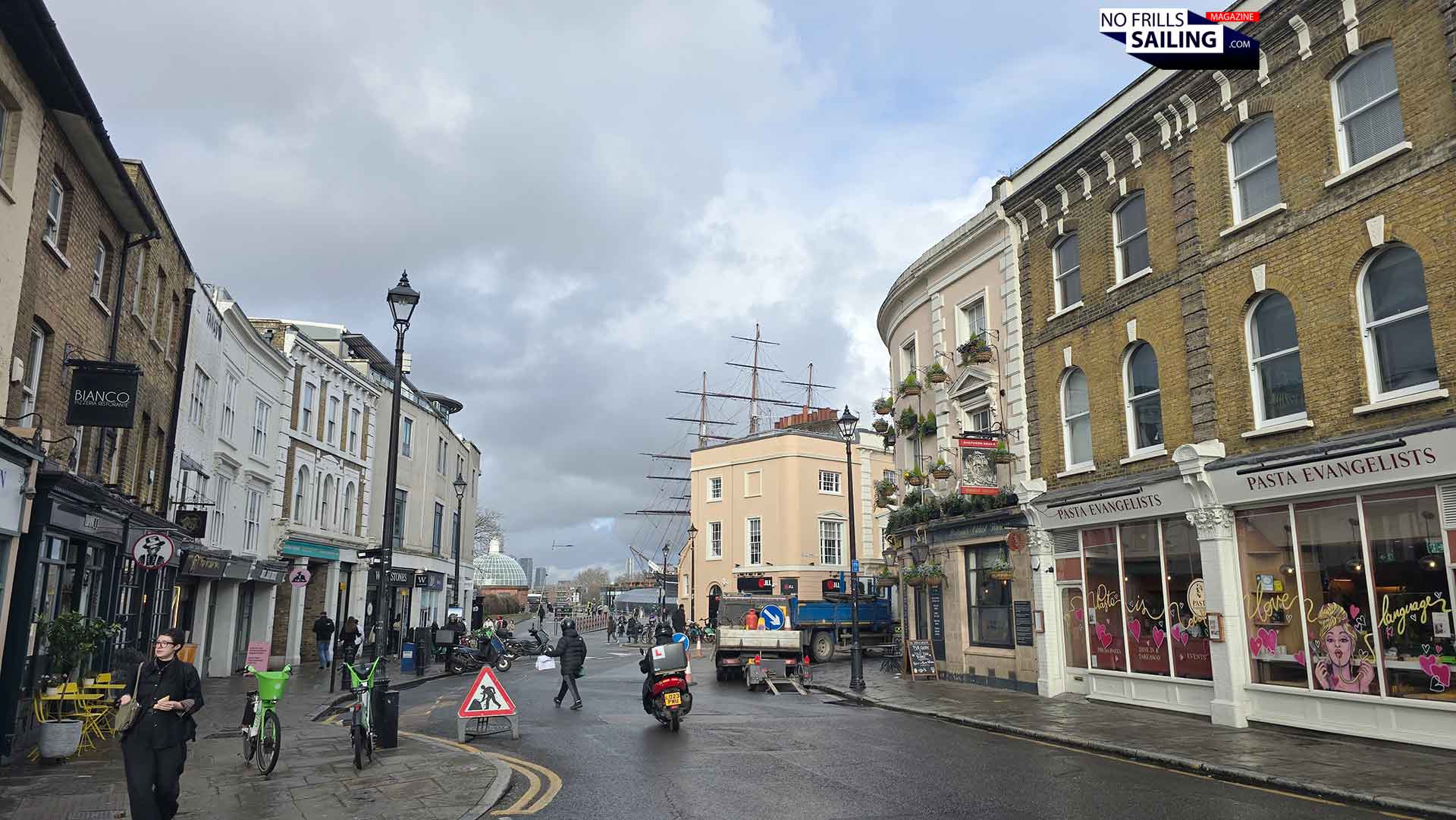
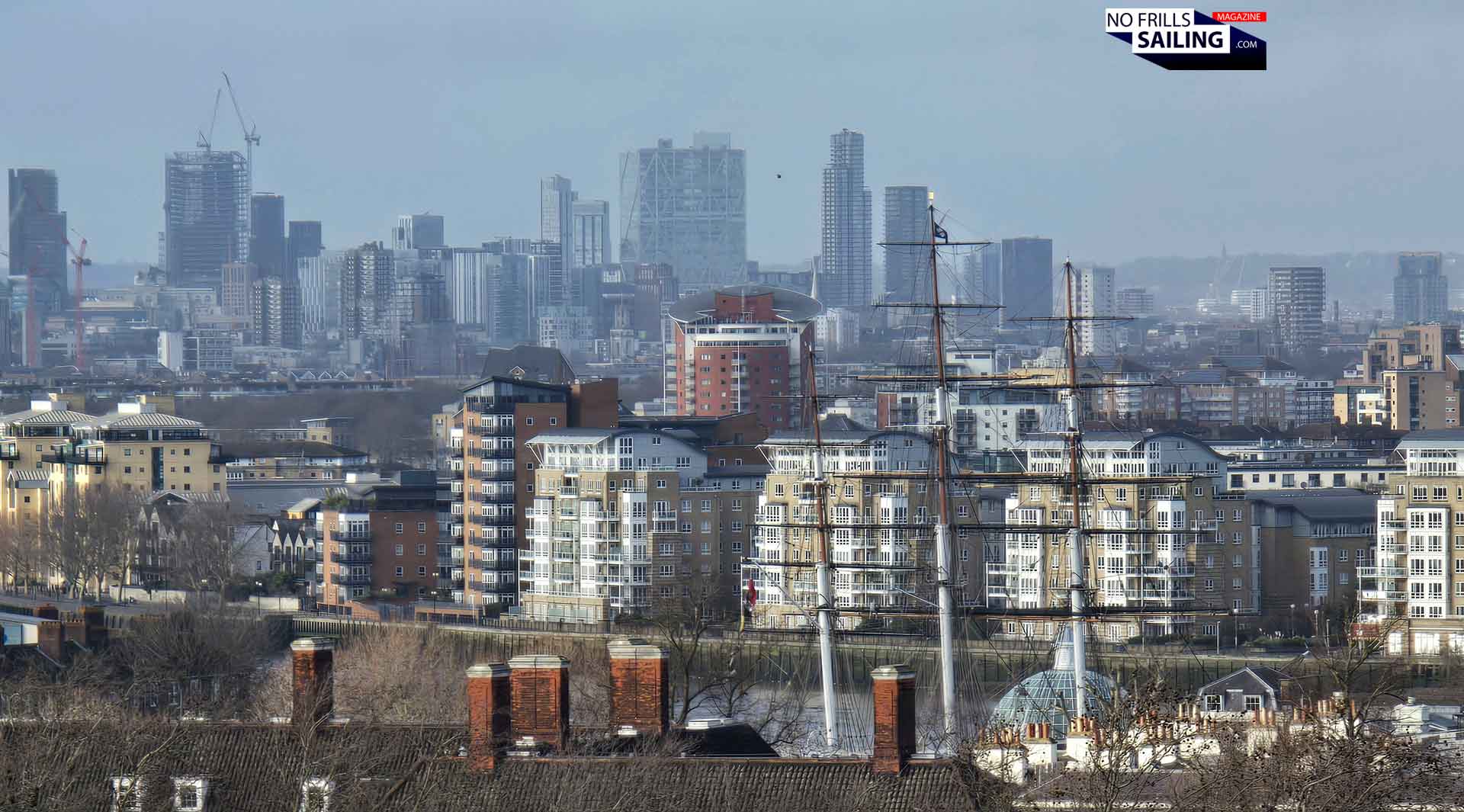
We took the tube to Canary Wharf and jumped on another local train to Greenwich. Walking from the station towards the CUTTY SARK site, you can clearly see her masts towering high above the houses. It´s not even hard to erase the nicely bituminized roads and modern cars, supplementing those in your imagination by carriages tumbling over muddy cobblestones. It´s the perfect opening nearing oneself this historic ship.
Ahhhh. These lines!
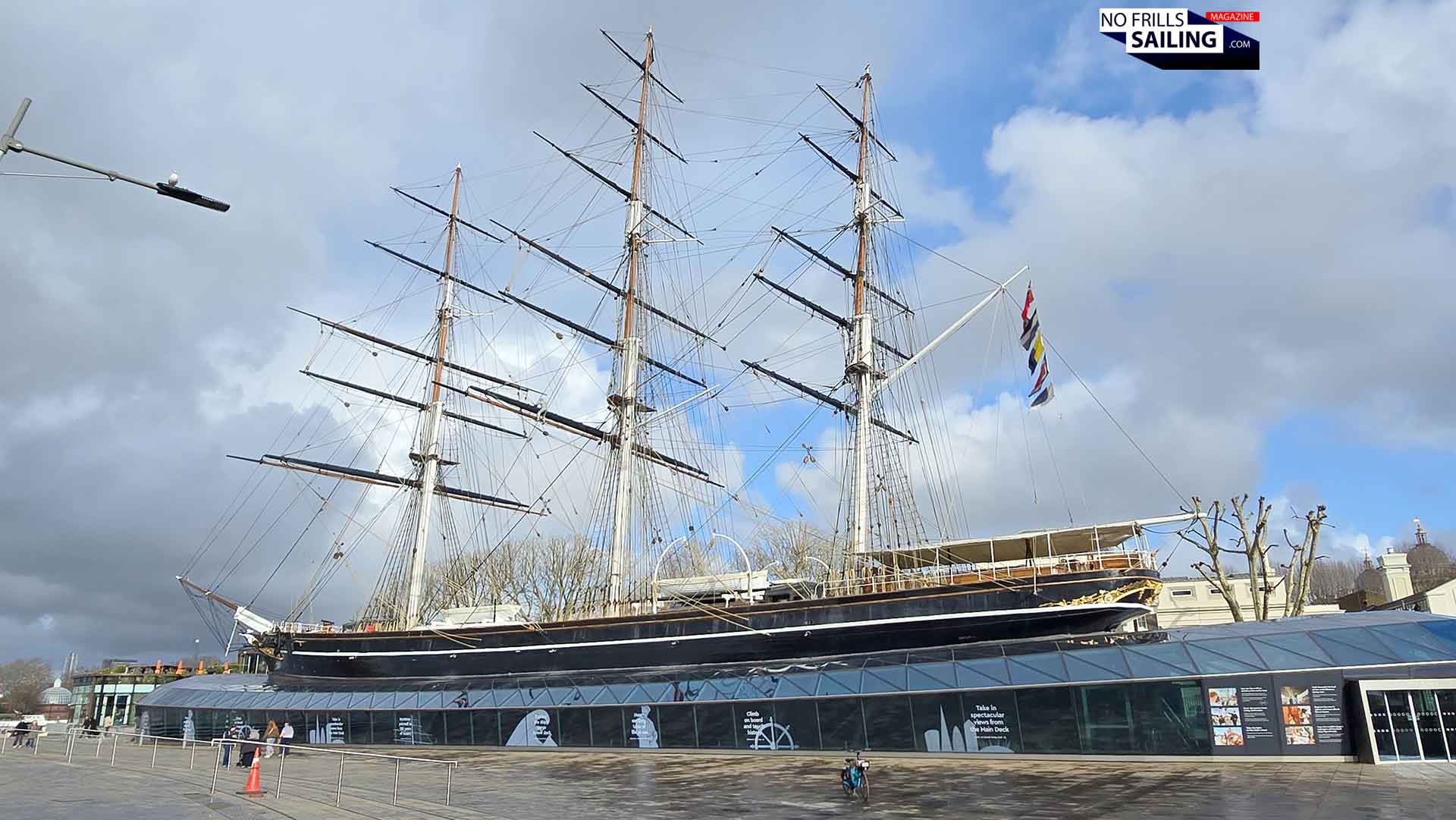
After walking less than a kilometer I reached the shoreline of the Thames, London´s mighty river and artery that keeps this city alive and well fed for over 2000 years now. Here she is, finally I can see her full beaty with my eyes: The last of the great tea clippers, the legendary ship that never dies, CUTTY SARK! This article shall give a little tour through this amazing tall ship, show you her inside, her secret why she was among the fastest ships of her time and how her crew lived roaming the seven seas. Finally: Is the CUTTY SARK museum worth its (hefty) entrance fee? Let´s get started.
The Formula 1 spectacle at sea – Britain ruled the waves
Advertisement
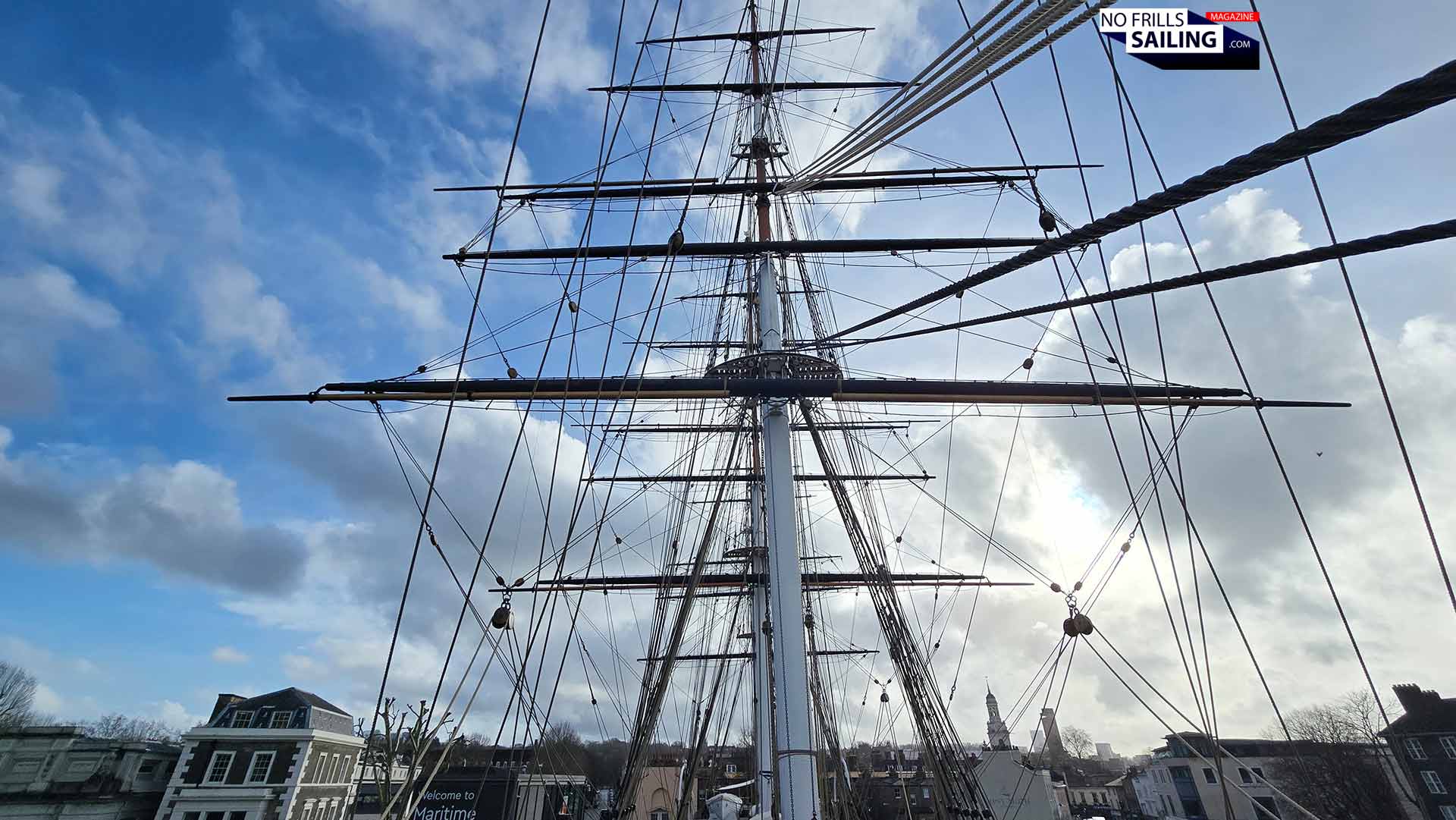
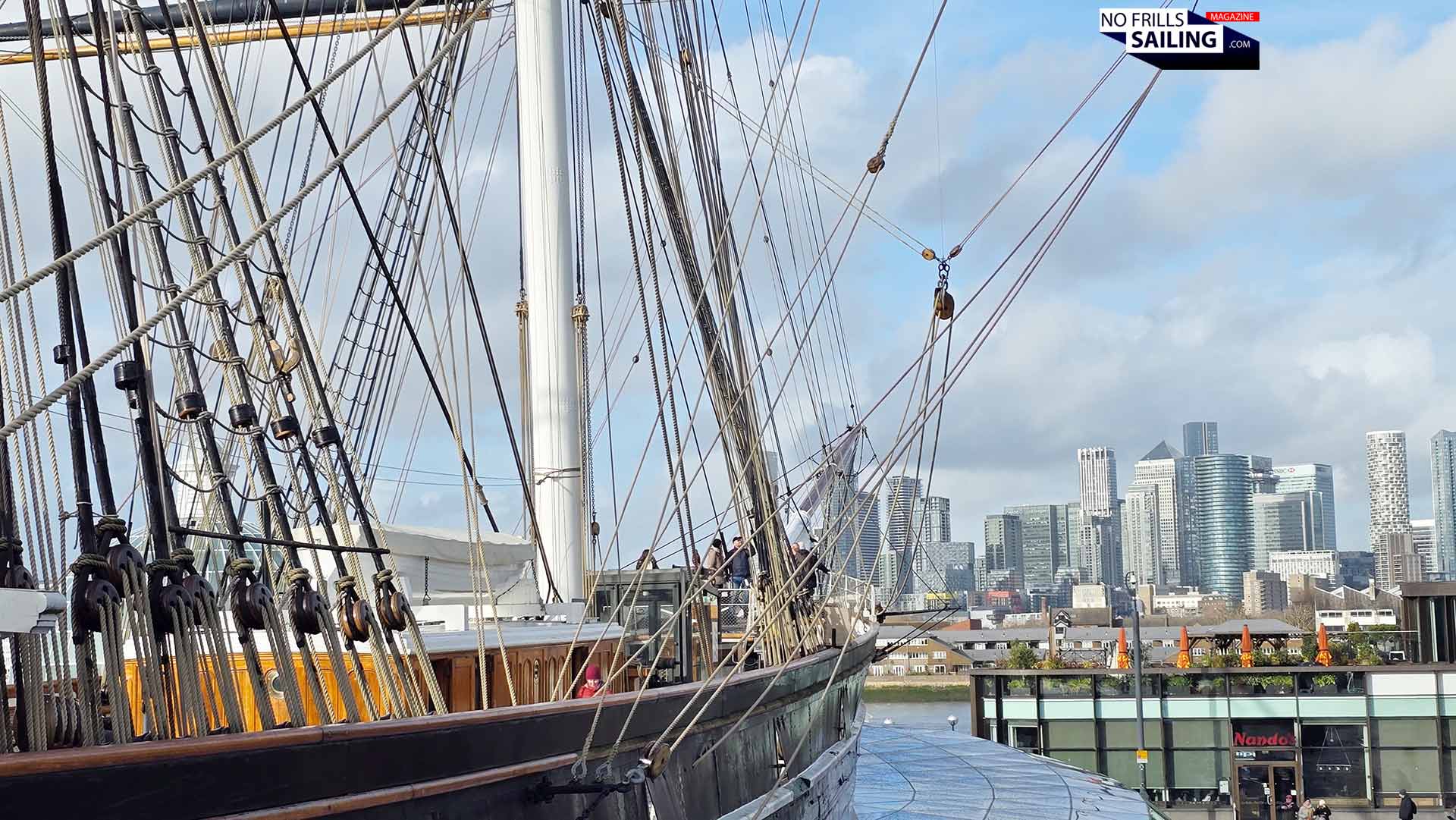
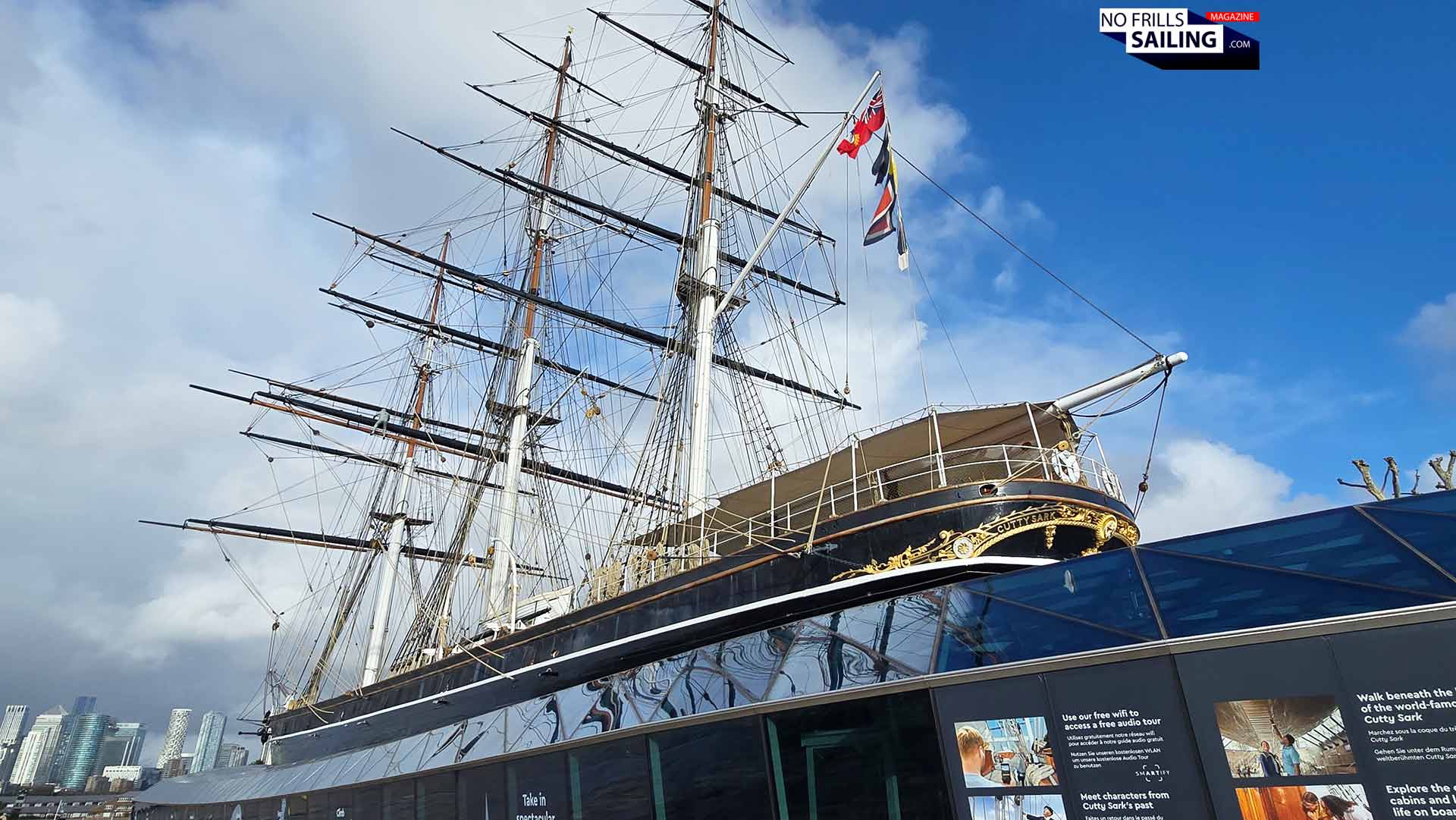
Standing underneath her almost 50 meters high masts, she is a very impressive technical feat! Back in her days – it´s the year 1869 – she was considered the most modern and fastest ship of her time. In fact, CUTTY SARK was not the first but among the last of the great clipper ships to being built. This type of massively over-powered and hilariously risky ships were the product of a very British frenzy: The ever growing longing for tea. Before, the Americans had built the first generations of clippers, serving in the great goldrush.
Towering masts: Like no other!
CUTTY SARK carried a maximum of 3.000 square meters of sail area, which pulled the 2.100 tons with a top speed of around 15 knots. That´s 15 nautical miles per hour, adding up a daily distance of some 350 miles traveled. Even my today´s standards that´s absolutely impressive! I mean, IMOCA racing boats will achieve average speeds of 20 knots during a Vendée Globe, which is “only” 5 knots faster. By the way, the fastest ever recorded top speed of CUTTY SARK had been staggering 17.5 knots.
Could you imagine?
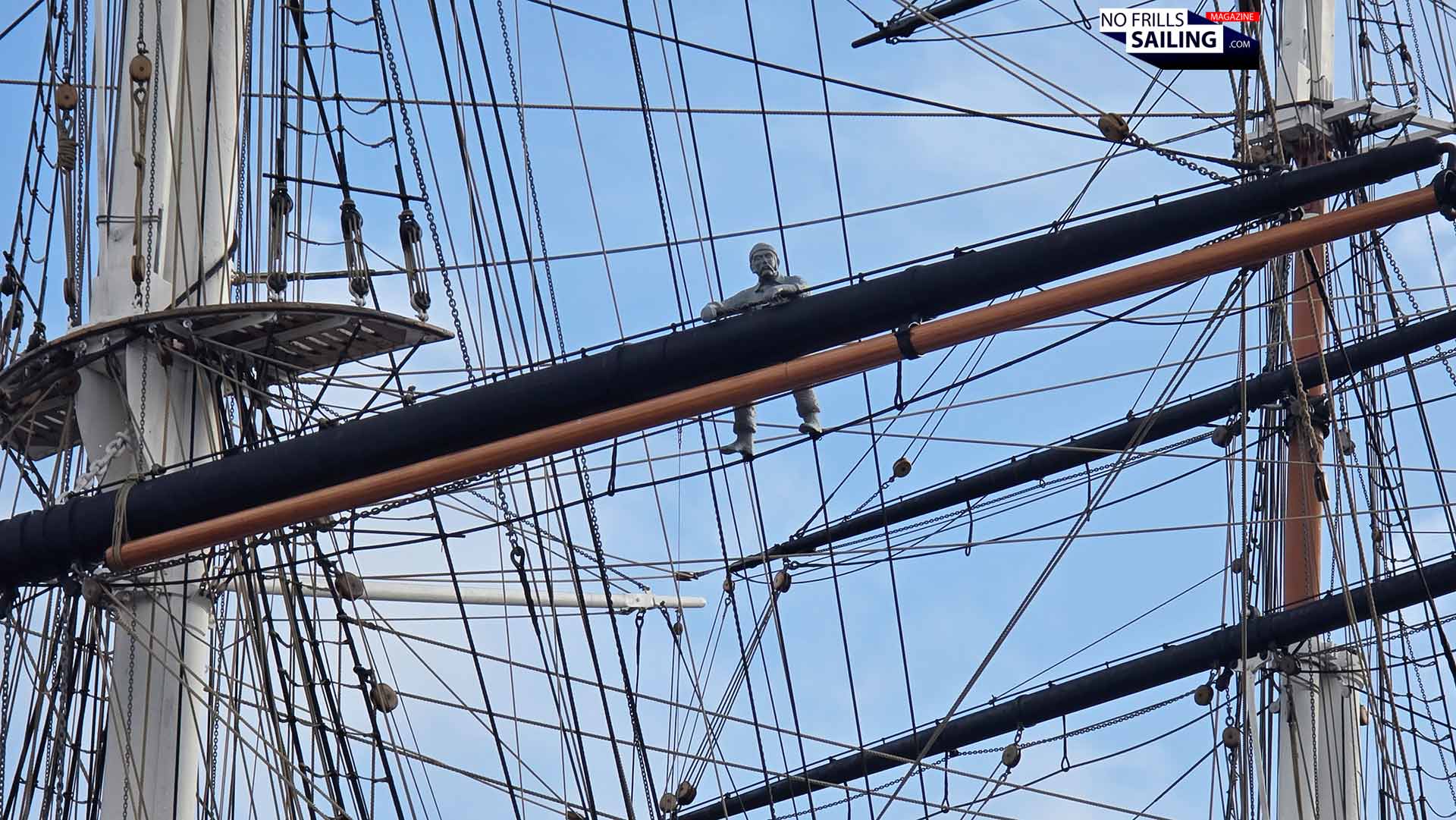
The ship´s three masts could unfold no less than 32 individual sails, controlled by the running rigging which added up to a total combined length of 11 miles. This is much more impressive when you realize that this big, fast behemoth only needed a crew totaling 26 men! With a 4-hour watch system, this meant that only 13 men sailed the whip (unless “all hands” was announced). Can you imagine? This all becomes much more impressive knowing that tea clippers like CUTTY SARK were by no means just commercial freighters – they were the Formula 1- vessels of their time. Racing against each other in a serious, adventurous and very dangerous battle for the “first flush” of the new season´s tea from China. Fortunes could be made (and lost) in these famous tea races. Later more on that. So, in essence, CUTTY SARK was an all-out racer. Overpowered, streamlined, no margin for error – always pushed to her limits, in calms and raging storms alike. This even amplifies the aura of this fascinating ship.
Of witches and horse-tails
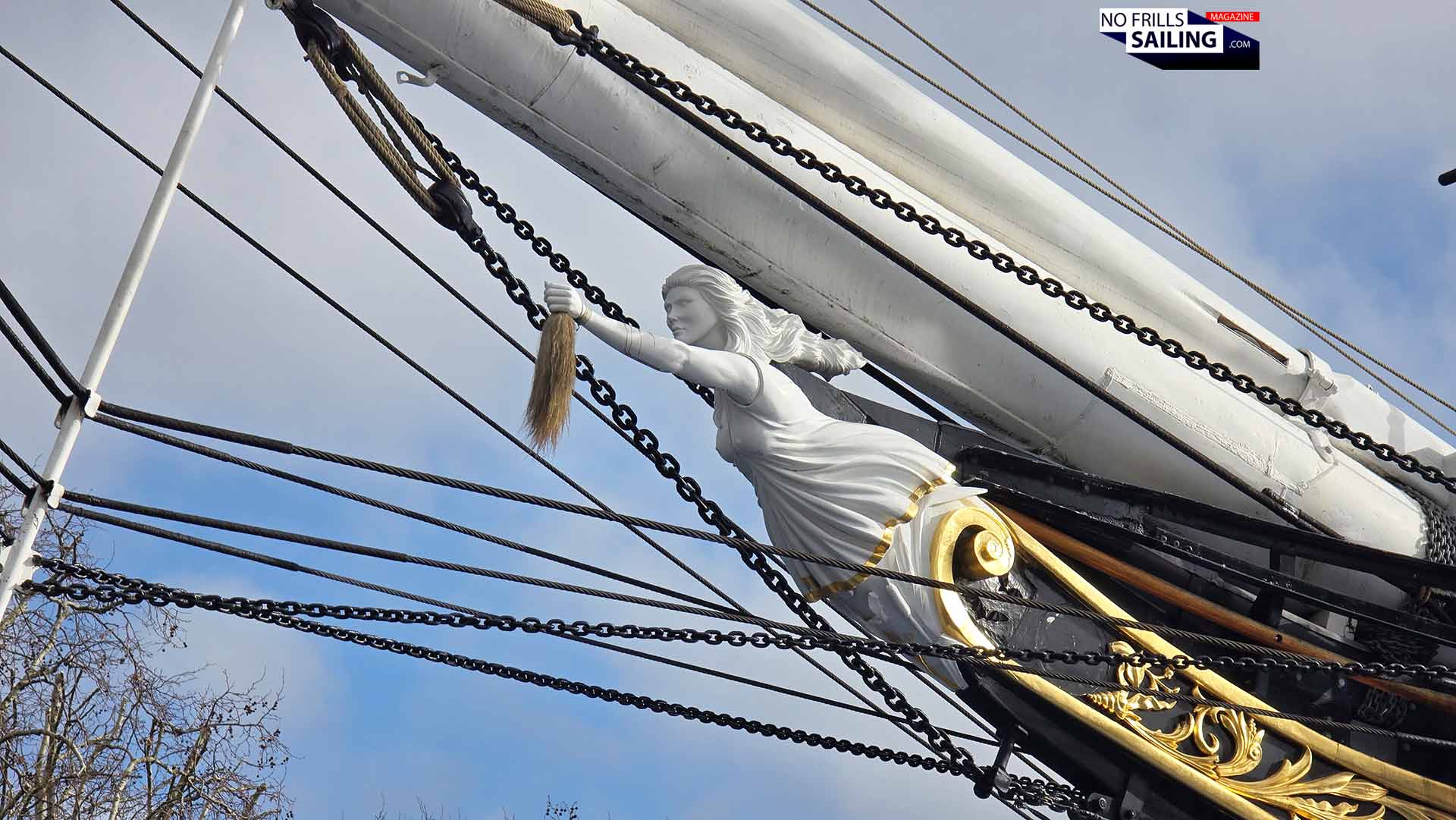
On her bow, as it was tradition for all proud sail ships of that time, a figurehead is mounted. It shows a beautiful witch, Nannie Dee, who is one of the protagonists of a famous poem by Robert Burns, “Tam o´ Shanter”. In this poem a, Tam, a farmer, watches a number of witches dance. The most beautiful of them, Nannie Dee, wears only a very short peace of undergarment. “Cutty” means short. “Sark” is the underwear. Exhilarated he shouts: “Weel done, Cutty Sark!”, as the witches – in shock – try to hunt the unwelcome peeping tom, he narrowly escaped by driving his horse through the river. Witches can´t go through flowing waters …
Nannie and the horse´s tail: Weel done!
… but Nannie Dee almost catches him, putting her tight grip around the tail of Tam´s horse, ripping it out. By this, the name “CUTTY SARK” clearly refers to the at that time famous poem, instilling daring adventure, a bit ruthlessness and most of all, speed, transferring these attributes onto the ship. Now knowing the backstory, one must admire the beauty of CUTTY SARK even more, right?
The CUTTY SARK museum in Greenwich, London
The famous ship has a very long and often not so glamorous history. With the tea races lasting only a few years, most of her time she fought a fight she could never win, tackling an opponent that was much more powerful than the sleekest of tea clippers or the heaviest of storms: The steam engine powered ships which were about to change maritime commercial traffic forever. It was thanks to the love of Captain Wilfred Dowman and his wife who bought the worn down hulk in 1922 and restored her to her old glory in Falmouth, and later a man called Frank Carr, who with the help by the Duke of Edinburgh turned her into the museum we can all visit today.
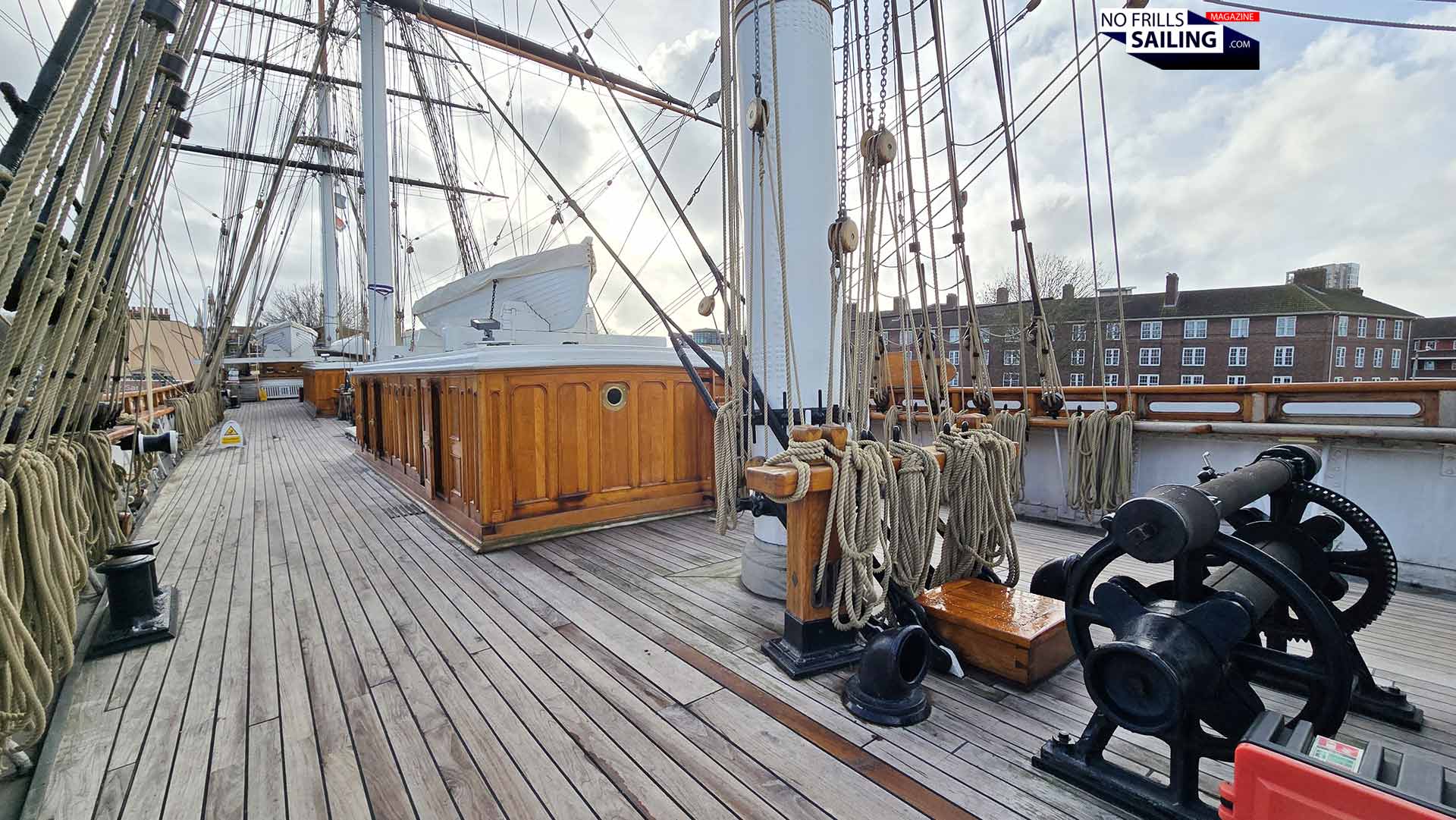
CUTTY SARKs main deck
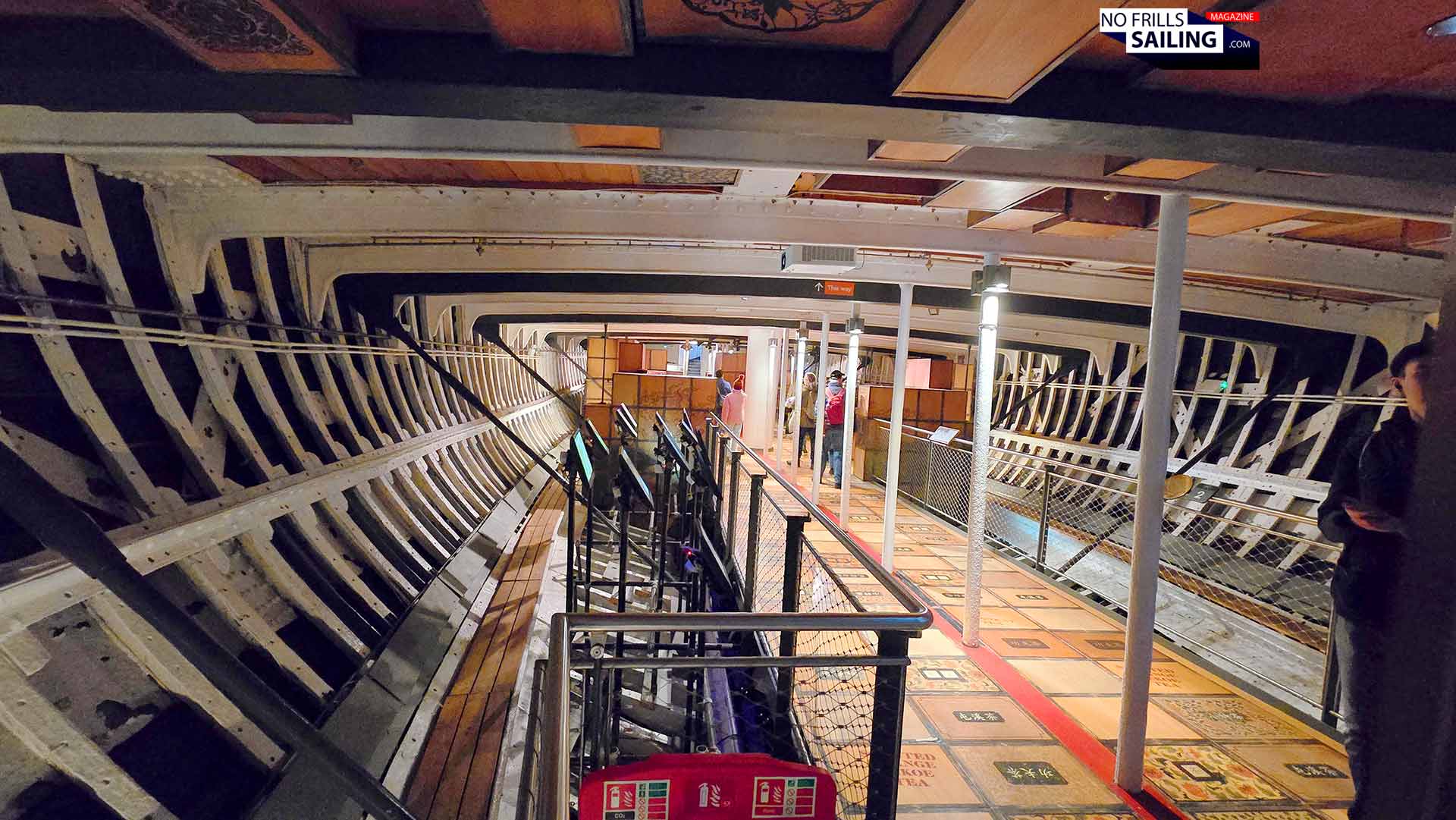
She sits in a former dry dock, around which a modern glass-housing has been installed. The ship´s underwater part is underneath this glass-house, the ship´s deck and her inside are open to the public. Upon entering CUTTY SARK at her stern below waterline, you find yourself in the middle of her tween deck. Fully planked, but essentially empty, it shows the sheer volume of cargo she could take on. In the beginning, of course, up to 10.300 chests, surmounting to some 600.000 kilograms of fresh new tea.
It was all because of Britain´s beverage number one
As I tour the ship´s inside, I gain more and more view onto the structural parts which lie bare in the aft part of the tween deck. But why the hell did people built these gigantic ships to race tea from one end of the planet to another? See, before the end of the 19th Century, tea – as any China-shipped good – wasn´t an everyday´s life commodity. It was rare, very expensive and thus mostly restricted to being enjoyed by the aristocracy and high society. With China trade intensifying, tea – fancied and envied by the growing middle classes – became affordable. And we all know how much the British love their tea! Even today.
It was all about the tea run
In this, bringing large quantities of tea to Great Britain promised to be a good business with high margins for the traders. We all also know that British are sportsmen and have a high sense for betting on virtually anything you can bet on. It became customary to attach the new season´s tea delivery to the very ship´s name that carried it. This “first flush” of the new season was eagerly awaited, yielding the highest prices on the market, sought after by the crazy tea afficionados. Soon, the trading companies would engage in fierce “tea races”, investing in building the most incredible sailing ships of their time, awarding high prize money to their Captains and crews. Reporters broke news, and if there weren´t any, invented adventurous stories of the race at sea.
Such fine lines
Whereas during the old times of the East India Company, it took a ship around 12 months to complete the journey from China to England. A modern clipper could do it in just around three! The big races started around 1859, the last official tea race was held in 1872. The whole frenzy lasted no longer than 20 years. At the height of it, a total of 11 clipper ships would attend such a race, with ships sometimes arriving after their 14.000 miles long dash around the world within a 20 minute timeframe. Amazing, istn´t it? By the way, I am really wondering why to this day not a single big movie has been made out of this fascinating material! Anyway …
The last and most sophisticated of the Clipper Ships
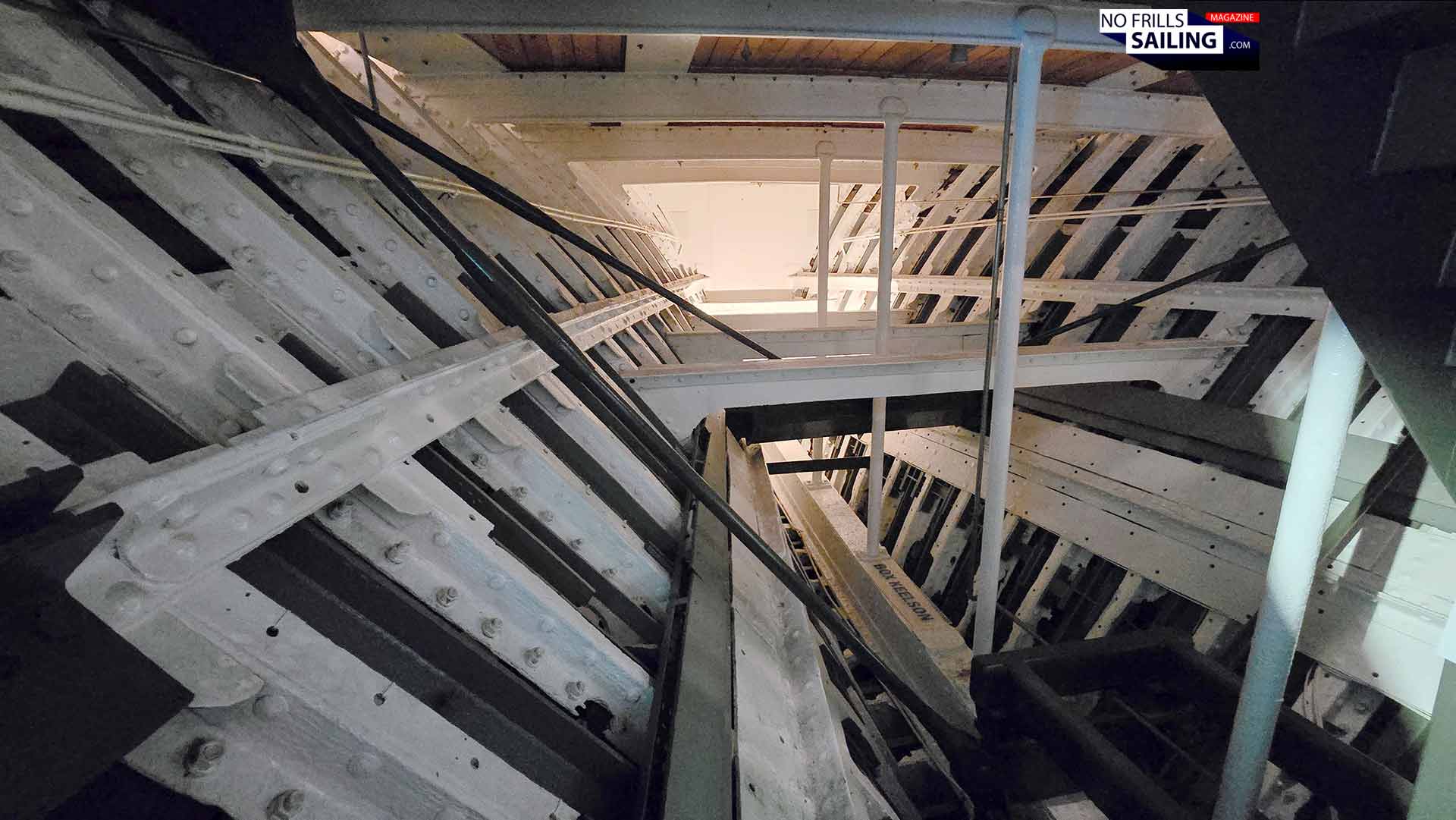
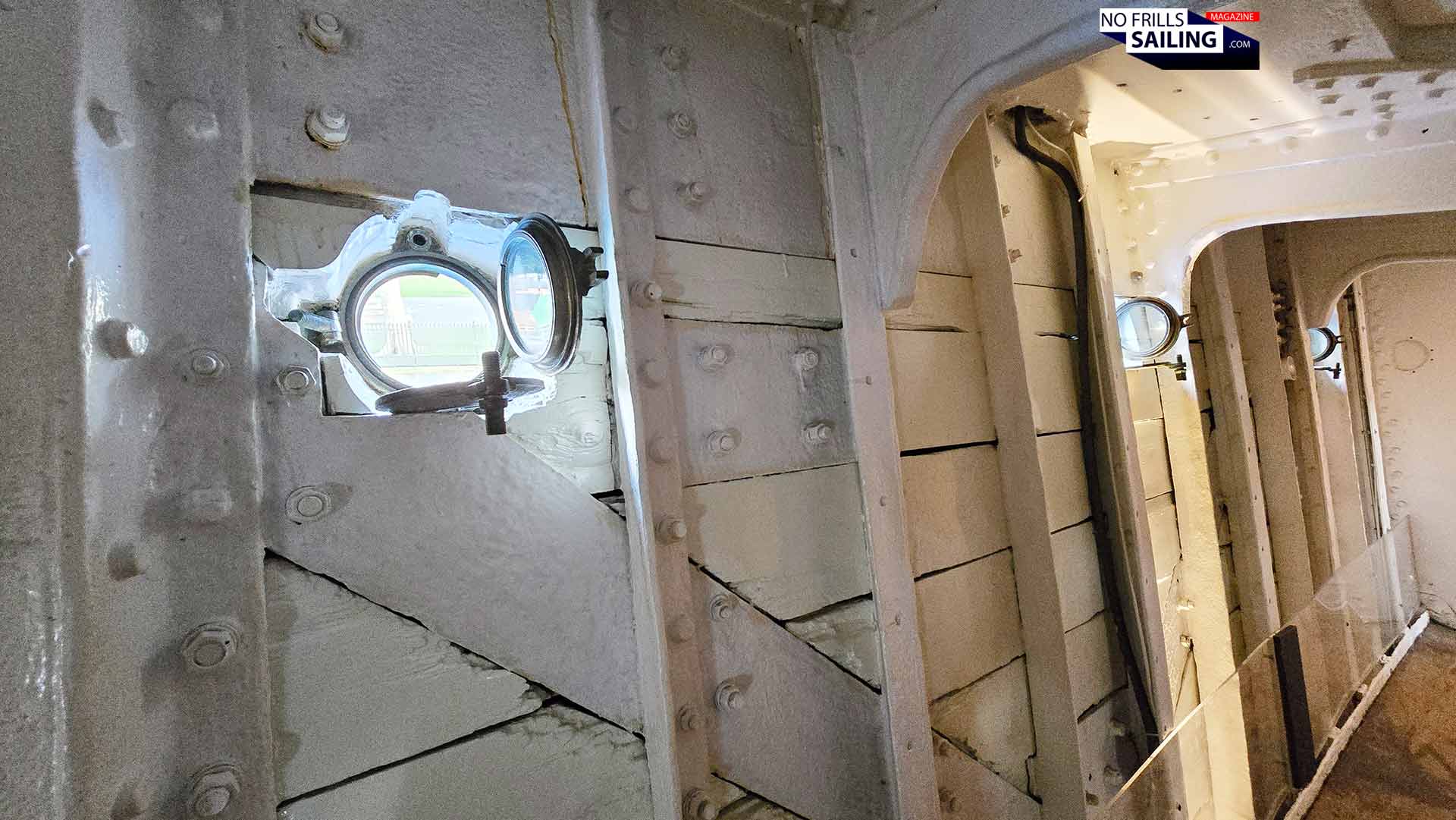
Roaming the deep inside CUTTY SARKs hull, you can see a piece of engineering art and how even in this “old” sail ship modern times have started to appear. CUTTY SARK was a so-called “composite clipper”. This means that her basic structure, naming keel, frames and stringers, are already made of iron bars. This skeleton had been riveted together and formed a very robust, rigid but also kind of flexible structure.
Peak of her time: The composite clipper
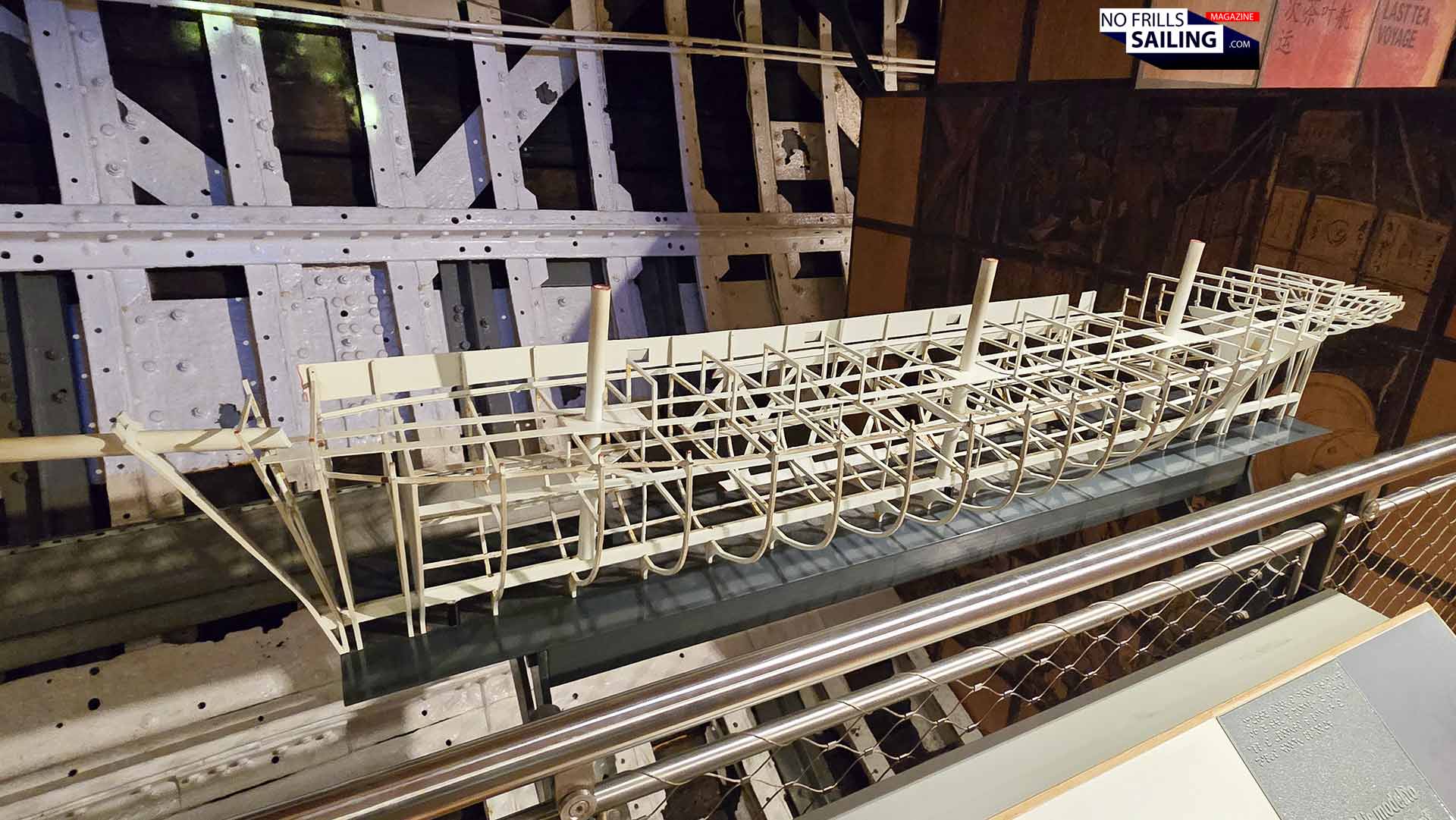
The museum shows a scale model of the frame which makes you appreciate the fine lines and hydrodynamically advantageous design of her hull. Onto the iron framework, the usual wooden planks would be fitted. In case of CUTTY SARK that’s rock elm below waterline with a thickness of solid 15 centimeters and teak planks above waterline. Most of the “classic” tea clippers of the early era were made completely out of wood, among them my favorite, Donald McKay´s FLYING CLOUD. CUTTY SARKs most prominent adversary, legendary THERMOPYLAE, was also a so-called “extreme clipper”, built as a composite iron-wood-ship.
A model of CUTTY SARKs frame
It seems that with this construction, CUTTY SARK was able to combine the best of both world. Nevertheless, one Sword of Damocles remained swinging over her head: Fire! Ironically this was never really a problem for the mighty ship during her active years. Just recently, in 2007, a fire broke out deep in her belly. An electric dehumidifier had been left switched on over the weekend. It eventually overheated and cause a fire to spread rapidly. The ship was quickly engulfed in flames. The dramatic pictures went around the world. At first it looked like the once proud ship had been lost forever. But CUTTY SARK has her nickname “the lucky ship” not without purpose …
Thick planks, though
What may have looked like she was doomed and lost, turned out to just barely be all-too dramatic. Luckily, only less than 10 percent of the original material of the ship had been lost to the fire. As a matter of fact, most of the ship´s interior had been removed to nearby warehouses for refurbishment, as well as the original masts, the running rigging and most of her planking. She indeed is the lucky ship. Lasting some 18 months longer than expected, the last and final big refitting of the ship made her shine even more after completion. Literally like a phenix from the ashes, CUTTY SARK would be standing as tall and proud as ever. Nevertheless, fire was and still is one of the big hazards to ships.
The short reign of CUTTY SARK
As I pointed out, the reign of this Queen of the oceans was rather short, regarding the initial purpose she was built for. Entering the tea races in 1870, it was already the swansong of the once proud windjammers. In this, CUTTY SARK was fast, but actually never won a race. Nevertheless, the adventures she embarked on, were filled with excitement and sparked the imagination of the Britons. On one of her three races, mostly against her arch-enemy, the THERMOPYLAE, she found herself leading by more than 400 nautical miles. But then she got hit by the most severe storm, loosing her mighty rudder blade.
From Formula 1 to tramp ship & wool trade
It was thanks to the ingenuity and perseverance of CUTTY SARKs ships joiner, Mr. Henry Henderson, who came up with the idea to construct, make and fit a new makeshift rudder whilst sailing, that this ship didn´t hade to make call at Cape Town but go on racing. This masterclass in craftsman- and seamanship was hailed so much back at home, that she finishing the race nevertheless made her even more popular than the winner of that year´s edition.
All hands on deck!
Roaming the main deck of CUTTY SARK makes me feel somewhat connected to her story, to the adventures and the individual fates of the people sailing her. The tea races were short, she only did three, after which both the new steamers and the opening of the Suez Canal soon made the races needless. CUTTY SARK had to find her a new reason to exist. A long, perilous and not very shiny decade of working as a tramp ship followed. The once proud racer hopped from harbor to harbor, each time hoping for a new client, transporting everything from dirty coal to wool. Though the wool trade from Australia to Britain proved to be a new “golden time” for the ship, one cannot deny that this wasn´t was she was intended to do in the first place.
Small crew, high speeds – would you dare to hitch a ride?
So, how would it feel like, being a crew member aboard CUTTY SARK? We all know from our own sailing experience, that the faster a ship goes, the more uncomfortable she becomes. Constant rocking, stress in the rigging, hardship of adjusting and trimming the sails, keeping a due course. I did some trips in a Class 40-racer myself and I know what it feels like trying to find a good night´s sleep on a fast boat. Not so much different from 150 years ago.
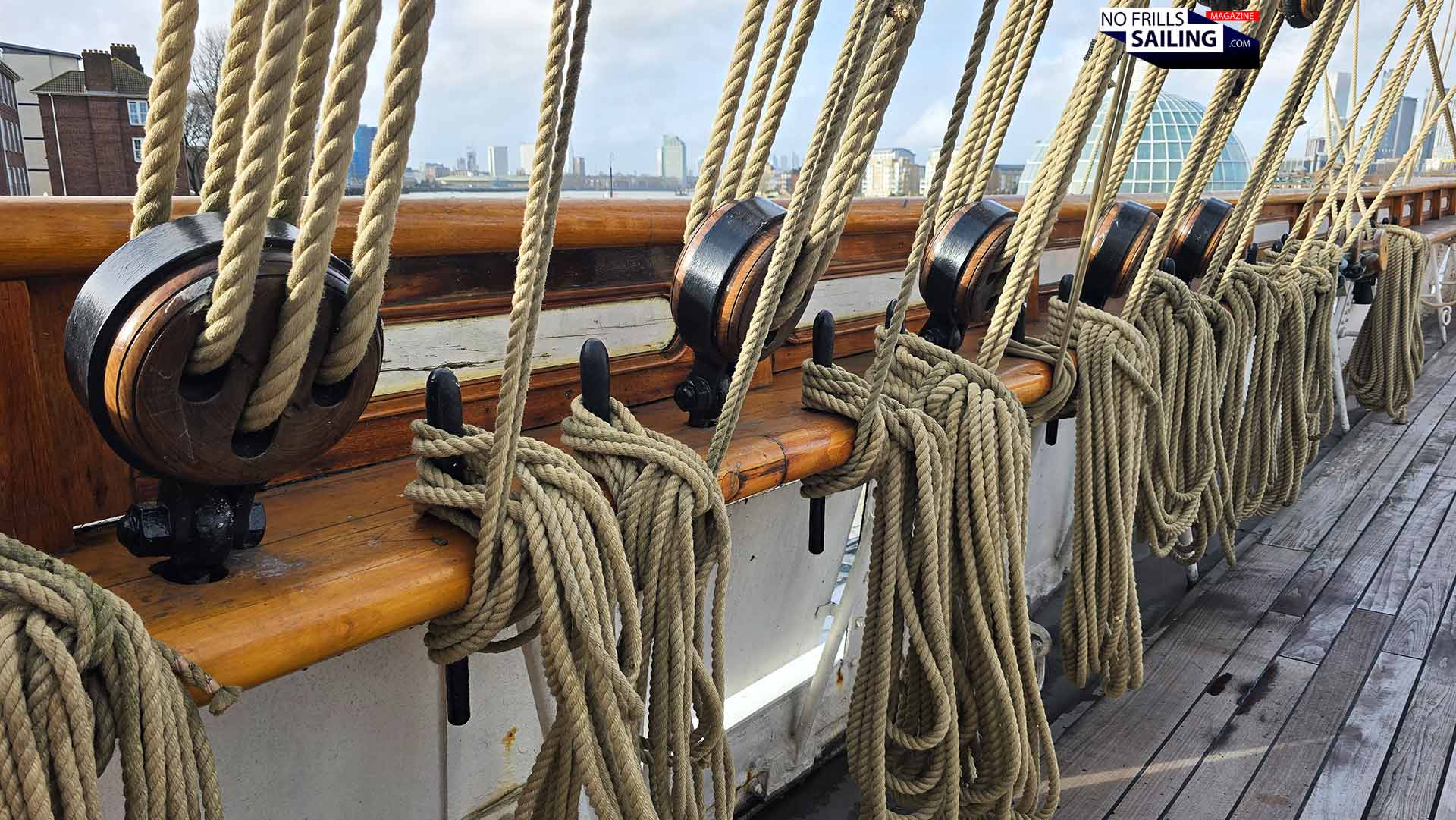
The main mast´s bracing
Clipper ships needed surprisingly little crews to be sailed. In case of the CUTTY SARK this was usually a complement of 26 people. There was the master, the captain, and two mates running the watches. A steward looked for the Officers, worked closely together with the ship´s cook. Then you´ve had the boatswain, the carpenter and the sailmaker (who both had own workshops, like the ship´s galley and the rather cramped joinery). Besides these officers, CUTTY SARK needed some apprentices, able and ordinary seamen who in fact did the very job of controlling the brassing and other lines to run the ship.
On the poop deck
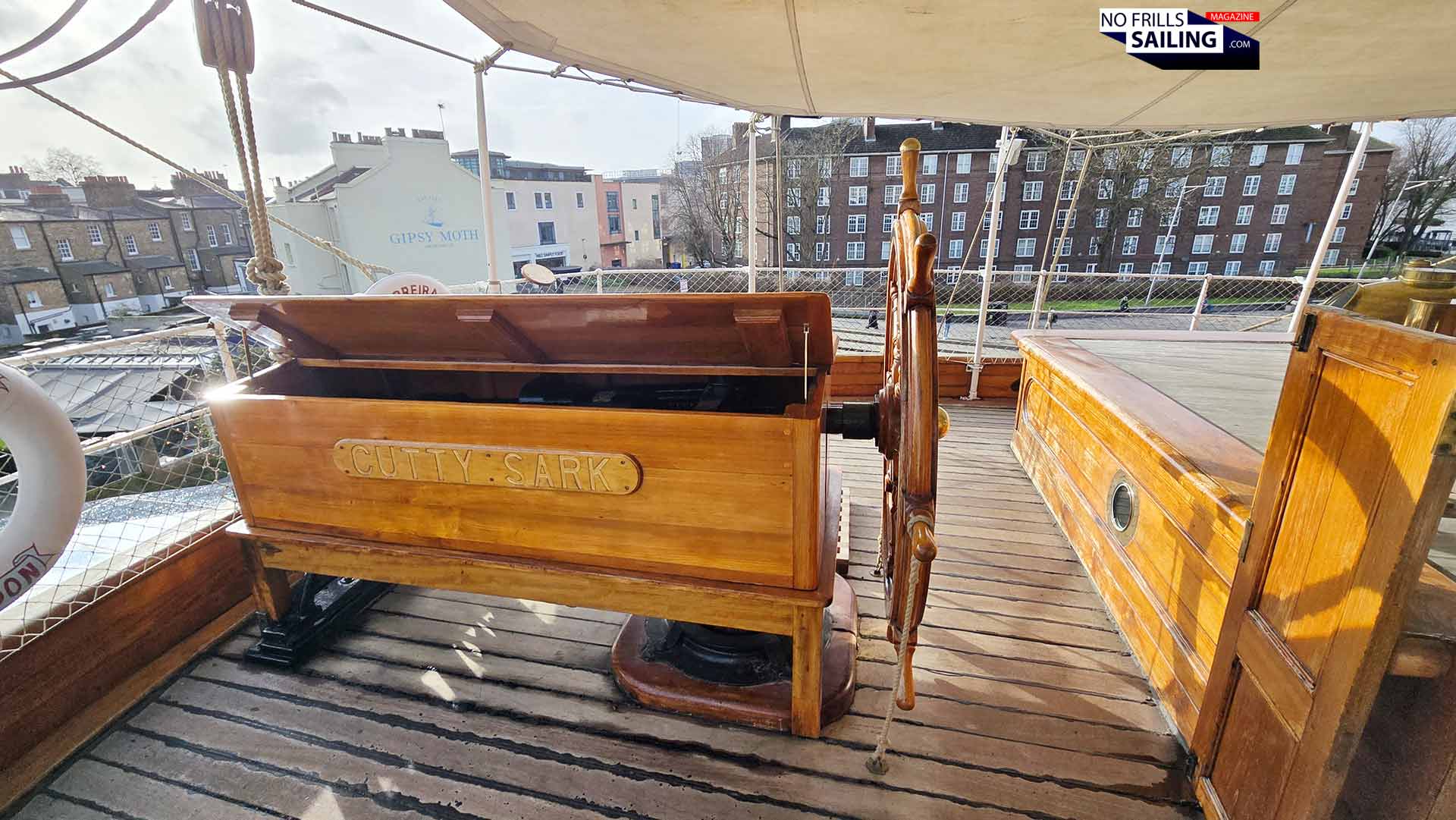
Standing back on the poop deck at the wheel house, which indeed houses only the iron steering mechanism that runs down the shaft to the blade, is quite an experience. First of all you can´t see anything from back here: It needed a number of seamen passing down sightings and information from the watchman in the bow to reach the helmsman. I can figure that especially maneuvering this vessel on narrow waterways would have been a very special occasion … let alone standing here in a full-blown storm, totally unprotected. A typical watch lasted 4 hours aboard CUTTY SARK …
Commerce, now and then
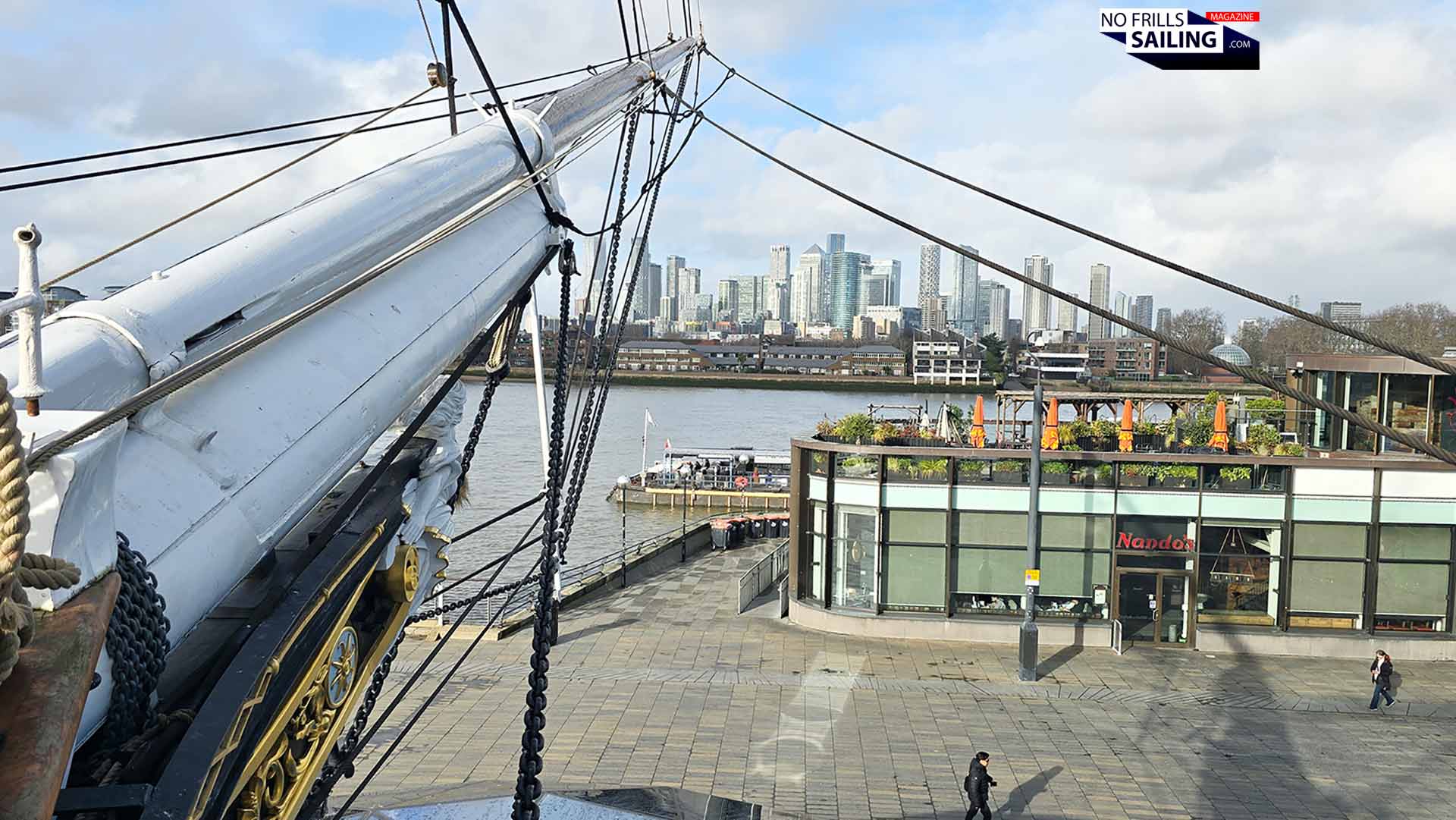
Nevertheless, it must have been an awesome sight, when she was under full sails dashing down the ocean! Both from abaft, but more here in the bow, her massive and pointy bow sprit is raised proudly into the sky: Imagine the full set of jibs under pressure, white foam flying by violently, her sharp bow cutting through the waves. Truly the Formula 1 on her time, it is such a valuable and happy occasion that this last of the tea clippers survived in such great condition. We can all feel very lucky and blessed. Would I dare to join her crew?
How did CUTTY SARKs crew live?
Well, joining a clipper crew back at that time was considered a great blessing and kind of boost to your career. You see, if your ship´s master made it first into port during a tea race, an extra would be paid on top of your wage – from the lowest grade to the captain. In today´s numbers, one single load of fresh new season´s China tea would cash in about six million British Pound! One single load! That meant that captain and crew would earn up to sixpence per pound of tea!
How did the crew live aboard?
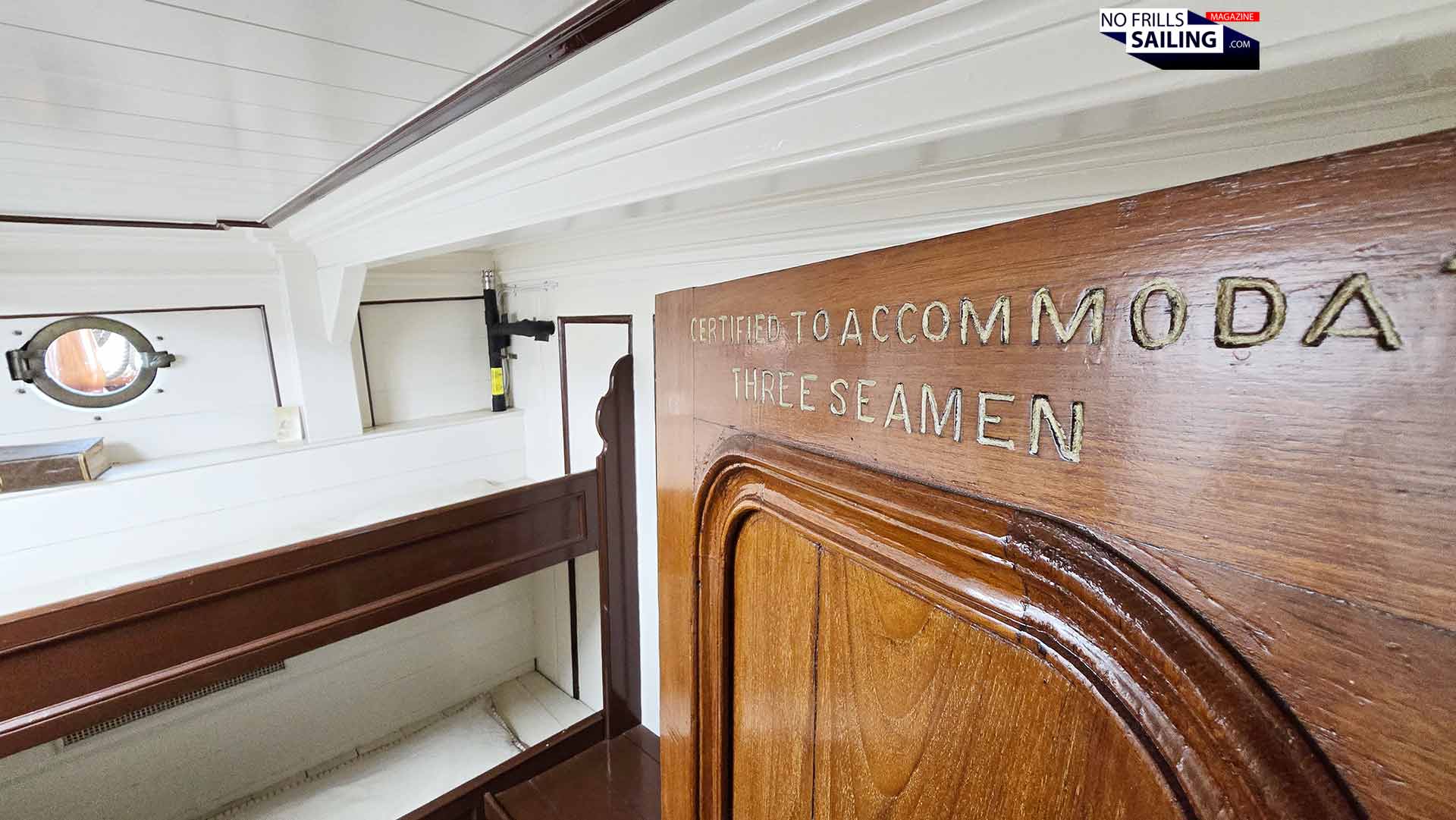
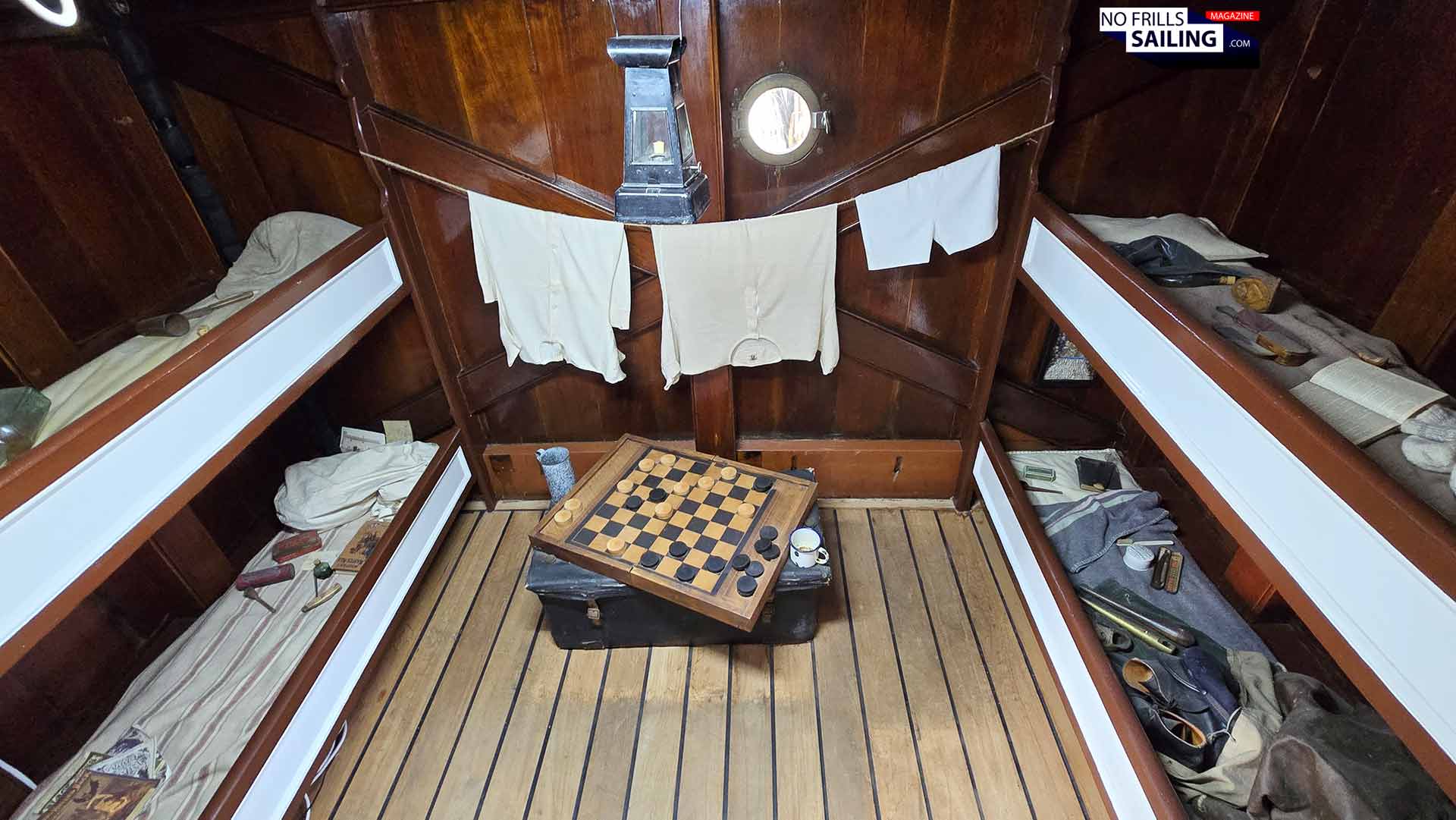
How the crew members lived aboard CUTTY SARK can be seen on deck. There are two large deckhouses which would provide accommodation for the able and ordinary seamen. A very interesting peek into the life of seafarers of the past. In fact, I have seen worse. First of all, they had actual beds or bunks, which is a huge step forward from the simple hammocks or having to sleep on sacks of straw on the actual freight. So, a bunk for everyone.
One of the deck houses
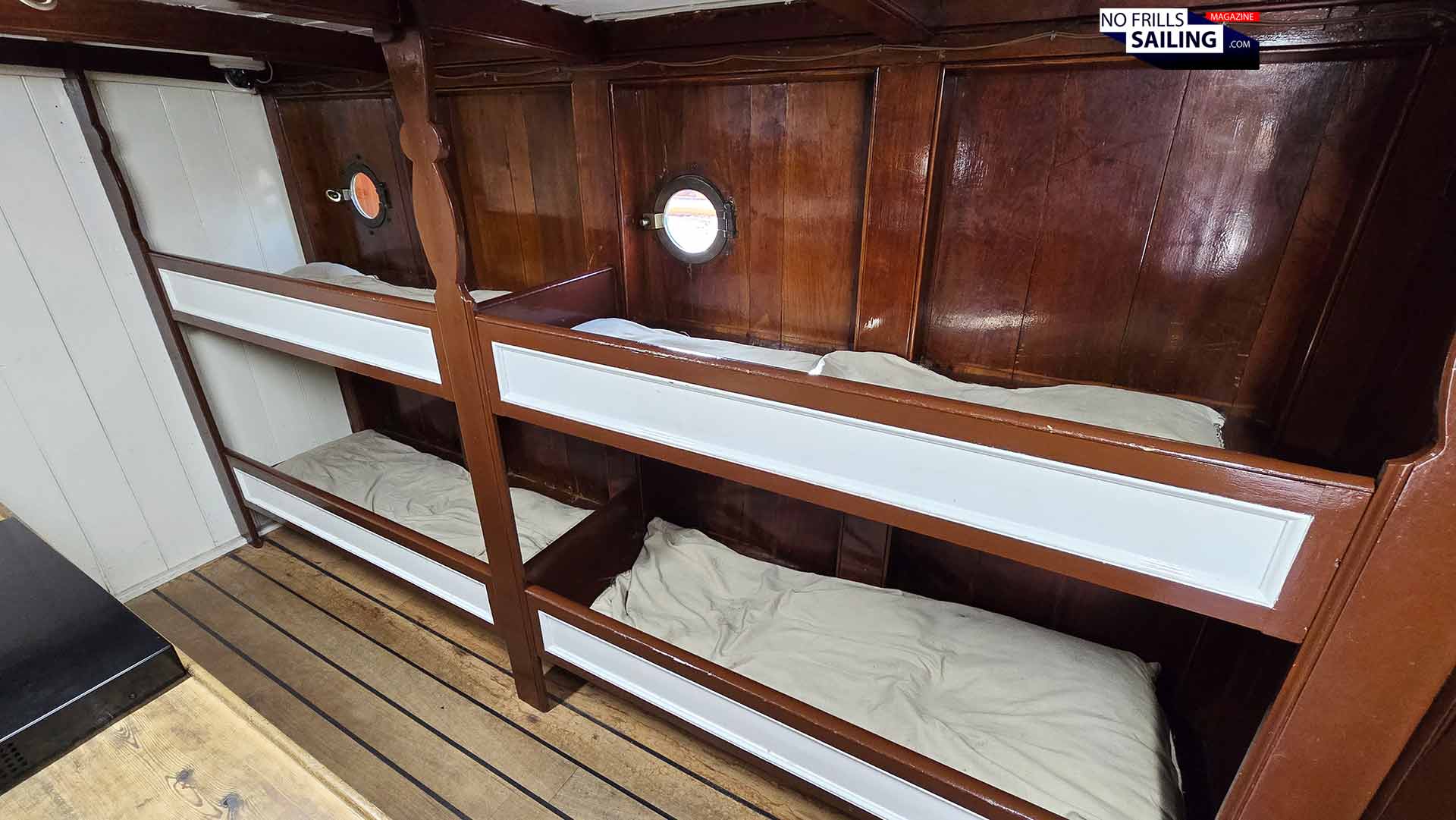
Yet, something feels oddly off: Is this a miniature ship? Because these bunkbeds are extremely short! You might not see it in my pictures, but the length of a bunkbed aboard CUTTY SARK was just about 1.40 meters. I didn´t measure it, but there is no way that a grown up man could stretch out in these, even if you take into account that people back in the day weren´t much taller than 1.65 meters. I guess, it was done on purpose – so that you´d wedge yourself in with your back against the deckhouse´s wall and your knees against the bed so that you won´t fall out in rough seas.
Pretty small bunks
There were small portholes providing fresh air and some gaslights for the nights. CUTTY SARKs watch system was arduous, but not different from that day: After a four hour long shift on deck or on watch, you would try to feed yourself, get your daily routine like cleaning your cloth or personal hygiene done and grab a few moments of sleep. Before it would all start over again. 4 on, 4 off. That’s quite heavy, I can tell you! Modern watch patterns have three watches with 4 on and 8 off: More time for personal stuff.
The ship´s galley
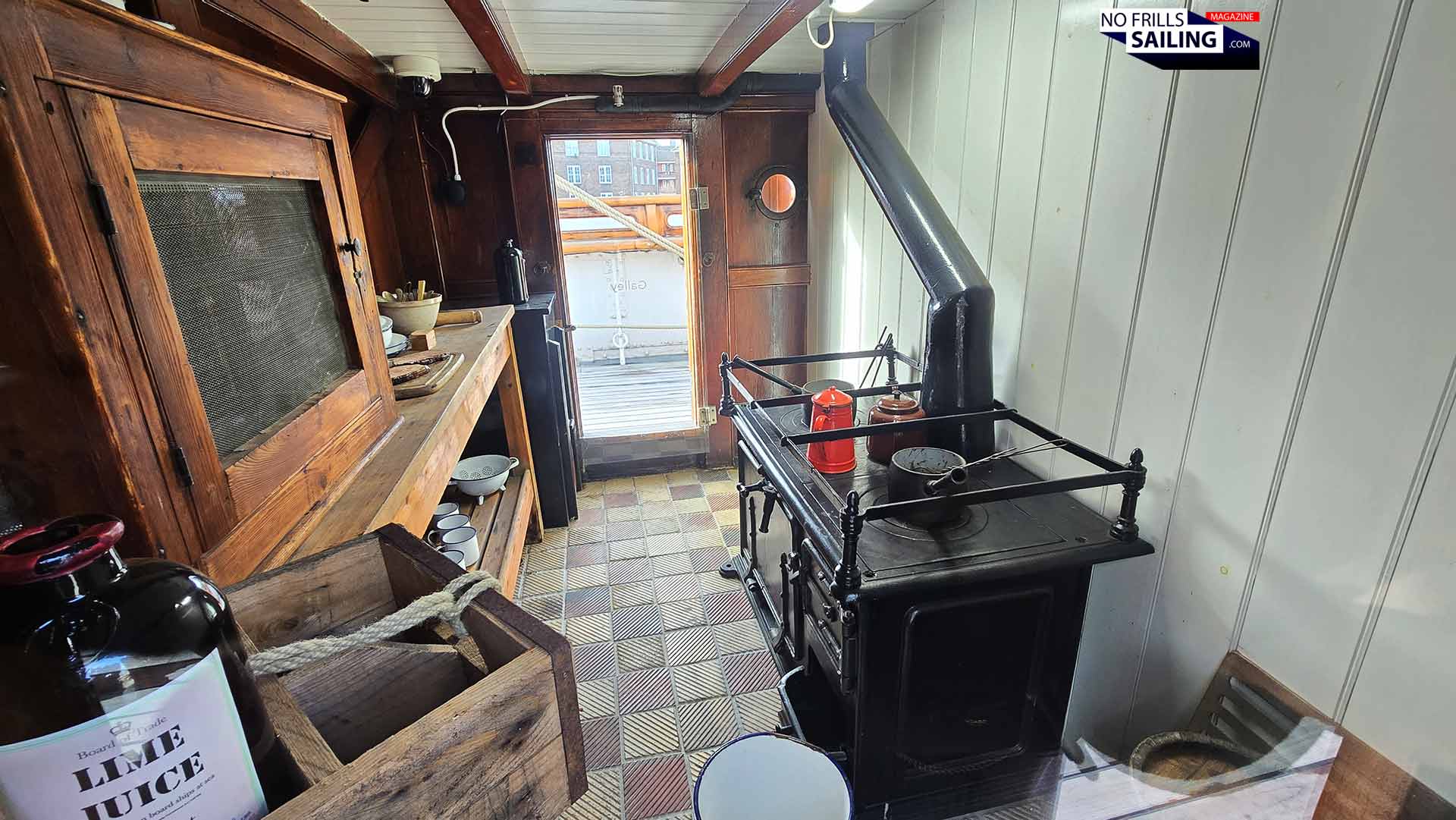
As for the officers, privacy was better, witch cabins for just two and even single occupation. The ship´s galley was of particular interest for me as I personally also like to cook when underway. For that time, the galley was quite big I shall say. A nice iron stove and fireplace with two large flames and an oven for preparing bread and other hopefully tasty meals, is mirrored by a large cabinet for ingredients and spices, as well as a chopping board. Whilst being the warmest and possibly dryest place in winter time, this must have been hellish to work in when CUTTY SARK was sailing near the hot equator. Further back in the ship, the officers and distinguished guests aboard the ship found a rather different and much more inviting interior …
Much better: Captain´s dining room
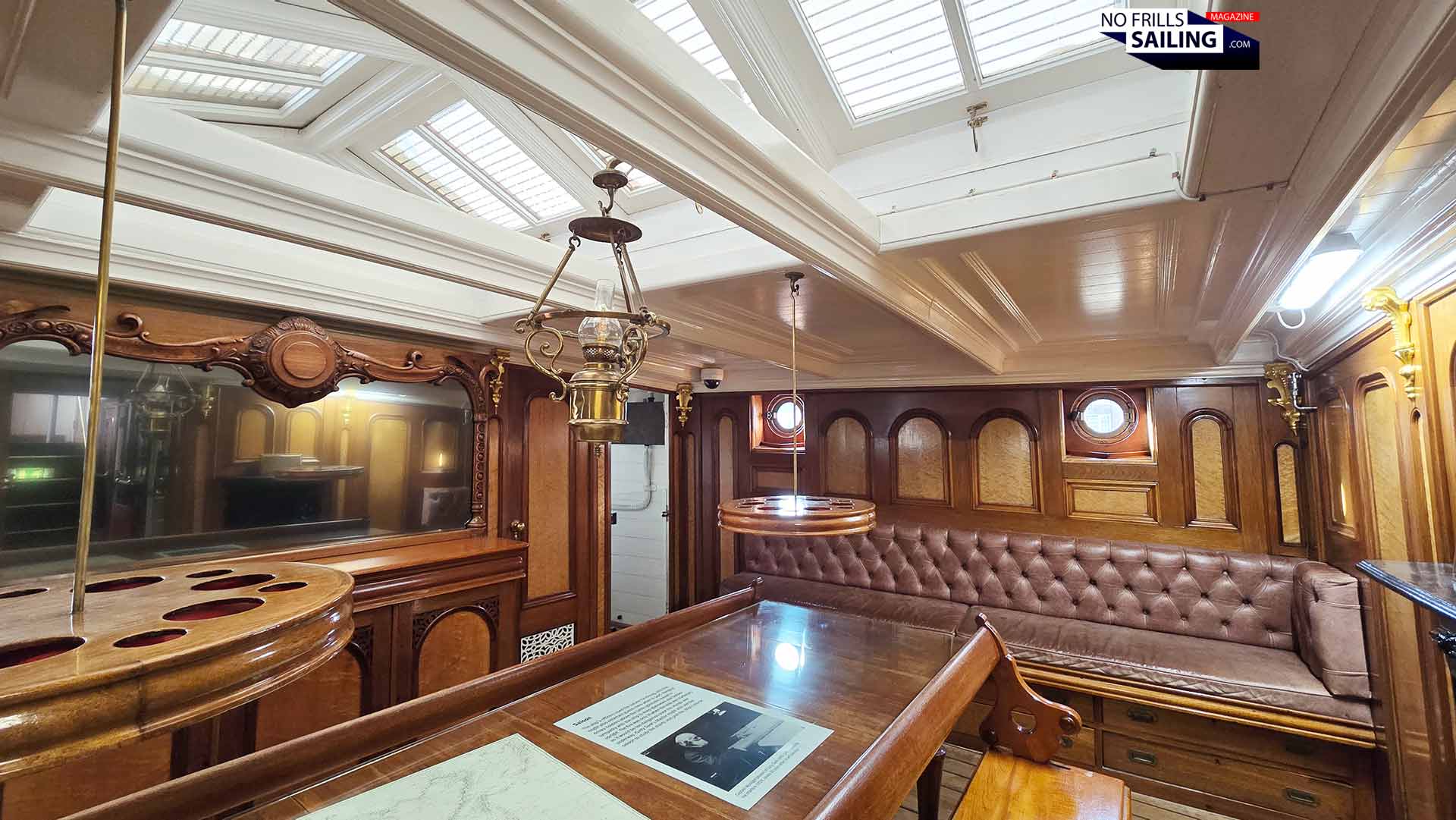
The stateroom and dining room of the ship are bristling with nice wooden ornaments, mirrors, a large dining table with a gimbaled cup-holder and some very nice leather sofas to either side. Surely, it was a great place to spend your off-watch time when not sleeping or when enjoying another of the ship´s cook´s treats. It´s a different game though when those treats had been processed …
The heads
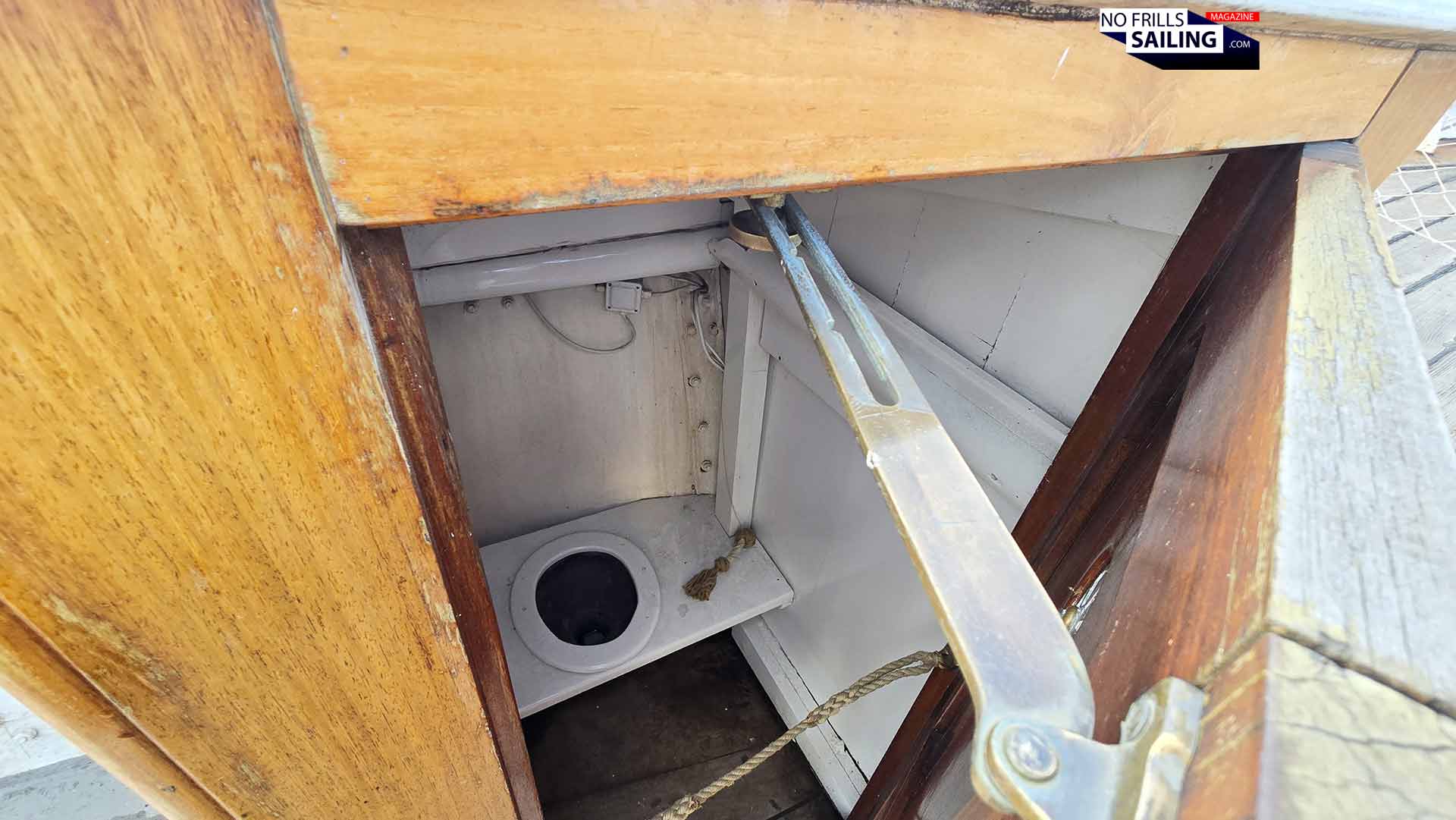
The ship´s heads are called this way because on the very first big sailing ships these had been outside and in front the forecastle, the “head” of the ship – where people went to find at least some privacy and took a dump through the gratings encompassing the bowsprit. I´m going to show this in detail in the article about London´s second must-see sailing ship, Sir Francis Drake´s GOLDEN HINDE. As for CUTTY SARK, the head was in the bow: A pretty nice and very “private” chamber with a proper toilet seat.
A quantum leap for naval architecture and ship design
Touring the CUTTY SARK, depending on the depth and level of information you are seeking, does not take very much time. I´ve spent all in all almost an hour aboard, roaming the tween deck, the main deck and the deckhouses. We were very lucky because 10 degrees Celsius in mid-January without any precipitation is a rare occasion for London. If possible, a guided tour with a proper guide who knows his ways around is advisable: There are hundreds of anecdotes and stories to be told!
What a glorious ship, indeed!
CUTTY SARK surely was the epitome of sail ship building and construction. As a so-called composite clipper she carried the best of both world, a kind of in-between product of the outgoing era of wooden ships and the iron and steel-ships reign of our modern times. Here intricate rigging, the brassing, sheets, halyards and other lines to set up and fine tune her sails are not only stunningly beautiful, but technically awe inspiring. Same goes for the hull and overall design.
Imagining her at full speed …
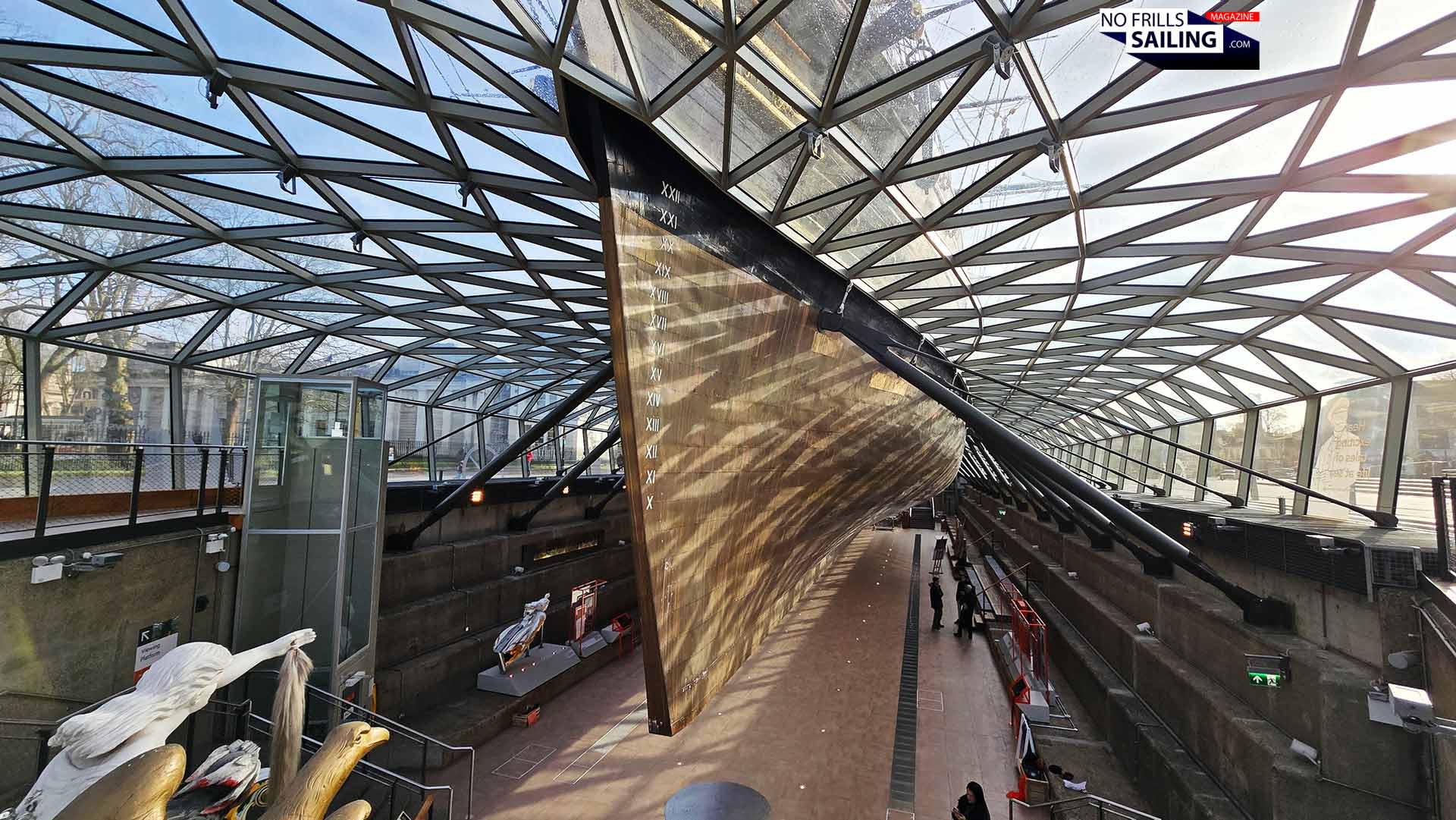
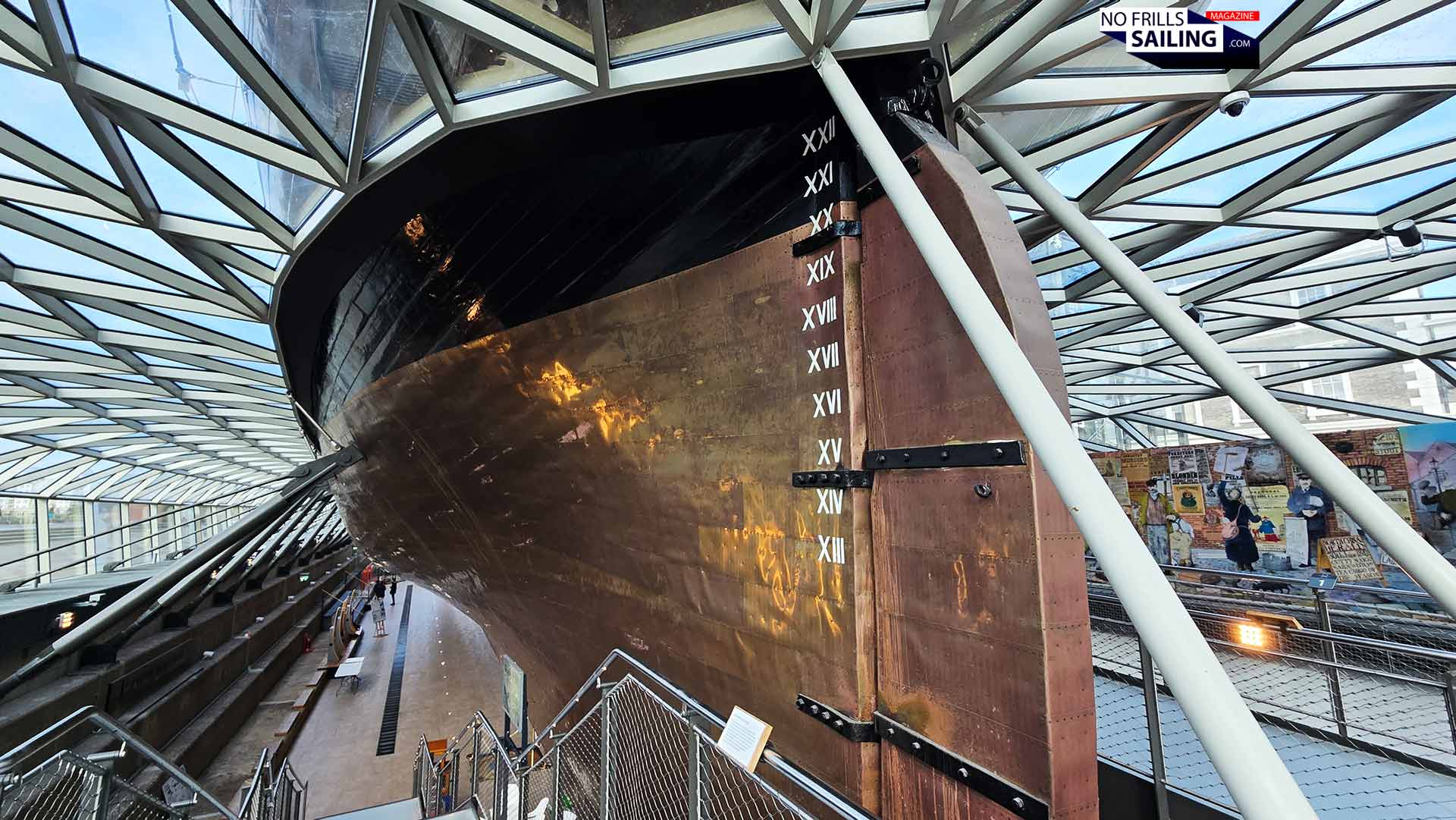
This can best be seen when you conclude your tour of the ship inside and on deck. You will head down a staircase which ends underneath the new glass roofing. CUTTY SARKs hull seems to be floating above the earth, suspended, flying. No less than twelve steel pillars are holding the hull in place, visually almost disappearing. It´s a stunning technical masterpiece and fits perfectly the narrative – a ship like CUTTY SARK knows no fixation, the beauty of her lines can thus be admired in its full extend.
What´s the secret of a clipper?
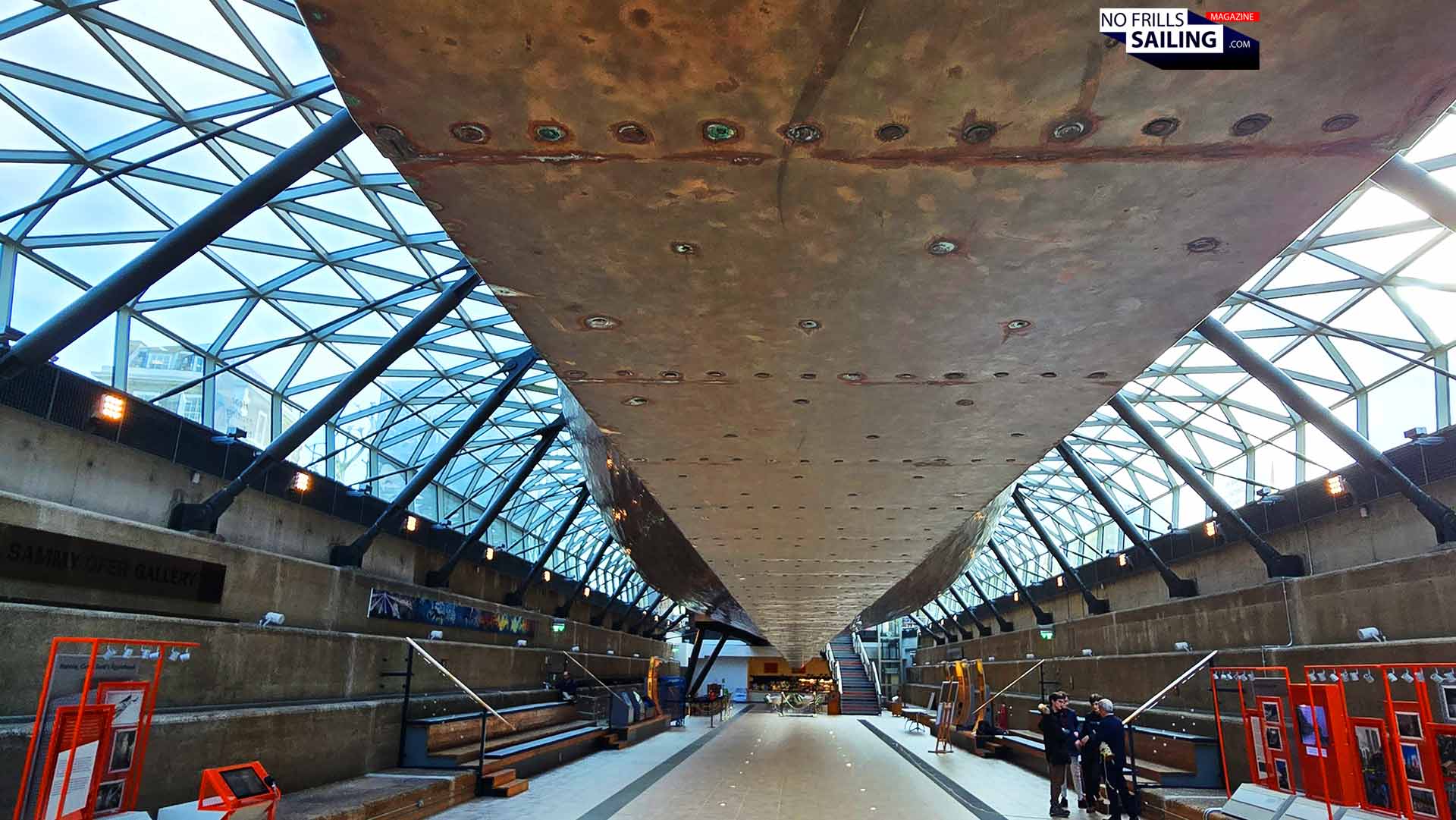
I wander all along the 85 meters long hull from stern to the very tip of the bow. Standing there underneath is nothing short but breathtaking! The body of revolution of her wetted hull underneath the waterline is pure eye candy. Sleek, pointy, sharp. It is as if she is destined to being fast by design. And you can see it, right there – once a breeze starts filling her canvas, there inevitably won´t be any holding back for sure.
As sharp as a knife
Later sailing ship designs, such as the famous Flying-P-Liners didn´t exhibit such aggressive and extreme lines. They were a bit bulkier, carried less sails area and focused more on efficiency rather than speed. It´s like comparing a Formula 1 car to a Volvo. Latter is quick, no question, but a race car … is a race car, right? By investing so much in this elaborate construction, the museum-designers have made the best choice to really show in plain sight why CUTTY SARK is of such a special breed. Absolutely mind-boggling! Just wow. Pictures by no means can transport how much excitement I felt when standing underneath her bow, admiring her sheer beauty.
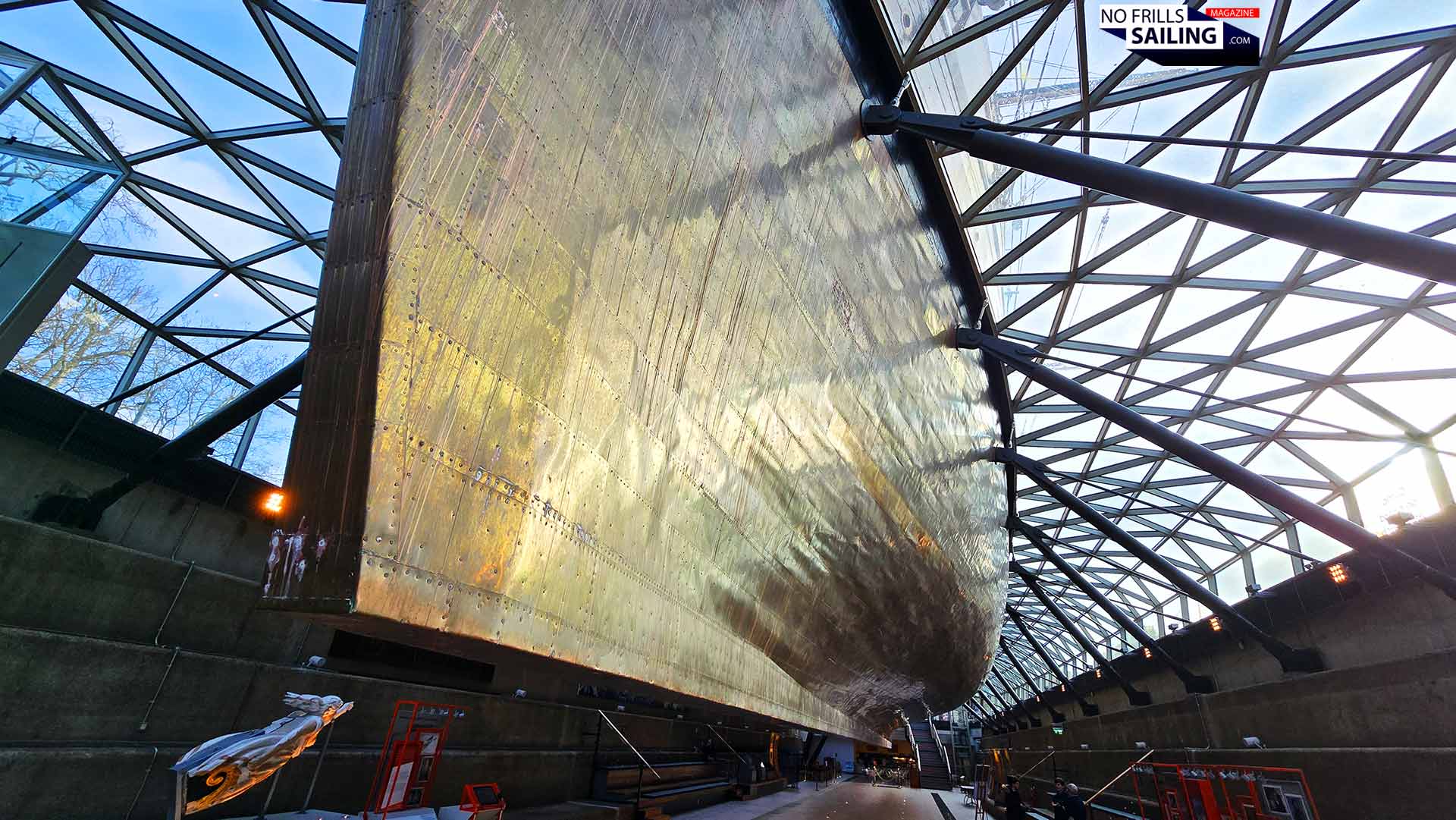
The antifouling of the time: Copper plating
Speaking of “underneath”, why copper plating anyway? Well, as we learn, it is not pure copper. It´s an alloy of about 70 percent of copper and 30 percent of zinc. This mixture is also called “yellow metal” or “Muntz metal”. It has been invented by George Fredrick Muntz, who owned a metal company in Birmingham back in the 1830ies. Because, as every ship even nowadays, the infestation of a ship´s hull by crustation and algae was a big problem for ships – the Muntz metal was the material of choice of its era.
Copper plating: Antifouling of her days
See, if only 10 percent of the underwater area of a ship´s hull was covered with those little barnacles, it meant that a ship would need to produce up to fifty percent more power to reach the same speed as without! Which meant, even a slight coverage of underwater area by barnacles would slow down ships drastically. For a slow coal-hauling hulk this might have been no problem, but a race ship like CUTTY SARK, destined to wind a 90 day dash from China to England, this was absolutely crucial!
Just all so gracious!
In this, the Muntz metal-sheathing made sure that by constantly releasing copper ions, it would deter reliably any biological life settling down on a ship´s hull. It could be called “antifouling” or “biofouling” then, and proved to be very sufficient for ships, one of which was the CUTTY SARK. Still to this day, copper-ions are the best proven countermeasures to deter infestation with marine life for submerged bodies, yet legal regulations in many regions prohibit or at least severely regulate their use.
A technological marvel, a piece of maritime history
I could write a whole book about this ship, and there already are a number of. I remember when I was young building two scale models of CUTTY SARK myself, making visiting and roaming this ship like a homecoming for me. These lines are so well internalized now. Fascinating. I could have spent many more hours here, which in the CUTTY SARK museum is indeed a no-brainer: You can have a coffee here, sit down, embrace the view and get lost in your own imagination.
Every angle is a beauty shot
We of course still had some more things to visit on our list, also, although my fiancé tolerates my hobby and profession, she does not share the same (almost excentric) enthusiasm for everything that floats. That is why I wrapped things up, shot almost 300 pictures and, after almost one highly interesting and densely packed hour aboard and around CUTTY SARK finally said Goodbye to this fine ship. But not without a little, almost heartbreaking discovery …
Her greatest rival …
Around the bow, down in the old dock, a nice collection of classic figureheads of sailing ships is exhibited. A colorful, sometimes funny, sometimes gripping mixture of mythical maritime figures, pretty ladies and … one very special specimen. There wasn´t a special badge nor any sign at all. As if it was meant to being discovered by the ones who know. And I knew. This very special figurehead once graced the bow of CUTTY SARKs nemesis, her arch enemy and closest rival: THERMOPYLAE. She was never never able to beat her really, but often sailed faster than her. Sadly, this extreme clipper was sunk off Cascais in Portugal after suffering a ten year period as a dead hulk at anchor. Seeing her figurehead is a nod to the once so chilling rivalry between these two great ships.
Is the – pretty high – entry fee worth a visit to CUTTY SARK?
First of all: If you happen to be in London and your schedule can take a 2, 3 hour detour, please take your time and pay your tribute to this clipper ship! It is a unique sight and a wonderful reminder of this great past of maritime history. If you want to tour the ship, your will have to pay a relatively high entrance fee of (written in February 2026) 20 British Pounds per person. This is, admittedly, quite a hefty price! So is it worth it?
Is she worth a visit?
For me, yes! I fell in love with them old stories about the clippers, the goldrush, the tea races at a very young age. I dreamt of them countless dreams, still today I feel touched on a very personal basis when looking at these lines, the towering masts, the spiderweb-like chaos of lines which somehow follow an intricate order. This is not a replica. This is not some Disneyworld-stuff. This is the real thing! There is just one left and I would say keeping it up, preserving her for future generation in this spotless condition is worth the price, yes, absolutely.
Advertisement
Whilst being in Greewich anyway …
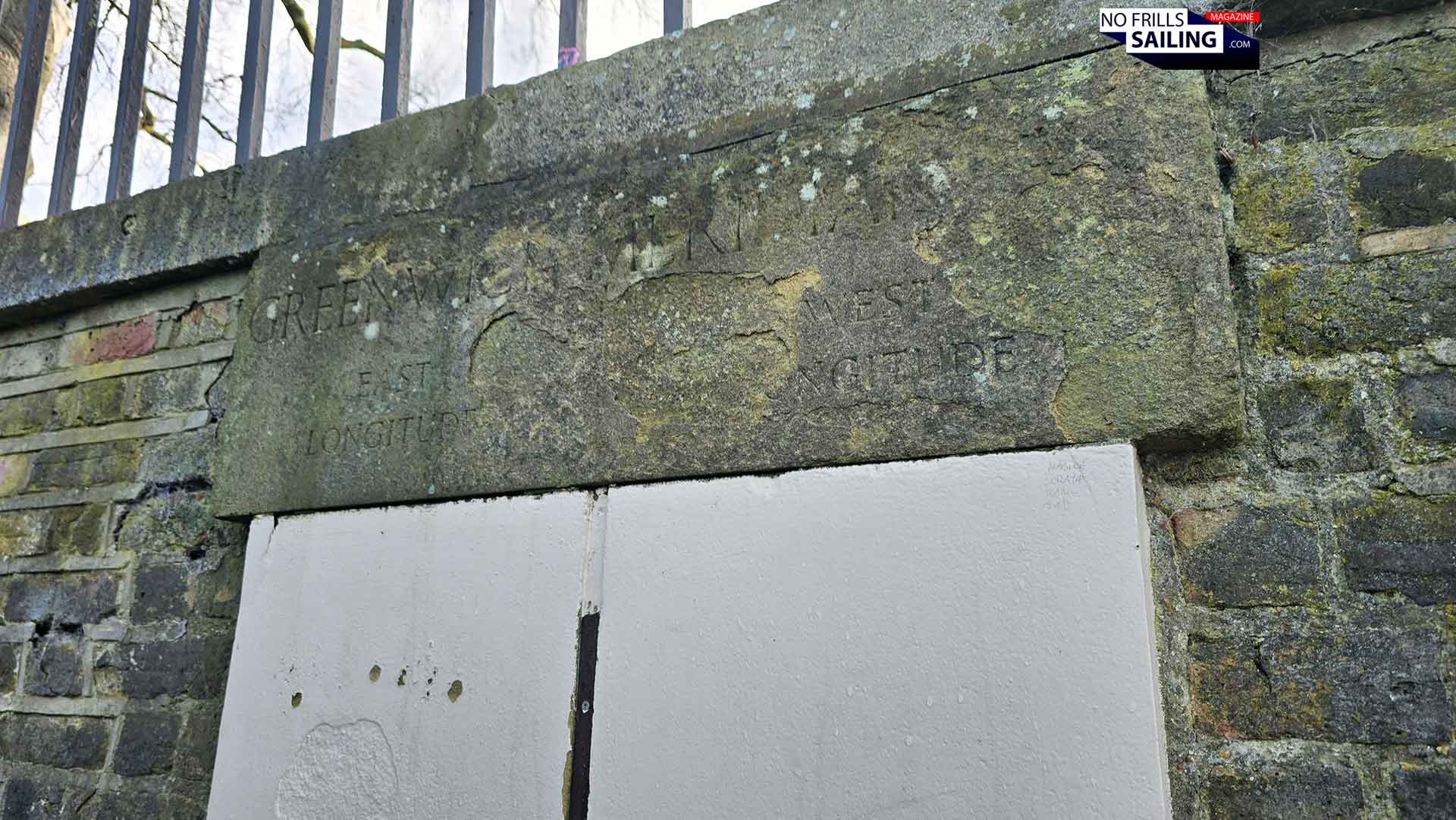
Greenwich, of course, offers much more than the CUTTY SARK. It´s truly worth a full day trip, as in the vicinity you´ll find the marvelous Royal Observatory, where maritime and not the least world-defining history has been written. It was here where Harrison introduced his revolutionary first ship´s chronometer, a gripping story so thrilling and exciting as any Hollywood-blockbuster! Of course did we climb the winding road up the hill, just to bypass the “secret” iron door and stand on the Prime Meridian (circumventing the next entry fee).
Don´t miss the Prime Meridian nearby!
Also, the nearby National Maritime Museum is a must for anyone interested in naval and seafaring history of Great Britain. Sadly, this was not on our list – but surely will be the next time I am here! Instead, after standing on the Prime Meridian and sending home the must-do selfie to our loved ones, we went to the Kings Arms pub, where they serve a classic Mash and Pie the old style: Either with the iconic green liquor or the dark brown gravy. Best about it: It´s just half the price you´d pay back in London.
Britain´s rich maritime heritage
I wave a final Goodbye to CUTTY SARK as our train rushes by. Her masts throne up above the city as if she is still telling us that she´s the master of the Thames and the seven seas. It was a very interesting and surprisingly emotionally moving visit. Maybe that´s because I kind of have a special connection to her from my childhood, but also maybe she indeed is a very, very, very special kind of ship of which there is no other. In any case: Weel done, Cutty Sark!
Related articles you might find interesting as well: