How important sports is for the development of kids and youngsters cannot be stressed often enough. I try to excite and educate my own children for sailing – but there´s much more you as parents can offer to your kids. How about rowing? I´ve had the pleasure to – by chance – being witness of a big rowing regatta and youth meeting, I got very much fascinated. And here´s what struck me most …
You think that sailing has something “snobby” or elite? Well, if so, your bias towards rowing must be even more deep. But that is complete nonsense: First of all, any sportive activity, especially for kids, is kind of expensive. So that´s a pretext. But I admit, I carried myself a bit of prejudice, to be honest, when it comes to rowing as an “elite” sport: Still having the Oxford vs. Cambridge rowing battles in good old England in mind, or the prestigious Henley Royal Regatta. Not to forget the “The Race”, Yale vs. Harcard, in the United States. To be honest: It is indeed a display of “good old” traditions and may appear to be … snobby.
There´s something big going on in Luebeck!
But this weekend I was about to being taught a very different picture. First of all, not everything that has tradition automatically translates to “upper class” and unattainable clubbing. I mean, it´s not like the New York Yacht Club where I was denied entry to even after asking for permission in an official, written form. Yesterday, it was an unusually hot spring day, I strolled my good old lunch-route around Luebeck, as I heard cheering, announcements and … starting signals. It was Luebeck Regatta-time, the first big rowing event in Germany after winter.
Now that´s something very different …
… to utilize Monty Pythons words here. Usually I am more into sailing. But since rowing at least incorporates water and boats, racing and rules, I think it´s okay. Also, I featured already some sidesteps from sailing here in my blog, least to forget my SUP adventures, which took place on exactly the same water area as this regatta. So, what´s going on here? As it turns out, every year my lovely city of Luebeck – namely the Luebeck Rowing Club, founded in 1921 – after all that´s more than 100 years of tradition right there – heralds the new sporting season with its traditional Luebeck Regatta. As people told me, a must-go for German rowing clubs.
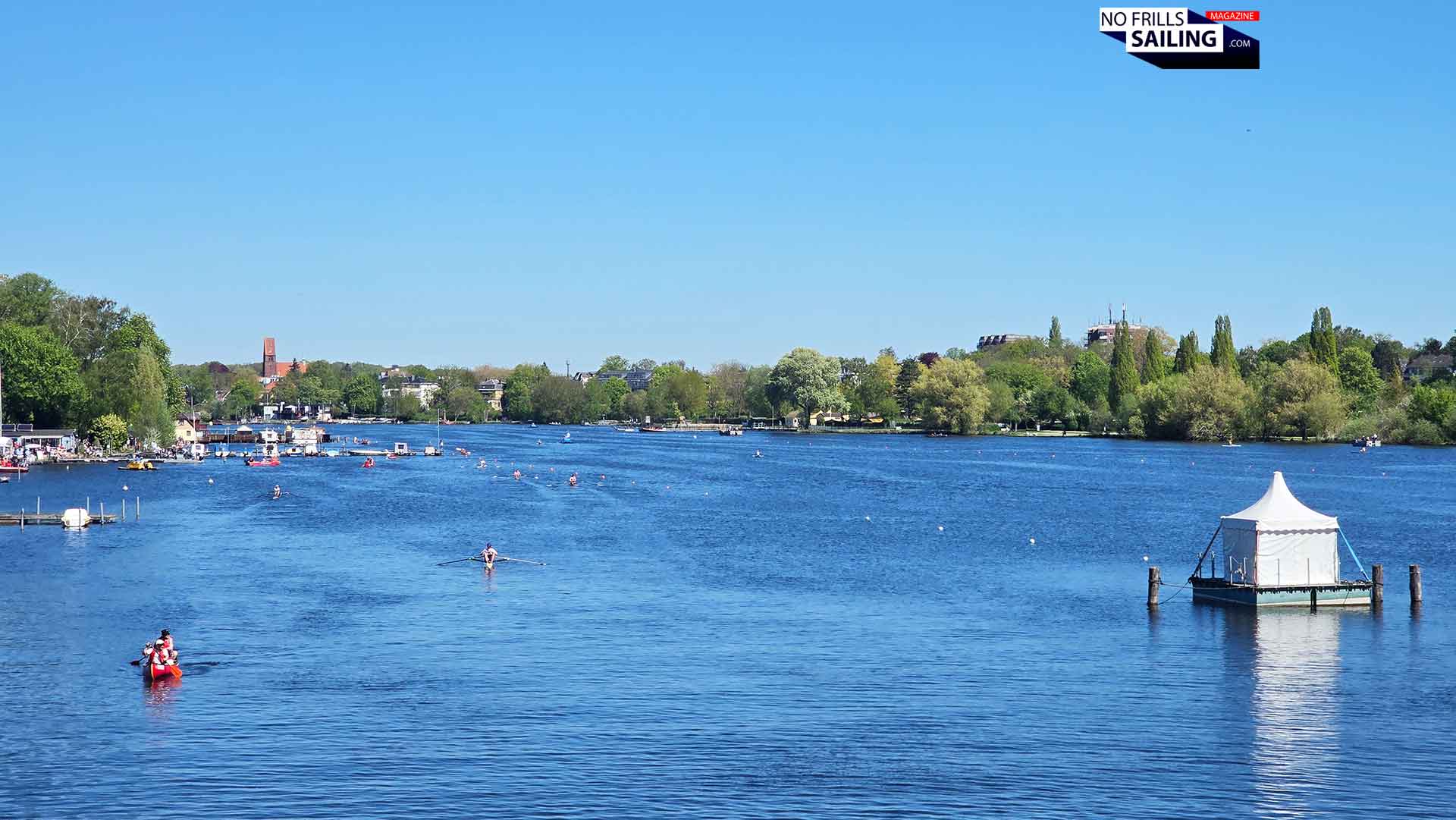
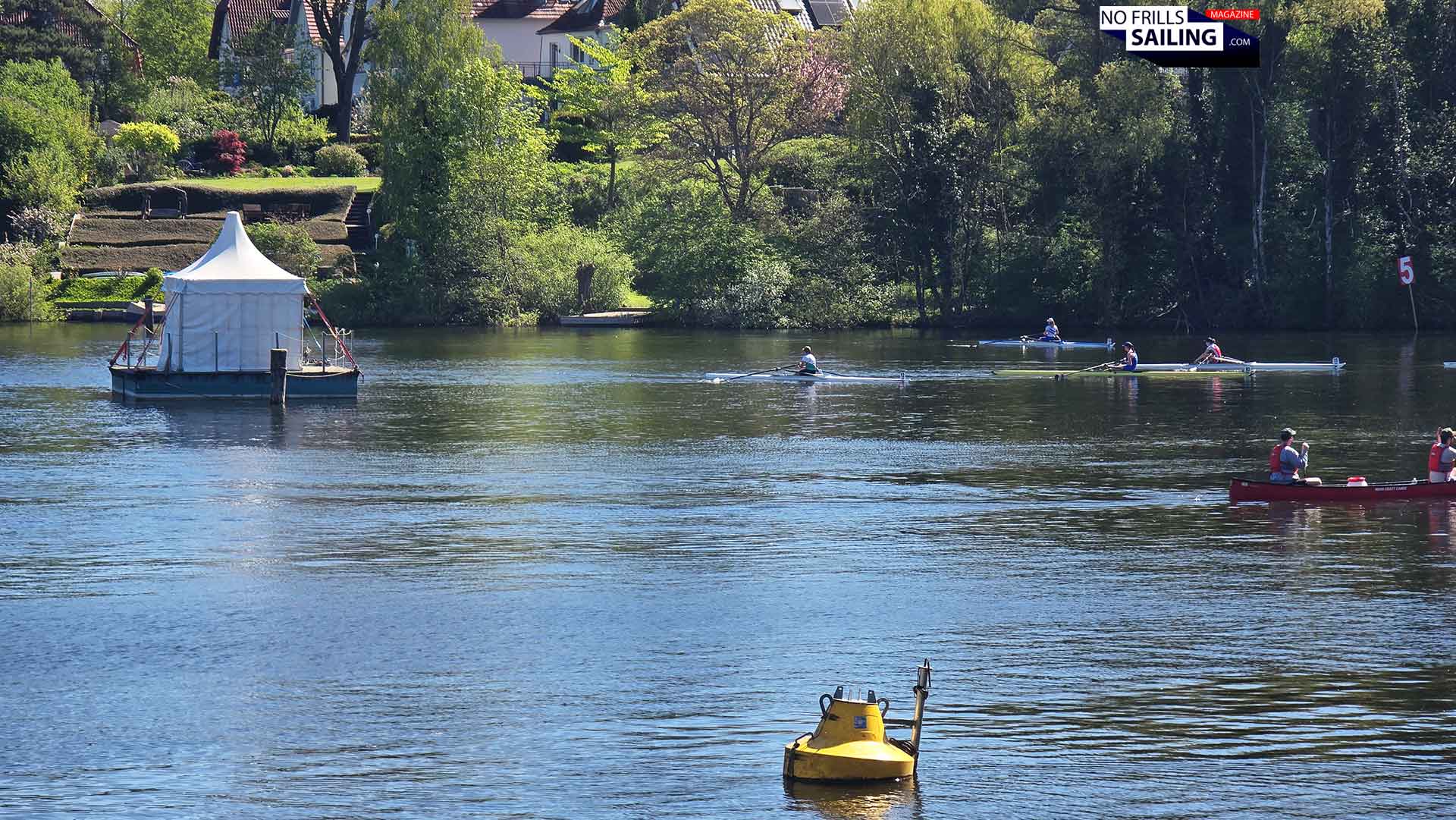
The finish line of the sculling race track
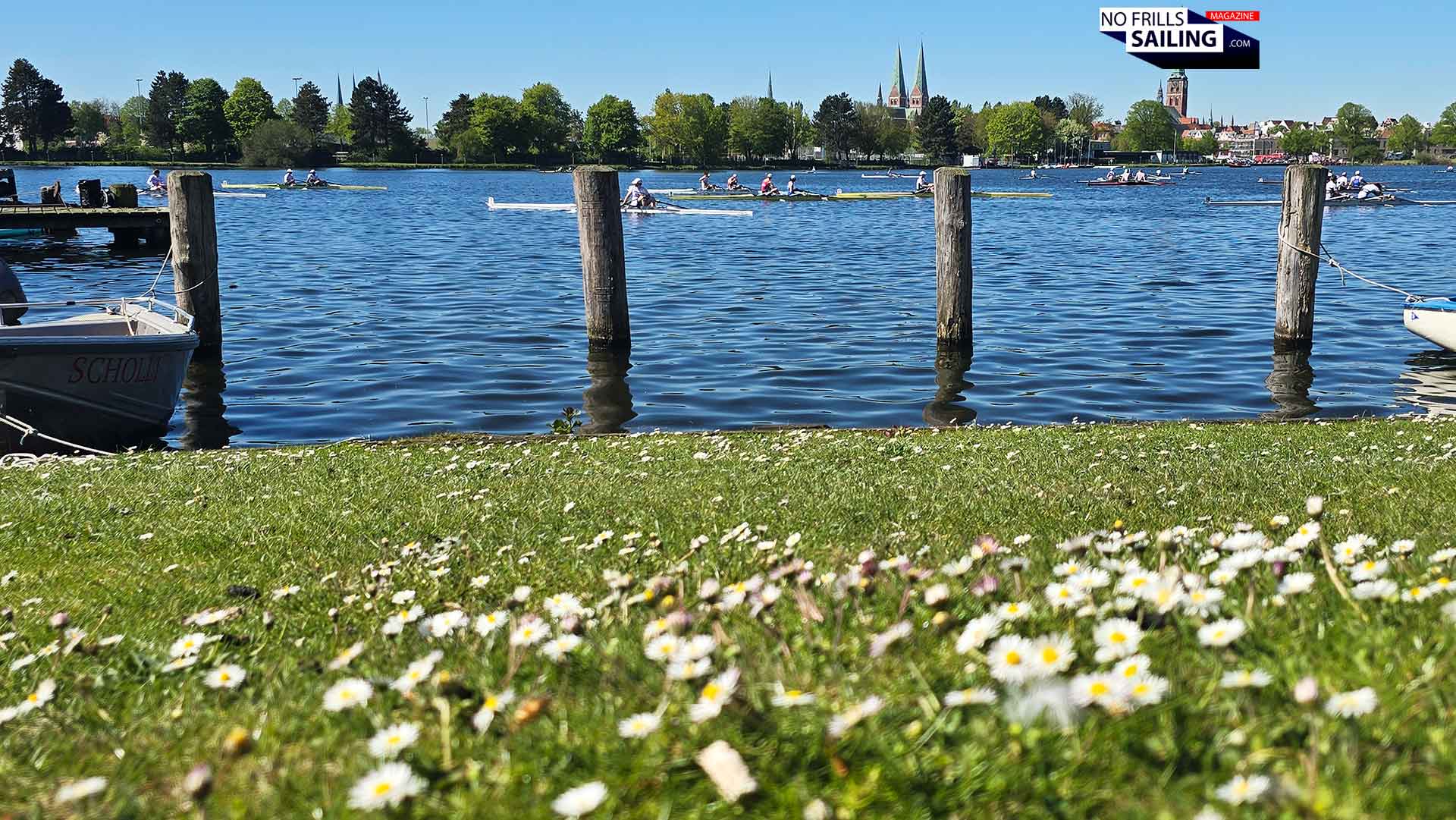
And indeed, checking the license plates and listening to the announcements, rowing clubs from all over Germany, even from far away in the south, arrived to take part. Luebeck´s old town dating as far back as to the pre-Hanse times is surrounded by partially artificial and partially natural waterways. There´s the river Trave, the old ditch of the citadel and the Wakenitz.
And here´s where the racetrack had been set up: 3.000 meters of straight sprint track for the rowers. I don´t know if deliberately of by chance, but when I was there, starting would be conducted against the wind, just as we know it from sailing races.
Action-packed excitement, just as in Formula 1
I sat down on one of the park benches, conveniently positioned exactly vis-à-vis the starting area. Here, every three minutes another new race would start. Checking on the internet, I realized that this huge event allowed for participants between 11 and 14 years only, additionally hosting a special race for university students. Bravo! Youth work is so important and will pave the way to foster characters, a humanitarian approach, teamwork and health of course. And indeed, in the rowboats I could only spot young boys and girls from that far away.
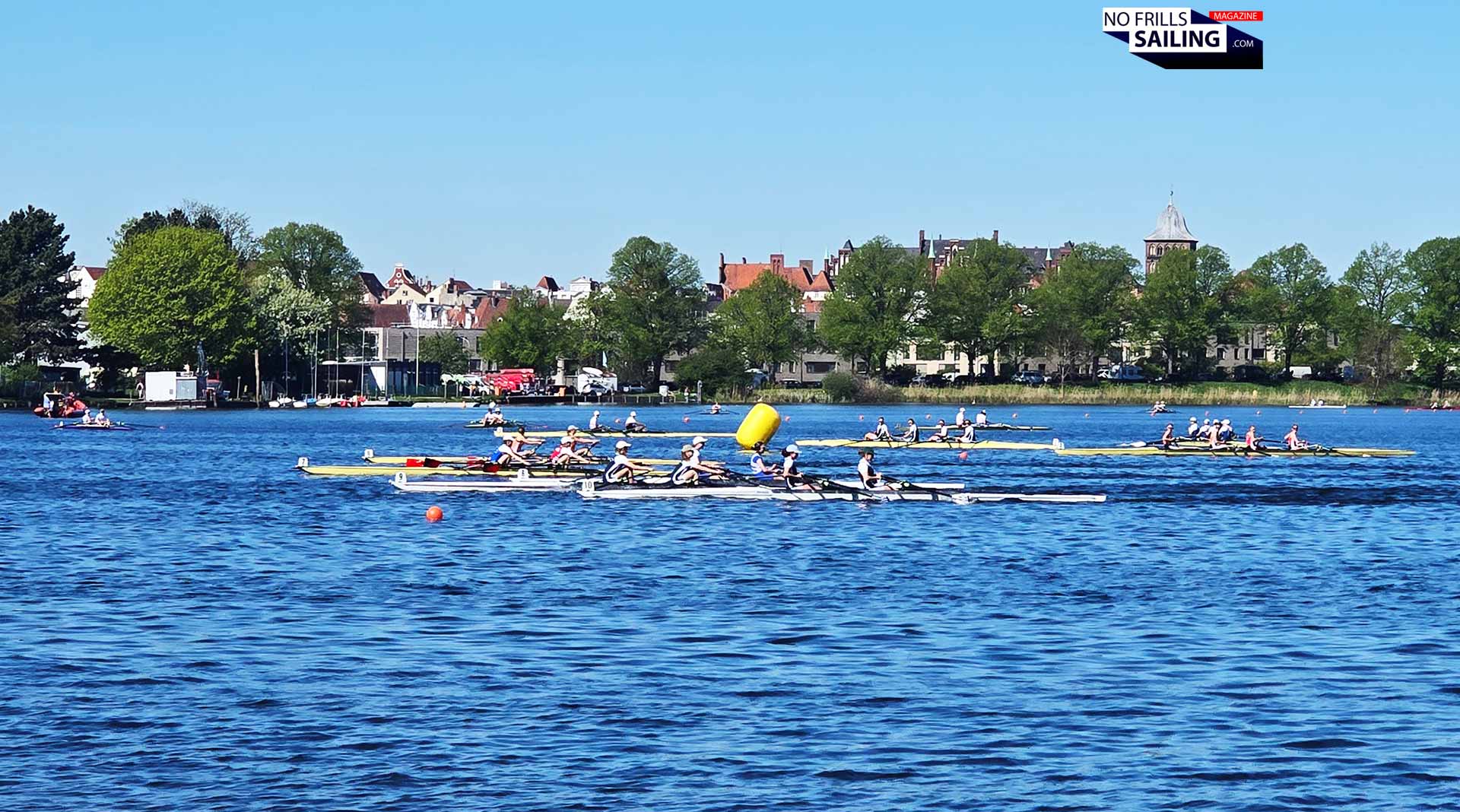
Another start – how fast they are!
The cool thing was that a loud announcement was made before every start, stating the type of race, type of boat and listing the participants. Apart from different local and regional rowing clubs, I heard the names of other Northern German cities and even those from farer to the East and South of the country. Astonishing: I´d never have thought that rowing is this big in my country! For me, this is more an English or American sport. And then, another starting signal – and the slim boats dashed forward, quickly shooting by my observation position. Wow!
The art of the start: Core rules for rowing
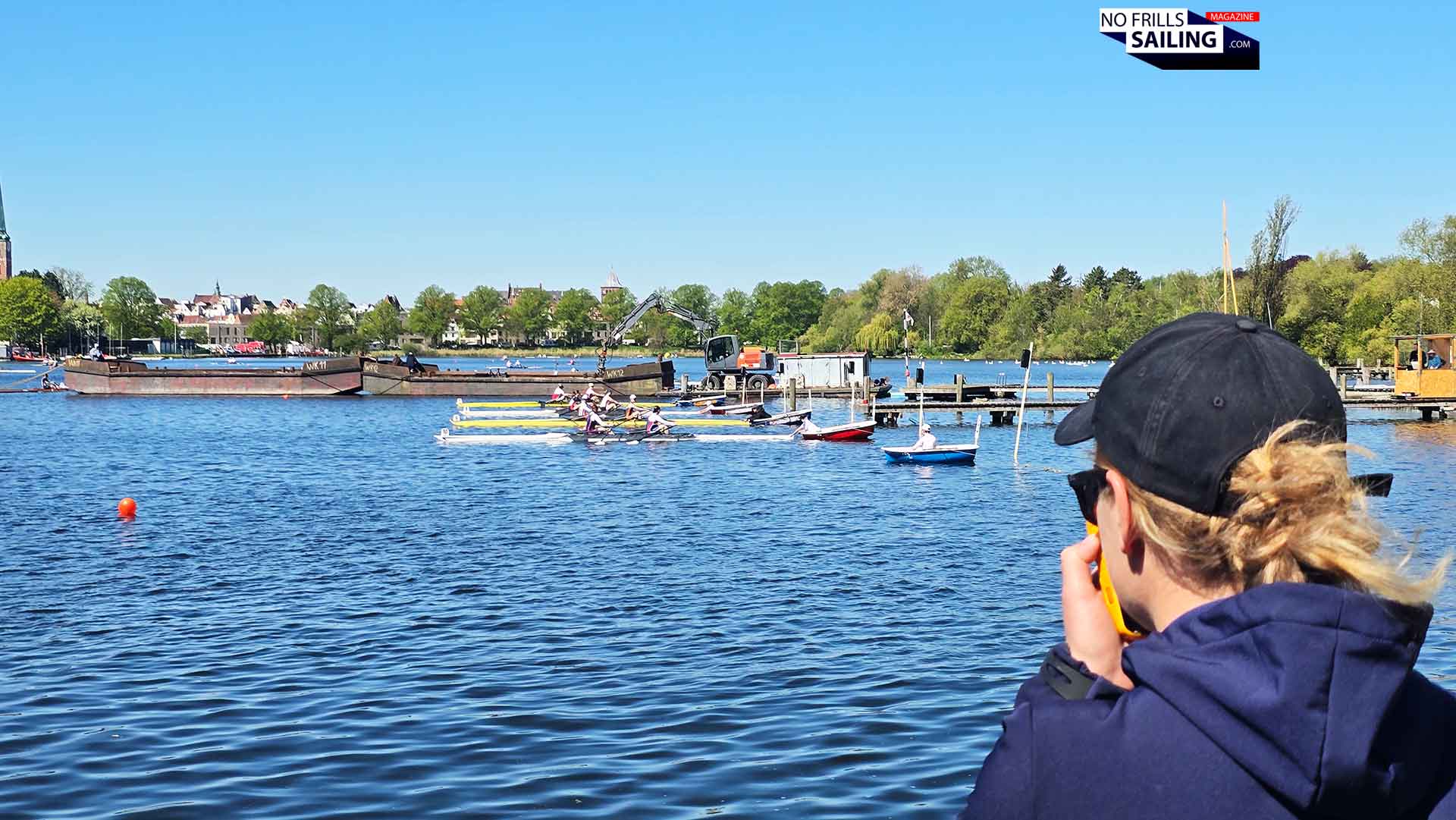
I changed my position and found an official assistant not far from my bench. I just asked her a few questions and the young lady was happy to answer – but only in between the starts. Because she was an official aide, had a flag and a handheld VHF. Apparently, it was her task to align the boats for the start so that each tip of the bow would be on the same line of sight relative to her.
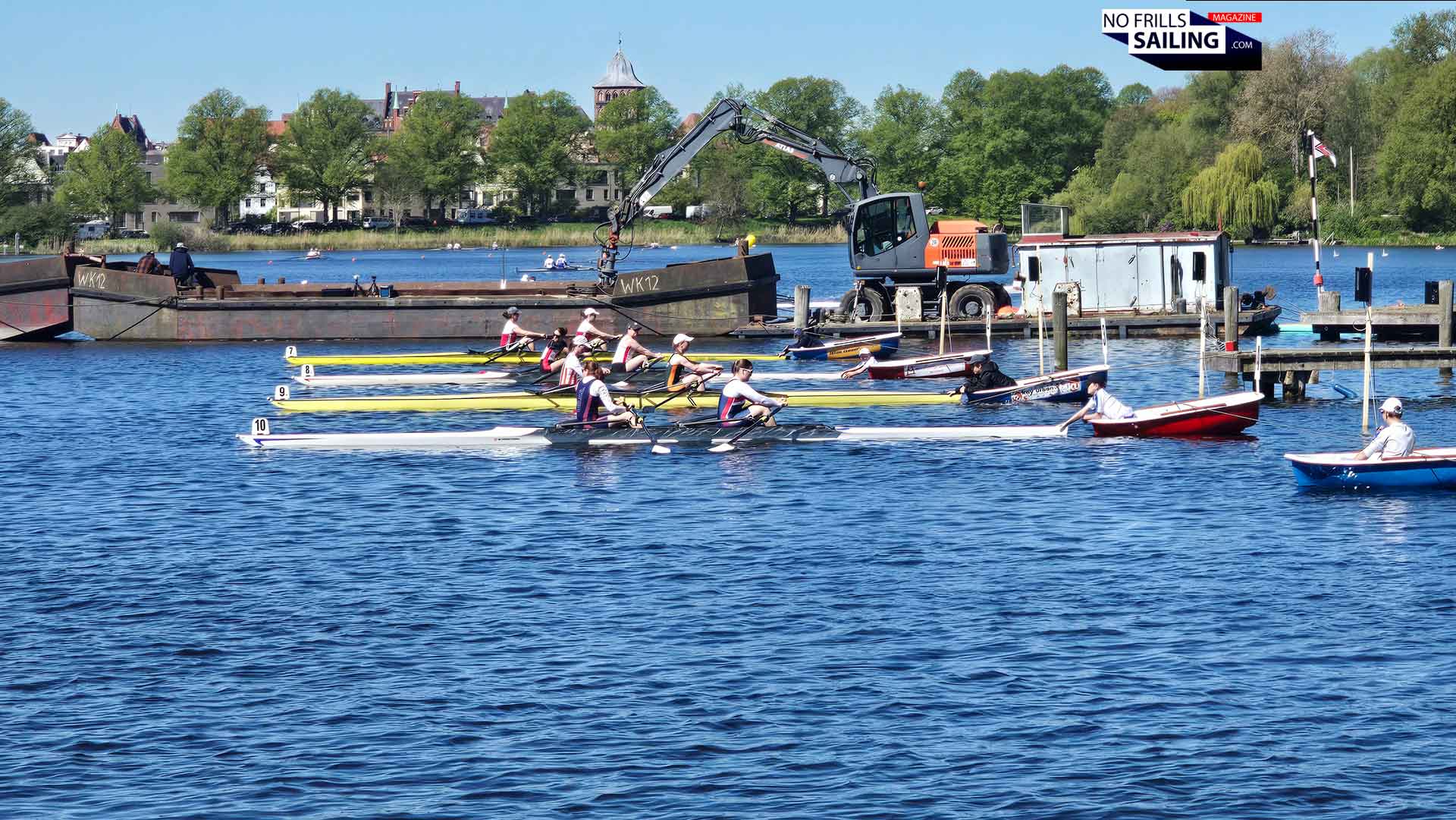
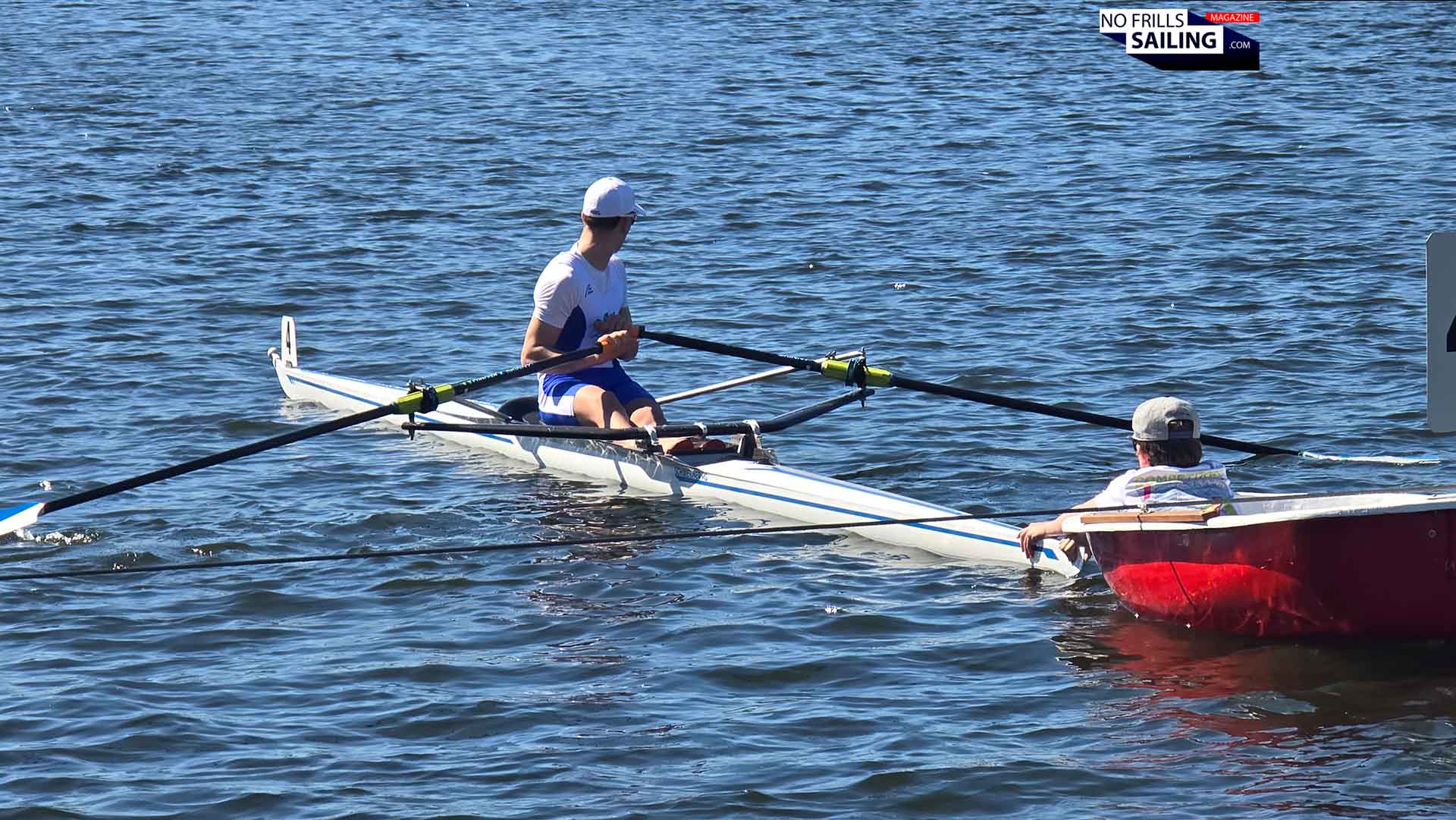
Aligning all boats for the start
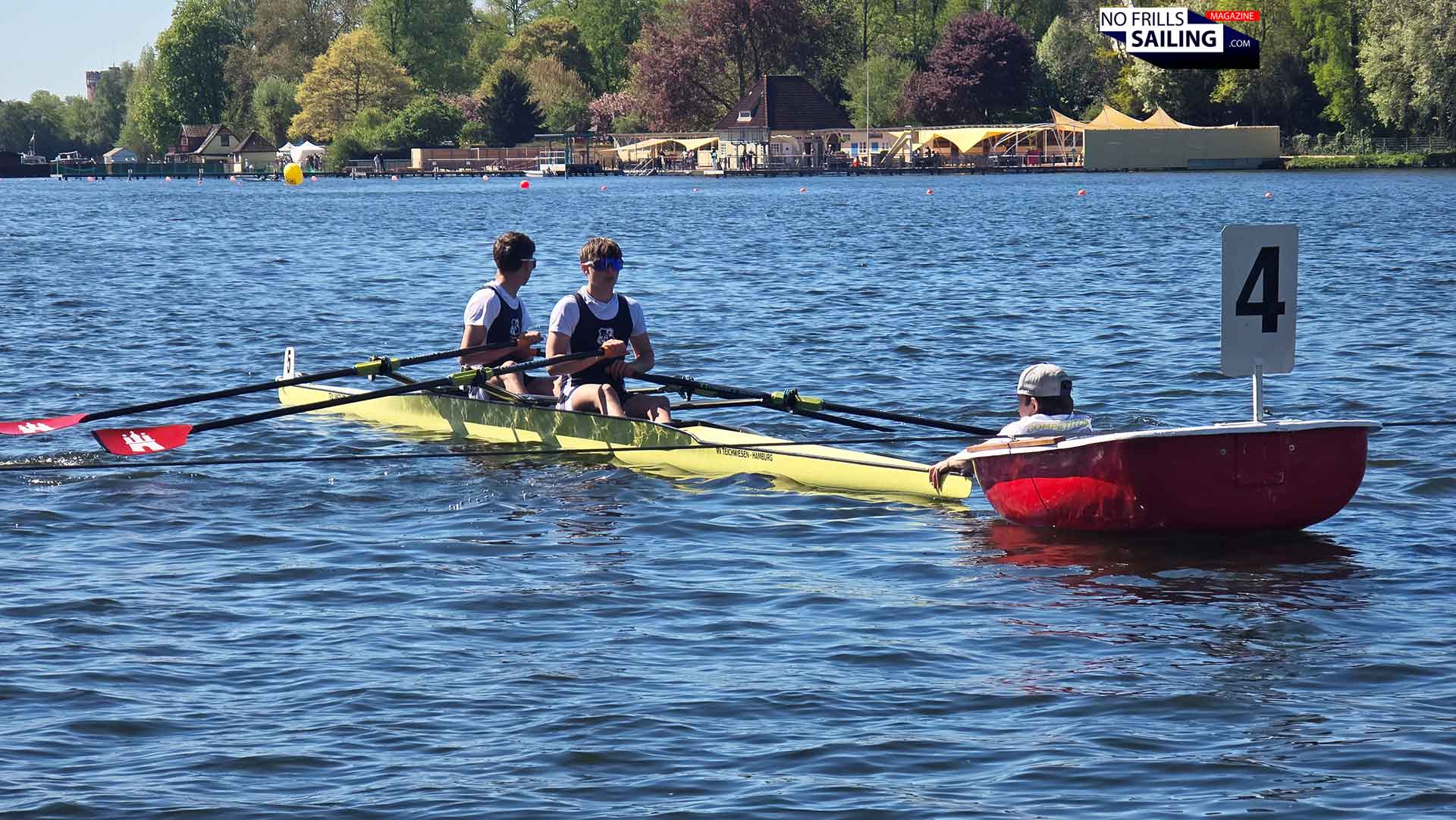
When another new race was announced, the contenders slowly rowed up to the starting line, turned their boats pointing with the sterns towards the “starting boxes” and slowly rowed backwards. There, at the end of each starting box (I know, this maybe has a certain professional term, but I don´t know it), a small dinghy was tied up to a pole. Each dinghy was manned with a start-assistant. Usually a kid, if I saw it correctly. So, we already have the starter – the lady next to me – and the “aligners”, whose job is to hold the rowboats in line and, upon request via VHF from the starter, either push or pull the boats in a way so that each one is lined up just nicely.
Now it´s just seconds to the start …
This practice usually took just a few seconds. If the line was set up correctly, she would show her flag, signaling that the sting procedure may commence. Directly behind the starting boxes a little tent had been erected on one of the jetties of the sailing club there. Inside three guys. I guess two judges and one lady announcing the starts. She would now go through the names of the attendees, after which a “get ready!” would occur. And then a single “beep”! Off they go!
What a level of acceleration!
And boy, this is what I´d call acceleration! I mean, yes, theoretically I am well aware that rowboats can reach speeds of up to 22 kilometers per hour, but I was caught completely off guard by the fact how fast these things do in fact accelerate! It took them no less than three or four strokes with their sculls (this is the term for the oars) to reach maximum speed. And let´s not forget: These are 11 to 14 years old kids! Amazing!
Holding the boats in place
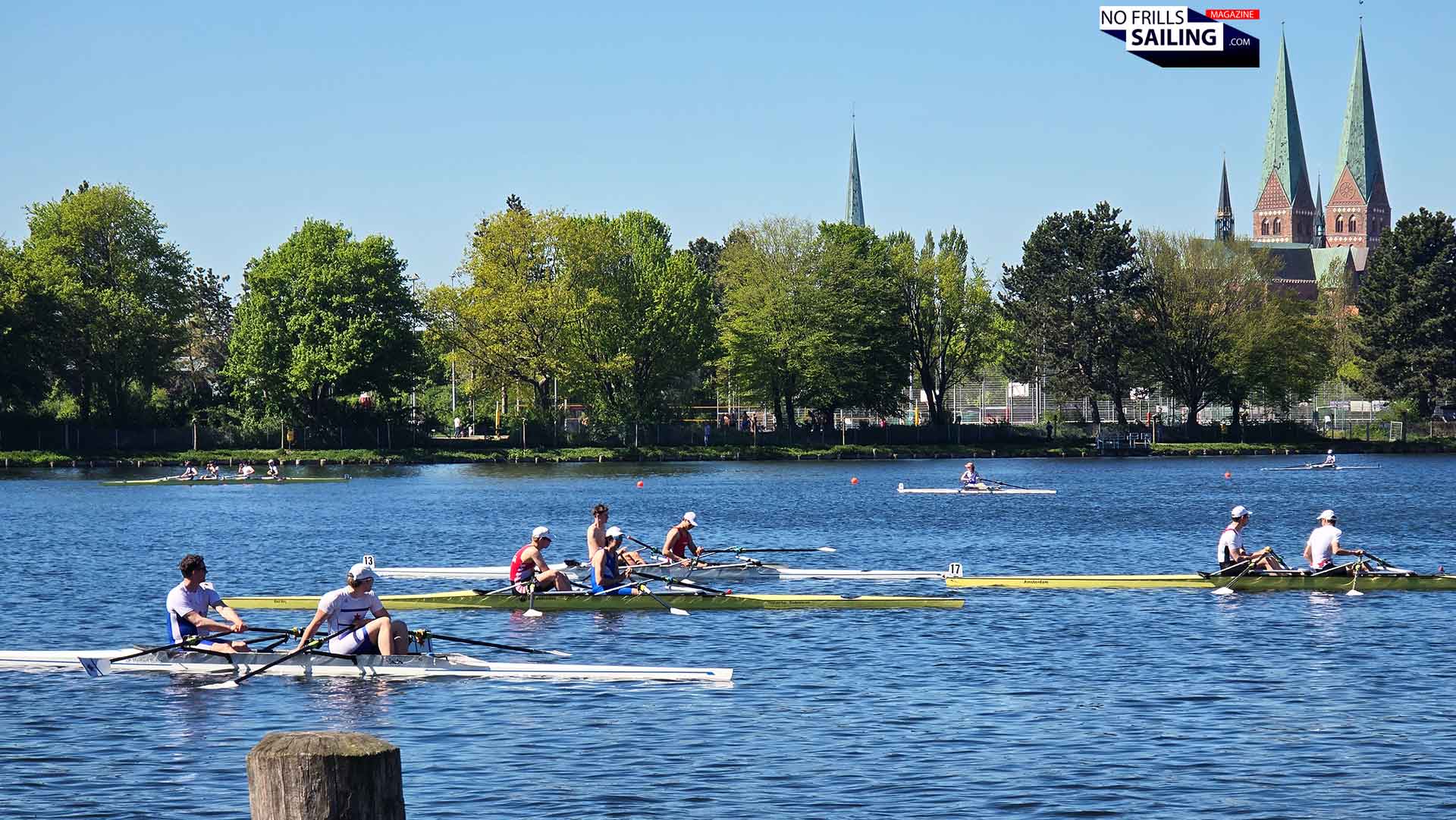
Race after race started. I witnessed single-seater rowboats, Called single, then Double Scull (same sex and mixed) as well as Quadruple Scull with four persons in them. These, of course, being the most exciting races to watch. But I can imagine that the twin-seaters are the most “fun”, because its more of an intimate teamwork between two people and the single scull being the hardest trial (or shall I say, ordeal), as you are alone, facing your opponents one on one. No matter which class went to the starting line, the tension and their concentration was palpable, even from so far away. By the way, in the meantime I sneaked myself onto the premises of the sailing club, directly behind the starting area.
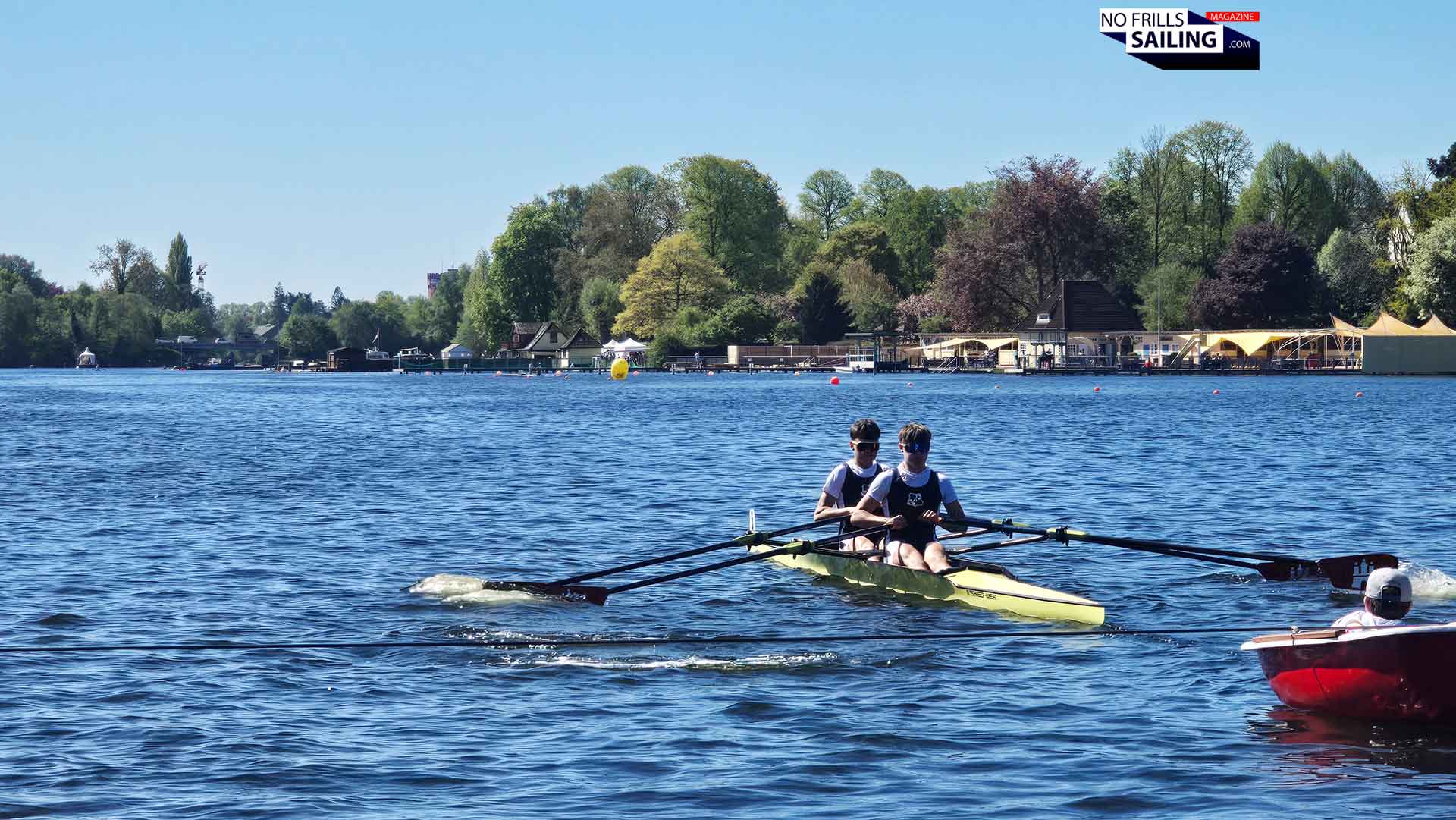
And off they go!
As it turns out, this regatta alone featured no less than 200 individual races for the kids, which I find an enormous venture to organize, track and secure nonetheless. You will later see how many people attended this event, coming into the shore team base area felt like being on a Coachella or other big open air concert. But here, on the water, it all was like a neatly choreographed dance. One by one the teams arrived, no hurry, no hullaballoo – pure professionalism. 11 years old.
Delving into regatta-rules of rowing
And off goes another race! The Double Sculls jump forward with the rowers pushing hard to reach top speed and hold this speed for the duration of the race. Standard racing distance in sculling is 2.000 meters, with exceptions. In this regatta there were long races with up to 3.000 meters race track, 2.000 meter races, 1.000 and 500 meter sprints as well. All races are pulled of as match-races: Same starting time, the fastest wins.
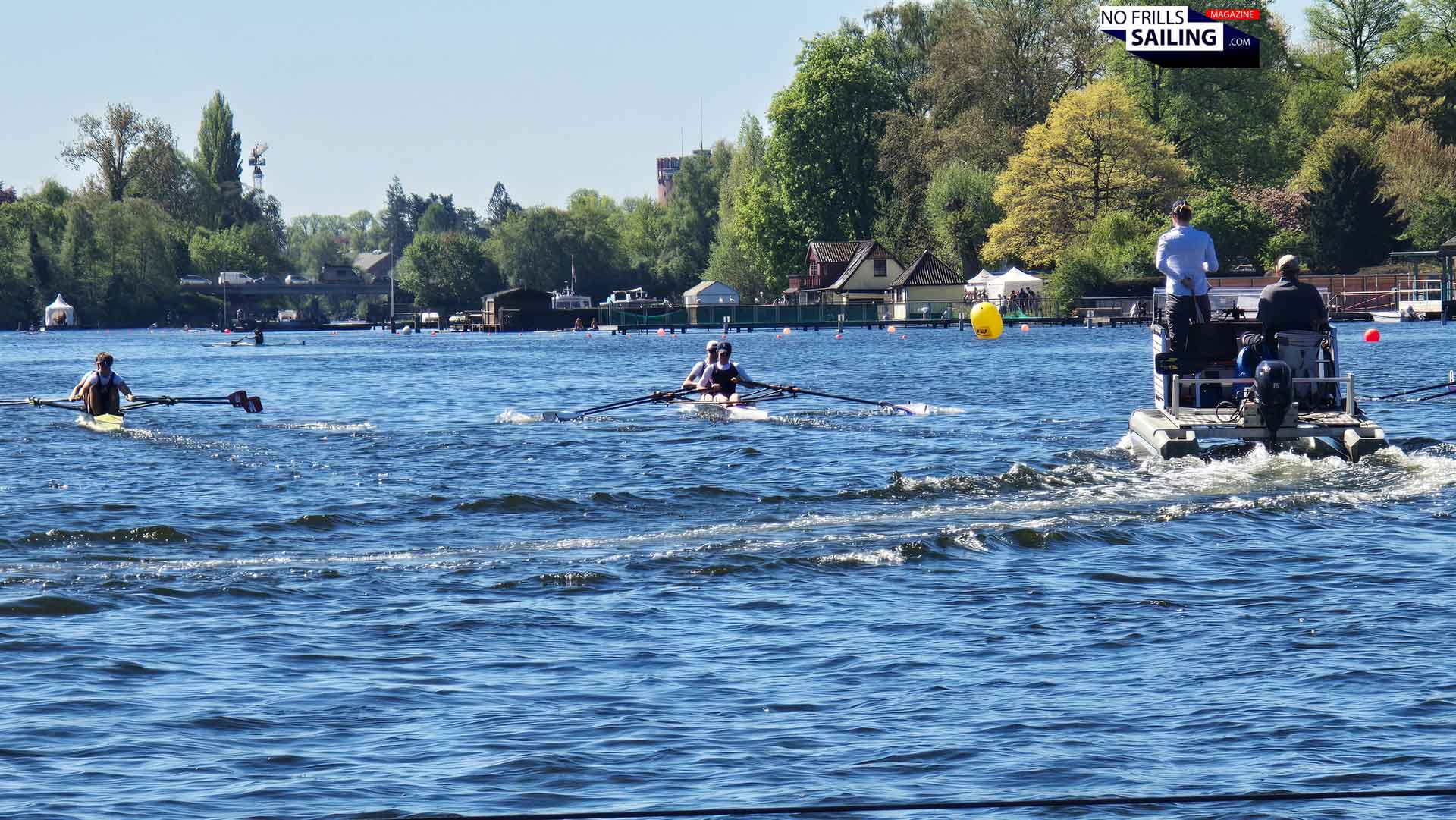
The Umpire is following
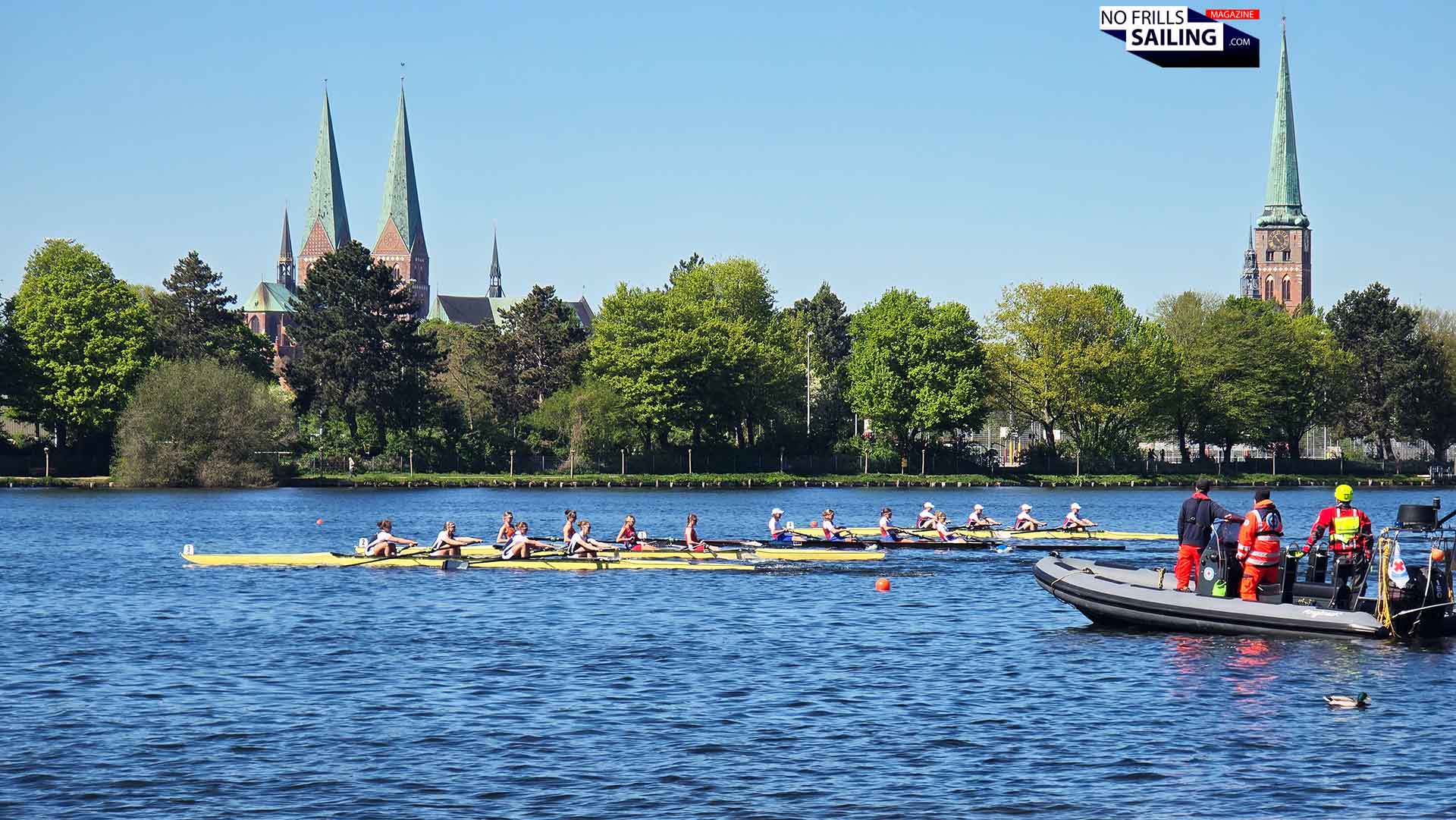
Behind every race a power boat sped to live and kept its distance. This is called the “Umpire” in sculling. You may translate this loosely with “judges”. These guys had a flag ready to raise, indicating a foul or disqualification. The friendly starter lady explained to me that in adult sculling, when rowers change from Junior to Adult, they have to take care of the due course of the boat by themselves. As a matter of fact here during this event the Umpire would announce warning and course corrections to boats if these would veer off course. Usually, that’s not done in pro-racing.
Crossing the finish … exhausted!
At the finish line a float had been moored to a pile where another set of officials would be seated. They would blow the horn each time a boat would cross the finish line, taking the time and staying in contact with the starting team. Apart from match-racing, rowing has also two other race formats: The head-race and the beach sprint. So, what do you say, isn´t that exciting? It is! And it gets even better.
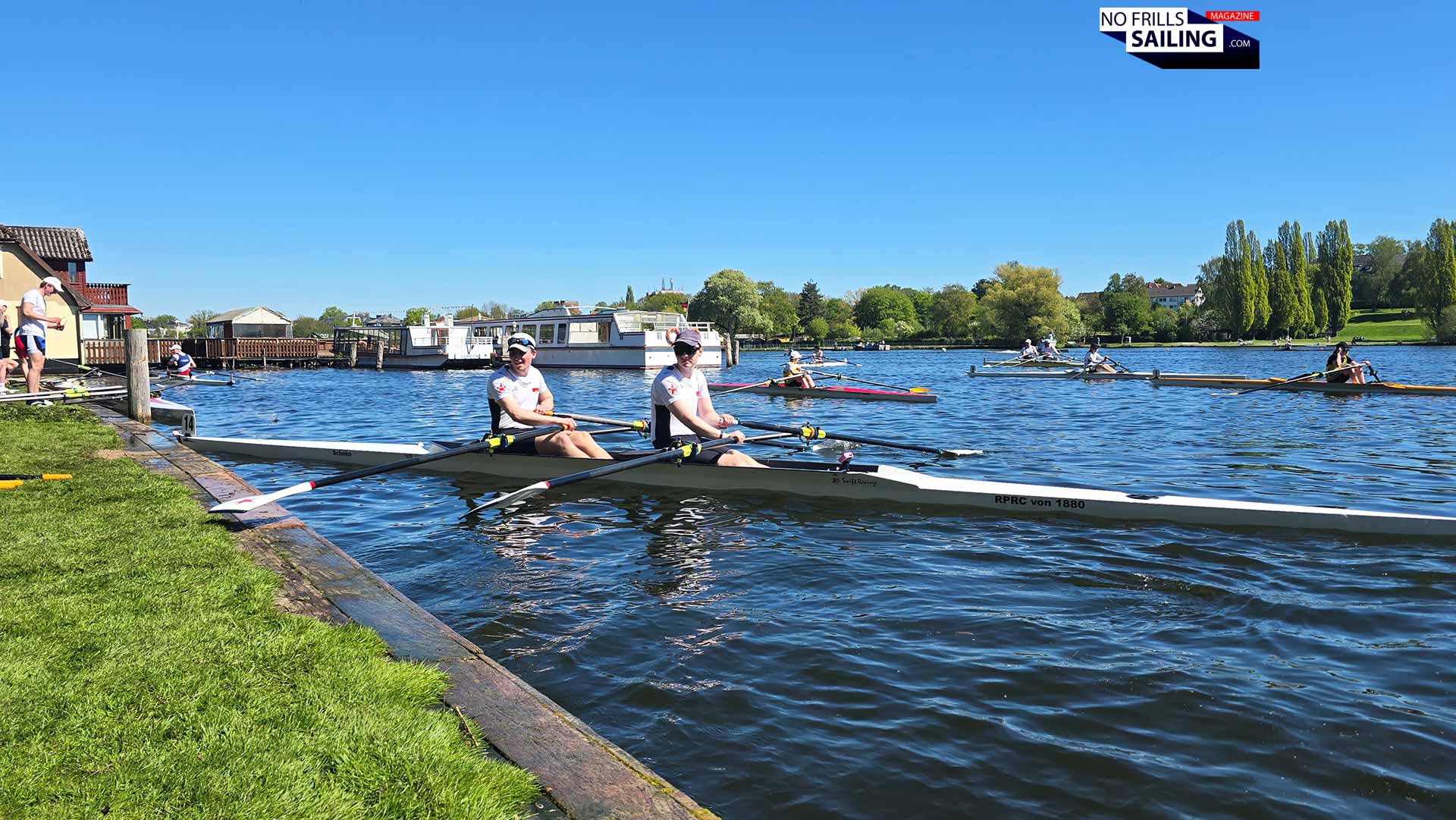
Single, double, straight-four – boys and girls
I guess we all had been engaged in some form of sports when we were kids. Me, for example, I started with weightlifting (yep, you don´t see anything of this in my statue right now, but it is what it is), then I went on to track and field athletics, followed by Judo (the only martial arts allowed in Eastern Germany) and finally found my happy place in race biking. My kids (as of course, they are Germans) tried out football (soccer, for my American readers) and sticked with sailing and swimming. Seeing those kids – literally at least two hundred, just filled my heart with joy!
How will I perform today?
I could watch the lonesome warriors, usually older adolescents, in their single seater boats: Great bodies, well pronounces muscles, healthy looks. Determined, focused – surprisingly professional and “adult”. That´s the power of sports right there! I also witnessed the warm and chatty cooperation of the double teams: I assume these are best friends, buddies. Girls and boys alike having fun together, chatting and laughing. And then – the same focus, the same concentration. It is right there, you can literally grab it: Partnership, cooperation and determination. Lastly, the flagships, the Straight Four.
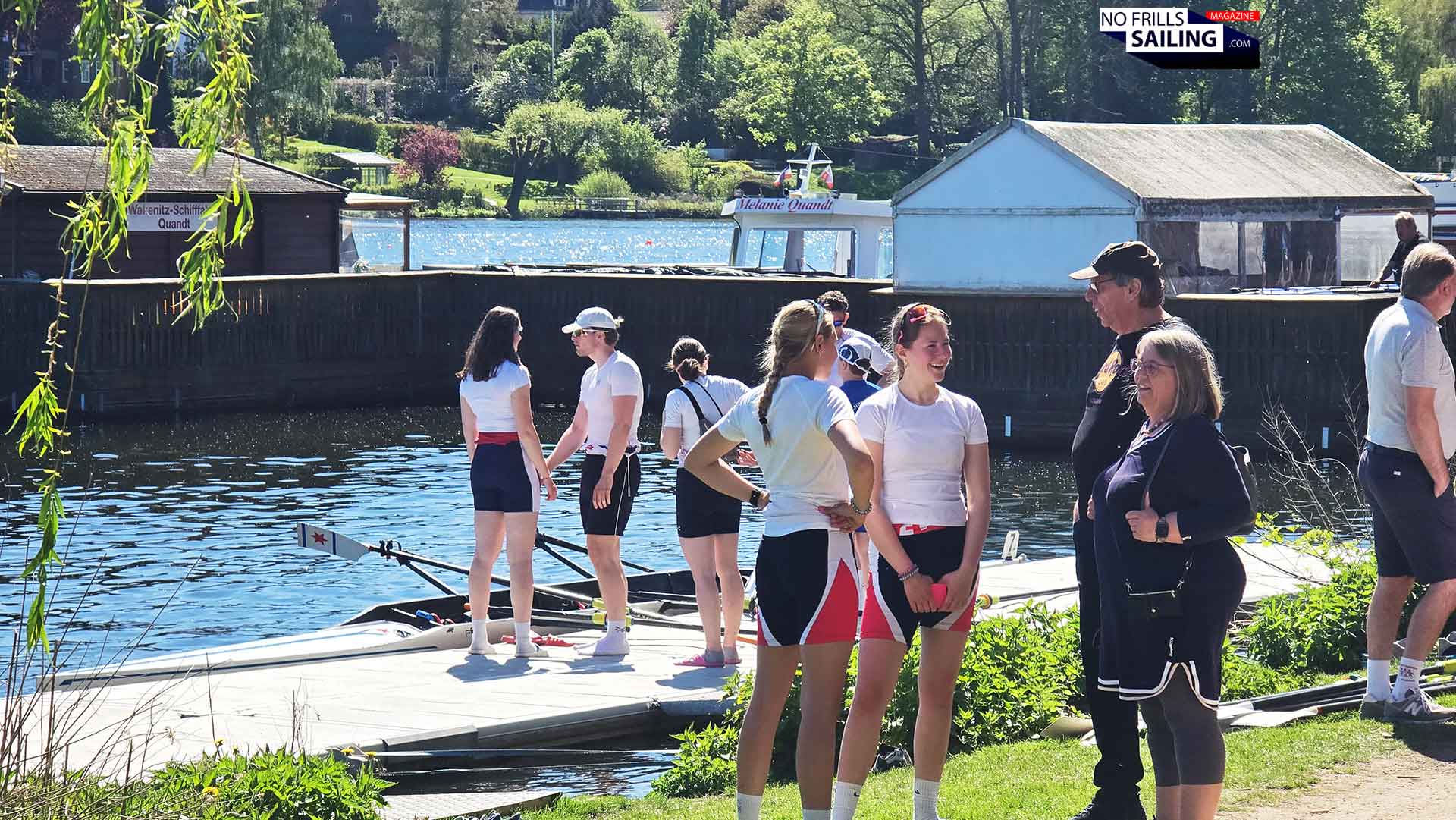
The waitng/staging area
These wonderful young lads! On their ways to becoming grown-ups, adults, but still so much embracing the easiness of a life in a breeze. Getting a taste of what its like to be competing, something their later lives will experience in manifold ways, but also what it means to achieve great things when working together as a team. And also, the joy and happiness about a race won next to being shattered and outraged when a race had been lost. A masterclass of youth work, a pleasure to watch.
What a big event for the youngsters!
After watching a dozen or so starts of different races, I left my location. I wanted to go to the event area, the “home base” of the teams. As the event is still ongoing (it´s Sunday that I am writing this article and award ceremonies aren´t up until later tonight) I cannot say for sure how many teams and how many attending kids have taken part in this regatta. But I would estimate 150 to 200 kids, for sure.
Arriving happy
I rounded the lake, passing by the waiting/staging area where the rowers would be lining up and waiting for their race to be called, and walked all the way down to the “pit lane”. This is another cool aspect of this event: It´s a huge, fun field trip!
Summer atmosphere field trip vibes. Just perfect.
Right there at the shoreline the event-organizers had set up a makeshift floating pontoon where the boats could be brought into and out of the water. That´s an approximately 250 meters long jetty that was bristling with rowboats, their crews, departing crews who were slowly approaching the staging area for their next races and also arriving crews, landing exhausted after a full-speed race.
Happy kids, happy parents … great atmosphere
The atmosphere was lush, friendly. There were no fences nor any barriers: Attendees as well as trainers and parents mixed up with spectators and people who occasionally passed strolling on this wonderful day. Back from the event area, where a little stage had been set up with a seating area and the usual conglomerate of food and drink trucks, the deep bassline of sportive music was humming through the park.
Wow!
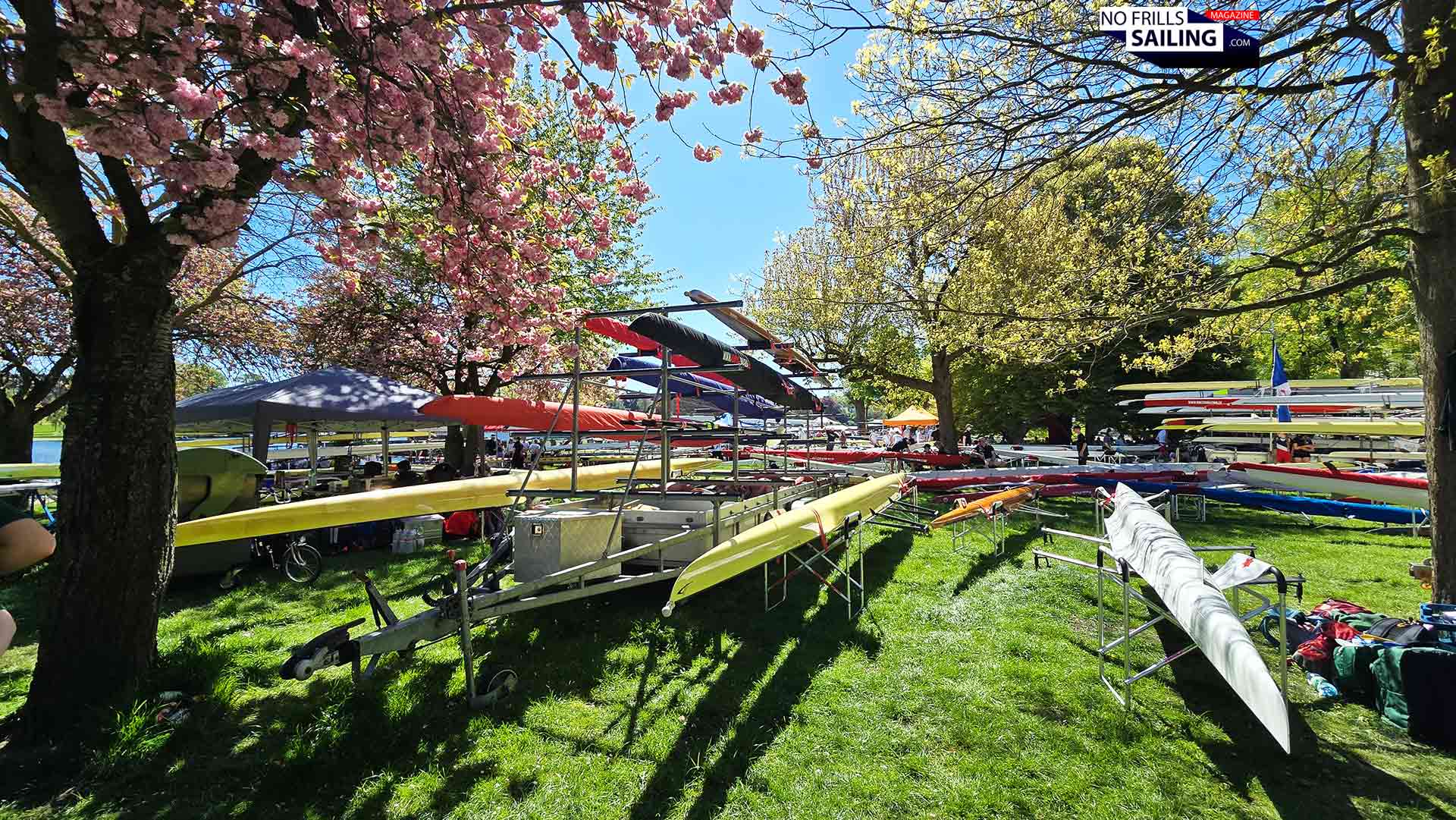
The whole park, usually a hot spot for Luebeck´s people to sunbath, take a swim in the lake or just sit down and having a picknick, was filled up to the brim with boat trailers and hundreds of these needle-thin racing rowboats. Apparently, each rowing club had their dedicated parking space for the trailers and a socializing area: Sun tents, seating and some even with their own BBQ-stations and ice cold drink dispensers.
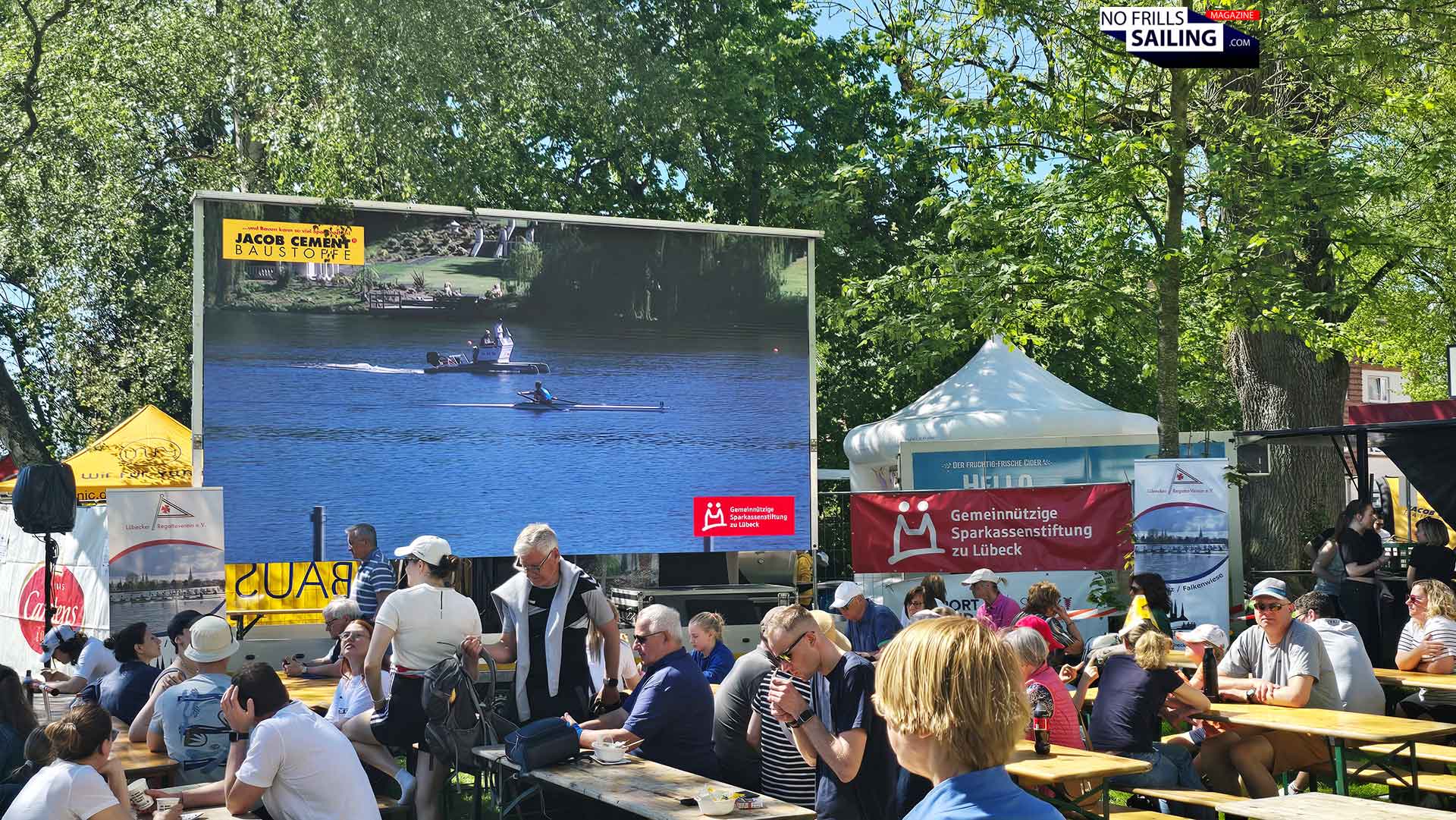
The event arena with live streaming
The event “arena”, let´s call it, was filled with people. A DJ gave his best and on a big LCD screen a live broadcast showed a drone-feed and different camera angles: That is quite some technical professionalism here, chapeau! All in all a very nice, lush and welcoming atmosphere, certainly very cool for all the kids who had the chance to meet like-minded from all over the country. As it turns out, many of them had their sleeping quarters in school gyms of surrounding schools nearby. Isn´t that cool?
Taking a closer look at modern rowboats
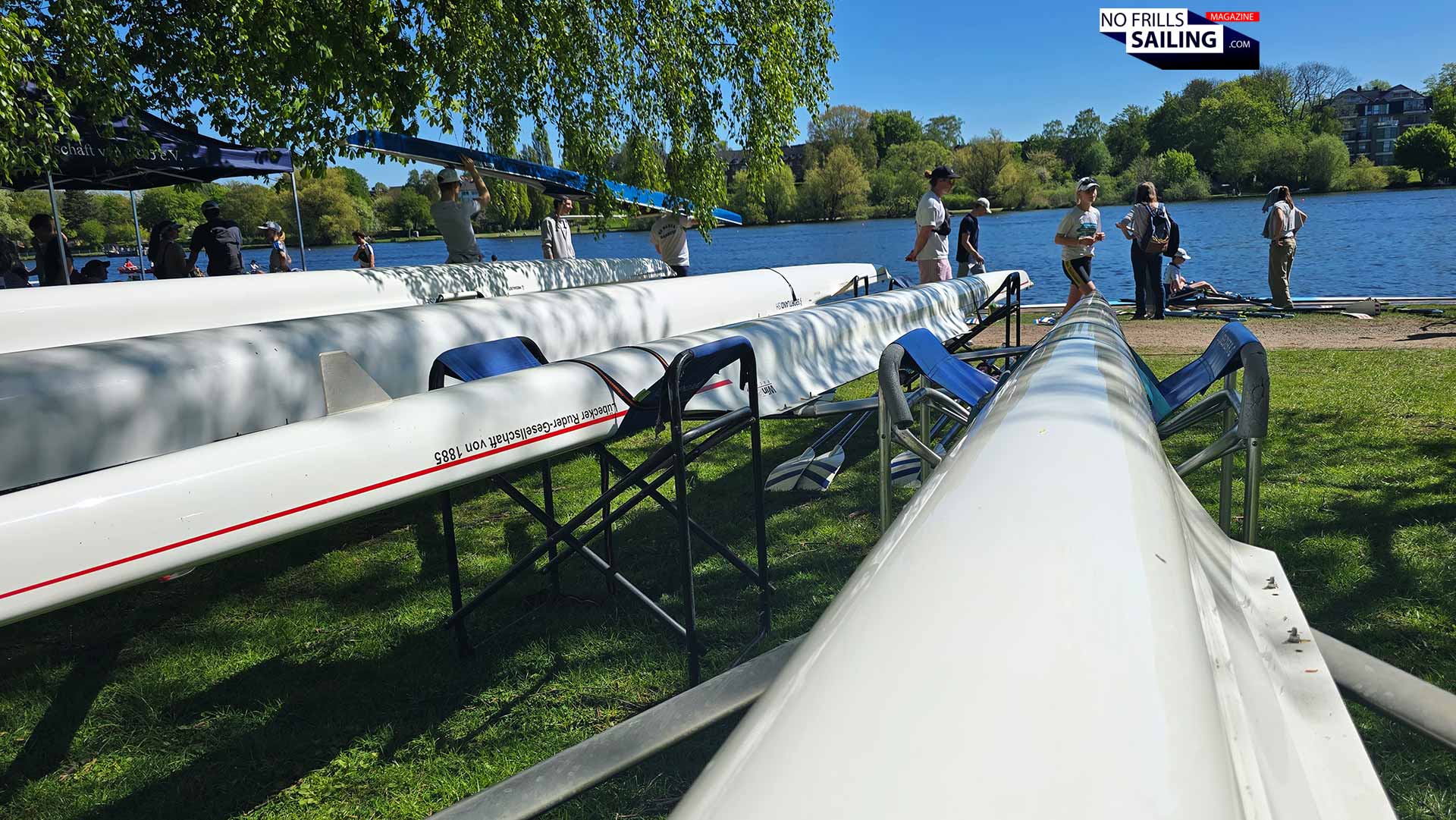
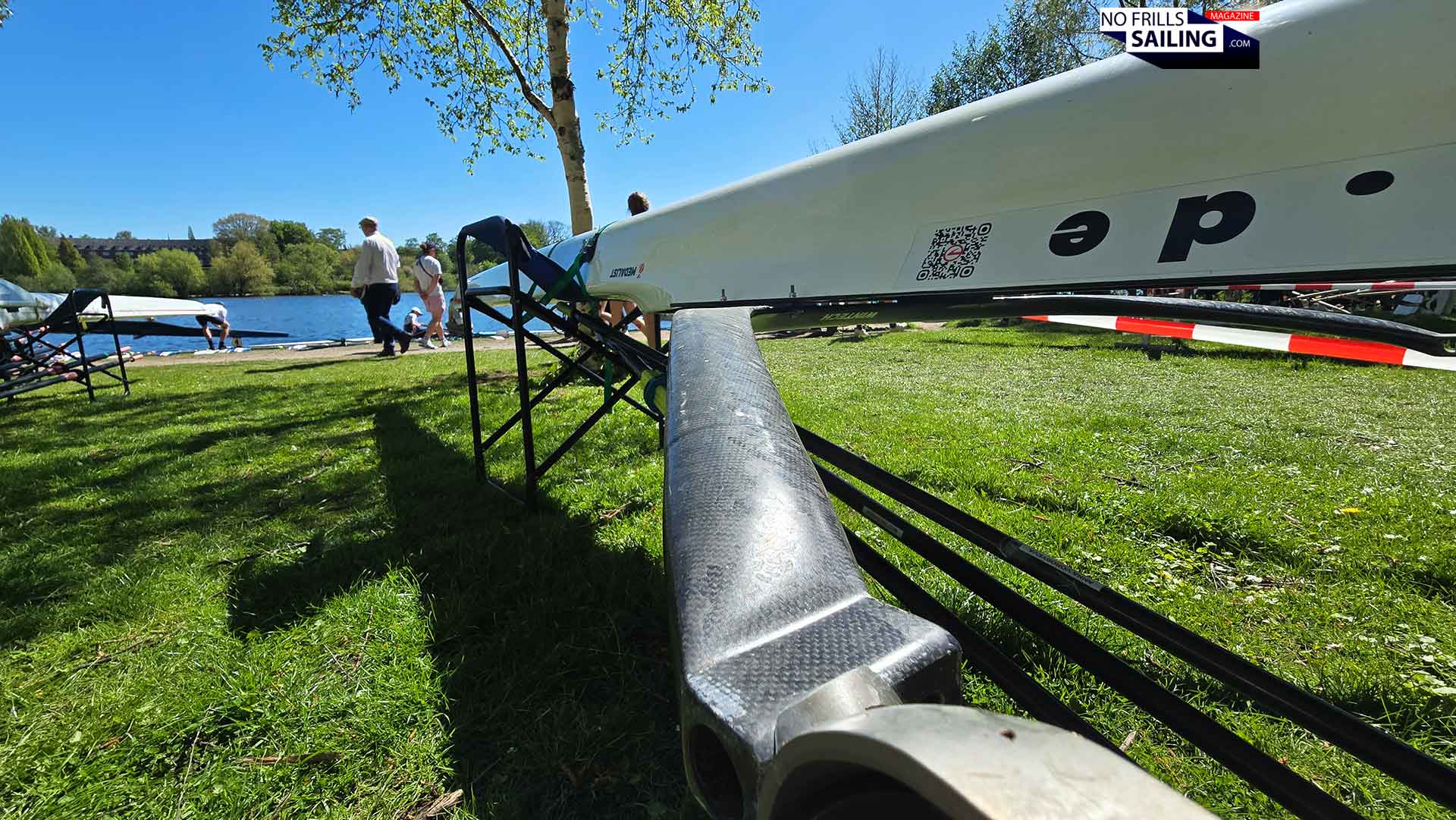
Being here anyway, I could not hold myself from taking a closer look at these rowboats. So I asked one of the clubs if it was possible to take some pictures: “Of course, go ahead!” And so I did. As it turns out – quite the opposite from what I had initially thought – rowing is not a sport where the richest kids get the best equipment. A rowboat must not be tuned to lightweight, something I supposed, maybe that´s something I still have in my head from my old race bike-times. So there´s a minimum weight for each class of boat: 14 kilograms for a single, 27 for the double and 52 kilograms for the quadruple scull.
Closer look at the boats
Although there is carbon fiber utilized to make these boats, if your scull weighs less than the minimum required weight, you have to add lead or sandbags until you´re there. This makes sense: In rowing it´s about the strength, technique and coordination of the crew that should decide a race, not the most lightweight built boat. Sounds logical to me. Ah, there are also weight limitations for the crew members as well: In the “lightweight” adult class, the individual member cannot be heavier than 72.5 kilograms, the average of both (for a twin) must not be greater than 70 kilograms. For lightweight women it´s likewise 59 kilograms max weight for individuals, crew average of 57 kilograms. That said, this sport also enforces a strict diet, I guess …
Carbon fibers …
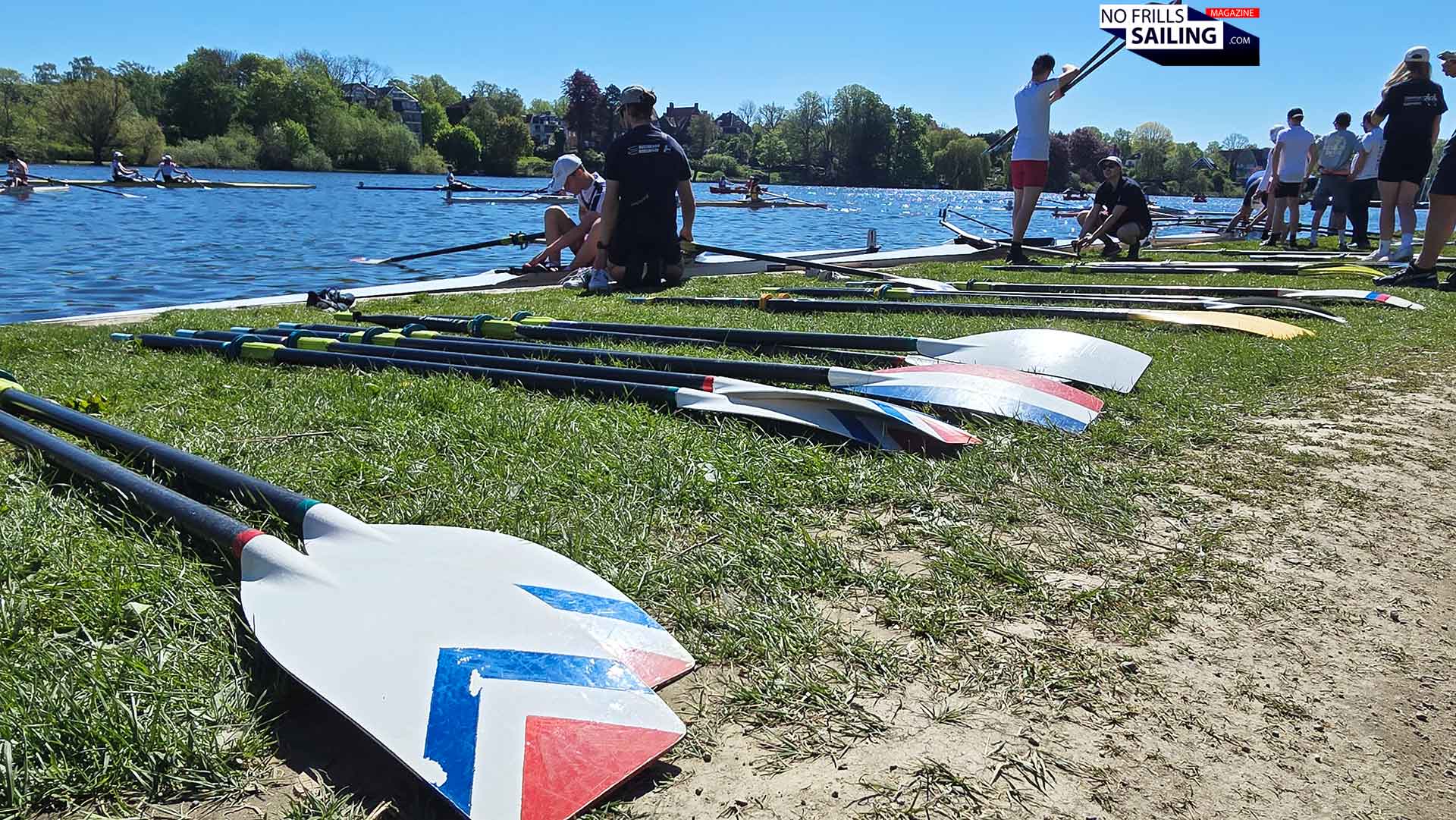
Same goes for the oars. I don´t know if adult oars are different from the ones utilized by these juniors, but a standard rowing oar in sculling is also a standardized and pretty interesting piece of equipment. The hollow shaft is nowadays usually made from stiff and lightweight carbon fibers, the blade, also called “the spoon”, is consists of a foam-fiber-sandwich laminate. These can be GRP or also carbon fibers. I´ve seen different shapes, even angles of mounting. I guess rules allow for more freedom here.
Carbon oars
All in all it is indeed a very technical sport – keeping the balance in these needle-thin boats alone is an act by itself! – but not all-too technical. The rules are meant to ensure a kind of same-level approach so that the quality of the material (meaning: the money to spend) is kept on an overall equal level. As I said, body strength, technique, stamina and coordination is what makes a winner, not the material and certainly not the budget of the club. I quite like that: It´s exactly the opposite from our biased prejudice from the beginning of this article.
Advertisement
Not a sport for snobs, not at all!
Nope, it is definitely not. I was walking by for a second time earlier today and the regatta was still in full swing. Happy, exhausted, rejoicing young people, having fun with themselves and with each other; likewise happy and proud parents, trainers and helpers. It´s such a joy to see such a big come together. More so in a world that often seems so dull, filled up with stupid TikTok-zombies and disillusioned, demotivated youngsters. It makes my heart jump as a father myself and I am certainly happy for all those kids, having a great time.
Is rowing cool for your kids as well?
Hosting such an event suits a city like Luebeck. It´s a great occasion to show off the beauty of my home town, especially if the weather is spoiling us with high season summer-temperatures of around 25 degrees Celsius. So, if you are a parent and you are looking for a new sports activity for your daughter or son, why nit try rowing? It seems that this is great fun, good for a healthy body and character development. Go for it!
More articles on youth work and kid´s watersports activities: