
Chapters in this post
You may have been reading my past article about my trip to London, fulfilling a childhood´s dream and visiting mighty, iconic CUTTY SARK at last. On that occasion (we stayed three days in UK´s capital city) it´s another landmark and iconic ship I´d love to write a more detailed article about: Sir Francis Drake´s legendary GOLDEN HINDE. In a way, this ship helped to shape British rule over the world´s oceans even more than the tea clipper did.

London, that be said first, did really surprise me. Usually I use the city as an airport hub, changing flights in Heathrow and enjoy a full English breakfast during the 40 minutes free transfer time. The last time I spent more than this little amount here was literally 30 years ago during a student exchanges. Thanks to my fiancé, who wished to come here for a little city trip, I kind of re-discovered this wonderful, surprisingly clean, modern, Brookly-vibe city. By that, of course, almost casually “along the way”, besides Tower Bridge, Millennium Wheel, the Gurken and so many things to see more, you couldn´t even miss GOLDEN HINDE.
Strolling along the Thames …
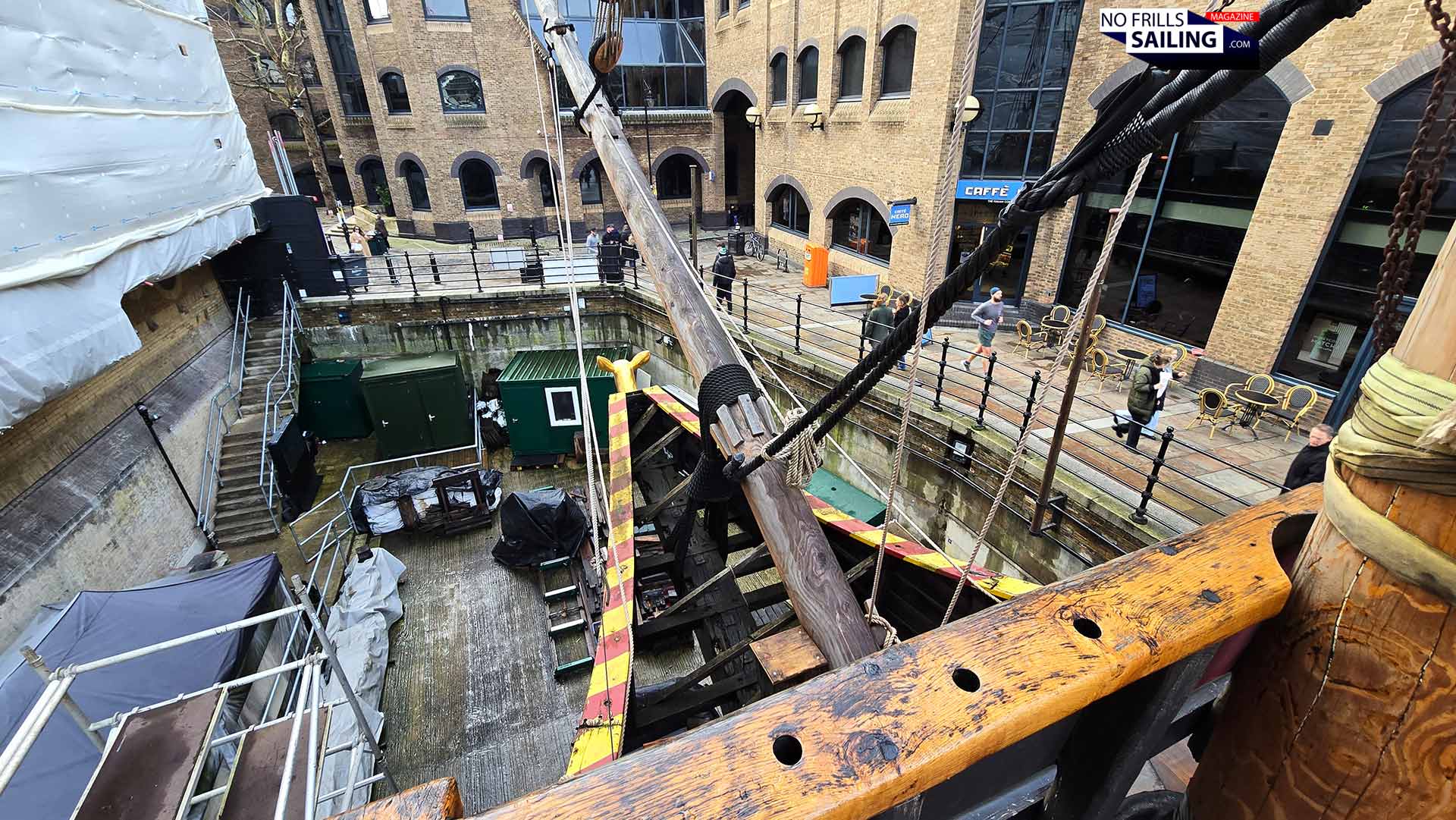
It´s not hard to find the museum ship nor is she far away. You do not have to take the tube to reach her nor do you have to walk far. The GOLDEN HINDE is located just between London and Southwark bridges on the southern bank of the river Thames. Her place is called Saint Mary Overie´s Dock, right behind a thick barrier blocking off the river to flood her final resting place. In this, she´s easy to miss right now (February 2026), as there is heavy construction going on, kind of “hiding” the ship a bit.
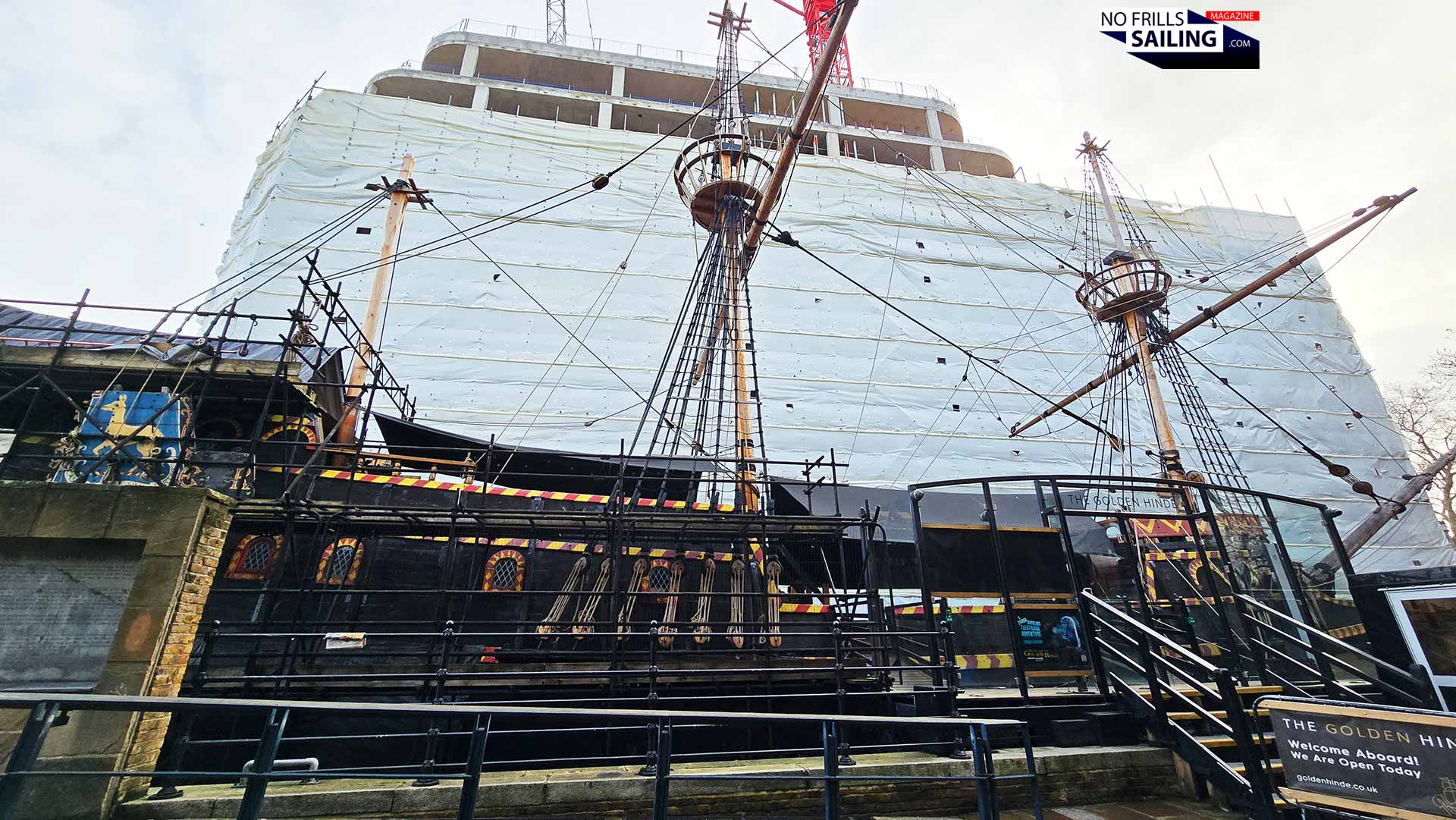
That´s also because of the fact that the upper parts of her masts and the corresponding running rigging had been taken down for renovating efforts: Unlike CUTTY SARK, you cannot spot her by her masts from afar. And then there is this awkward first reaction when you finally spot her: She. Is. So. Small! No really, GOLDEN HINDE is a very, very small ship. I knew the numbers, for sure: 120 feet length overall, 75 feet waterline. But in reality, this is tinier than you think.
I maybe somehow might have had a picture of Nelson´s VICTORY in my head, like a huge, three cannon-decked ship of the line. But this galeon, was the complete opposite. Comparing her actual size to the things she did and her impact in English and worldwide history, it´s the first real “oha!” that comes out of your mouth. But it won´t be the last for sure. So, after strolling by a few times with my partner, finally, on the last Saturday before we left, I paid the entrance fee (later more on that) and we boarded the ship. Finally.
A childhood´s dream comes true. Again.

You see, when I was a little child, I didn´t grew up reading the usual kid´s stuff: Grimm´s fairies, which is standard literature our German little kids will be read too before bed time, wasn´t exactly what was stowed in my book shelf. I grew up with Robert Lewis Stephenson´s “Treasure Island”, Homer´s “Odyssey” and many other stories about seafaring, pirates and sailing ships.I don´t know why, but somehow my parents (I suppose it was more my father´s side) made sure that the longing for the seven oceans got planted into my head pretty early.

The story of Francis Drake, a pirate becoming superstar, hero and first Englishman to ever sail around the world (and by that, the second to complete a circumnavigation ever) was one of these. He really was (like most of our “heroes” are, I suppose) a very ambivalent person. Working his way up through the ranks from ordinary seaman to captain, the early Drake participated in raids and the slave trade, interestingly one of the ships he served on was the JESUS OF LUEBECK, named after my home town.
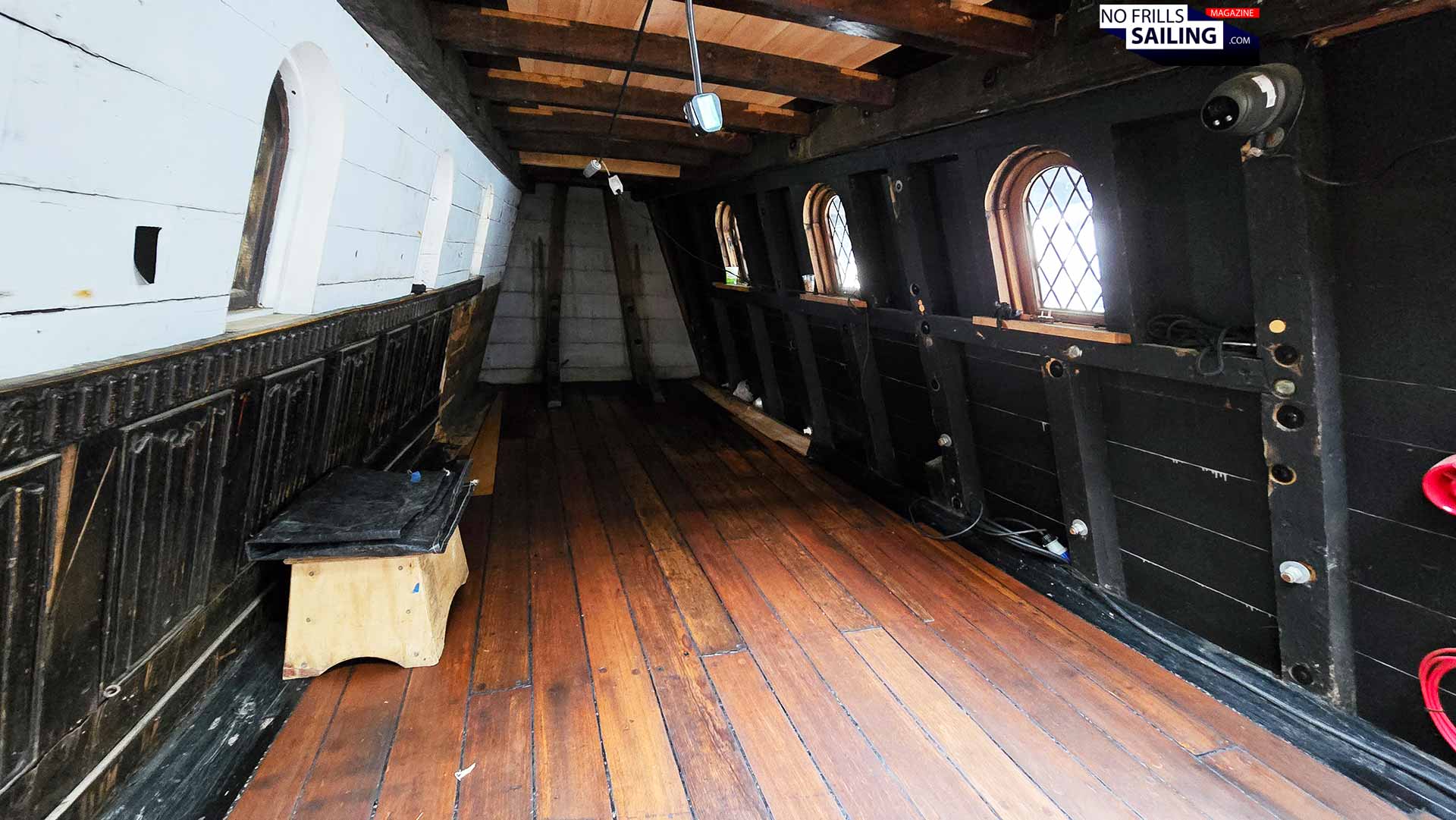
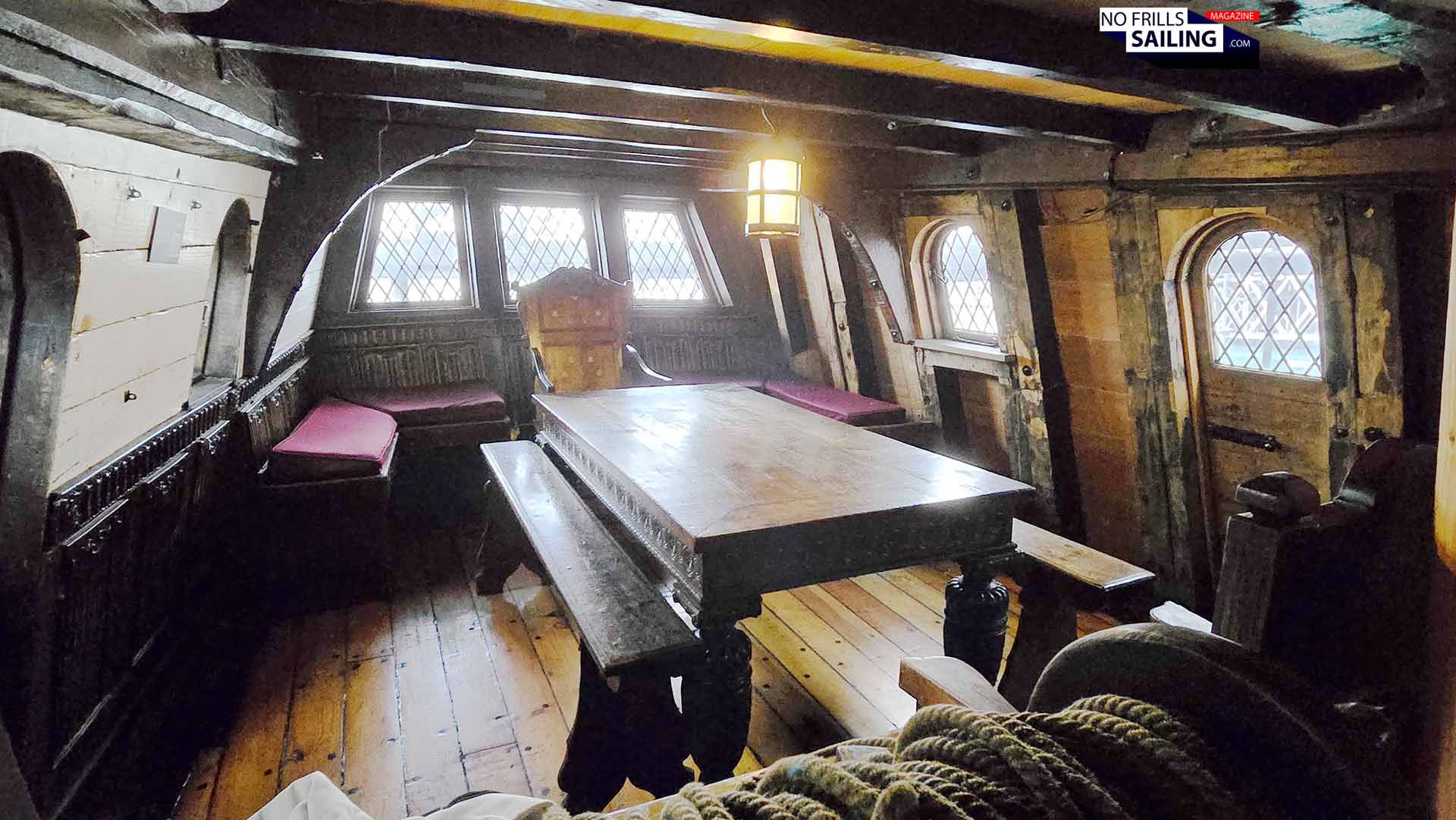
It´s a pity that the actual GOLDEN HINDE (of course a replica of the original ship) at the time of my visit was undergoing heavy reconstruction and refurbishing works. That said, most of the rear upper deck rooms were empty, except one. So we couldn´t really see how Drake might have been lived and from where he would have commanded the ship during the perilous and adventures voyages.
Sir Francis Drake´s stateroom
In fact, the cabins were empty, all but one, showing a large wooden table and some stools. I d not believe that this was the original outfit. So, what´s the deal with GOLDEN HINDE in London anyway? As I´ve mentioned, the ship you can see here is a replica. The original ship, initially christened PELICAN, in fact was proposed by then-Queen to being kept afloat for future generations to see. That was after all back in 1581. She was kept and thousands indeed went to see her (even back then!), but sadly rotted away so that her last remains had to be scrapped in 1692. She had been, at least, 100 years a London attraction.
The replica had been built in Devon, back in 1973 – which is also almost half a century ago. Utilizing traditional handcraft and building methods, GOLDEN HINDE was the product of decades of painstaking scientific and historic research. But she wasn´t intended to sit motionless in a dock. Indeed, she retraced the famous circumnavigation of Drake from 1974 till 1980, which is most fascinating. From 1977 on this very ship had her appearances in many film productions. “Swashbuckler”, a lesser known feat, but “Shogun” might be familiar for all of us. From 1981 onward she sailed around Great Britain only to cross the Atlantic ocean into the Caribbean in 1985.
Onward passing through the Panama canal (a comfort not available to Sir Francis Drake at his time) and arrived at the World´s Fair in Vancouver/Canada in 1986. She toured the US west coast, transferred back into the Atlantic ocean via Panama canal in 1988, visited many ports in the Gulf of Mexico, crossed the ocean a second time to arrive back in English waters in 1991. After another UK-tour the ship finally arrived in St. Mary Overie´s dock – where she is right now – in 1996. After a brief visit to Southampton boat show in 2003, a major refit program was put in place. From 2017 onward GOLDEN HINDE is now partially tourist attraction, partially construction site. What a story, right?
Sailing, living and fighting in the 16th Century
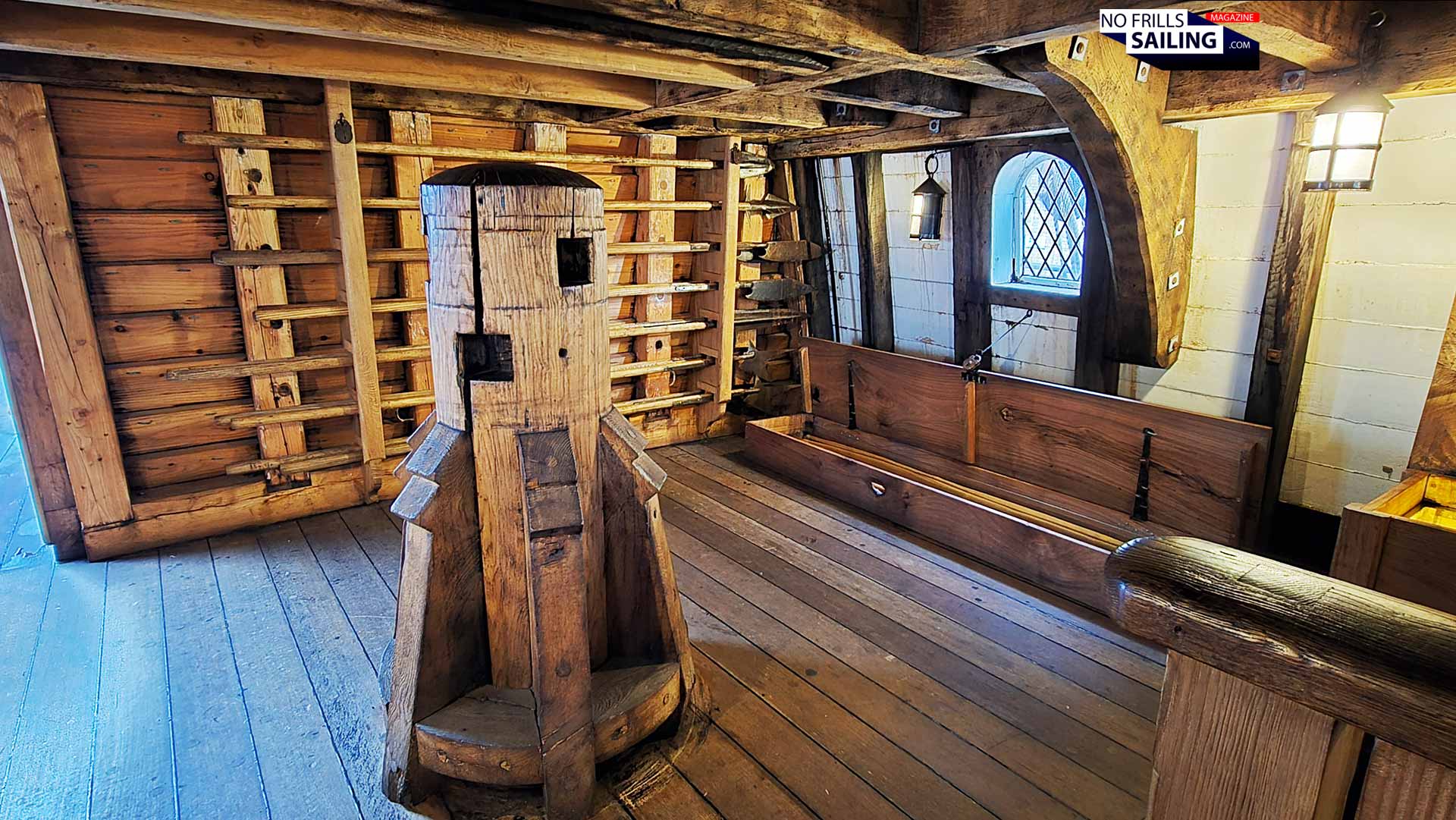
Having said that, GOLDEN HINDE might be the best interpretation of what sailing could have been like back in the sixteenth century. When I visited her, sadly, the place where the helmsman would have steered the ship was empty, as was the “great cabin”. Most of the armory was emptied as well so that I cannot show more than a mere structure. Nevertheless, the guys seem to take care of the fact that the ship is never a whole construction site really so that there was still a lot to discover.
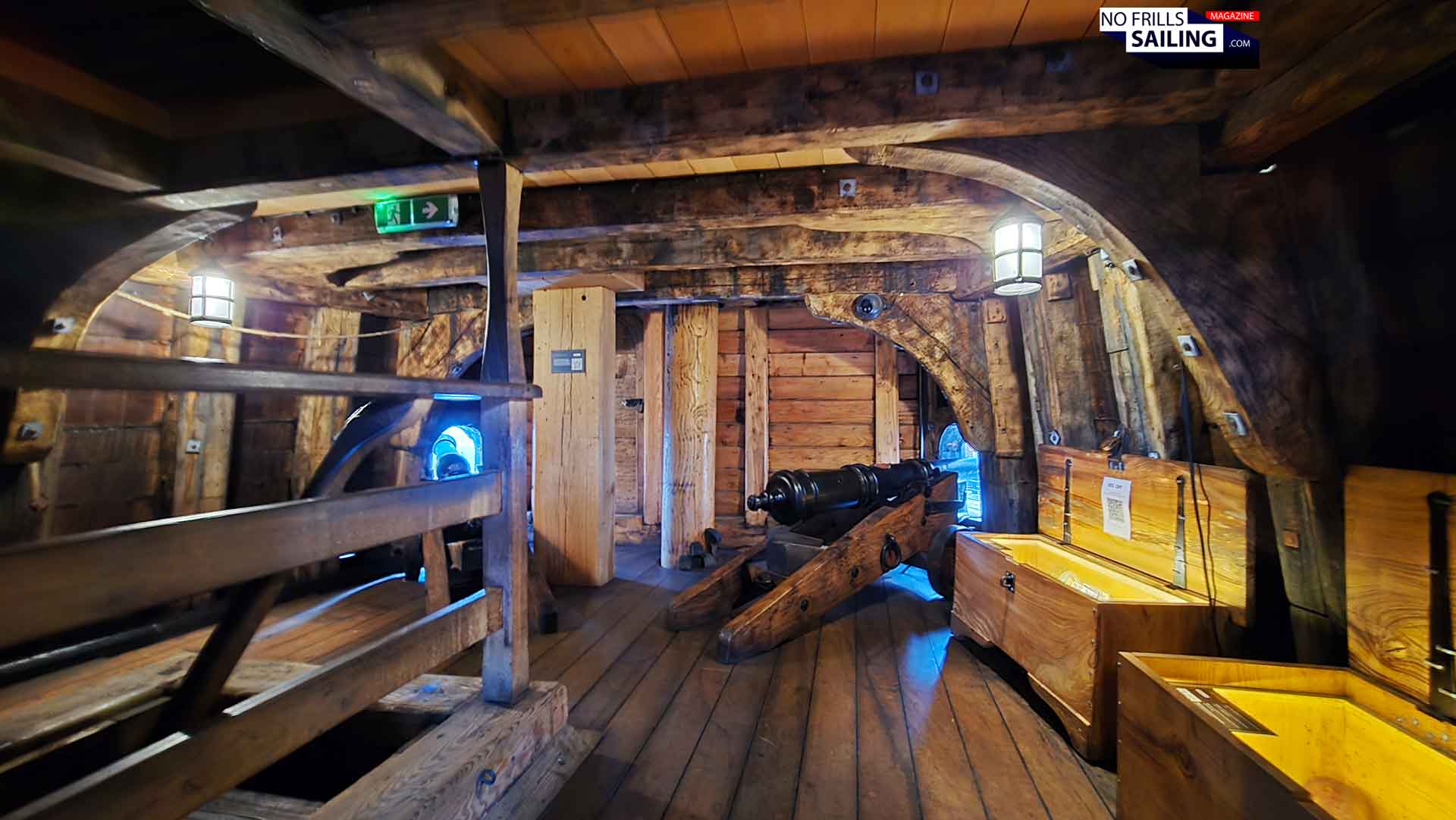
The adventure started by going down into the first enclosed deck. The gratings had been closed with thick canvas – I guess that was due to the winter months and maybe these are open during the dry summer´s months – so we were greeted with a dim light, most of the gun deck lay in half-shadows. Of course the light sources were modern LED-lamps, but a little “flickering” effect of those would have contributed to the impression of real candle-light or oil lamps, which had been in use for that time.
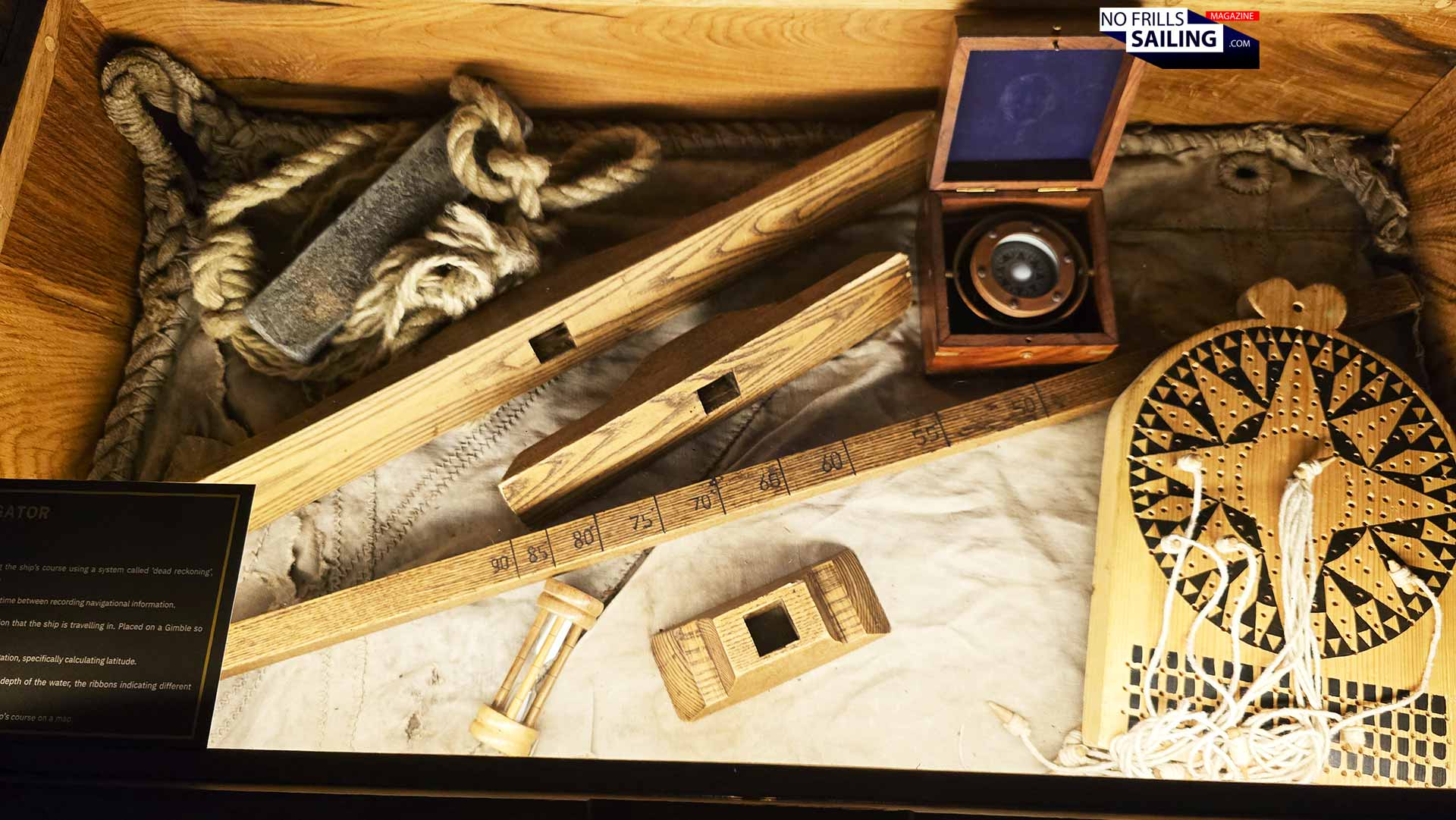
What really surprised me was the standing height down here. Or, let´s call it better: “squatting height”. I couldn´t find the exact number and didn´t bring my ruler, but I´d say the headroom of this deck is lower than 1.50 meters. Look at the picture below: My fiancé posed for reference: It´s really backbreaking! On the gun deck, parts of the exhibition for the half deck and armory were on display, for example the first navigational aides of that time: Jacob´s staff, astrolabe and a rough magnetic compass.
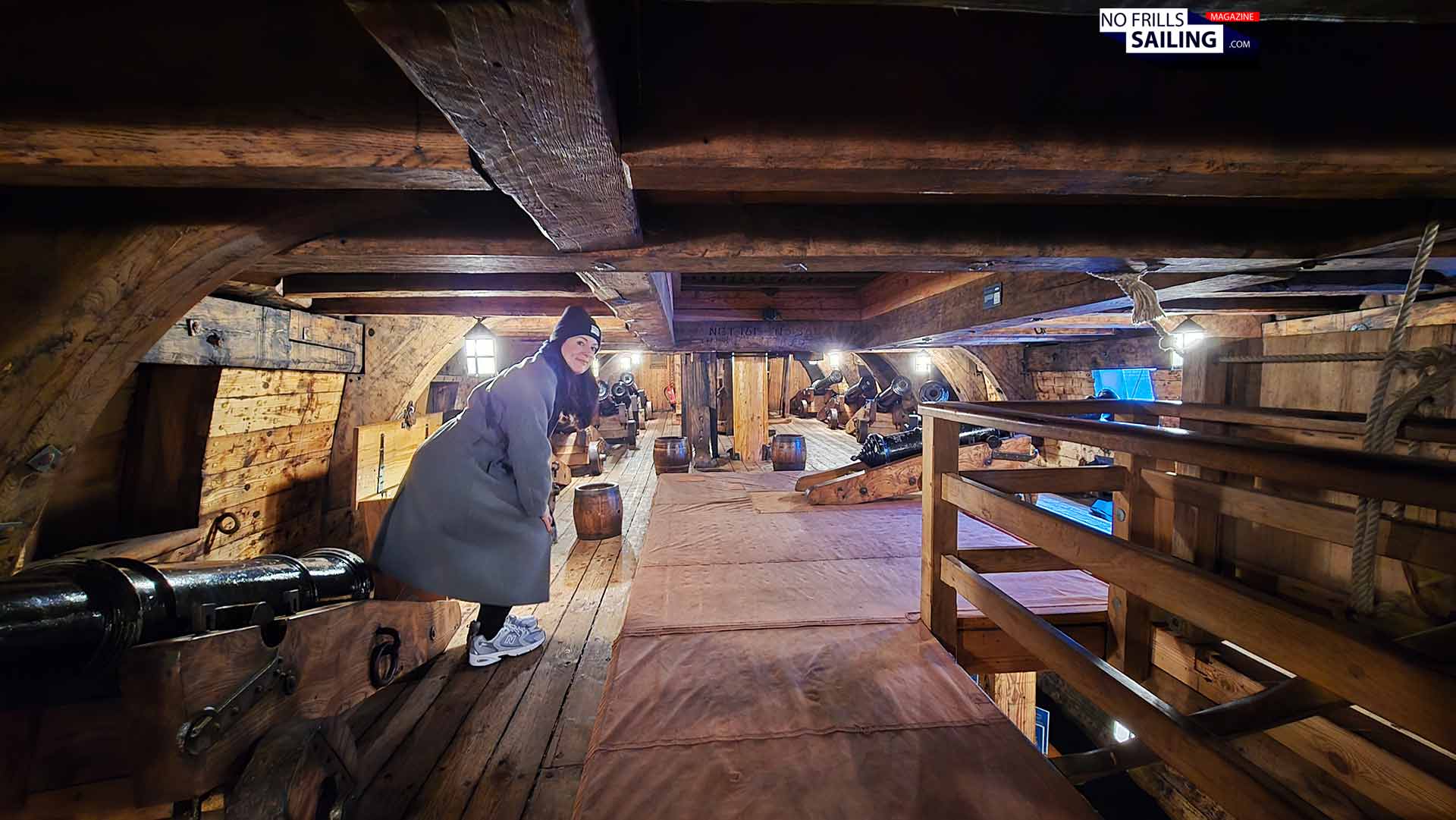
The ship carried around 20 cannons of many sizes, of which some are on display down here. It is absolutely breathtaking and mind-crushing to imagine how the crew of this ship may have lived down here. And how they have even fought in battle here! Imagine the turmoil, the smoke, the confusion! Imagine having to set up such a big, heavy cannon with a new load of gun powder and an iron ball. All the while the ship is rolling in the oceanic waves! It´s incredible. I mean, look at how she´s squatting back there?! Can you imagine?

During GOLDEN HINDEs circumnavigation, which lasted from 1577 till 1580, some 60 men are to believe have taken part as crew members aboard. That´s a lot of people cramped into this very, very tiny ship! For comparison, during the sailing trip to San Francisco (of the replica ship), only 15 to 20 men were needed to sail and run her safely. Just imagine the cramped living conditions, the awful hygiene and social implications. This all cannot be seen aboard this ship, but can vividly imagined.
Impressively built: Cape Horn-approved
As her original counterpart as well, GOLDEN HINDE is built almost completely out of timber. For the structural parts, the keel, strong, thick and very hard English Oak had been utilized. For the frames, Elm trees had been cut and put together to form the skeleton for the ship. Deck planking has been made out of Rine and Fir trees, as this timber was also used to make the masts. But that posed a problem …
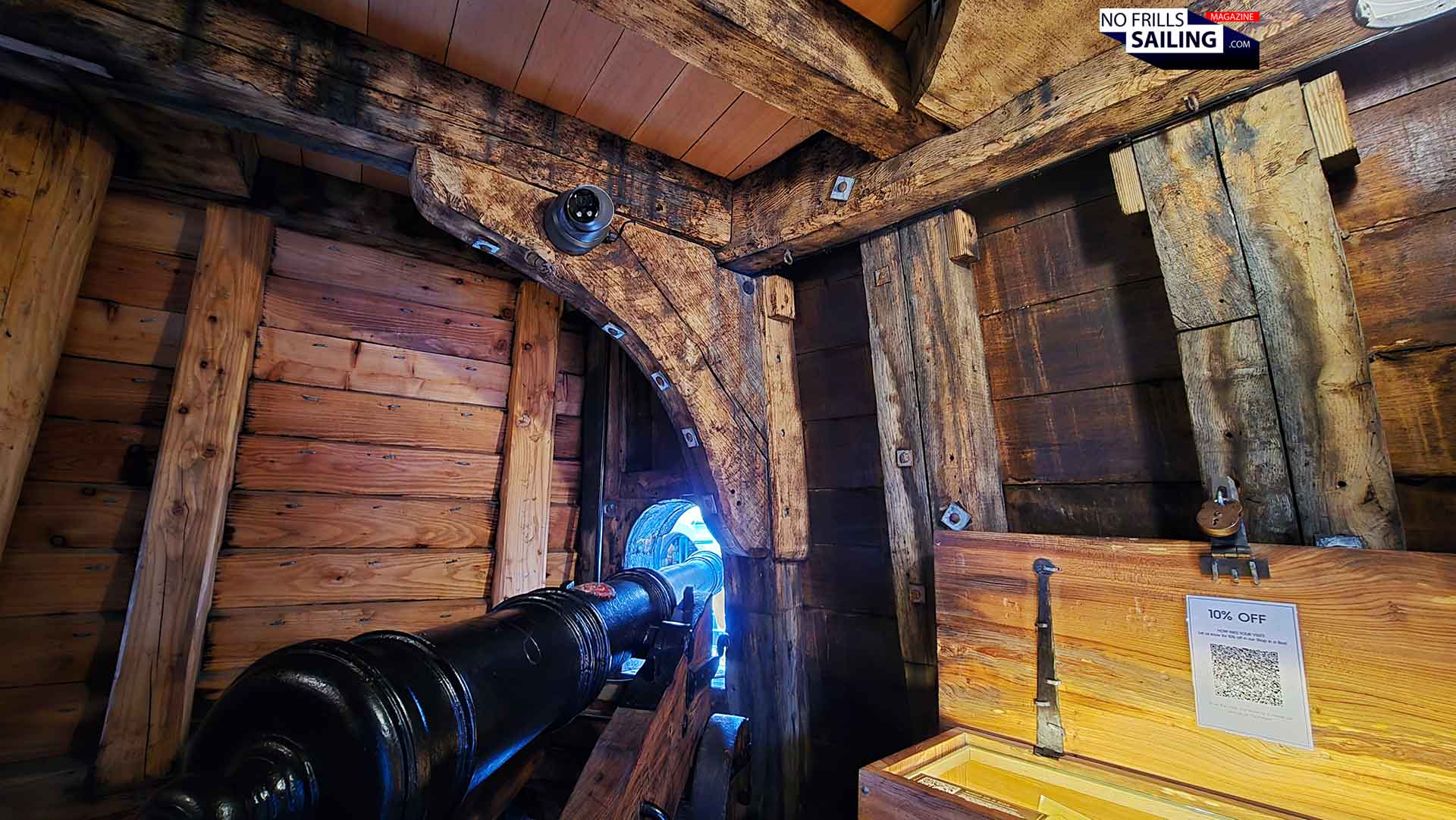
To find the right amount and quality of the more abundant timber like elm and fir was comparatively easy. Finding Oak trees and especially a tall, free standing, straight and branch-less fir tree to make the masts, was a real problem. Britain´s forests had been decimated to a laughable size even back then: It took the crew years of painstaking research to identify the very trees which could be used. Wooden boatbuilding, even back at that time, was quite an undertaking I guess!

I roam the gun deck from stern to bow. It´s quite amazing to look at these massive frames, huge pieces of wood. Especially the bow section fascinates me: This is where the ship would crash-bang into the harsh waves, where mechanic torsion and strong loads would be bearable the most. The long, massive bow sprit runs down entering from outside, attached at its foot to the strong frame of the ship. The ceiling is secured by hanging and horizontal “knees”, bent-grown Oak parts, specifically sought after by the shipbuilders and carpenters of that time. Of course, the modern GOLDEN HINDE utilizes modern steel anchors and huge nails to further secure this framework.
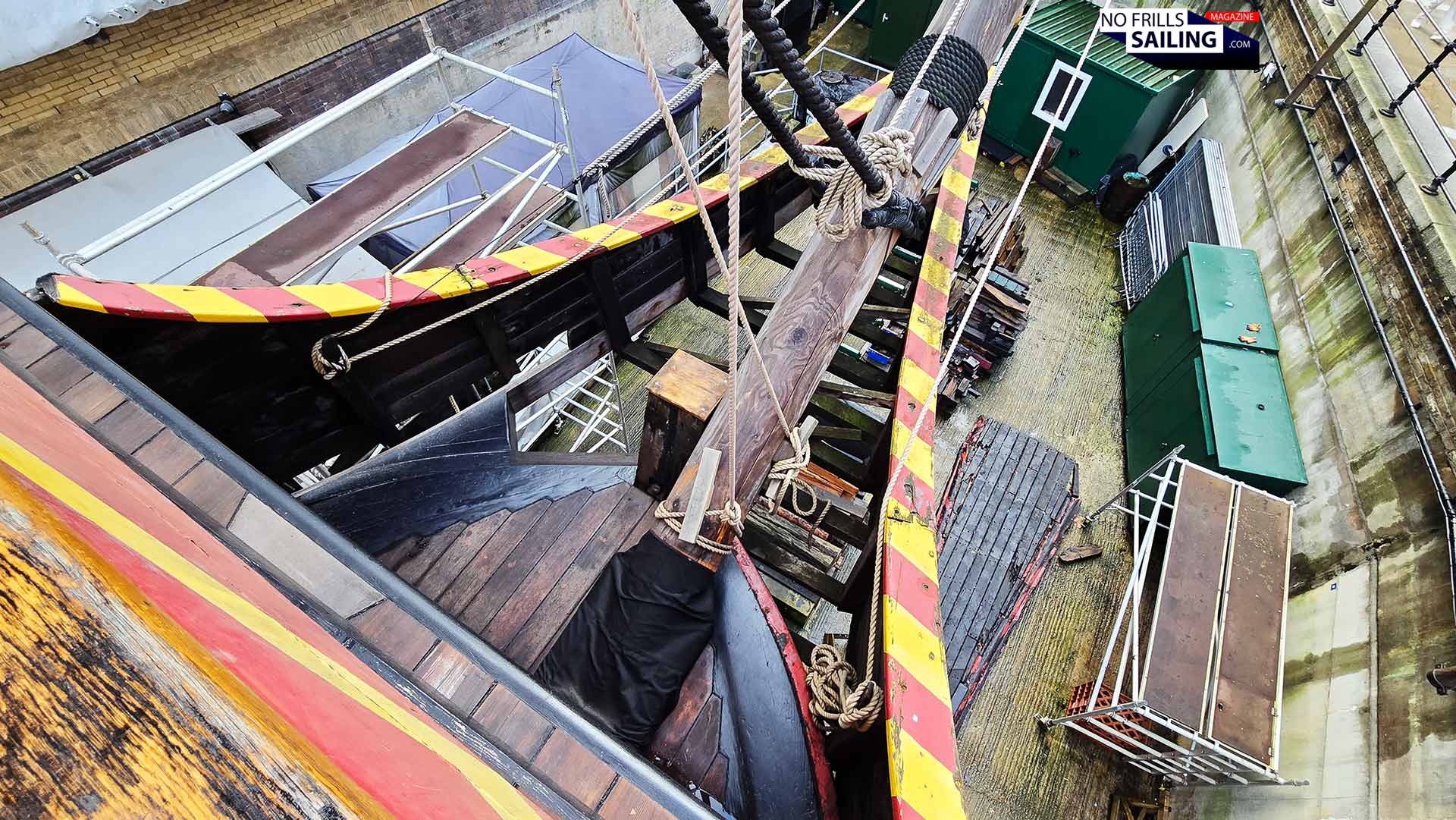
As we reappear in daylight again after 20 or 30 minutes down below decks, I climb onto the forecastle, which back in my childhood would have been the most interesting part of the ship. Here´s where a lookout would have his post, here´s where the full speed of this ship, her cutting through the seas would have been palpable the most. And, by the way, looking down onto the big grating of the bow sprit, one gets to understand why even today a ship´s toilet is called “the heads” – because it was here where the crew would be able to take a dump.
Is it worth visiting the GOLDEN HINDE?
This ship, although much smaller than thought, is a huge undertaking. Building her in the first place, but also preserving and running her as a museum. The GOLDEN HINDE is worth of keeping alive, although she is “only” a replica. Sir Francis Drake´s voyages as her Majestie´s privateer had paved the way for Britain to become a naval power and one of the largest empires the world had ever seen. So, of course, you will have to pay an entry fee to board GOLDEN HINDE.
And this is a fair and surprisingly small amount. I was astonished: That´s just six (!) pounds for an adult! I mean, visiting CUTTY SARK was 20 pounds per person, and I found this a reasonable price as well regarding the huge efforts needed to keep those ships up. But six pounds is a real bargain. Moreover, as we had been visiting on a Saturday, they offered the “two for one”-pass, which essentially meant that my partner was free. I don´t know if this was due to the weekend, a form of “compensation” for the partial closing due to construction or a national holiday, but that was quite something.
I mean, I don´t know if there is some state-sponsored budget to run this landmark – I certainly hope so – or if the whole enterprise is solely dependent on entry fees and donations, but you should certainly not hesitate to go there. The United Kingdom, and especially London, is not a cheap tourist destination. With soaring prices, each trip here should be backed by a sufficient travel budget. In this respect, six pounds entry fee is nothing.

Compared to the laborious efforts these guys must undertake to keep the ship in a good state. Remember: The original GOLDEN HINDE, although by Queen´s decree protected and deemed worth preservation, didn´t last very long. Even back then this ship was seen as a kind of national heritage. Being out here in the open, exposed to rain, moist air and lots of visitors, I can imagine it´s a race against time, constantly eroding the wooden substance. And to answer the question: Yes! It is absolutely worth a visit!
Preserving seafaring history
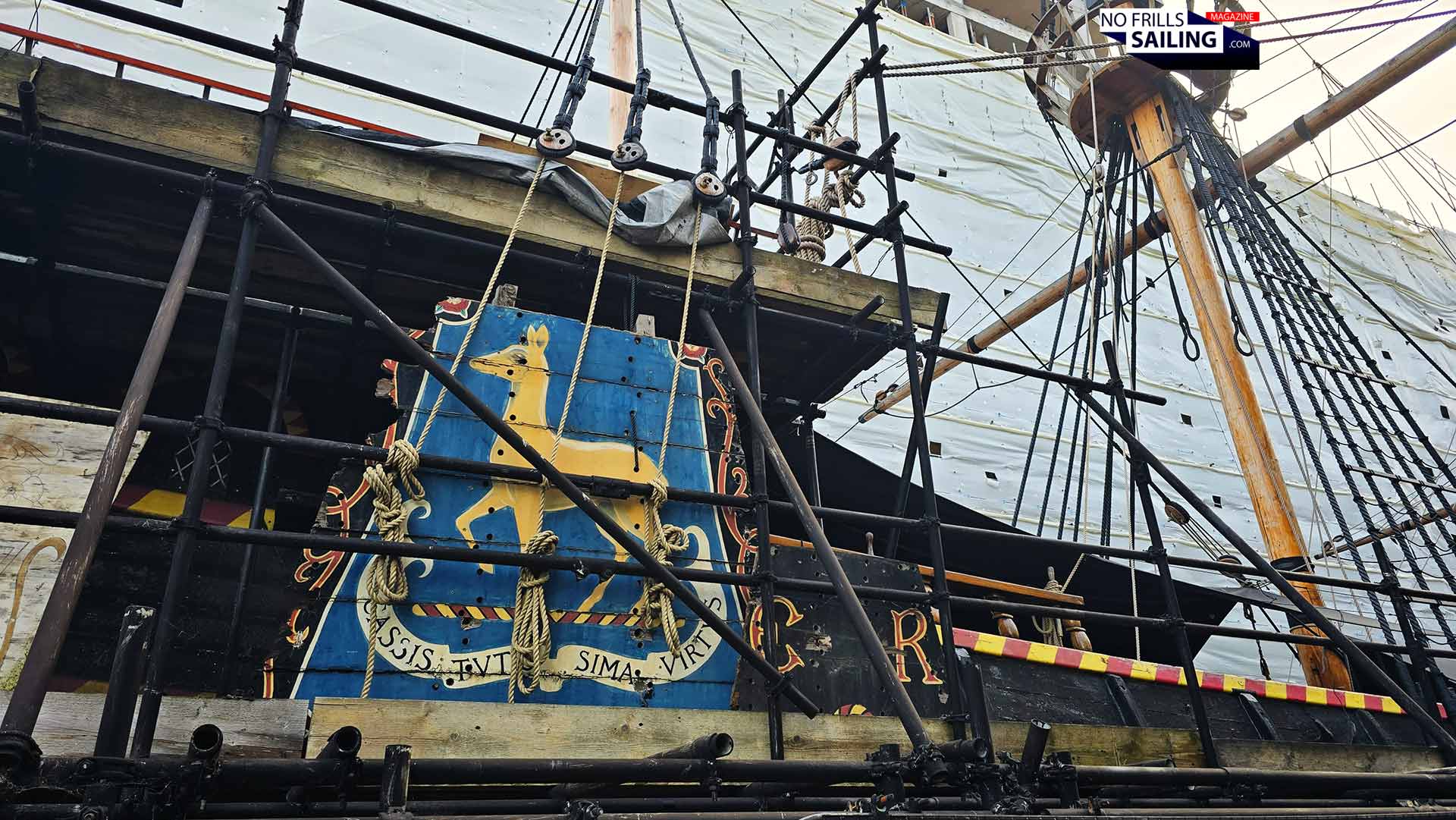
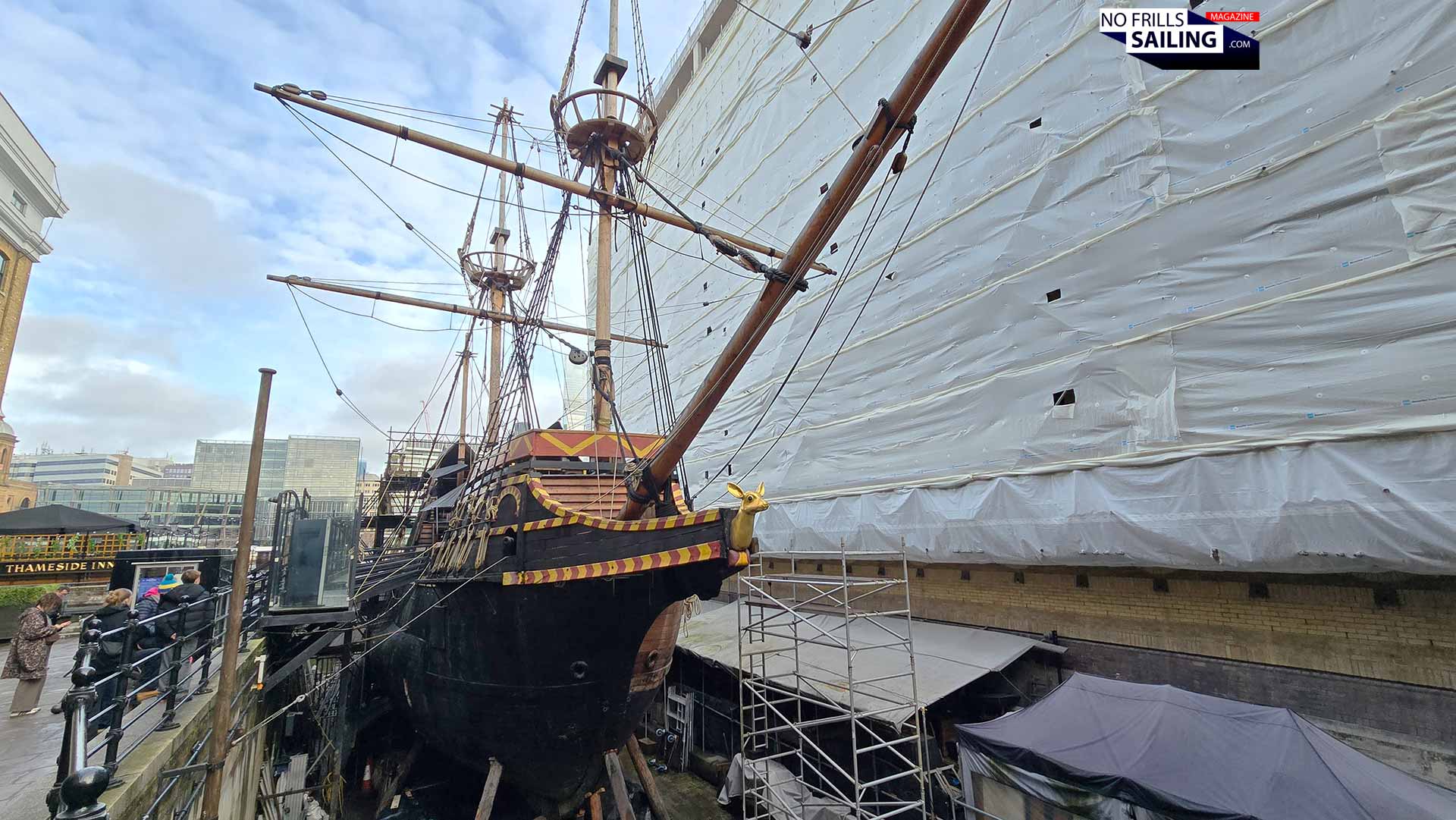
As renovation of the GOLDEN HINDE is an ongoing project, the current round of works had started almost ten years ago. It is undeniable that most of her outward appearance is currently obstructed by scaffolding. The beautiful coat of arms, once the proud grace of her transom, has been dismounted and put aside. The motto of the ship Cassis Tutis Sima Virtus means “Virtue is the safest helmet” is nicely readable.
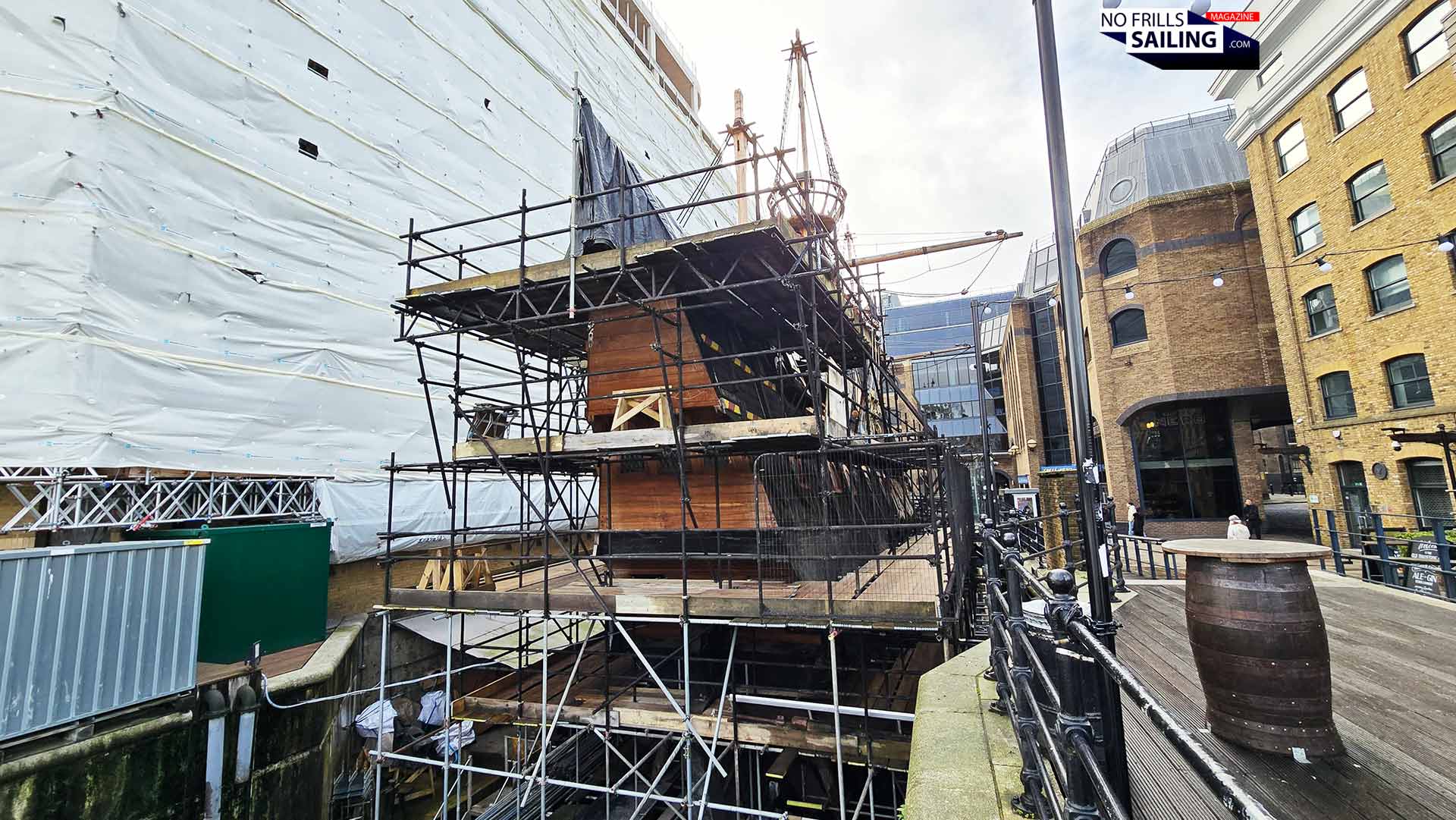
As the rigging is incomplete, I hope that in the coming few years her masts will be refitted and put onto the ship again, showing the full beauty of her two square rigged masts and the third, aftmost, Latin-rigged mast. Then we might also re-discover the royal Lion´s head at her transom again and the beautifully colored “balcony” near the waterline. These are all things I had not the privilege to observe myself when visiting.
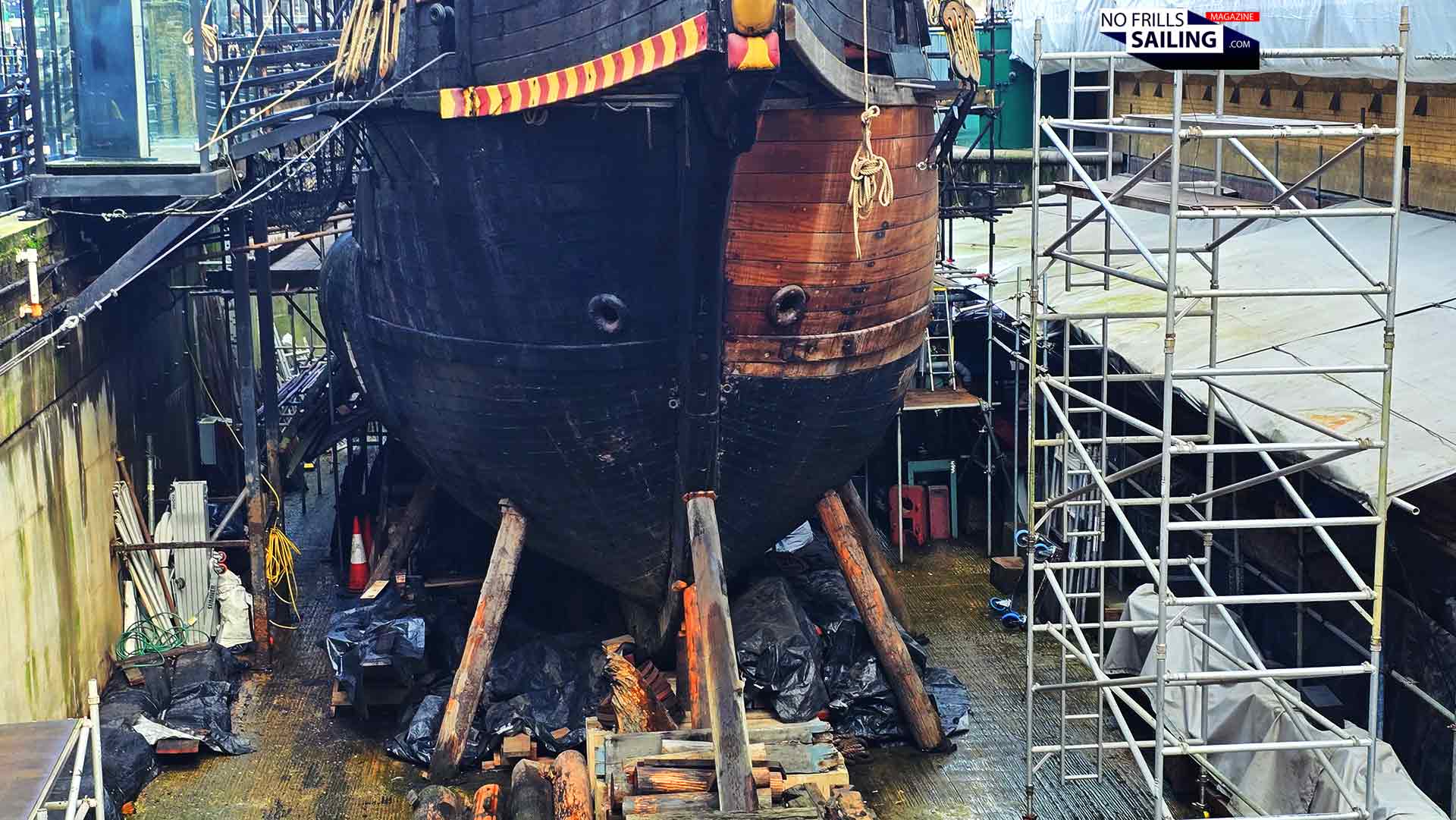
If you can, I would also suggest not to book a simple tour by yourself, but a guided tour. It hasn´t been offered to me (maybe due to the fact that it was a weekend or our pretty early visiting time), but this would bring much more fun and information to you. Maybe you will be granted exclusive access to the dock itself: Seeing the mighty hull from down there will certainly make much deeper impression and teach a lot more.
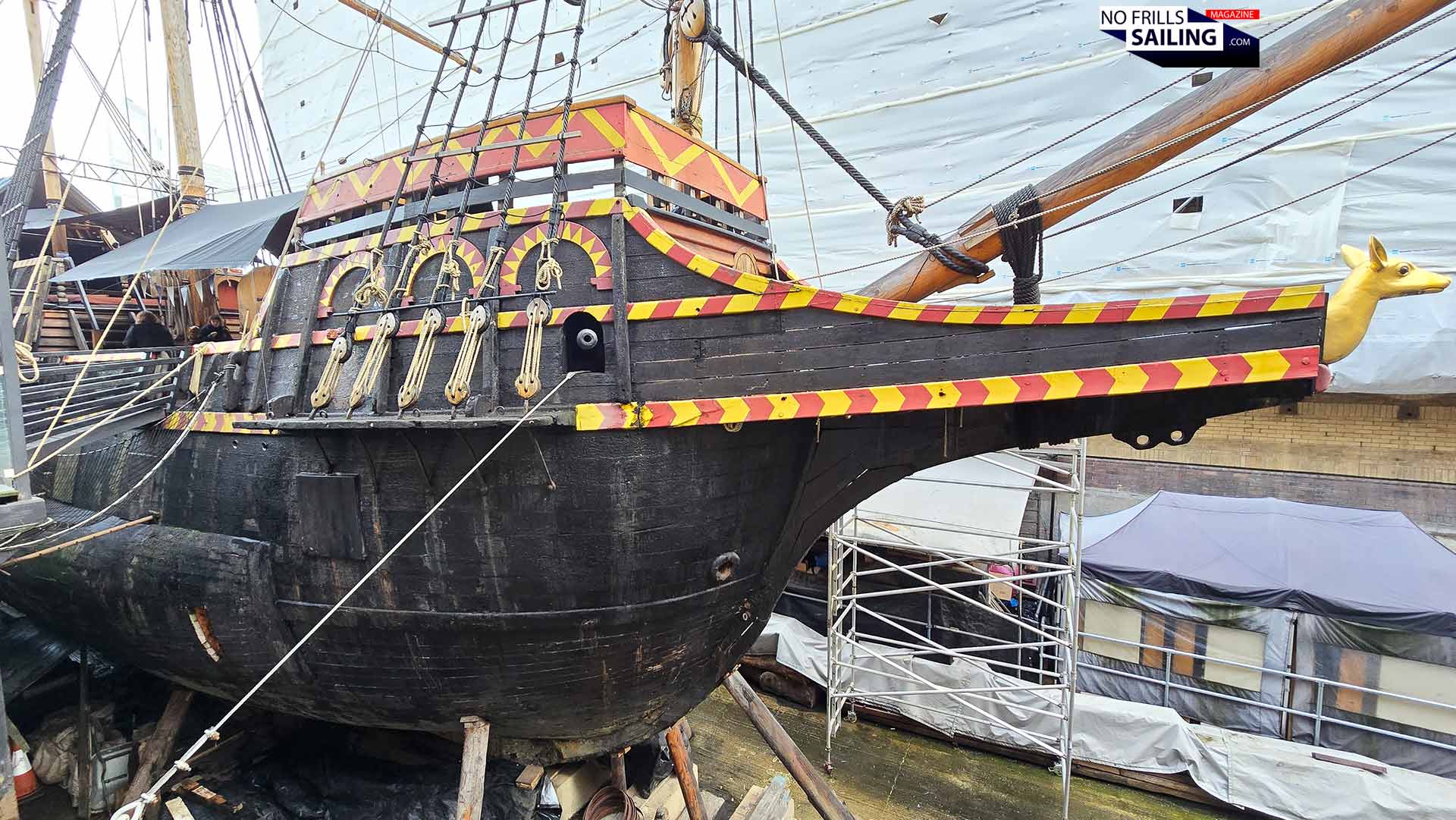
Lucky for me, at least the whole bow part with the nice and beautiful painting and GOLDEN HINDEs figurehead, the very golden hind, was clearly visible. The deep black color of the fully tarred hull stood in sharp contrast to the decorative red and yellow paint on the forecastle. The nicely shaped figurehead of the golden hind makes her look sweeter than she was: In the end, this ship attacked and robbed Spanish vessels, not to forget.
London: A maritime history buff´s Mecca
Ah, how I loved this occasion! Of course, I could have spent much more time roaming GOLDEN HINDEs belly, but as this trip was predominantly a present to my fiancé, I didn´t want to “spoil” it with all too much maritime history, of which naturally she was not most interested in. London, I marked for a later visit, offers so many different locations if you are interested in history and naval history in special. There´s the BELFAST cruiser from the Second World War nearby, you may have read my CUTTY SARK-article and not to forget the museums!

It´s a Mecca for history buffs and surely for your kids! I wave Goodbye to GOLDEN HINDE, wish her the best for the future and a speedy refit so that future generations can admire the craftsmanship, the bravery and class of the very seafarers who started to conquer the world´s oceans and biggest empires 500 years ago: What a great ship, what a cool London destination to see!
You might as well find these related articles interesting to read:
Visiting the legendary and iconic CUTTY SARK in Greenwich
One – if not the – best seafarer´s streaming shows: “The Terror”
You like pirates? Watch “Black Sails”!