
The mating of the deck with the hull is a very, very important step in any GRP-boat´s building process. When deck and hull are put together, basically, a construction site turns into a yacht. This is what happened last week at the Omega 42 building shed, as this article (part 1) shows the intricate, exciting and elaborate techniques utilized to make the “marriage” happen.
As promised in my last article, mating of deck and hull of my new sailboat took place last week. The guys in the shipyard invited me to witness this event, which is indeed a bit unusual: I already told you in my previous articles that no other shipyard allowed me to write about the marriage, last it was Beneteau, where I shot a very beautiful set of pictures of this very process. They prohibited me from publishing the mating of an Oceanis 51.1 deck: “That´s a production secret!” Of course, I adhere and I also understand.
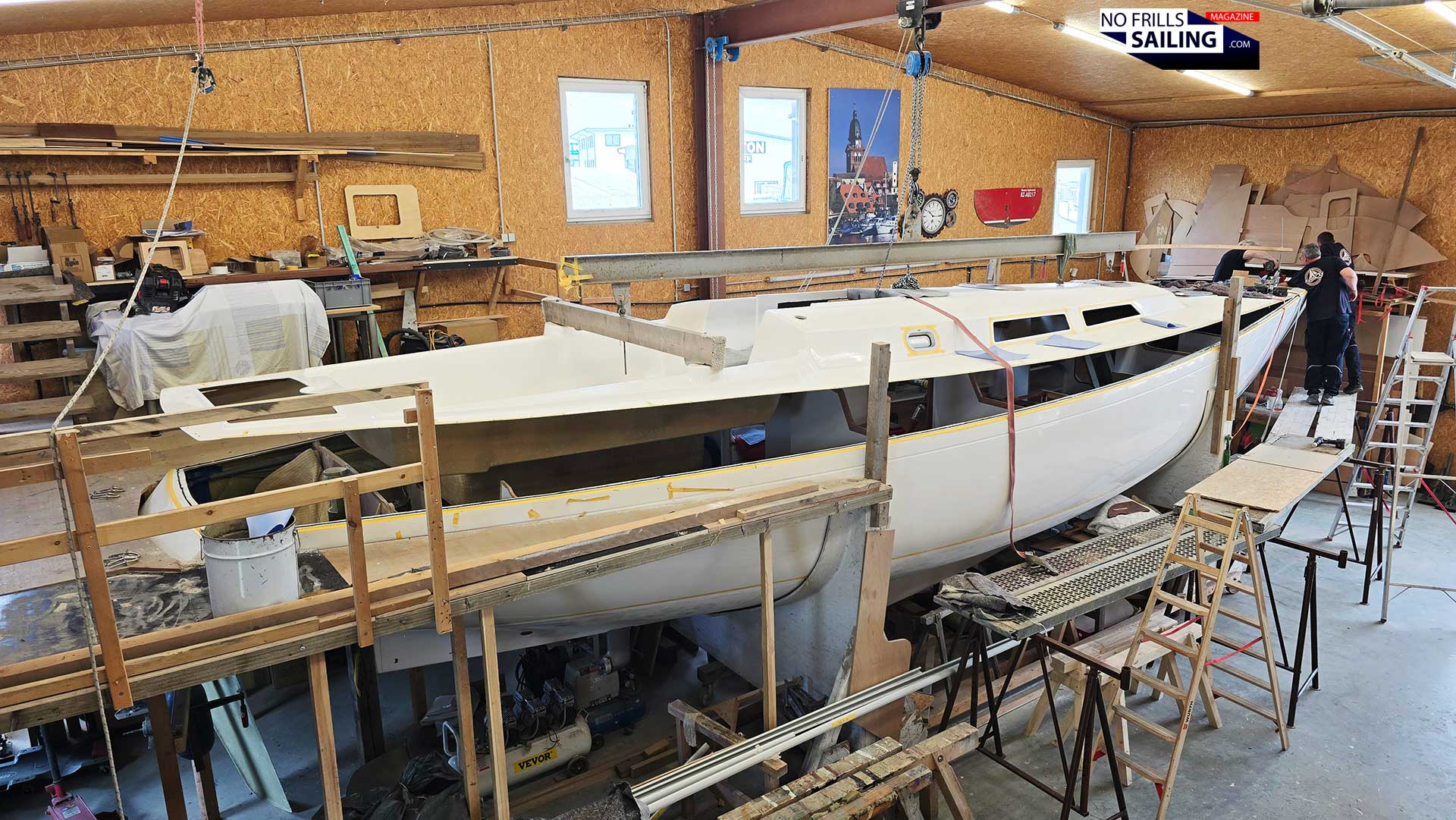
The more happy I am that the boss of my shipyard, where the Omega 42 is currently being build, agreed: More so, he invited me to stay all day so that I might see how intricate and elaborate this very event is in reality. So many things can go wrong, a lot bad stuff can follow up if not done properly. More than anything else done in the past three years here in the shipyard: If today the boatbuilders fail, the boat can become refit-project instantly, worst case. On the other hand, if done right, the strength and stiffness of the yacht sailing the seven seas later will have been defined right now, right here – today!
Why the hull-deck joint is so important for any sailboat

When I arrived in the morning, Heiner, the boss of the shipyard, sat together with his team of five boatbuilders (three of them master craftsmen) and hade a luscious breakfast: “Feast at will, fill up your bellies!”, he encouraged the team. Because once started, the process of mating the hull with the deck must not be stopped for a lunch break, even P-breaks are said to be limited to quick, sporty pitstops. In the building hall, the deck of the Omega 42 was already hovering right over the hull: Everything had been prepared just neatly.
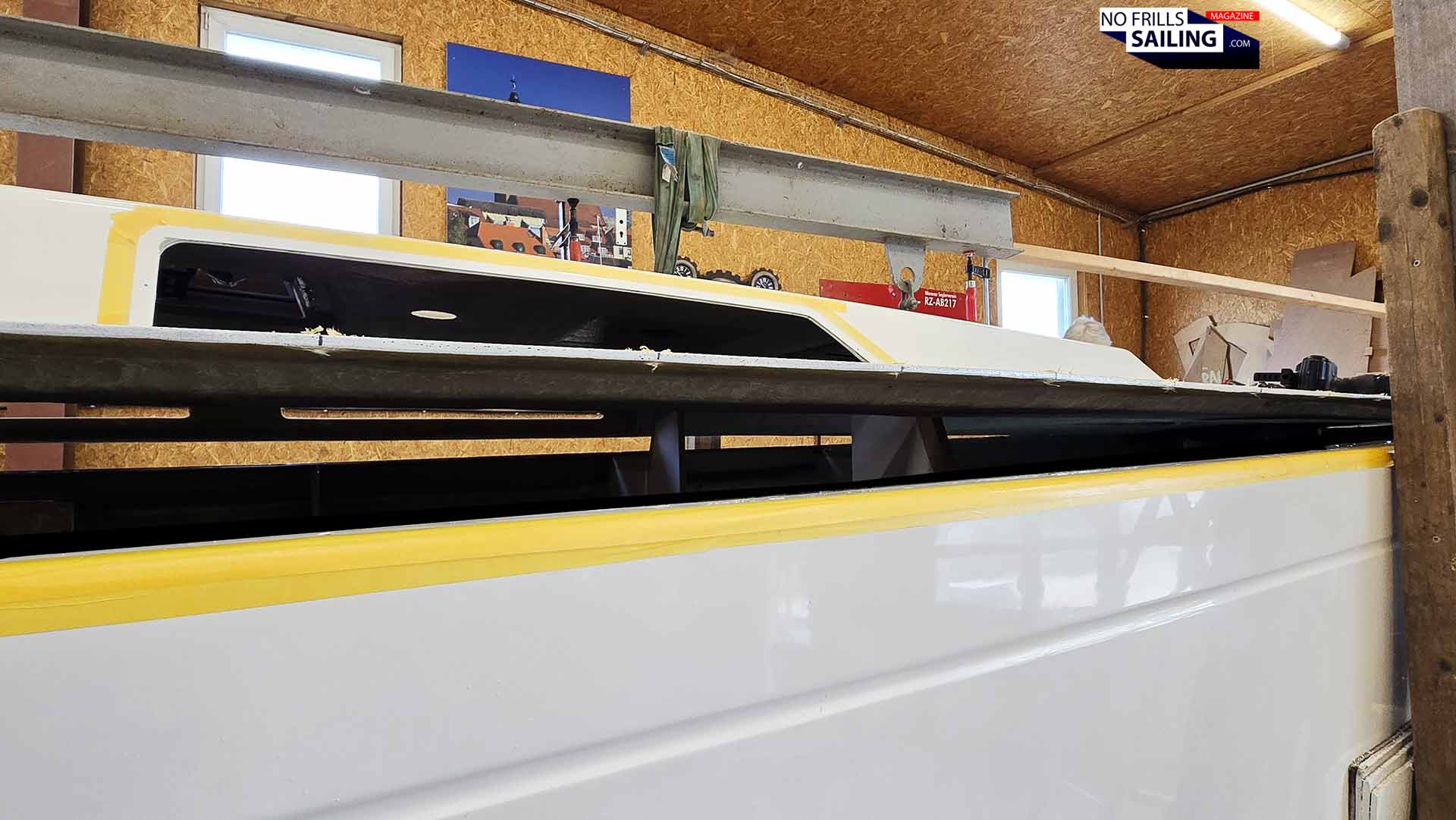
But why all the fuzz?, you might think. It´s basically just a lid that is put on the pot, right? Well, not quite. See, first of all, no hull and no deck – no matter how hard you try – are really 100 per cent symmetrical. Maybe today´s CNC-milled molds are, but as you know, the Omega 42 had been laminated in the one original mold where all of the other 160 classic yachts were born in the eighties and nineties. In fact, you can easily spot minor inconsistencies. Correcting those, a work of fractions of centimeters, took a significant part of the preparation in the past days. Inside of the boat, large steel shaping formers spread and squeeze the hull to a near-perfect symmetry.
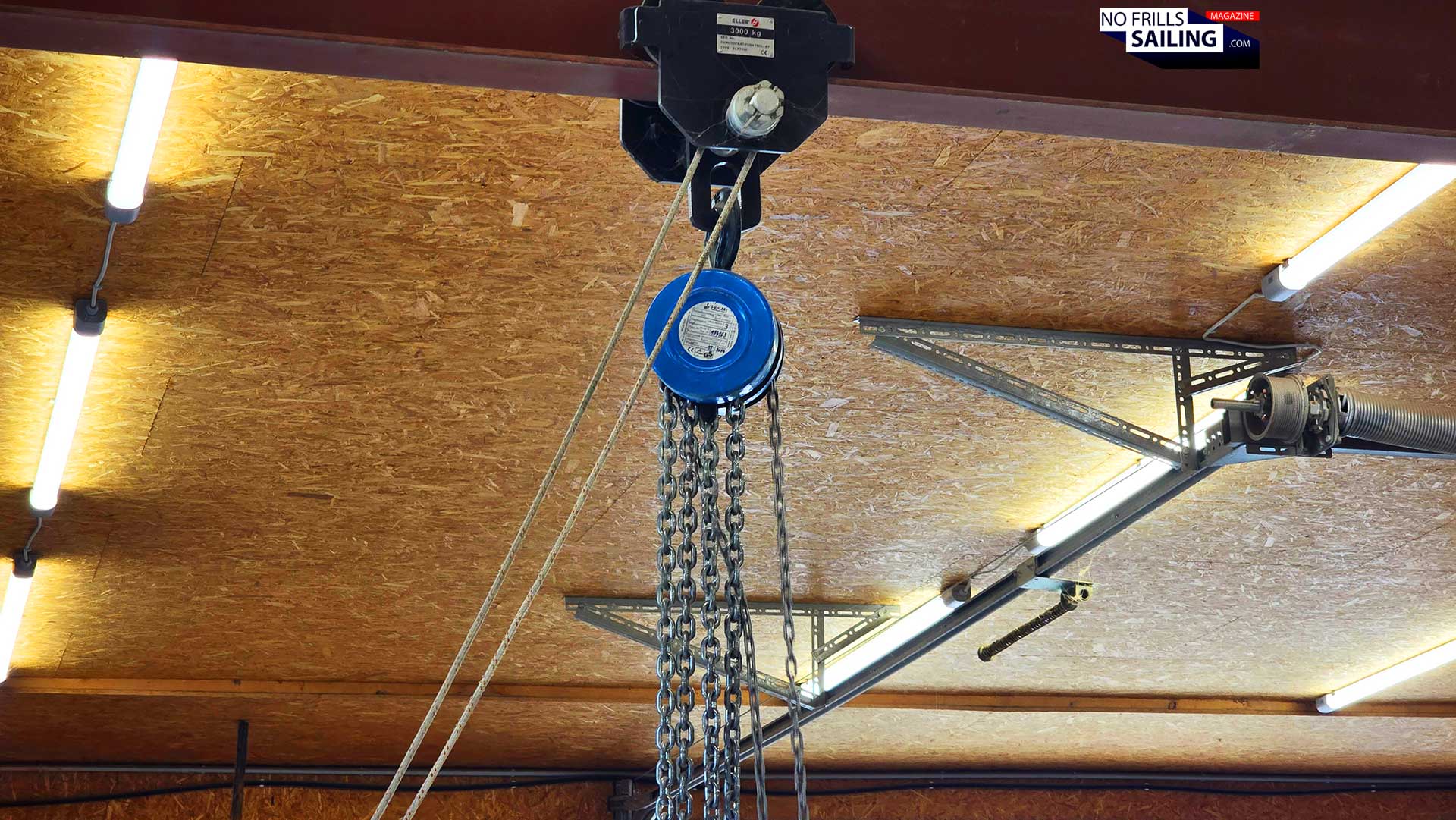
Above it, the deck is fitted to a lifting crane and a large hoist. This way it can be lowered (and raised if necessary) at will. The thing is: If today´s work isn´t done correctly, if the guys don´t work as precisely as possible, the whole hull could turn even more asymmetric, which will ultimately have a very bad influence on its trim, stability and thus might ruin the sailing properties of the yacht. And have I mentioned the strength of the hull-deck joint itself? If something goes wrong, flexing and even tiny movements could break it open, make it leak or worse. So really, basically, the functioning of the boat as a whole is at stake. No joking around today!
Glue? Or Screws? The mating technique
On the other hand: These master boatbuilders are not master craftsmen by chance. Albeit such an undertaking as the marriage of hull and deck aren´t daily routine at all, these guys know what to do. At least, they have shown once how it´s done – hull #001 WINDFAENGER is sailing (and obviously not leaking nor flexing). The atmosphere was very positive, I could feel that they were also happy that at last this very important step of the building process is now up on the list. I was wondering how they would do it: Utilizing the latest adhesive products of the chemical industry? Or would they just bolt it together with a bit of sealant, the way it was done in past times?
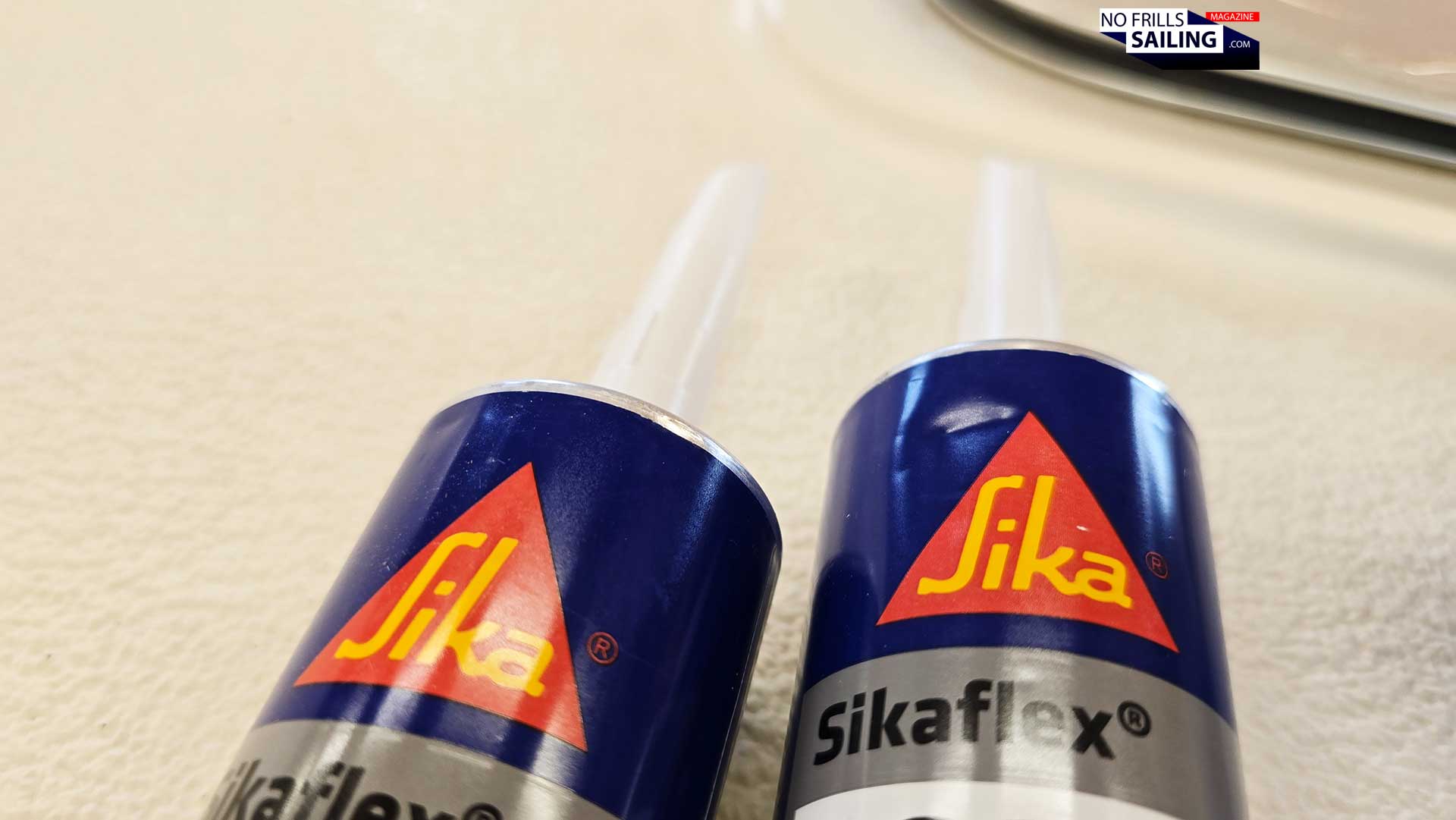
In fact, it turned out they would utilize the best of both worlds: Chemical bonding and mechanical means. As Heiner told me, the first new Omega 42 had been bolted and glued together, which worked out just as fine. After consulting the external specialists from Yachticon, general importer of Sika-products, he decided to switch from epoxy as bonding agent to a Sikaflex-product. That is why a handful of caulking guns had been prepared with their cartridges, a number of cardboard boxes filled with dozens of cartridges were opened and made ready for use.
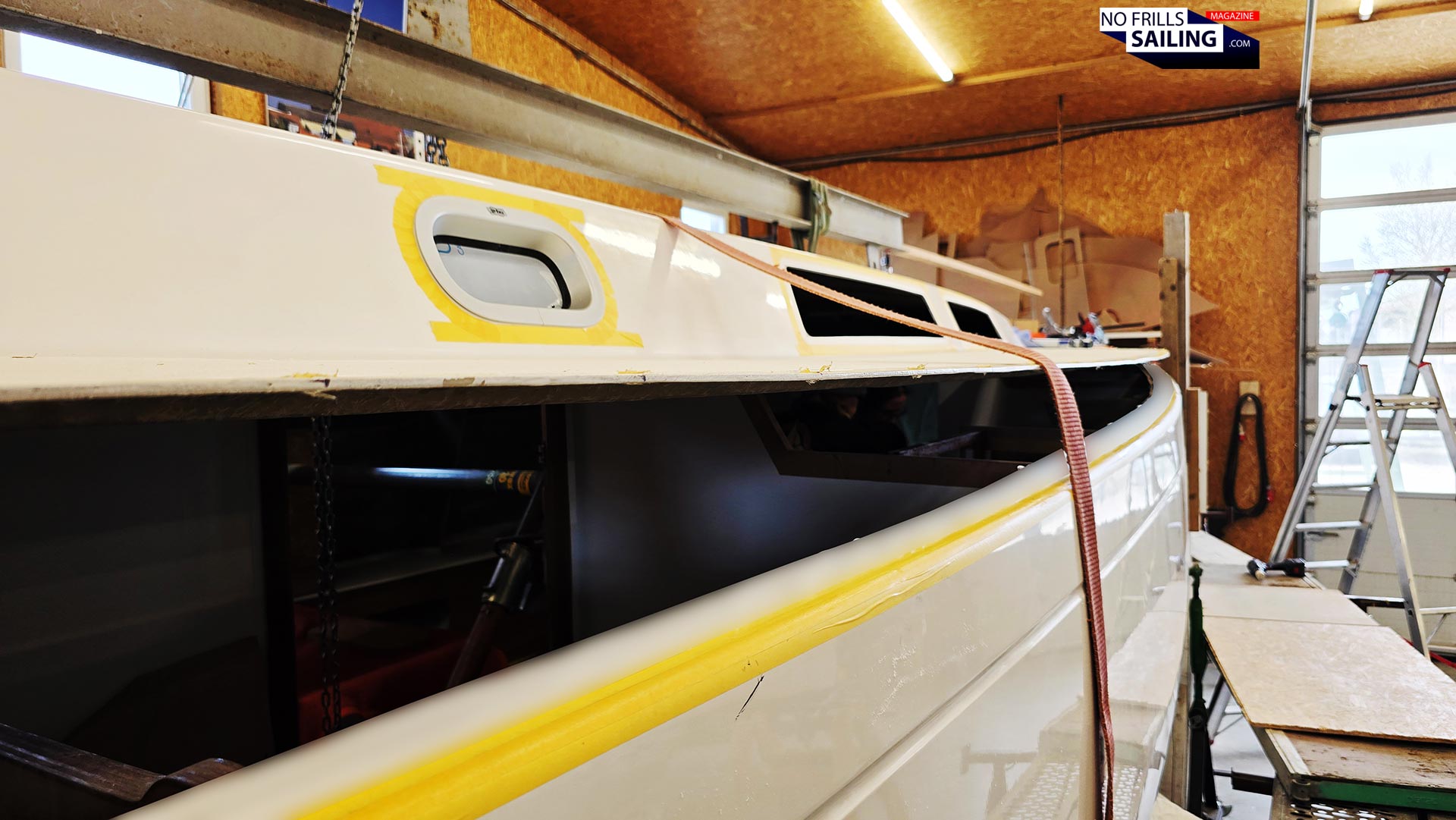
The guys asked me not to show the very technique of how the glue had been prepared, how thick or wide the material has been put onto the overlapping GRP areas had been nor any other details: “It´s something I´d want to keep for my own”, Heiner told me. I guess, no matter if you are the biggest shipyard in the world or the smallest, these guys love to keep their secrets, right? So, you shouldn´t wonder why I have altered the glue-surface areas in the pictures. So, basically, it works like this:
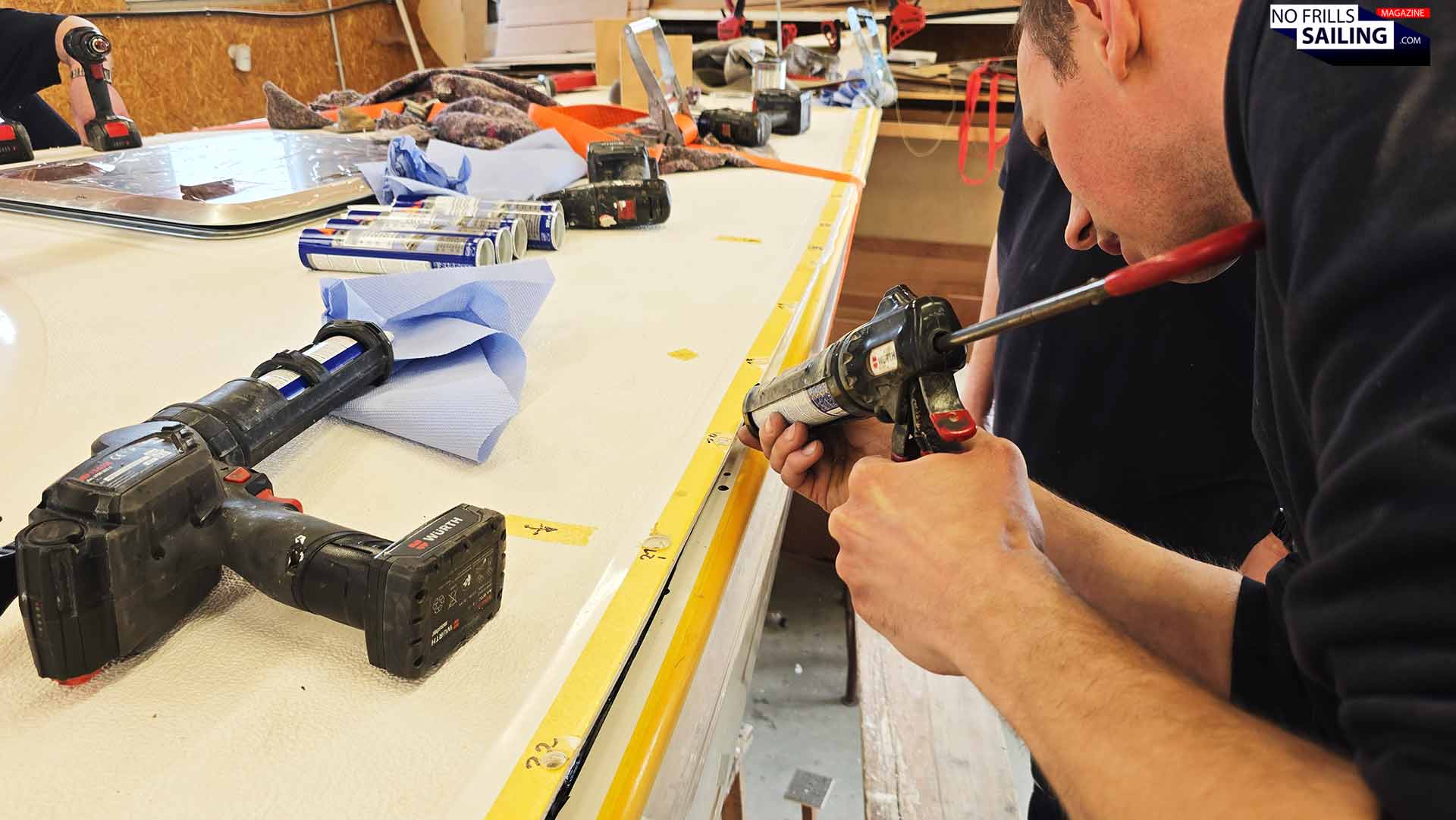
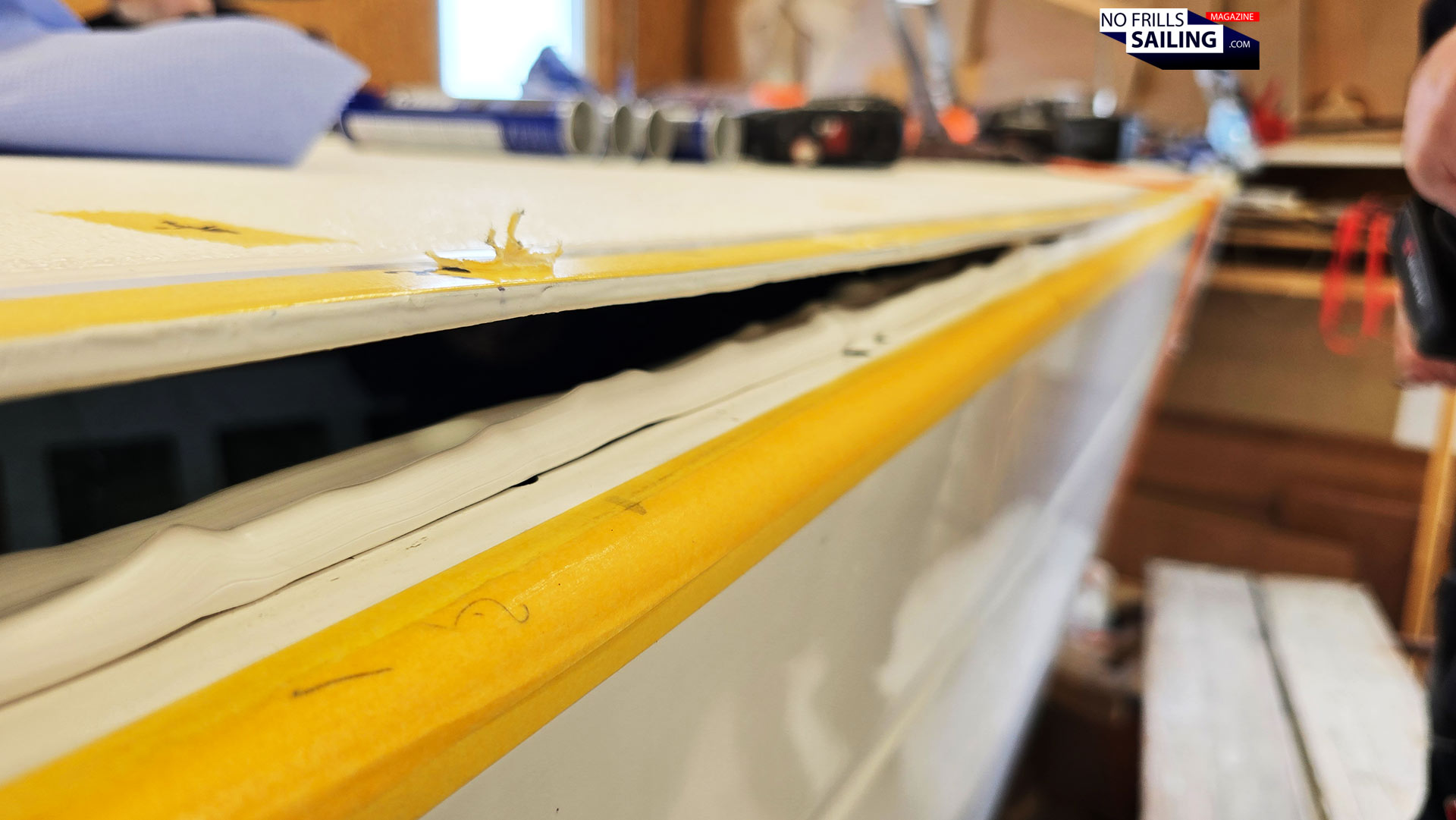
Onto the clean, degreased and dust free surface a special amount of glue is put by means of the caulking guns. In this, the amount of the cement and also the thickness, form and even the position is specified, the guys cannot derive from it to achieve the best possible outcome. Now the deck is lowered – very slowly! – in a way that the deck and hull come together, pushing firmly the glue all over the contact area, which closes air bubbles and makes for a nice, overall coverage. All that´s left is a few millimeters wide seam of glue that will immediately start to vulcanize.
Deck-fitting: A race against time
That said, time is crucial here. Which by the way was initially one of the reasons why the shipyard wanted to stick with the good old epoxy-resin. By putting in more or less hardener the time which the glue needs to dry through and bind together hull and deck could have been adjusted: More hardener, and the reaction-time is reduced, less hardener, and the more time the guys will have for the second step of the undertaking: Putting in the bolts and nuts. Now, by utilizing the Sika-product, there is just that amount of time in which it all has to be done.
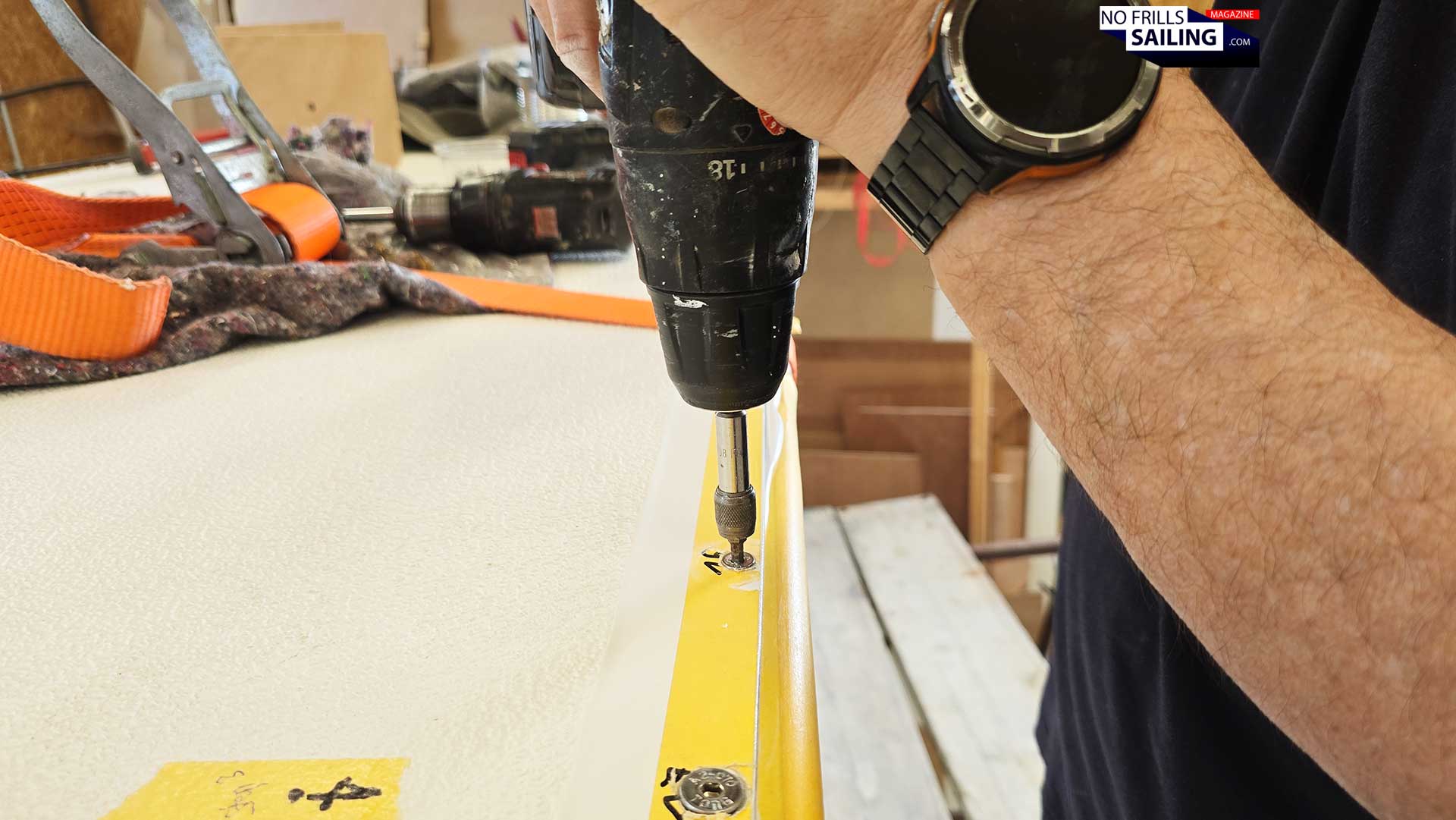
What follows after hull and deck are brought together is no less than a race against time. In a distance of approximately 20 centimeters the time had been marked the positions of the bore holes. Clever: Both outside all along the deck line and inside the boat. The yellow masking tape, initially intended to protect the gelcoat from surplus glue, carried the hole numbers from 1 to 60 from bow to stern. During the past days of preparation, the team had already had the deck sitting on top of the hull, drilling those holes.
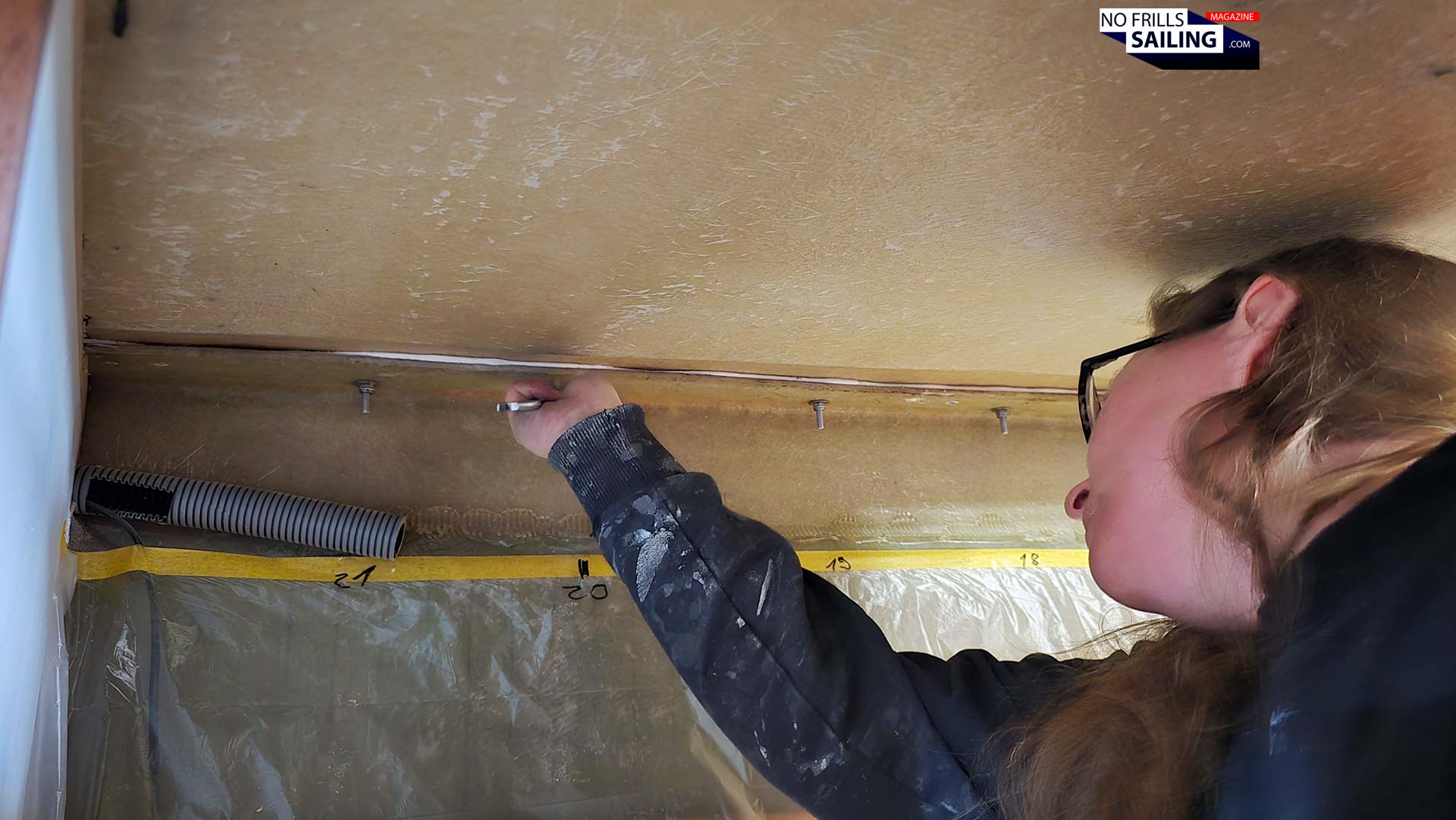
In doing so, every 10 or 15 holes nuts and bolts had been inserted to temporarily fix the deck before all the other holes were free to drill. You certainly don´t want to have an error here: Once the holes are pushed through the material and fixed, there is no only a very miniscule range for later corrections. This is the reason why it took the guys so long: The preparation time for this very moment was manifold, it took them almost one complete week!
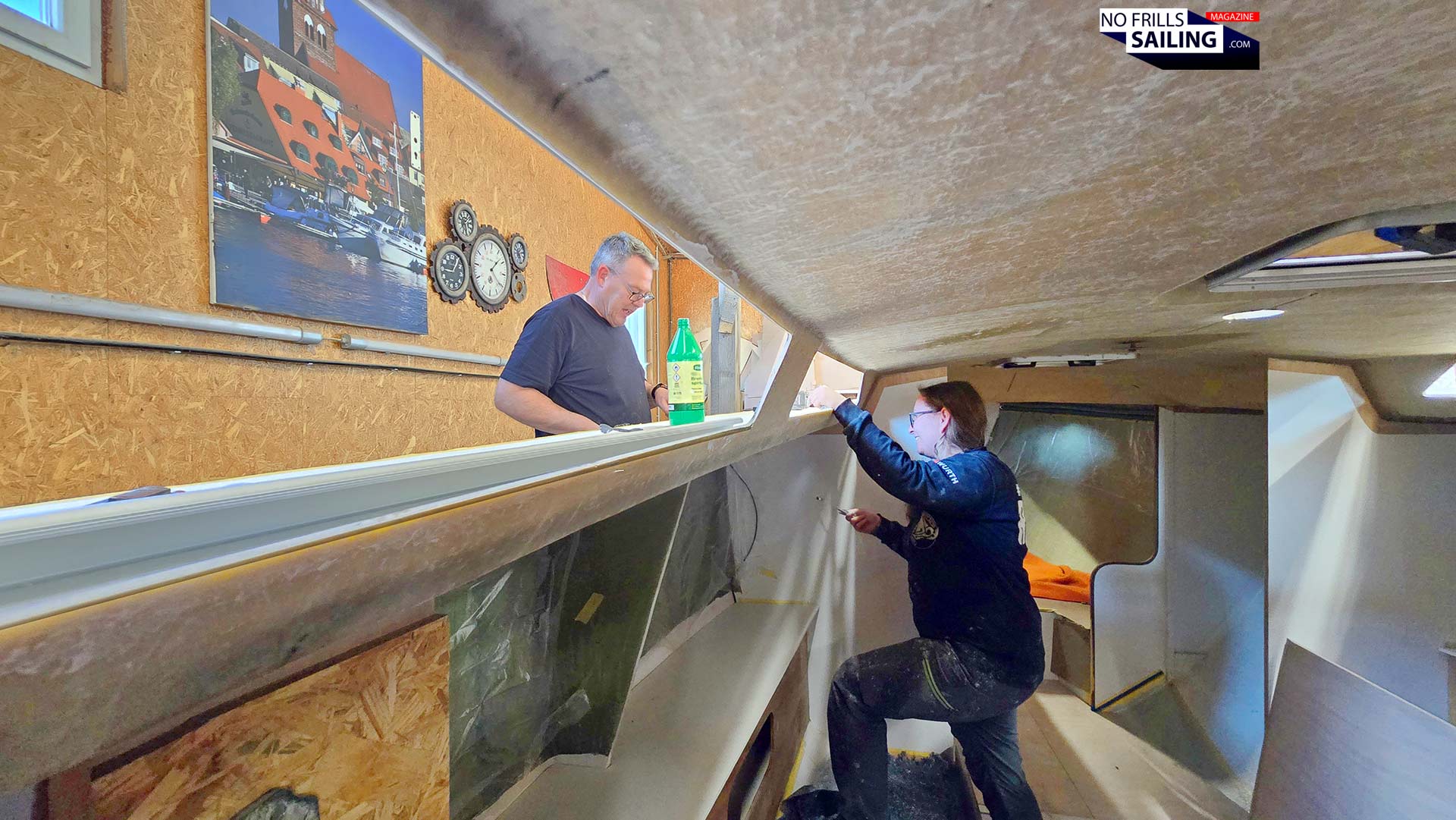
Now they started to work in teams: Down below decks the two ladies (being the lightest and slimmest of the team) had their equipment and waited for the guys from the outside: After controlling the right fit, they took out a screw (either 8 or millimeters in diameter, stainless steel of course) and announced the number of the bore hole. By applying some sealant to the screw´s head, they inserted it, with the ladies putting the corresponding nut onto it. Counter-securing the nut with a wrench, it was the guy´s job to turn the screw to a stalwart fit.
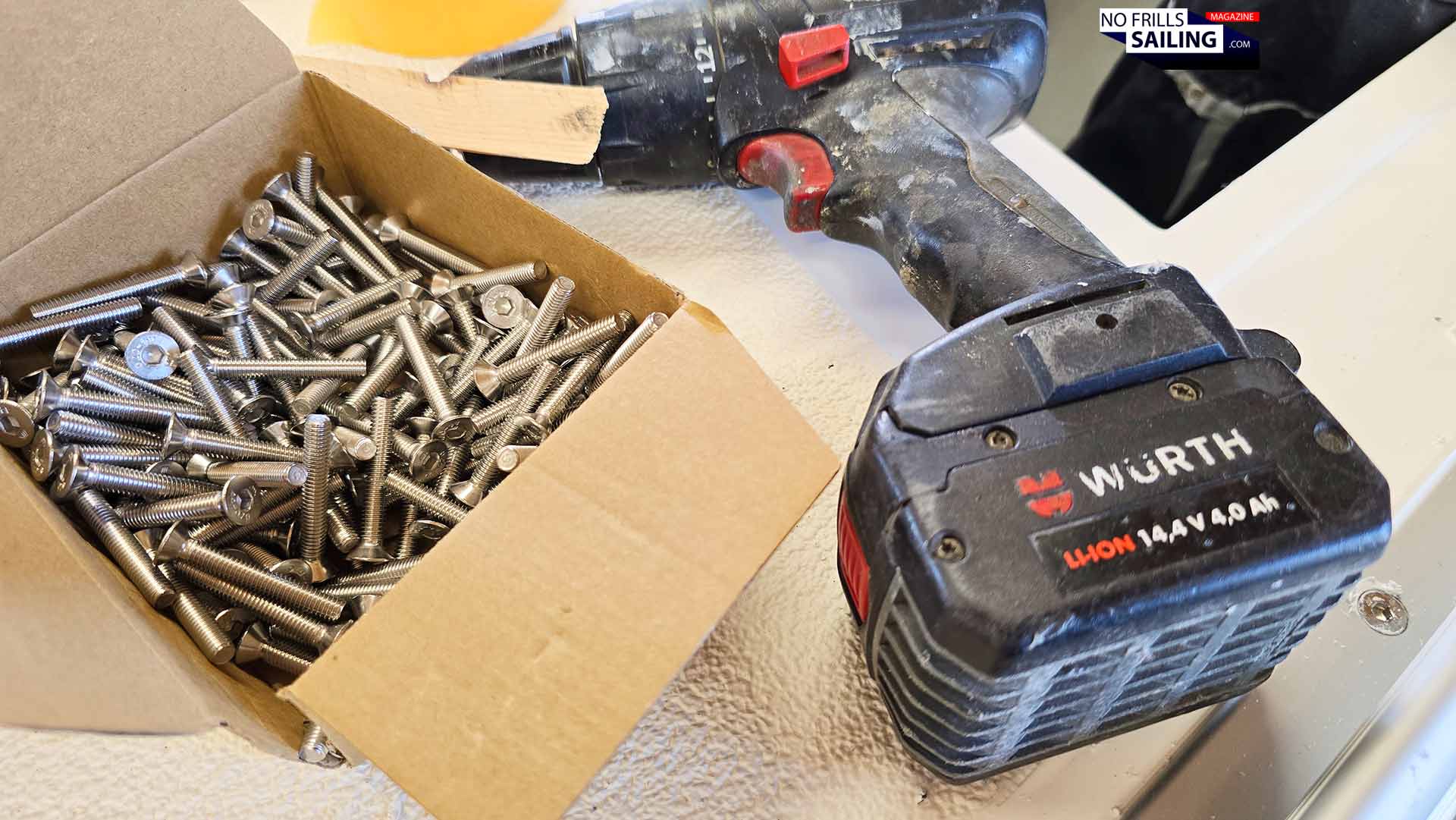
The “art” of this process was to not having it fastened too tight. Because there is a certain thickness of the seam needed: Too tight and there wouldn´t be enough of the glue left, too loose and it would not bond. At the same time, it was paramount to ensure the absolute accurate and evenly horizontal fit of the deck. Because, obviously, the area around a screw will kind of “sink” down, forming a cone. In the end, if not done properly, there would be 60 cones all along the boat´s side. A rollercoaster of ups and downs: Ugly ponds of rainwater. To add a bit of spice, time, as I mentioned, was crucial. So they had to really “race” down from hole 1 to hole 60.

Why? Because they worked in sections: Starting from the stem of the bow, at they would apply roughly three meters of Sikaflex bonding agent. Lowering the deck so that most of it would come down in than first, front area, they started to put in the bolts and nuts. The idea was to apply the next three meters of glue just in time when the precursing layer would still be bonding to it. 13 meters of boat, three meters per segment – that´s four segments. In the end, some 120 nuts and bolts would have been inserted, sealed and tightened.
C-clamps and tension-belts
This, as you can imagine, did of course not go through completely without a little bit of tension and even trouble: With the two teams working on either side of the boat, the ladies down below and inside of the yacht ad to listen very carefully, which hole would be treated next. Of course, all of the hatches had been open to facilitate a good communication, but it was hard nevertheless. Often voices overlapped, causing hesitations, asking for repetition and sometimes even a bit of frustration. Maybe there was also a bit of competitiveness between the two teams? In any case, an occasional joke would calm down most of the heat. Although, down below, especially in the somewhat cramped and light-less fore cabin, it must have been pretty hard to work.
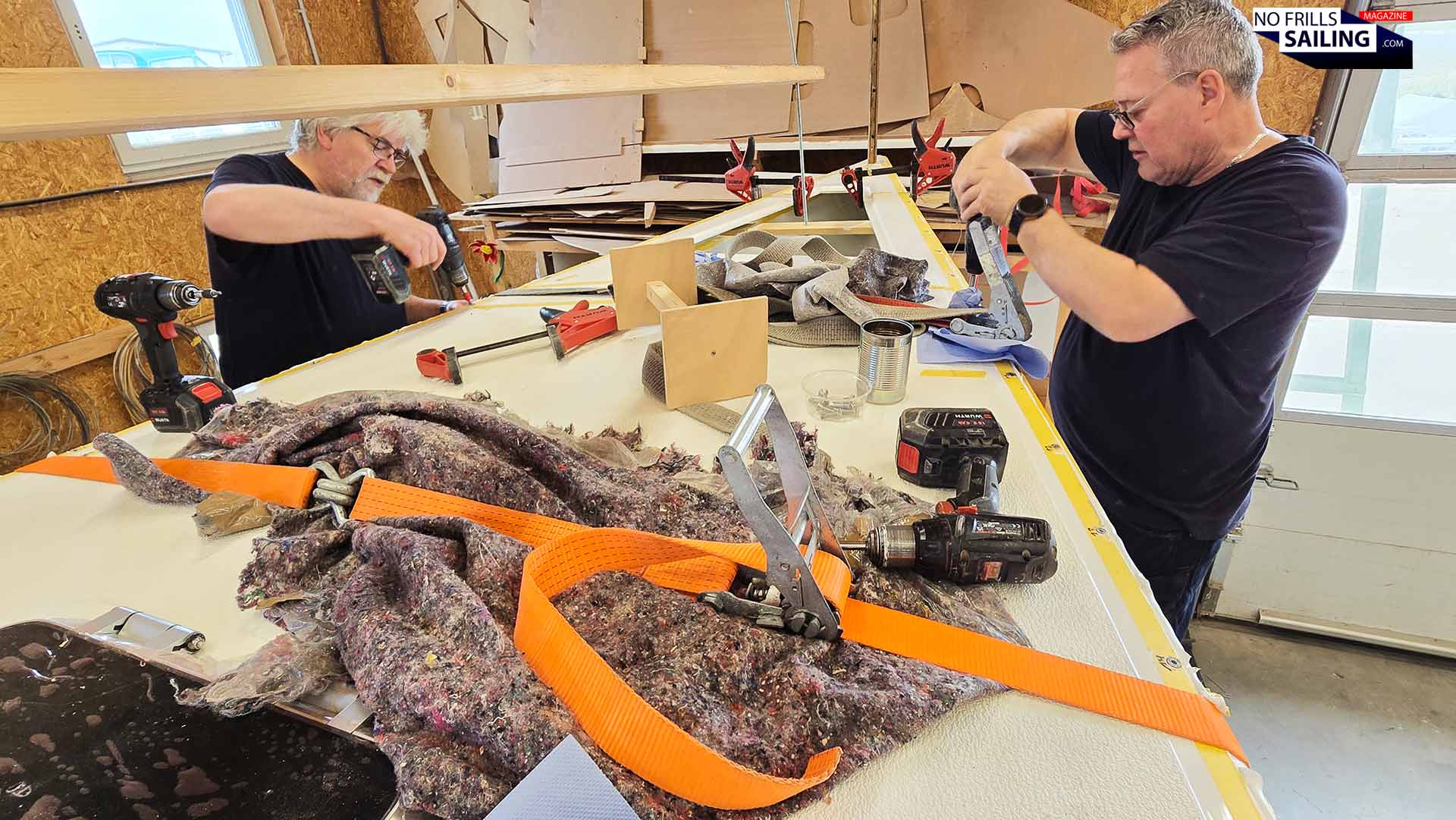
Between the act of lowering the deck and applying the nuts and bolts, the guys put tension belts all around the boat. This was meant to apply further pressure onto the parts and hold them fixed in position. At the bow and stern section, c-clamps were used in certain areas, as well as support bracing that was countered by the hall´s ceiling to exert pressure. It was mainly the master boatbuilder, Jonas, who was in charge of these delicate matters: He helped to set the bolts, but moreover checked, re-checked and even double-checked the perfect fit of hull and deck.
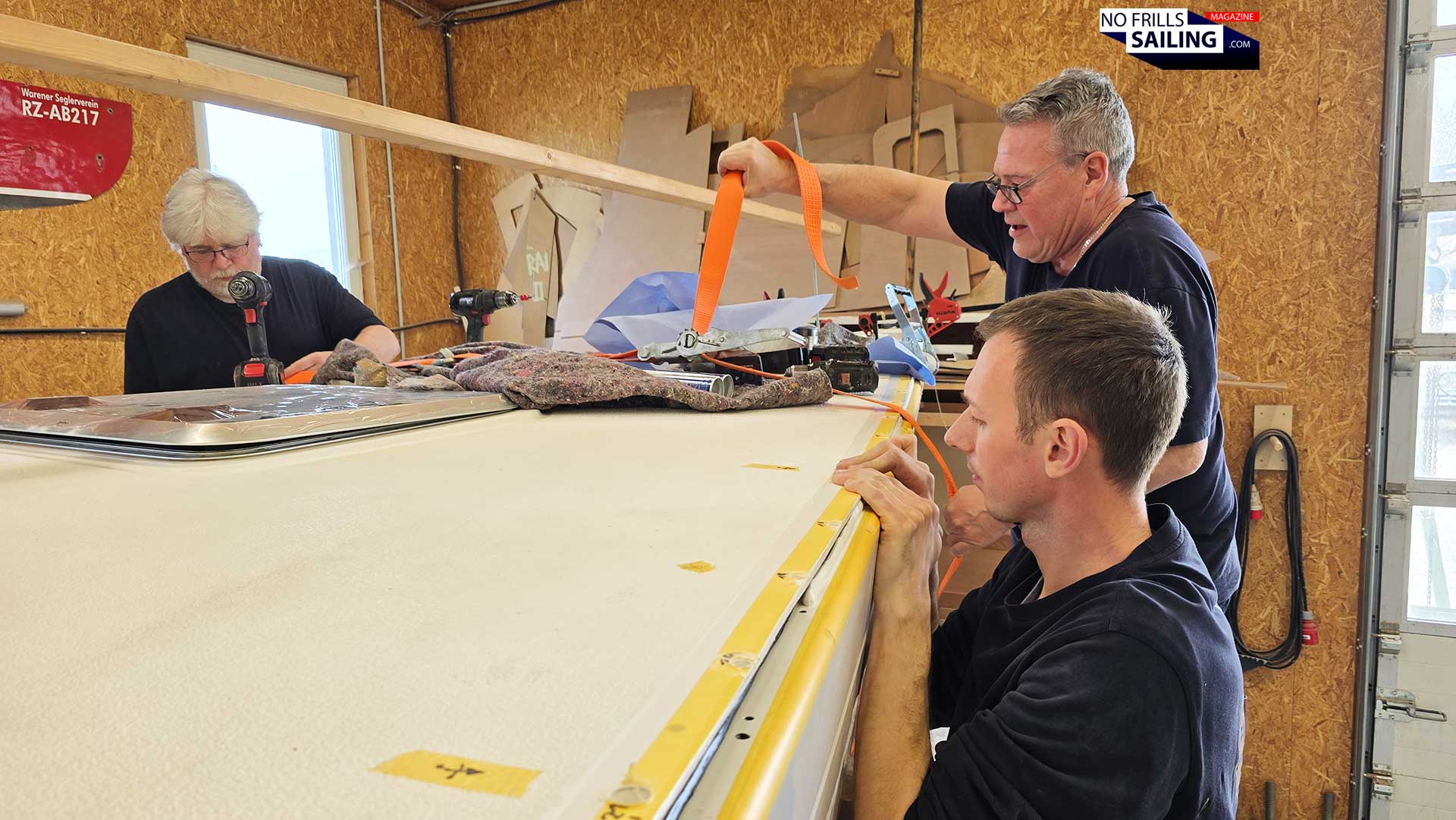
Five people, fully focused and concentrated. I am still fascinated by the level of self-controlled and fully individual action as well as their concerted teamwork, hand in hand action and creative, instant reaction if someone needed the hand of another. I mean, these are skilled craftsmen, sure, but how often do they put a deck on top of a yacht? Moreover, of such a big boat? 42 feet is pretty big for Baltic Sea conditions. They have mastered it once, yes, but this was seven years ago! Many of the team members haven´t been working here at that time.
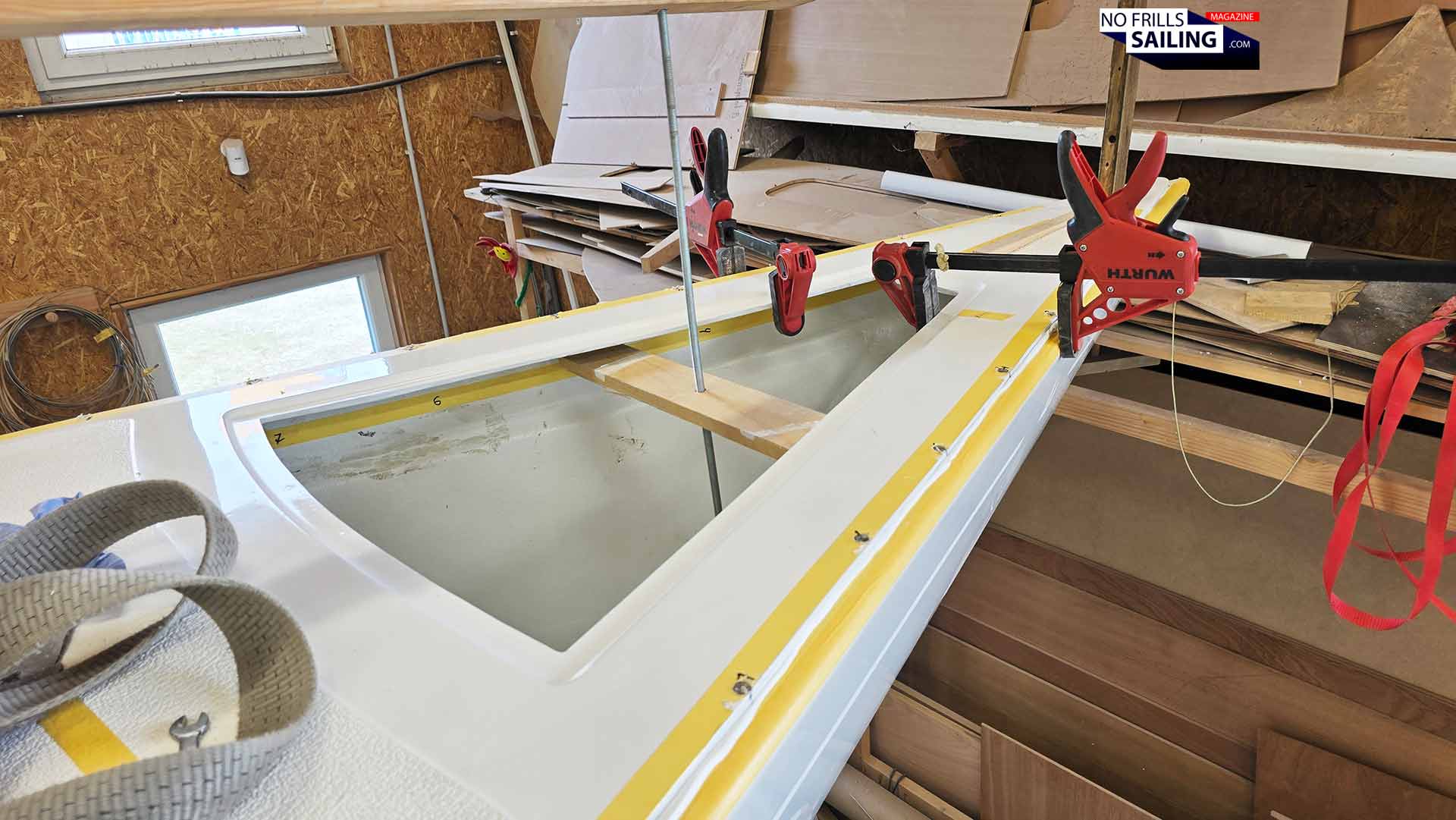
Segment by segment, cartridge by cartridge and bolt by bolt it all came together. Like an oversized jigsaw puzzle. More and more the deck came down on top of the hull. I was astonished when I first took a look onto my wrist watch: It was half past 10 a.m. and we were nearly there at the stern! Only a few dozen bolts left and the deck would be fitted!
From bow to stern: Teamwork!
And indeed, no three hours after the team went on to work after their lush breakfast feasting, it looked like we were on the final spurt. But, as usual, the tricky parts are in the details. Sometimes the ladies needed a restocking of their nuts, sometimes a caulking gun wouldn´t work. Having worked with those mechanical appliances myself a lot, I know how much they hurt over time. Now imagine you have to exert pressure with the handle to squeeze out more glue – over hours! It´s just awful! Of course there was an electric caulking gun, but only one. And it needed frequent change of fresh batteries for juice.
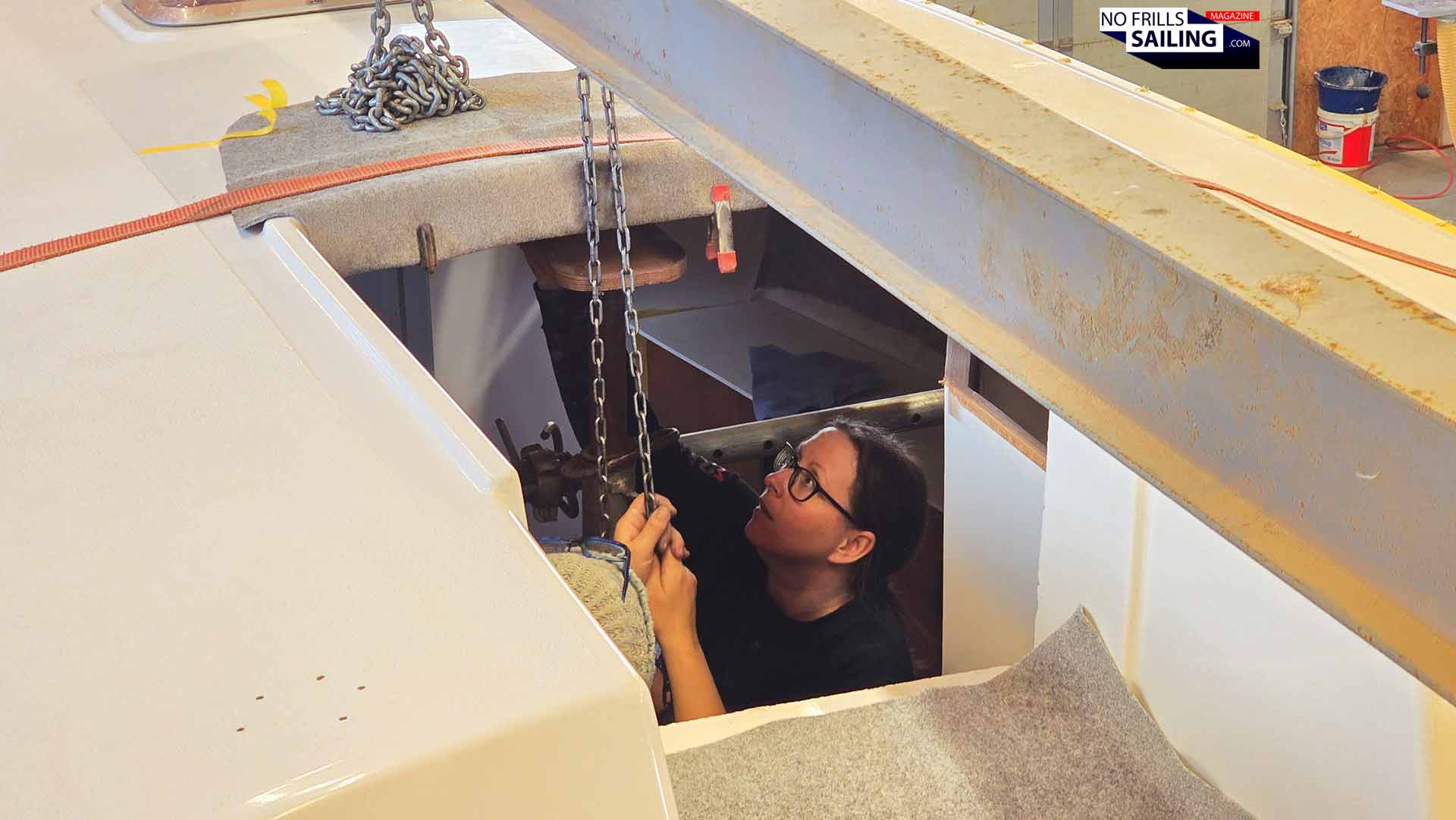
As we have spring time now coming up in Germany as well, temperatures were rising. You can imagine the heat inside the boat when two people are working together in such a cramped, mostly dark environment! And not forget the odors: I am a big fan of the GRP-related smells in shipyards, I must admit. But there´s a difference between a shipyard-visit and working with chemical agents in close proximity. In short: It stank sharply! But, amidst the circumstances, nobody murmured or held back. They did their best and sped downrange from bow to stern.
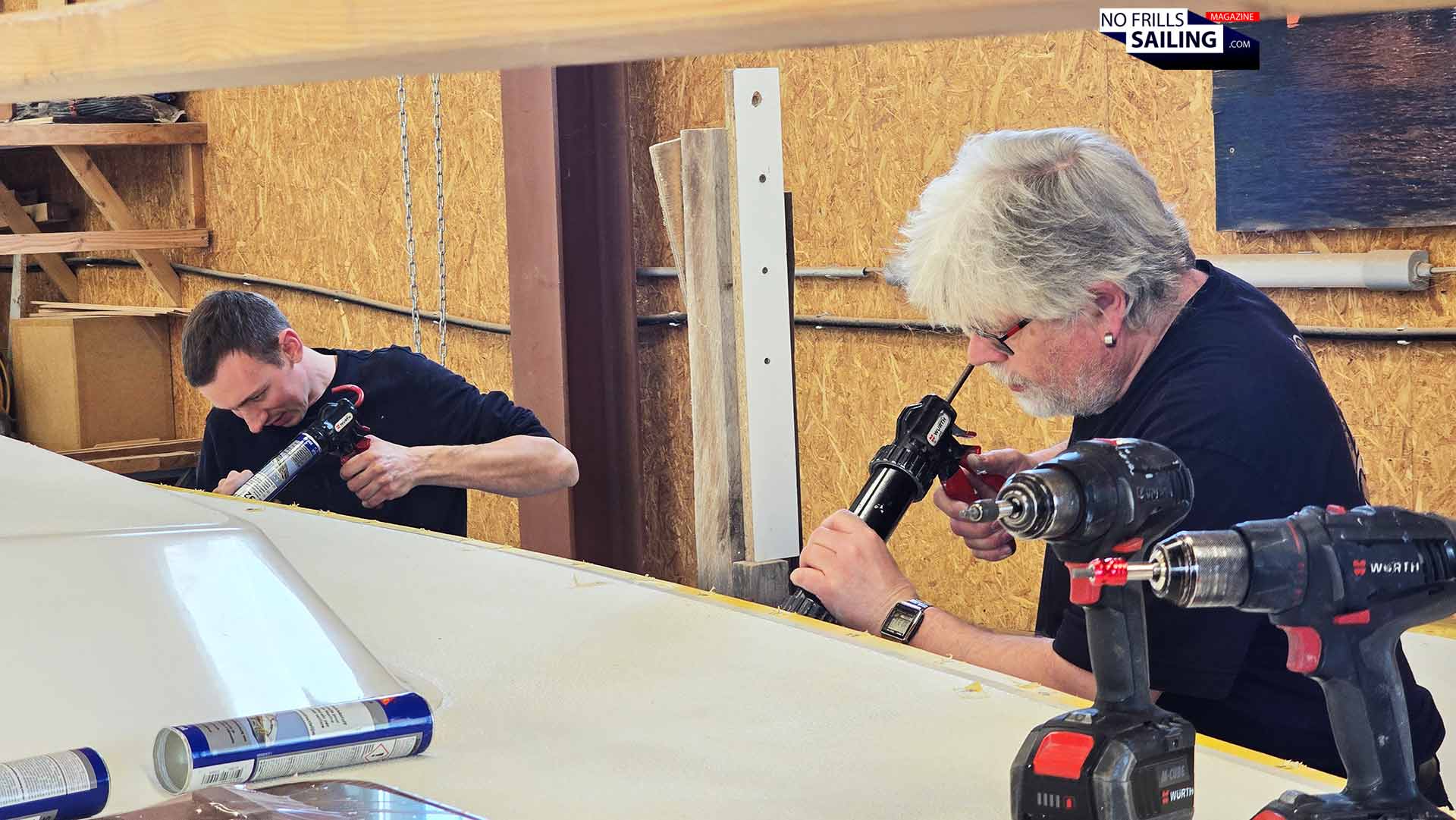
Centimeter by centimeter the deck came down ever so slightly. The two teams consisting of one working outside and one inside the boat were strengthened now and then by Jonas, who acted as a standby-man and jumper. He would hand over tissue, bolts and other tools upon request. He would apply surplus glue with his caulking gun, go for new cartridges and even bring water for the crew for a quick refreshment. Because as promised by Heiner, the boss, during the breakfast: There wasn´t even time for a short pee-break during the undertaking. And I? I was completely captivated and fascinated!
The profession of the boatbuilder is so rich in multifaceted. It is so rich in different techniques, materials you work with, shapes and forms. It fosters your individual creativity and craftsmanship as well as it asks for teamwork, reliance upon your colleagues and your own responsibility. What a beautiful occupation this is! Achieving such marvelous things as a boat. Right? Shaping stuff with your own hands, making things which are bigger than you. Things which will last. It must be so deeply satisfactory!
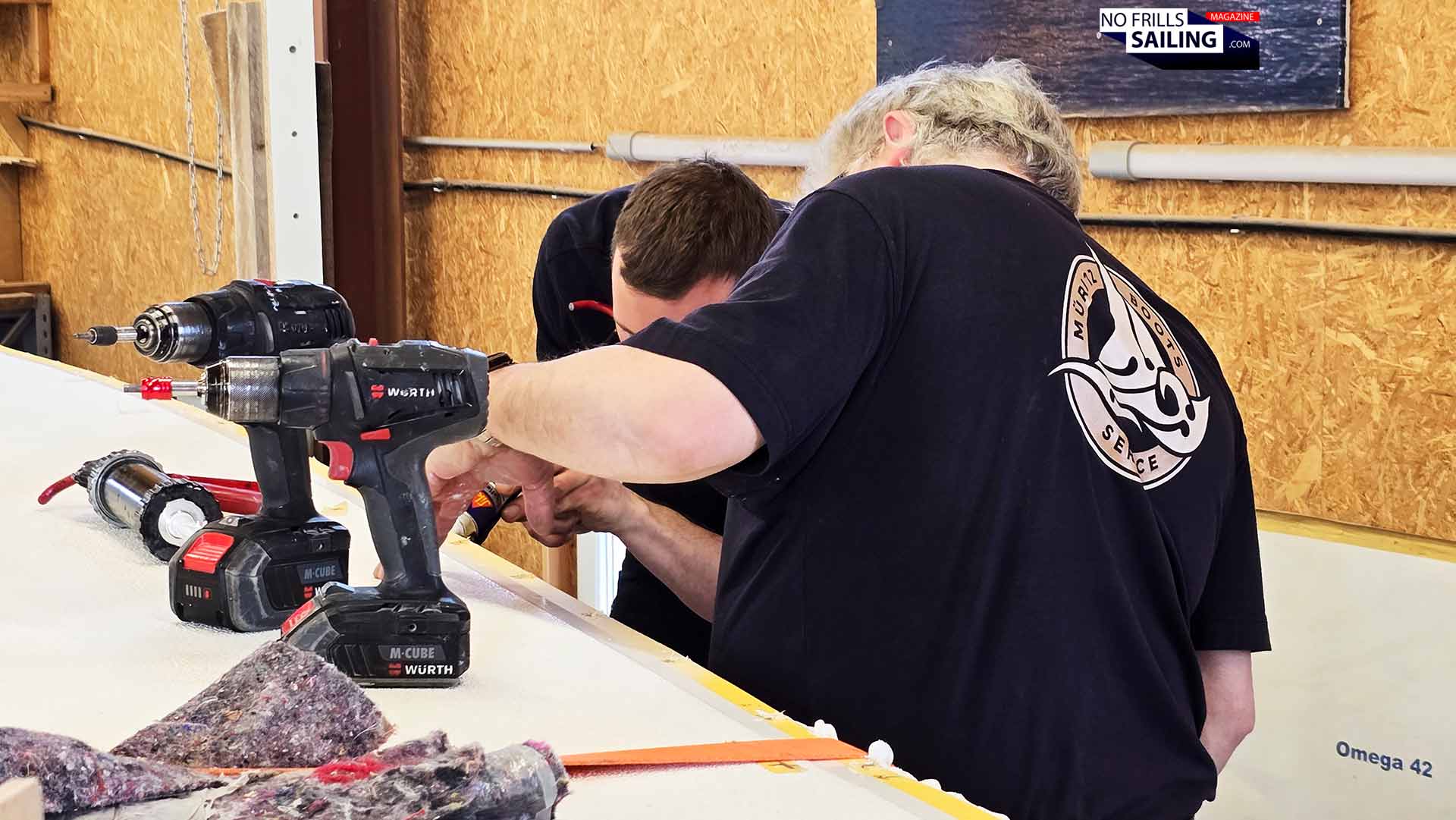
Of course, this is a man´s world, albeit women make up quite an astonishing proportion of today´s boatbuilders. The men were “joking” around, as usual on construction sites, with a bit of an edgy, rough humor. But the girls didn´t take it for a minute and were quick in their responses. You´ve got to love this: Equals working among equals, or at least, I couldn´t sense any outdated patriarchal tendencies, rather than benevolent teasing and joking. It helped to ease the pressure – because still, the clock was ticking!
Hull and deck are finally joint together!
And then, suddenly, the big moment had arrived: On one occasion I could still spot a dark black gaping groove between deck and hull, on the next blink of an eye it wasn´t merely visible. All of the five team members had worked their way all back to the stern with the deck nearly fitted once and for all. It did not take even three full hours – much faster than I had anticipated the process in the first place. Nevertheless, the faces of the crew were sweating for real!
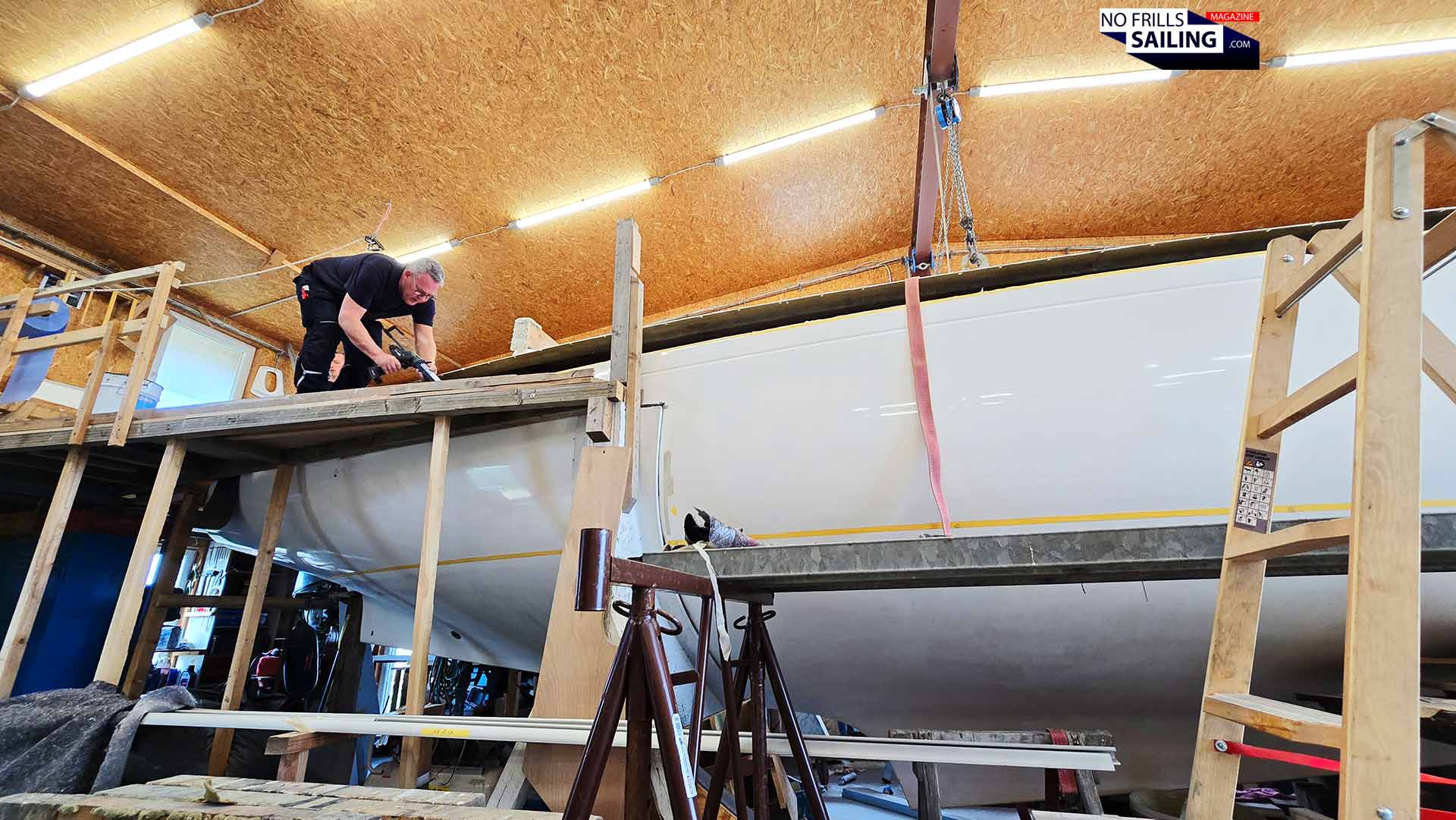
For me, this day reminded me of the occasion when my then-wife was pregnant with our first child and it was time for the first real 3D-ultrasound scan. I mean, I knew that there was my kid growing in her belly, but it was all so distant, so abstract. Now, after that particular day, I held his first picture in my hand. Although it was clumsy and kind of awkward, you could see that it was a human face, a sweet one too. Same here in the shipyard: I of course knew that a boat was in the making. But until today, visiting the building shed was coming to a construction site. This changed profoundly. As of today, we´ve had a boat!
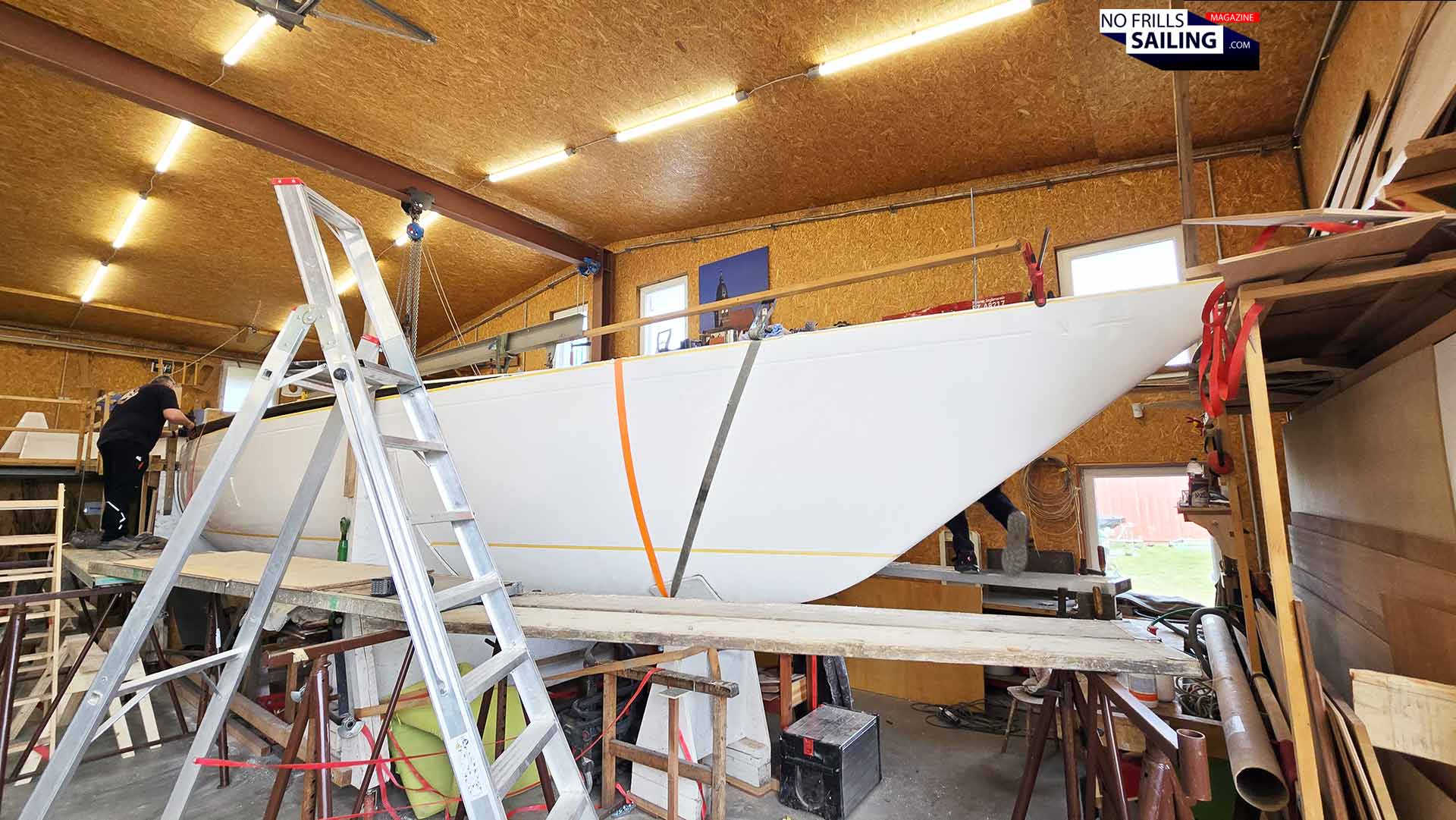
I couldn´t help but look to the past what we´ve already achieved, what was laying behind me. From my first ever visit to the Omega 42 to the weeks of decision making, whether or not I should cancel my purchase order of the First 36 and go for the Omega 42 instead to the very day than I finally signed the contract and building commenced. The months flew by, almost three years now, with a longer phase of inactivity due to personal reasons. Now it was all done. Now it was all of no importance anymore: Because finally by joining the hull with its deck, we had created a ship for real.
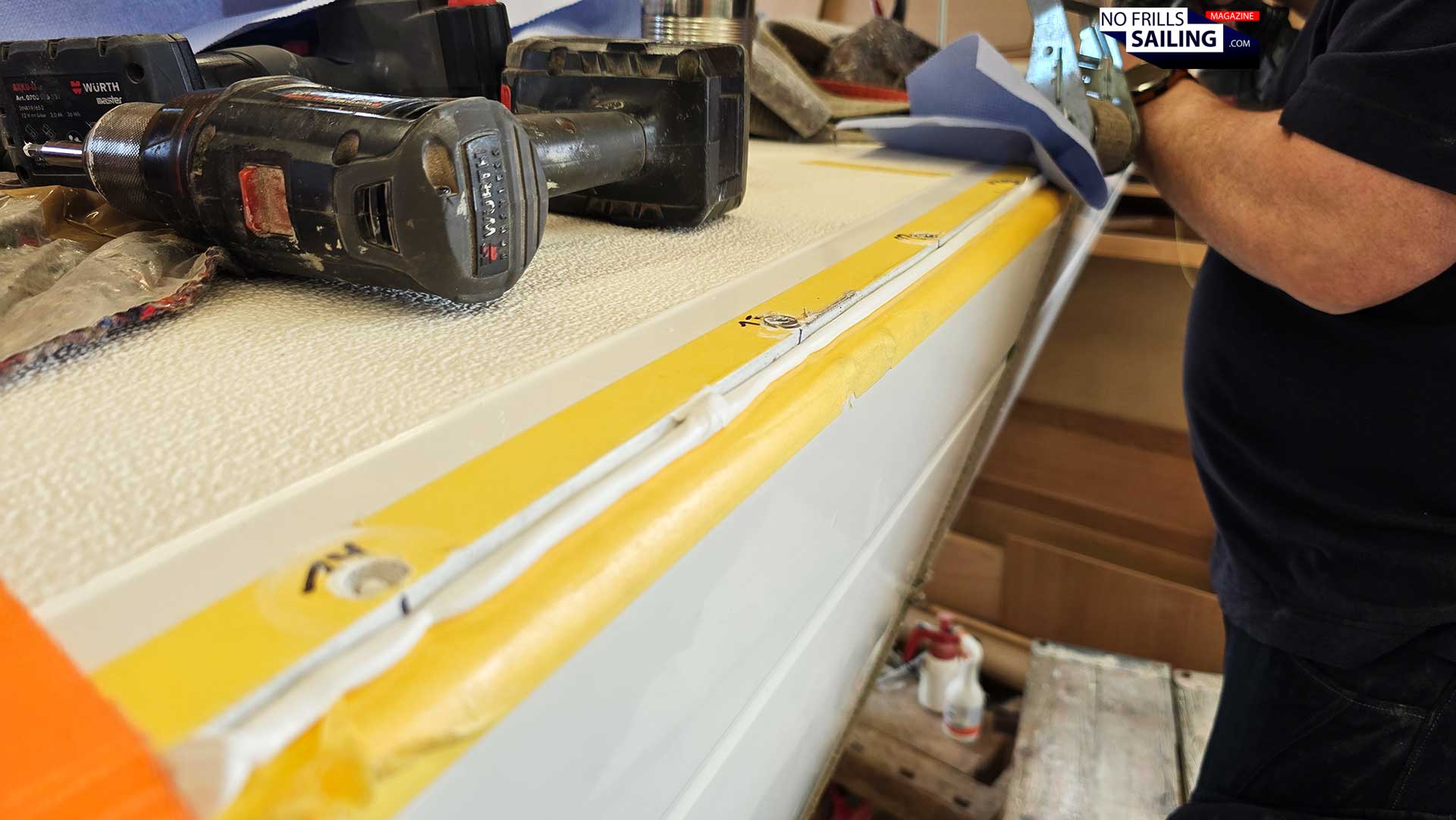
And then, an announcement: “These are the last screws, ladies and gentlemen!”, and the deck went down for the last time. Closing the last gap, now completely sitting on top of the hull. The last bolts sealed and inserted, the last nuts put on top with the screwdrivers buzzing with caution. Not that I´ve had tears in my eyes, but for sure, my heart jumped to an increased rate – we are having a boat right here, how cool is that?!
“Houston, we have a boat!”
I positioned myself right there at the stern, when the deck came finally down. Gently the weight of it pushed the cement out of the seam between it and the hull. Jonas took a thorough look, smiled and invited the guys to put in the last bolts. He smiled, as did the others: Like surgeons realizing that the complicated operation would be a success. Patient alive and well, surgery succeeded. Bravo, guys! I stand in awe, bow down in respect, happiness and pure joy. I couldn´t grasp it: I have a boat now!
With a bit more distance between the boat and myself, I saw ALPHA in her full beauty. From her fine stern end to her extreme overhanging sharp bow. What a beautiful yacht this Omega 42 indeed is! As you can see, the cutouts for the windows had already been applied, which was a very special concern for me. It all makes so much sense now and the strive for the best possible outcome did really pay off – even now, in this very raw and rough condition, the timeless iconic shape of Peter Norlin´s legendary Omega 42 are present and electrifying the whole room.
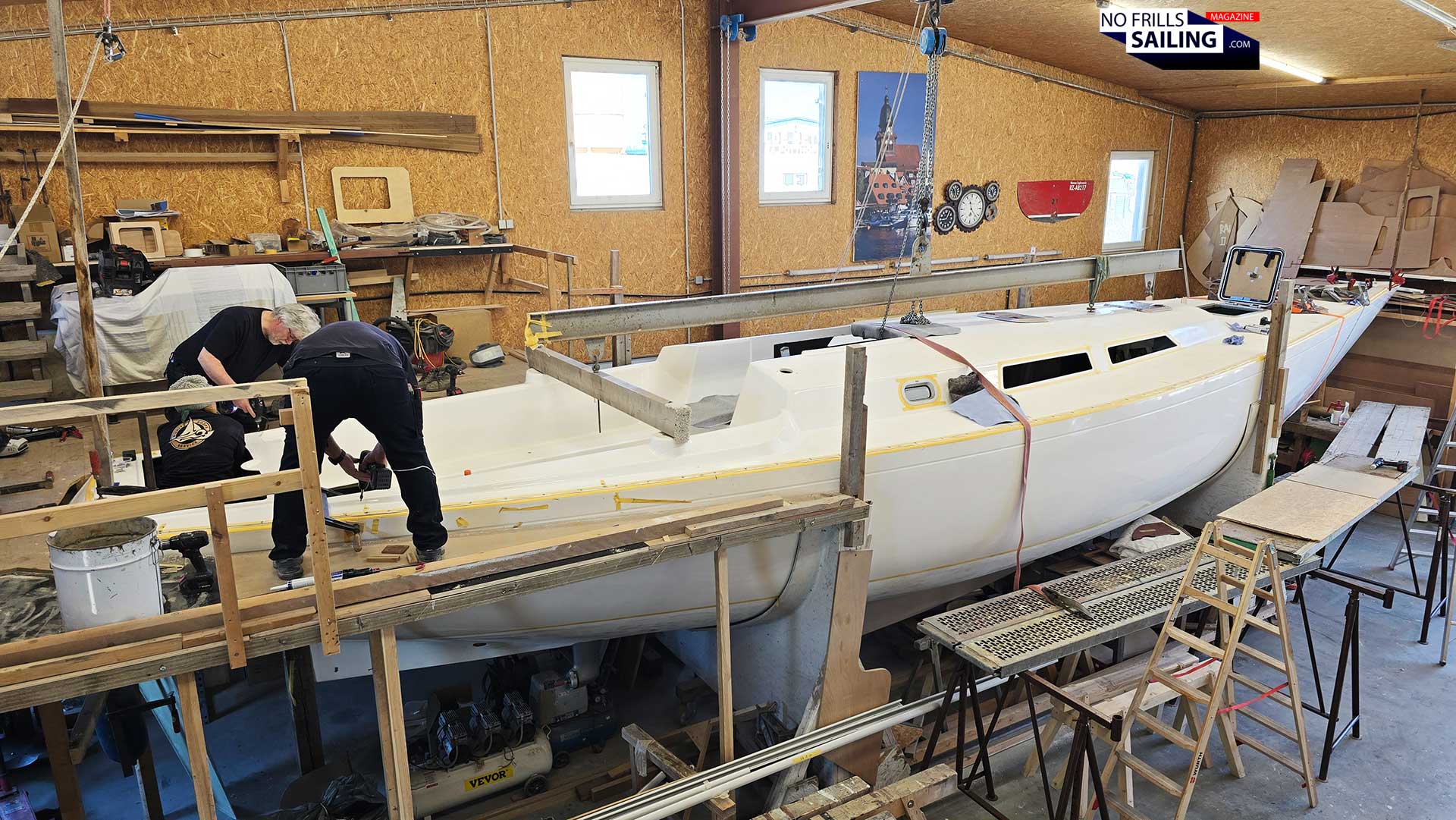
Heiner joined me, shoulder on shoulder we stood there, admiring her shape, looking at the team applying the last working steps. “She indeed is a big-ass boat!”, he nodded. It´s true: Every time I come to the shipyard, seeing the boat with my own eyes, I am astonished just how large the yacht is in reality. Her sleek, long appearance, her slim waist and the low coachroof … bow even more beautiful as indeed, deck and hull are finally joined together. Inseparable, forever, I shall say. This moment really had something sacral to it …
Quality control & next steps
But behold: This isn´t finished. Not at all! With some 120 bolts and nuts set, we´ve just reached roughly a third of the time needed to finish the operation! Because the mechanical fitting is far from being over: After glue and the first round of bolts had been set, it was time for the toe-rail, which is a very integral part of the hull-deck joint. But as this exciting and elaborate process would be too much to be shown in one article, I´ve decided to show you the following working steps in a separate, own article. Stay tuned for part 2 of the hull-deck joint-series, going live tomorrow – click here to jump directly to the article.
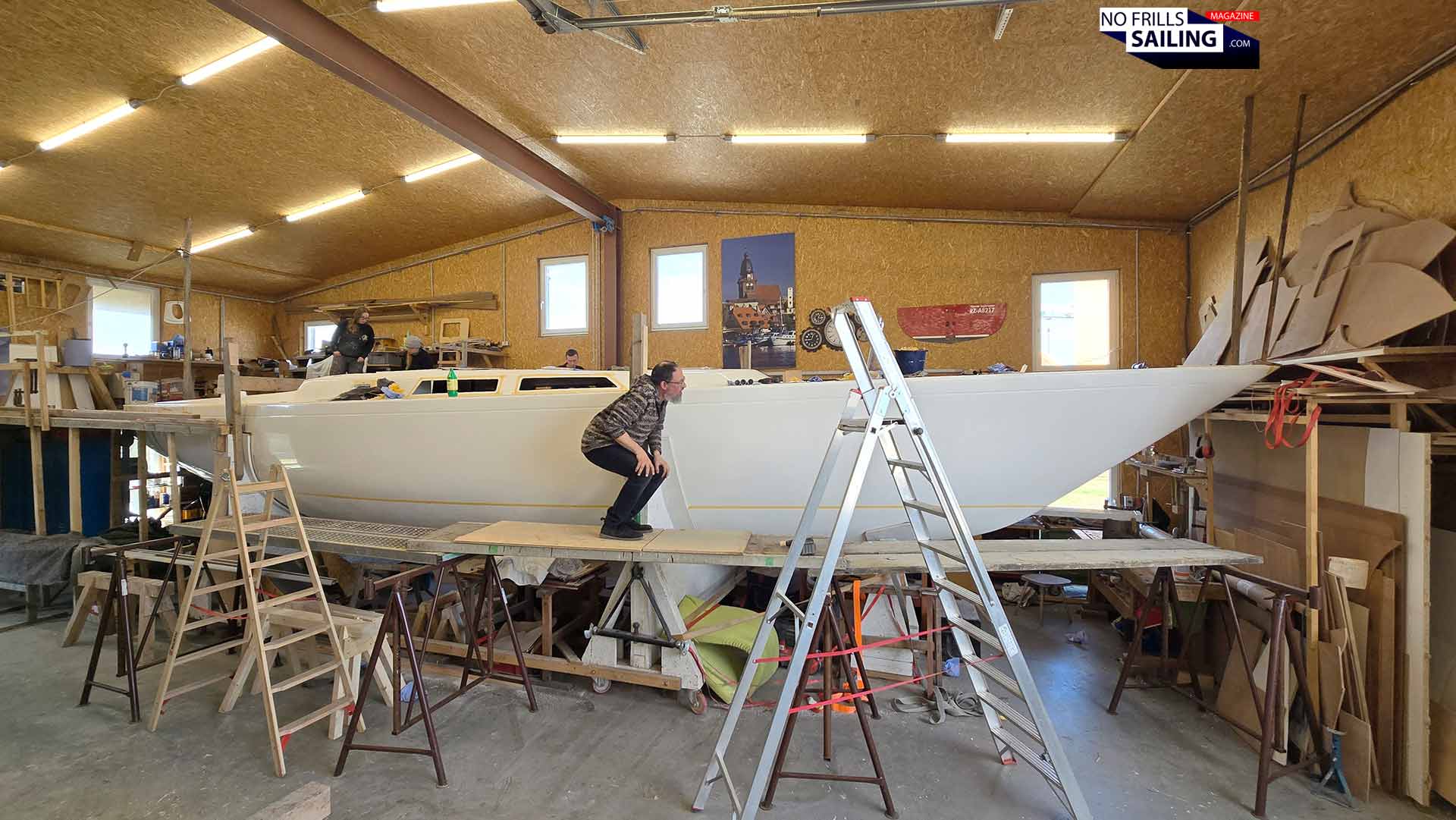
For now, as the team retreated for a short lunch-break and refreshment-pause, Heiner utilized the short calm period to thoroughly inspect the work. He crawled on his knees, put his eyes down low and worked his way from stern to bow to check for the hull-deck joint: Was it smooth and even? Had been used the right amount of glue and bonding agent? Was the tightness of the screws just at the right amount? I guess he was very satisfied, because at the end, he stood up, turned and looked at me. Presenting the brightest smile I have ever seen in his face. That´s a “Go!”, I would say.
Also interesting articles of related topics:
Cementing hull windows (into my first sailboat)
All work-in-progress articles of the Omega 42 building process
What is so special about the Omega 42 anyway?