Many boatbuilders have their whole or parts of their production outsourced. Buying an English, Danish, German or other brands doesn´t necessarily mean that these boats have been built in that respective country. There´s a lot of bias, hearsay, retention and flat out rubbish-talk when it comes to yachts made, for example, in Poland. This article deals with Hanse Yachts, Germany´s powerhouse boatbuilder, where I roam their Polish factory and try to find an answer to the question: Is a Polish-built boat cheaper or of lower quality?
I´ve heard is so often – and you probably as well – that it has become a bit tiresome: “The boat is not made in this or that country, so it must be just of cheap quality!”, or: “Why should I pay the full price for a yacht that hasn´t even been built in my country?!” It´s a bit of a peculiar situation, because, frankly, most of our electronics come from China or Asia, the same goes for our clothing and even Volkswagen does manufacture in many European countries. So why is focusing on the country of origin for boats such a hot topic?
You´ve already seen Hanse Germany?
I guess it´s partly because of the high prices in the current boat market, which pose a perceived gap between the brand´s value and the knowledge that the boat had not been made in the county of the brand´s origin. Catamarans made in Marocco, almost all outboard power boats of the Beneteau group are built in Poland, the small Oceanis 30.1 and 34.1 as well. Fired up by the brand´s marketing strategy, of communicating the “French way of sailing”, “British naval traditions” or the “Made in Germany”-label, that is still highly renowned. That said, it´s surely a difficult topic, for both market actors, their marketing departments and … you, as a prospect client.
Eastbound to Hanse Yachts in Poland
Advertisement
That said, knowing that Hanse Yachts does indeed have a large production facility in Poland, I just asked Hanse Yachts CSO Maxim Neumann if I could go there, take a look and delve deeper into this topic. He happily agreed, seizing the chance to at least tell the story from the company´s perspective and maybe get things straight, show the reality and why it is that way and get rid of the annoying and irritating misunderstandings and bias.
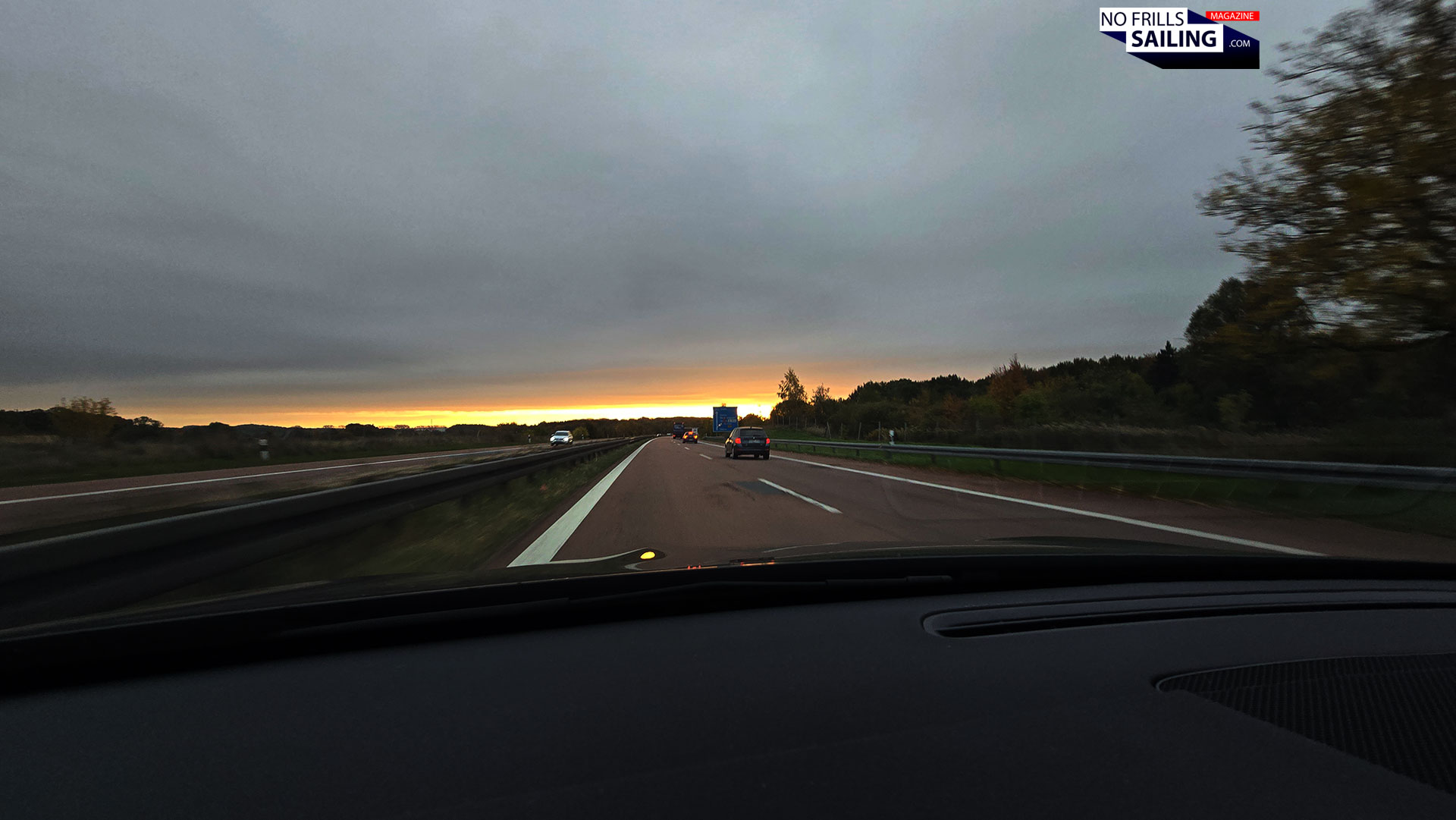
It´s quite a ride to the Polish border
It was a long morning ride on that October Thursday, driving from Luebeck at the Baltic Sea to Hanse HQ in Greifswald is a two hour trip anyway. There I parked mine and jumped into Maxim´s car, tackling another +2 hours ride to the Hanse facility in Poland. And right up that moment when we entered the Stettin area, I´ve had my first learning: This is not a company location choice by chance. Stetting, just as Poland itself, has a century old tradition of having a marine industry. Shipbuilding, ports, fishery. And since two or three decades, this area specialized in fiberglass-industry.
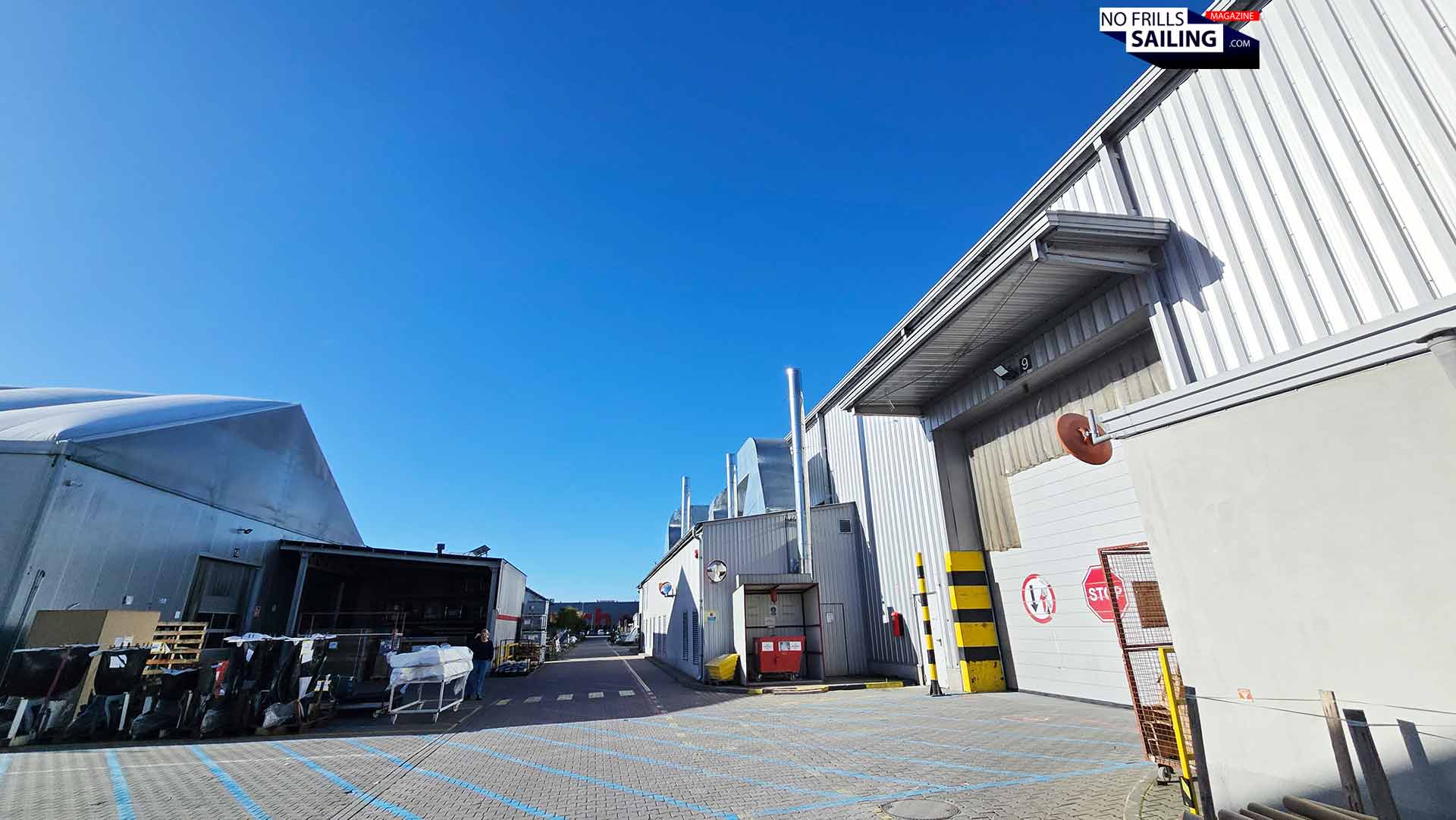
Arriving at the Hanse premises in Poland
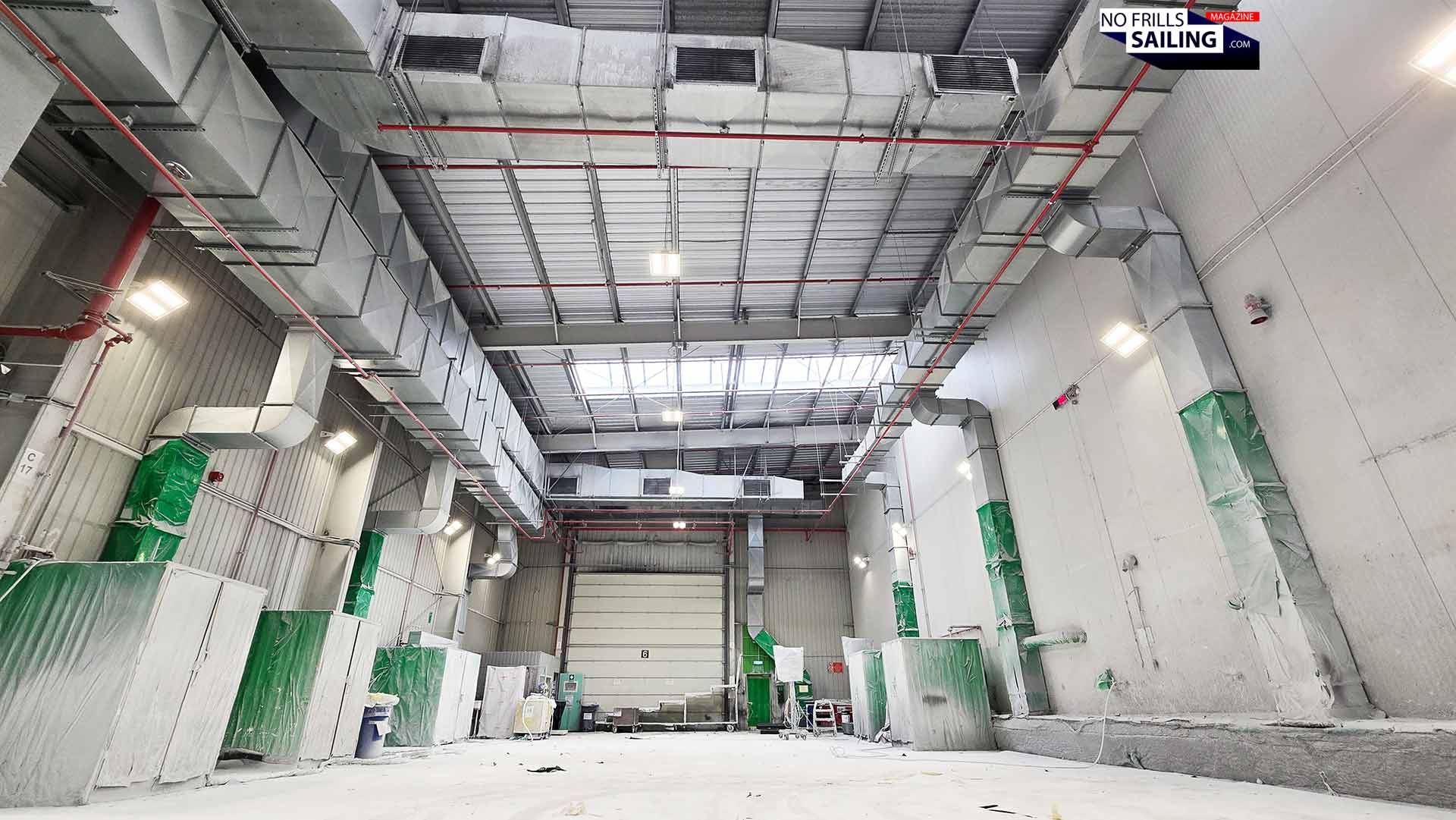
Parking the car on the Hanse premises, I witnessed a lot of other companies have settled in the near vicinity as well: From wind mill vane-manufacturers to wallpaper factories. Anything that is made from glassfiber or has something to do with composite materials and molded products, you´ll find here. There a number of such “centers of excellence” in Poland. The Beneteau-premises for example are located farther to the east around Olecko area, near the Lithuanian border, where there´s another center for fiberglass- and composite industry. X-Yachts has their company literally 500 meters away from the border to the Russian exclave Kaliningrad. So, here we are: Stettin, Hanse Yachts Poland.
A split production from the start
Maxim hands me the usual protective gear you ought to put on when visiting an industrial facility and we enter the building. He tells me that Hanse Yachts is engaged in their activities here for over 30 years now. That´s right from the start of the whole brand after the Iron Curtain came down and famed Michael Schmidt, who is now making the luxury Y-Yachts in Greifswald after selling Hanse, founded the company. “Hanse Yachts did from the onset follow the idea of having a split production between Germany and Poland”, Maxim explains. First learning: At least they didn´t jump to cheap labor here recently, it was all the original plan of the company when founded.
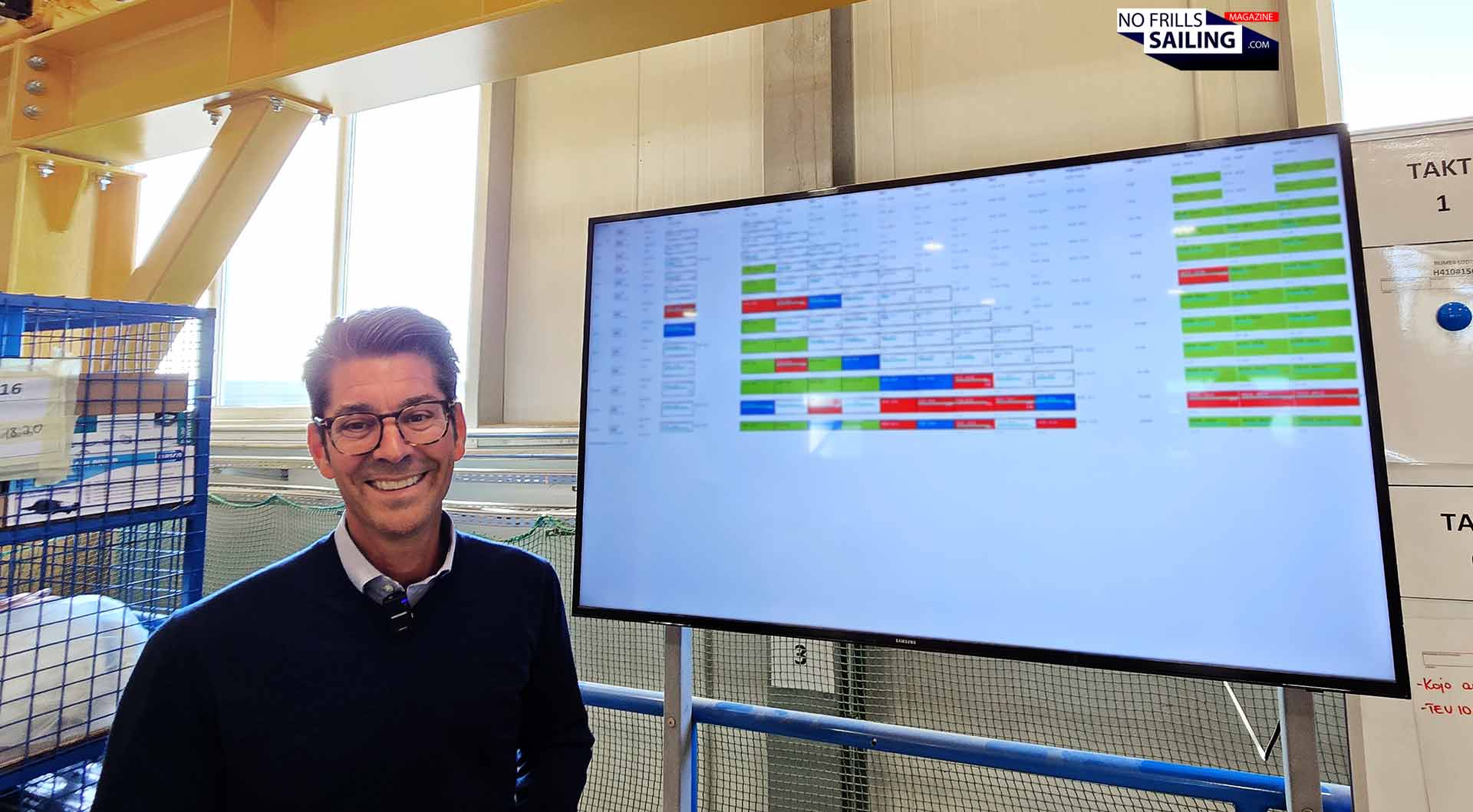
Maxim Neumann is proud of a full order book
Back in the day, around 1990 when Schmidt started with his company, the boating market wasn´t as big and as profitable as it used to develop into when the charter-boom set in in the 2000s till 2010. “Back then the idea was to build affordable sailboats for everyone, which kind of still is the brand´s core of Hanse Yachts.” The decision was made to have a split production in Germany and Poland as well – right from the start.
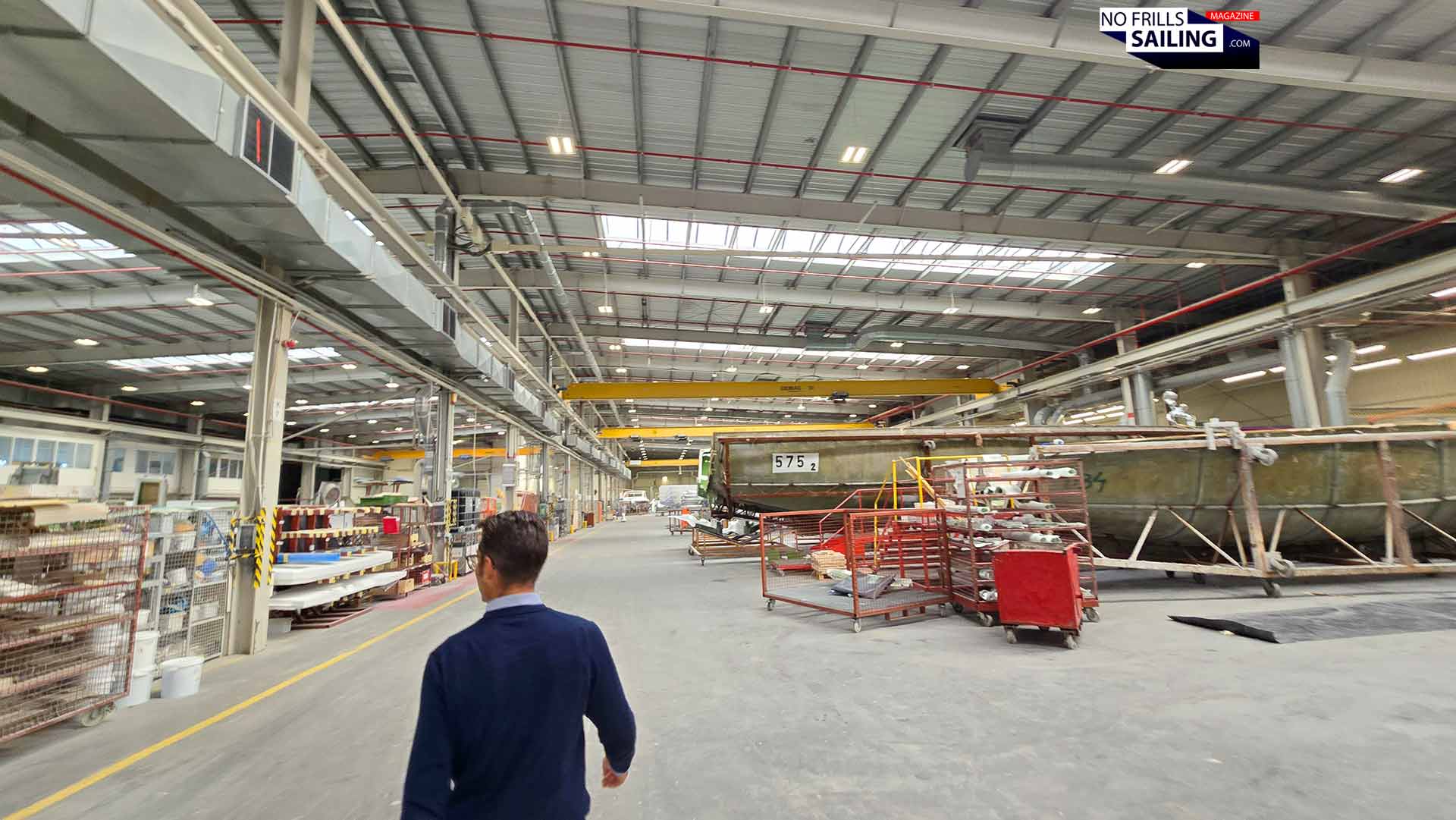
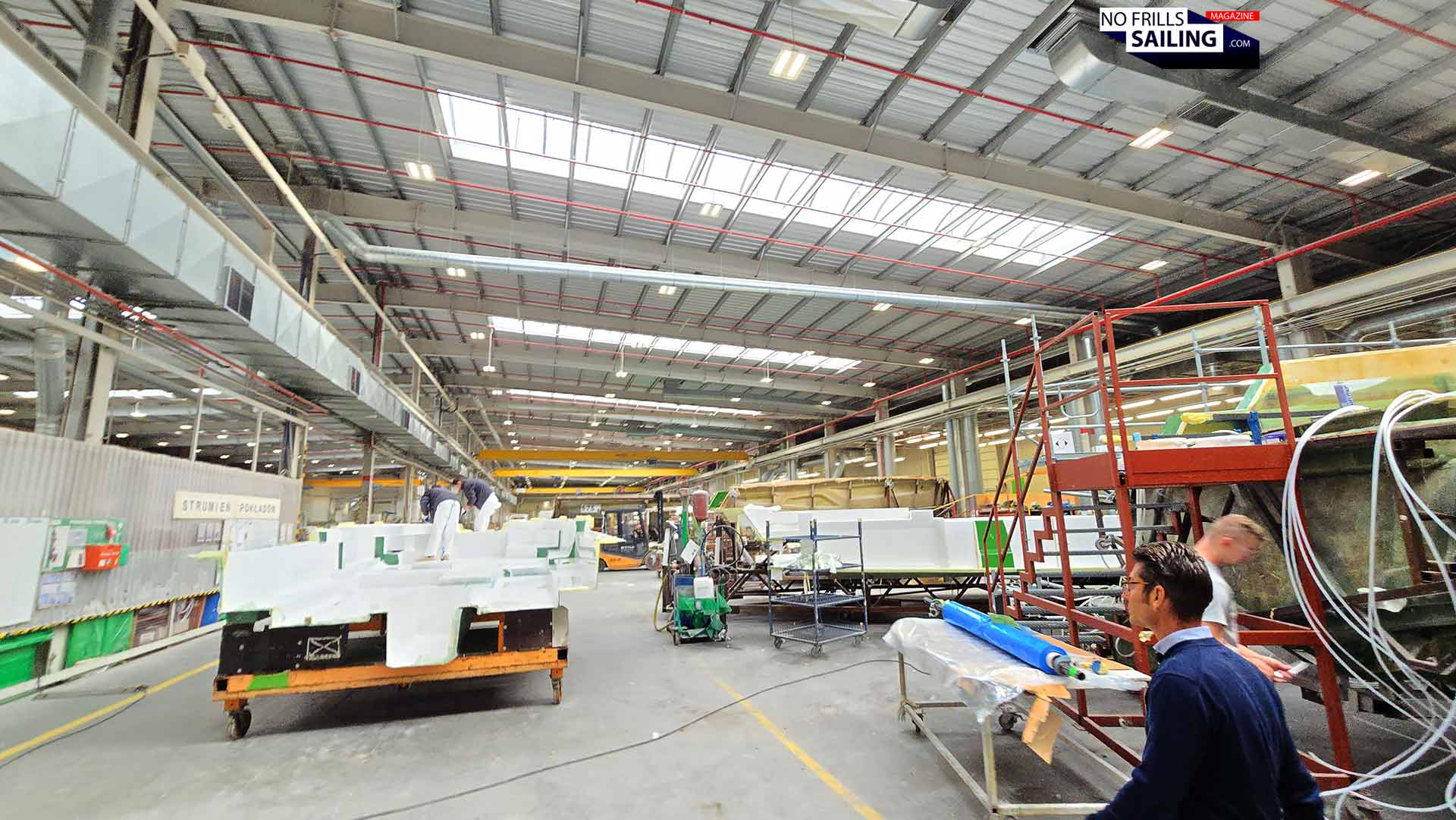
One of the big production halls
The original building facility, which we visit first, started with 10.000 square meters. It´s still a huge factory hall. “Gradually we had to expand on these premises”, Maxim explains. Later he will show me equally big industrial tents, housing special production compartments. Together with the more than 110.000 square meters in Germany, it´s just showing the big jumps the company made. “During the first years, it was incredible! We grew at 30 to 40 percent – per year! Can you imagine?” These first years must have been an exciting ride, apparently.
Boatbuilding quality from the start
So that´s a first learning: At least for Hanse, optimizing production cost and settling where a specialists-workforce is already available played a role from the onset of the brand´s founding 30 years ago. Sure, wages are lower in Poland and they used to be way lower back in the day. Nowadays, Maxim says, the gap isn´t that big anymore. But emphasizing the all-embracing skilled labor shortage, it is definitely a big advantage to settle in a center of excellence. Meaning: Due to the other factories in the vicinity, there´s a much better market for hiring skilled composite and lamination specialists here. “In fact, it´s the other way round: That way, it has quickly become a worker´s market here. These people are highly mobile and only work for employers who grant reasonable wages and surplus services. It´s definitely not a cheap labor market!”
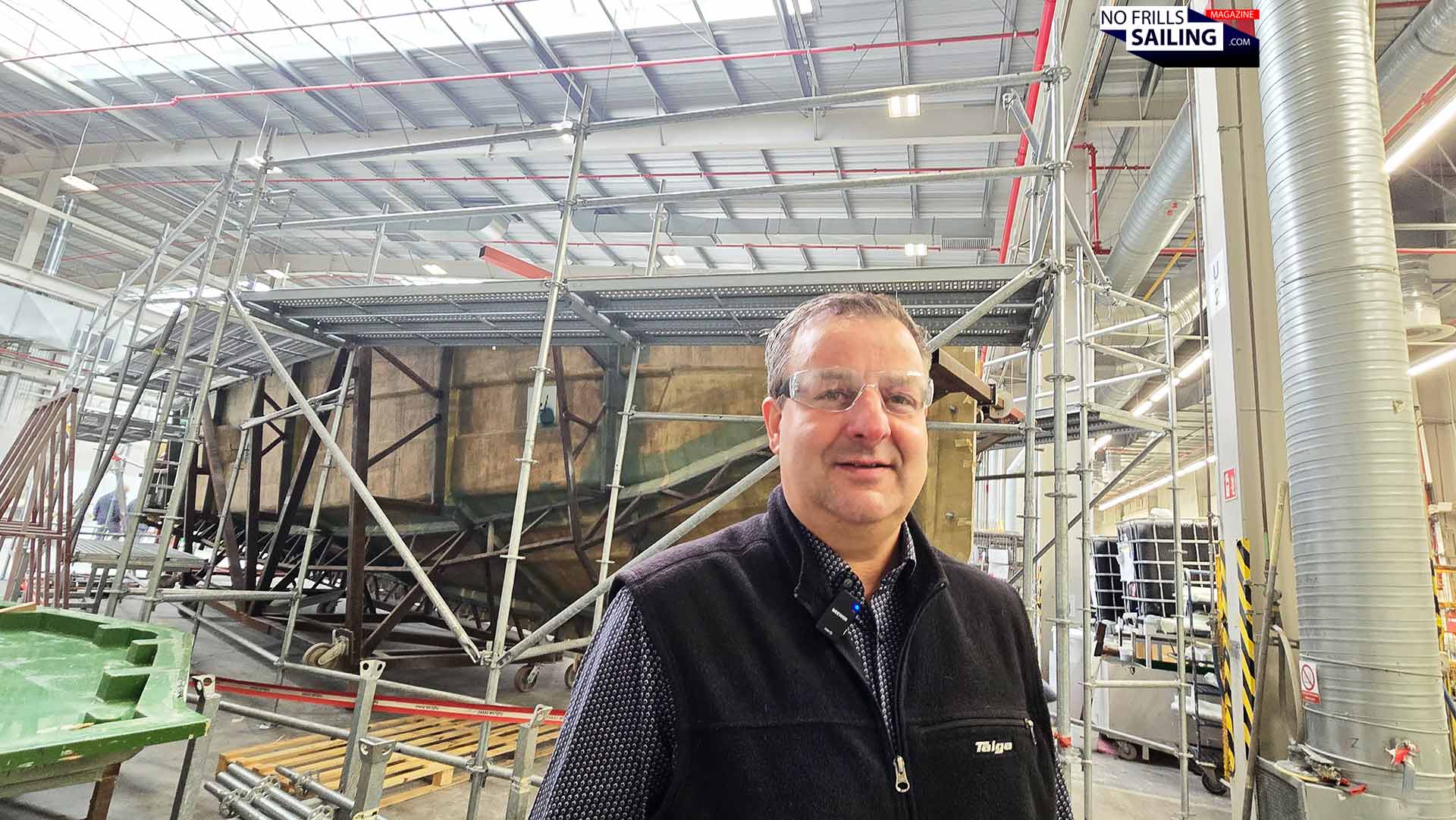
Meet Canadian Stephen Eigendorf
That´s interesting! And new to me. In fact, the Polish staff I get to meet and see working in the factory does not make an impression of being low-wage or exploited. Clean overalls, smiles and a friendly “Dzien dobry!” everywhere I go. Then I am introduced to the production manager of Hanse Poland. And that´s another surprise. He´s neither German nor Polish. He´s Canadian! Stephen Eigendorf comes from the Vancouver area where he started and developed a pretty impressive career in composite boatbuilding. He´s with Hanse since 2008 now, one could call him a senior in the best sense of the word. Introducing his knowledge and expertise to the production, the aim of Hanse was not to make things cheaper, but better.
Complex layup: Composite competence in Poland
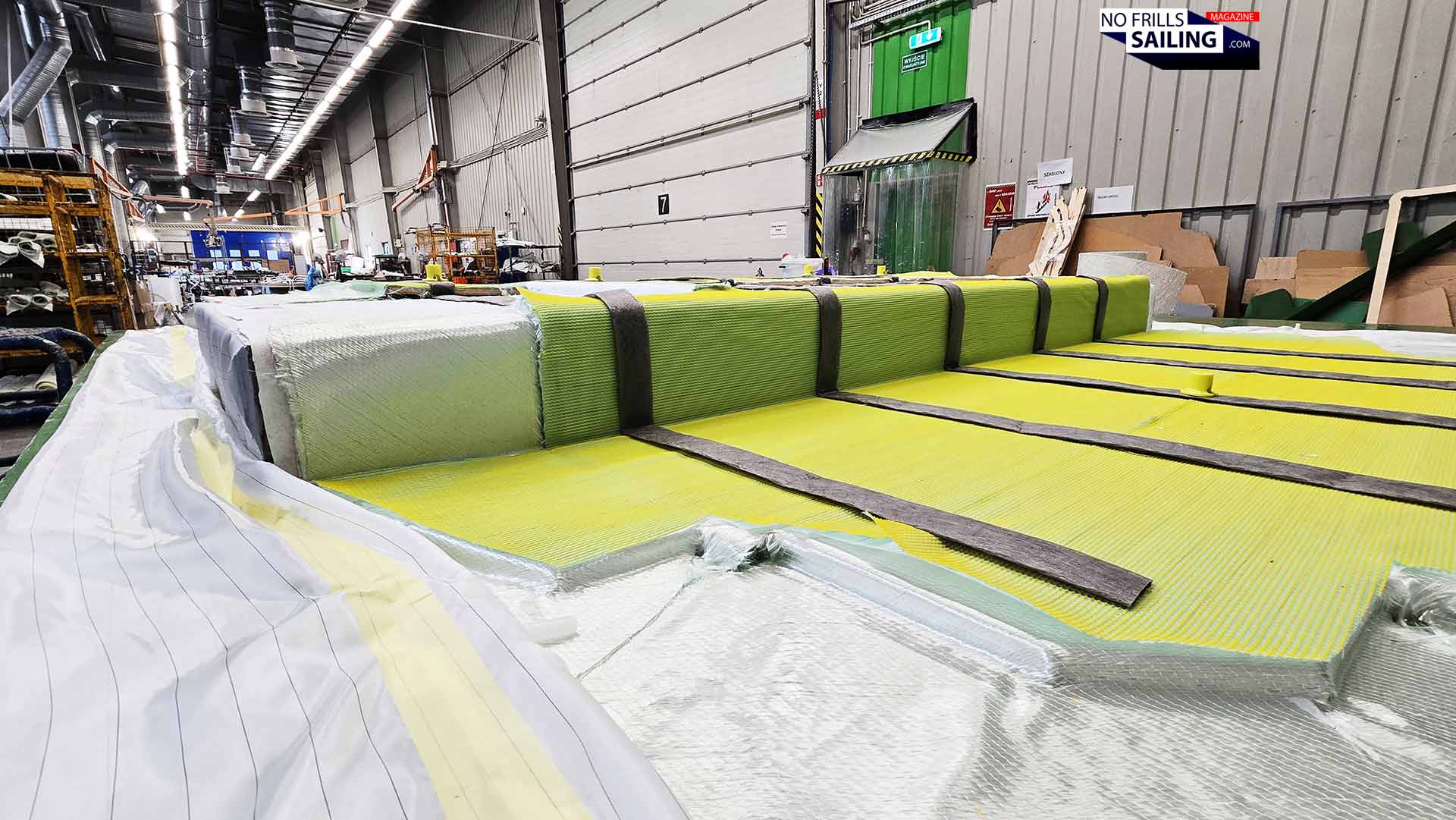
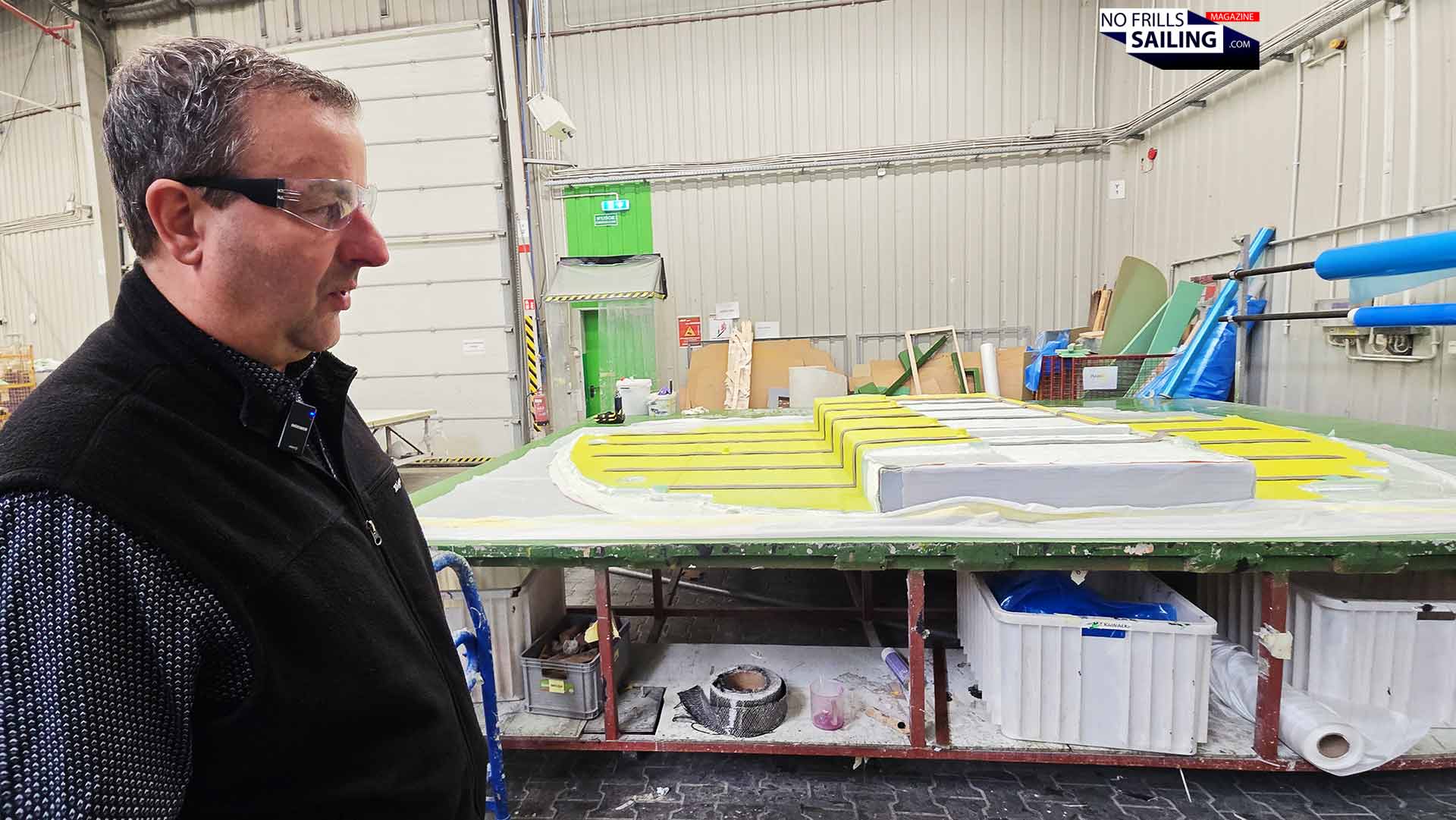
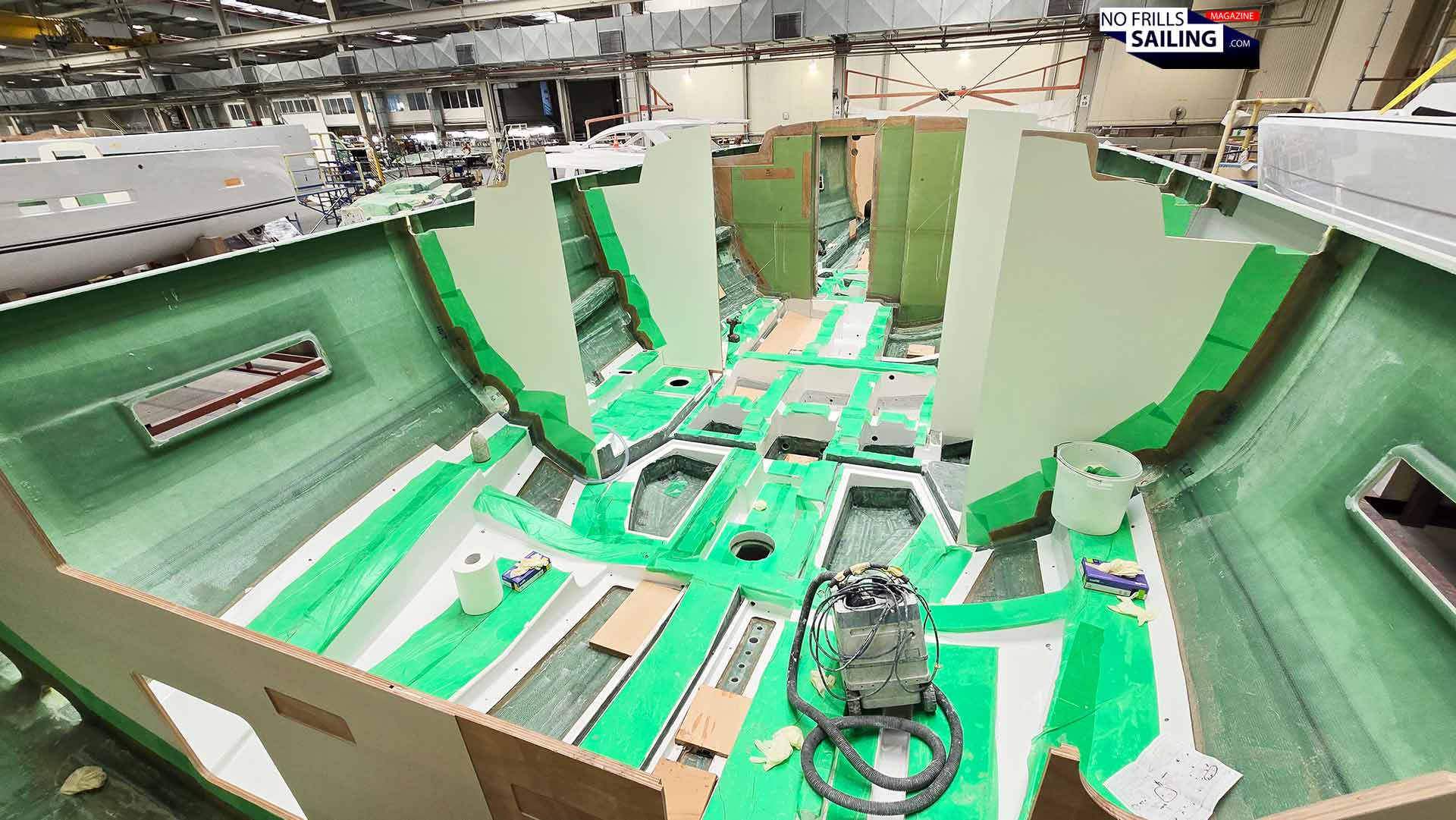
Stephen will go on and show the complete lamination and composite production here at Hanse Poland. We start where we stand: The bulkhead manufacture, which, he says, shows just as nice the aspiration of modern Hanse Yachts. Most of the structural bulkheads for any of Hanse´s brands, be it Fjord, Sealine or Ryck powerboats, or the Hanse, Dehler and Moody sailing yachts, aren´t simply made of plywood, but intricate, lightweight and high grade composite parts. On a prepping table, one of these structural bulkheads is just prepared to be made.
Stephen explains how it works
That requires not only high precision composite techniques but also the right materials and the skilled craftsmen to do it. The sandwich layup and the order and direction in which the individual precision cut matts are put into the female mold is definitely not cheap. Nor could this be done by underpaid people …
A techniques of fiberglass lamination
So if you´d had expected to see a dirty, dark, stinking makeshift production hall with Zombie-like people, demotivated and desperate … well, it´s quite the opposite here. Stephen explains and shows me the different building slots in this main production hall, where the hulls are laminated and prepped for the next production steps. Hanse Poland can deal with any required technique needed for any boat type within the range of the company. And there are a lot: Currently, all brands of Hanse offer more than twenty different models in many variants.
Working with carbon fibers
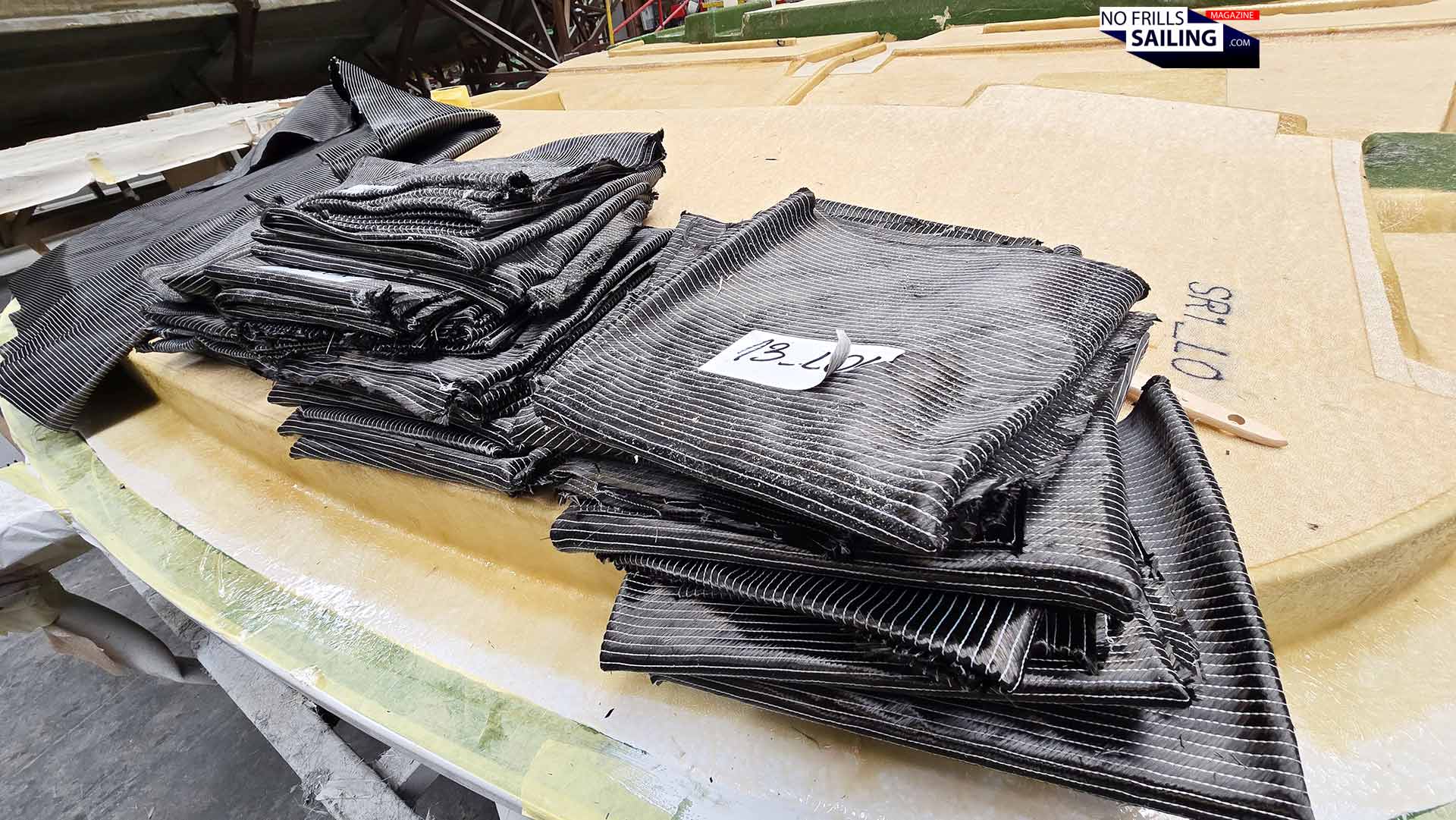
“We can do everything from hand lamination to vacuum-technology.”, Stephen says. But … isn´t this … carbon? Yep, it is! So, apparently, some of the parts made predominantly for their very successful Fjord powerboat range are utilizing carbon fibers to save weight and increase structural ruggedness. Again, this is far from being just “cheap” here. As there´s mainly no real difference between fiberglass or carbon in lamination, you still need a lot of expertise to use those properly. Here, they also do carbon cages for some of the yachts for increased stiffness and weight saving efforts.
Vaccum infusion and injection is a no brainer here
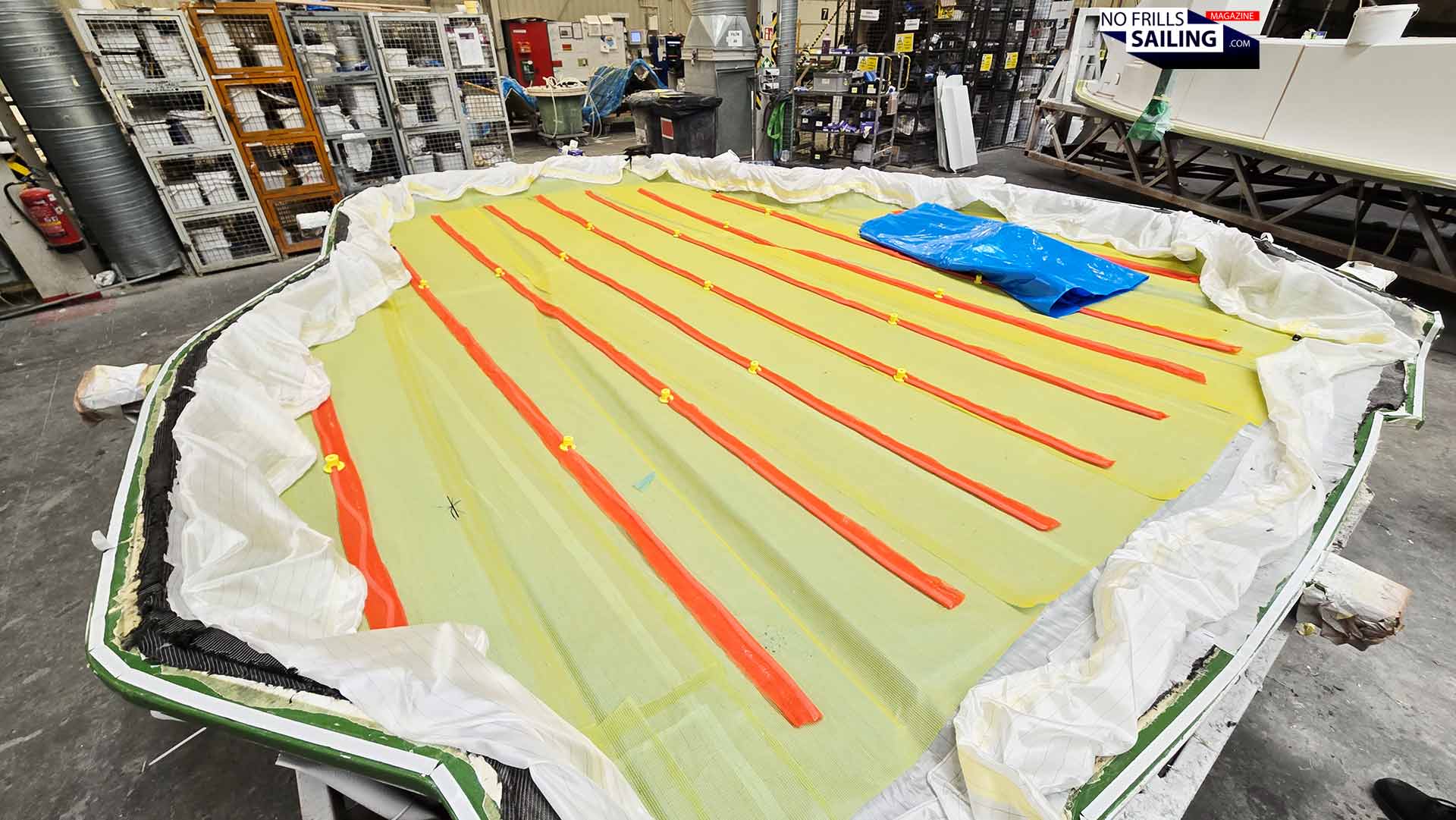
Another section of the hall is dedicated to vacuum infusion and vacuum injection. I´ve written a lot of articles roaming various shipyards about this technology and it is certainly not as “high-tech” as you´d be expecting, but still it needs some different (high) skills, tools and materials. It also shows that here at Hanse Poland it´s much, much more than just cheap labor needed to operate the boring rolls in hand lamination. Here in the vacuum-department it shows the level of skilled expertise. And it goes even further.
Another spcialty: A and B-side injection
Stephen is particularly proud of their vacuum Injection products. Vacuum injection, in contrast to infusion, produces parts which do have two A-sides. Whereas “ordinary” infused parts only have one A-side (where it was molded into) and one less beautiful B-side, where still the marks of the plastic wrap and pipes can be seen, injected parts have two molds, hence two “nice” A-sides. He shows a freshly demolded part, a locker lid.
Smaller parts, raw finish
It hasn´t been properly fettled and sanded, but it indeed has a nice outside, later part of the cockpit´s seating benches, and a very beautiful, flat and smooth inside, which is the underside of the closing lid of the cockpit locker. “That way we invest a bit more effort into the initial production, but we save a lot in after works – and it just looks so much better on the boat, that just having a kind of rough and ugly underside.” He´s absolutely right! In order to make such parts, the pre-works and kitting is of utmost importance.
Computer aided production – a basic requirement
Stephen leads me into the opposite side of the hall where the cutters are located. These are two large CNC-milling machines, oversized plotters, I would say, which are fed with precise CAD data and will cut any material needed for any part of any boat. That´s fiberglass matts, carbon as well, foam core parts and all the other stuff that needs to be precision cut. I forget to take pictures of these machines, so please check my YouTube-channel for the corresponding video, here you will see them in action.
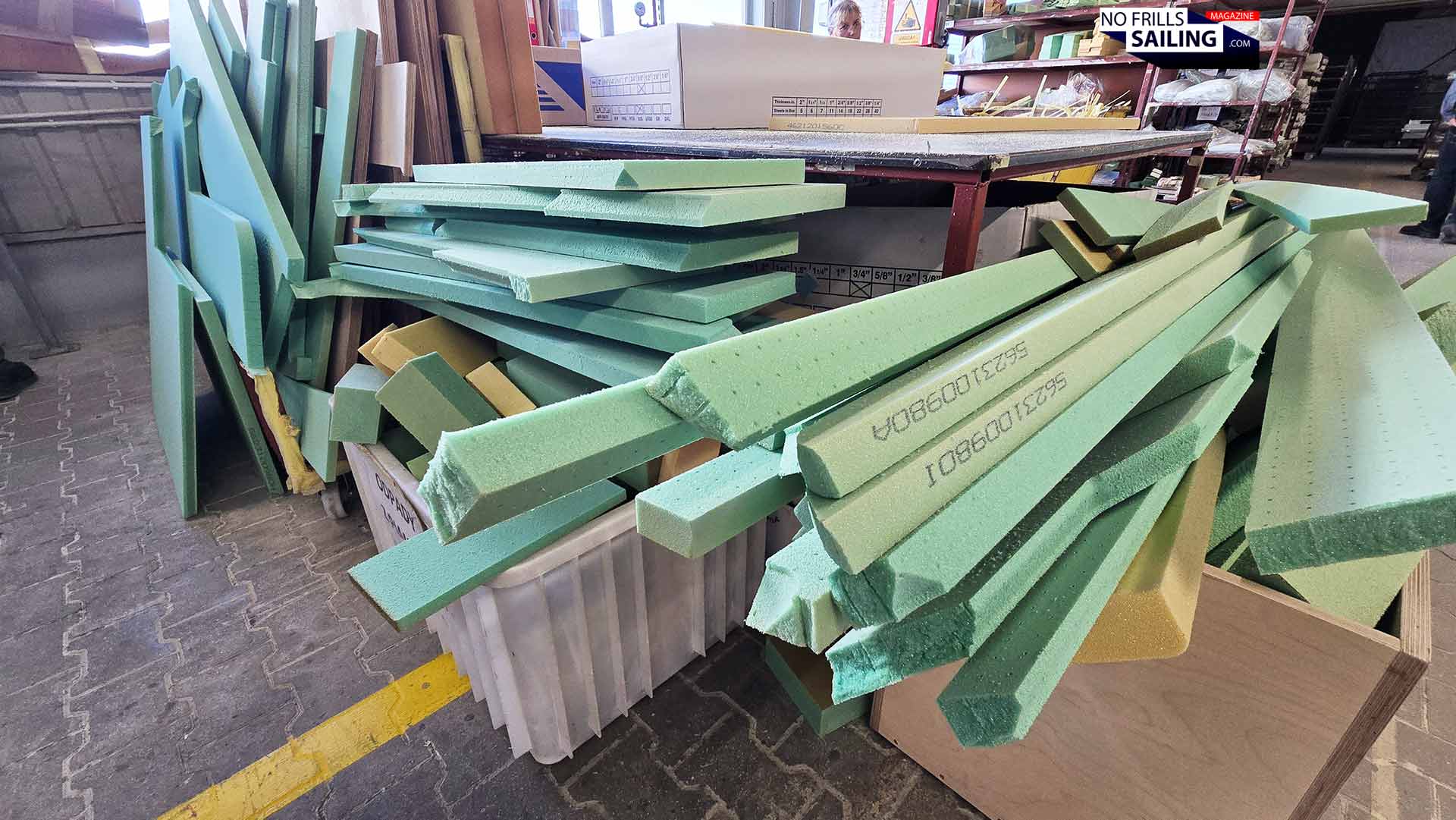
Collecting the foam core offcut
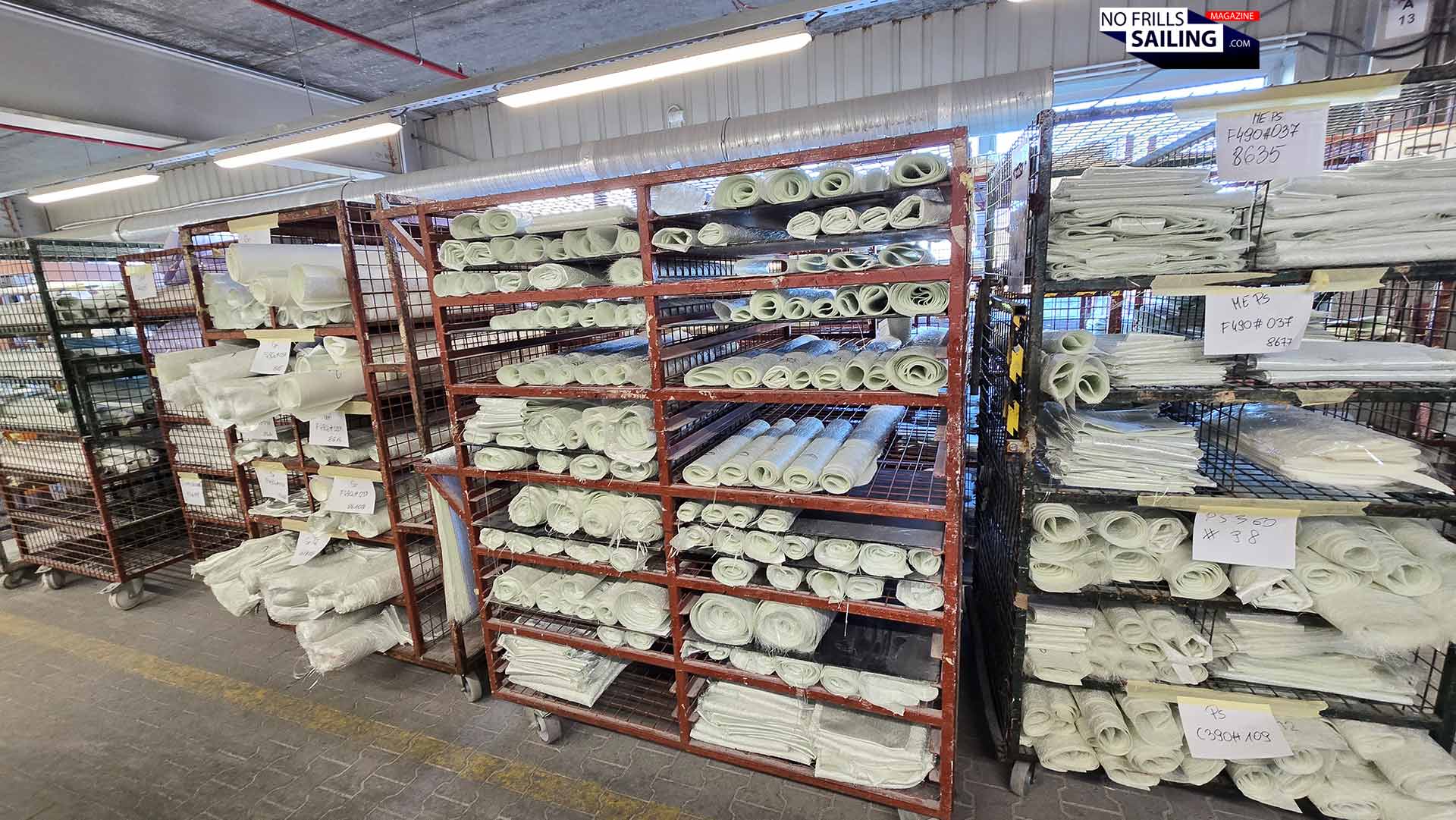
Either way, the outcome is Hanse´s ability to deliver any part in a matter of minutes. Stephen shows the back of this compartment: Large multi-story carts are located here. Each one is filled with clean rolled fiberglass-bundles. “These are basically the next boats we will produce here”, he says. Each cart, sometimes two, contains every layer of precision cut glassfiber matts, carbon parts or foam core material needed for the molds to be laminated and become either a deck or a hull. It´s fascinating: Every boat starts as a bunch of loose fiberglass bundles …
This is how every Hanse starts
The carts, stacked into to two rows to either side of a central walkway, amount to some 20 in total. “That´s some eight or nine new yachts”, Stephen explains and smiles. Showing these to prospect buyers or customers here during shipyard tours does always amount to a Eureka-effect. When clients understand that these bundles are the nuclei of their yacht, it´s even more awe-inspiring when switching to the finished hulls. A manifestation of loose glassfibers, if you will.
Speaking of aha-effects: Maybe you don´t know this, but you do not have to regularly check NO FRILLS SAILING for new articles. As much as I appreciate any click on my site, you can have it easier. Just subscribe to my monthly newsletter and receive one simple email at the end of each month. That way, you just check the thumbnails for any article that´s of interest for you and very conveniently with one click browse to the content you like. That being cleared, let´s go back to Poland …
Sailing yachts, power boats: Flexible production
Having seen the smaller departments and little “manufacture within the factory”-shops, Stephen leads me into the huge main hall. First things first: What surprises me is the little amount of stench within here. Although every single building lot is occupied, there´s much less styrol or other chemical odors in my nose that I would have expected. This speaks for the efficient air condition within the hall and, ultimately, for the working conditions for the staff. By the way, don´t be surprised not so see all too many workers on my pictures: Although everyone was very, very welcoming and friendly, it seems like Polish people do not like being photographed. They respectfully stepped back a step or two to let me take my pics, but kindly refrained from being pictured. I guess that´s kind of a cultural thing …
Another mold is prepped for a new yacht
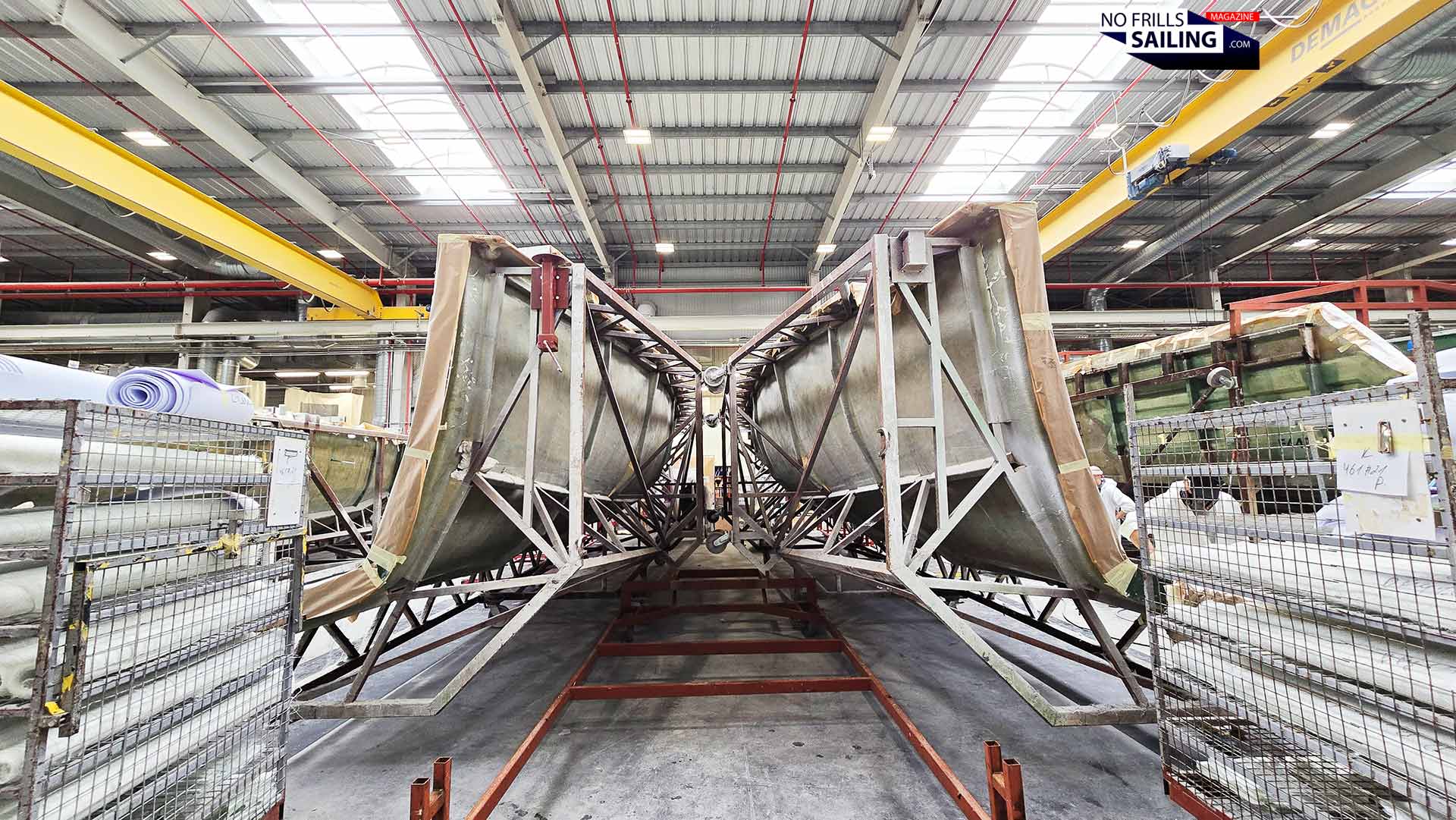
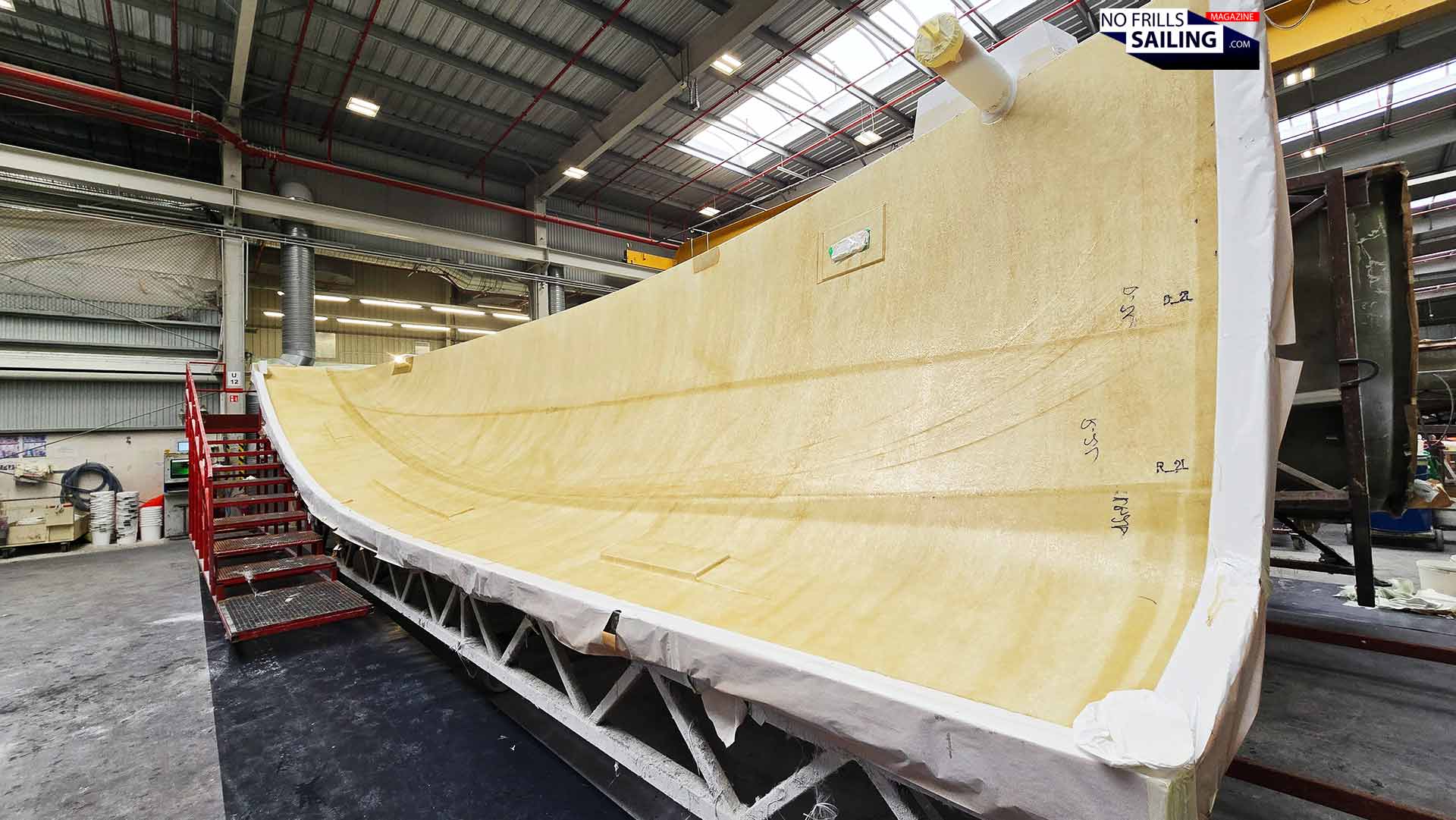
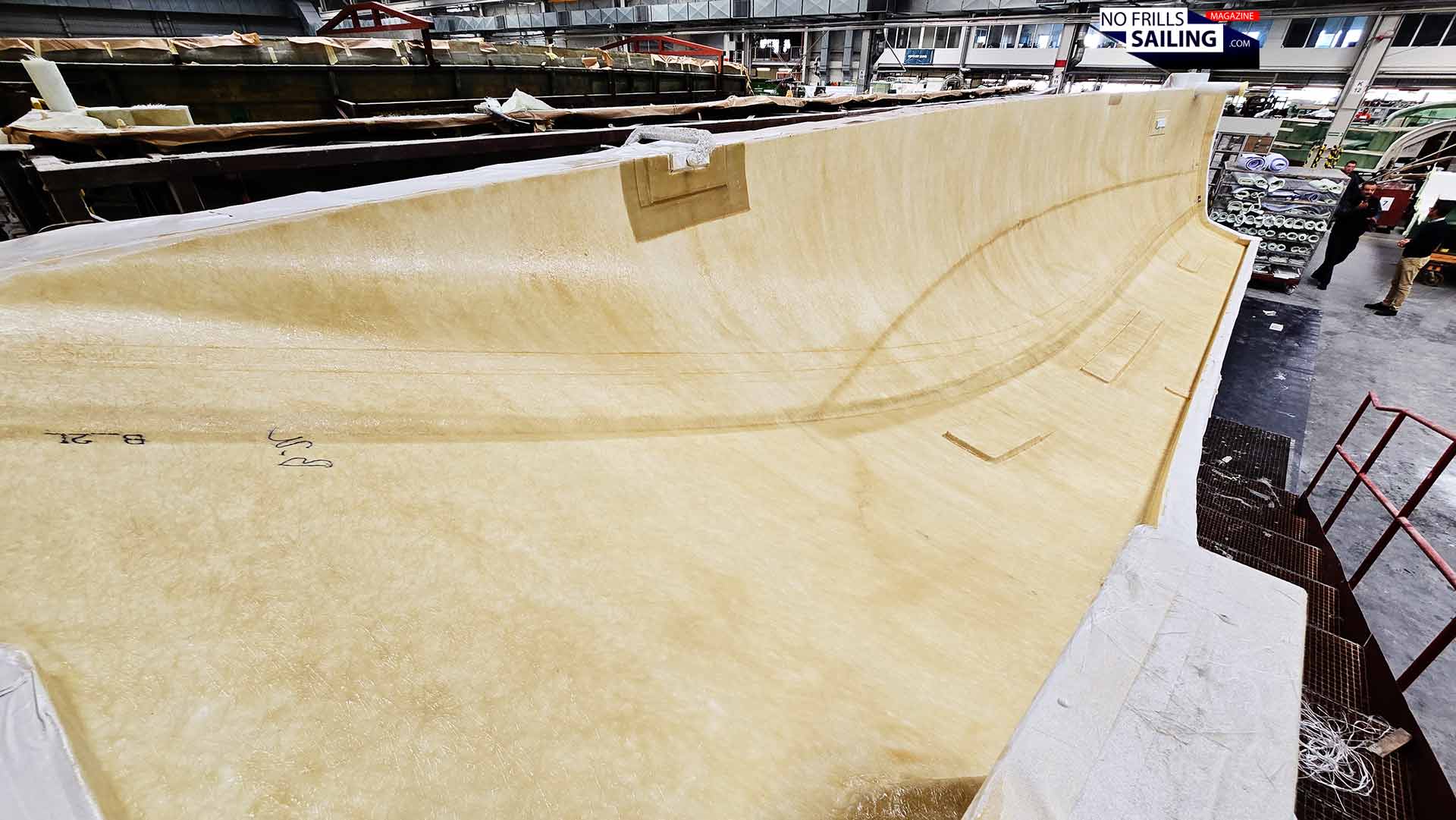
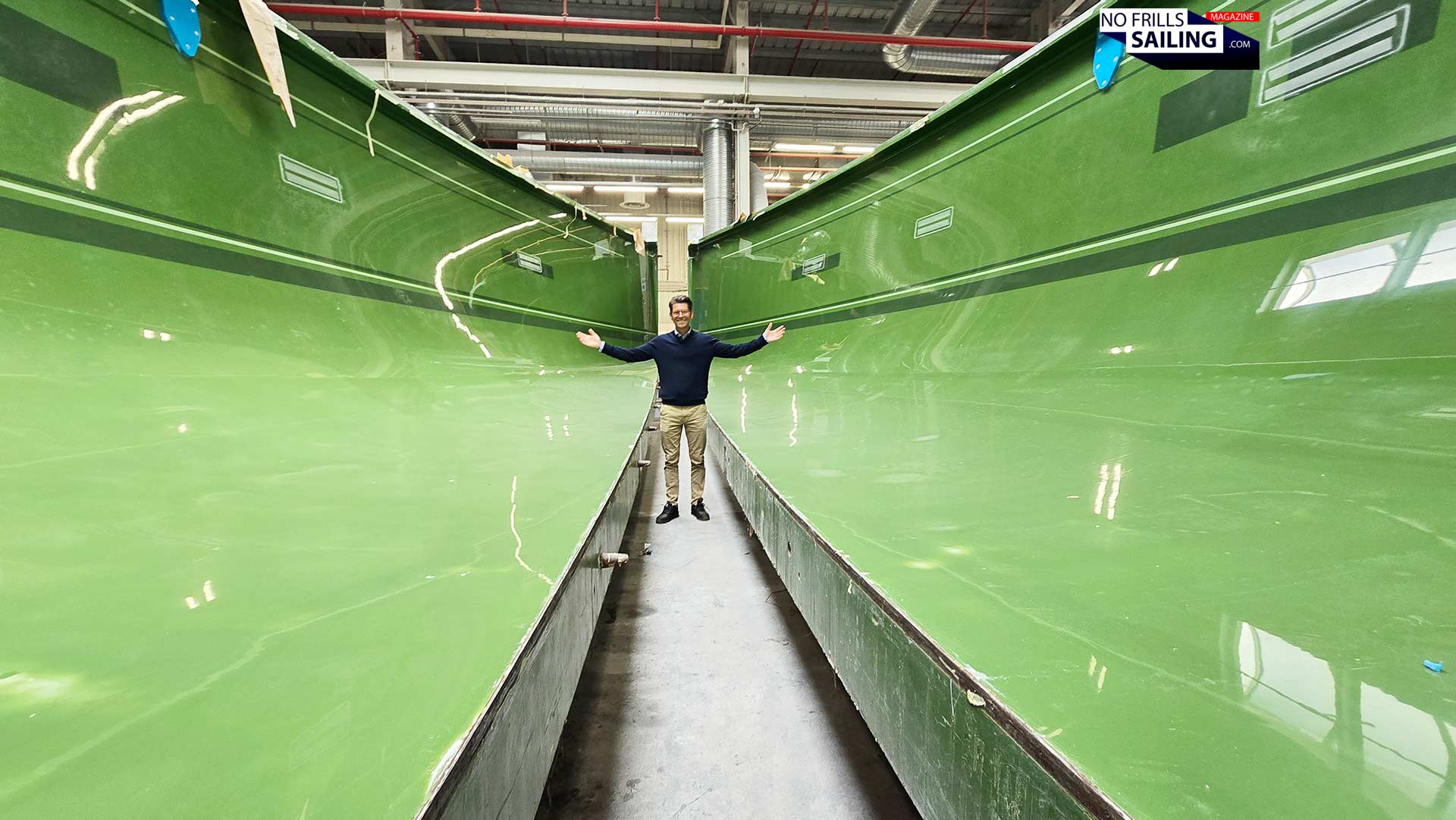
Now Stephen shows me the big mold for a new Fjord powerboat. For this type, hand layup lamination is the production method, as it is valid for most of the yachts produced by Hanse. This particular mold is interesting: Here, the hull is laminated in two individual halves along the central axis, but it´s still one mold. By rotation, the two halves will later be joined and finished. Two-half-molding is often done for yachts exceeding 50 or 55 feet, this system allows Hanse to utilize the advantages of both methods: Gelcoat in halves, laminating in one mold.
First gelcoat and GRP layer are applied
I know from many other shipyard visits how expensive these molds really are! On one occasion in another factory they told me that it takes up to 100 units being sold to cash in the invest of making such a mold in the first place. Can you imagine? That said, each time a hull (or deck) leaves the mold, it needs to be thoroughly cleaned, checked for possible scratches or damage, refurbished and carefully prepared to take on the next hull. Being used hundreds of times during the lifetime of a model, the aim is to have the same high quality of surface from hull #001 till hull #200, #500 and more.
All boatbuilding techniques on display here in Poland
This particular boat has just left the gelcoat spraying chamber, which Stephen will show me next. Here at Hanse, gelcoat is still being sprayed by hand as the first layer into the fresh molds. It´s an art, calling for smooth, steady hands and lots of experience in how to move the spray head. Maxim, who is accompanying us but rarely talks, adds that the company is looking to replace or assist this manual labor by acquiring a robot. I´ve seen these machines doing incredible things, for example at Cranchi Yachts in Italy, but I also know how incredibly expensive these are …
A hail to the Blues Brothers …
Which brings us to the industry-old question of manual versus automatic labor. As a large volume-producer, Hanse, more than smaller brands, absolutely needs to maximize their efficiency in order to stay competitive within a very, very price-sensitive and hard-fought market. Robots can indeed lower cost. They will also produce in a steady quality, don´t make mistake (well, rarely) and don´t get sick. On the other hand, Hanse´s “Blues Brothers” are the best example for the fact that true dedication and craftsmanship often cannot be replaced by a robot.
The huge gelcoat spraying hall
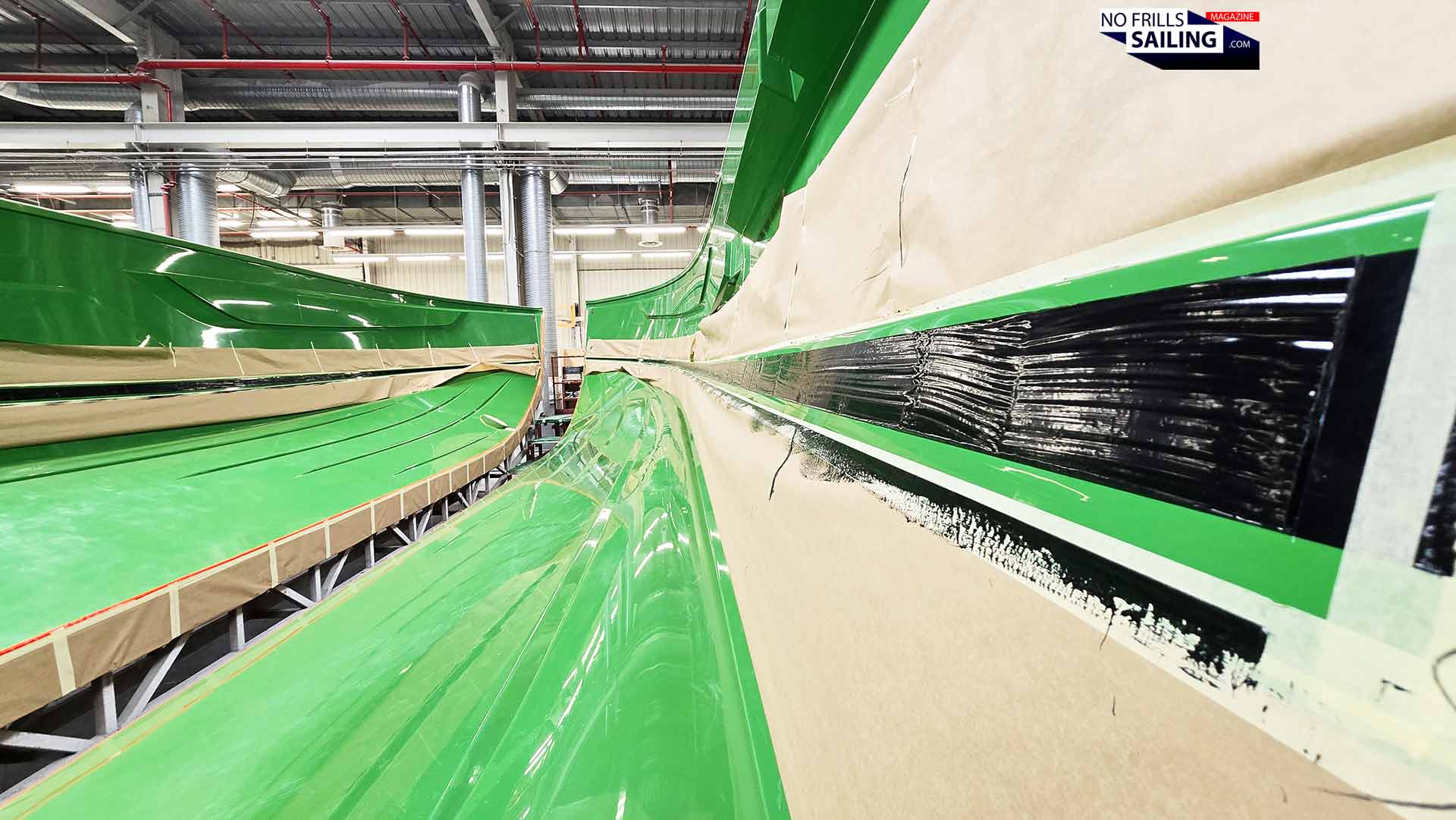
After having showed the large gelcoat spray-chamber (which has the dimensions of a proper hall in a hall), Stephen introduces me to a gang of workers, called the “Blues Brothers”. They laugh when I meet and greet them (again, no pictures wished to be taken), and I asked what this is all about. “We take great pride in the fact that all of our waterline markings are gelcoat stripes, part of the hull!”, Stephen says. He points to a mold where the Blues Brothers just had completed a black waterline for another power boat: “If you buy a Hanse, or any other of our brands, these stripes are part of the geloat structure! We do not put cheap stickers on our yachts!”
Stripes: Part of the hull. That´s cool!
Back from a shipyard visit to X-Yachts, who do the same, I know how intricate and seriously difficult it is to accomplish this. Waterline stripes do not only have to be perfectly straight and leveled when looked upon from the side, they also distort and bend following the curved surface area of a bent hull. It´s really, really hard to do this properly. Here, at Hanse, these Blues Brothers are a gang of workers highly specialized and only doing waterline markings in gelcoat! No robot can do this. And the best is, some of these workers are with Hanse right from the onset, being part of the team for 30 years now. You can´t buy this with a robot.
What´s Polish about a Hanse, what is German?
Having understood that this is not just or purely about exploiting the wage-differences between a high-wage country like Germany and Poland, I ask the guys about the distinction between a German-made Hanse and a Polish one. “There is none.”, Maxim says and takes over the tour. Thanks so much, Stephen! It was highly insightful and, personally, I am thrilled having the chance to listen to your lovely Vancouver accent again, truly one of the vacation destination I´d love to visit again! So, what´s German and what´s Polish about a Hanse, Maxim?
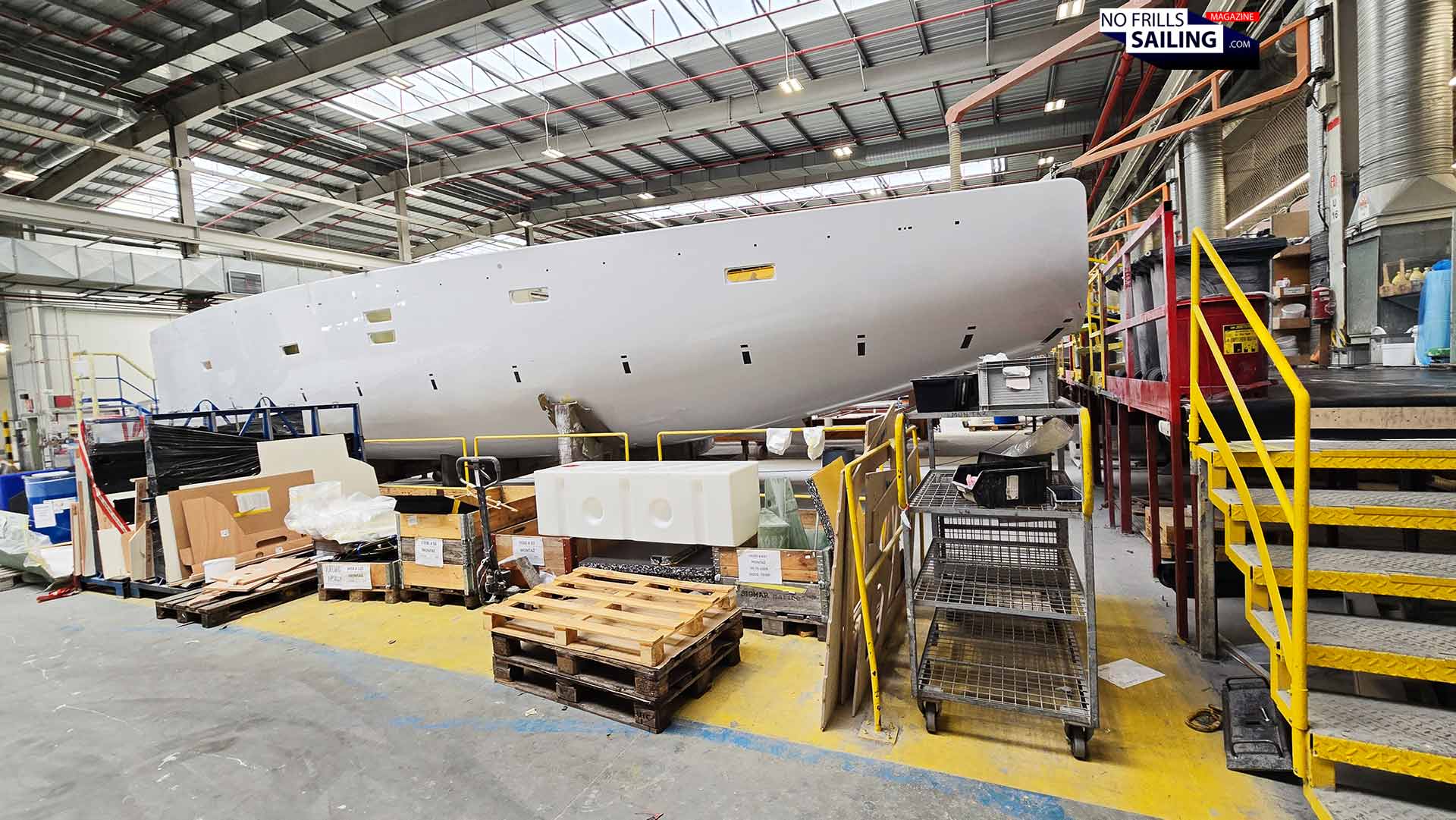
A large Moody in the making
We stand in front of a brand new Moody 54 hull. It´s a great example to explain how stuff works here: “Every single hull and deck of any Hanse boat, no matter which brand, has been produced right here in this factory.”, he clarifies. That has always been the case for most of the yachts ever produced. Your “British” Moody is a Polish hull. Your “German” Dehler has a Polish hulk. “Then it depends on the brand, the type and the size of the yacht what happens next”, he tells me. Hanse needs to be highly flexible, being able to react in no time to fluctuations in the market. What does that mean?
Hanse Poland: That´s hull & bulkhead works
“In addition to the usual seasonal movements in the market, sometimes peaks can occur. This may be the fleet order of a charter-company or for whatever reason a part of the market – maybe induced by a boat show – leads to many more orders than the pre-planned production can satisfy.”, he tells me. If that happens, Hanse can use over-capacities in Poland to make up for it. Because, usually, boats will only be fitted with bulkheads, tanks and pipes here and then shipped to the German main facility, where the boat will be completely built. “But as we have equally skilled workers here, we indeed can complete the whole boat here as well.”
Also the tanks and pipes are installed here
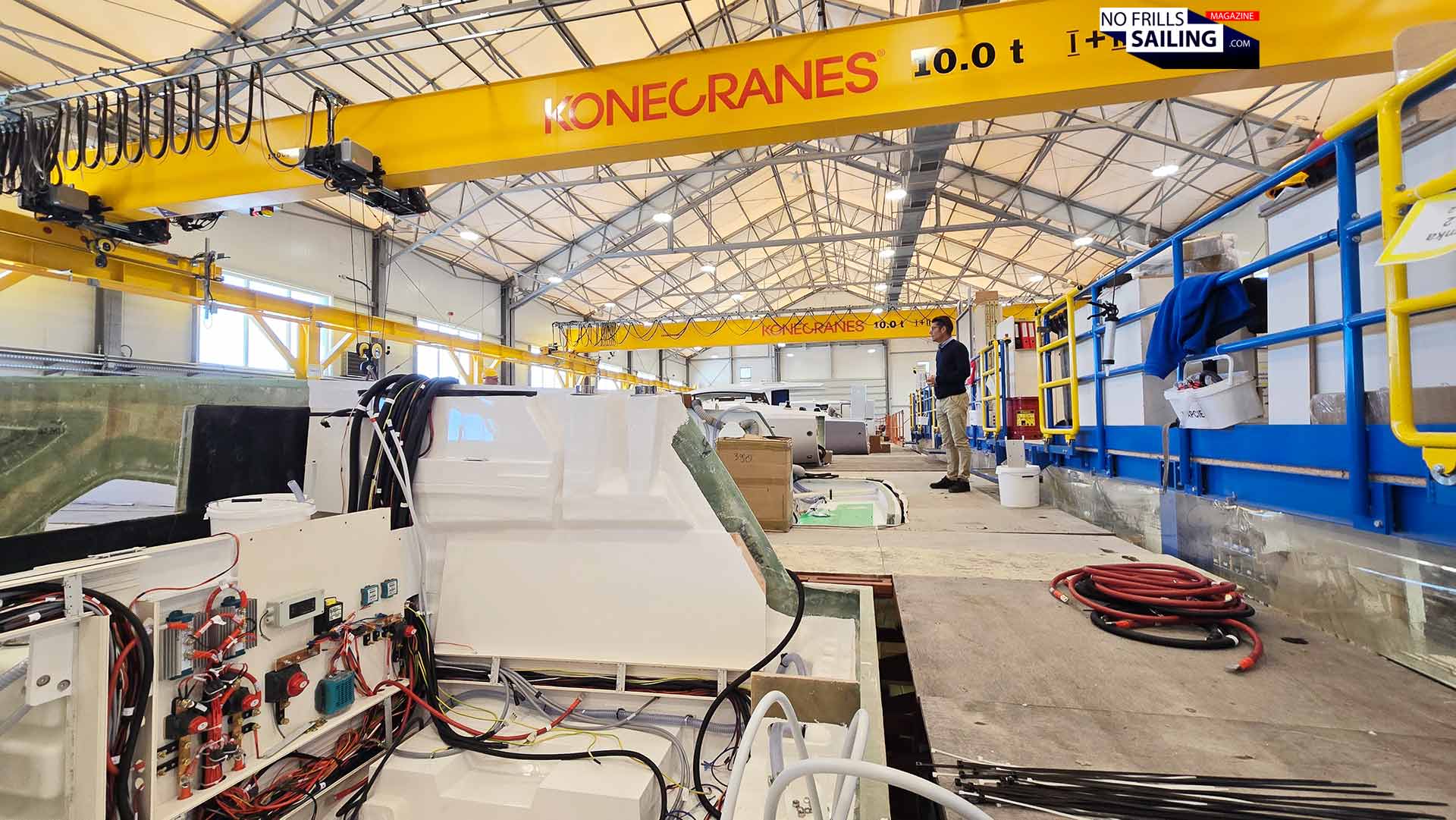
We go into one of the other factory parts, housed in a large tent. “Here we have currently set up a whole assembly line for power boats, where the complete process up to the finished yacht is exercised.” Apparently, this “Takt 1” called line, produces Fjord power boats, which according to Maxim enjoy a steep increase in orders. By having both the fully skilled workforce and the space here in Poland, Hanse can react in short time to such peaks in the orderbook. “But usually, as I said, all boats tend to be finished in Germany in Greifswald.”
Another production hall: Powerboats!
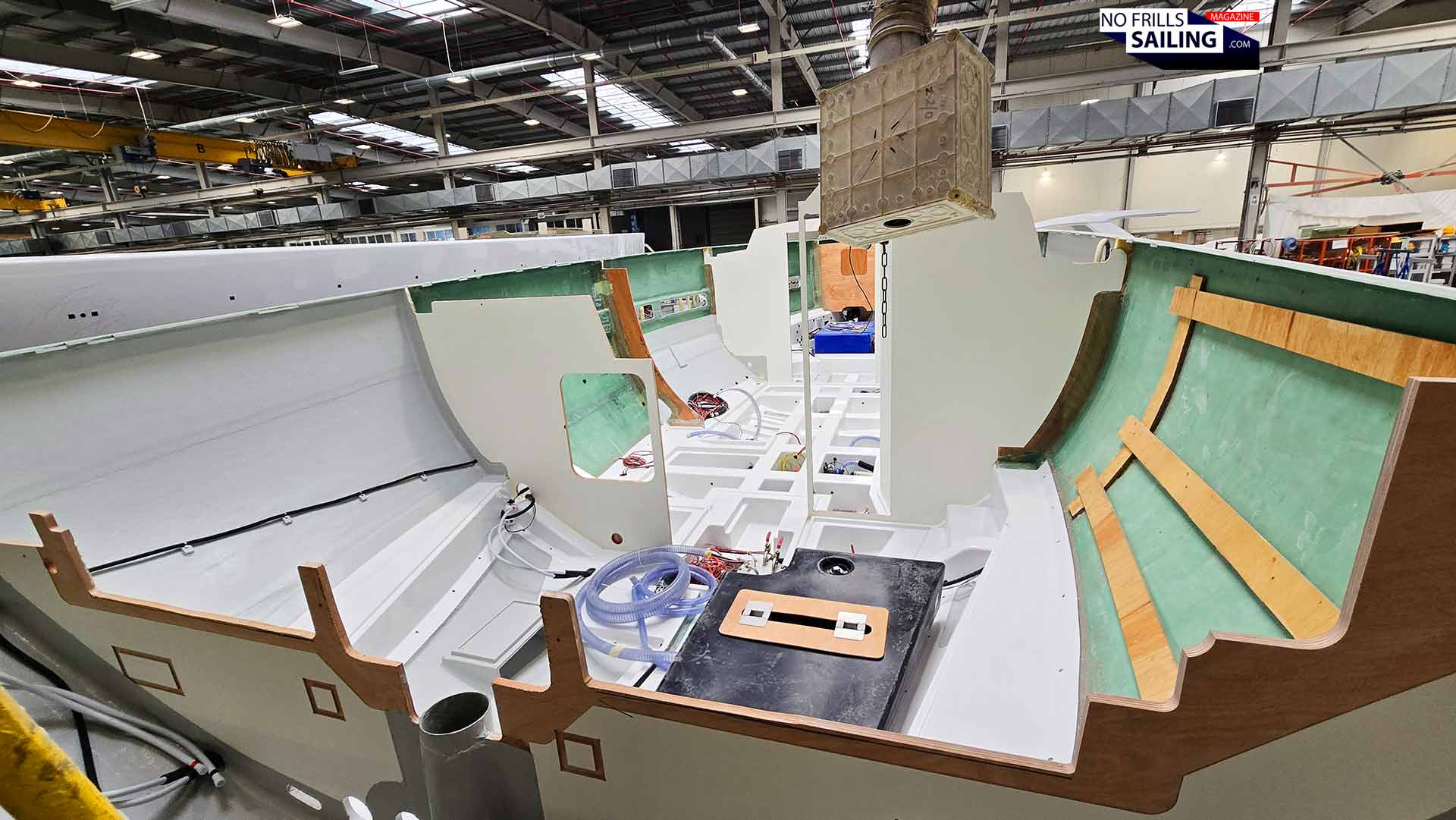
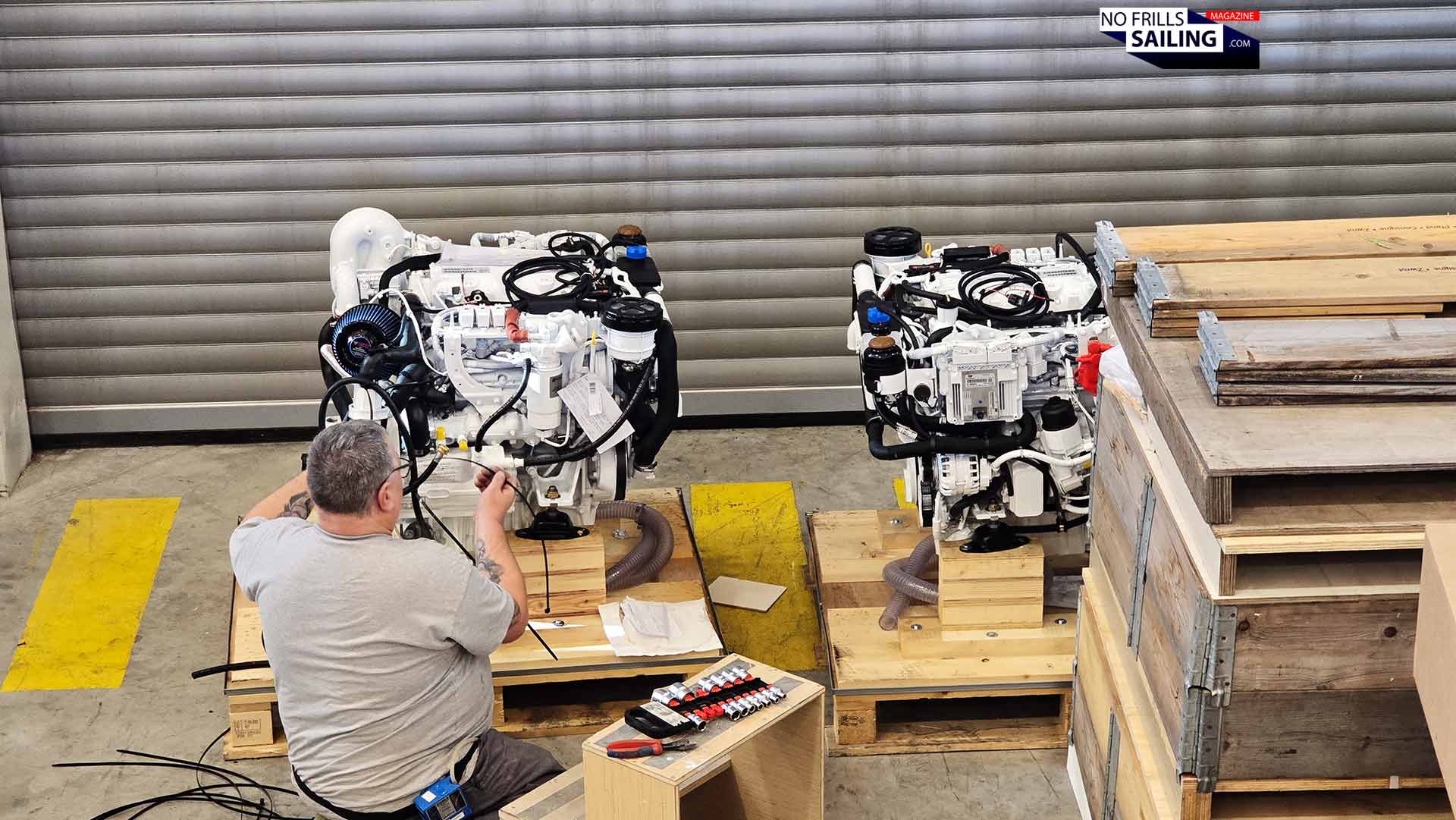
That means that when a hull leaves the Polish factory, it is essentially empty. “We fit all structural parts like all composite things and the bulkheads, and of course also the keel for the smaller yachts, but usually no furniture.” It, the almost the same for the decks. Everything structural, saying, the “shell construction”, is done here. Windows, PVC-deck, winches and other fittings will be pre-mounted here in a different assembly line which Maxim shows me next. “Seeing engines being prepped here is a rarity, honestly.”
Some types are completely manufactured here
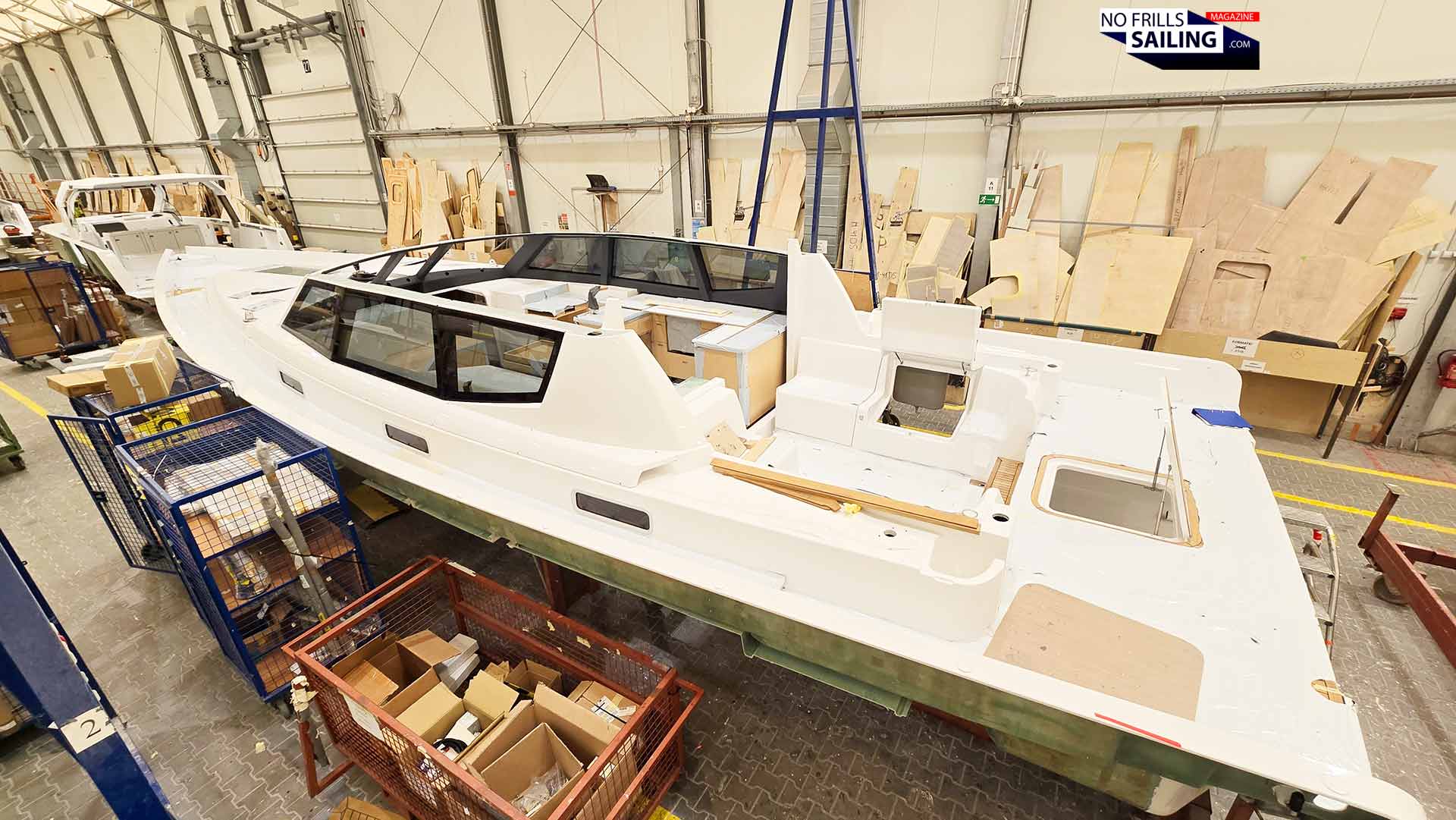
Some of the decks require more, some less work. For example, for the Moody blue water cruising yachts, it makes more sense to pre-fit all furniture modules here in Poland than to do it in Germany. For other models, like Hanse or Dehler, the empty hulls will usually receive their pre-fitted and pre-wired decks on top – loosely. After arriving in Germany, the deck is taken off and put aside, the finishing production steps start in the assembly lines there. You may check this article to see how it looks like in Greifswald.
Fitting of a Moody deck
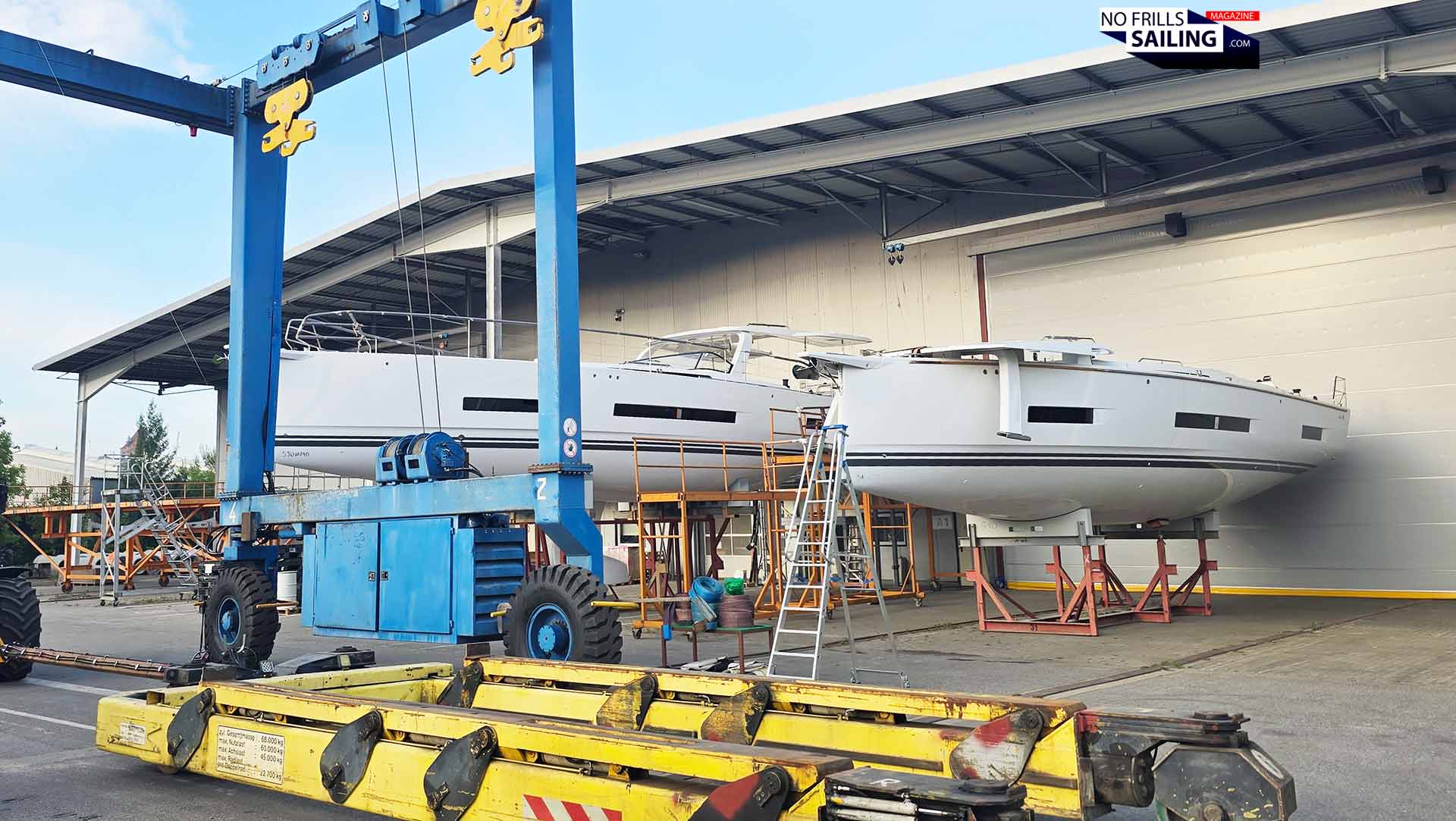
My tour with Maxim ends at the large rolling gate. “Here the boat is ready to go. When the truck transport arrives, this Dehler 38 SQ for example will be loaded onto the truck and arrive a few hours later in Greifswald. Here the final assembly will start.” I climb a ladder at the side and take a peek inside into the hull: Indeed, it is completely empty! The deck just loosely (but secured, of course) just sits on top.
Most Hanse yachts are indeed “Made in Germany”
So that´s it, right? Having seen the whole factory of Hanse Yachts here in Poland I think I have a complete picture of the undertaking now. Finally answering to the initial questions: No, it´s far, far beyond just wage-saving and cashing in on lower production costs here in Poland. At least for this brand I can say that usually more than half of the efforts needed to build a yacht are yielded by the German part of the production, as here in Poland only decks and hulls with minimal, mostly structural, fittings are made.
Another Dehler 38 SQ is ready for shipping to Germany
To being able to deal with peaks in orders or other special occasions, like an exception from the usual code of conduct, only selected boat types and only for a specific time period are fully produced and finished here in Poland. By splitting the production from day one onward, Hanse was able to profit from the individual location advantages, both in Germany and here, in the “composite excellence area” of Stettin. This was part of the initial idea of Hanse from the onset. By that, Hanse Poland is not a hasty makeshift outsourcing project, but an integral part of the family. Now even with workers being Hanse staff in second generation.
Making our way back through the premises
As we walk back to the office building, I go past all of the different stations I have seen today. The cutting, the milling, the deck molding, the hand-layup, the vacuum infusion and even the Blue Brothers smile and wink. Maybe there are companies to cash in on the exploitation of workers, even in the boating industry. But I doubt that those products can survive, even more in a market like now: With prices for yachts out the roof, even small-size buyer have to pay hefty budgets, having sharpened their senses and demand for quality. “Quick and dirty”, meaning cheap boats, cannot survive, I am pretty convinced about this. That said, with EU regulations and rising standards in Eastern Europe, the wage-differences aren´t that huge anymore. It´s definitely other things which count more: Energy prices, overregulating and bureaucracy for example. And here, unfortunately, my home country definitely has a big problem! That´s nothing Maxim implied, but that´s a fact every Germany with a half-functioning brain knows.
Advertisement
Any more questions?
So anyway. I don´t want to delve all too deep into politics here. What´s important is that – valid for Hanse at least – you can be eased. The quality that the Polish Hanse-guys are producing here, as far as I was able to see, does not differ from a French shipyard or any other renowned brand I have had the pleasure to visit. On the contrary, I´ve seen some very interesting “islands of specialties”, like the Blues Brothers, where Hanse is abler to offer surplus quality and high-grade handcraft. I mean, the waterline of a Beneteau is an ordinary sticker … so, putting aside any “assumptions” or bias, quality it´s not a question of the origin, definitely.
Rightfully proud: Thanks Maxim for the tour!
Driving back home after parting with Maxim again in Greifswald and processing of what I have seen today, another thing hit my mind: It was the pride and almost … childlike enthusiasm with which Maxim seemed to enjoy walking around, sniffing here and there, chatting with the staff and showing the different steps of how a sailboat is made. Then I fully understood, that for him – having joined Hanse Yachts in the earliest days of Michael Schmidt as well – there is no Hanse Germany or Hanse Poland. For him, it indeed is just one company, one brand, one boat. And, as cheesy as it may sound, one family.
Here´s more about Hanse Yachts, their boats and the company: