Some boats are so good that it seems ridiculous to change them. Why come up with something new if the current model is just as perfect? This may have been the reason why Hanse Yachts didn´t do anything about their current Dehler-range for more than a decade. Now with the new SQ-line, the fleet received quite an extensive makeover, yet without touching their basic DNA properties. I´ve tested the new Dehler 34 SQ under sails. Is this 10 years old design still competitive?
Let me first make clear that I really like the Dehler brand. From the start, when it still was a brand and boatbuilder of its own, these boats have found hundreds of die-hard fans all over the world praising their sailing capabilities, their good overall performance on all points of sails and the price-worthiness of the yachts. Dehler boats have competed in races all over the planet, including the Sydney-Hobart race! I think, that says it all.
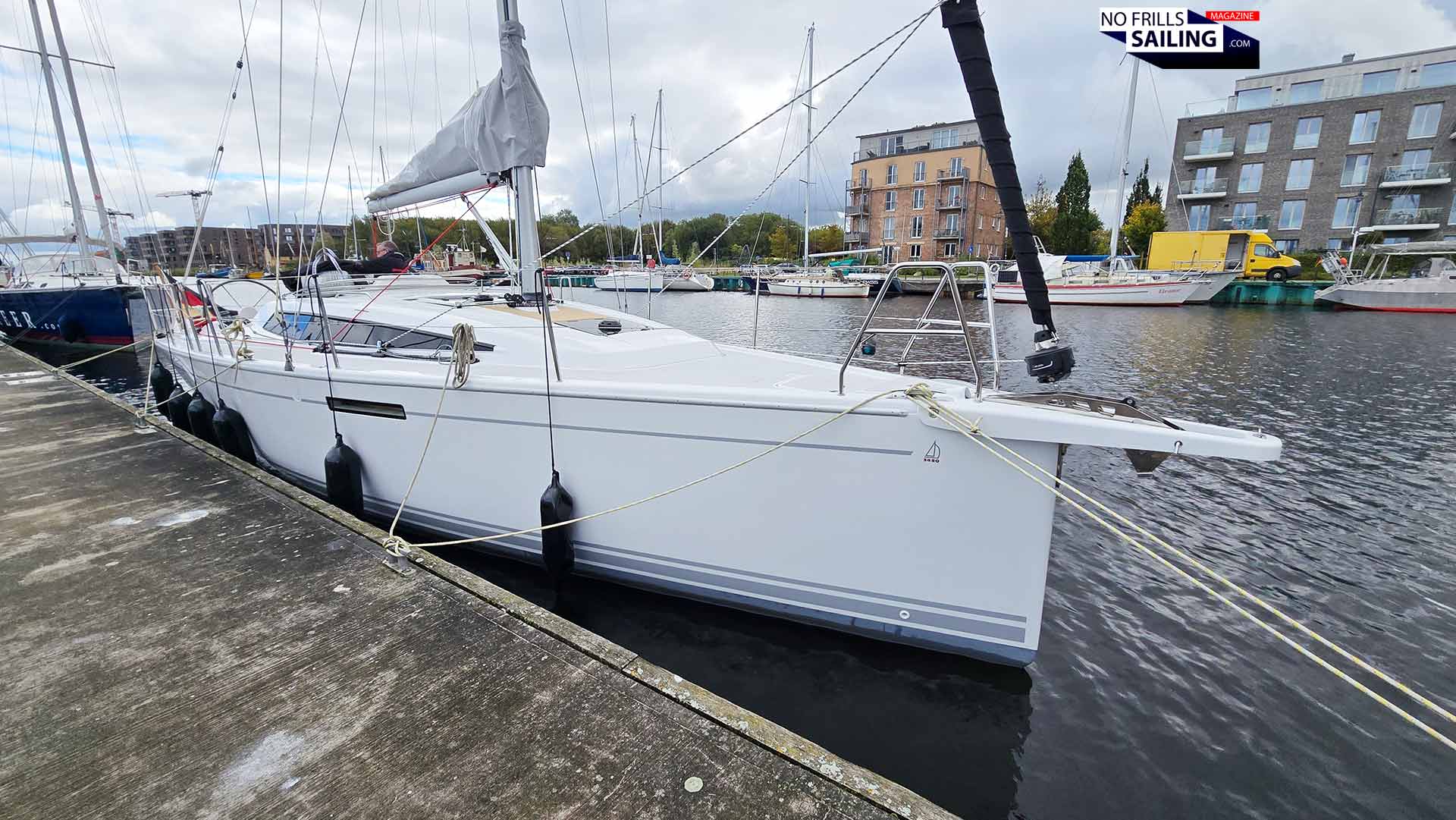
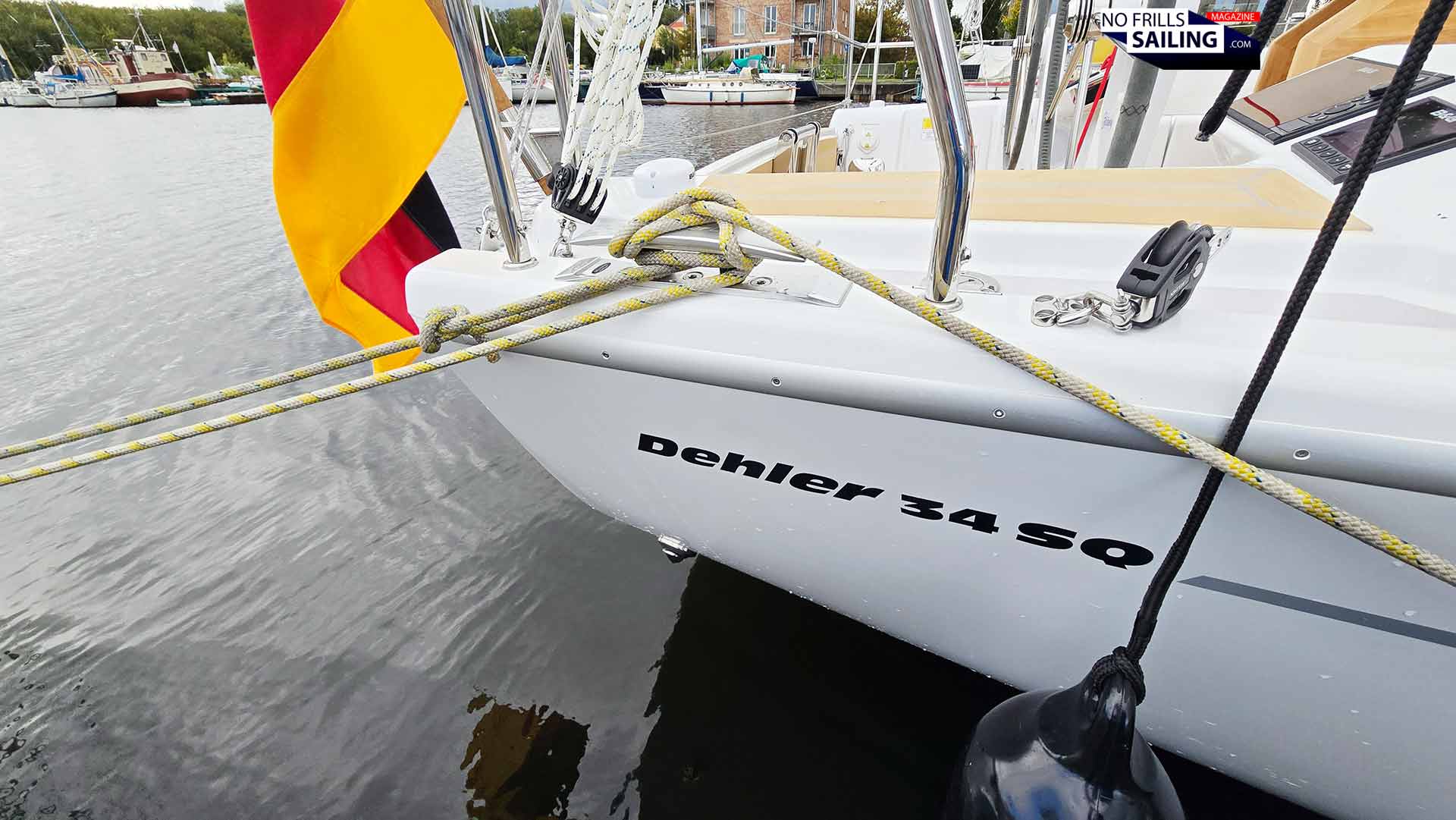
Familiar shape – the Dehler 34 SQ
On the other hand, one of the main pillars of the good reputation of Dehler boats, besides their sailing performance, is their price. There is this proverb in Germany, dubbing the Dehler as the “X-Yacht you can afford.” I personally know a lot of people who went for a Dehler instead opting for a First back in the day when I was Beneteau-dealer, and I know many more who´d happily go for one if they had the budget. So here we are, a misty morning in Greifswald harbor, I jump aboard HILDE, hull number #001 of the brand new Dehler 34 SQ just launched the week before.
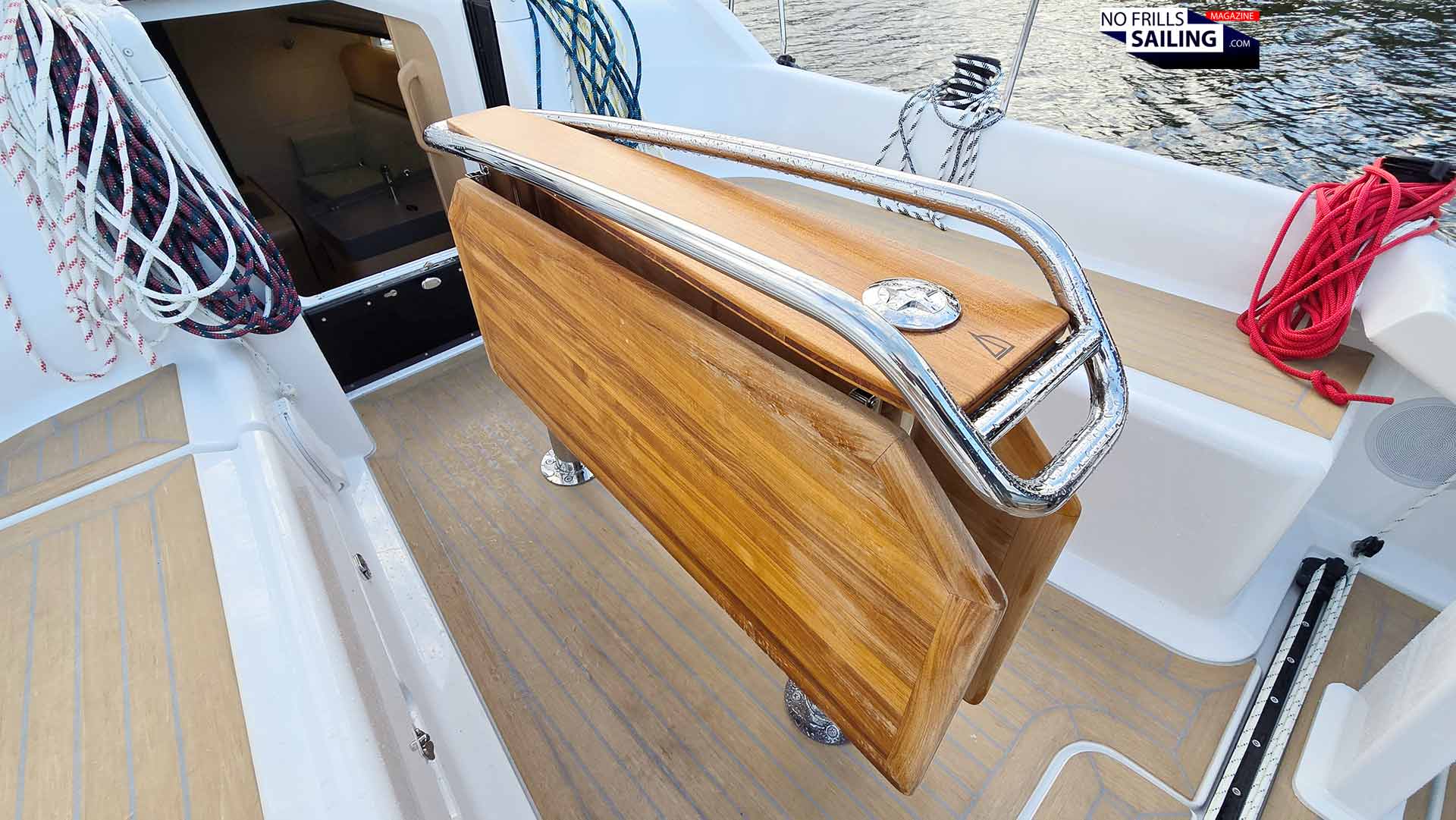
God knows, a stable, rugged cockpit table is worth its money!
In this, to be exact, it´s not a new design. The first Dehler 34 designed by renowned naval architects Judel/Vrolijk hat been launched in 2016, which was exactly ten years ago! Back in that day I had freshly started my blog, NO FRILLS SAILING, and these boats (for me it was the then-new Dehler 42), were among the hottest contestants for the most sought after performance yachts. Today, there´s a whole new generation of same-sized performance yachts, spearheaded by the fast “planing cruisers” of Sam Manuard or the extravagant French brands Pogo or JPK, all competing in the same area: But which design can draw in the most affection from active, speed craving skippers? Let´s see what this Dehler has to offer …
Modern, stylish and very up to date indeed
Advertisement
You might think that re-launching a 10 years old design is a mere re-fresh and more marketing than real sailing. I am honest, I thought so as well. And truly, most of the Dehler 34 remains untouched. But as Andreas “Andi” Unger, Head of Sailboat products at Hanse Yachts, tells me, why changing what was already near-perfect? That said, the naval architecture of the Judel/Vrolijk-hull still delivers plentiful of sailing action and speed. Something I´d be celebrating myself in a few minutes.
Let´s check her internals first
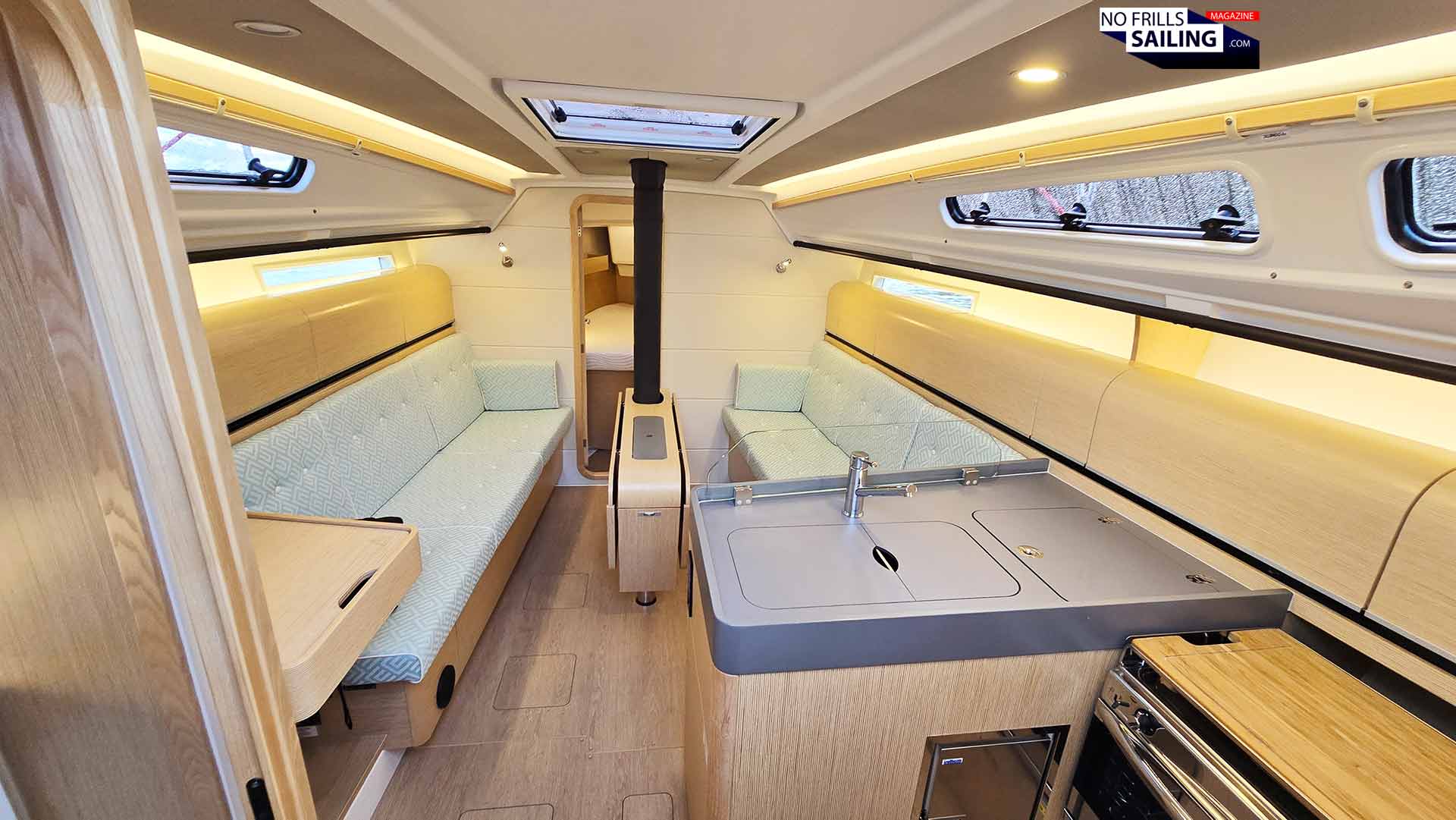
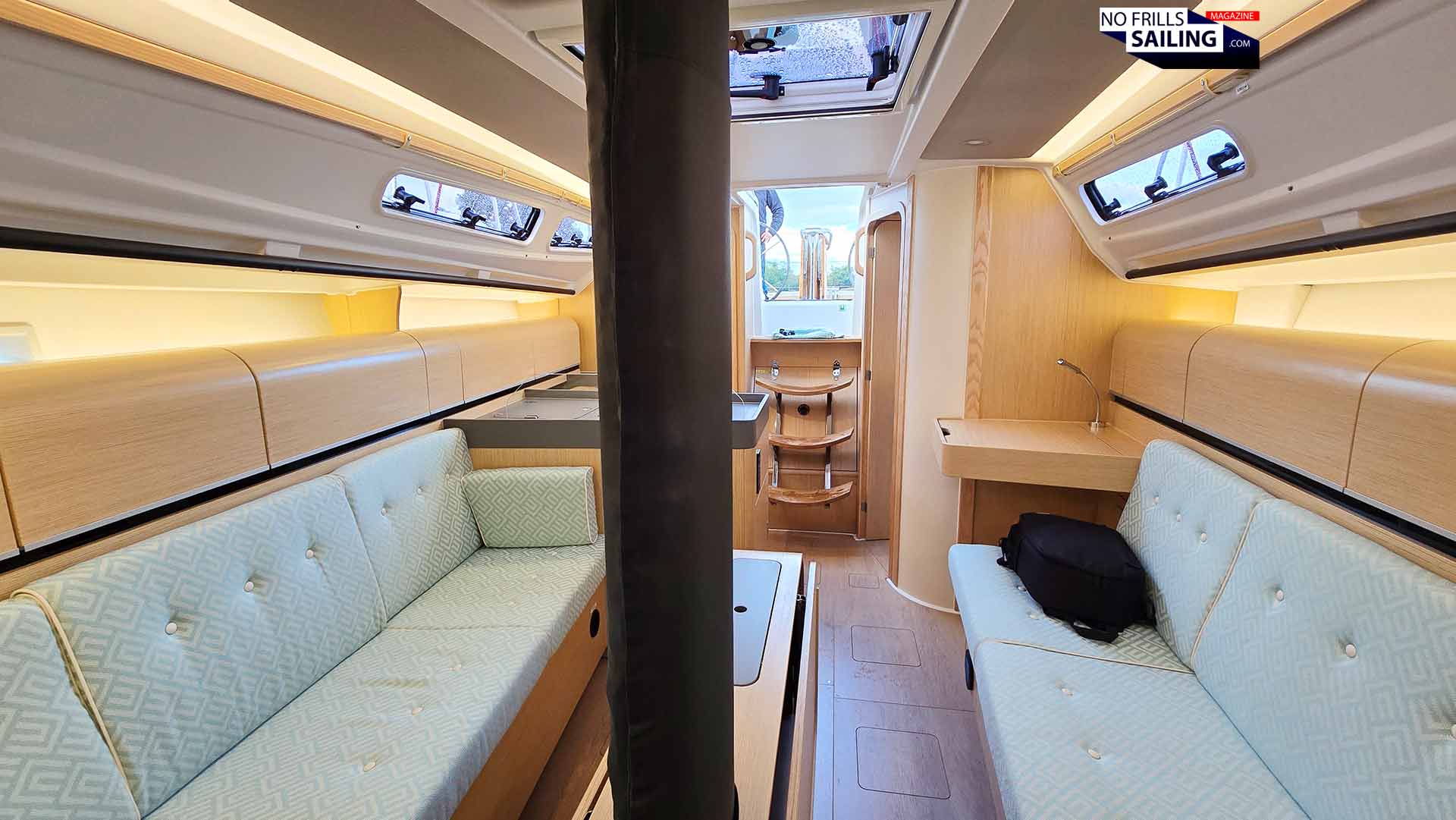
As Andi was prepping the yacht for casting off, I roamed the premises under deck. And I was surprised: Indeed, this interior design doesn´t look anything like dated or boring. It´s kind of fresh and new. Hanse has significantly improved the veneer-quality as the furniture appeared to be much more rugged and less sensible to wear and tear. Many things the “old” Dehler boats advertised as something “cool” when they were launched, had been corrected, such as the nav-station. In the old boats the chart table was mounted to a vertical rail system so that it could slide up (table position) or down (to form a surplus seat). This is now a simple fixed solution, and I like the simple things.
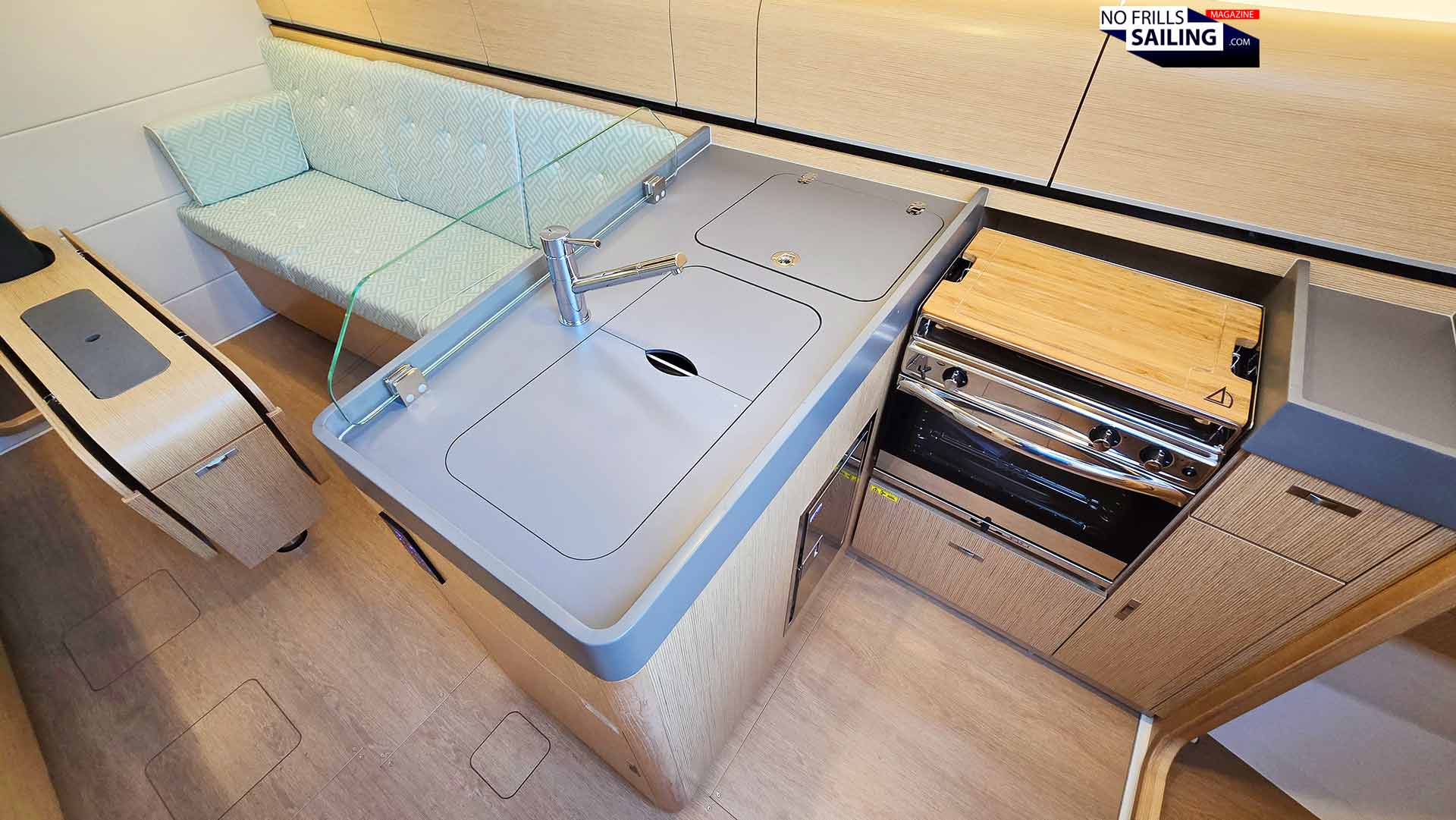
Proper L-galley
Apart from the improved surface quality, the boats now come with a very nice set of cushions, both in terms of thickness and feel, but also in terms of the quality of the fabric used. The colors are fresh and modern, playing with the natural light that comes into the saloon through the coach roof windows and the slim hull window-ports. It´s a very simple and basic layout, but the changes made make sense and really elevate the overall impression.
Dehler´s aircraft interior design
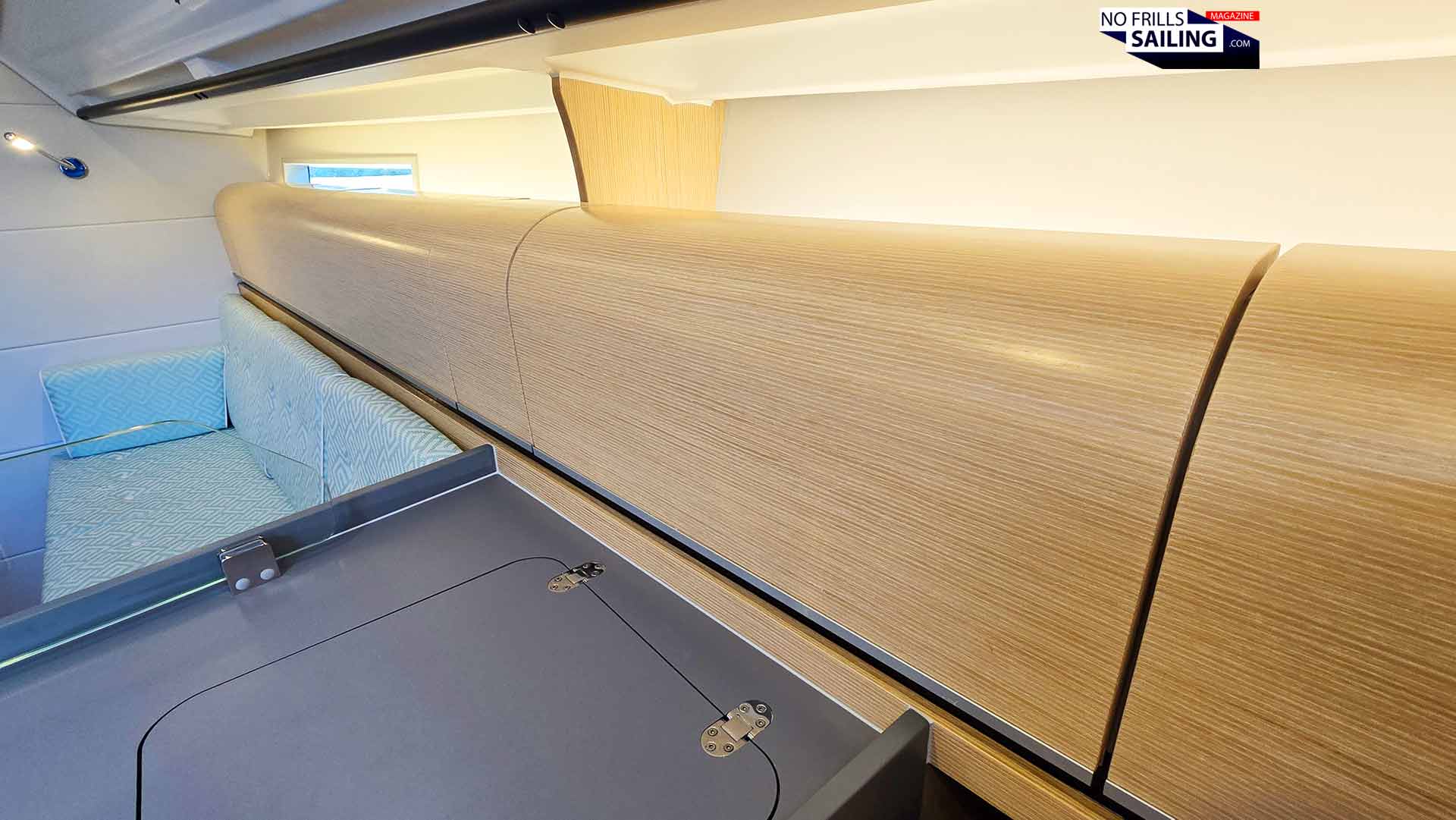
What the current Dehler generation set apart from all the rest of the interior designs to date – and this is valid for both 2016 when first launched and 2026 today – is their “aircraft design” for the backrests. It´s an ingenious design that is unique, at least to my knowledge. It resembles somehow the interior of a modern airliner and gives the otherwise classy boat with its classy layout a very modern touch.
The “aircraft design” backrest-lockers
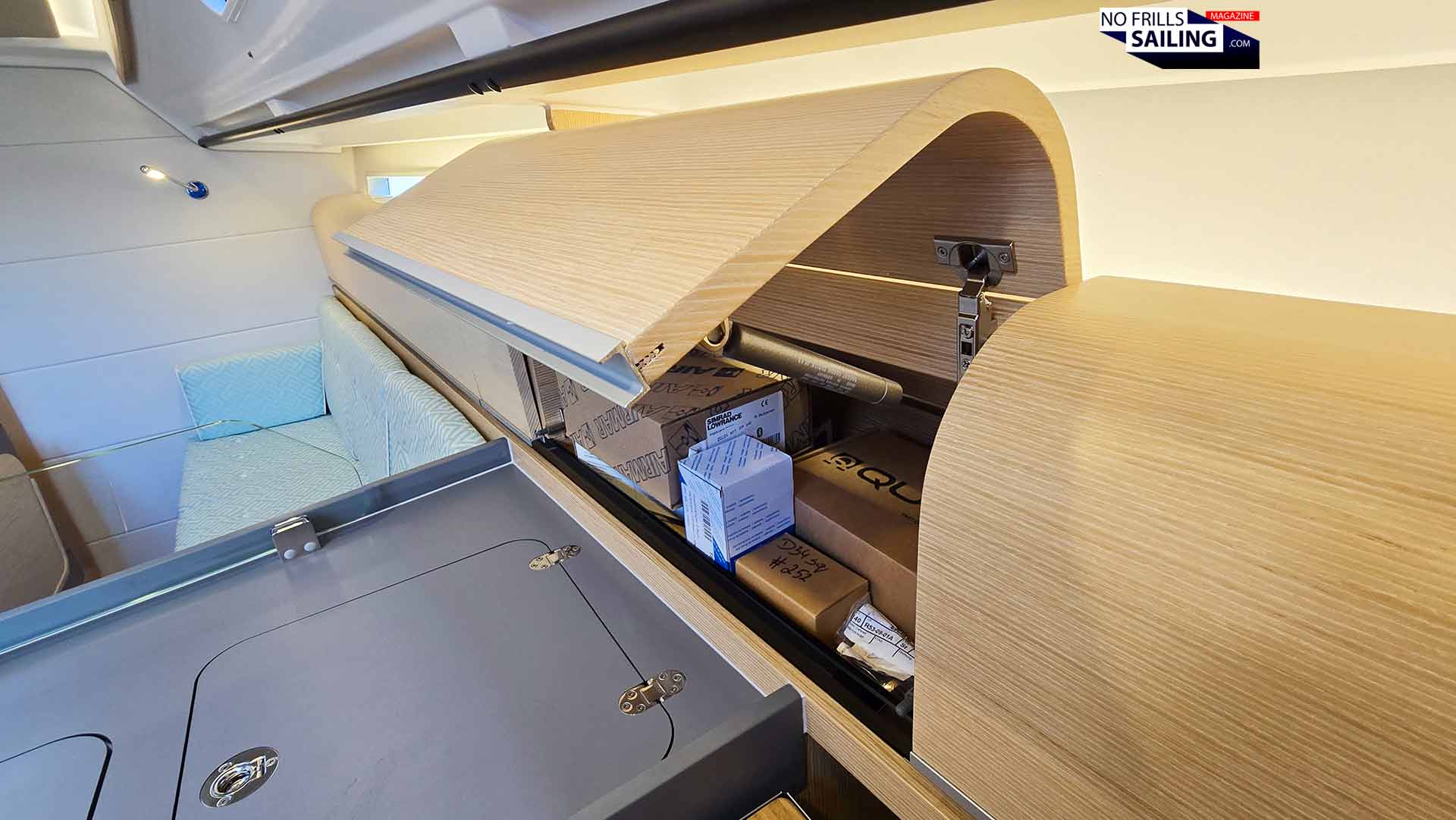
There´s more to this setup. Because each of these round-shaped covers can be lifted up, revealing a lot of stowage behind and underneath. Since the boat is too small for hanging lockers this is a clever solution and utilization of space without sacrificing usable space. It blends in to the overall design yet creates something very special, something you can only get with a Dehler. The opening and closing mechanisms – like for all other moving parts aboard as well – are supported by gas-struts for nice soft closing. I like this!
Soft opening and closing, nice!
This “aircraft design” is also present on the larger sisters, the Dehler 38 SQ and the Dehler 46 SQ, the flagship. “My” Dehler 42 is currently not available and Andi was smiling a bit “knowingly” when I was asking if or when a new 40-footer would be launched by the shipyard. The 40-42 feet range is a very popular size for Corinthian and amateur racing, so why not refreshing the proven Dehler 42 concept and launch a 42 SQ as well? Well, maybe there´s something coming up … if I interpreted Andi´s mystic smile right.
Not very mystical, but even practical, would be the subscription to the NO FRILLS SAILING newsletter. It only takes five mini-seconds to get yourself onto the mailing list and you will never ever miss any new article or video published. So why not quickly subscribe before returning to the article? Ah, I see, you are already on the list. Well, then let´s go on …
Quite fancy ideas for an otherwise classic layout
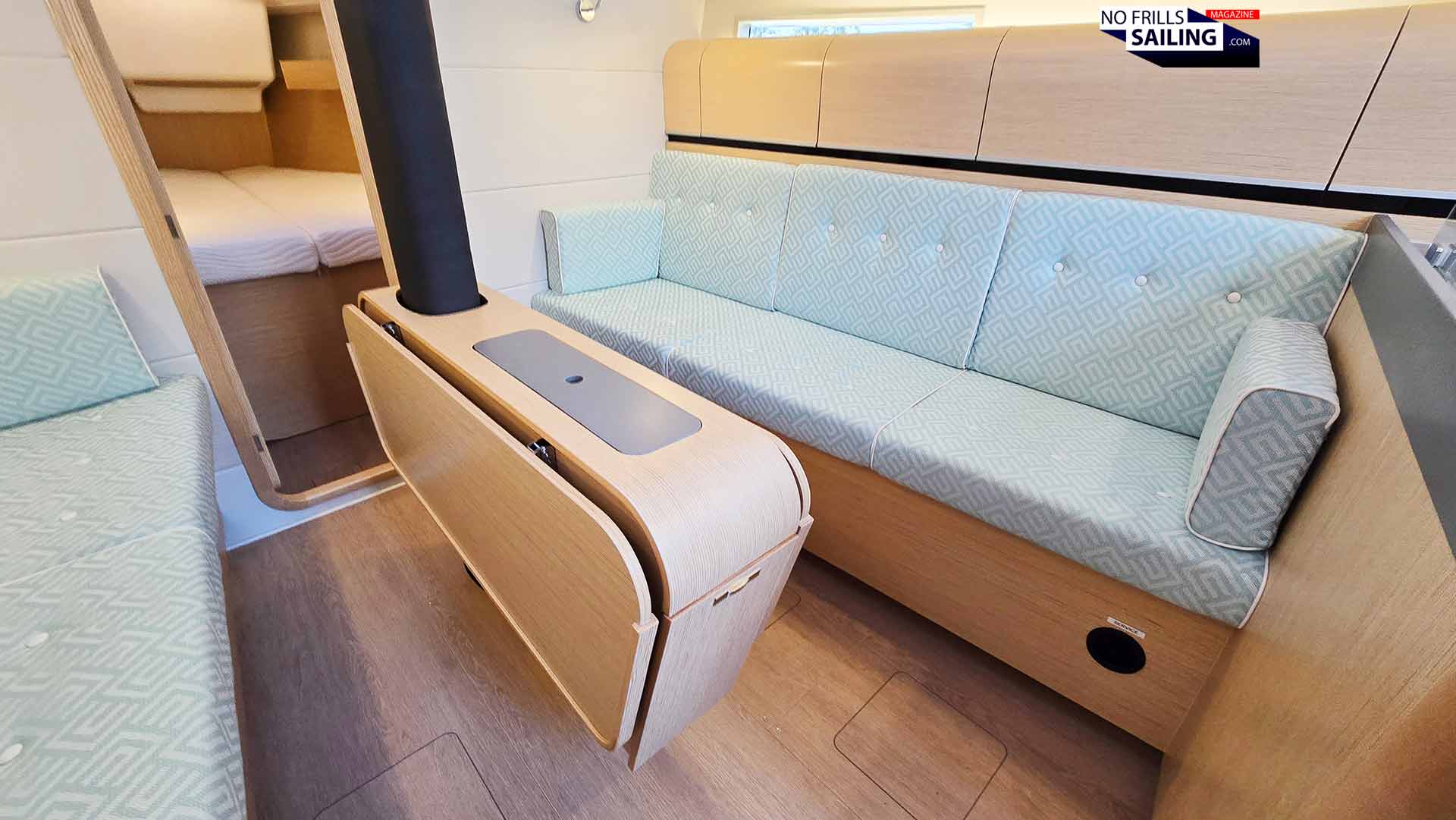
The “aircraft”-borrowings do not stop at the backrest-stowage. The saloon table is also a nice example for this. It´s shape takes on the dynamic lines and curved nature of the backrests and creates quite a nice piece of design. I mean, in series production there´s the strive towards becoming more and more angular because this simplifies the production complexity and also gets down the price.
I like the “floating” saloon table
But it seems as if the Dehler designers decided to have some “lighthouse”-elements within this series production interior which stand out. Like magnets drawing in the attention. I mean, stuff you see or use all the time, things you interact with on a daily basis, may indeed receive a bit more attention and some better treatment. It´s these few details – above-average in use – which may be improved a bit and which will elevate everything else with them.
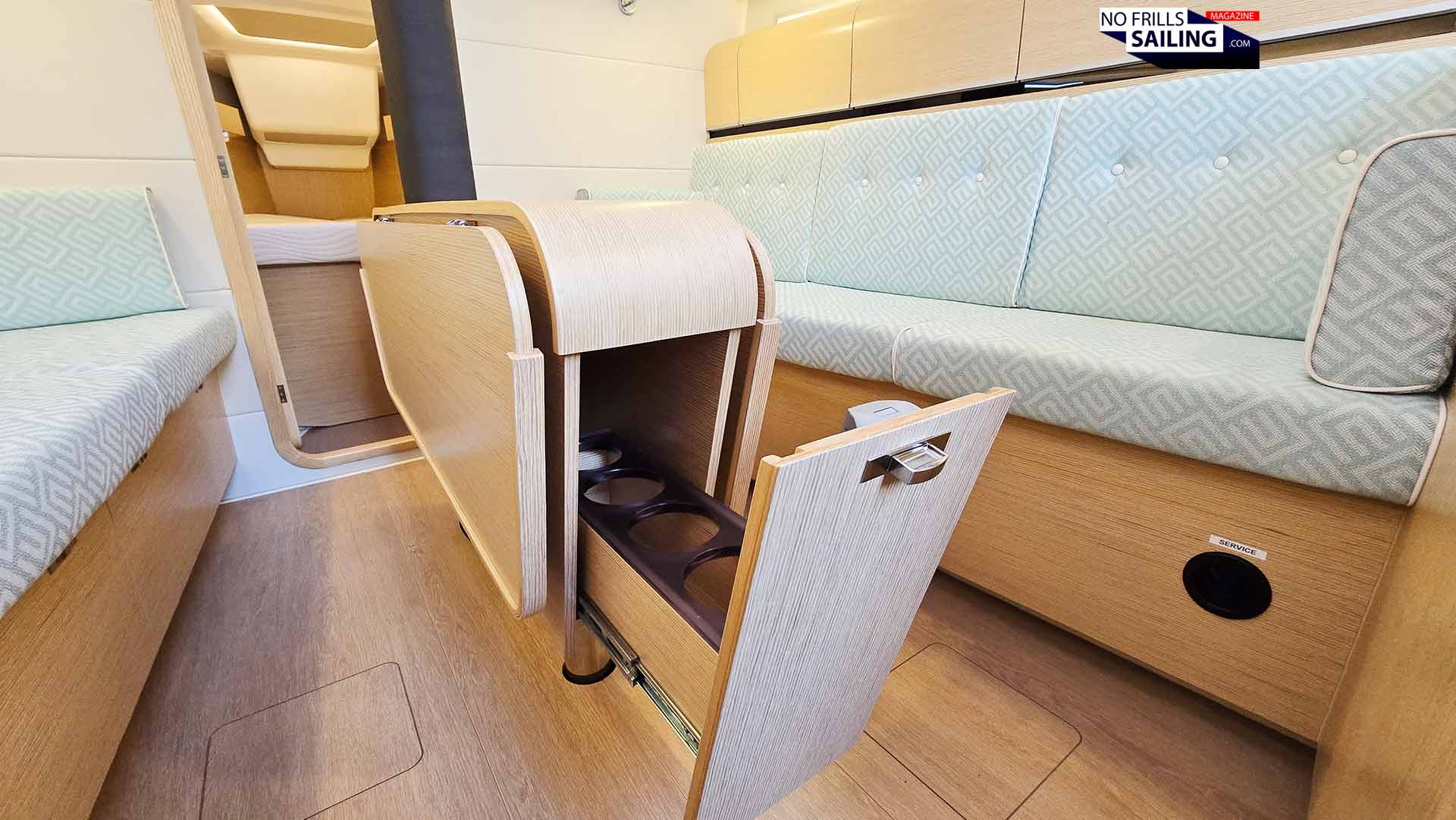
Full of stowage
The saloon table is a nice example for this strategy. It´s the central part down here in the saloon and – apart from the cockpit table maybe – the most-used single item. Investing in its shape, it´s design and carpentry makes sense. It´s funny to look at these details, revealing the different approaches of the different brands. Some French brands would never put so much emphasis on something so “unimportant” as a saloon table, right? It´s these things which make the Dehler stand out for once, uplifting the otherwise very simple and classic layout and letting her appear surprisingly fresh and modern.
Simplifying the sailboat concept
On other occasions, the shipyard worked hard to simply things even more. I am a big friend of the KISS philosophy. Keeping it stupid and simple often prevents stuff from becoming over-engineered, un-manageable and high-maintenance. That can best be seen when looking at the cabins within the Dehler 34 SQ:
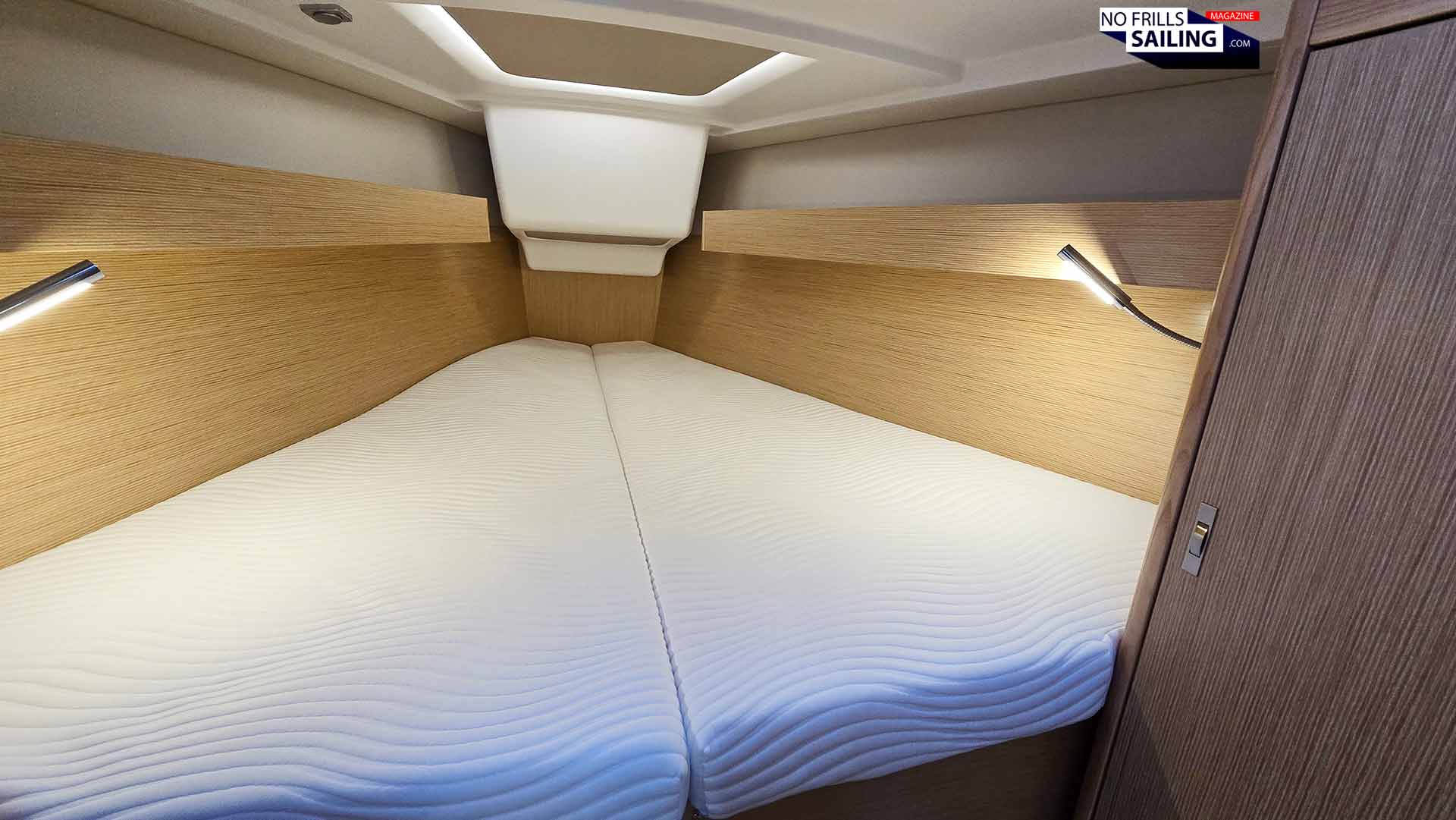
Simple, roomy: Fore cabin
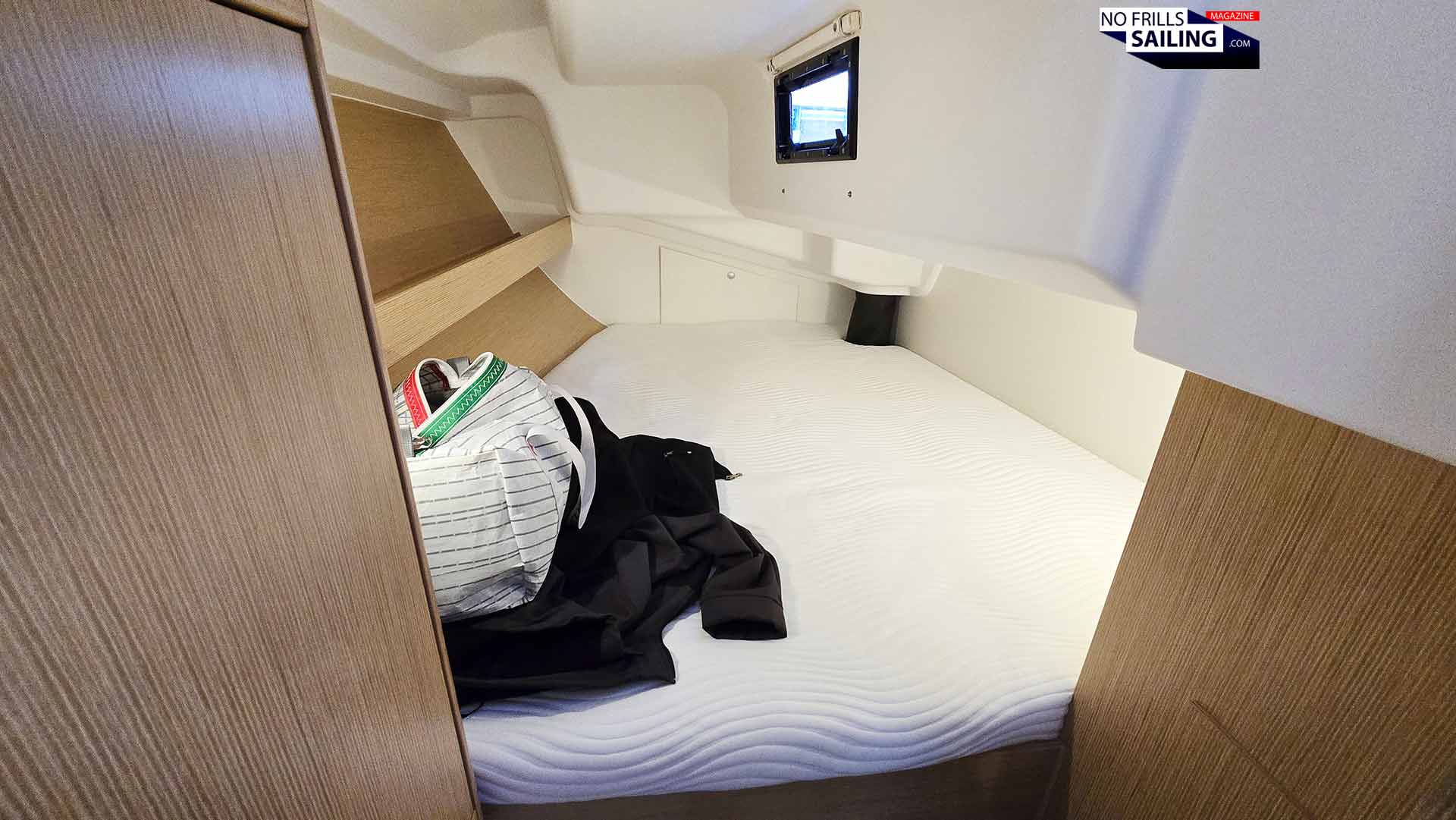
As for the overall cabin layout, there´s only one available, offering a V-berth front cabin and a double-berth aft cabin to starboard side behind the galley. This simplification makes calculation of the production more simpler: For a series production company, relying on minute-precise on the dot calculated production plans, each single individualization by owners poses a threat to the plan. By only offering this single layout, it makes things much better predictable – and surely cheaper.
Another simple aft cabin.
Talking about the price, a current Dehler 34 SQ, reasonably well equipped, will clock in at around 250 to 280.000 Euros exVAT, a lightly equipped, less racing oriented boat will likely cost 190 to 230.000 Euros. That said, even the price tag for the “all in” variant seems vey attractive to me, facing the much higher prices of the First 36 for example, who in turn have recently launched their “Spirit”-version that will be a direct competitor for the 34 SQ, albeit bigger. It´s quite a clever move by Dehler to launch a small-sized performance boat into the market as there isn´t honestly any serious competition in this price range as well.
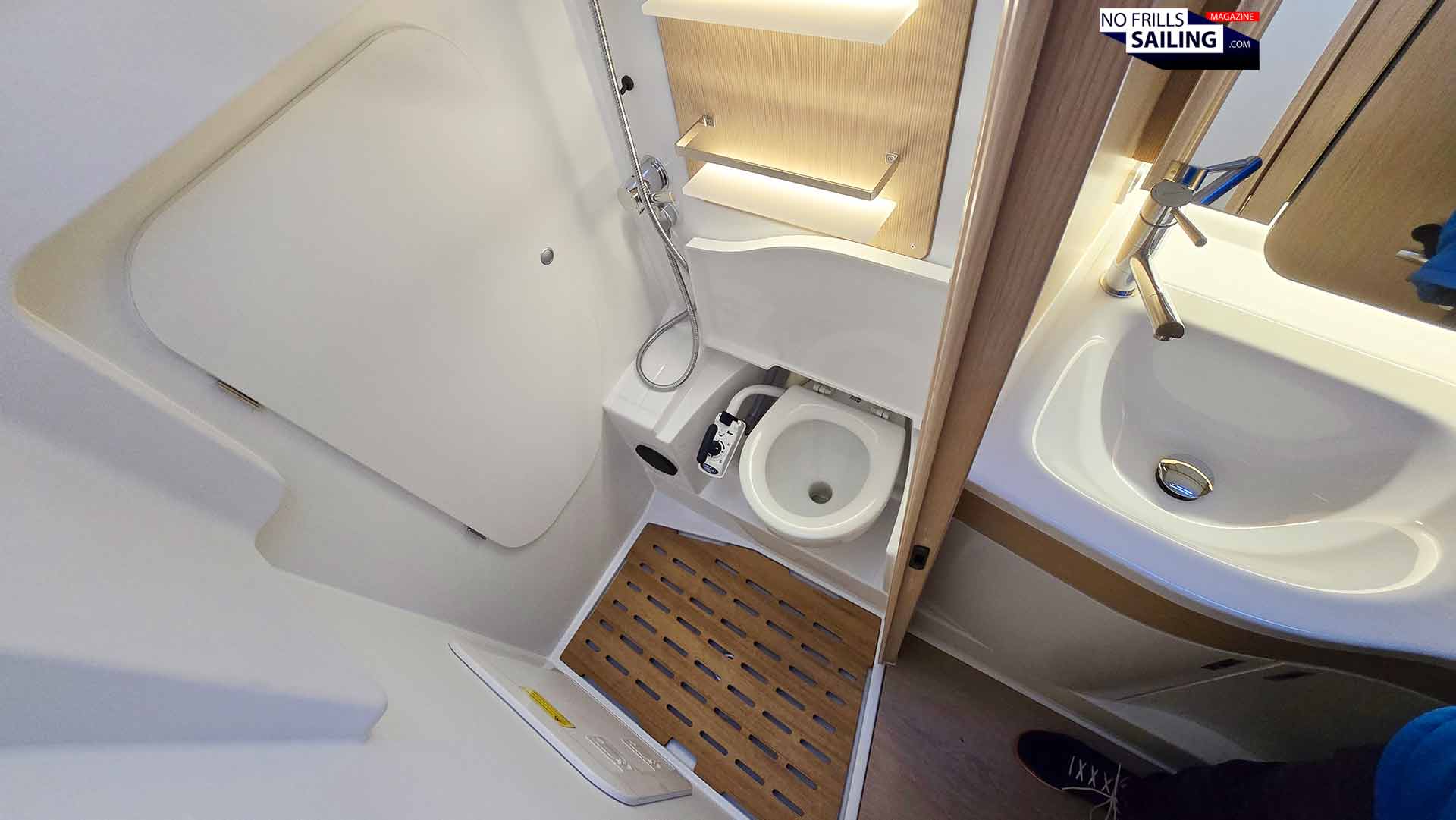
The bathroom, divided.
A novelty is the bathroom. Here, the shipyard got rid of one door and re-purposed the remaining one. For once, when the door to the bathroom is closed, the door separating the shower/WC from the washing table is open. If you want to take a shower, you may close this very door as it neatly also fits into the frame separating the shower/WC part from the rest. I guess this is a remainder from the older versions with three cabins. That way, the aft bulkhead didn´t needed to being changed. It´s a bit awkward at first, and it remains so I must say, but it works for me. So, that´s it for the interiors. Andi has removed the sail covers, let´s cast off!
Let´s sail the Dehler 24 SQ, shall we?!
I´ve never sailed in or out of Greifswald so this was a new one for me. There´s this little river, called the Ryck, at which shores the Hanse Yachts shipyard has its premises. Here, every new boat up to the large Hanse 590 flagship will be put to the water and readied for deliver, when staying in the Baltic Sea or leaving on its own keel. Still, today a large portion of Hanse´s output leaves on heavy duty trucks and will be brought to the dealers and clients all over the world. We boarded HILDE, started the 29 horse power diesel engine and off we went. Steaming downriver, almost 30 minutes, I could test her helm. As any current Dehler, she features a single balanced spade rudder. For the Dehler 34 SQ performance-package it´s shape has been redesigned and it has also been prolonged a bit.
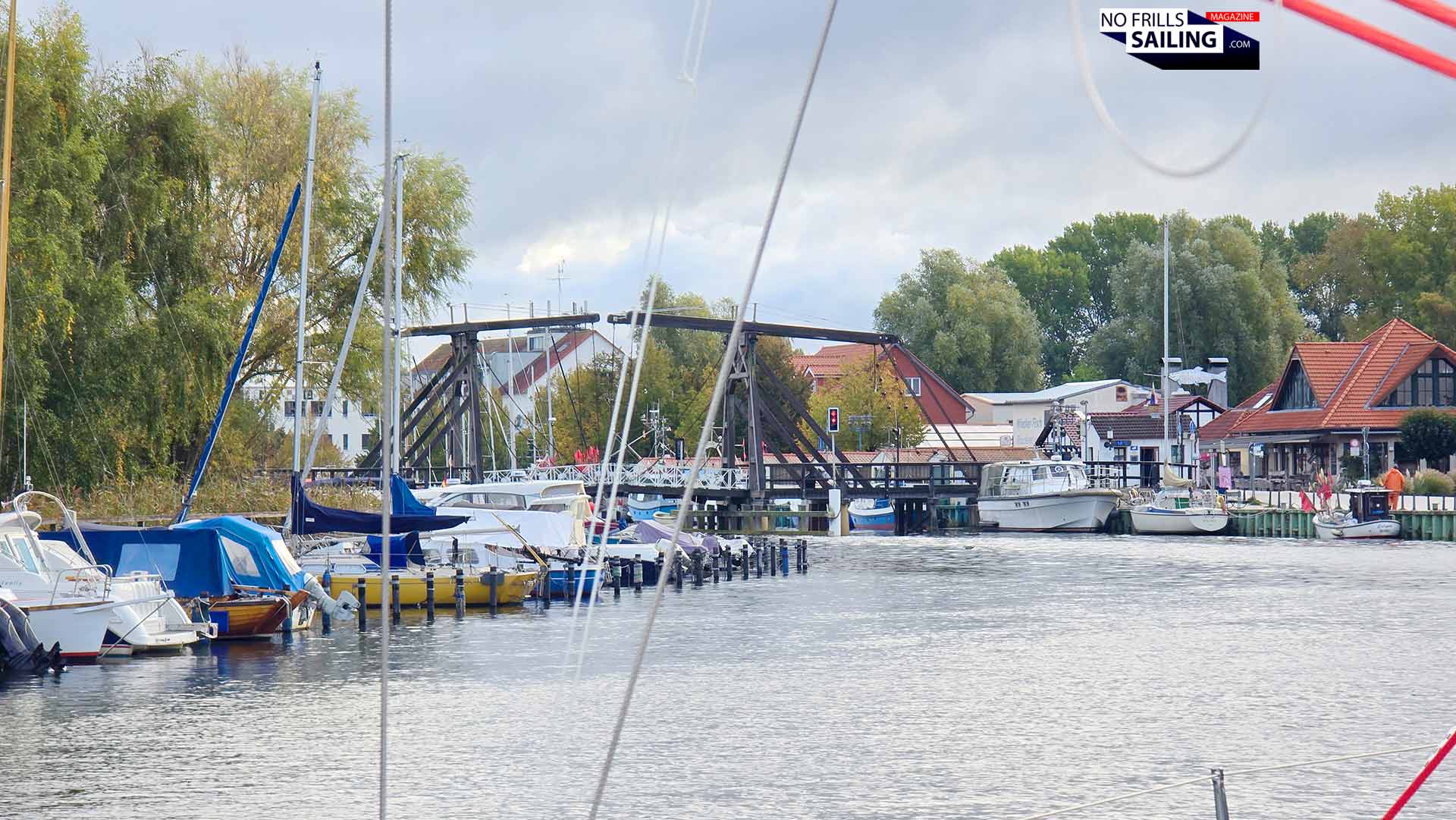
Nearing the bridge – let´s sail!
This goes as well for the keel fin, which for the performance-version is much sleeker and both dimensions, featuring a T-shaped lead torpedo. On our version, we´ve had the standard deep keel. Reaching the picturesque muscle-moved counterpoise bridge of Greifswald´s Wiek harbor, we had to wait a few minutes for it to open. Passing a brand new Y-Yachts 80-footer in commissioning at the dock here (Y-Yachts is located not far away), we steamed out into the Greifswald rush and hoisted the sails.
Higher mast, more power, better sails
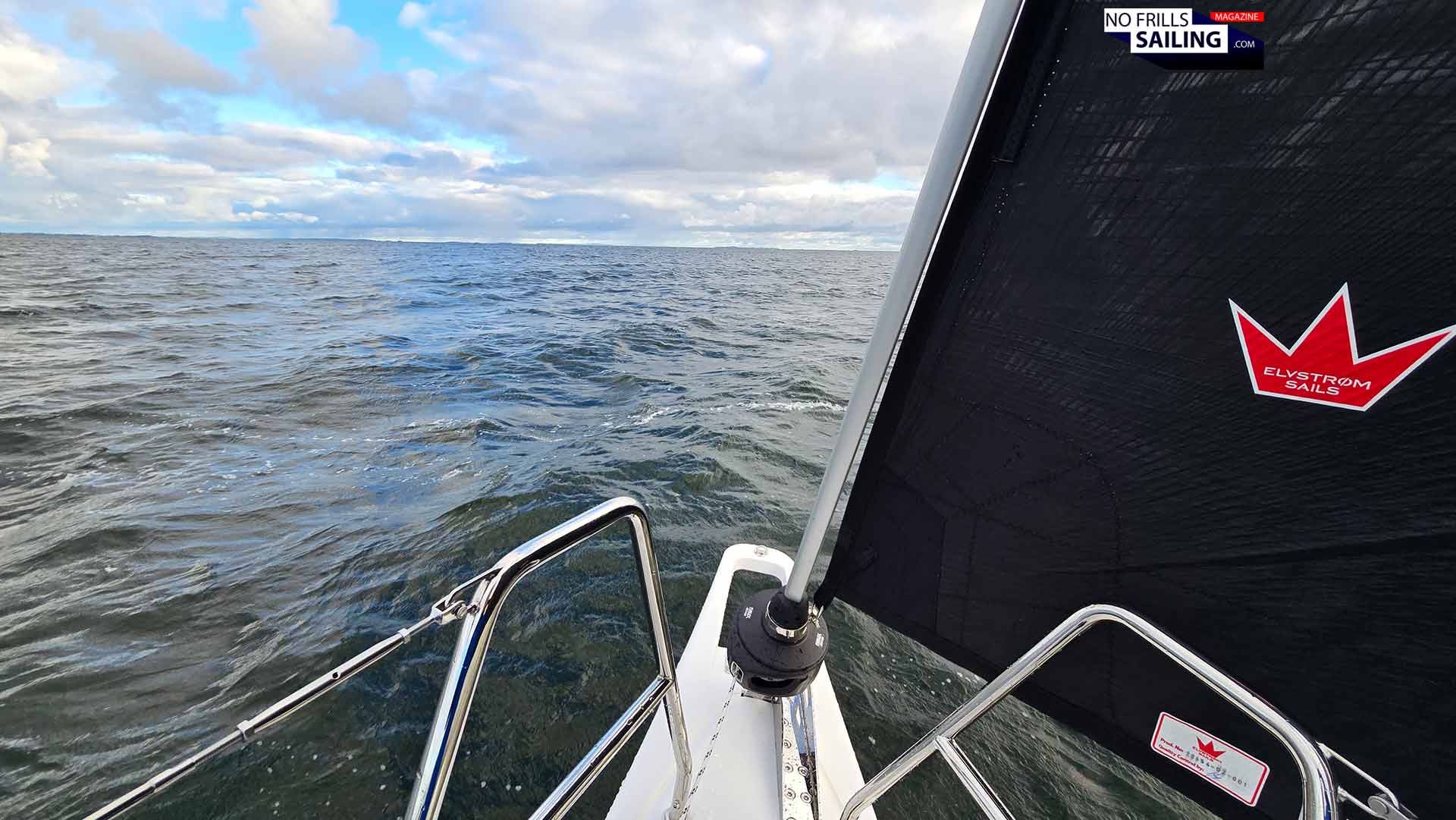
Which brings us to the bare numbers. The new Dehler 34 SQ is a powerhouse sailboat, boasting quite serious weapons to compete in a regatta: The mast has an increased height of 16.27 meters (air draft), now carrying 65 square meters of total upwind sails area. You could opt for an even taller rigging, then with a clearance of 17.02 meters, bristling with 71 square meters of upwind sails area. For some reason Hanse Yachts switched from Quantum Sails as their principal sailmaker to Elvström, HILDE sported a nice pitch black membrane sails upgrade.
Good sails are common sense
I´ve already mentioned a competition-keel, which will then have a draft of 2.10 meters. The standard deep keel has a draft of 1.95 meters and there´s a shallow draft option with just 1.55 meters, which is likely to be chosen by inshore-skippers. The boat has an overall length of 10.70 including its bow sprit, the waterline length is 9.60 meters. The beam is considerably wide, 3.60 meters, but with 5.6 tons competition displacement to 6 tons standard displacement the Dehler 34 SQ is likely less a “planning” boat as her French competitor is advertising. Nevertheless, her qualities – and I am going to experience this myself now – are her all-around capabilities. She´s not optimized for a single point of sail, but rather for 360 degree sailing.
She´s a vivid, quick boat indeed!
Which is a must, regarding the usual racing courses which include upwind and downwind passages. And even if used as a fast cruiser, the Baltic Sea and most areas up here in the north have pretty challenging wind patterns. At least the Baltic Sea is changing its wind direction in average every six to eight hours, opting for a narrow-focused boat (like a Pogo, for example) may come with downsides. The Dehler wants to – and indeed is – an overall performer.
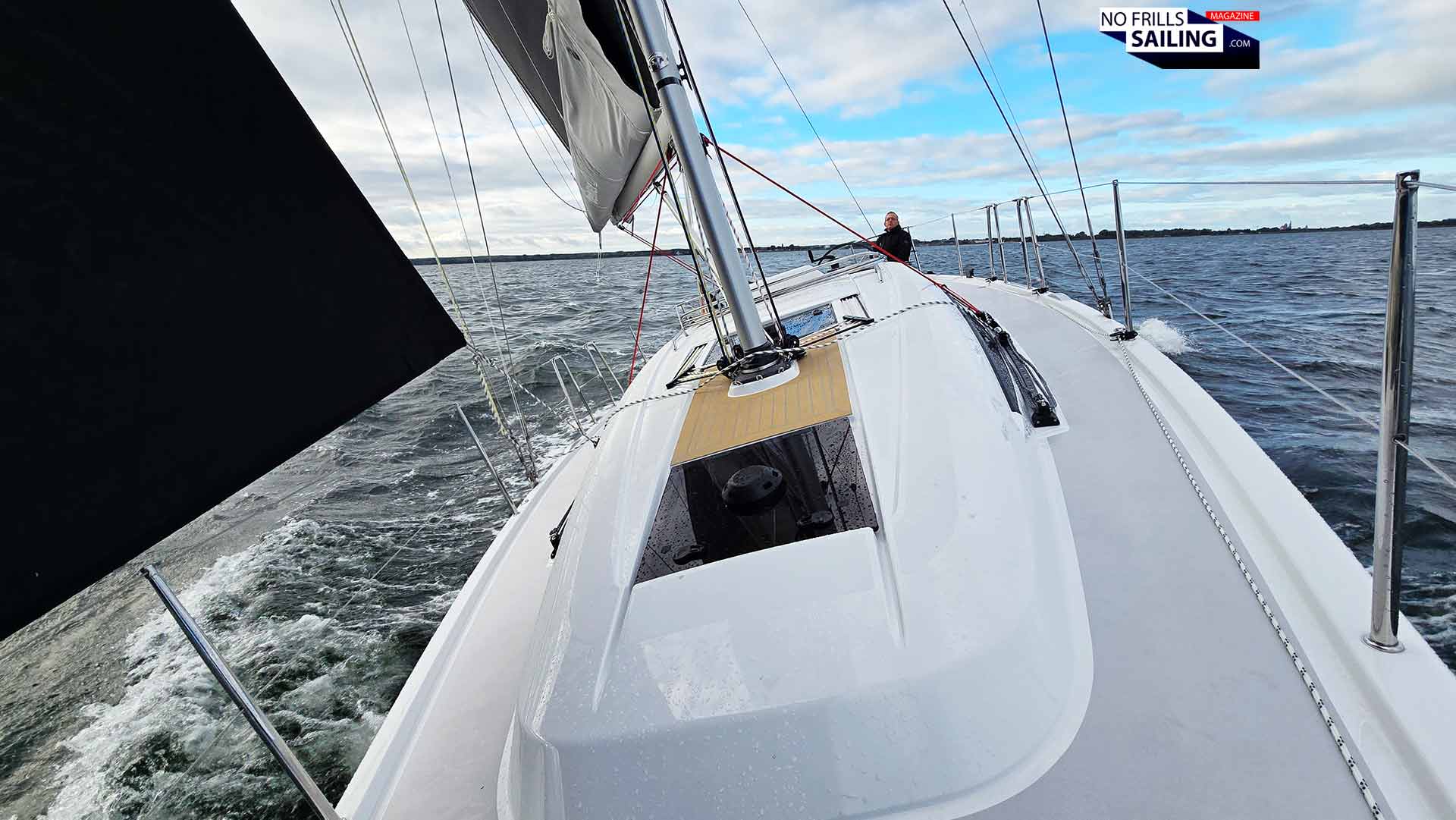
Everything´s there for decent fine trimming
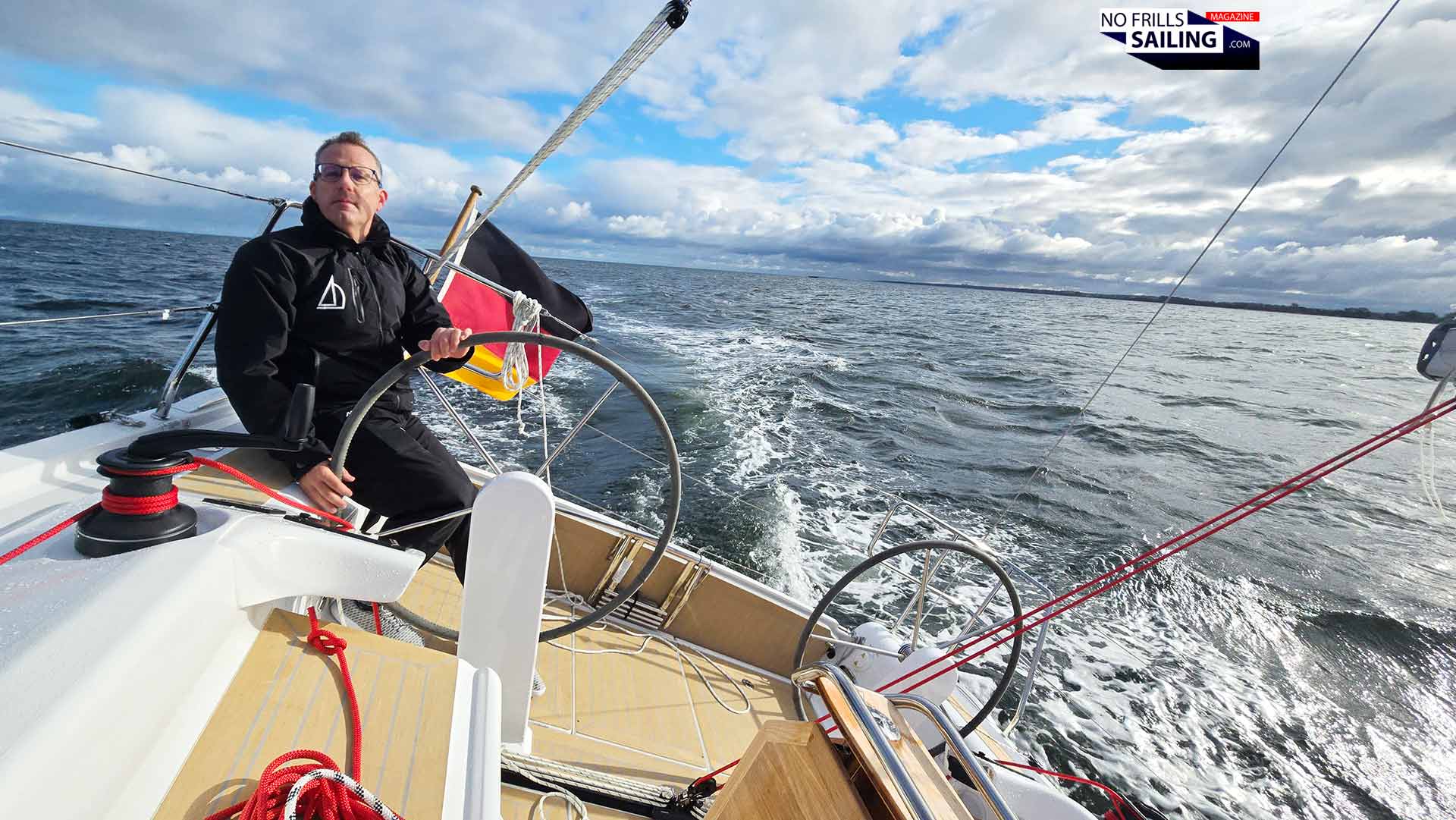
Another significant simplification for the new Dehler SQ was the skipping of the tiller steering. Older models have been available with tiller, and I would still opt for this method of steering preferring it always over the more complicated, less sensible and less fast wheel steering, but the shipyard decided to go for double wheel steering. I guess, if sales figures were at least similar to those of “my” Oceanis 30.1 tiller vs. wheel back in the day, it absolutely made sense: Out of some 25 Oceanis 30.1 I sold myself, there were only two (!) with tiller.
Impressive upwind performance
So, first of all let me say that I was again impressed by the size of the boat. 34 feet, 11 meters, that´s a decent boat size indeed! I know that we all strive for the big units, and it makes sense though, but honestly, why? Most sailors use their boats for weekend-rides near or around their home bases, for the traditional one- or two-week vacations once or twice a year and … that´s basically it. So why go for a big boat, pay all that extra money and not really using it for the intended stuff? That said, the Dehler 34 SQ is of perfect size for the “normal” sailing guy. Small boat, easy handling – the sails are up in a matter of seconds.
Choppy, gusty Baltic Sea – she behaves nicely
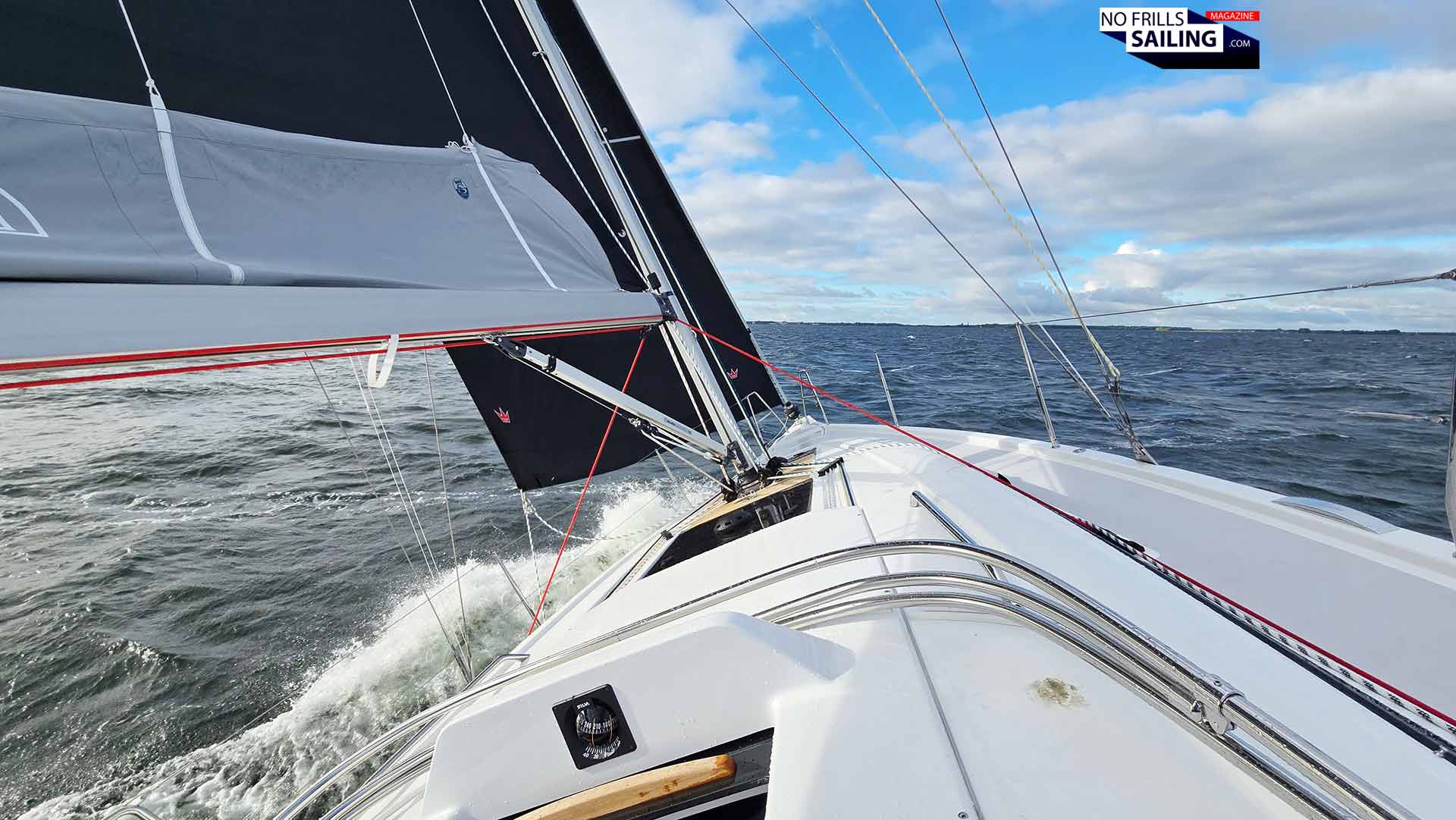
So I ask Andi to show me the performance of the Dehler 34 SQ on every point of sail. And he did. We started going upwind. Something, sailors don´t usually like all too much, because it brings most heeling, most choppiness by cutting through the waves and hence the most uncomfortable movements for crew – and above all, the guests. We´ve had 13 to 15 knots average wind speed on that day, with an occasional gust coming in with some 17, 18 knots. The boat heeled quite excessively during the gusts, but it was no problem at all – Andi didn´t even eased the main sheet traveler, but simply went on sailing … it´s that stiff!
Upwind: Surprisingly comfy sailing
Speed-wise, the Dehler 34 SQ was cutting along through the waves at 7.3 to 7.5 knots SOG easily, close hauled. Andi veered off a little bit to take out stress from the rigging, so I´d say we were sailing at some 38 to 40 degrees TWA. The Dehler can point much higher, but that´s only resulting in more heeling and leeway. For the racing guys reading this: This is a good time to opt for the thinner, lighter but deeper performance keel and the deeper single rudder blade.
No tiller steering anymore
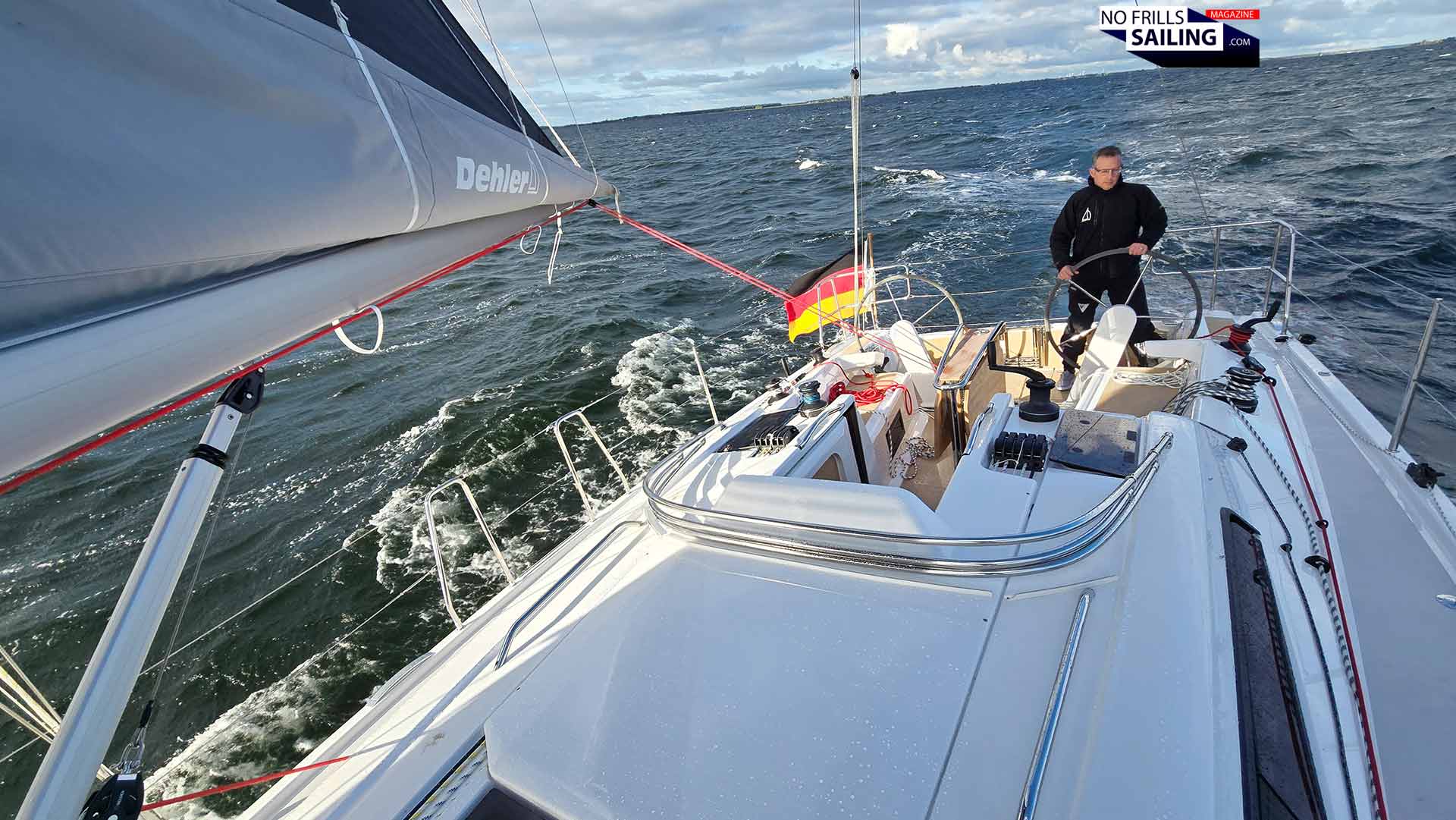
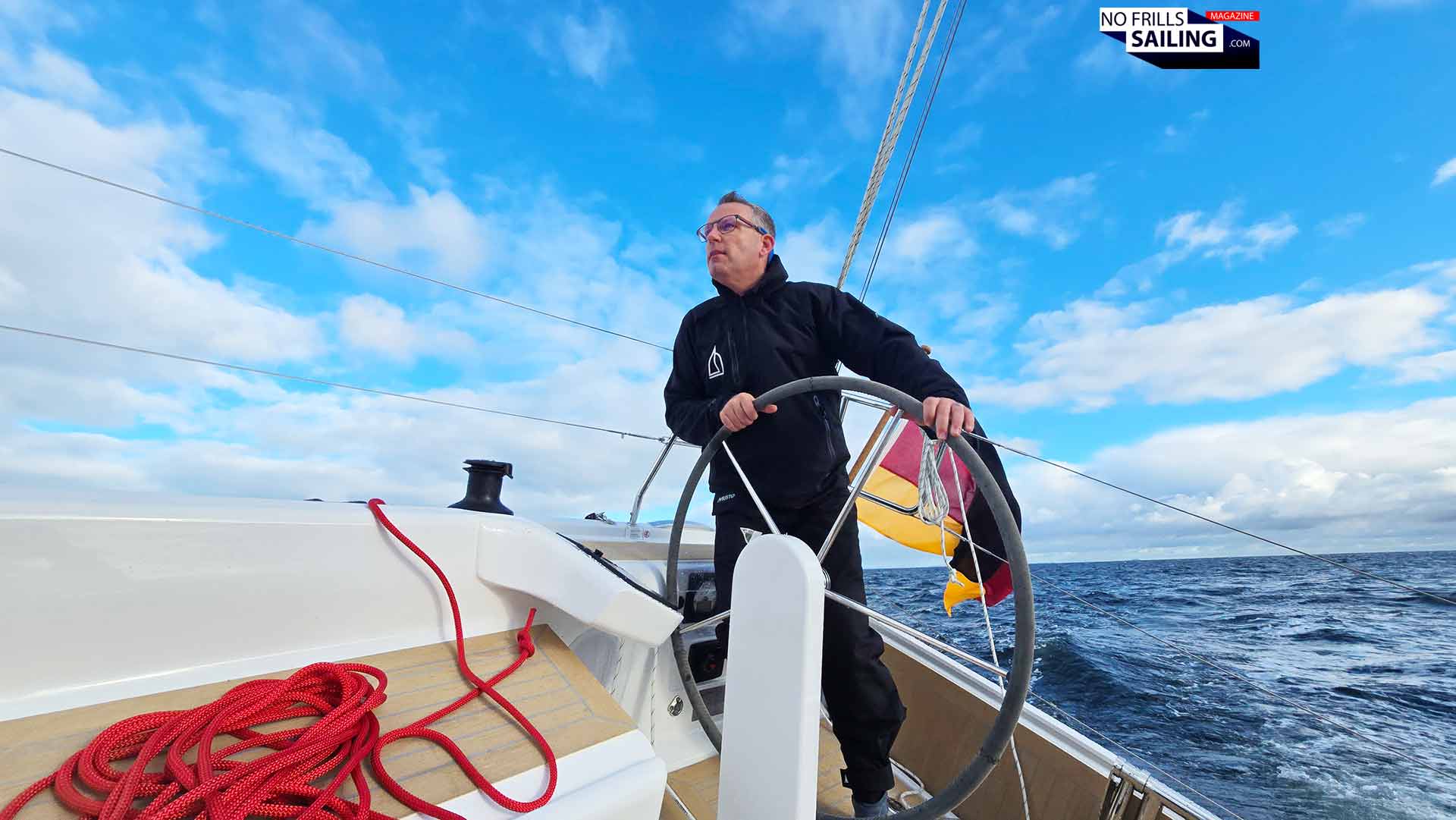
I´ve already mentioned it: The Dehler 34 SQ does not come with a tiller option anymore. People wanting the “full yacht experience”, buying the twin-wheel steering anyway. I thought this was a bit of a shame, but the market has spoken, right. On the other hand, the tiller would have kind of messed up the perfect steering position you´ll have behind the Dehler´s wheels: It´s really that good. Visibility is totally clear in front of the boat, the small instrument panels are adjoining the seating benches, so no oversized columns in front of the wheel. I really liked it behind here.
The helm position: Perfect view!
The only thing that bothered me was the backstay cable, which prevented me to really snug in to the pushpit corner on the one hand, and the fact that because there´s no instrument panel there´s no way to grab a safe hold near the wheel. For the latter, you will quickly develop alternative ways to make yourself standing safely. As for the backstay, well, I´d say I´d rather have a decent backstay lashing to fine trim the mast and look for another seating position than sail without, right? That´s a sailor´s boat, so naturally the emphasis is on sailing here.
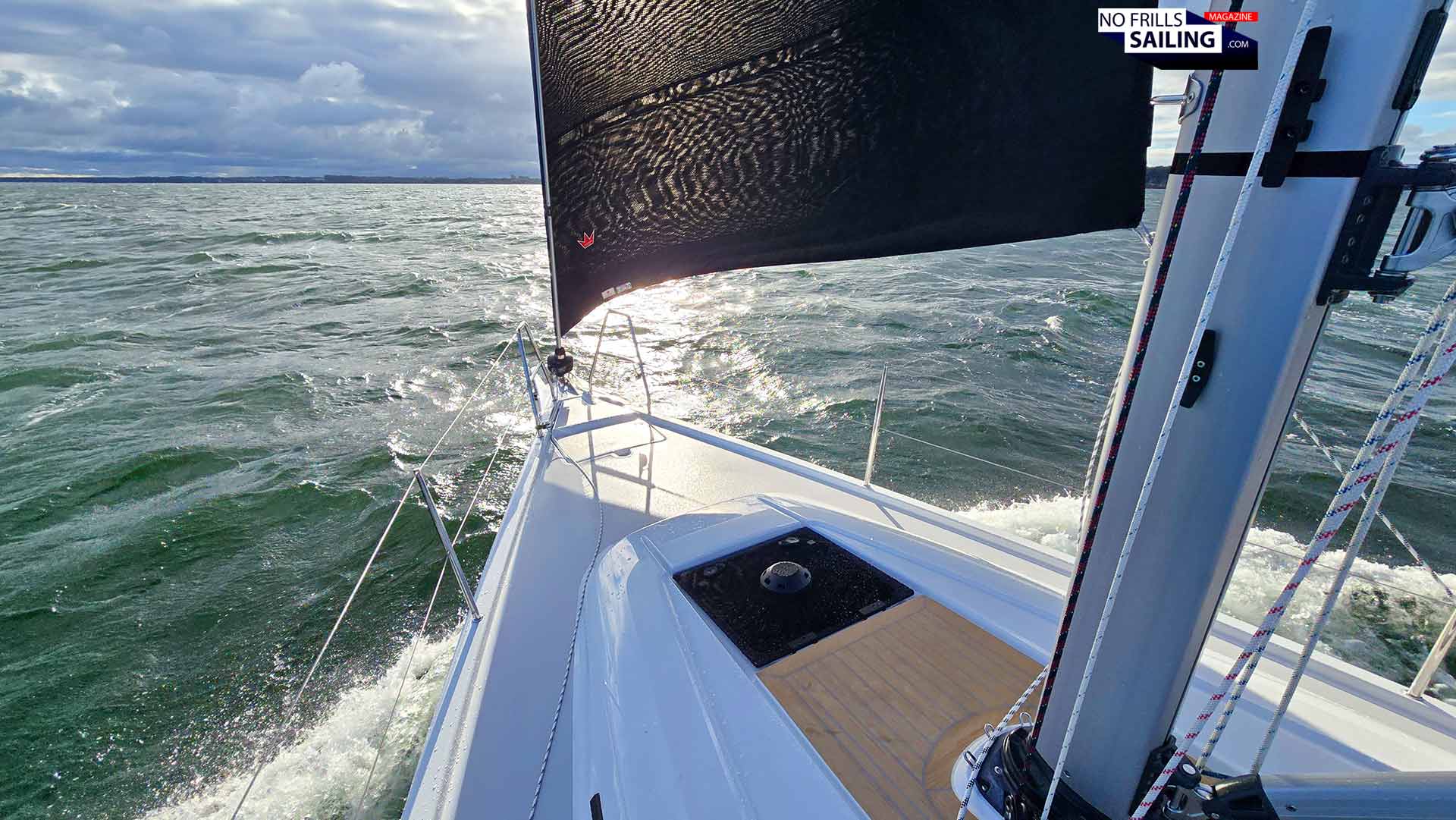
No wash on the bow upwind.
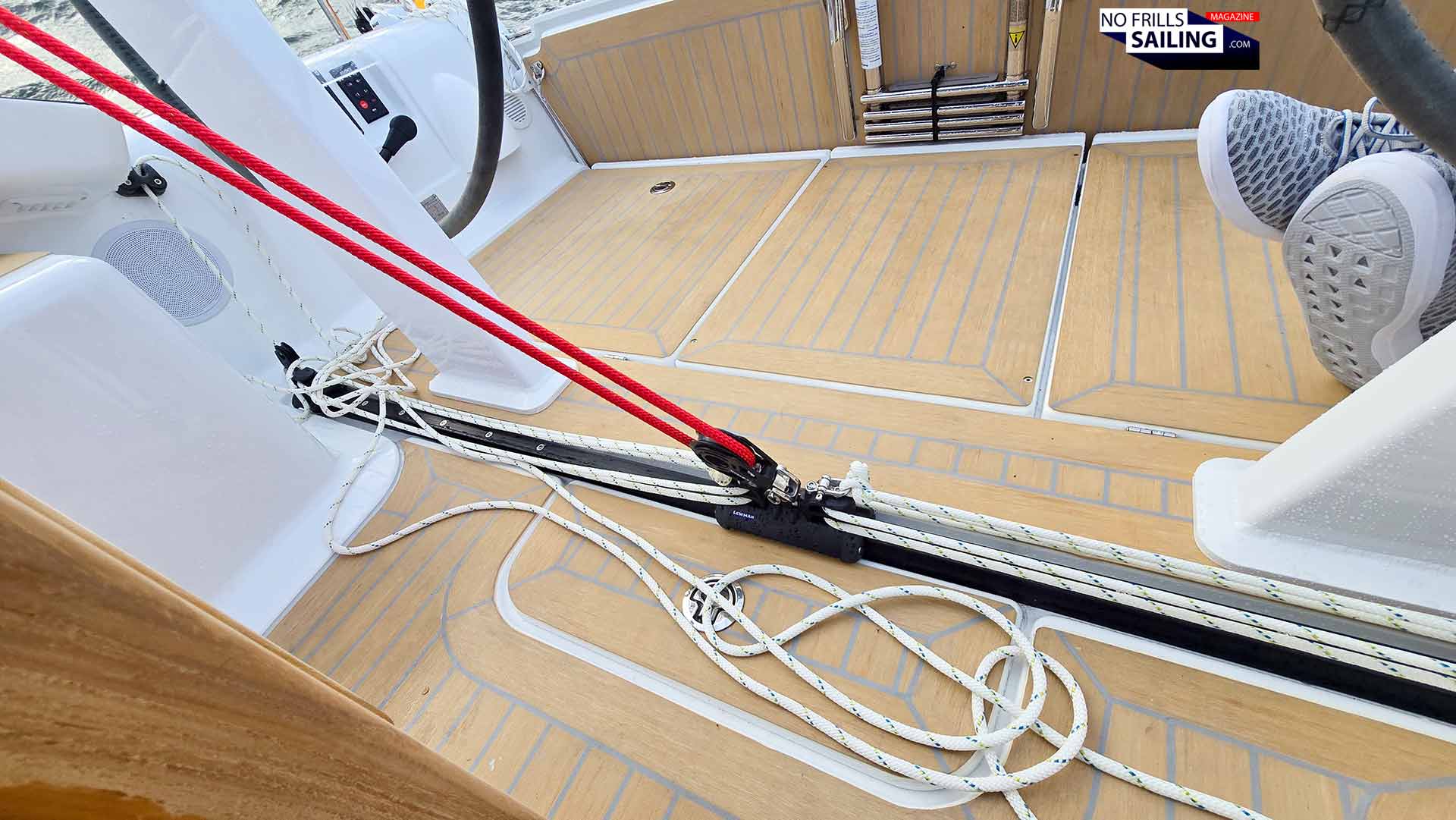
As for the layout of the winches, the Dehler 34 SQ can be rigged the way you like it. Our HILDE came with a true German mainsheet system (something I´d change back to classic mainsheet immediately). That way it was possible to sail the boat in single handed-mode easily, nevertheless, Andi had to switch on the auto pilot and leave his helm position to reach any of the six winches. That said, you´ll have the freedom to rig your Dehler 34 SQ anyway you please, adjusting the setup of the lines for crewed racing, easy cruising or single-/double handed sailing. Nice.
Broad reach and downwind: Delightful!
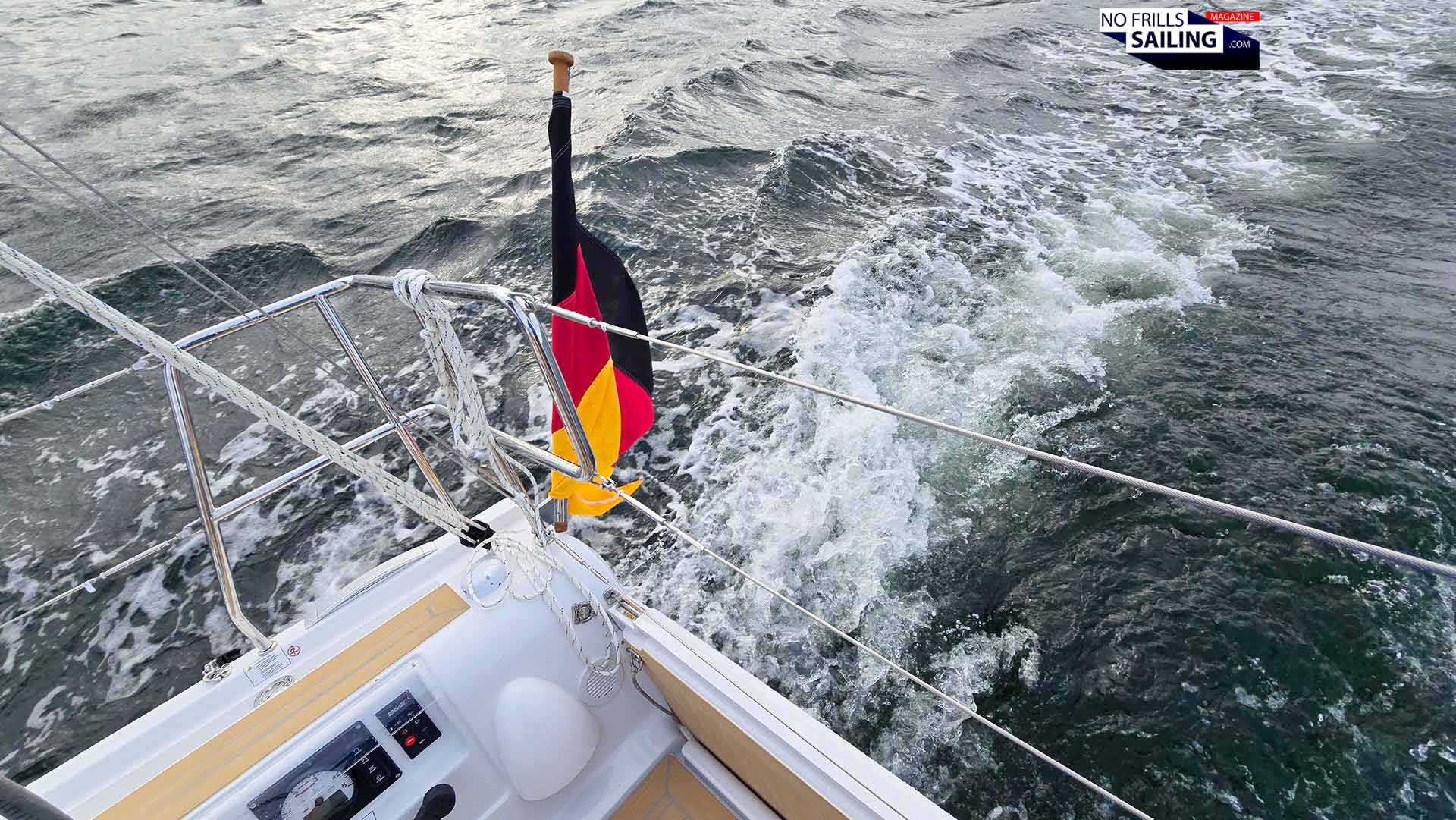
Now it was time to veer off a bit and check how the boat feel like when the wind hits her in a 90 to 100 degrees angle. Of course, she accelerated a bit more – now with a steady 7.5 to 8.0 knots SOG, wind still at 13, 14 knots true – but what struck me most was the nice way the hull was coping with the incoming waves. The Baltic Sea is famed for it´s choppy, steep, little motherf****ers, we call it the “Ostsee-Hack”, like “Baltic minced” if you will. Usually, sailing upwind and in a broad reach means that the boat is “hopping” through this mess.
Sailing along quickly
But she did just as fine! Still, she´s a small boat in size, but she really went stoically through the waves, dampening the choppiness, which is a big plus for her hull. See? Never change a running system! This hull-design, hydrodynamically, seems to be perfectly well suited for choppy coastal sailing and gusty winds. None of which could make the boat wobble, her rigging pump or steering become erratic. Heads off to the Judel/Vrolijk-guys 10 years ago – this is a fine, balanced, fast but comfy hull!
I was quite impressed with her sailing capabilities!
Will she plane? Well, I think she is perfectly well with sailing quickly and she can surf at times, which she was proving when we went downwind back to the shipyard again. I assume that in longer waves and with a bit more TWS the Dehler 34 SQ can and will exceed her hull speed significantly. Planing is a different story. Her hull is more conventional, optimized for an all-round good performance, whilst other boats had been designed deliberately to shine on the planing-points of sail. If you seek this sensation, the Dehler will not be your first choice. But if you look for a very comfy, quick boat on all courses, she should be considered.
Advertisement
So, shall we change the running system?
Well, that´s the question, right? Brands like Pogo have revolutionized the concept of ultra-fast sailing and lightweight boatbuilding, introducing these things to the common sailors like us. Over times, more brands joined in and with the latest Firsts designed by Sam Manuard the “planing cruiser” has become a common term. And it´s fun indeed! In this respect, the Dehler 34 SQ does not join this faction. She is in many respects a conservative, but still modern, performance-cruiser.
Classy, but modern. I like it.
With her 6 tons of displacement she´s even significantly heavier than the (bigger) First 36, so that these numbers alone make clear that both boats are indeed not direct competitors but sailing in different categories. But here´s the thing: I myself refrained from acquiring such an ultra-modern yacht and opted for the Omega 42 because I was looking for an allrounder. I wanted the “classy” sailing experience. I wanted a proper upwind comfort, not the heavy pounding and mast-pumping. Planing is fun, of course, but it´s just one or two points of sail. What about the rest? For me, the Dehler 34 SQ, although a modern yacht, represents more the classic approach to sailing and I am completely fine with it!
Is she a boat for you?
When we´ve had HILDE back in the marina, tied up at the pontoon, I thought that – at least for this sailing area here up in the north, the North Sea around UK, the choppy waters of the English Channel and the French Atlantic coast, this boat might be perfectly well suited – you don´t have to wait for a favorable wind direction, you just cast off because she can take whatever Poseidon is throwing at her, wind-wise. You could change a running system, but improving it here and there, can still produce a decent product nowadays, as I have learned today.