The ropes and lines of a sailboat are by far one of the most essential parts of the equipment. Investing in high-grade running rigging for halyards, sheets and dock lines is a must to make sure the boat is sailed safely and efficiently. But how is a modern, high-quality rope for a sailing yacht made? This article shows in detail the production of ropes in Europe´s most modern ropemaking factory at Mamutec in Hungary, where the Ullmann ropes are made.
Following my social media channels like facebook or instagram you may have noticed that I was in Hungary a few days ago. Of course I enjoyed the lush atmosphere of Budapest, one of the most pleasant capitals of Europe. Of course I took a bath in Hungary´s “Pannonian Ocean”, the lake Balaton. But I wasn´t here on vacation …
Hungary: I´m not here for bathing in Lake Balaton …
Hungary, albeit landlocked, sharing no coastline whatsoever with any bigger body of water, is indeed a sailing nation, did you know that? Check out my factory visit at Pauger Composites, which is absolutely stunning. There are a lot of shipyards in Hungary as well: A quick Google search reveals that a lot of foreign brands have their production facilities here as well as home grown brands. So, Hungary is a factor of the European boating industry. Widening the scope, there´s more than boats and rigging. Ropes for example.
Europes most modern ropemaking factory
Advertisement
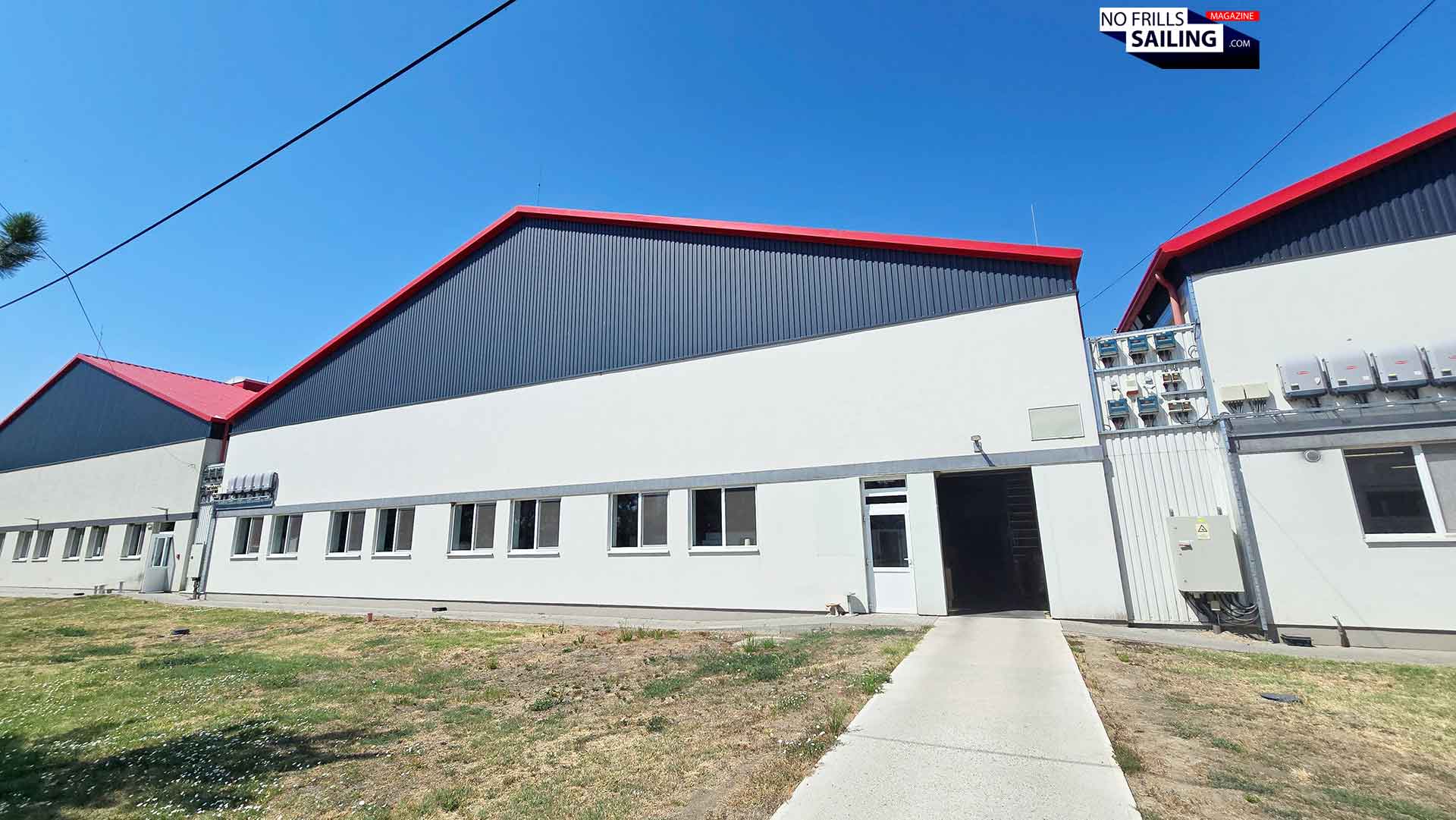
I contacted Ullmann ropes, which was founded as a small ropemaking manufacture in Switzerland in the year 1915, to talk about their boating division. Not having set a focus on this product range for years, but constantly selling high-grade ropes to skippers and owners all around the world, they agreed to show me their production, disclose the “secrets” behind their ropes and – maybe – make me order my running rigging with them, not with the big names. The only precondition: I would have to come to Hungary. Even more, not Hungary but almost Romania. Because Europe´s most modern ropemaking factory is located some 80 kilometers away from their Romanian neighbors, some 180 kilometers east of Budapest.
Greeted by Norbert Medve, Managing Director at Mamutec
Here I meet with the factory´s Managing Director, Norbert Medve. It´s funny that I find myself in the middle of the hot Hungarian hinterland (the Autobahn stopped at some point and I had to drive on narrow rural roads) and talk to a “Norbert”, which is a totally German name. Funny. That´s also how Norbert was: A friendly, funny guy, but filled to the brim with knowledge about ropemaking – of course. After sitting down in his air-conditioned office (we´ve had 42 degrees Celsius outside on that day!) and receiving a general overview of what I was going to see now, we proceeded into the large factory halls. And boy, was I about to enter the land of milk and honey, in terms of machinery, loud mechanical noise and fascinating robots!
Let´s see how modern ropes are made!
Norbert works here since 2003. This location belonged to another Swiss company before it had been taken over by Mammut AG, the successor to Arova-Mammut AG and the company behind the Mammut Sports Group AG brand, which has long been one of the major names in the world of alpine mountaineering and rock climbing. So, the expertise required for rope manufacturing was already firmly established here. After the company had been taken over by Seilfabrik Ullmann in 2008, and subsequently grew into one of Europe’s largest rope manufacturers, it was renamed Mamutec – which is why we do not find any Ullmann logos here. Mamutec now produces about 95 percent of all Ullmann-products, from playground to sailing ropes. That’s 20 millimeters to the arm-thick ropes for securing offshore buoys. Why here? This little town with the unspeakable name of Gyomaendröd, used to be a center for Hungarian shoe manufacturing and textile industry. So there´s a skilled labor force and premises already present.
A familiar name …
But why Ullmann though? To understand the background, the story goes as following: With my Omega 42 now in the last few weeks/months of her production, it´s time to acquire the running rigging for the boat. That´s everything from halyards to sheets, from reefing lines to dock lines. There are the “usual suspects” of sailboat ropes which I checked, be it Liros or – my up to then favorite – Marlow Ropes. But then I discovered that there is a brand with a huge (really huge!) background, rich history and seemingly whole range of products: Ullmann ropes.
Ullmann dominates the playground making business in Europe
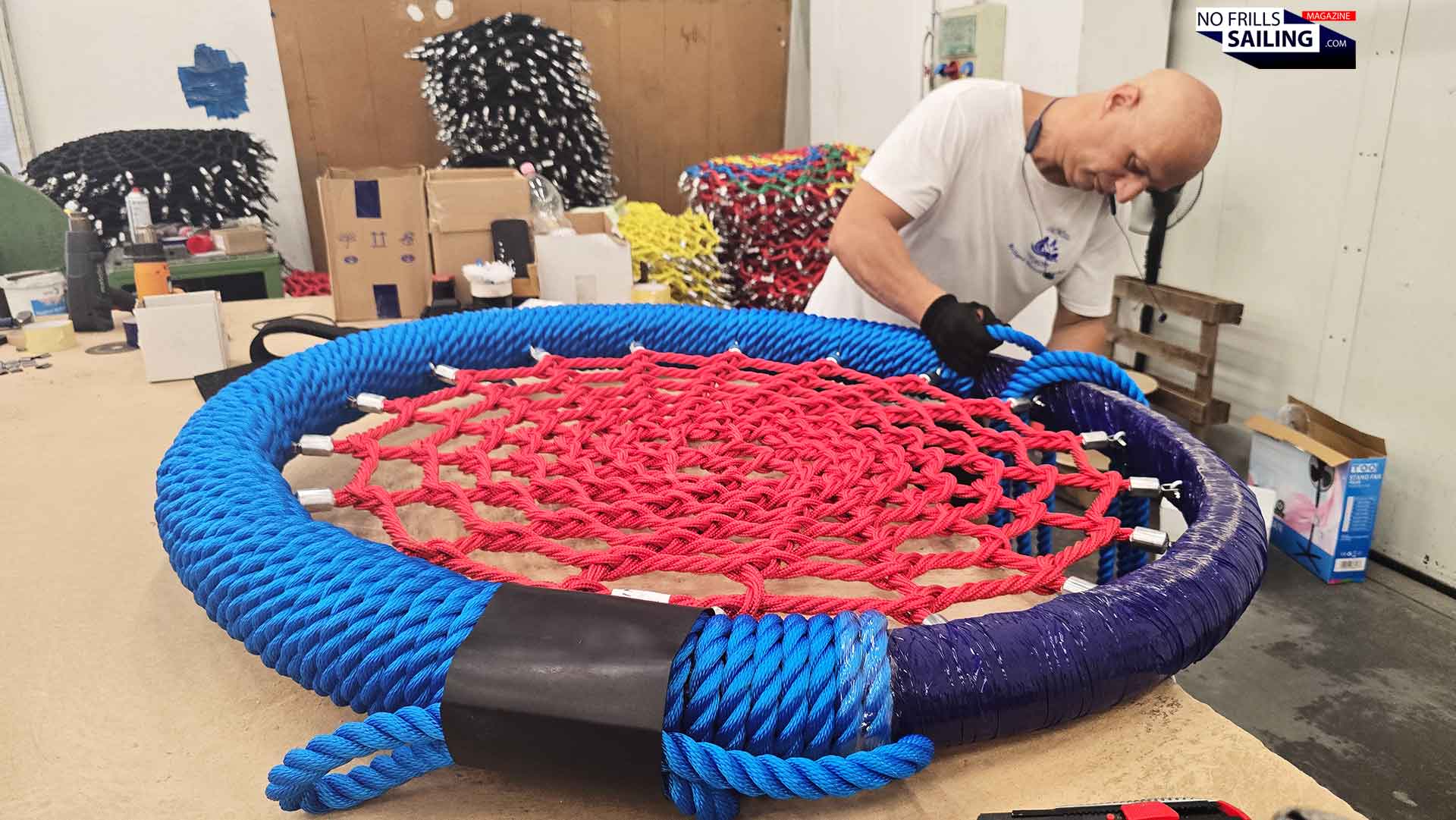
Ull … what?!, you may ask now. And it´s true: Seilfabrik Ullmann, a Swiss brand, is not very known among sailors. But there´s a fair chance that either you or your kids have been or are right now in fact heavy users of Ullmann ropes. That´s because almost half of their turnover is made with playgrounds. You heard right: Playgrounds! Everything that needs a rope, from a simple nest swing to (my favorite) the climbing pyramid is made here at Ullmann. They export to all of Europe and into the world. High-class, safe and long lasting playground modules. I checked at home, our playground is an Ullmann pleasure ground too. And then there´s the Usacord shock lines.
This is why I know Ullmann Ropes: Usacord Shocklines
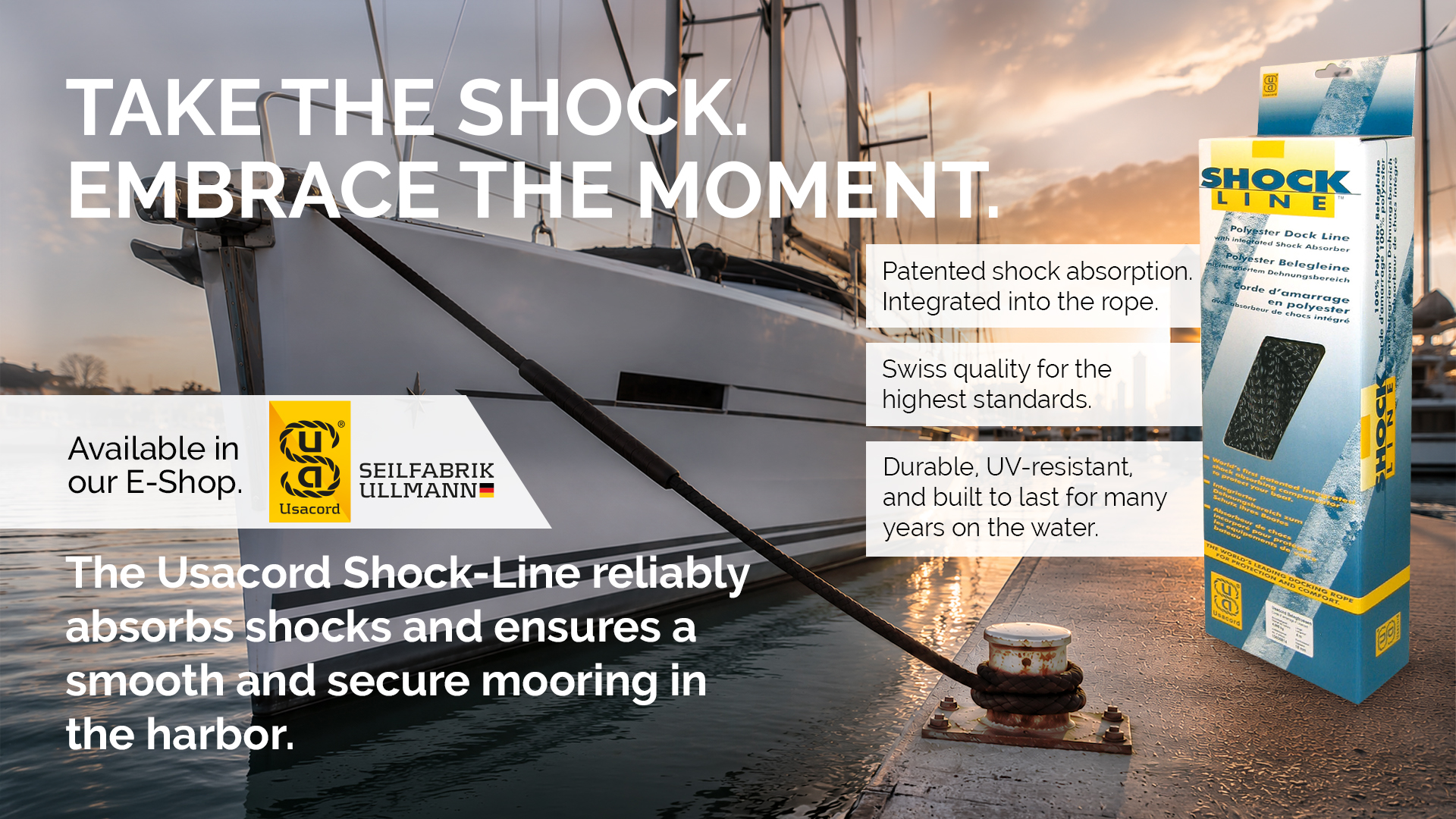
I´ve come across these innovative mooring lines a few months ago by chance. One of my clients did send a product sample to me to write a review of this one for his website blog. I´ve honestly never heard of Usacord shocklines. After careful research and testing with my own hands, after speaking to several boat owners who use those and talking to my client I received the impression that these are indeed a kind of “hidden champions”. Mooring lines with integrated shock absorbing capabilities (later more on that), readily spliced, robust and tenable. Not cheap though, but we all know what happens when you go for Temu & Co, right? So that´s the backstory. A brand that´s on the rope market since the year 1915 … there must be something about it, right?
Twisting, braiding, weaving and stretching.
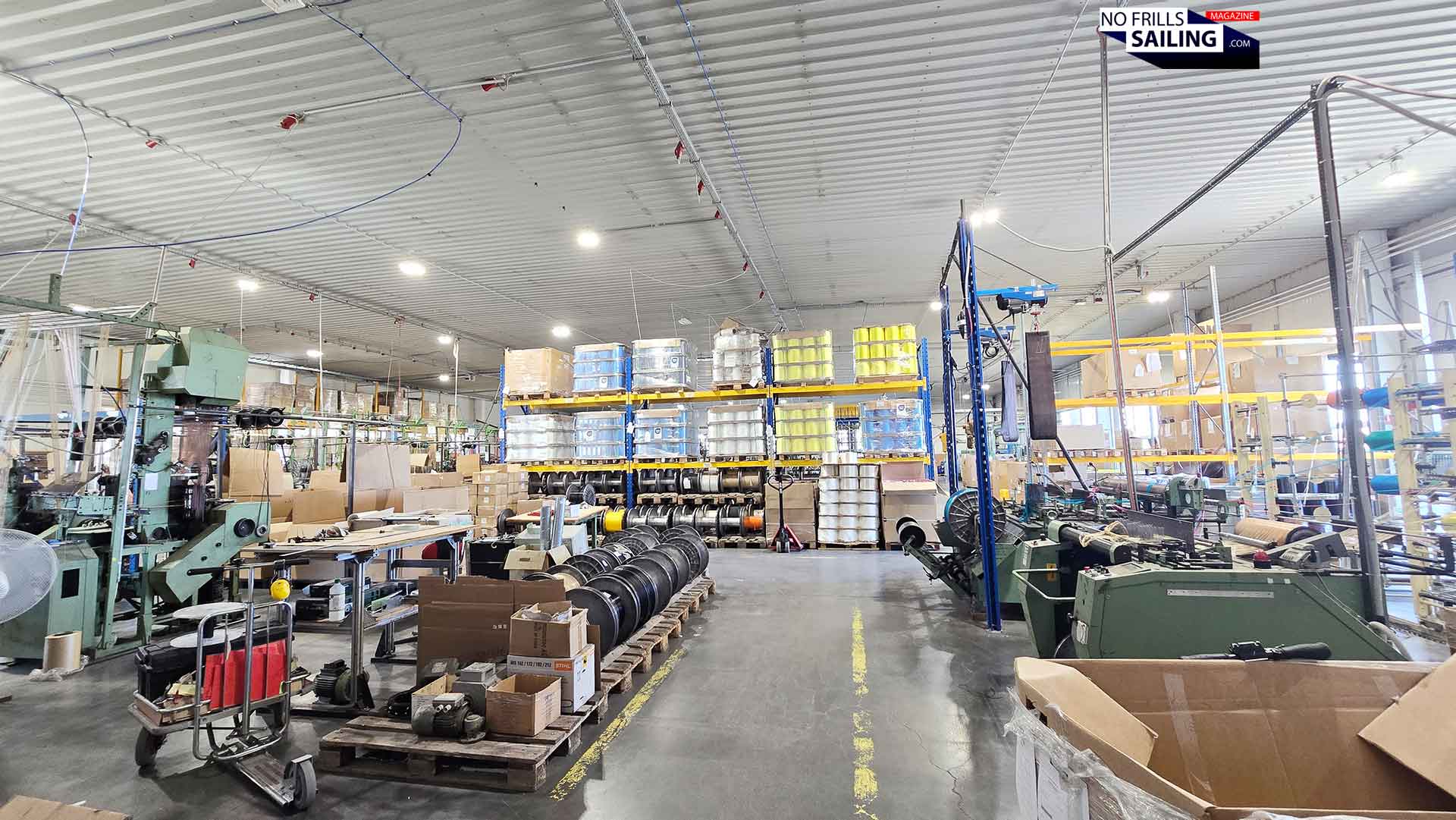
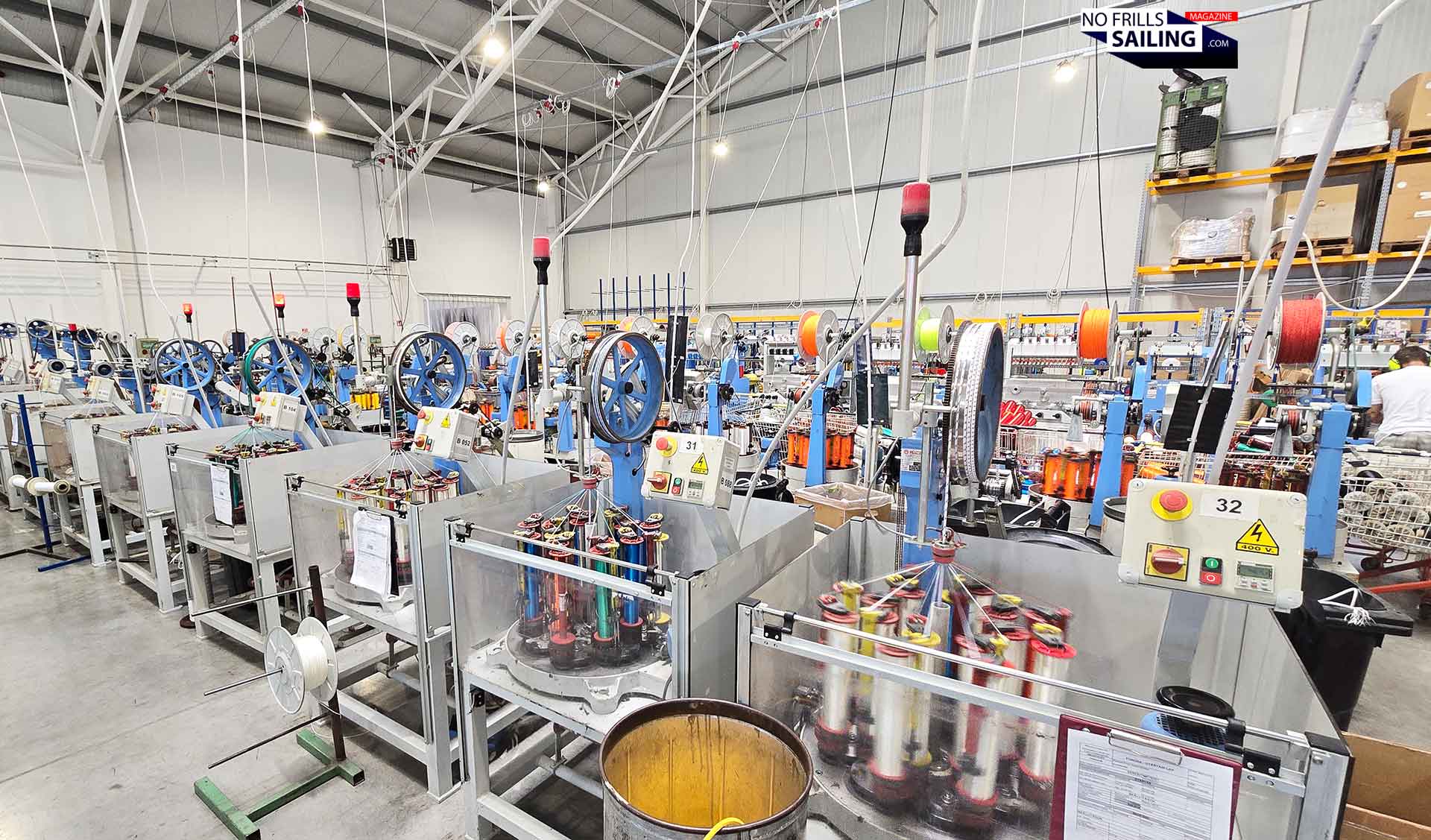
But let´s go inside and see how it´s made. Along with the “old” factory buildings Mamutec took over in 2008, they have set up three large new production halls which represent the pinnacle of current ropemaking technology. That´s a staggering 9.000 square meters area filled with loud machinery. And these machines are running five days a week in two full shifts. It´s your perfect definition of machines worked by men (and lots of women!) – labor intensive, but also heavily reliant on automation.
If you could hear that noise …
Ropemaking is an ancient profession. The first “ropes” found by archeologists date back 50.000 years, made by the Neandertals. Yarns even more, to staggering 120.000 years. The old Egyptians introduced the first ropemaking “industry” some 6.000 years ago: They discovered that you can make thick, strong and durable ropes by twisting and – much more so – by braiding thinner yarns into one thicker. Twisting and braiding is even today the principal technique how a rope is made.
The first production step: Spooling up yarn on these mandrils
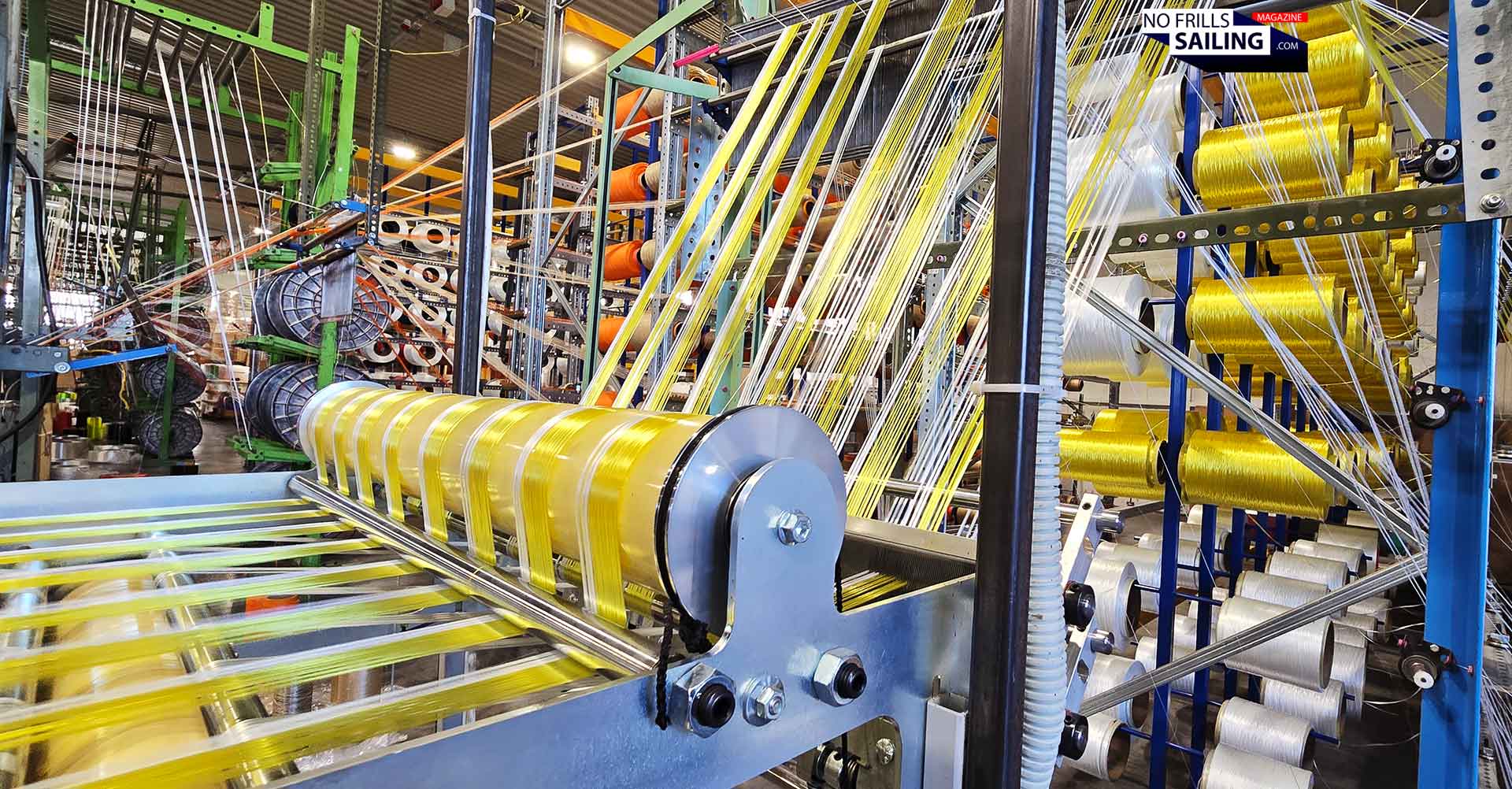
Norbert shows a machine that makes mandrels of spooled up yarns. For modern ropes, only seldom natural fibers will be used – at least for heavy duty ropes. For modern ropes, for example used on sailing yachts, modern Polyester is utilized. This is durable, relatively cheap in its basic product and can be turned into so many forms and shapes. For the Ullmann ropes, the make multi-filament yarns here: A filament is a single, thin and unbroken PE-fiber that can be extruded in literally endless lengths. That´s the one big advantage over natural fibers, which have of course a definite length and must be “stapled”.
A labyrinth of yarn
That is why synthetic ropes are stronger: They offer an unmatched tensile strength, can be made to incorporate low friction properties as well as smooth handling and they stay flexible at the same time. These mandrels with the multi-filament yarns are then put into twisting machines, which will make thicker yarns out of them. We will see that in a few moments. For now I am stunned and fascinated by these machines: Working almost completely automatic, they need frequent checks by the personnel. Meter by meter the mandrels grow in thickness with more and more yarn spooled up.
All colors of the rainbow are possible
Another advantage of PES is the free range of colors. As we all know from any plastic products, this material can take on any color of the rainbow. Here at Mamutec the guys are very proud: It´s possible to order ropes in any base color you want, mix those individually to come up with rope designs of your choice. I will later check in the Ullmann rope catalogue which designs are readily available for sailors. Be it dark black to shiny yellow or orange, apple green or pink: Everything´s possible here.
Fascinating mechanical computers
Now, you can imagine that the soundscape of such a huge production is overwhelming. As we enter one of the large factory halls, I am instantly enveloped by a constant loud noise: A clicking, hacking, beating, there´s only the baseline missing and I´d say I am wandering through a hardcore EDM-concert. I can barely understand what Norbert is telling me, having to put my ear near his mouth to get a grasp of what he is explaining.
It´s overwhelming!
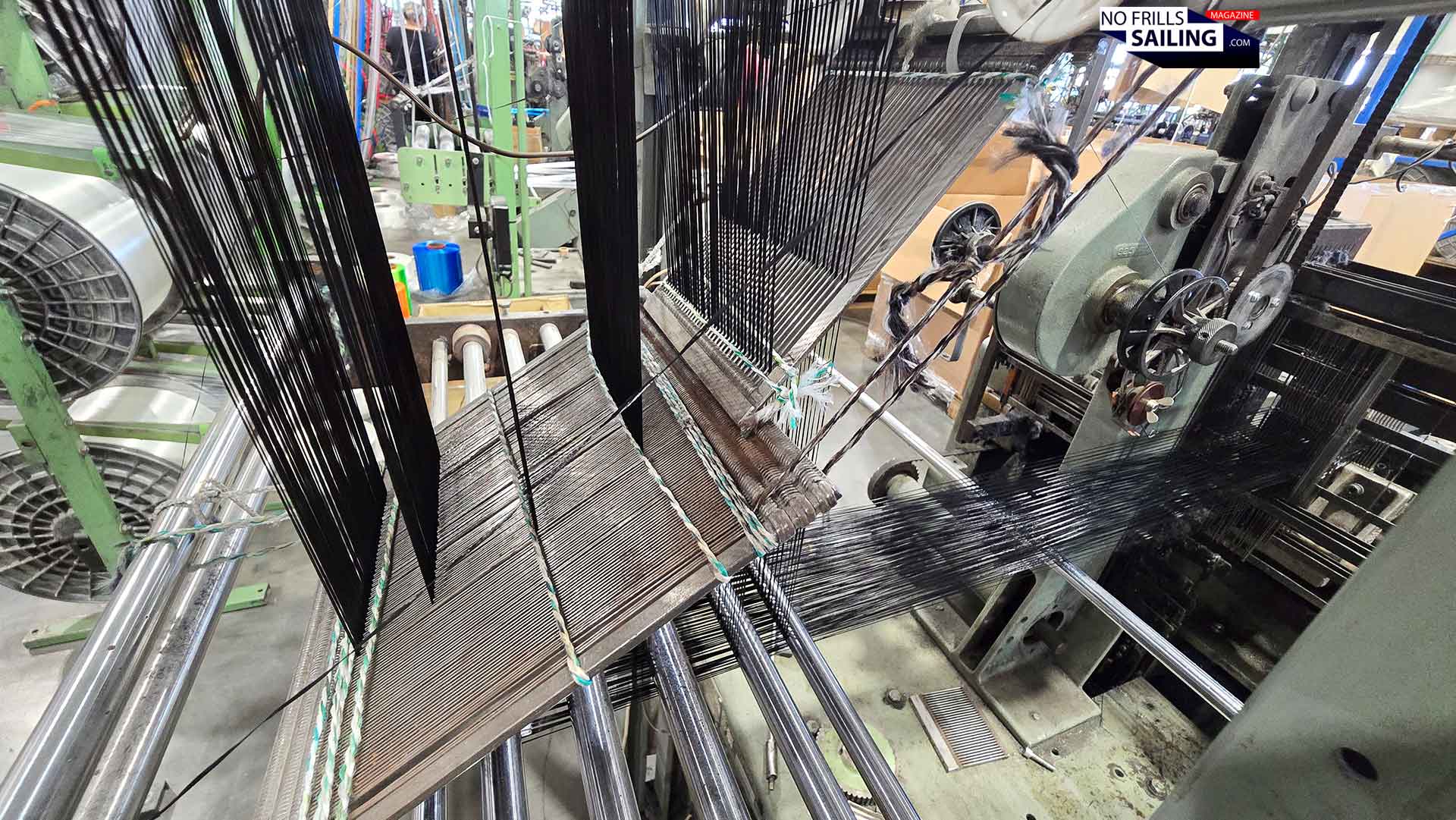
These machines, albeit high-precision automats, are almost purely mechanical computers. Refined through the almost 200 years of rope making machines, their core principle remains the same still today – yet the very materials and the quality of the rope of course has changed ever so slightly. So, to start with, these machines create a rope by twisting yarns (from the said mandrels) into strands. Usually, these strands are twisted in one directions, which is either the “S” or the “Z”-direction. This is the first principle production step.
Now, how exactly does this machine work?
Norbert shows me all of the machines. None is the same: The colors of the yarns differ from machine to machine. And its not only their color, but also their thickness and material: As you all may know, apart from the PES material, modern sailing ropes also contain various other fibers, such as Dyneema for the core to make sure that breaking loads are greater or the stretch of the material is minimized. The thick drums from which the yarn is literally sucked in and “eaten” by the weaving machines rotate ever so slightly. If it wasn´t for the loud noise, you couldn´t see that meter by meter the thin yarns glide over the countless idler pulleys, effortlessly coming nearer to the actual hooks, which perform the next production step.
The art of ropemaking
Norbert shows me the production of a very special rope they make here at Mamutec. They call it the parallel braided “Paraloc”-rope. It´s a specialty and proprietary product here. We all know that ropes, when damaged or cut open, usually loose their stability and often quickly unravel into chaos. Once the protective layer, or the coat, is open and the core lays bare, exposed to the elements, a rope is lost. Fraying and unraveling is a big problem for ropes, especially if their ends aren´t properly protected. Norbert demonstrates this with an offcut piece.
Pulling hard, it won´t fray!
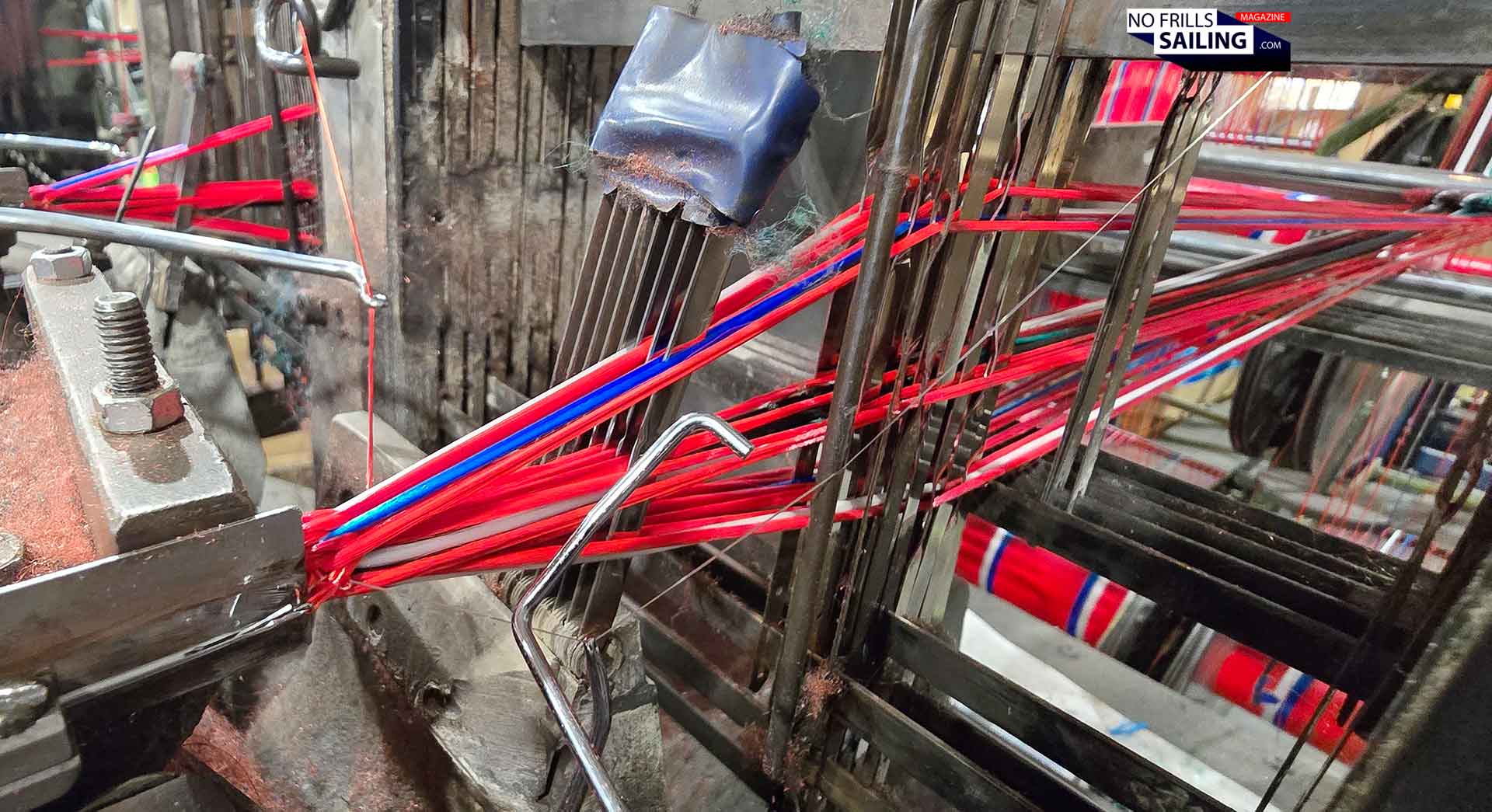
This is something that Mamutec addressed with their Paraloc-technique. If you look closely at the picture below, you can clearly see that the individual strands being fed into the weaving hook coming from the right hand side of the frame are complemented by two single, very thin yarns, which enter the scene from above and – barely visible – from the upper right hand side. These two yarns “secure” the strands by knots every other time. This way, the twisted structure of the whole rope is knotted “in place” if you will.
Their patented knot-making hook
By showing me the end product at the end of this weaving machine, Norbert points to these little knots. In the rope shown here in the pictures, the knots appear roughly every four millimeters, securing the whole rope from within. What´s the outcome? Well, Norbert cuts the rope in two, fraying out one end and handing me the rope. The fraying stopped immediately once the next intact knot is reached. It just stops there – no more fraying!
No fraying: Ullmann´s “Paraloc” ropes!
I have to pull very (!) hard to bust open another knot. The material is seemingly very tough. Imagining such a rope in real life use, it would take a lot of force to really destroy the structure. Paraloc is a technology that will prolong the life of a rope and make it destined for heavy use. I don´t know for sure, but I guess this is something the guys learned from their climbing-customers. If your life is literally hanging on one thin thread, this thread must prevail under all circumstances! Paraloc has been patented in 2005 and is one of Mamutec´s and therefore Ullmann Ropes´ trademark features. But, only one, as I was going to learn.
Noise and heat
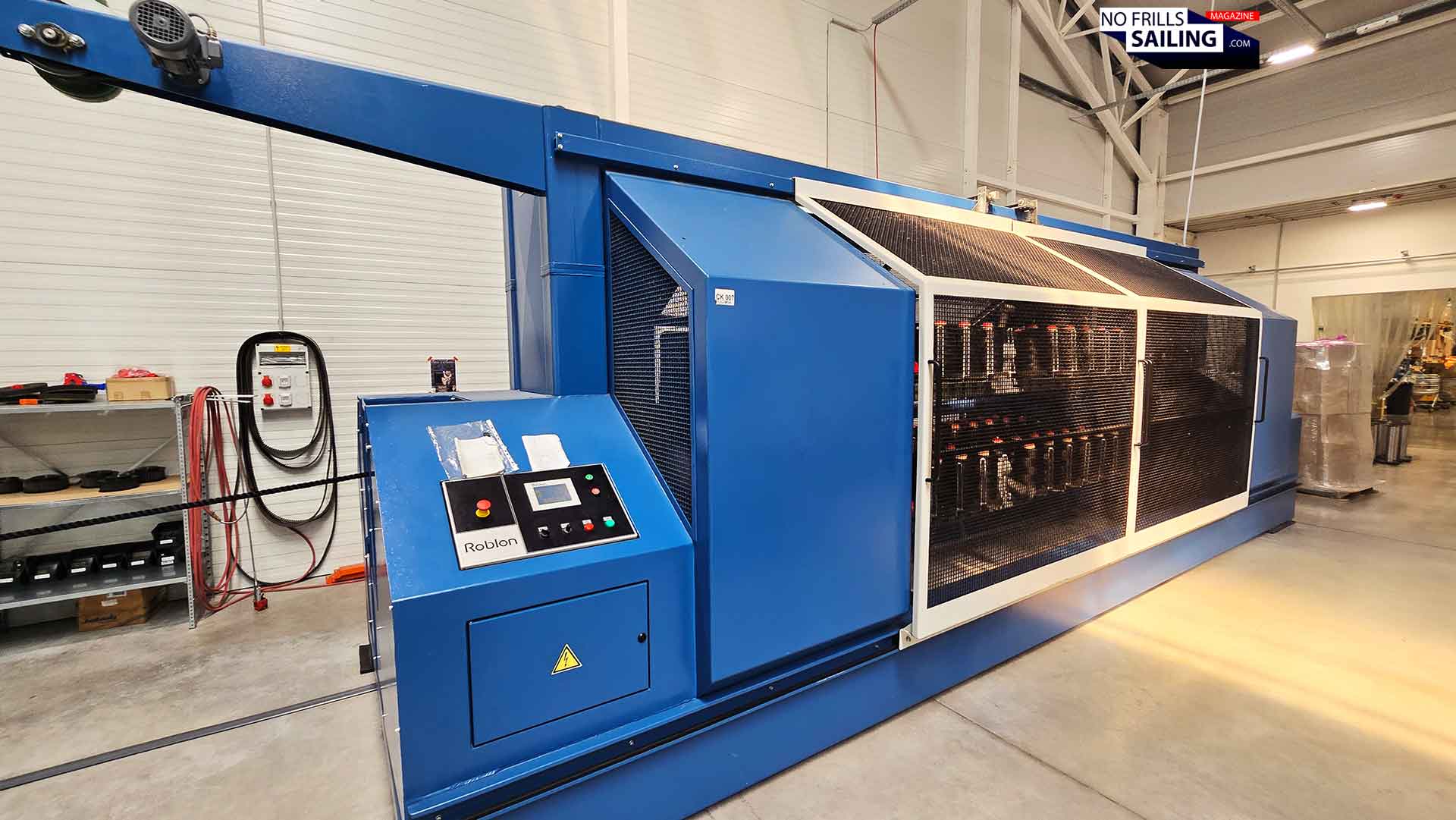
Back to the fascinating machines. These always hungry beasts need constant feeding from the workers, who regularly check the ongoing processes and put new mandrils of yarn into the whirls so that another batch of ropes can be made. After having already twisted the strands, usually three of them will be twisted yet another time by these whirls to form the rope. Often instead of three strands, four and more can be used. And when it comes to sailing ropes, there´s also a core involved.
Everything´s moving fast in here
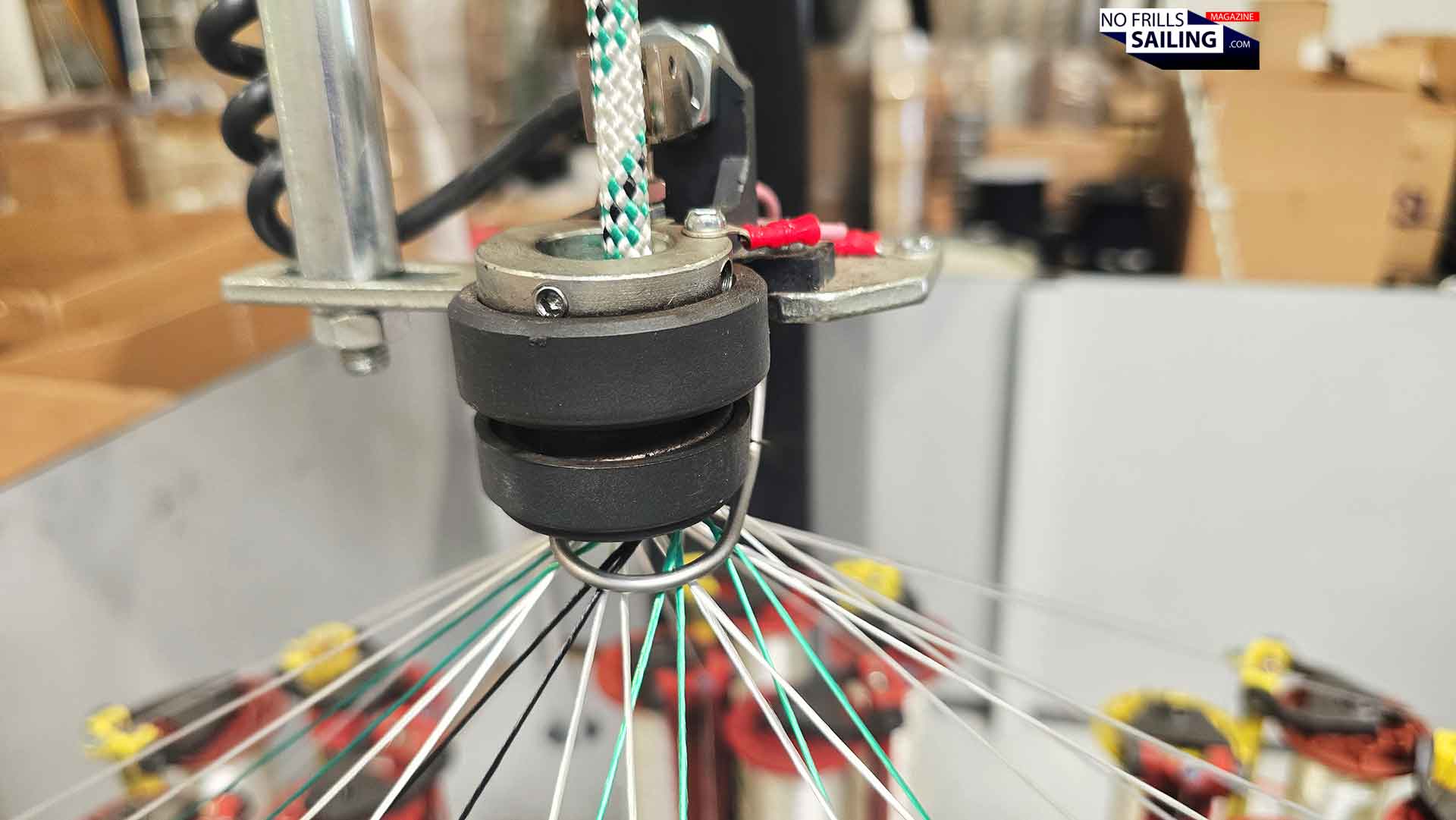
The machine seen below makes a rope that consists of no less than eight strands, which themselves consist of four yarns. As you can see on the very top edge of the picture, these strands are woven together to form a rope that is overall white with green and black braids. If you could see hiw it´s moving! The mandrils with the individual yards are rotating in one directions (for the first twist) whereas the whole whirl is counter rotating in the other direction! It´s so fast that my eyes cannot comprehend what´s going on. In the end, it´s that second twist (brough into the already twisted yarns) that makes a rope become “stable”. It´s literally twisting the twist.
The whirls in action
The combination of the friction that results from the twisting and the stretching applied, the rope will retain its form over many, many years. What began as a single, thin and fragile fiber has now become a rope with a breaking load that can exceed the weight of a grown elephant! A century old technique, cultivated by out ancestors, tried out with plant fibers like flax, linum and of course cotton, taken over by sheep wool or other animal-sourced filaments, is now a high-tech product, utilized even on the most modern IMOCA yachts!
Twisting and braiding
Norbert shows me the very machine that makes their Shockline mooring ropes, the very product that made me come here. The picture below shows how the whirl is weaving the cover for the elastic inner core. This machine is way more complicated than the others, because the core – being elastic – needs to be stretched to a pre-determined length and also “know” where the later eye with the shock-absorbing inlay will be.
It´s all so fast!
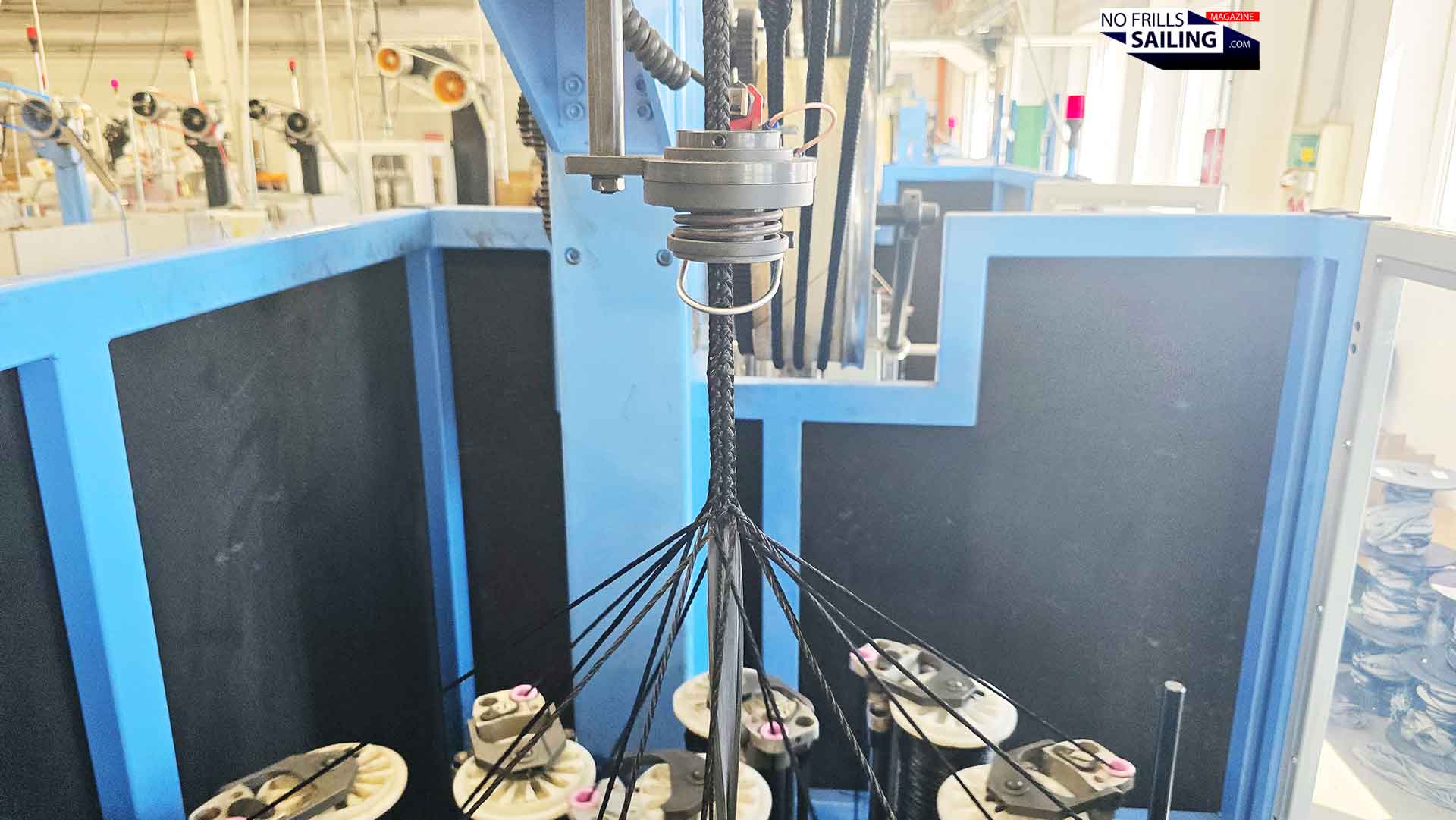
On these pictures you can clearly see how the outer layer of black twisted strands is woven around the core. Centimeter by centimeter, meter by meter, the machine tirelessly produces new rope. In this, it´s workings always remain the same: Rotation and linear feed, tension control, separation and closing and finally the direction reversal. In this, the final product not only looks great, it is strong and torque-balanced.
Coating around a core is made
Right at the end of the factory hall, Norbert shows me two huge stranding machines. These work adhering to the same mechanical principles, but the rope coming out of that monster is 6 or more centimeters thick: As I mentioned, Ullmann Ropes is more known in the commercial shipping industry for their strong thick ropes which are often used to secure large waterway buoys. Also, they have a full assortment of rope products for larger square rigged traditional sailing and tall ships.
That´s one big-ass machine, indeed!
As fascinating this all is, Norbert discloses, their Paraloc-product wasn´t such a great commercial success. He is surprisingly open and honest about that. Although the Swiss Sailing Team used their ropes exclusively when competing in one of the big races, Paraloc couldn´t make a huge breakthrough on the market. The ropes are comparatively expensive, he adds: Which is no objective in professional racing, most “ordinary” sailors and cruising skippers mostly look for cheaper solutions. On the other hand, he adds while smiling, maybe it hadn´t been communicated that good? Because he insists that having a rope that cannot fray even when badly damaged … should be of great interest for sailor, right? I agree on that one!
Heat-setting and stretching the ropes
We enter another area of the production because there is another interesting detail Norbert wants to show me. “What´s annoying especially in new ropes?”, he asks me by yelling to my ear? Well, mostly it´s the twist they have when unboxed. It takes a few weeks for fresh ropes to “uncoil”, which was a regular hazzle when we delivered brand new yachts and rigged them: Halyards would form knots, sheets would jam. It´s a mess. “Yes, that´s one thing! And another is … stretching!”
Heat treatment: Thermo fixation in progress
Norbert is right: Unless you have a rope with a large portion of Dyneema, stretching can become a problem. Not so much for sheets, but for halyards and also reefing lines. Because, once the sail is hoisted, it´s the strength of the rope that keeps it up. If a rope stretched under tension, the sail will come down and “sag”, which destroys its profile and hampers airflow. Ullmann ropes are pre-stretched so that they won´t twist nor stretch. This is done in such a machine.
Pre-stretching the raw rope
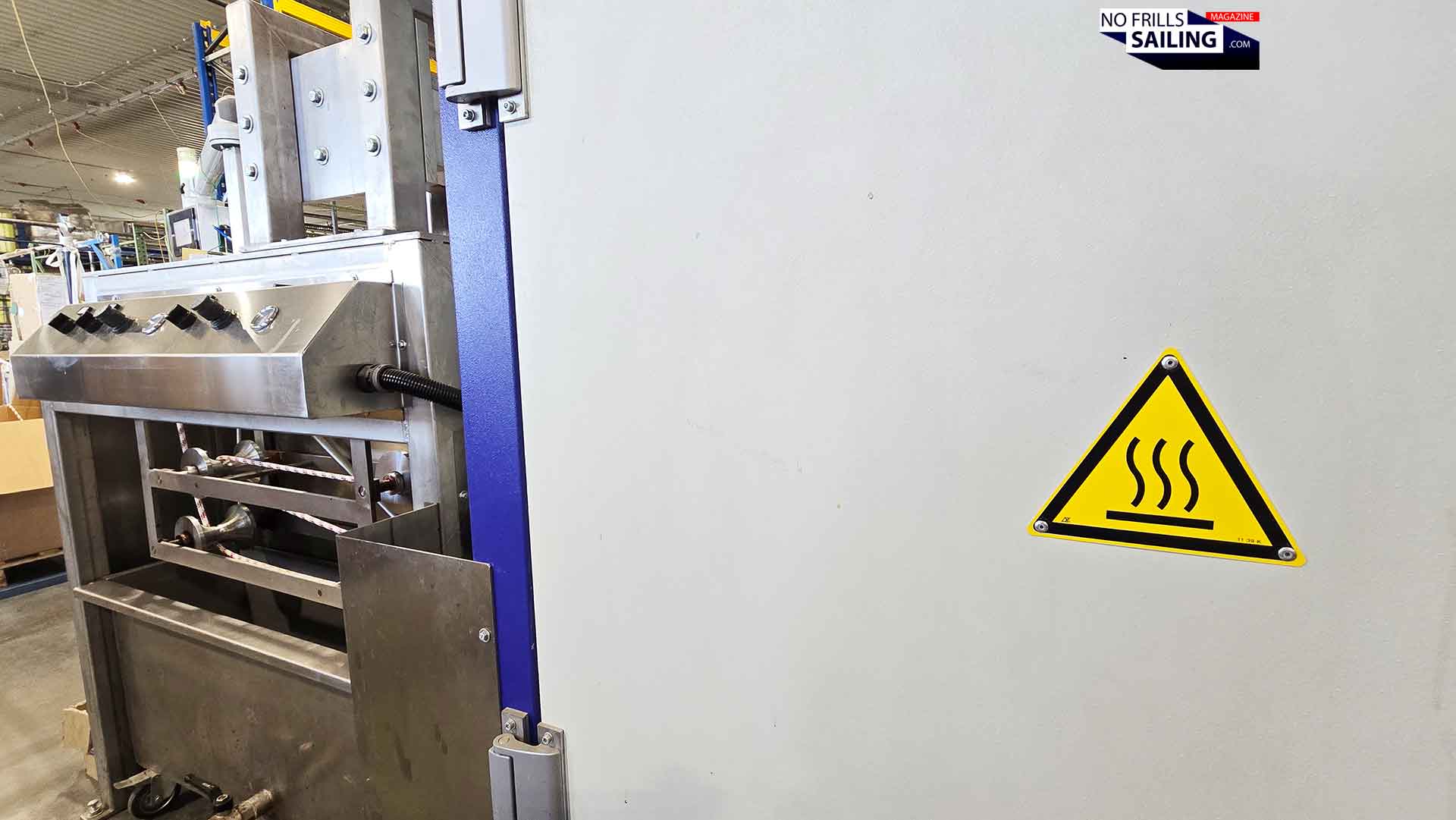
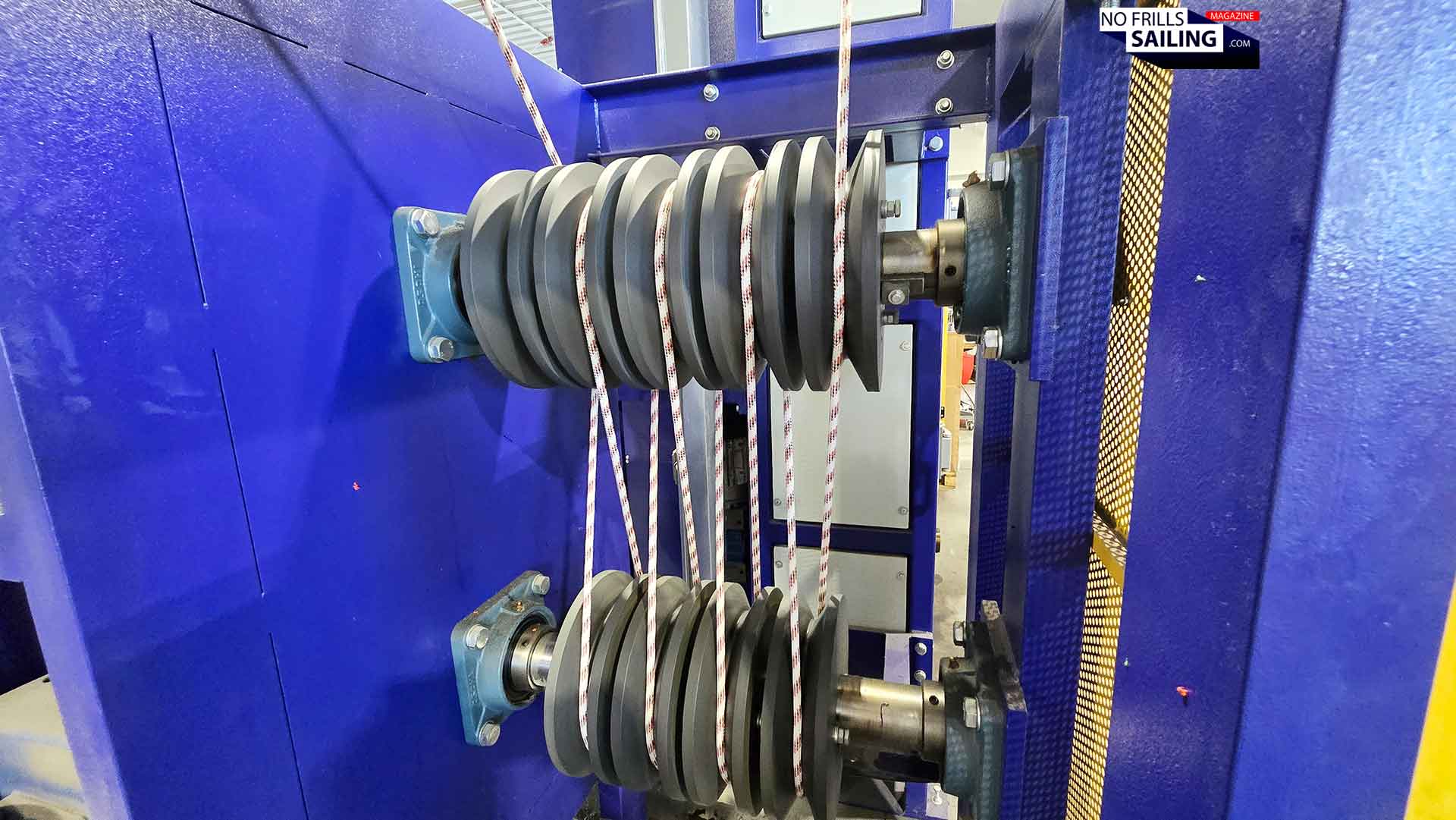
Did I mention that we´ve had 42 degrees Celsius outside that day? Well, standing next to this machine it felt like more. Basically what it does is that it takes in the finished rope from the weaving machines and feeds it over many pulleys. The rope will be stretched under enormous forces. Running through two heated “ovens”, the rope is kind of “baked” – maybe like curing in the autoclaves for making carbon masts – and thus pre-stretched.
Fixed and ready for packaging
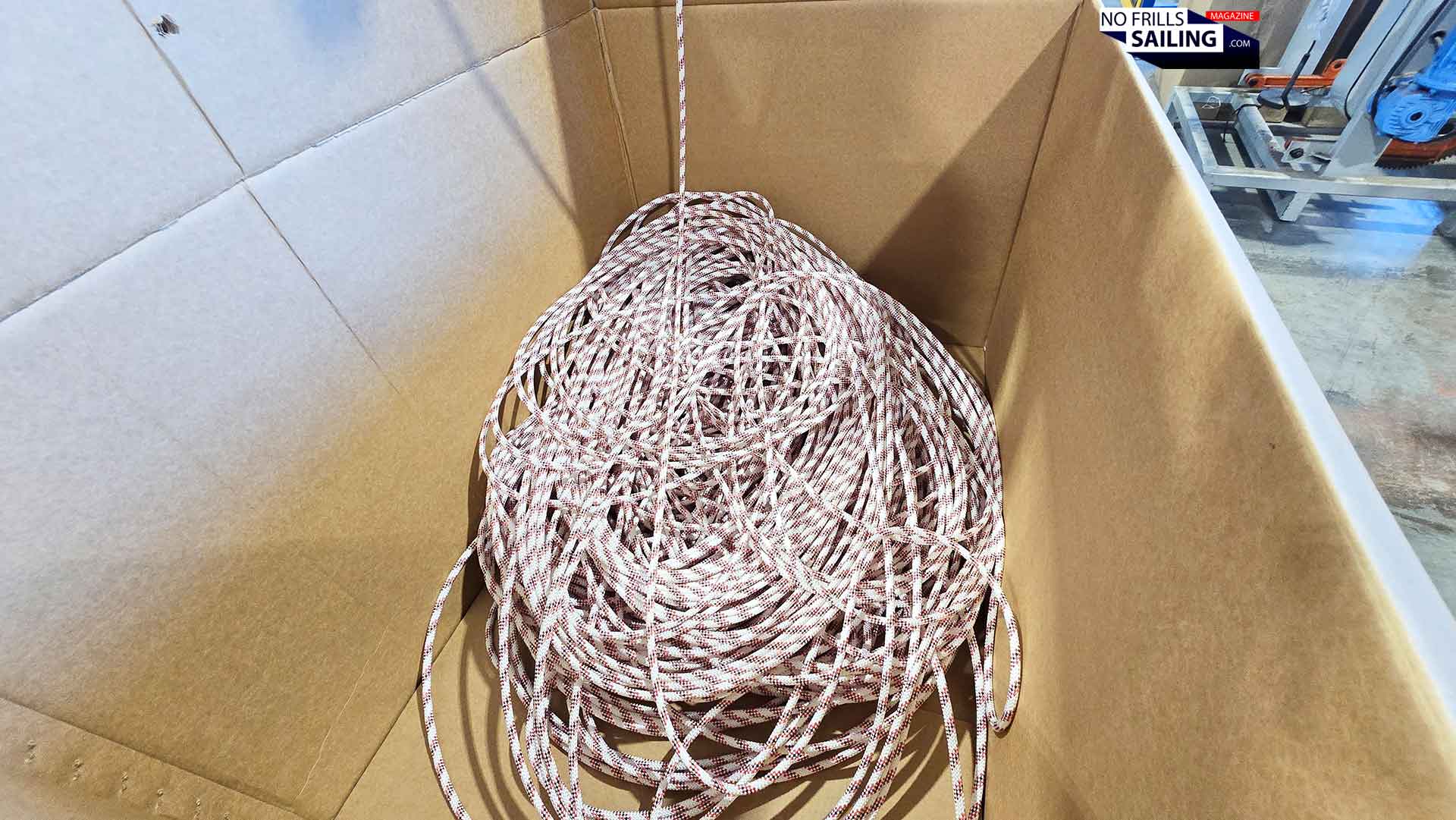
At the end of the machine, the finished roped is spit out. It is now prepared and ready to being used. Treated with tension and heat, such a rope won´t stretch anymore: Perfect for being used as a halyard. On the other hand, for some ropes you want at least some stretching: That´s mostly in climbing ropes, but also for landlines. Because stretching will absorb mechanical energy and kind of “soften” the impact. There´s a specific rope for each application, sure.
A wide product range
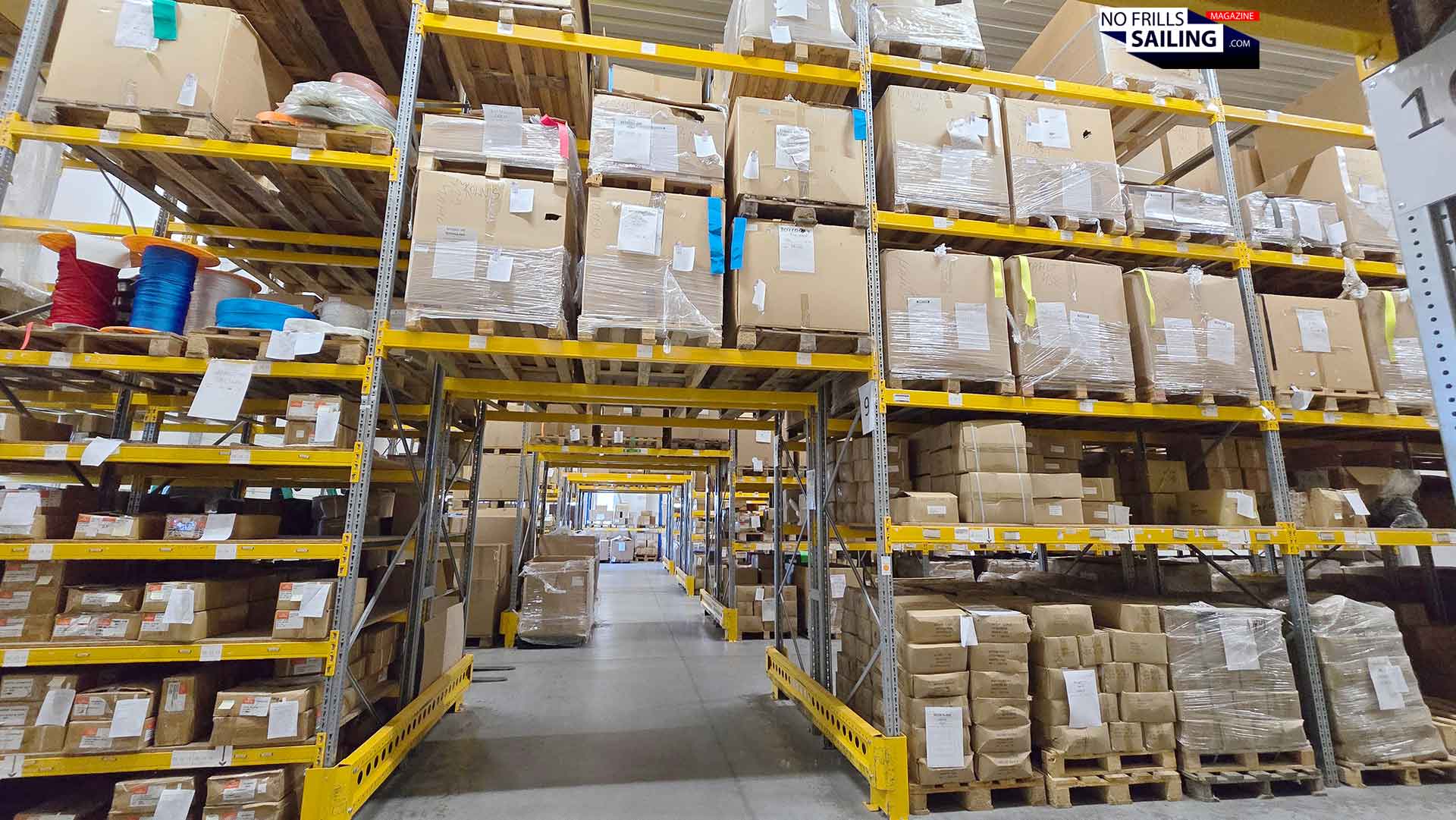
We proceed to the other parts of the production facility. One of which is the storage. You wouldn´t think of this as being so important, but Norbert explains that this is by far one of the most important capabilities a ropemaker like Mamutec has to have in order to being able to compete in the market. That´s not so much valid for the sailing ropes or the climbing ropes, but more for the other products which are made here.
Impressive warehouse!
For example, Mamutec manufactures household yarns, shackles, belts and straps of all forms, sizes and colors. For home improvement stores and the biggest multi-national supermarket chains. “What they want is that we can deliver any product at any time within a five day-notice!” That means that their production for the most part is to keep up their storage rate, along the already ordered products. In this, range of different products is staggering.
They make (much) more than just sailing ropes here!
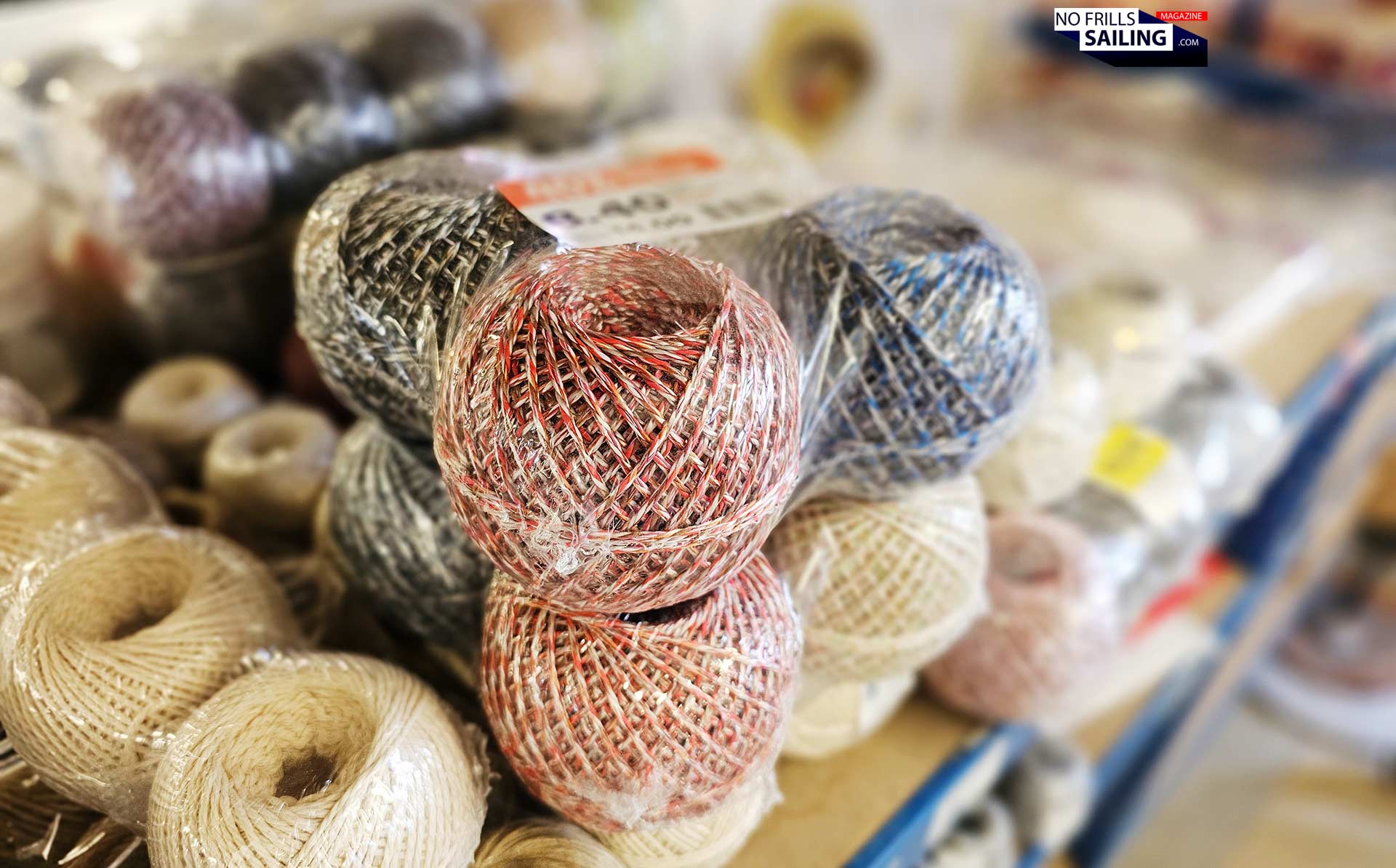
Arriving here I already knew about their huge importance for the playground production, but this is far beyond imagination. High grade products along with absolute niche stuff, like cowbells for Switzerland or household threads like it is found in almost every kitchen in the world. Everything´s here! For whatever reason, I somehow fall in love with these colorful balls of household yarn …
My fave: the household yarn
“It´s a special product”, Norbert says. Not because it is so complicated (it´s not), but how it is made. Because for these, Mamutec basically collects and buys production residuals, lots of offcut and unused material from all over Europe. Cotton recycling, if you will. The workers – mostly ladies – can then freely decide which colors they want to produce by choosing the base materials. In the end, what I only know as the same old boring brownish household yarn, here at Mamutec, becomes a colorful, happy, sweet product.
Such a sweet product …
Norbert smiles: I guess this is what the lead buyers of the large supermarket chains think too. This low cost-high volume cheap product is indeed one of Mamutec´s heroes. And I like them too! Apart from that, coming back to sailing ropes, Ullmann offers ropes from 2 to 40 millimeters, UV-stabilized, some are floating, thermo-fixed and pre-stretched. And although the workers don´t have the freedom to freely decide on their colors, the palette of available designs is also pretty wide.
Finally: How the Usacord shock line is made
Norbert wants to conclude my tour through the Mamutec/Ullmann production by counter-balancing the almost machine overkill of the fascinating and overwhelming weaving and braiding machines by showing the human factor. Because if this would be only about machines, you could start your business everywhere, right? But it´s not. People play a decisive role in ropemaking, still today!
This is the inside of a Shockline
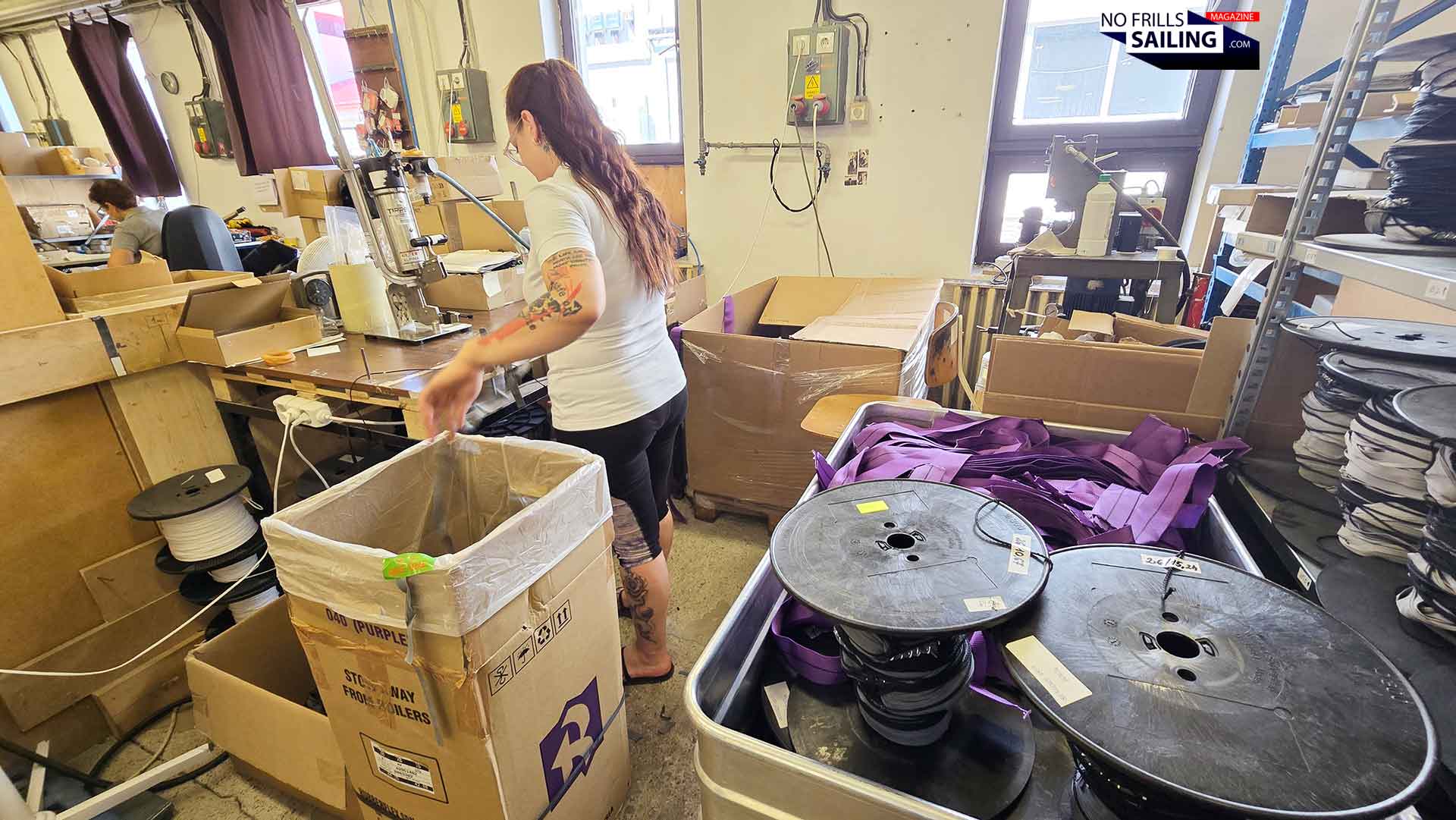
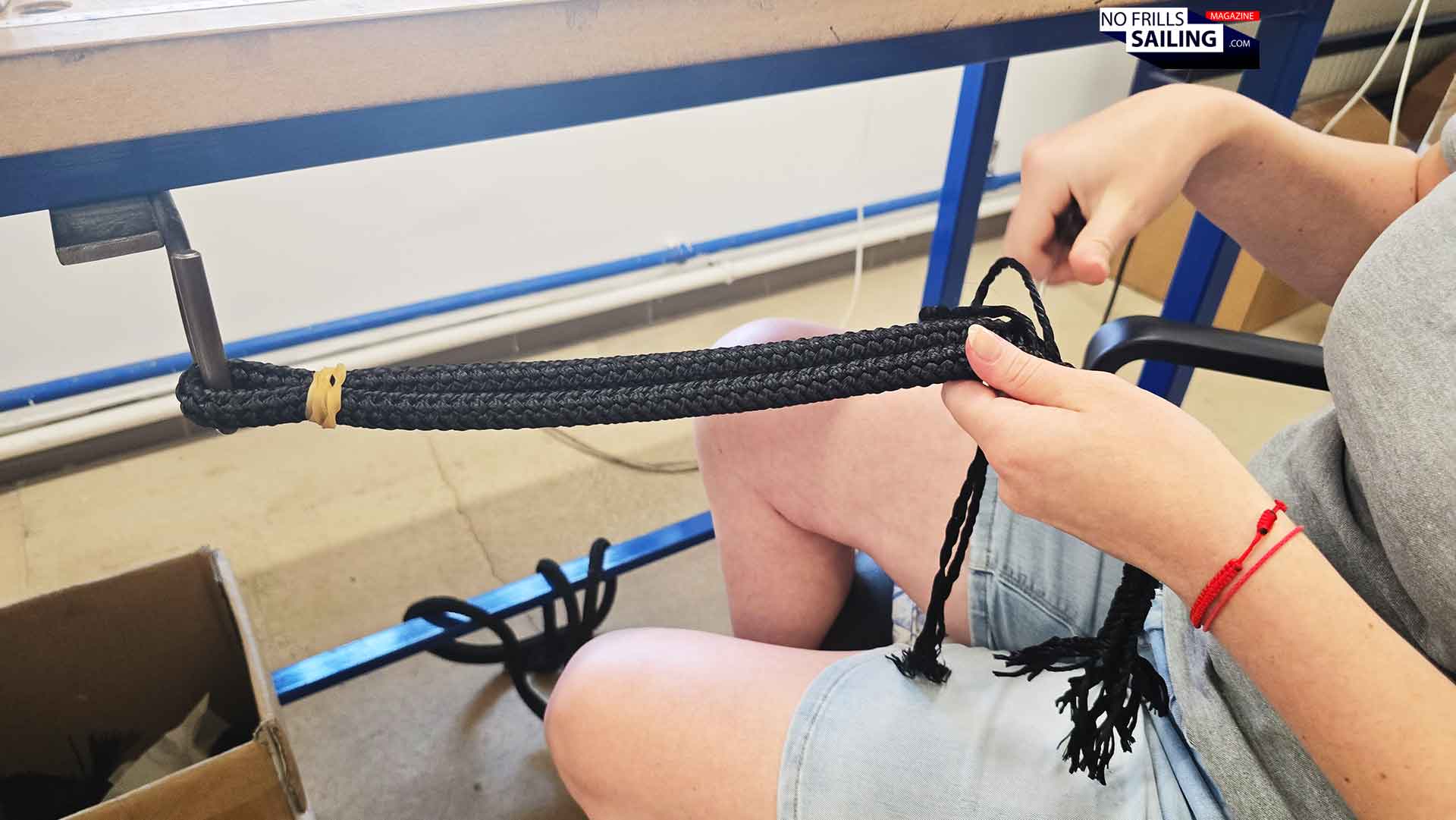
Here at Mamutec Hungary, almost 150 people have a save workplace. As mentioned before, this region used to be famous for clothing and shoemaking in the past, so there´s a strong affection of the people here for work like this. The human factor of rope making can best be seen when looking at their Usacord Shokline-product, the one that brought me here. We enter a smaller workshop where – again mostly women – the flexible shock absorbing cores of the Shocklines are processed. Entirely by hand.
All made by hand …
I ask one of the women if it was okay if I´d look over her shoulder, and she happily agreed. But believe me, even though I witnessed her hand movements a dozen times or so, it was still so fast that I cannot say for sure what she had been doing in the first place. Nonetheless, the outcome of her work, and that of her colleagues in that workshop, was a whole large storage shelf full of spools with length-prepped Shocklines, ready to being processed by the machine we saw earlier in this article.
So much handcraft skills!
But it doesn´t stop at preparing the ropes for production. It´s also the final steps of it, or let´s say, the cherry on top: We enter another room where four ladies were sitting or standing next to large cardboard boxes. This was the splicing room. I don´t know if you already knew that but there is still no way that a computer or automated machine can make a splice as good as one made by a skilled human?
It´s so fast, I cannot even picture it properly
That said, here at Mamutec, every splice, ends and eyes are made by hand! These skilled women can make pone splice every 20 minutes or so: It´s fascinating to watch their routine which is still a mystery for me. Expecially the single colored ropes, like these Usacord Shocklines for example, are not easy to splice because every strand has the exact same color. Neither Norbert – who is a skilled professional – nor me would be able to do this. And in that speed!
One splice every 20 minutes!
That said, if you decide to go for an Ullmann rope, remember that it was one of these ladies who spliced the eye of your landline, who incorporated the metal eye-ring or sewed the end of the ropes so that they would not fray over time. They make 800 different types of ropes here, so even here in the splicing department, I am sure, it will never get boring as every new day presents yet another product they are working on.
Beautiful handcrafted work!
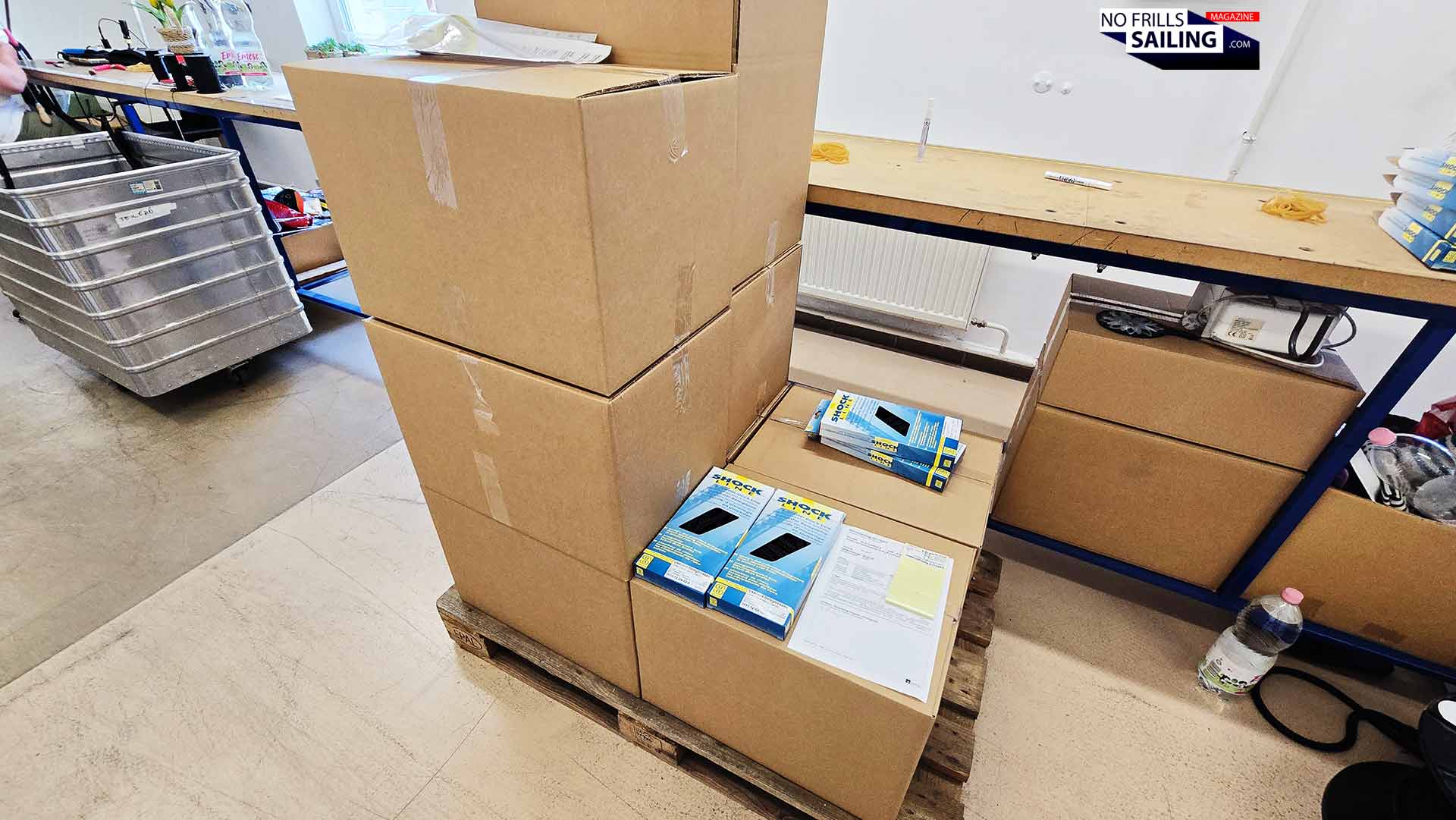
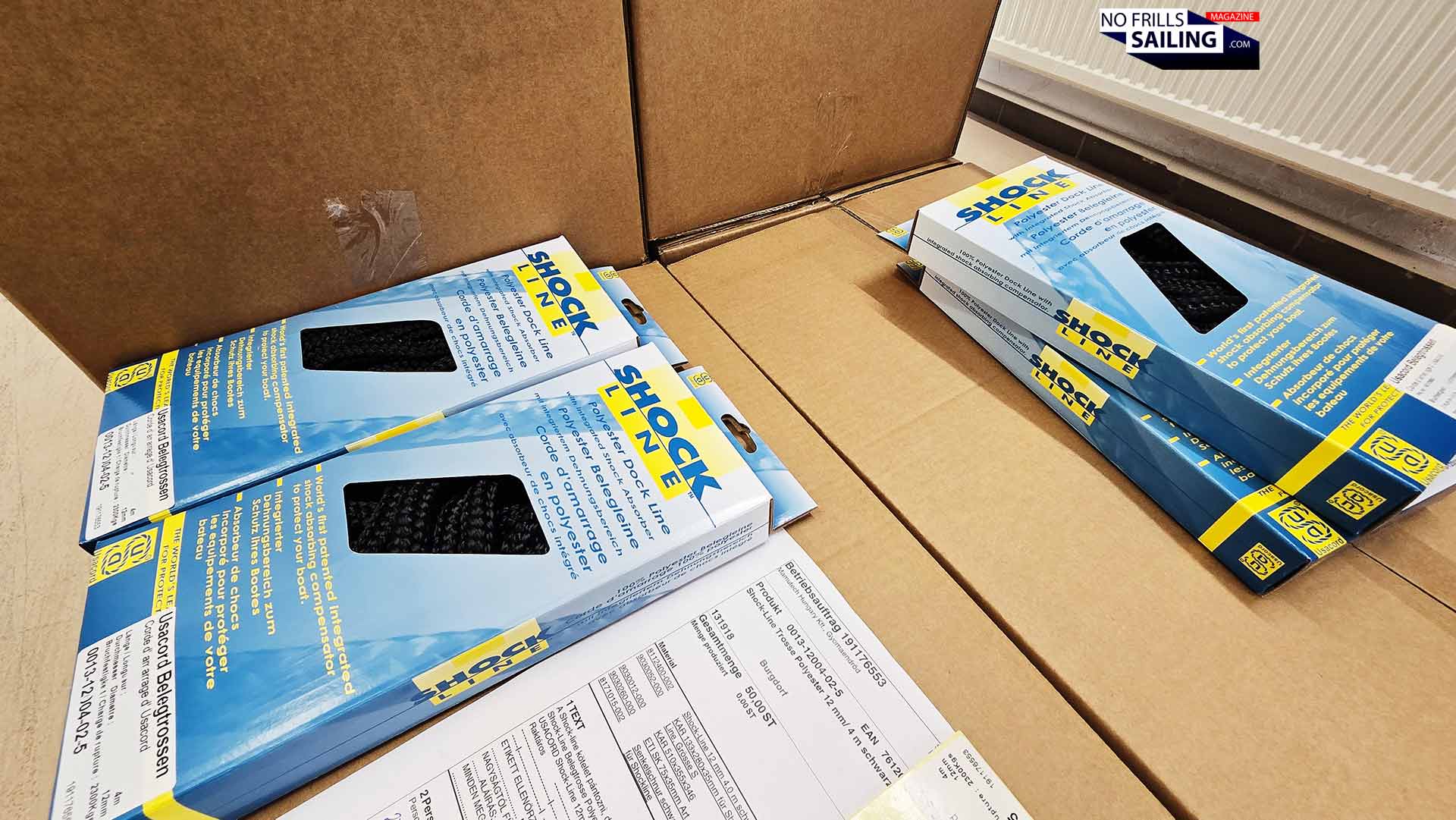
In the end, the Usacord Shocklines are coiled up, secured by a rubber band and put into their cardboxes by hand as well. Ready to being shipped to the chandleries and online-stores around the world. Those come with pre-defined length and diameters, ranging from 2 to 15 meters in length and from 12 to 26 millimeters in diameter. There are Shocklines with a large spliced loop on one end and ones with a stainless steel thimble on the other end.
Would you have thought that?
So that´s basically how it´s done here at Mamutec, where the Ullmann ropes are made. I have a good feeling about this. Because, frankly, I am of course here because I am looking for the complete running rigging for my own new yacht as well. As much as I like to save in money, what I surely don´t want is to invest in cheap stuff that eventually breaks and causes havoc! The running rigging together with the mooring lines and – least to forget! – the anchor line are among the single most important parts of equipment for any boat. So naturally, I want to be sure of its quality before I click on “add to cart”, right?
Advertisement
That was one very interesting trip!
Mamutec Hungary is one of the true “multi color” producers for ropes worldwide. As I had seen with my own eyes, their machines and staff are so flexible that it is possible to quickly adjust the machines to make whatever product in whichever color a custumer may want. Their range of products is staggering, their track record and experience beyond doubt. Norbert tells me, that here in Hungary alone 200 tons of polyester and another 200 tons of polypropylene are turned into high-grade ropes every year. And that´s a lot by all means!
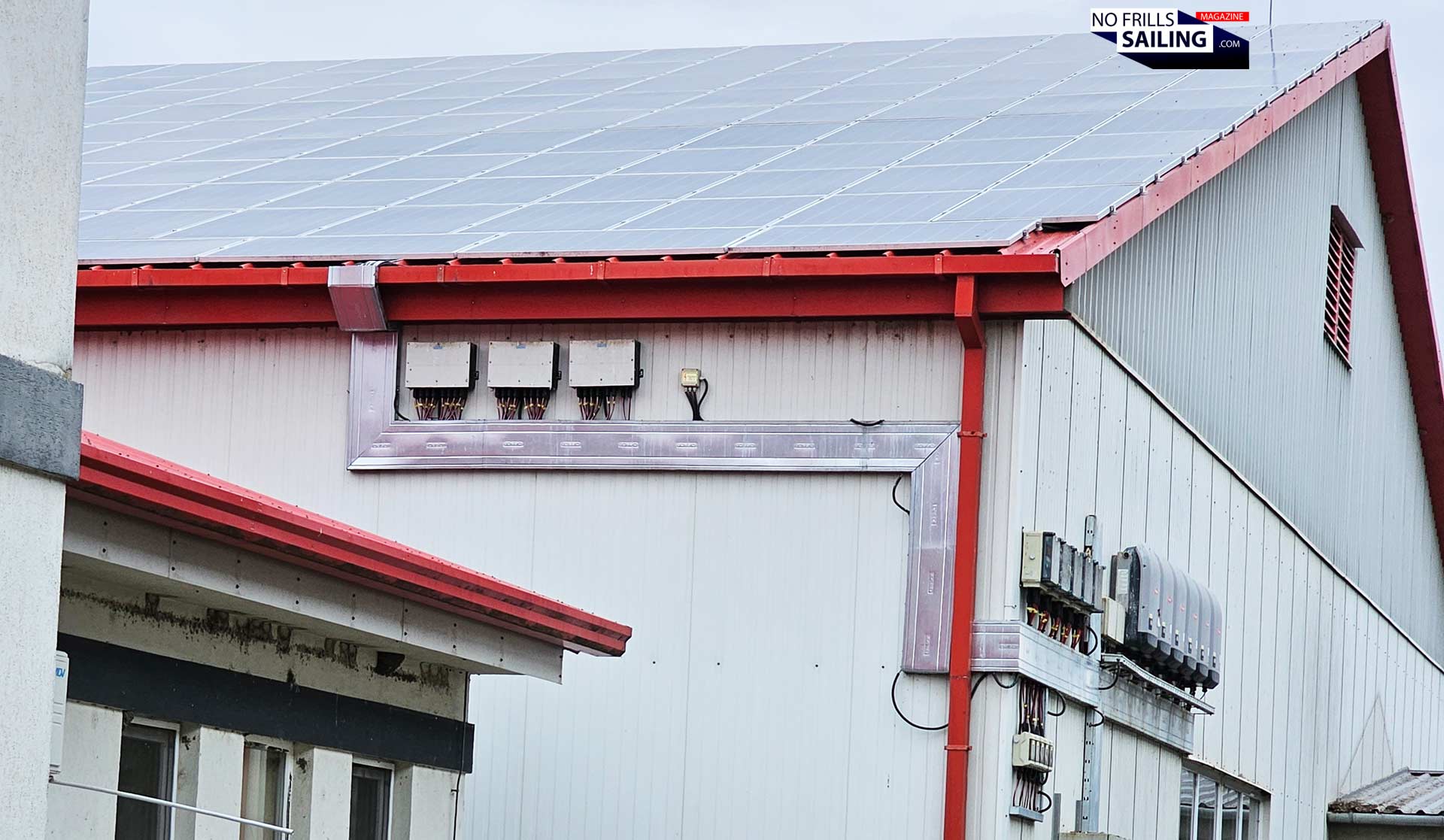
That´s a lot of solar power
Heading out into Hungary´s summer heat, I notice the solar panels on the rooftops of the factory. Albeit Norbert cannot for sure tell me how many kilowatts (or megawatts?) of power these generate, he says that last year almost half of the factory´s current consumption has been supplied by these panels. And you have seen how many energy-hungry current eaters there are … amazing!
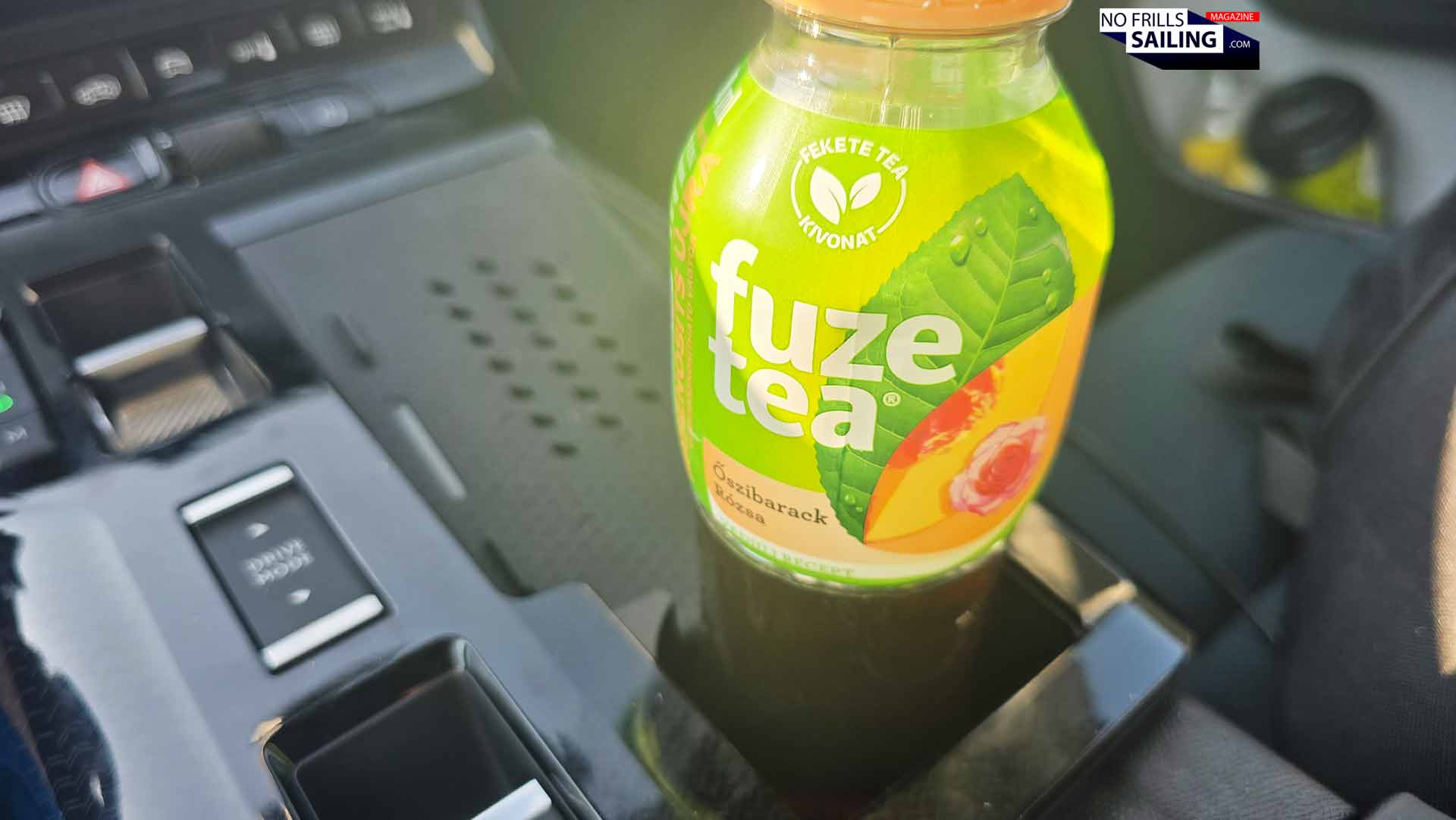
You´ve got to love Hungary! Rose-flavored ice tea …
Thanks so much, Norbert Medve, for this amazing, detailed, open and so much interesting tour in your factory! Although I still cannot really grasp why a simple twist would form a stable rope, but for some reason it works. It was not only exciting, but very informative – worth a TV-documentary for sure. How modern machinery and skilled handcraft go together, how a centuries old tradition still works today with modern materials. Amazing! I guess I will trust my Omega 42´s running rigging being supplied by Ullmann ropes. Because, frankly, a country that can bring together Ice Tea and rose-flavor can surely tackle any challenge!