A chef would always say, a guest enjoying a multi-course dinner is either won or lost by the dessert. That´s not completely right, but there´s a spark of truth in this saying. Same goes for yacht building: You may put up panels, veneers and facings in front of “rougher” stuff when building a boat, but the finishing touches should be 100 percent perfect. Since we´ve seen that even behind panels here at Oyster it´s always “dessert”, this article looks at what happens to a new boat before she leaves the shed at Wroxham/UK.
I´ve said it right there in the first article published on my Oyster yachts shipyard visit: There´s so much going on here that I definitely cannot squeeze it all into one single article. Even splitting the content up into two posts wouldn´t have been sufficient. I´ve taken far more than 400 detailed pictures … none of which was I asked to delete by Oyster, by the way.
Boats are very much advanced in the process
So here´s the final part 3 of my exciting full day shipyard visit at Oyster. Summer was in full bloom, it was nice, warm and sunny outside, so the shipyard had literally all doors open to let in the fresh air and stimulatory light. Again, I am guided by Stephen Parkinson of Oyster Yachts, who took a full day off of his precious time to show me around. So, what´s about the final finishing touches before a new Oyster can leave the building shed?
The secret to recreative, relaxing sailing
Advertisement
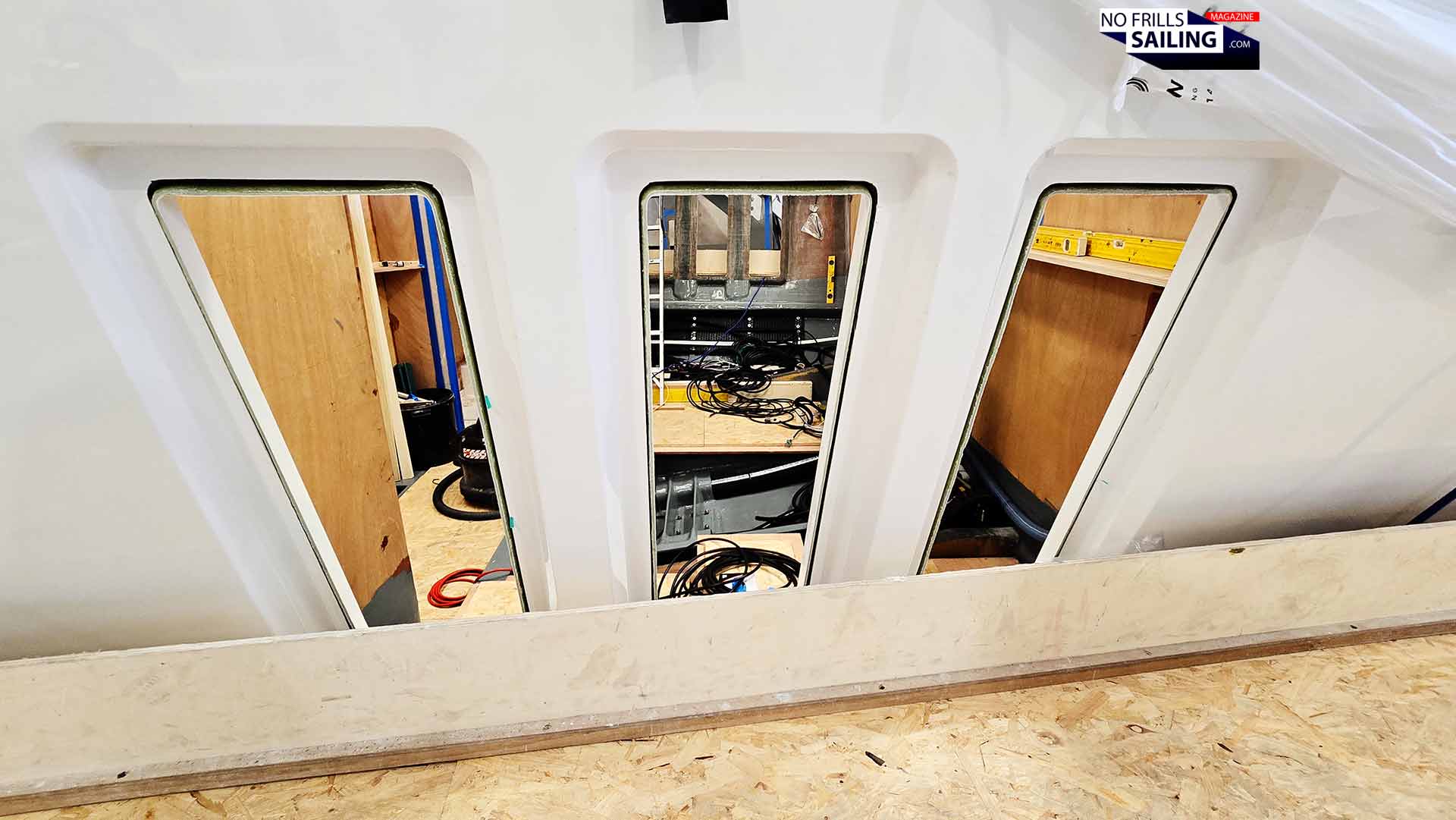
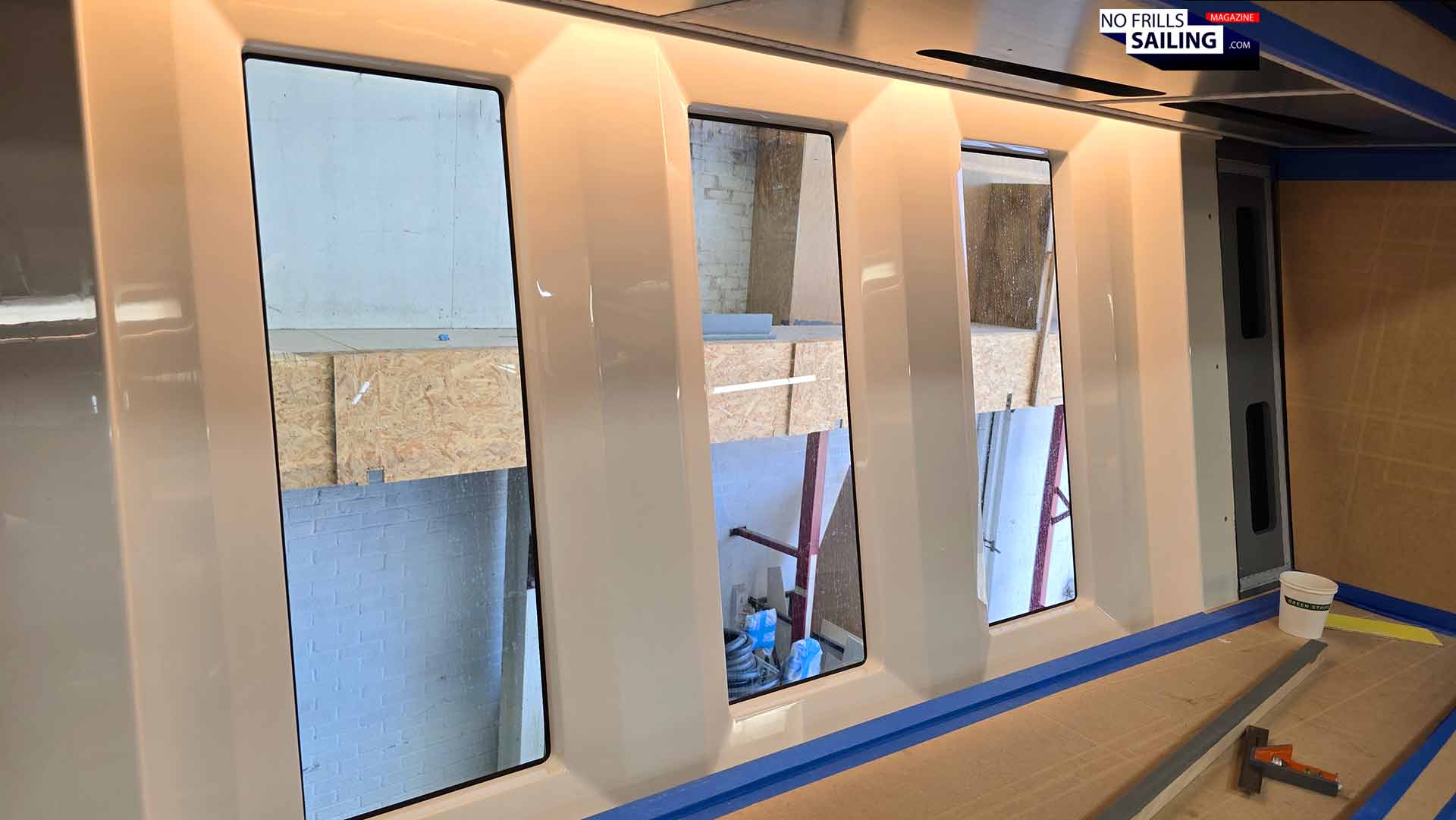
As the fitting with the rich interior progresses, I´d love to emphasize a bit more on one of Oyster´s absolute signature design features: The seascape windows. These three vertical stripes define an Oyster´s appearance and make her indistinguishable even from afar. These windows are offered from their smallest boat, the now new 515, throughout the whole range.
The iconic “seascape” windows
In this, with the 515 the seascape windows are only provided for the large, lush owner´s cabin in the rear part of the yacht. Growing bigger in size, the windows will appear in the saloon as well from Oyster 565 onward. As I will be sailing an Oyster 675 the following day (and you can absolutely look forward to this article!) I will experience myself what a major impact on the internal light situation these windows have.
What a view! Well … later.
Because, of course, the amount of natural light that is able to shine into the interior, be it the saloon, the cabins, the galley and even the bathrooms, is a deciding factor of the wellbeing of crew and guests. Natural light has an inherent beauty that cannot be imitated even by modern LED-lighting concepts. The rich colors of the sun, the playful reflections of it in the water surface and even the blueish shine of the ocean will create a light pattern inside the yacht that greatly contributes to recreation and relaxation of those who sail on the yacht. This is why so many boat builders integrate windows to their yachts.
Lots and lots of natural light
There are also practical reasons that go beyond beauty: Being able to see the horizon can significantly reduce the risk of sea sickness. And of course: As long as the sun illuminates your yacht´s interior, you don´t need to strain the batteries. So I take great length to check how here at Oyster the seascape windows, along with the “cat eye” saloon windows are fitted to the yacht: The light situation, for me, is a huge and deciding factor for or against a yacht. Even in my classic Omega 42 – though I´m of course not able to fit hull windows – I took great care to decide about the design of the windows.
Entering the final steps of production
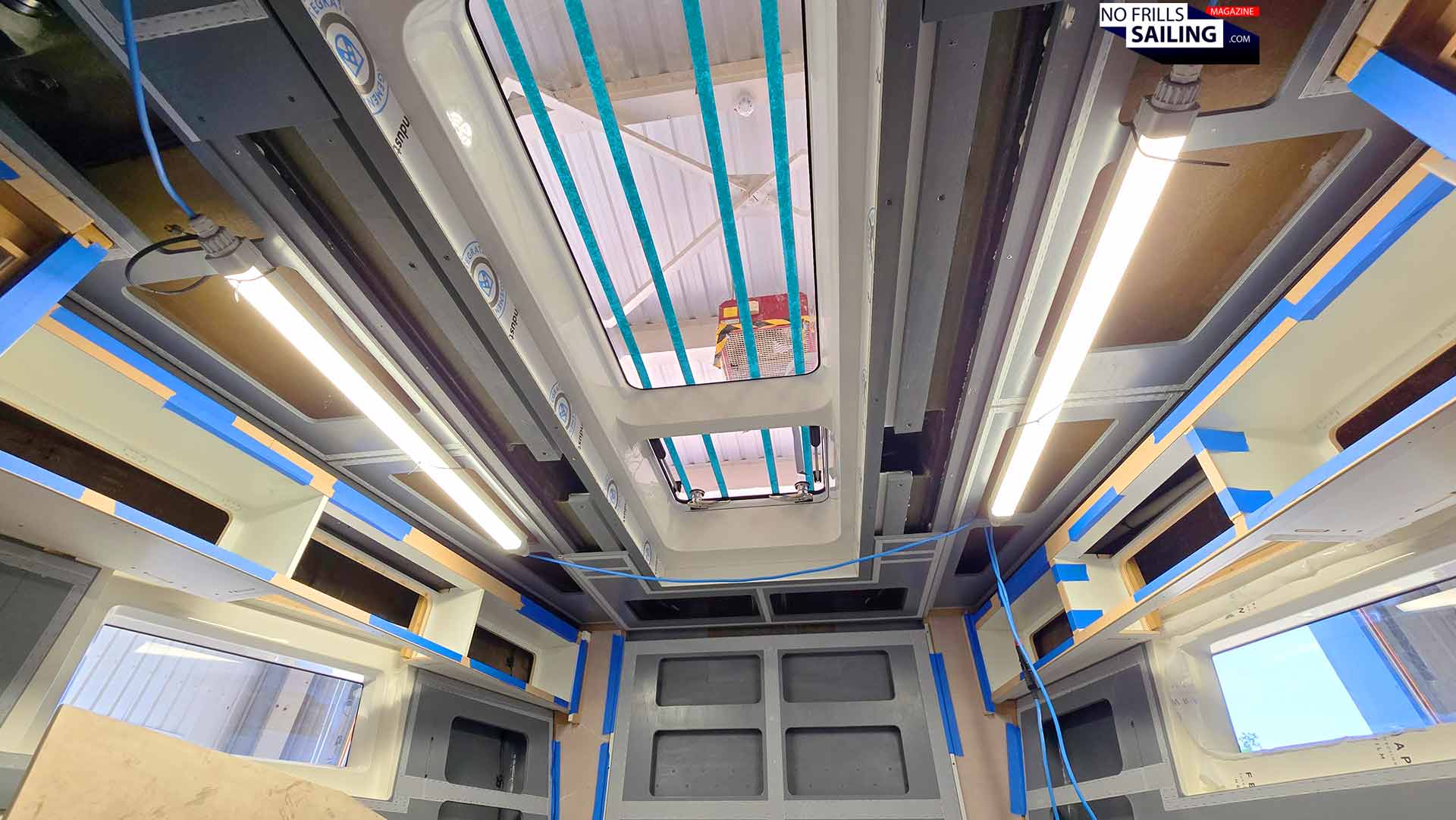
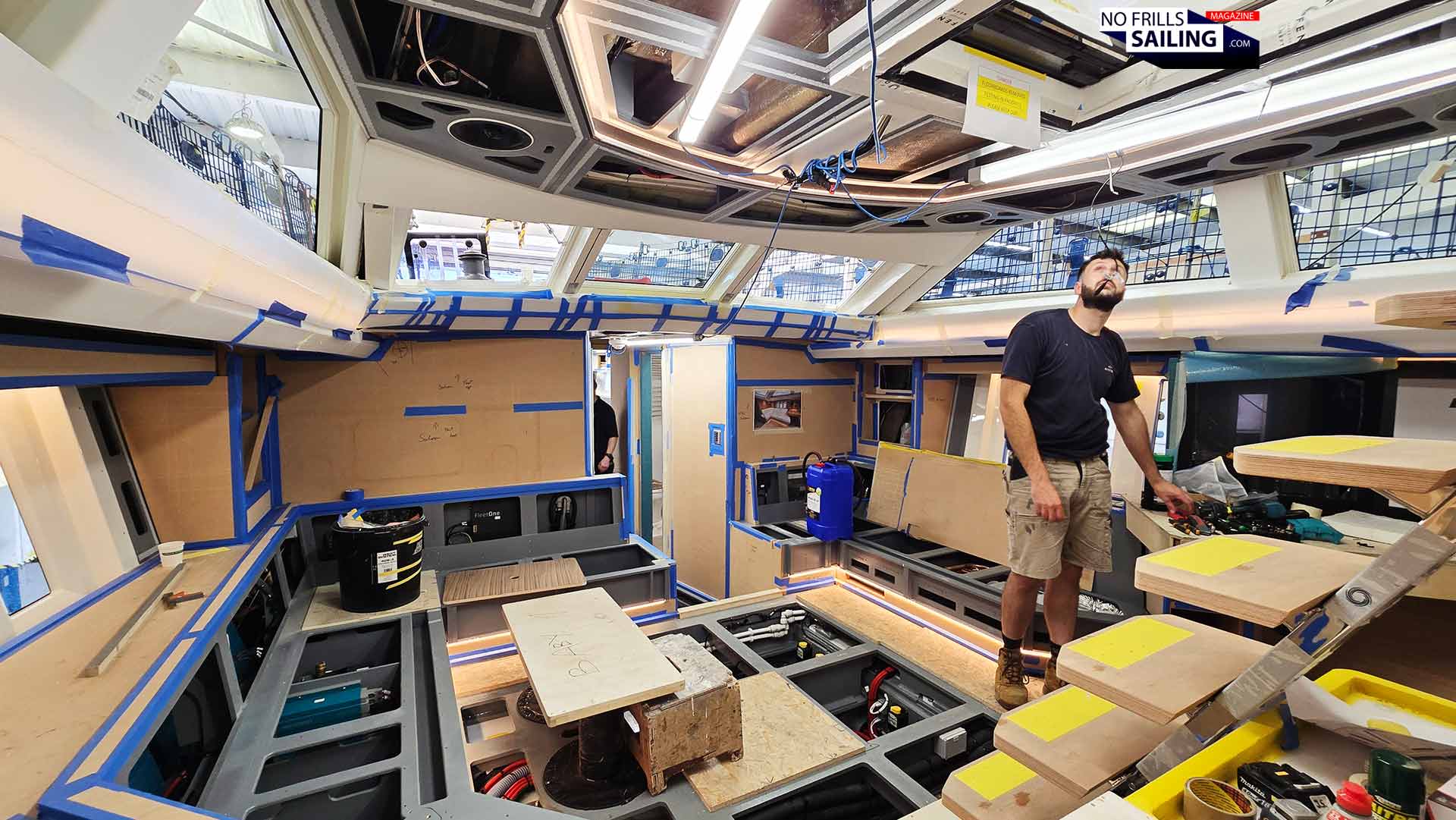
Looking back to the previous steps of the production, the Oysters we visit now are all significantly further in their production process: Hull and deck have already been joined together, most of the electric wiring and piping is done and at least the base mountings for the carpentry and joinery is fitted. From now on, it´s just a few weeks work until the yacht is finished.
Still a long way to go …
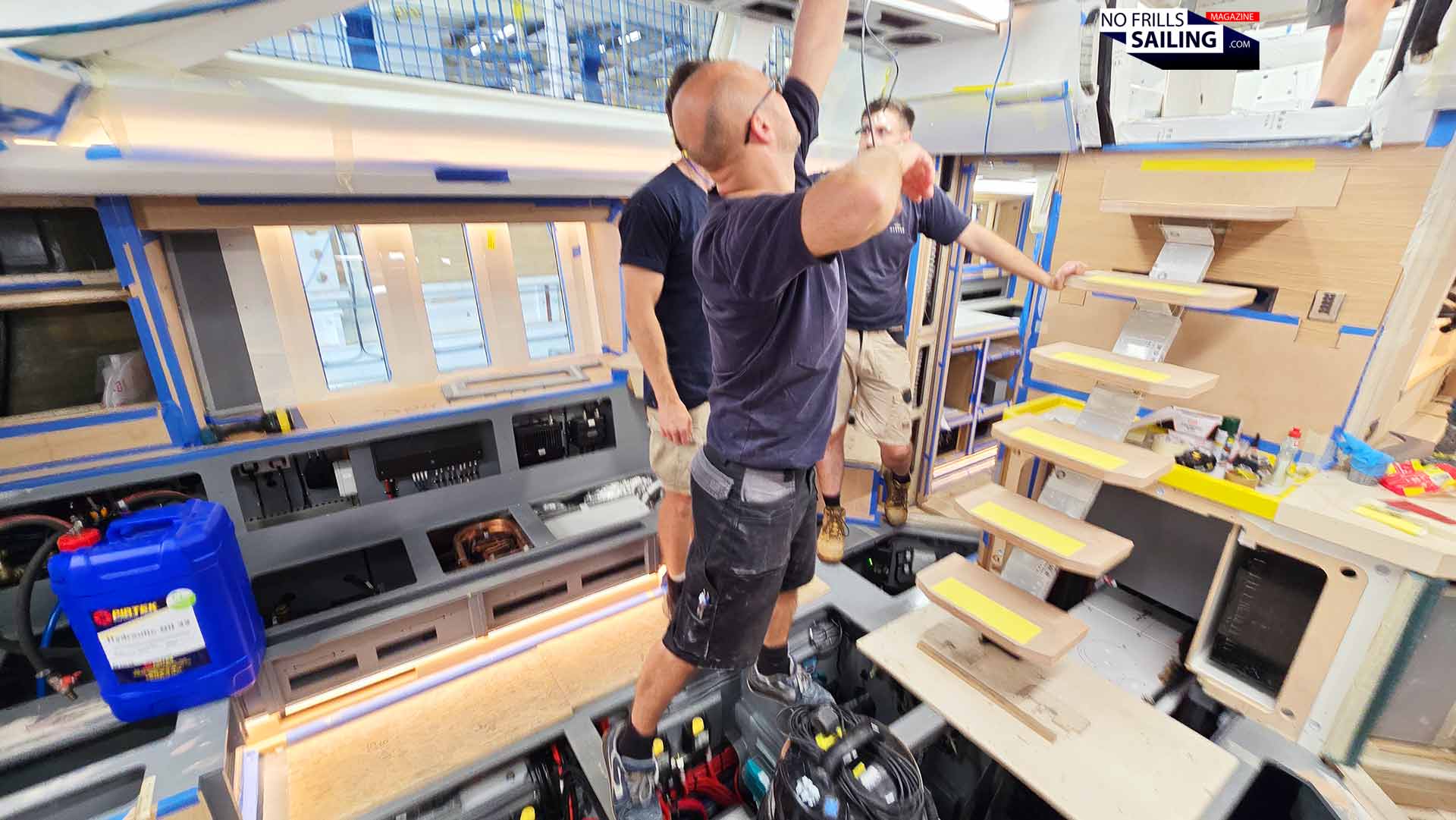
A few, yet deciding, weeks since from now on everything that has been specified to be on board will be mounted here. And thoroughly tested. This goes for the lights, the pumps, the AC unit, the gen-set, the engine of course and the navigation system. HiFi, TV-Sets, wine cooler, galley and bathroom-amenities. Everything. Literally, hundreds of parts, thousands of connections: And everything regularly checked. Did you know that when signing a contract with Oyster, you will get assigned your personal Project Manager who will guide you through the whole building process? He will update the owners, act as their representative “against” the shipyard, convey their wishes to and information from the shipyard to the owners.
“That´s massive!”
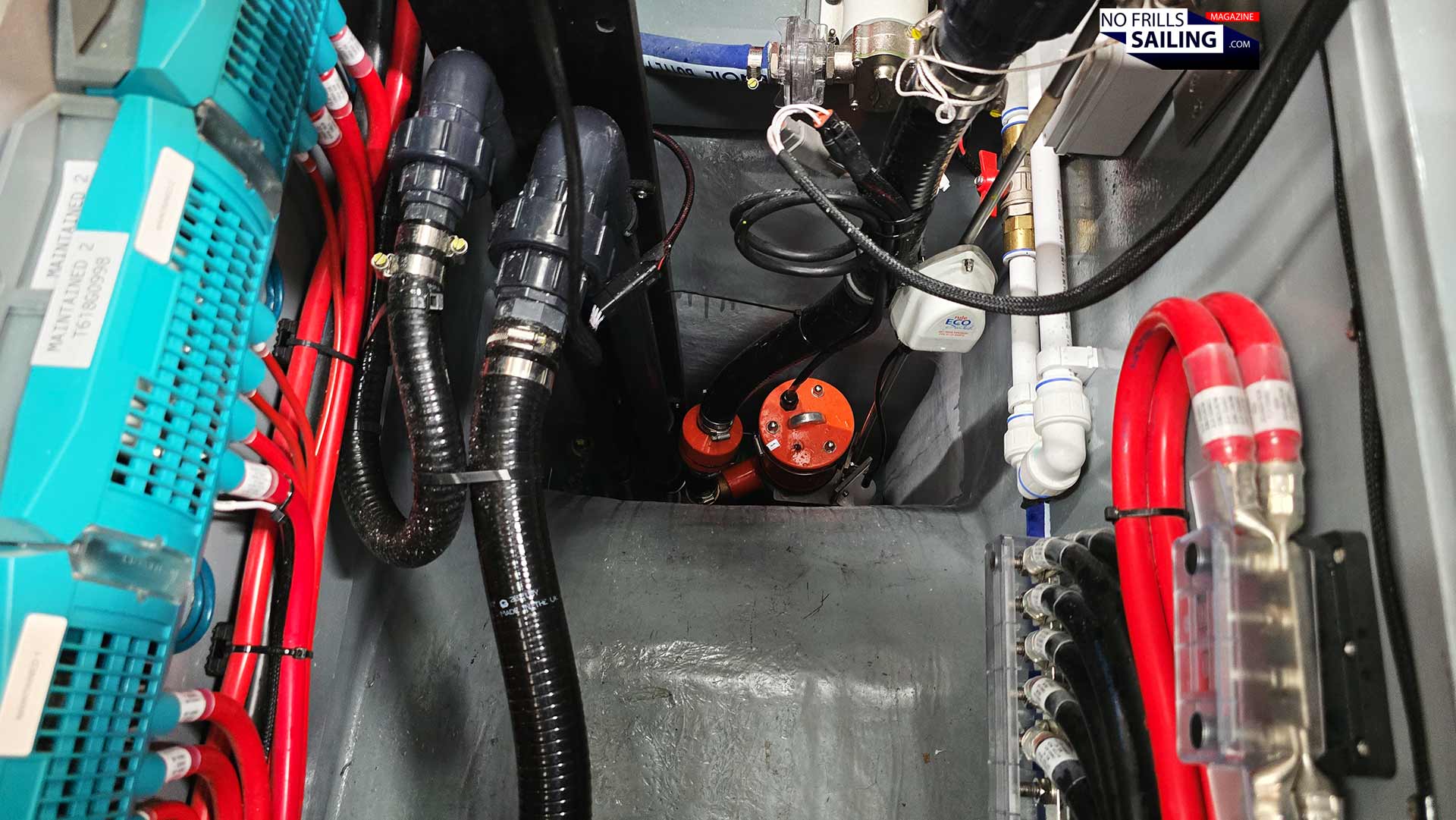
Here´s an example of how deep this process of fitting, checking and testing the equipment really goes. Take these bilge pumps for example. These are undeniably a vital part of any sailboat´s safety concept. Even though the Oyster is equipped with two watertight crash boxes in the front, water ingress may occur for many reasons. In this, it is essential that it is detected and counteracted as quickly as possible.
A detailed look into the bilge
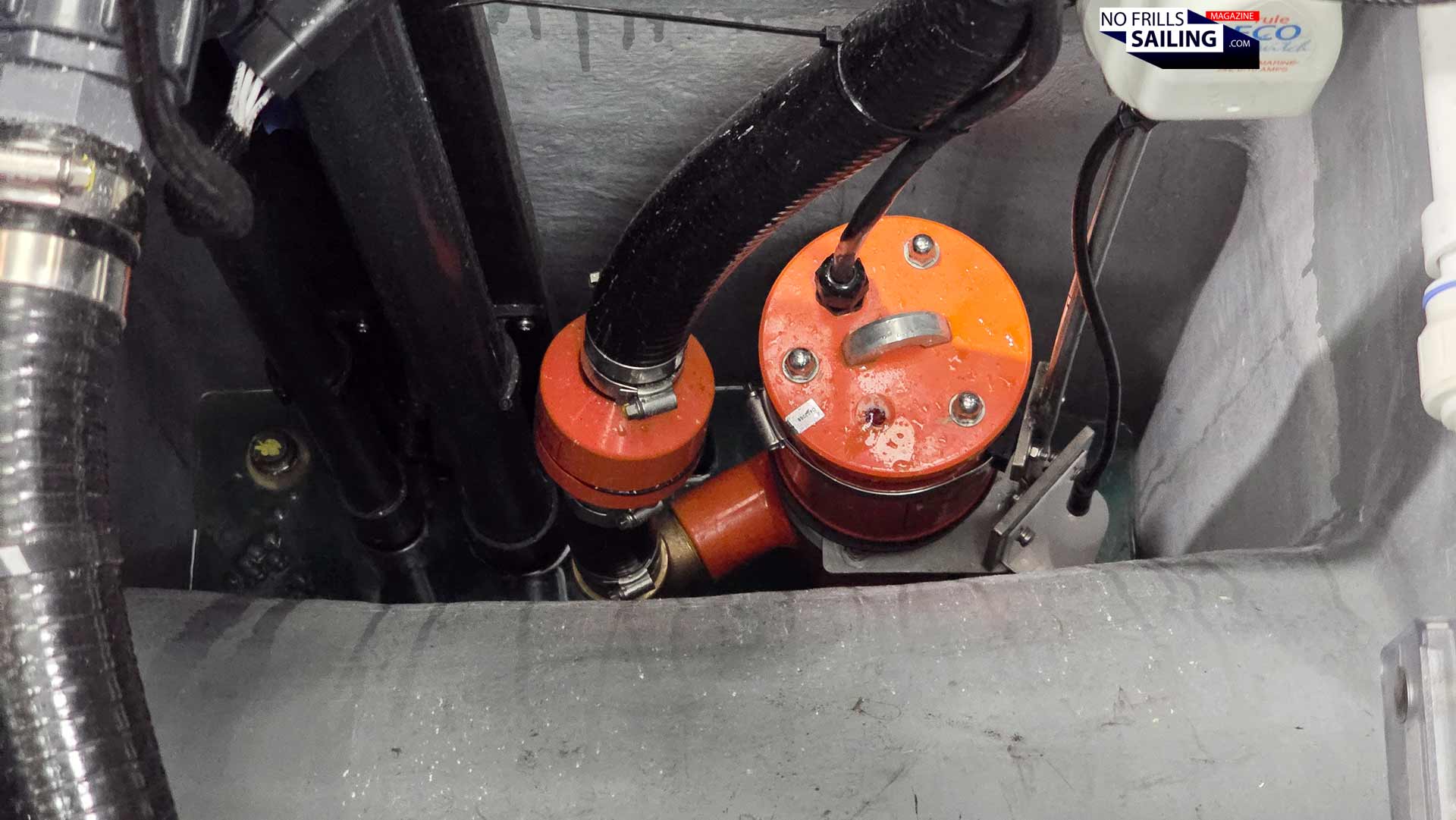
I am astonished to see how big these bilge pumps deep down in the central bilge of this yacht are! I´ve never ever seen those industrial-sized pumps on private leisure yachts up until now! Massive. And believe me, I know myself how much of a difference an efficiently working, capable bilge pump can be. A few years ago, during a delivery of a brand new Excess 11 catamaran, I woke up and the whole owner´s hull where I slept was flooded. Floor boards swimming around … even the small pump installed by Excess emptied the hull in under one minute. Amazing!
Massive bilge pumps here!
So I can only imagine how powerful these massive pumps at Oyster will manage to fight even constant ingress of water through a leak. Watch closely and you will notice on the pictures that the bilge is wet. As the guys told me, they had just run a test: They had flooded the bilge up to the top with hundreds of liters of waters. The detection system jumped right on in, these huge bilge pumps sucked it dry in a matter of seconds. Well done!
Everything is wired up and tested
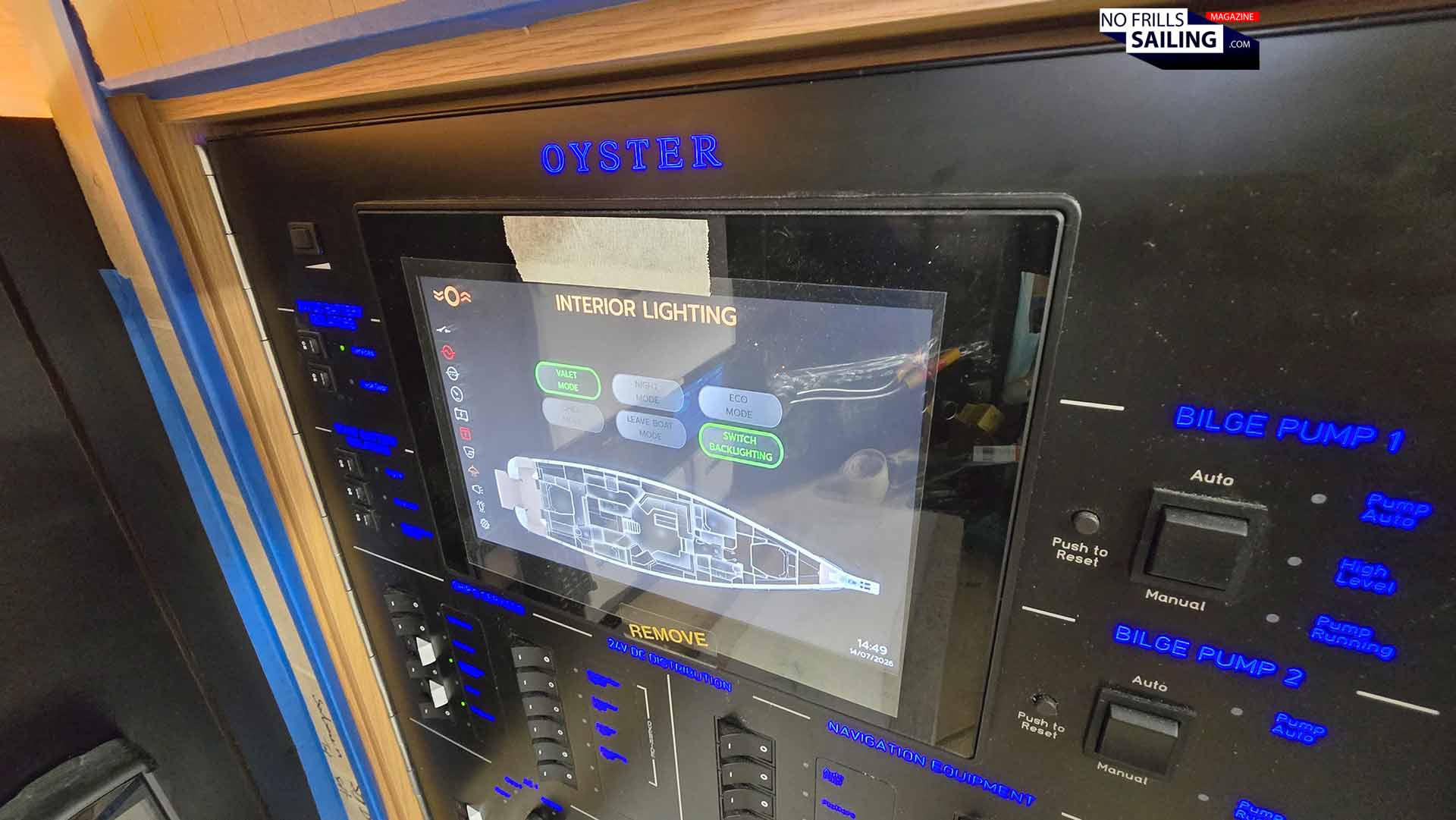
So this meticulous testing makes sure that everything that is installed aboard is not only displaying a green read-LED, but actually really working and doing its job the way it is supposed to do. As most of these parts are third party equipment, Oyster makes sure that is flawlessly integrated into the system. I´ve witnessed many times over that shipyard often deny responsibility and refer to the third party. This creates frustration for the fresh owners, a feeling of being alone and ultimately, betrayal. No matter if it´s Yanmar, B&G, Fusion or whatever brand any part is made by, Oyster makes sure it works when you switch it on the first time after handover!
Wires, cables and a perfect puzzle
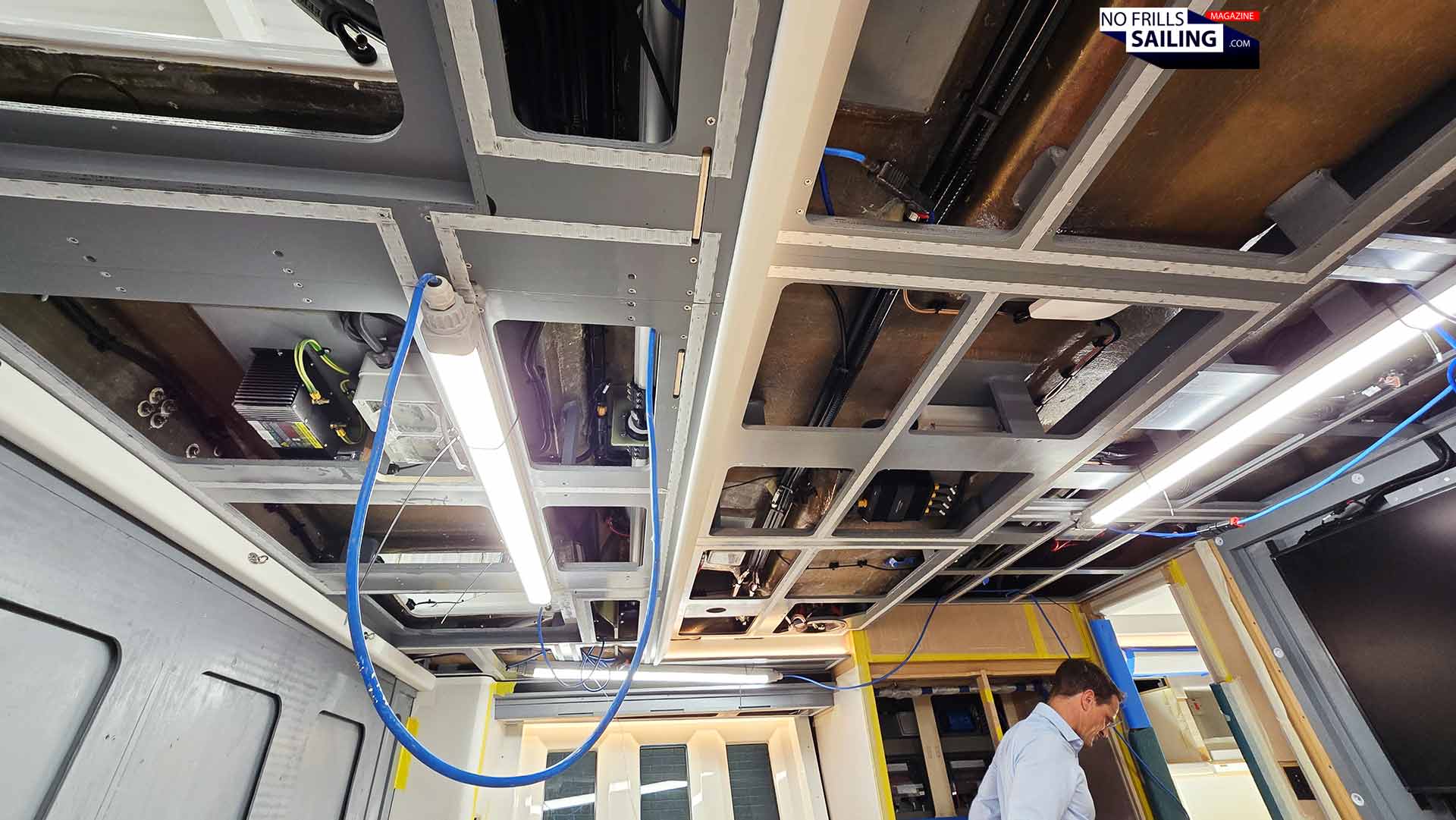
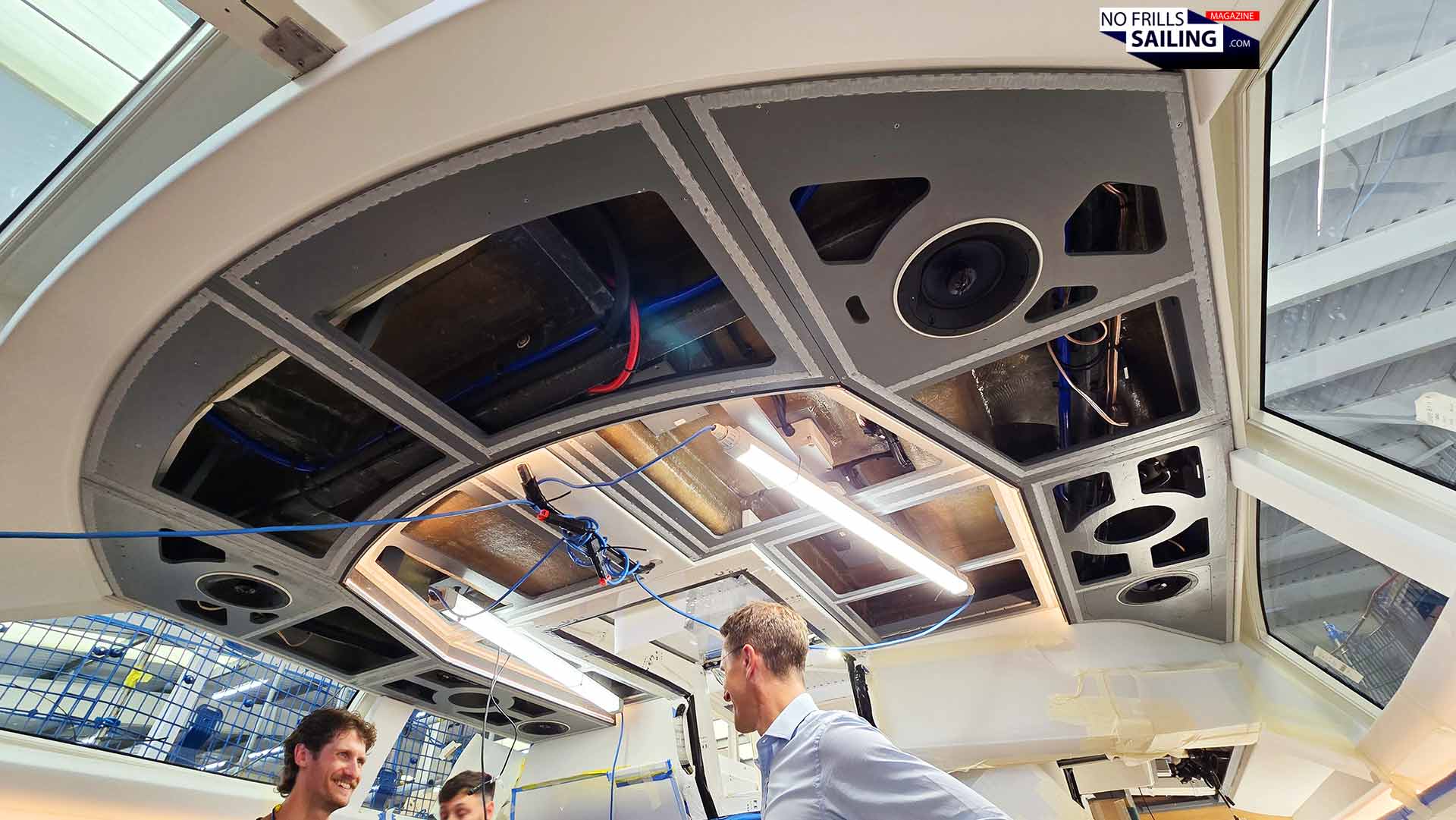
Have you read part 2 of the shipyard tour? We´ve seen the amazing work the electrical department does in their “loom room”. Now I can check their work here inside the yacht. It´s a maze of wires and cables, neighbored by pipes and ducts. An Oyster is by far not a “no frills”-boat indeed! In fact, Oyster may be the “most frills”-yacht I´ve ever seen!
… and that´s a lot of wires!
But this is in the DNA and frankly the consequence of luxury: Any amenity an owner goes for when ordering a yacht needs at least a wire to receive electric current. It may need another wire to be connected to the onboard network, if not already wirelessly connected with Bluetooth. It may need fresh water for cooling or an exhaust, a seacock or two for seawater, you name it. Anything that works and runs on electric current needs wires.
Later, nothing will be visible anymore
Of course, when you are sailing, none of which will be visible anymore. People opting for a luxury sailing yacht in this class usually know that maintenance and regular checks is key to a flawlessly functioning yacht. Taking into consideration that these yachts need to be regularly maintained by skilled technicians is a precondition of owning one, in my eyes. When putting her in her home berth, you will surely have a service guy at hand – sailing around the world, Oyster provides for contacts and certified services all around the globe.
Would you retain an overview?
So there´s no need to worry: The stuff built in here is top shelf, it won´t fail after half a year or when the warranty is expired. Nevertheless, the amount of installations apparent from bow to stern behind the panels is staggering: Hats off to the engineers and designers who came up with the elegant ways to hide this labyrinth of wires, bow to the technicians who do not get lost in this maze.
A role model engine room
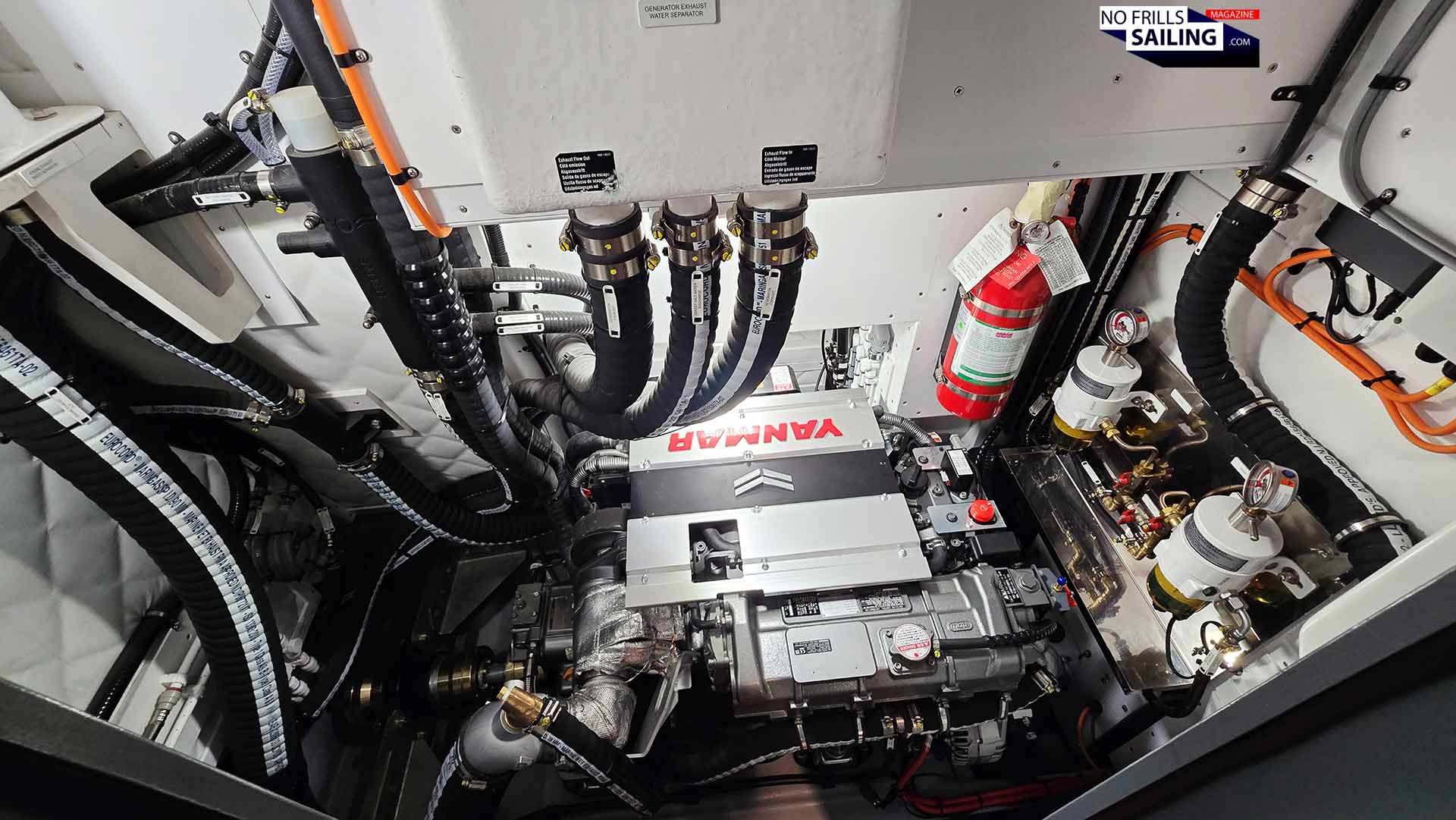
Another nice detail which can now be seen in full bloom is the engine room of the Oyster. First of all, this is one of the few modules pre-fabricated outside the boat with most of the principal installations already fitted in the workshop. It comes in a nearly finished state when mounted to the hull-structure. Now I can admire it finished.
The spotless engine room
First of all, there´s easy access to any all sides of the engine. Above all, there´s enough headroom to stand upright! Don´t you also hate those cramped engine “rooms” – more like chicken houses – where you have to kneel down, bent your backbone to breaking load just to reach for the dipstick?! I´ve been on yachts where the entryway-ladder wouldn´t even swing up to a level so that you could monitor coolant or the impeller without having to lie down on your back! Well, not here: Standing, nice working light – everything is well within reach. Exemplary!
Thickest soundproofing I´ve ever seen!
Something Oyster is very concerned about is noise insulation. In the end, we all know that we have to drive the boat under engine power far too often, much more often than we´d like to. But in a calm, what to do? Most of us have to be at home on Sunday afternoon, we cannot just wait for the wind to return. Motoring for a few hours might not be the problem, but motoring all night is. Especially for the guests or crew off duty. Oyster fits a very thick, special dampening material that is said to reduce noise level to a meager humming. Note this for tomorrow when we are sailing …
Raising efficiency in boat building
A word on modules in boat building. If you check my shipyard visits to Hanse, Beneteau or any other of the “big five” series production boat companies, you may notice that they are utilizing the modular construction to a far greater extend. Frankly, it´s that “building block”-approach that is one of the key factors for reducing cost, shrinking construction time and generate massive output numbers. But, as well, it comes with many downsides.
One of the few modules: Front cabin bed
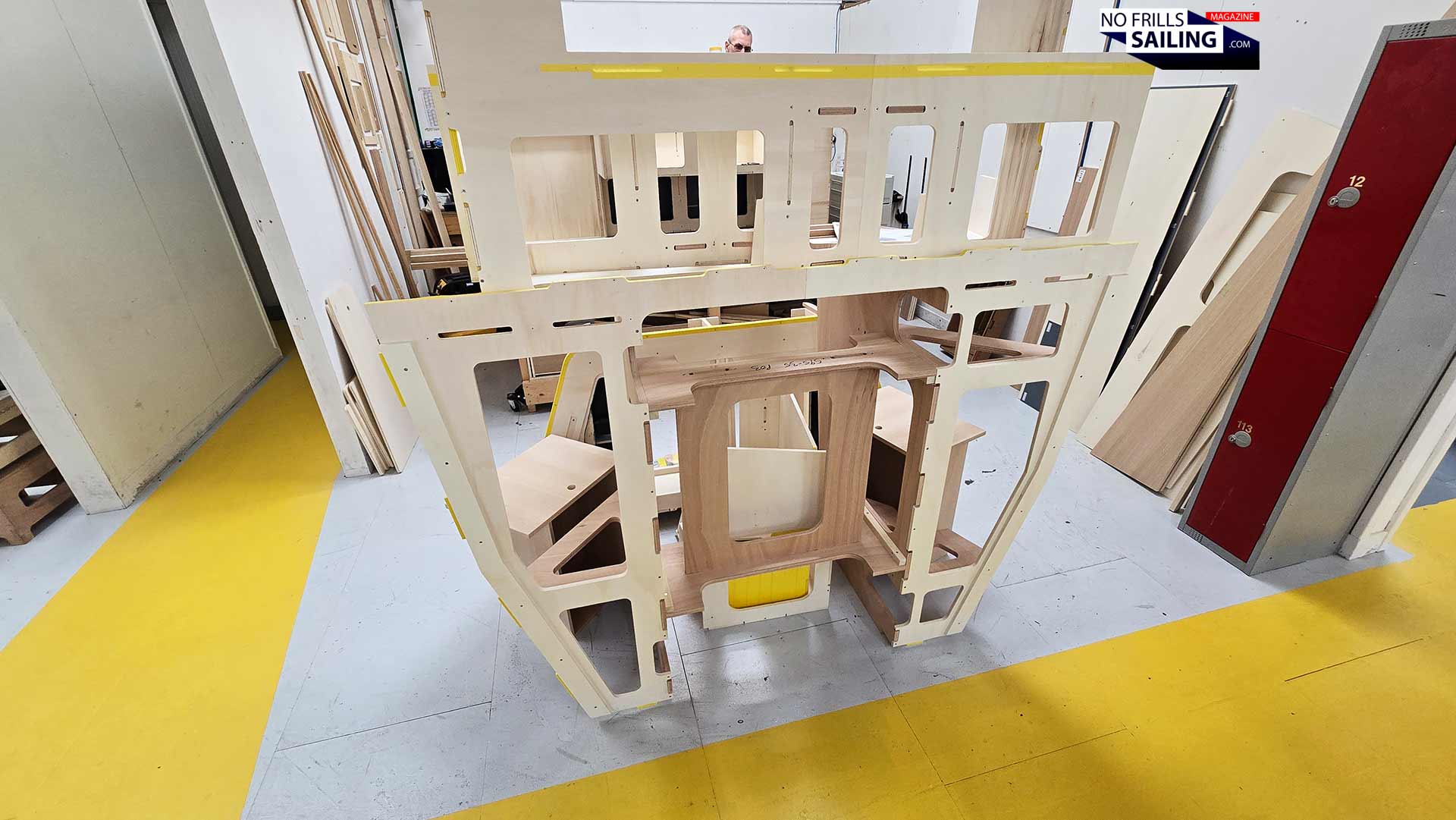
Here at Oyster they tell me that they gradually increase modular parts, but very cautiously. They want to apply this technique where it makes sense – and where it won´t affect quality and individuality. Because modules only make sense if they are standardized. If you want to offer customization, modules effectively fail. A good example for where it works for Oyster is the above mentioned engine room, and base-mountings or carcasses for certain parts of the furniture. Like the owner´s bed, for example.
We are getting there …
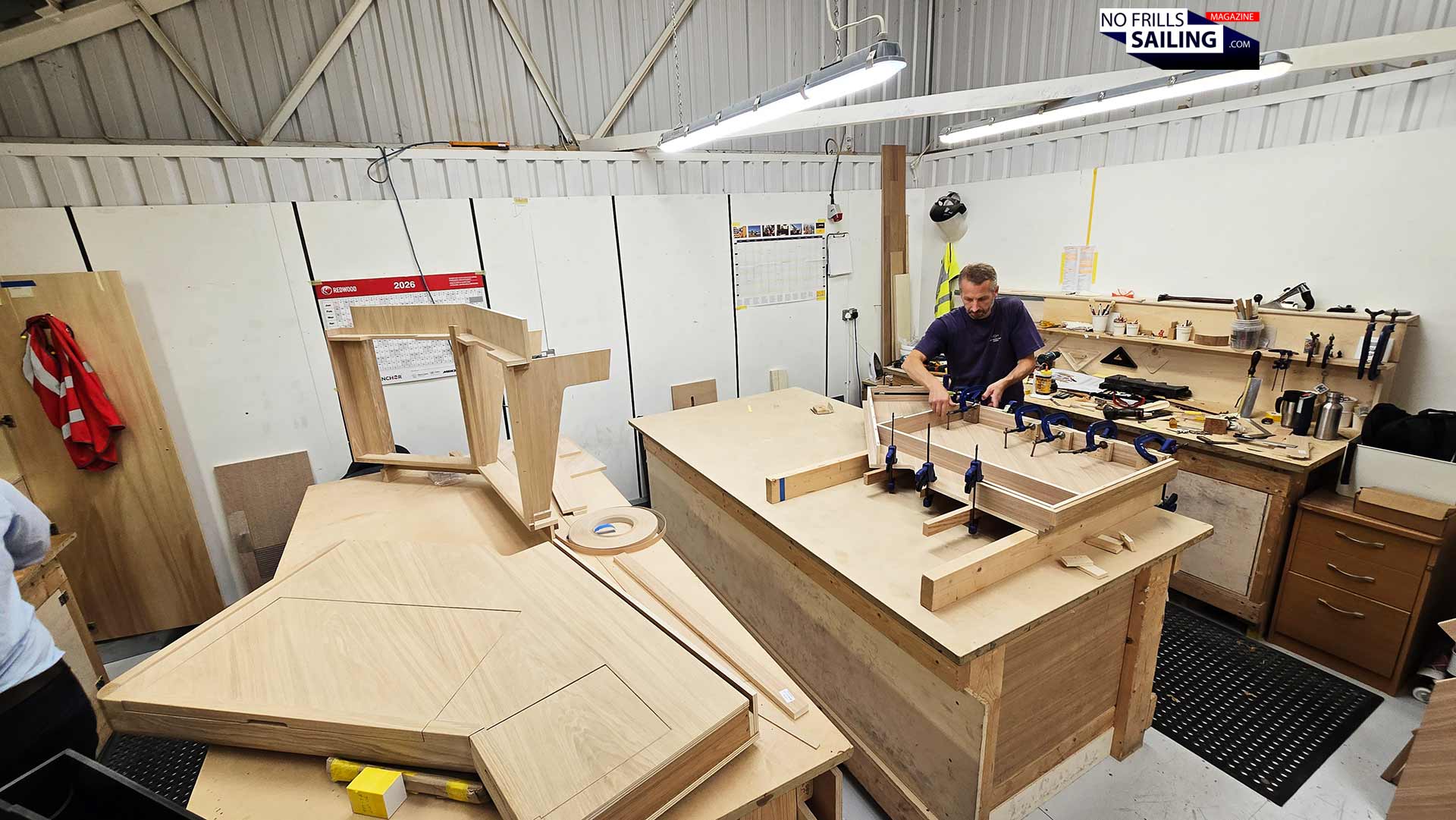
The base chassis is a module that indeed can be manufactured completely because it does not matter for which timber type and style an owner may have gone in his boat. The carcass is always the same: Individual parts are mounted to it later. Yes, Oyster constantly increases efficiency by introducing modules, but only if the large freedom of individual choices for their owners isn´t affected. Quality-wise, it goes without saying, these modules are made by the same skilled joiners as the nice woodworks we later admire in the finished boat.
Utmost care for the joinery …
Which brings us to exactly these guys. You know that I have a craving for wood, wooden yachts and everything that has been made out of wood. I´m honest, my heart was bleeding a bit a few days ago when the guys fitted my PVC-deck – because of course I would have loved to have a real teak deck. But that´s far, far out of reach for my budget. Going aboard an Oyster, especially below decks, is always like entering a seafaring palace – and that is largely due to the fine woodworks.
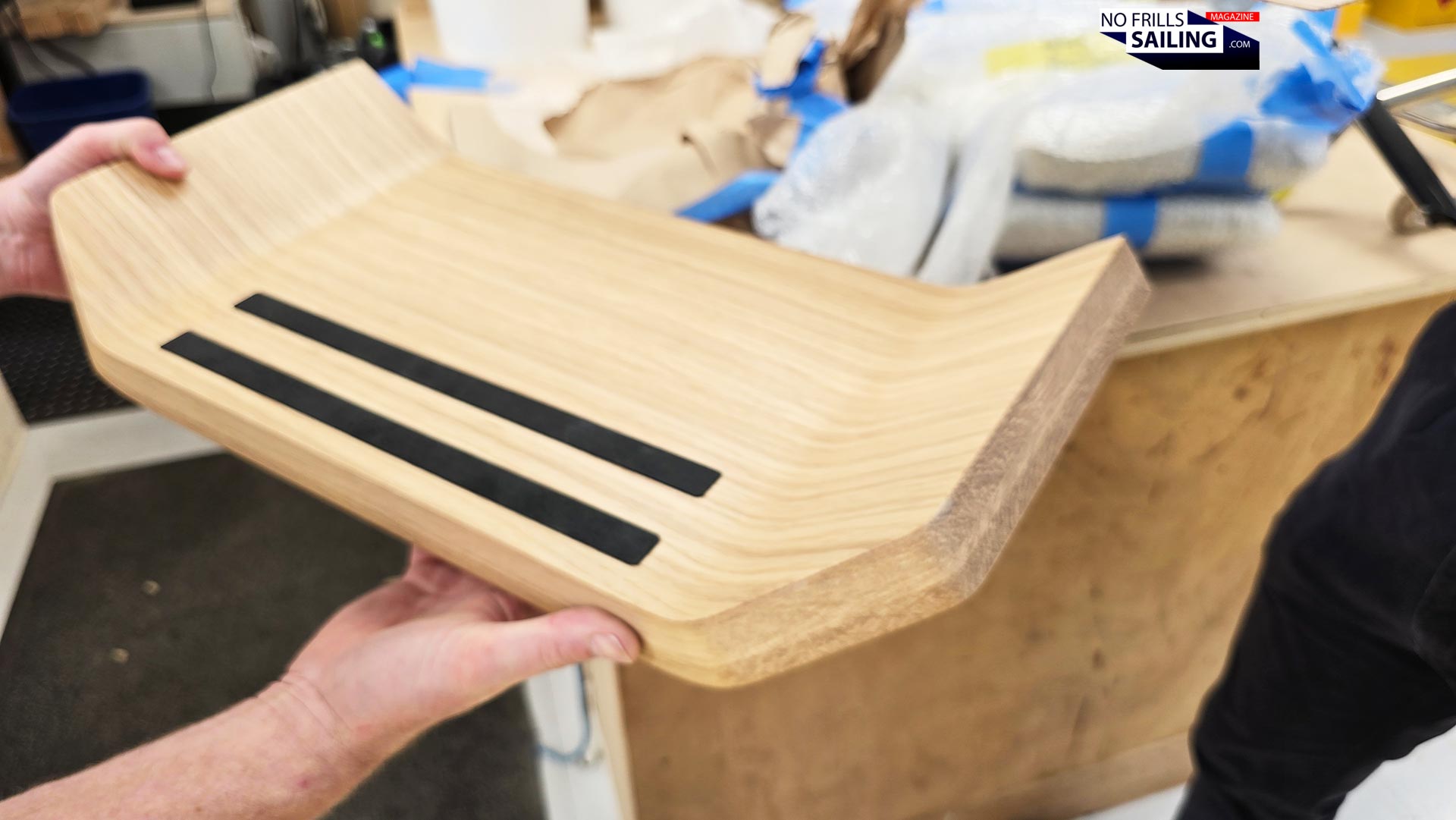
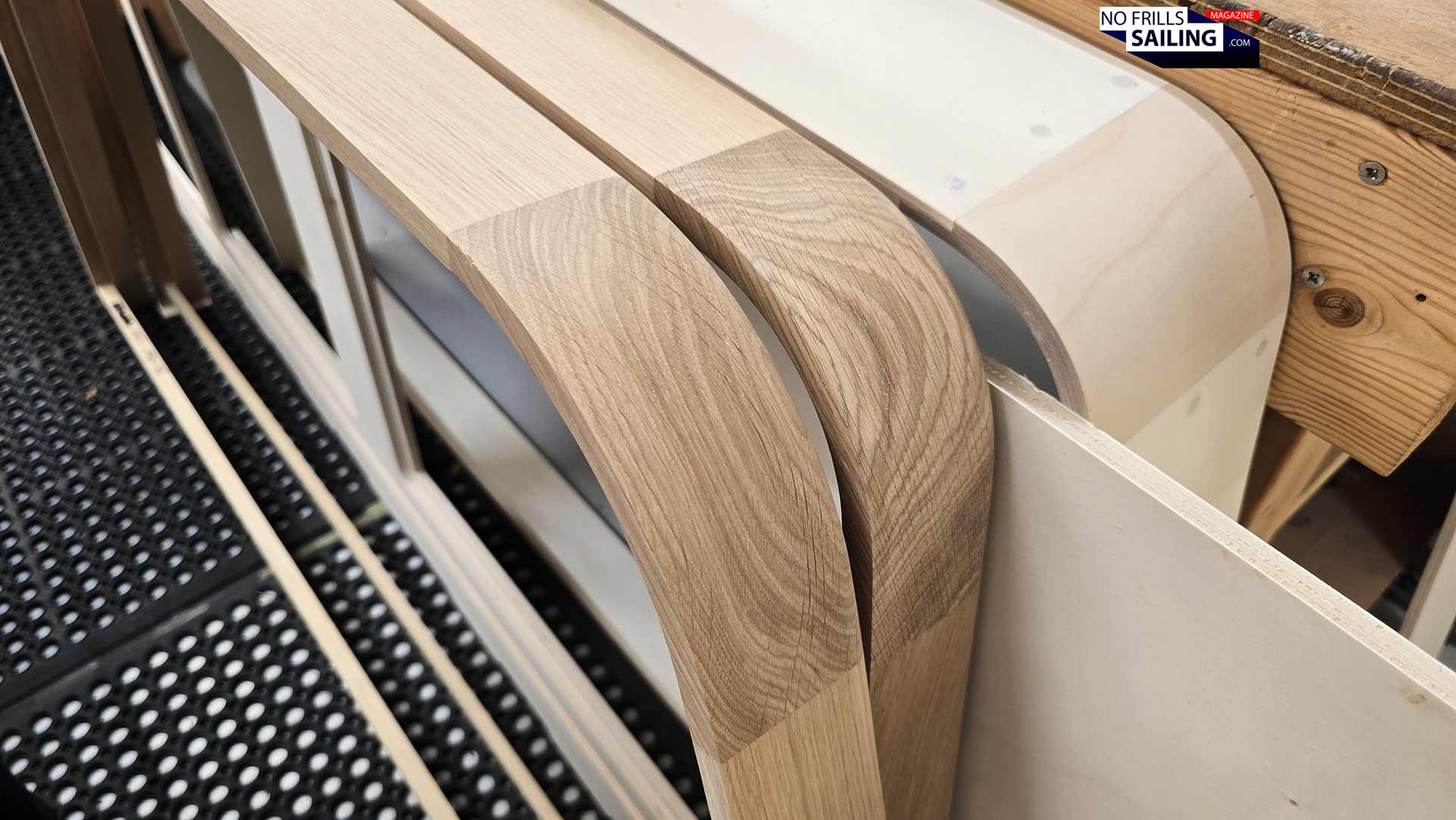
Awwww. Laminated steps. Nice!
Take the above picture for example: It´s a seemingly simple part. A step for the entryway ladder. But this step alone comprises lots of man hours of work and skilled craftsmanship. Because here at Oyster, those steps are laminated utilizing dozens of sheets of high-grade wood, thin cut to less than a millimeter. These sheets will be glued on top of each other inside a mold, forming the nice curvature. This process takes weeks. For a single step! After cutting to size and sanding it, this piece alone is a work of art.
Master carpentry!
I don´t know if you remember, but when I was planning the interior of my new yacht, Oyster´s entryway ladder was exactly what I showed to my shipyard. In end, I bought my steps from Bavaria: Not laminated, but massive oak. It´s also a nice piece of work, but far from the Oyster level. It´s price? 350 Euros exVAT. Per step. Now imagine the laminated quality upgrade …
The level of detail is stunning
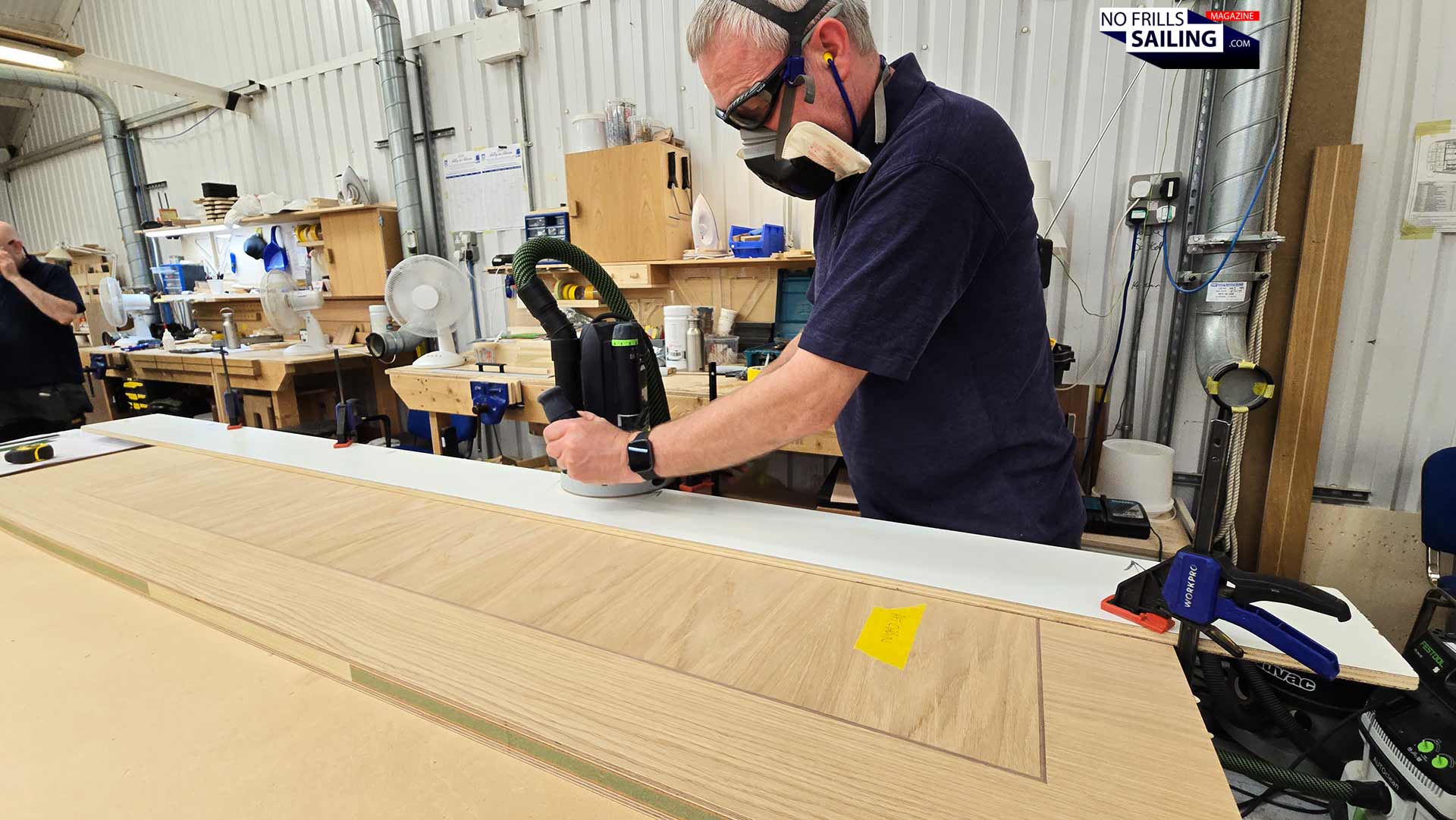
The joiners here at Oyster yachts are just great craftsmen. As the level of individual choices which can be made by the owners and of course their extra wishes for custom parts almost has no limits, these are the ones coming up with not only feasible but also beautiful solutions. Take this cabin door, for example:
Even the small things look awesome
It´s not only the art of making a door itself (which won´t bend or distort in the moist marine environment), but it´s also the immaculate choice for just the right parts, the grain of the wood and how to arrange them. And then there´s the details, like this thin, 3 millimeter inlay between the vertical grain on the outside and the horizontal parts on the inner side. In which direction is the grain “showing”? It takes a lot of experience, spatial sense and imagination as well as Knowledge of the very boat these parts are made for.
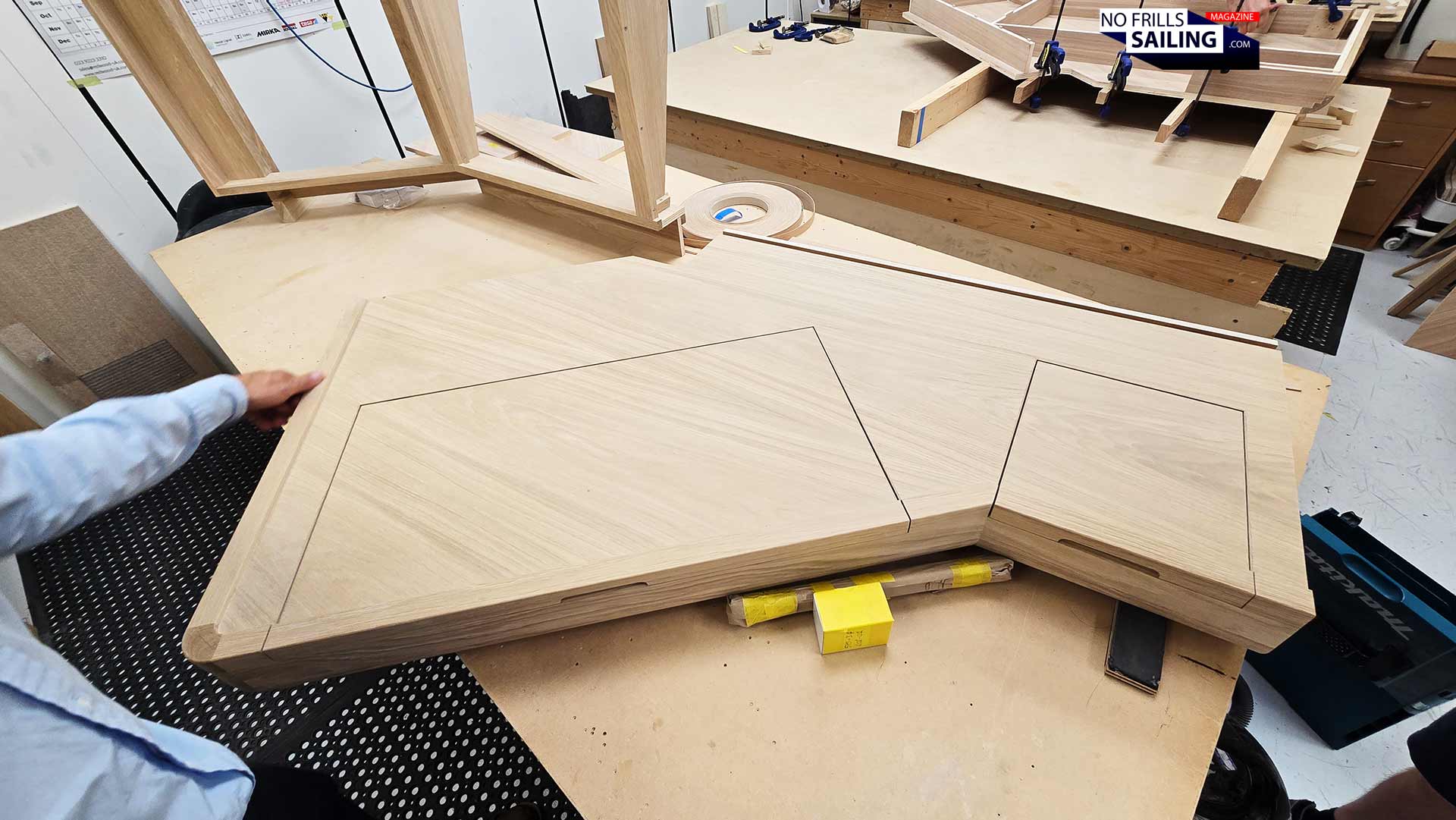
Artwork: Chart table!
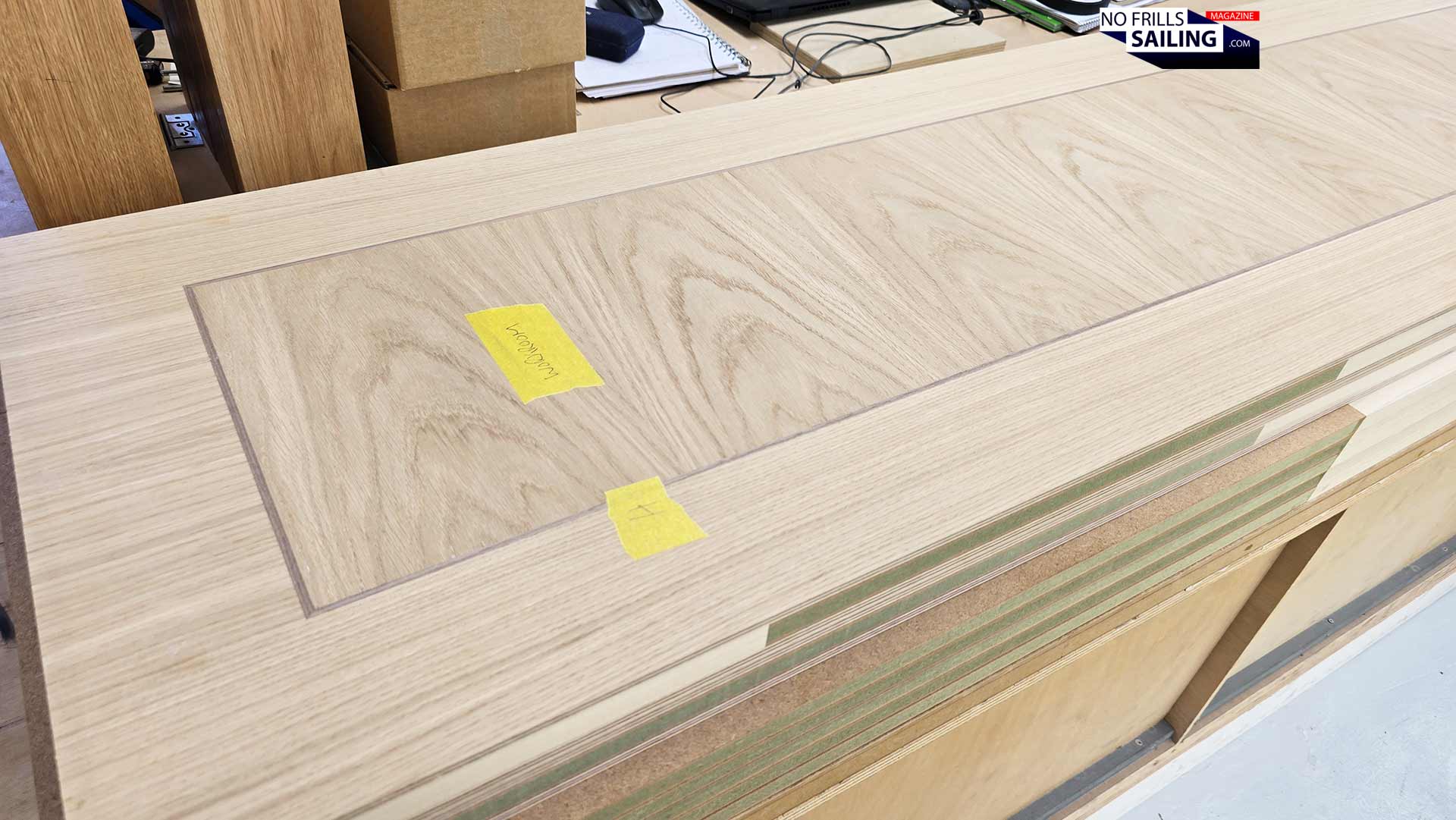
And that was only the workshop-door! Imagine the level of attention that goes into furniture parts which are used and interacted with permanently. One of which is for example the chart table, another is the main saloon table. Again, I am a sucker for chart table solutions and fancy the “Captain´s corner” of an Oyster very much: This is indeed a place worthy of a proper skipper! Not these little makeshift excuse tables as seen in many contemporary boats nowadays.
Making a chart table
I´ve designed, built and fitted a “dream chart table” to my very first yacht as well. That´s one of the few things I got right and I am still proud of, when it comes to my own, very limited crafting abilities. But as I can see here in Wroxham, these guys are kind of applying the same techniques as I did back in the day. And above all: Their chart tables also are made “from one piece”, as you can see.
It´s one piece
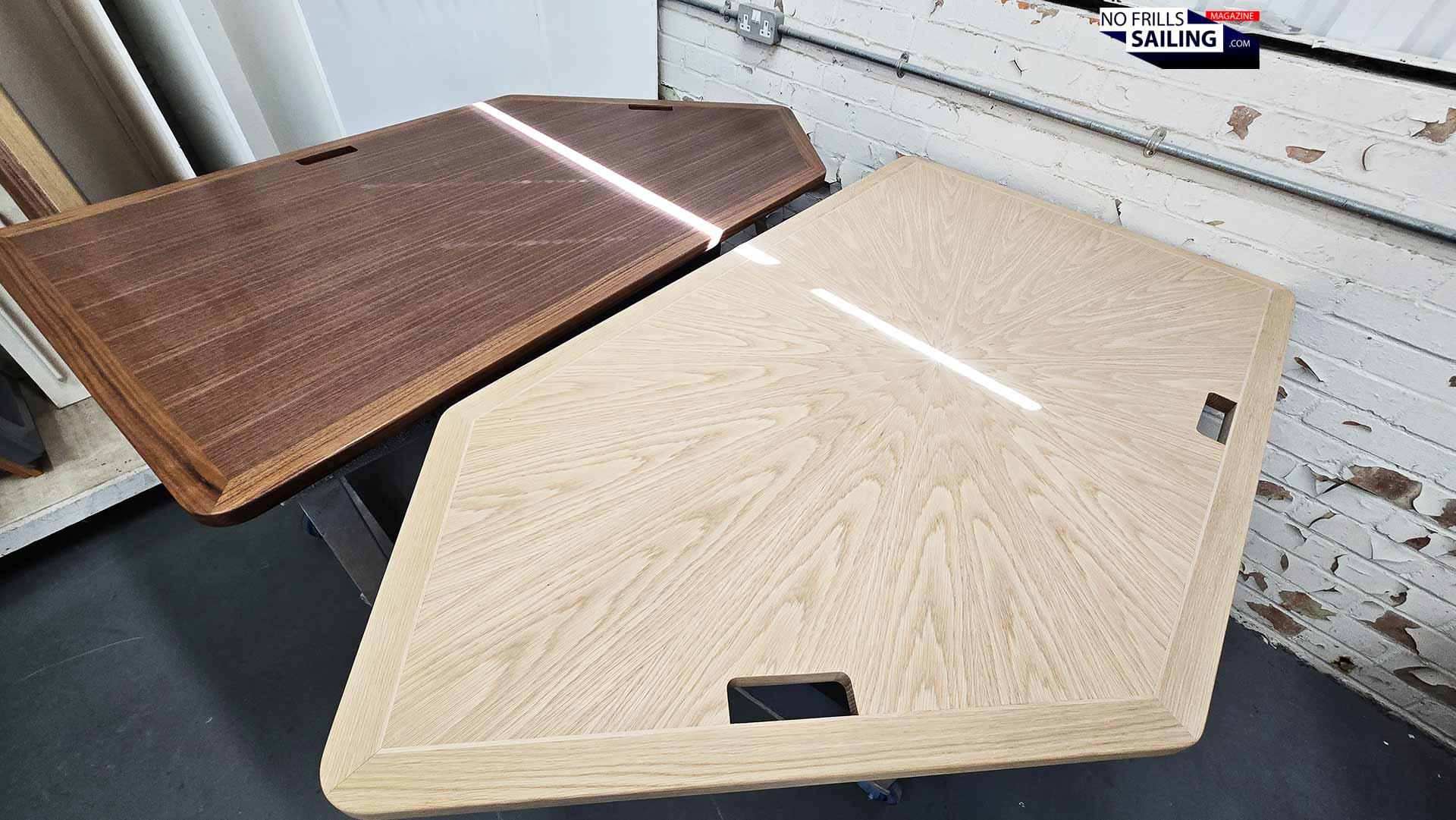
Continuing grain is a must for any chart table, I think, and pulling this off requires not only skills and a good eye, but also spotless raw materials. You need to decide where to apply the cuts and which parts of the grain-“picture” is worth showing in the later finished table. The opening lid must integrate seamlessly and it all should perfectly align to the surrounding wooden parts and their grain. It´s really not trivial! Or take the saloon table tops:
Most beautiful woodworks!
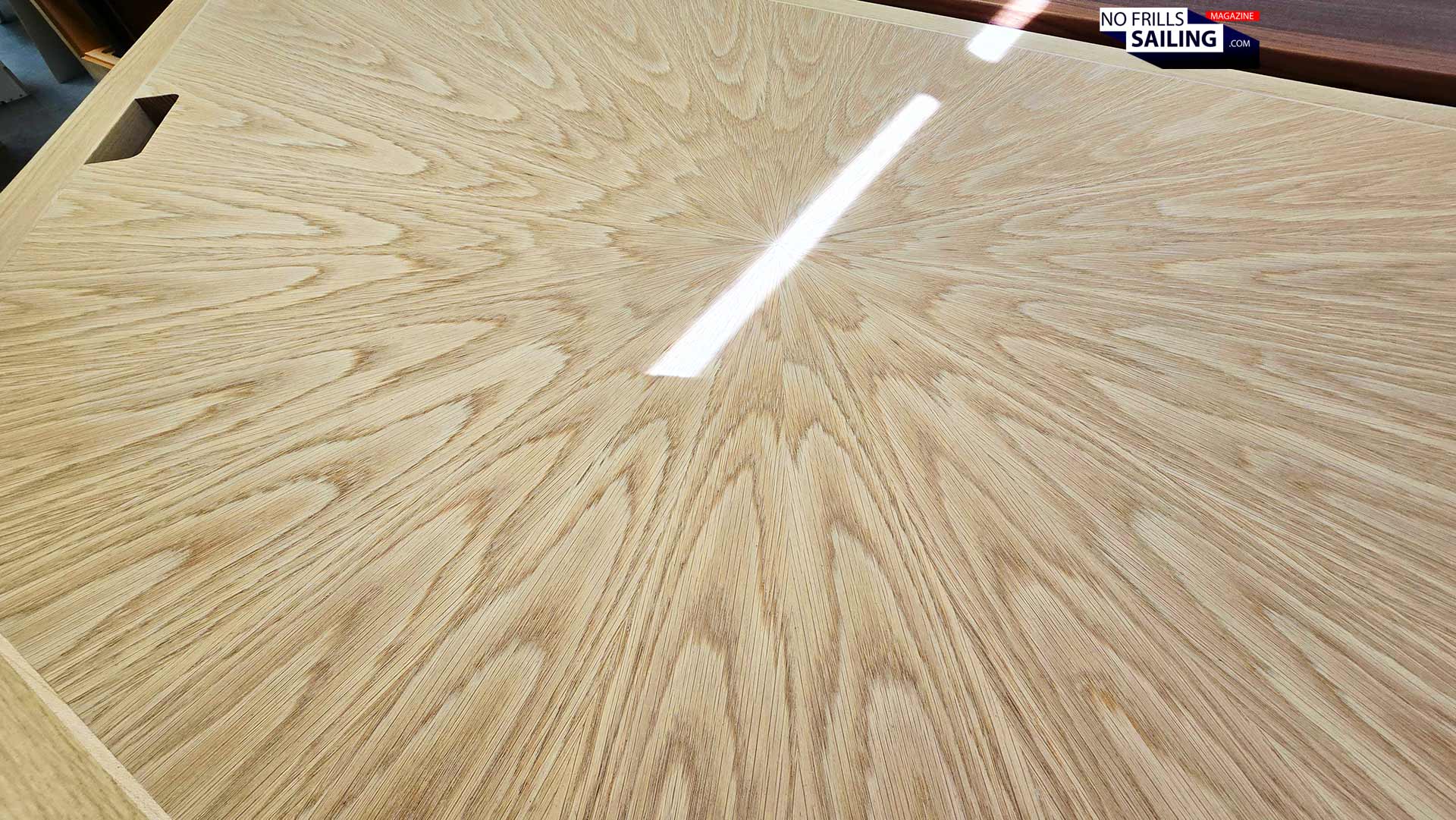
Stephen shows two different styles for the same part. The dark table, sporting more contrast but also offering a unison grain that just flows in one direction. This table will almost merge within the surrounding design of that particular boat. And then there is the light oak table, sporting a “starburst” design: Very laborious to make and surely an eye catcher. This table won´t merge, it is meant to attract your attention, it will be the star and focus point of the saloon. It´s all thought through, designed and finally crafted by humans: The great joiners and carpenters here at Oyster.
What´s your choice of style?
The freedom of playing around with ideas and wishes is seemingly limitless here. Of course, there are limits. But it´s something different if you can turn your ideas into reality by talking to people who think about it and come up with solutions, or you just have to choose from a few options in a price list. This is also where the difference in price comes from later. The more stuff become individual custom made parts, the higher the tag, obviously.
Starburst-design!
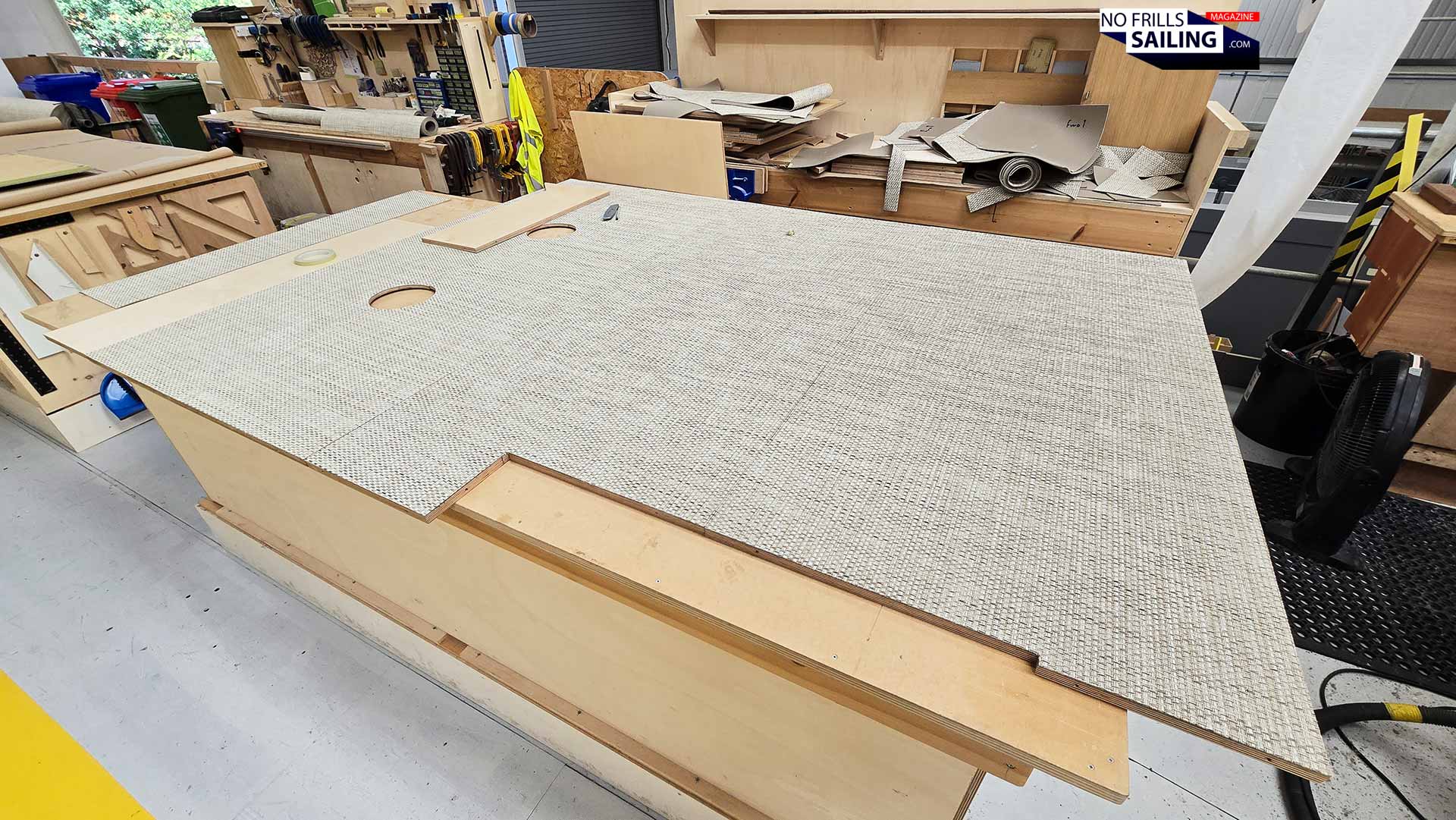
In this, choosing your style for a new Oyster basically does not differ from what I do in my own yacht: I am constantly trying to insert my ideas of how things may look like, awaiting feasibility and cost estimates from the shipyard, to later balance my wishes and dreams with my (sadly very restricted) budget. In this, instead of having a joiner-made saloon table, I will fit a caravan-table, to save money. But like here at Oyster with this special flooring-material, I also opted to spend more money on my new floor boards as well:
Choose your preferred flooring
The budget may differ, the act of choosing, weighing and deciding is not. The consequences of opting for a custom or semi-custom yacht are exactly these: You have much, much more freedom to design your own perfect one-of-a-kind boat, but it takes longer to make, it requires much more thinking efforts, discussion time and decision making. And ultimately, money, of course.
A meticulously clean production
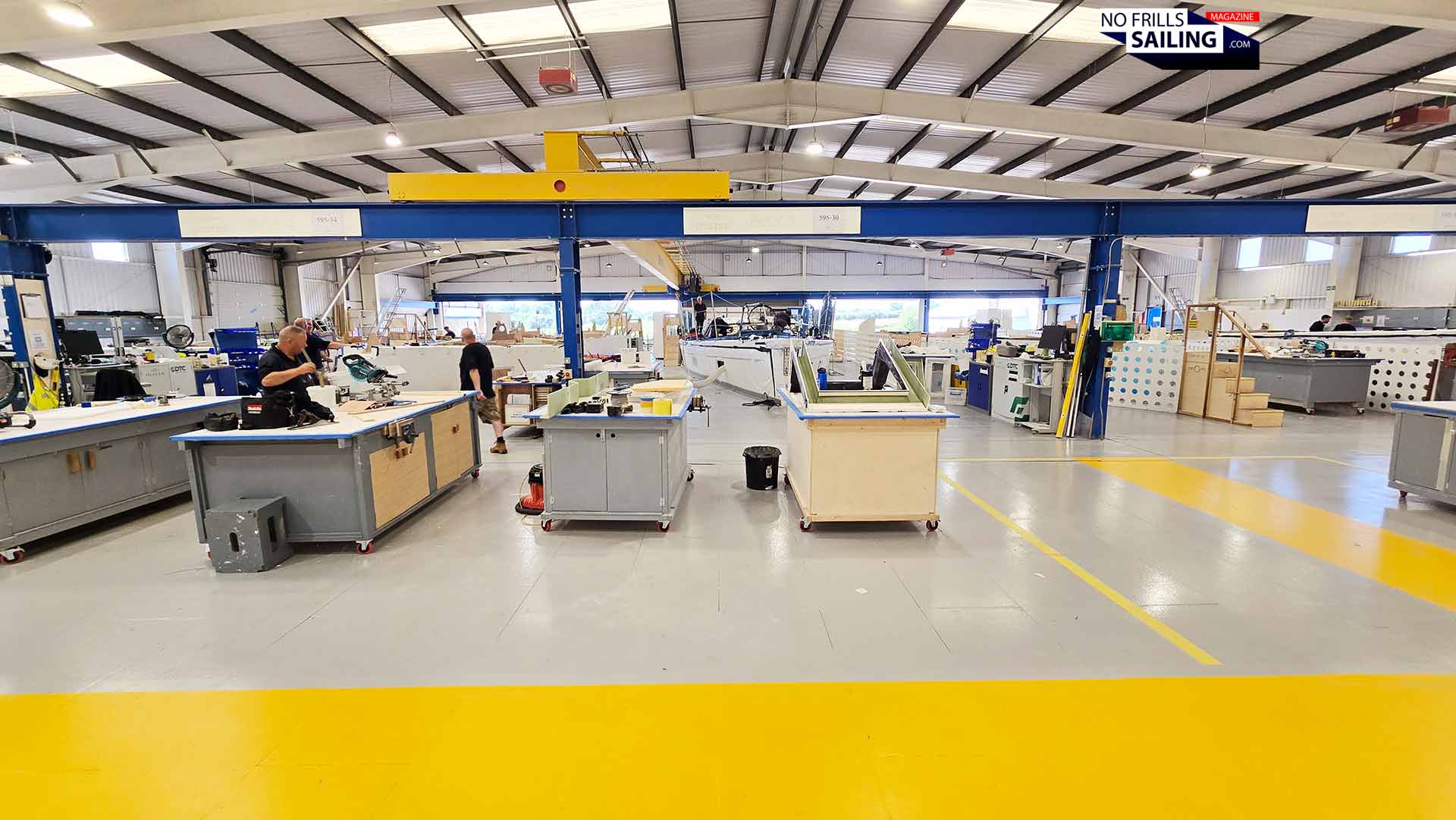
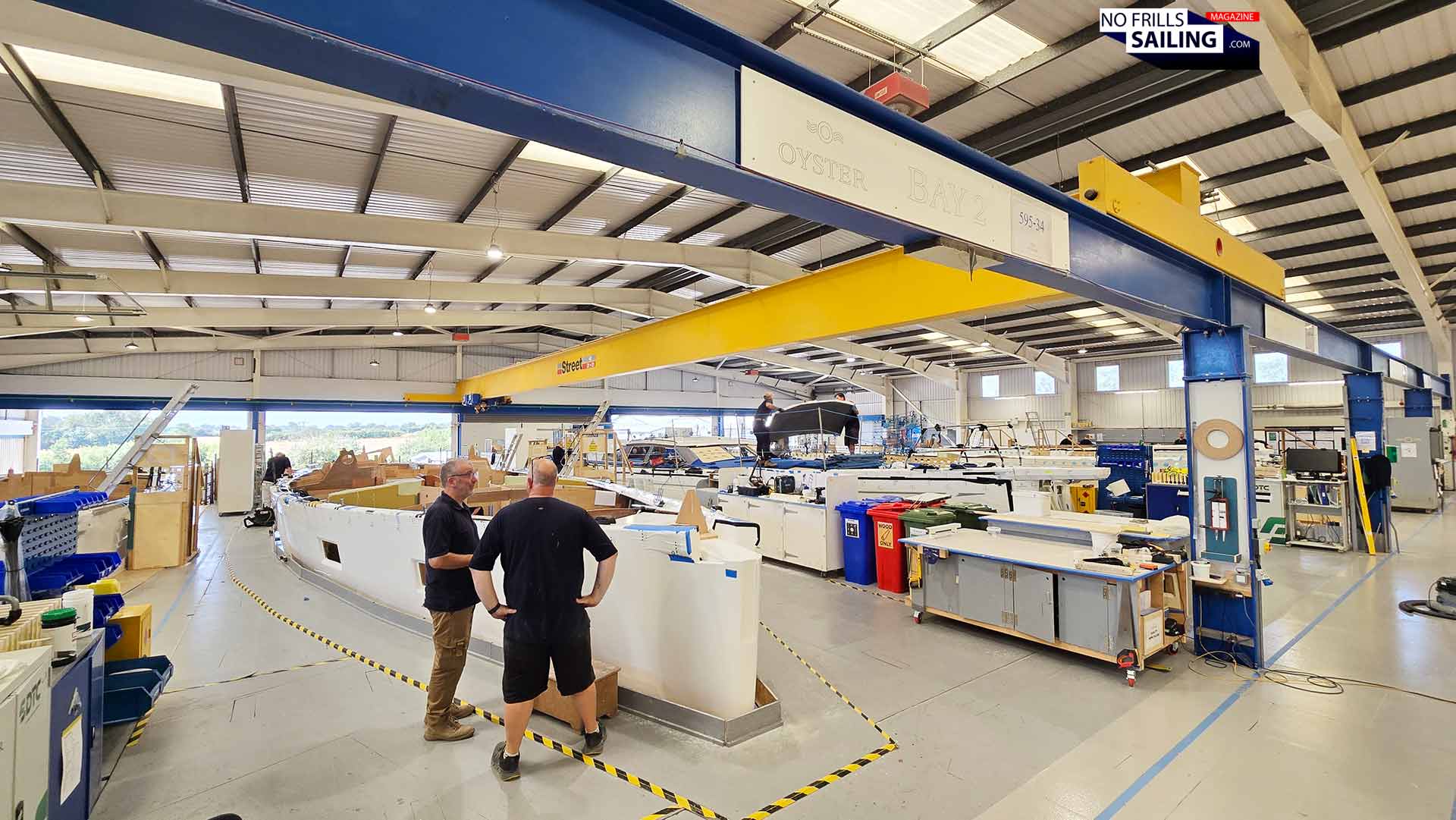
But enough for the details. I guess you, dearest reader, get my point: A boat is always a compromise. Even here at Oyster yachts. Stephen and I leave the last yacht to proceed to the very last section of the shipyard. There are just two major building steps left to take a look at and so we have to walk all along through the complete length of the factory hall.
Clean. Spotless. Tidy.
Again, I am puzzled and amazed by the cleanliness of this factory! I am sure that Oyster did not have it all cleaned up just because I would arrive, so this is the usual level of tidiness here. “Show me your factory – and I can tell you about the quality of your product!” This is valid for small businesses as well as for big shipyards. I have seen many workshops – even big names in the industry – smutched and dirty, full of loose tools flying around, offcut material on the floor, chaos on the boats as well as within the whole premise. What other than a messy product could evolve out of a messy workplace?
Surgery or shipyard? Can´t tell …
Not here. And it´s not just the clean and clear workshop: It´s the people too. Corporate uniform T-shirts, displaying proudly the Oyster logo, clean, friendly people, displaying a smile and a greeting when we pass. This is all adds to the atmosphere here: I feel welcome, not as an intruder (as it is sometimes the case when I roam shipyards). Happy people who don´t show up for a job in the morning: If they like what they do, they will make great products. Good to see it being that way here in the factory, very reassuring.
Varnishing an Oyster
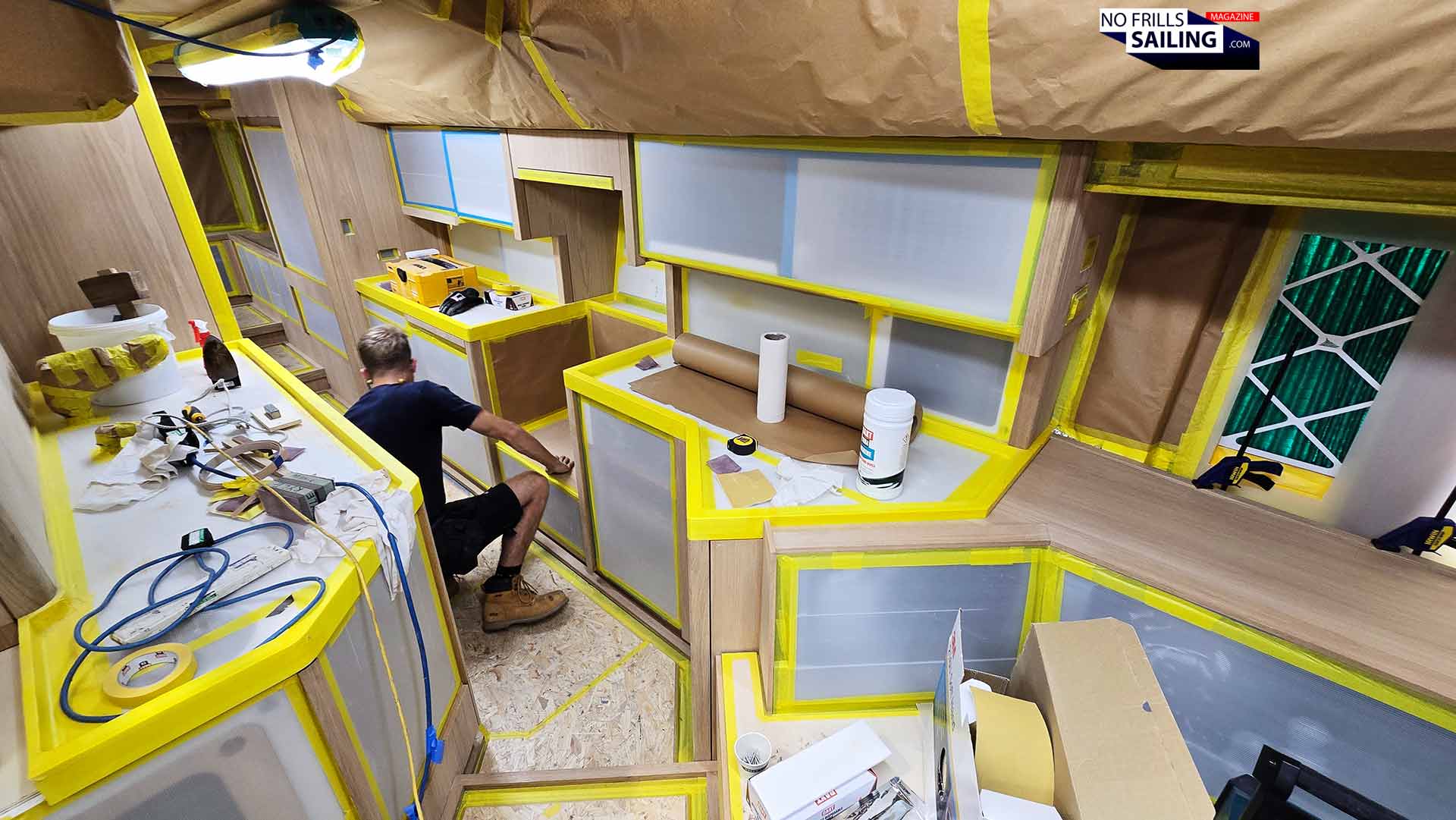
Now, let´s bear with me, we have almost made it. It´s just the two last things I want to show you here. One of which is the painting department. At least, that´s what I though I´d be seeing. Instead, as Stephen guided me aboard yet another Oyster yacht in the making, I realized that there isn´t any paint shop in the classic sense. Here at Oyster, the varnishing and glossy painting of wooden parts is done the old way: Aboard the boat!
Before varnishing
Usually, as seen so many times in series production shipyards, the furniture will be varnished right where the raw sheets or boards are produced. Beneteau for example has a whole factory dedicated to applying the Alpi-veneer to the plywood-base, I´ve seen similar machines at Bavaria in Giebelstadt as well. So, when these company cut the boards to the parts out of which the kitchen- or saloon-modules are made, they are already painted. Any scratch or mishap will remain or has to be removed after fitting of the module to the boat. It´s so much different here at Oyster.
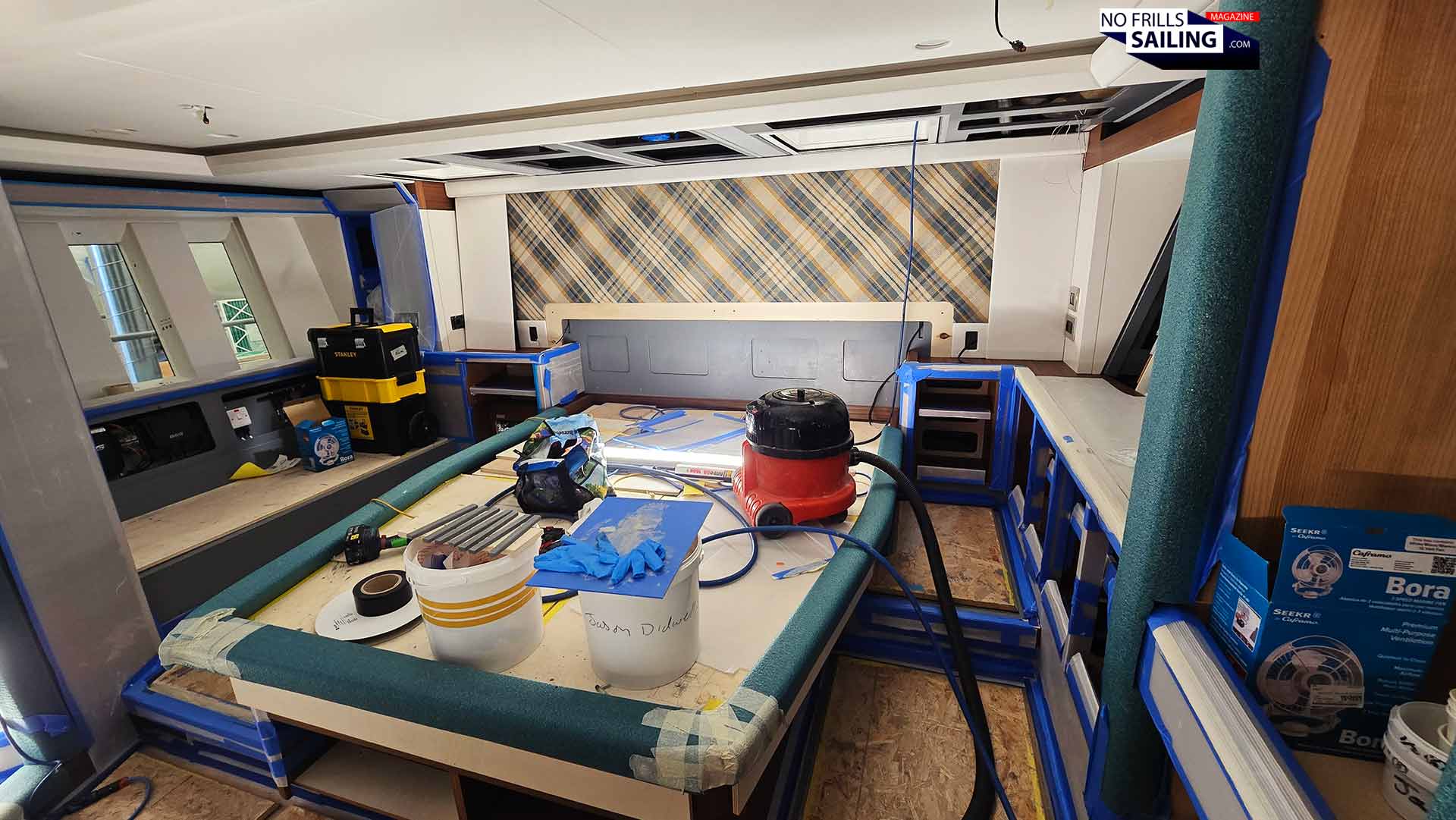
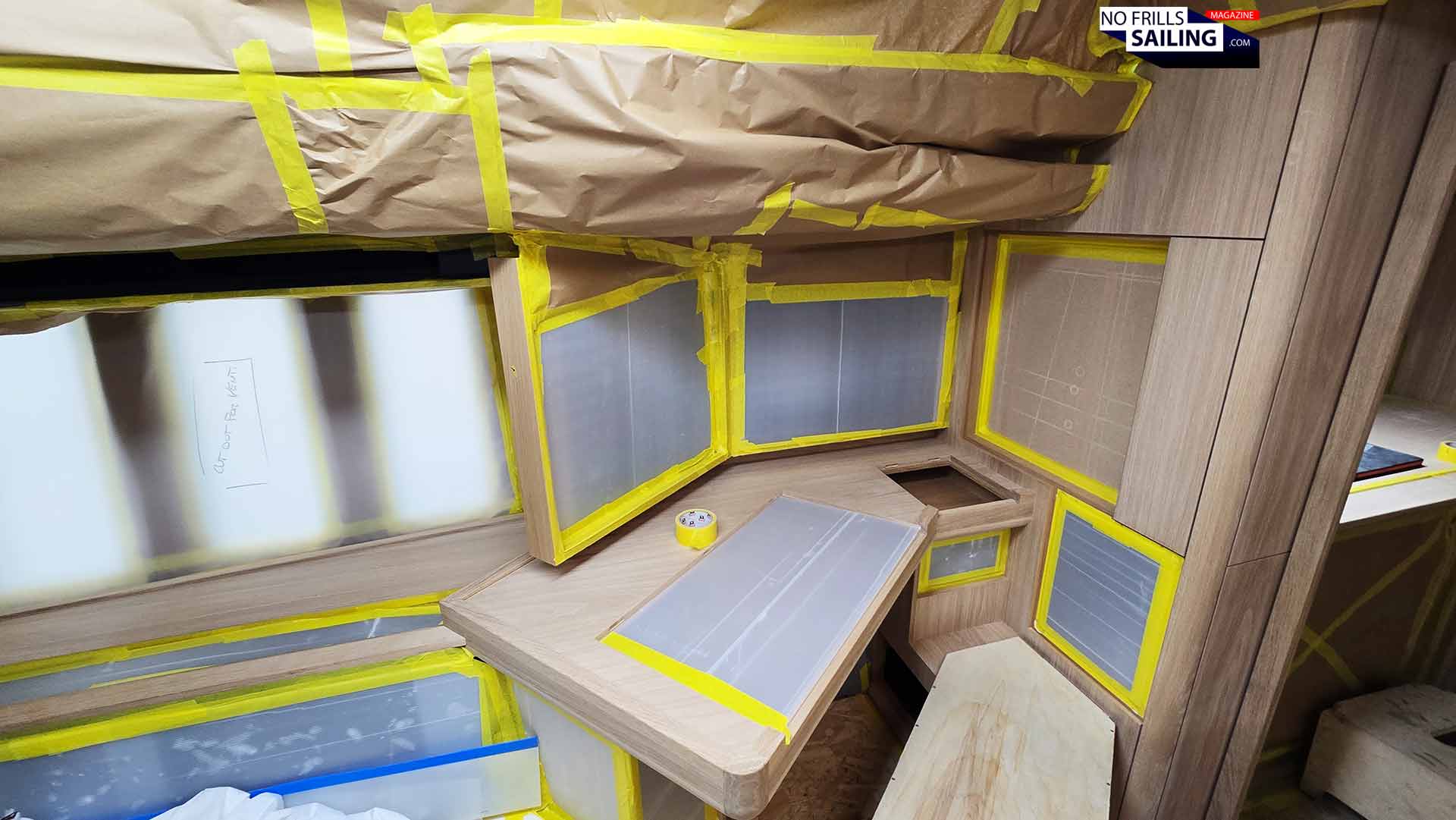
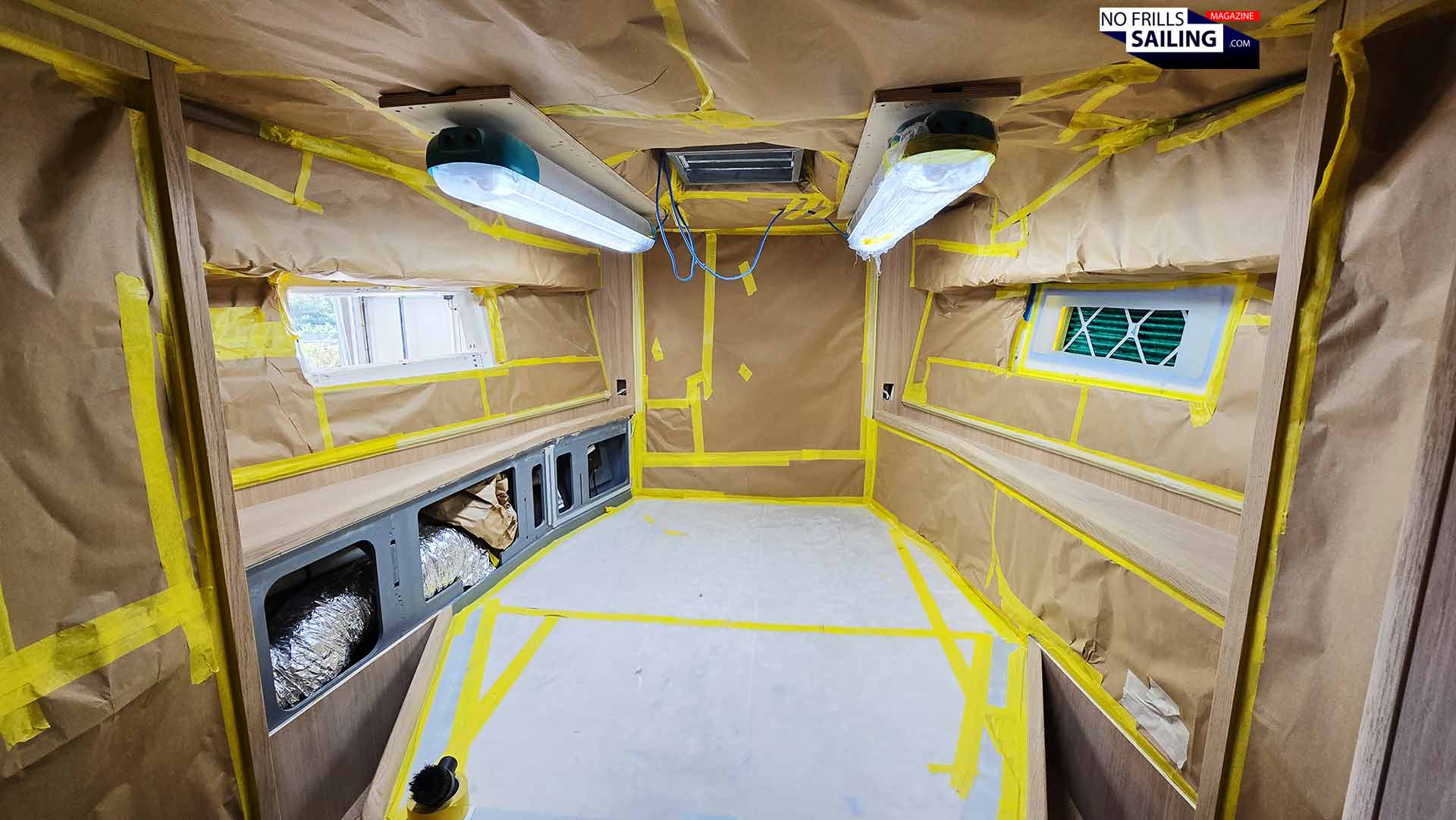
Everything is meticulously covered
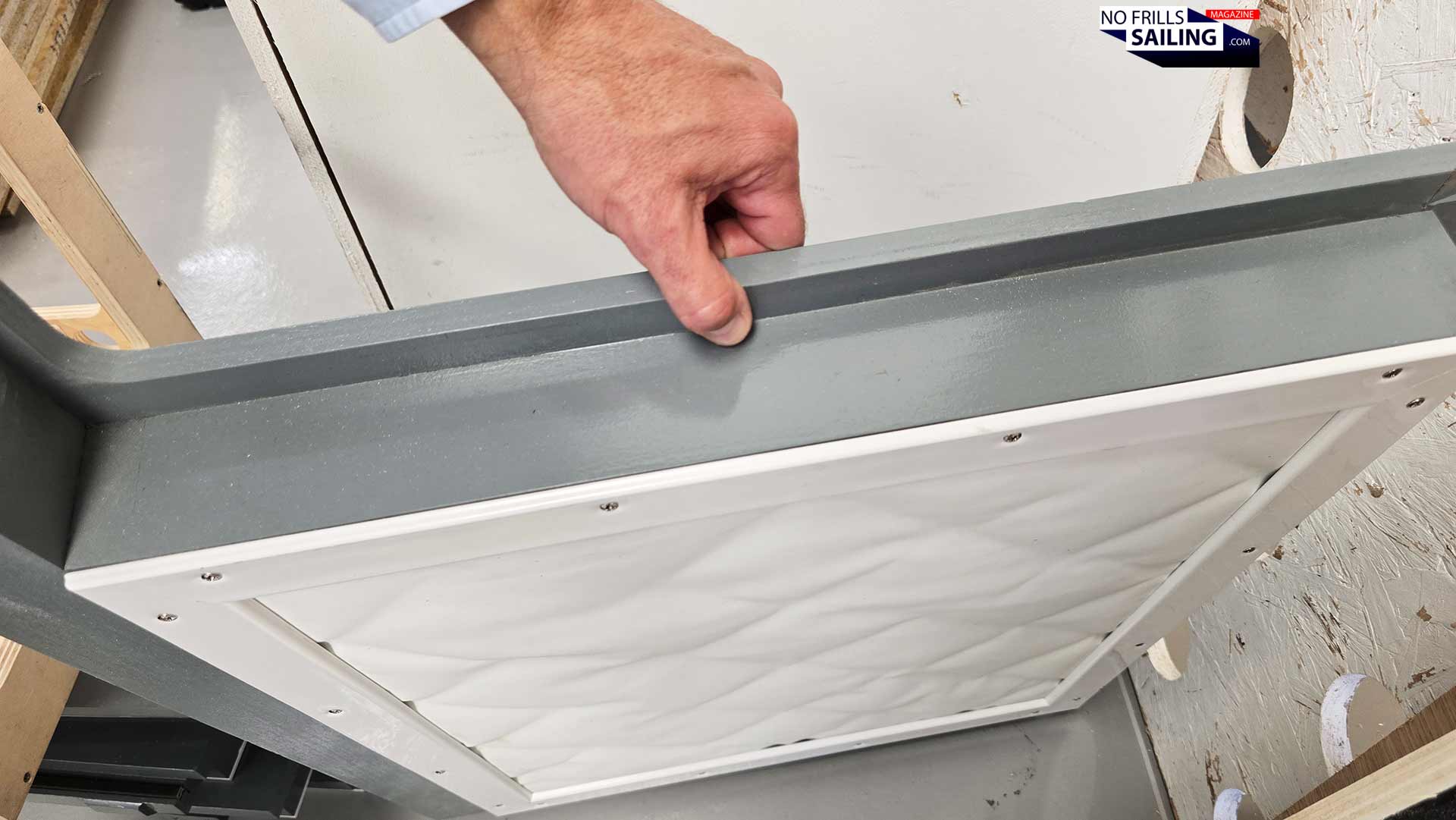
While some of the wooden parts, like the floor boards for example, are indeed spray-painted in a dedicated painting room in the carpentry, almost all of the joinery fronts are painted after fitting and mounting inside the boat. When I showed these pictures to the boat builders at my shipyard where the Omega 42 is currently made, they agreed: “This is how we do it with your boat as well. And this is how it´s supposed to be done.” But, you can see why it´s rarely done and if, only in the upper segment: It is just so immensely laborious! The masking of all non-painted surfaces alone takes a full week of work! Can you imagine?
It´s a week´s work
But in the end, as the painters assure me, after the up to five layers (!) of paint have been applied, the outcome is absolutely spotless! I´m not a painter, but I understand that the level of accuracy is much higher, as well as the aim to achieving a unison appearance, which is guaranteed when you paint the whole boat in one and at once, rather than different parts, supposedly on different days and in different circumstances. Once I handed over a white lacquered catamaran (which was an expensive extra on the menu): The three sides of one cabinet in the saloon showed three different (!) shades of white! Well, one thing leads to another …
The final fittings
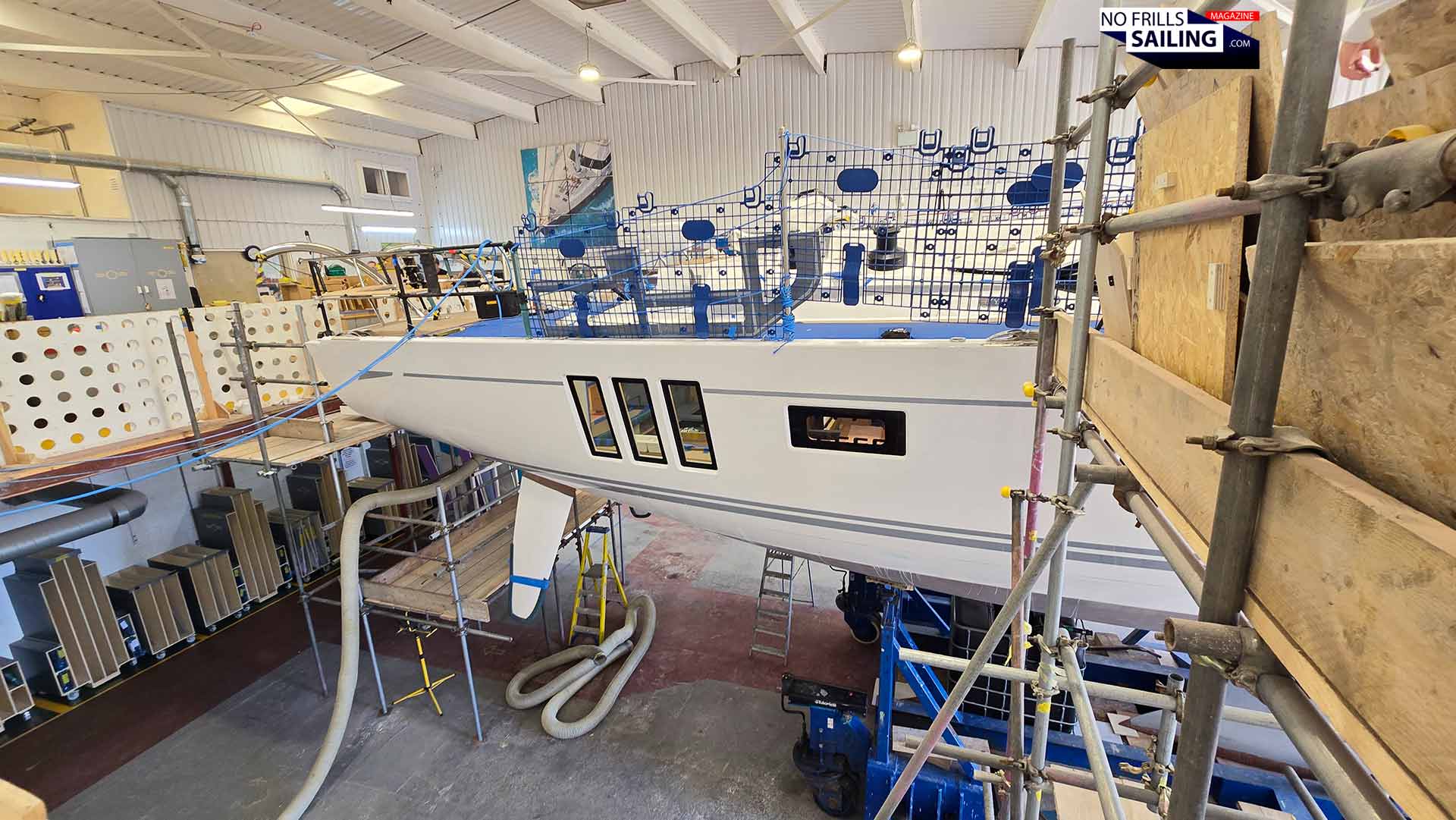
And so we arrive at the final station for the Oyster. Now, inside everything has been installed and thoroughly tested, the furniture is painted, everything works and is up. Matresses are delivered, the network is programmed and the boat basically is finished up to 99 percent – the rest of which is done in the water.
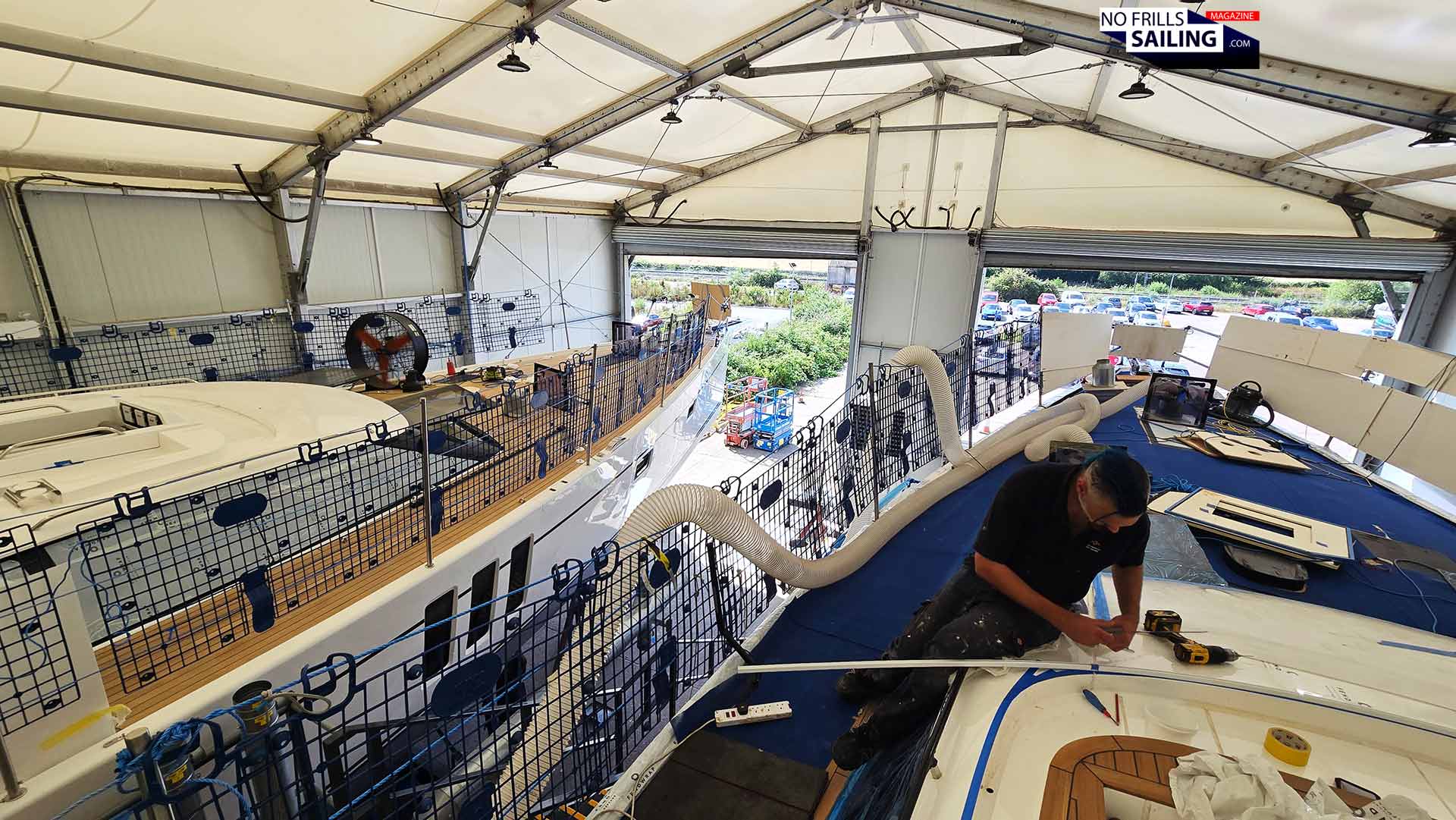
Last works up on deck
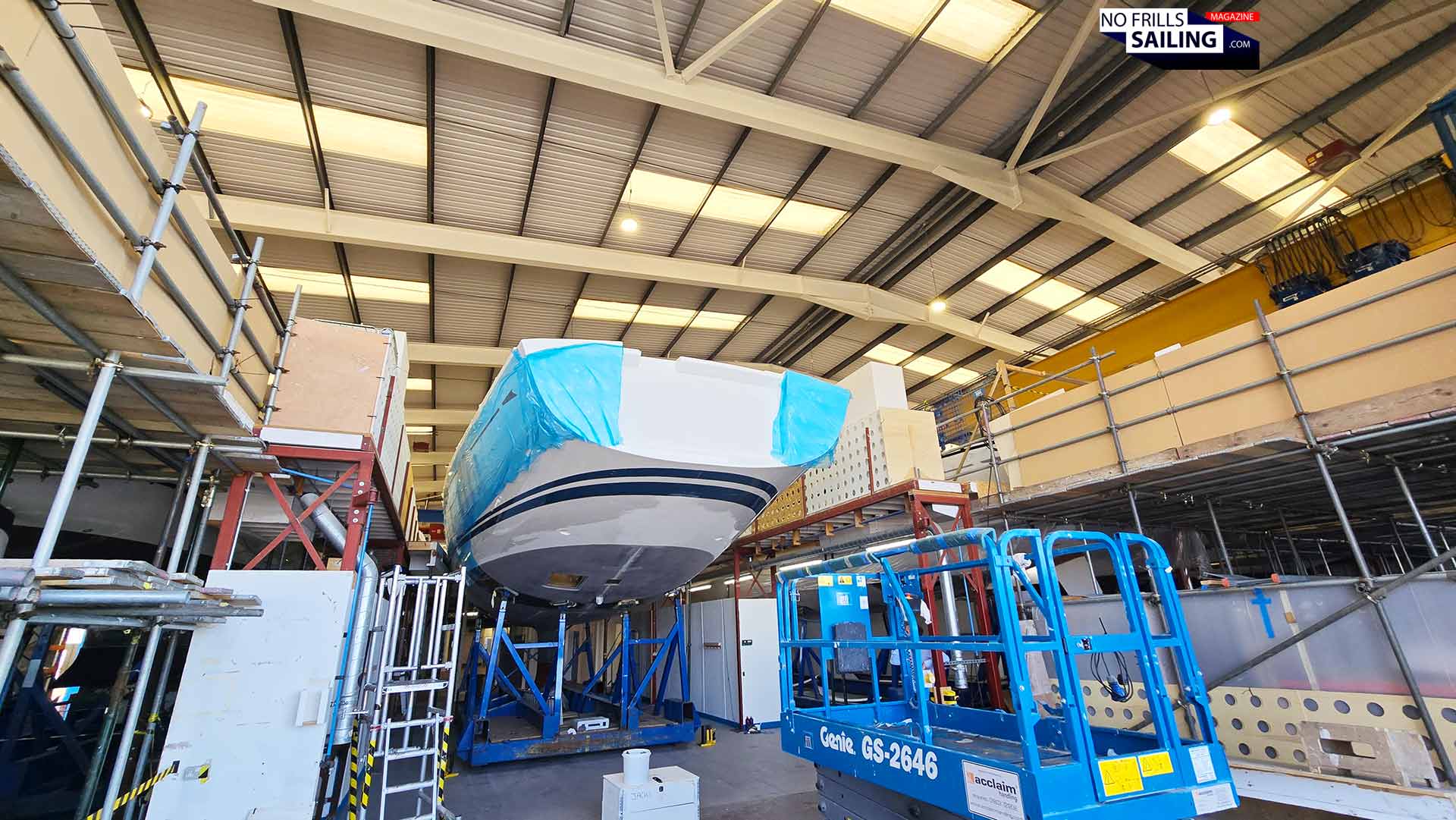
Below me, at her hull, a crew of five guys is currently applying the bottom paint. The details of which are determined by the sailing area the yacht will be sailing in and the wishes of their owners of course. Having done the bottom paint of my new yacht by myself a few weeks ago, I now absolutely know what it is all about and how straining bottom painting a yacht is. So it´s good to see that so many people share the workload, which also makes them complete the task faster.
We are nearly there …
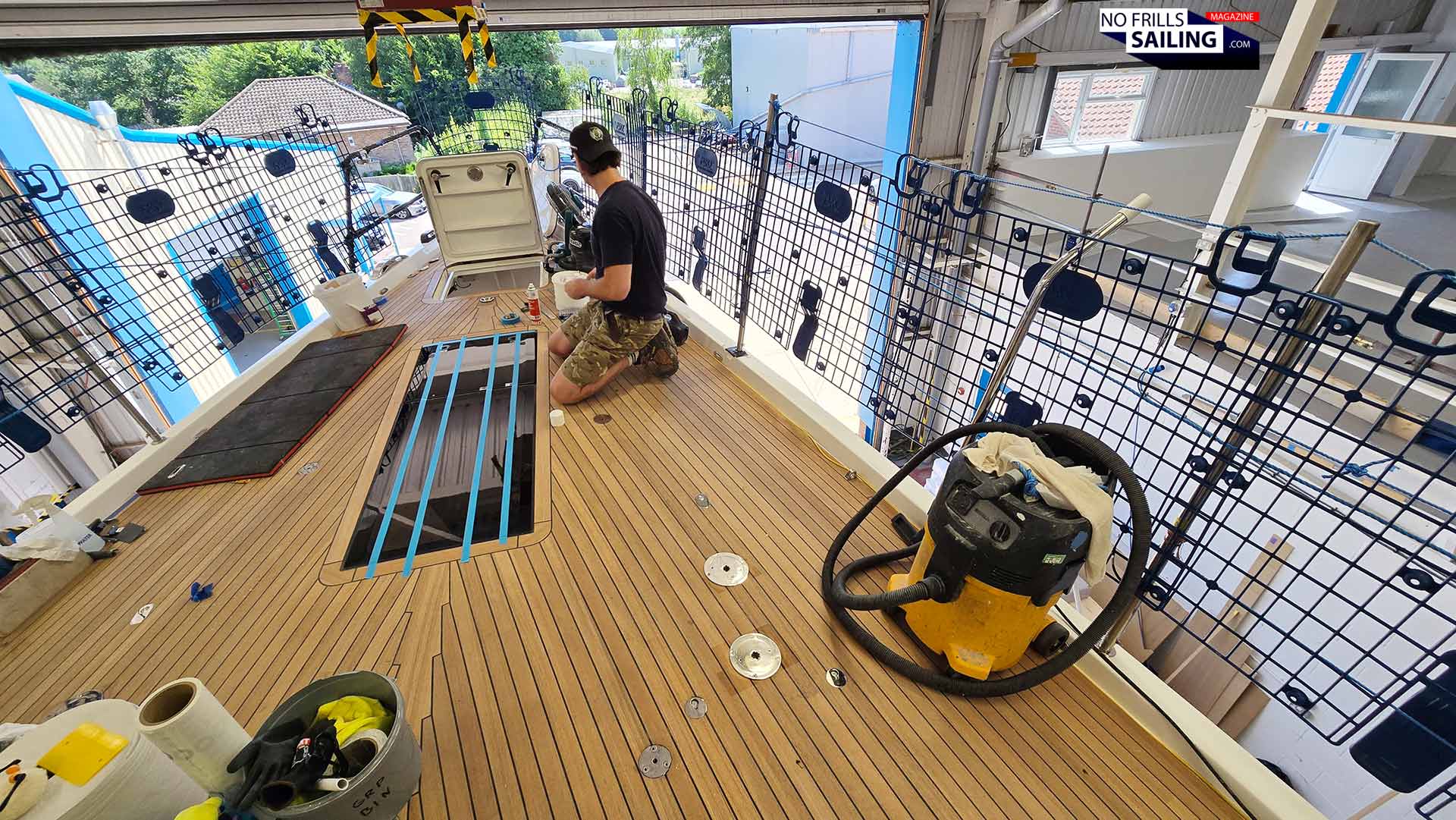
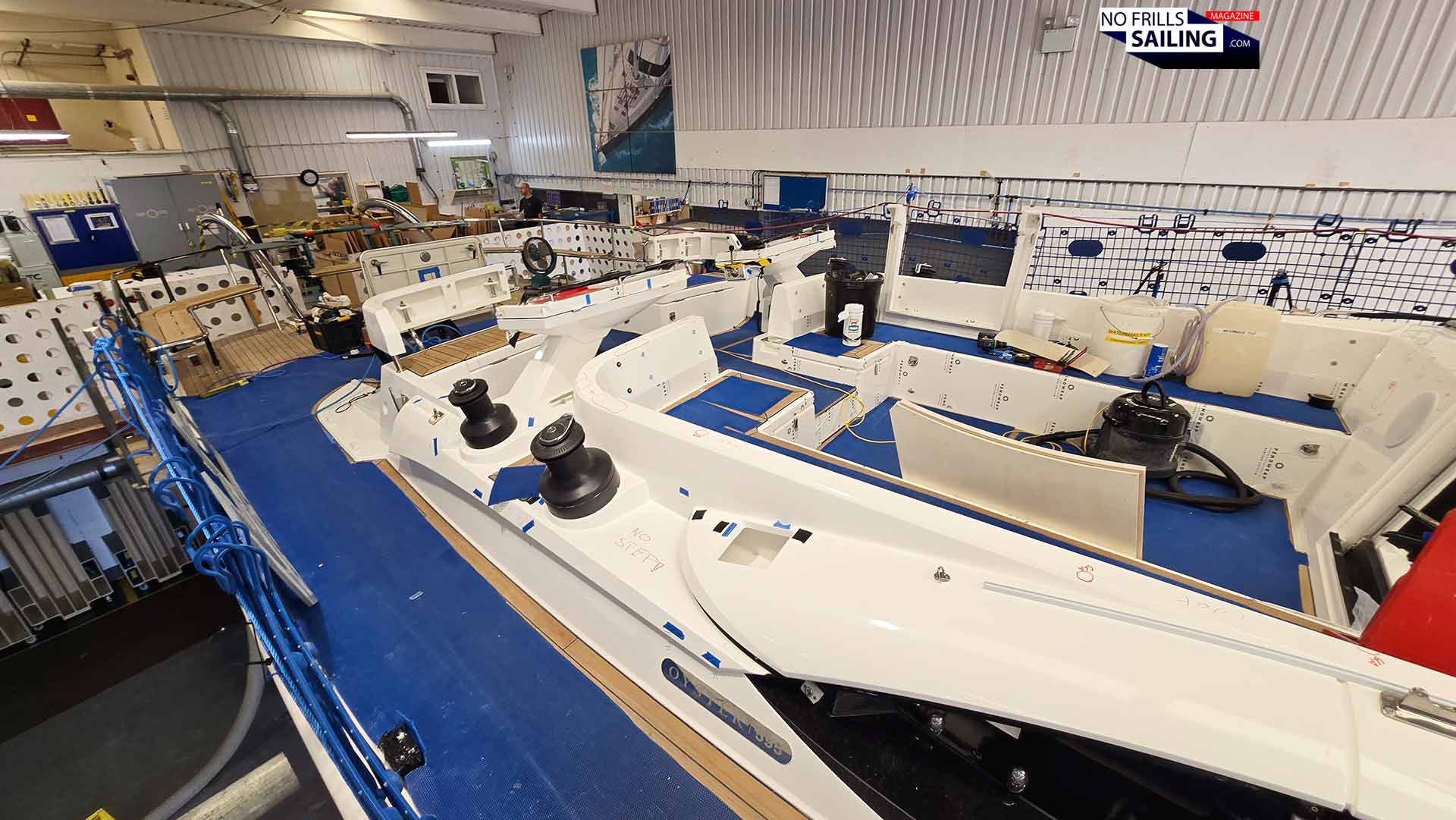
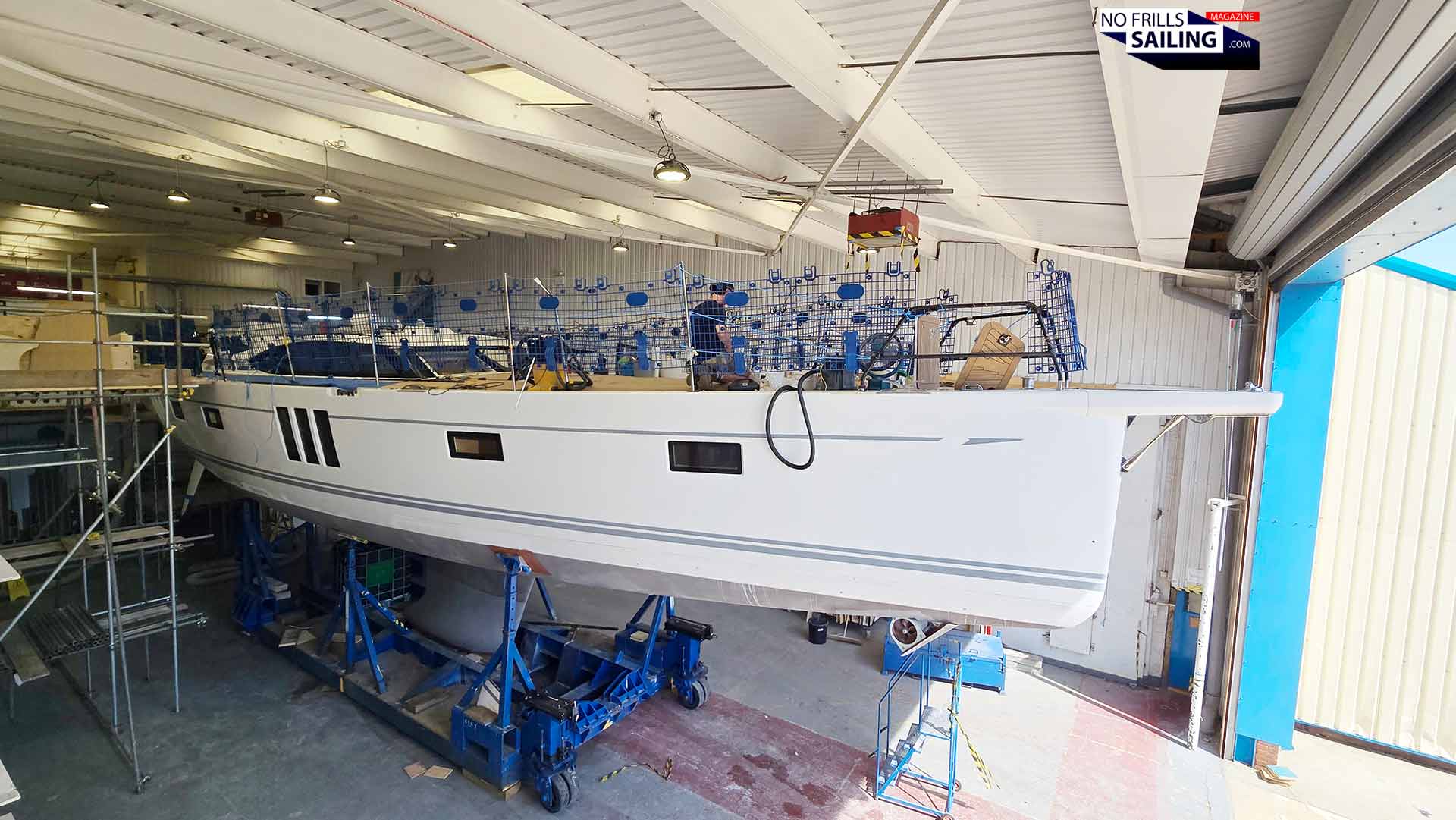
Up on deck the final bits and pieces are installed as well, just as the non-skid stickers on the skylight hatches as you can see on the picture. The teak deck is fully mounted, but it will need a concluding treatment once everything is done here on deck. Back in the cockpit the guys are connecting the chart plotters and secondary displays, fit the cockpit fridge and lighting system – it´s all the little jobs here and there to master the last items on the to do lists. By any chance: This yacht has it almost, this “new boat smell” …
Controlled chaos, you´d think.
Gradually, as works on deck are brought to an end, the safety nets are dismounted, replaced by the stanchions and railing for the yacht. The anchor and chain are fitted, and everything is thoroughly tested again: Red/green position lights, the windlass, cockpit electrics and electronics as well as the intricate machinery that works the dinghy garage in the stern. The boat won´t leave this last station up until everything is tested and the Commissioning and Quality departments have signed off the boat as finished. Even then, the project manager – often teaming up with the owners visiting their finished yacht – will himself painstakingly check every nook and cranny from bow to stern so that everything is just as the brochure promises.
Preparing the yacht for handover
And that´s it. We´ve reached the end of the production line: This is Oyster Yachts in Wroxham. We´ve seen the lamination of hull and deck, were able to take a detailed look at the parts which make up the structural integrity and stiffness, ultimately the seaworthiness and comforts, of an Oyster. We have seen the interior coming together from the bulkheads to the furniture – and finally the finishing touches and the constant testing to achieve an immaculate status.
Ready to go?!
The yacht is now declared “ready for delivery”, which in itself is a whole new chapter. Unfortunately for me there wasn´t a roll-out of a finished Oyster that day. Usually, this is a big thing for both the owners (of course) as well as for the team here at the shipyard. Another yacht being hauled out and put on a heavy duty trailer to being driven to the sea. What a great feeling this is – pride, pleasant anticipation and lots of excitement, I can imagine! But, what happens next?
Another Oyster 595 shortly before delivery
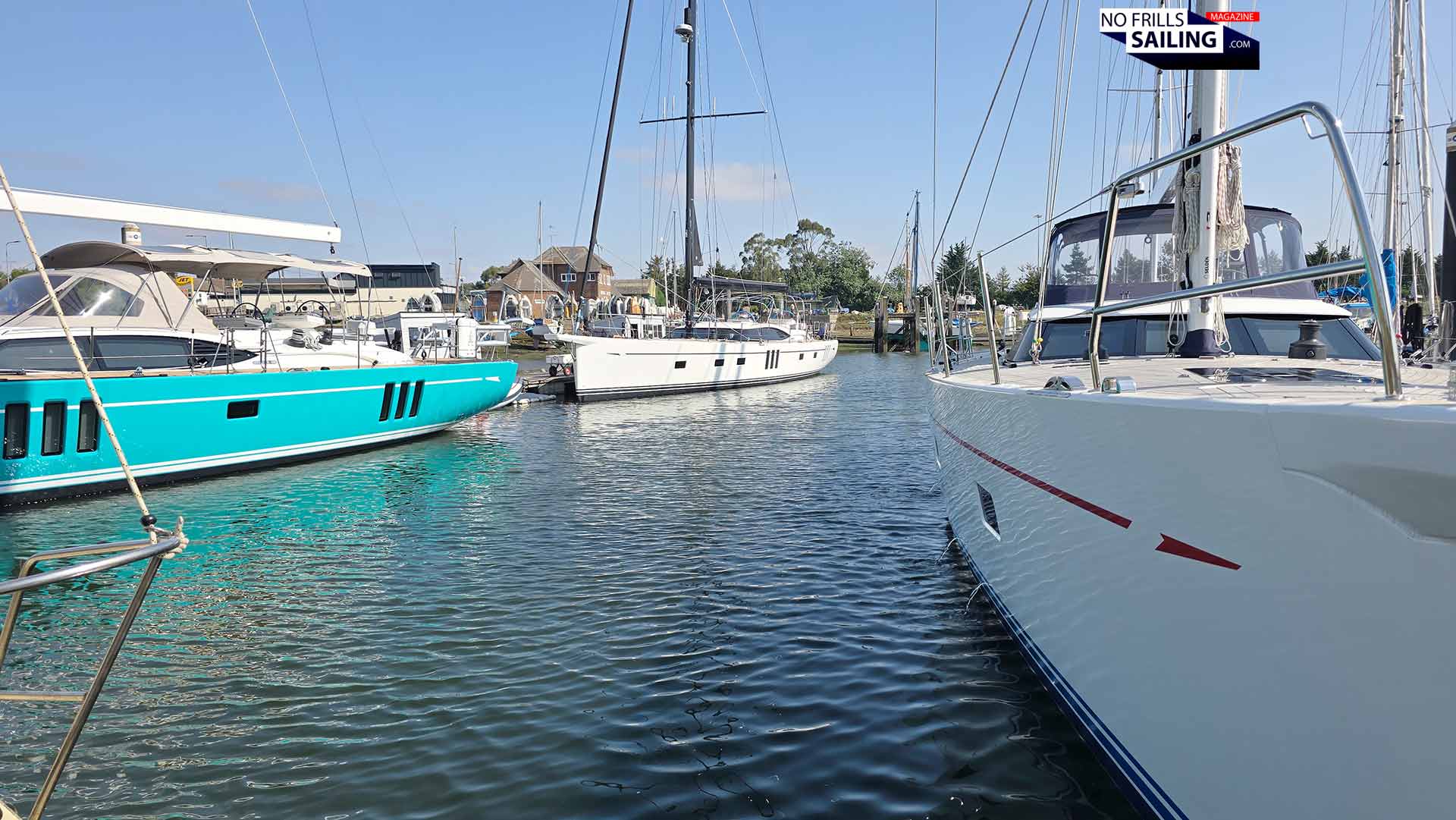
As the now freed building slot here at Wroxham is quickly filled with another new raw hull being finished just up the road in their Hoveton factory, the next Oyster will ultimately enter its final phase. Everything set to zero again, the chain starts all over. For the finished boat the journey has indeed just begun. Usually, any new Oyster being built here in Wroxham will make its first 50 miles on tarmac – being brought to Ipswich.
Advertisement
You should stay tuned …
What happens here is the next chapter, and you can absolutely look forward to this article. Because after I say Goodbye to Stephen Parkinson here in Wroxham, I drive the same roads to the small town located at the river Orwell. Here, in the famous Fox´s Marina, everything that is Oyster today has it´s origin back in 1973 when Richard Matthews decided to build the Ufo 34 prototype. I will have another full day here with the Oyster-team tomorrow, and you should stay tuned.
Next article: At Oyster in Ipswich!
We will board the yachts and take an Oyster 675 to the seas. Finally I will make my dream come true to check how an Oyster behaves under sails, I will watch how neat and nicely even such a big yacht is able to navigate in and out of the most cramped berths and what will happen to a new boat arriving here freshly out of its building cradles back in Wroxham. This will be an amazing experience as well!
So, why in the meantime don´t you just quickly subscribe to the monthly free newsletter? This way you´ll never ever miss any article again. Every month an email informs you about the last postings and the fresh videos on my YouTube Channel.
For now: Thanks, Stephen, for the wonderful, exciting and informative hours here in the fantastic Oyster shipyard!
Check out these related articles for more on Oyster Yachts: