When it comes to serious oceanic sailing, true blue water yachts should come with structurally sound hulls, built as robust and safe as possible. As much as rigidity and stiffness determines how reliable a sailing yacht will be, it should come with a lightweight displacement and of course must be beautiful: This article will delve deep into production methods and high quality standards at Oyster Yachts in Wroxham, Britain´s leading prime brand when it comes to true luxury blue water sailboats.
When we think of Great Britain, of course, many stereotypes will ultimately hit our inner eyes. I´ve only recently re-discovered my love for our European neighbors after literally ignoring England as a travel destination for over 30 years. Which is a shame, because this country has so much to offer, from a rich historical heritage to vibrant cities, culture and one of the most friendly and likable people on Earth. I´ve tested this a few months ago when visiting London, really falling in love again with UK after I´ve been here for the last time during a school exchange in 1996.
Ahhh, Great Britain!
When talking about “love”, it´s of course much more than loving their Fish and Chips, Sunday Roasts, the Guinnes (albeit not English, but Irish, but never mind). Because one thing I had truly admired for so long now is their prime brand when it comes to yachts. I of course am talking about the epitome of luxury sailing, the potentially most admired yacht brand when it comes to blue water cruising and – if you ask me – the most beautiful semi-deck saloon yacht there are. I am, of course, talking about Oyster Yachts. Yes, I am an Oyster-fanboy, I´ve made my own half model of the Oyster 745 which put over my working desk. Maybe as a stimulus, surely because I so much admire the distinctive and unmistakable lines of these yachts. So, please don´t expect me to be fully objective and neutral this time … because as much as I want to keep a certain journalistic distance, this time, whilst visiting Oyster, it was really hard for me …
Arriving in the Norfolk Broads – at Oyster Yachts!
Advertisement
I was astonished how easy it was to get a go-ahead for a trip to the UK again. Usually, shipyards are a bit restrained and, how shall I put it … skeptical? … about seemingly non-potential buyers asking for a shipyard tour. That has something to do with them don´t wanting to disturb the workflow in the shed, not wanting to waste precious time of their professionals and also with production secrets: There are still shipyards I couldn´t visit and there are still so many stories I couldn´t do because of stuff being deemed “secret”, remember my hull-deck joint article? Beneteau prohibited the publishing of this interesting content, for whatever reason. Anyway, when I asked Oyster if a visit would be fine, I received a confirmation with a warm welcome right away on the same day! “We would be delighted to show you around!”, the marketing manager wrote.
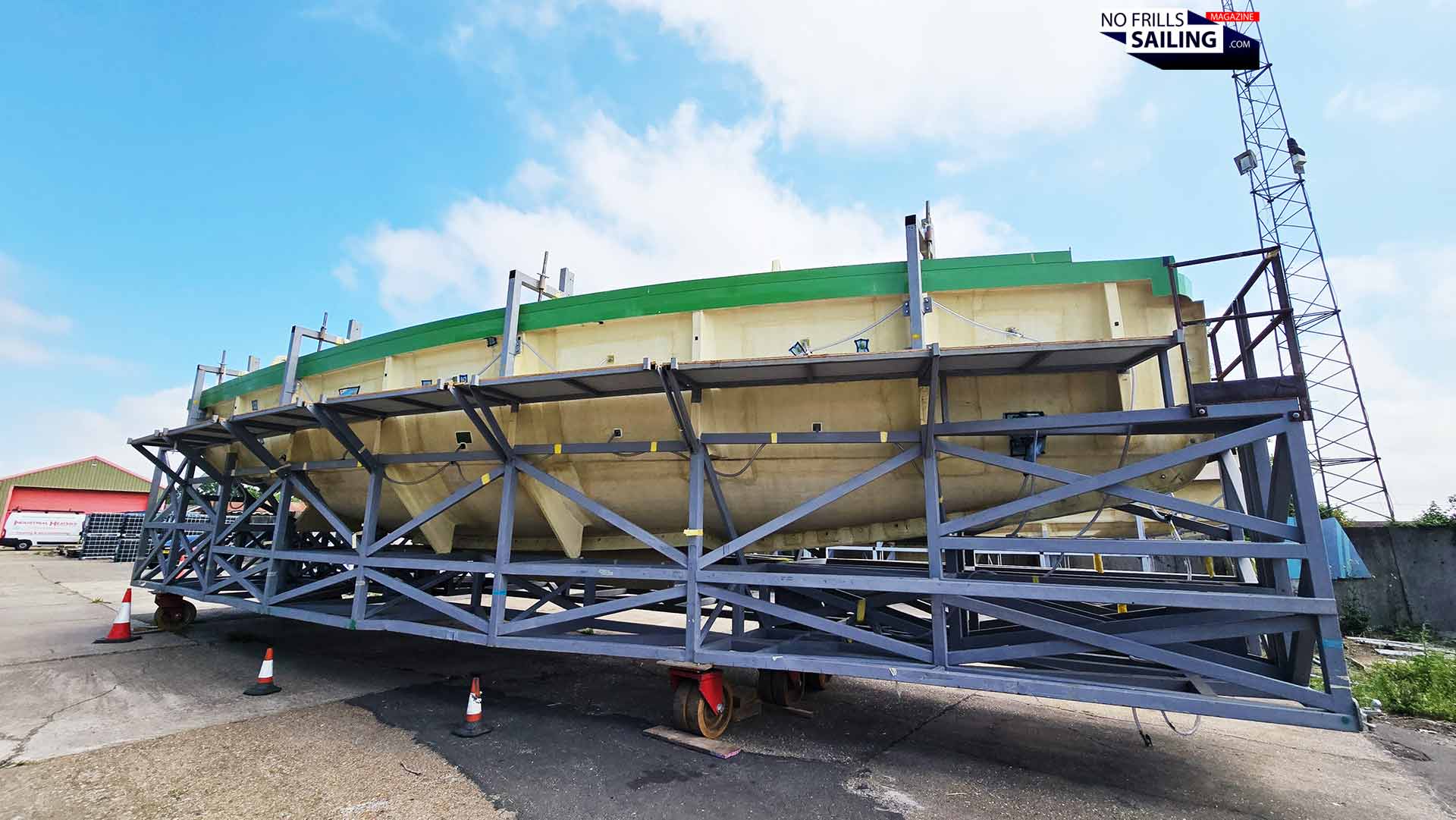
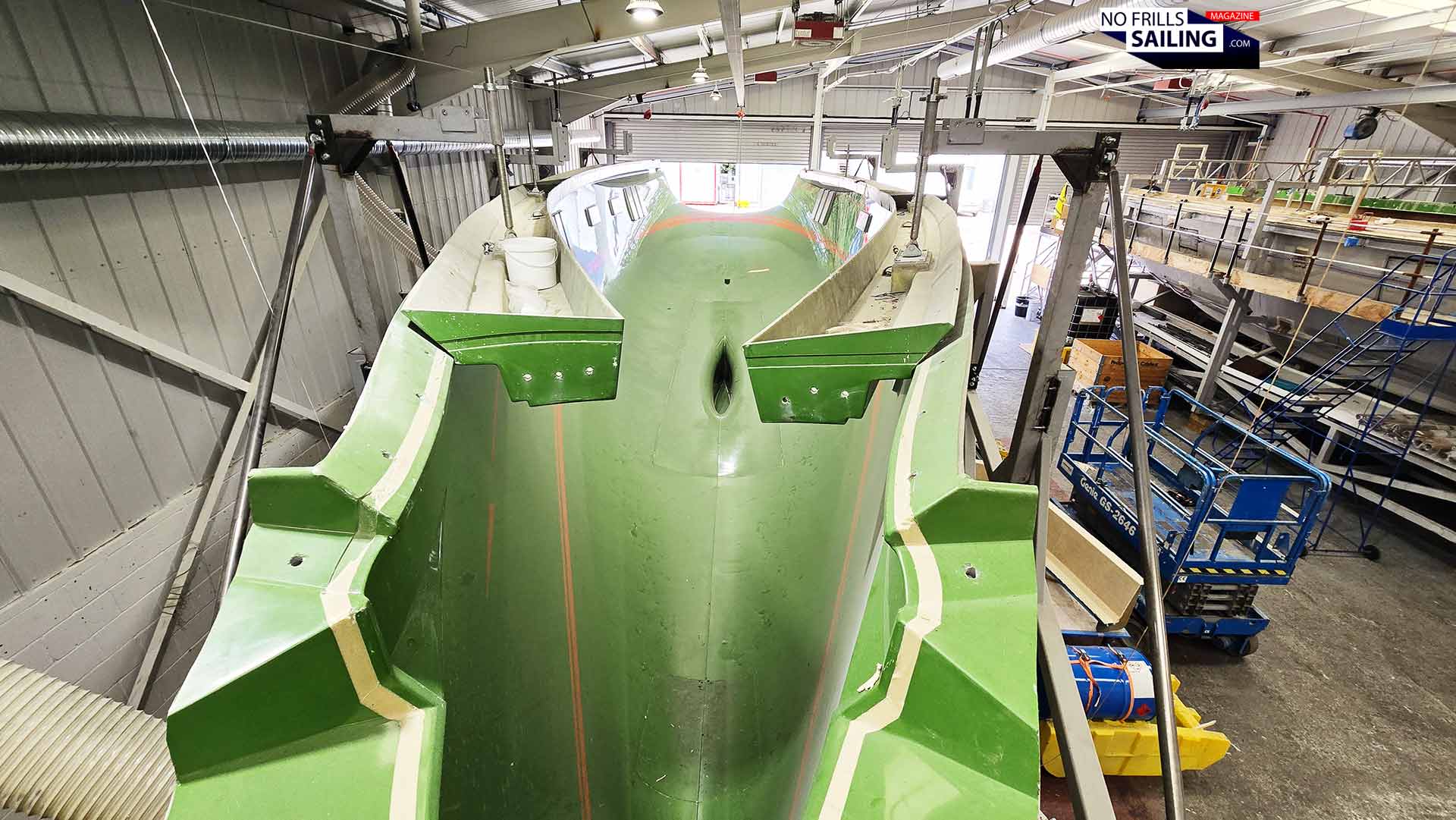
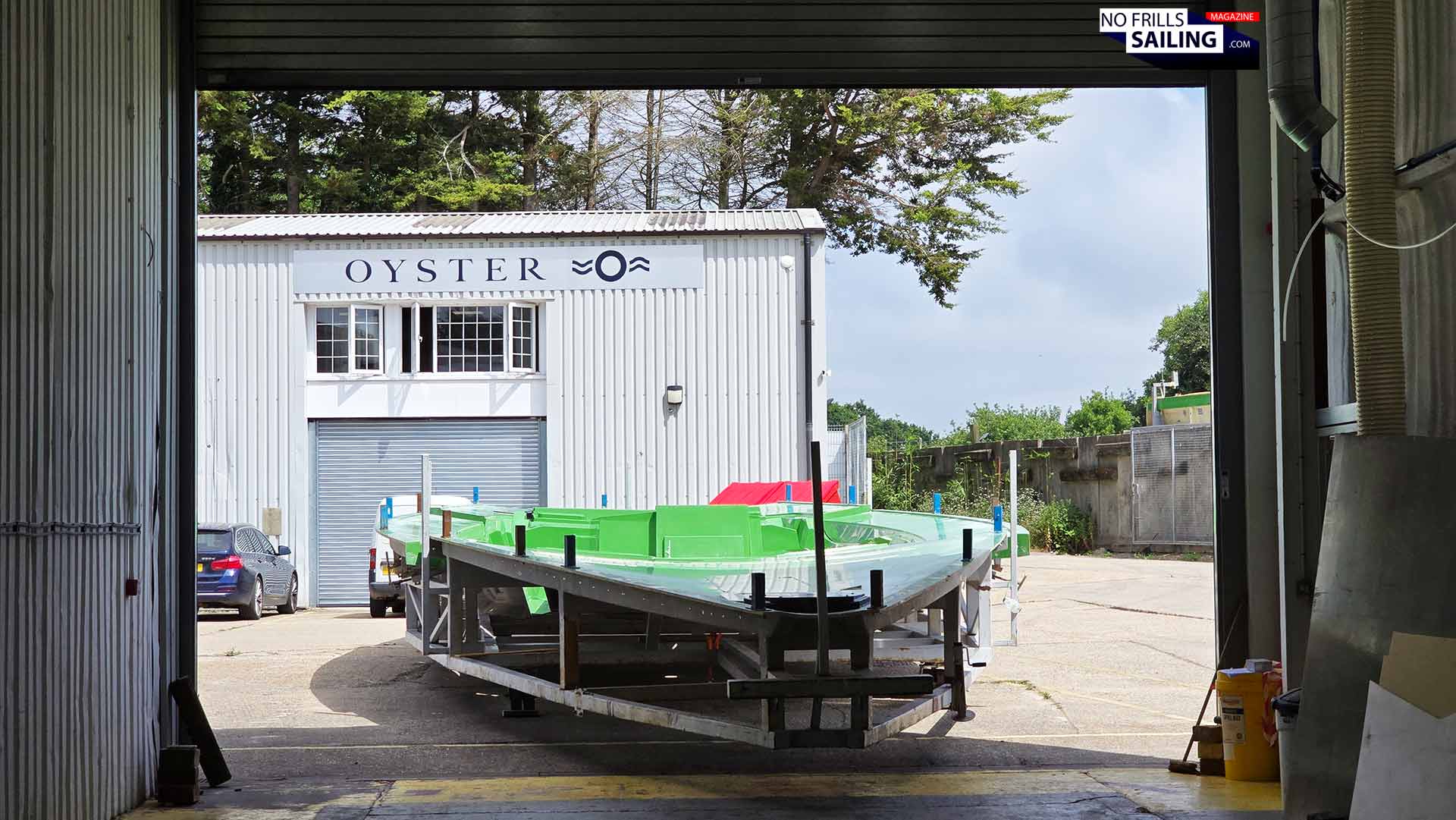
The new Oyster 515 hull mold
“We” in this case was none other than Richard Gibson, Group Sales and Marketing Director of the company, who welcomed me at the Wroxham premises after a two hour drive from London-Stanstead airport. Oysters are built in the Norfolk region of England. It is an interesting region: Beautiful rolling hills, wide open fields and of course the network of canals, little waterways and shallow lakes. A man made landscape, combining natural beauty with England´s history. The Norfolk Broads are to this day a prime destination for regional vacation, for Londoners seeking some relaxation and spare time. Oyster Yachts was founded here back in 1973 by Richard Matthews, who named his company after the shellfish. Leaving the transfer taxi I am greeted by Richard Gibson, who introduced me to his staff right away. As there was so much to see, we jumped into his car and drove after two quick minutes arrived at the first location of my walkaround: The hull lamination and deck production facilities.
Exciting times …
I am visiting Oyster during exciting times. Having announced their latest entry to the fleet, the brand new Oyster 515, I could see the mold being prepared to make the first boat of that new type standing outside of the shipyard´s halls: Ready to welcome the glass fibers and the resin. It´s a great occasion for Richard to start the walkaround on the premises, because, as with any other GRP yacht as well, it all begins with this mold. The new Oyster 515 will replace the great 495 right away, which had been introduced only four years ago in 2022.
20.000 hours for one digital Oyster …
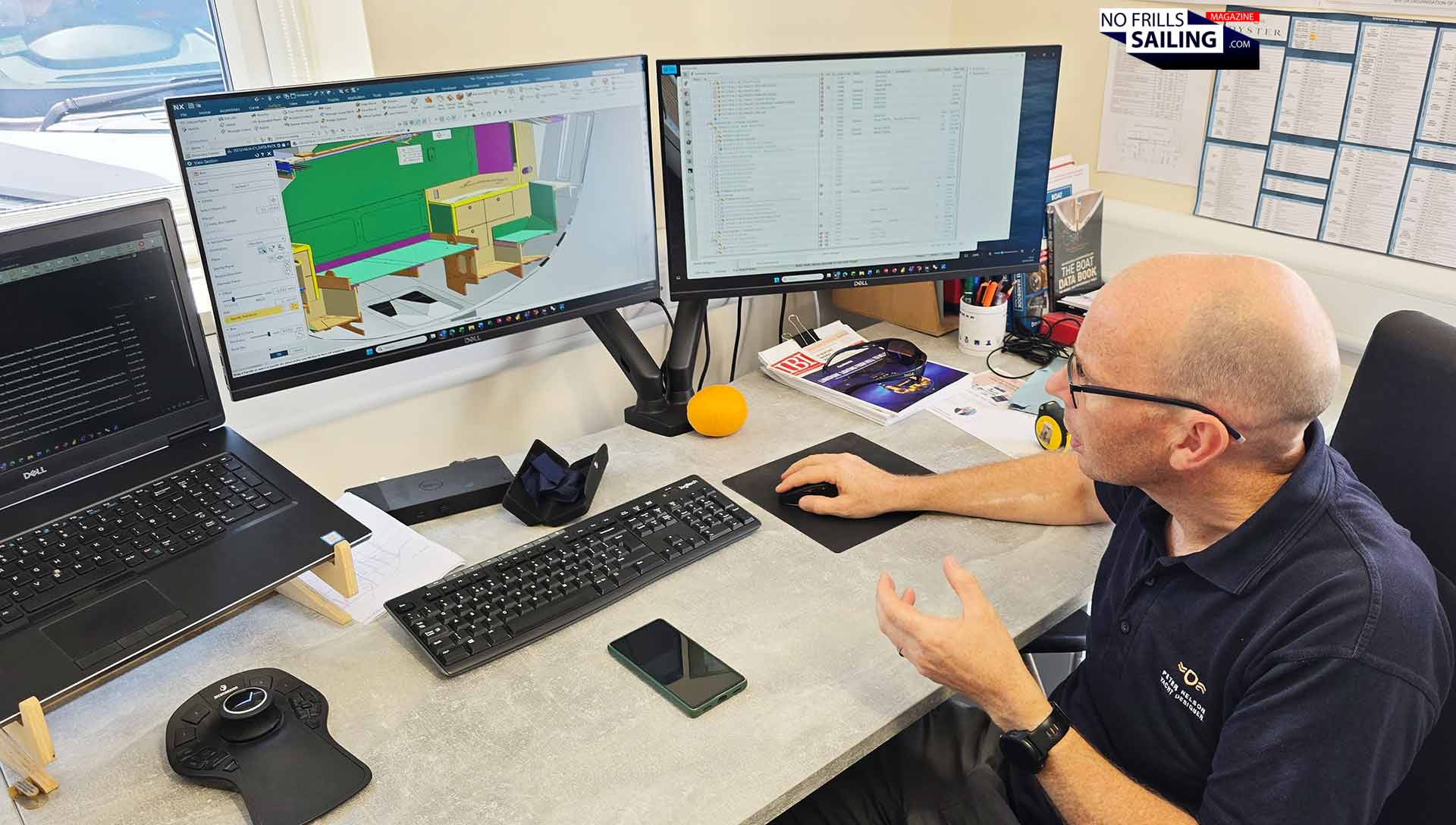
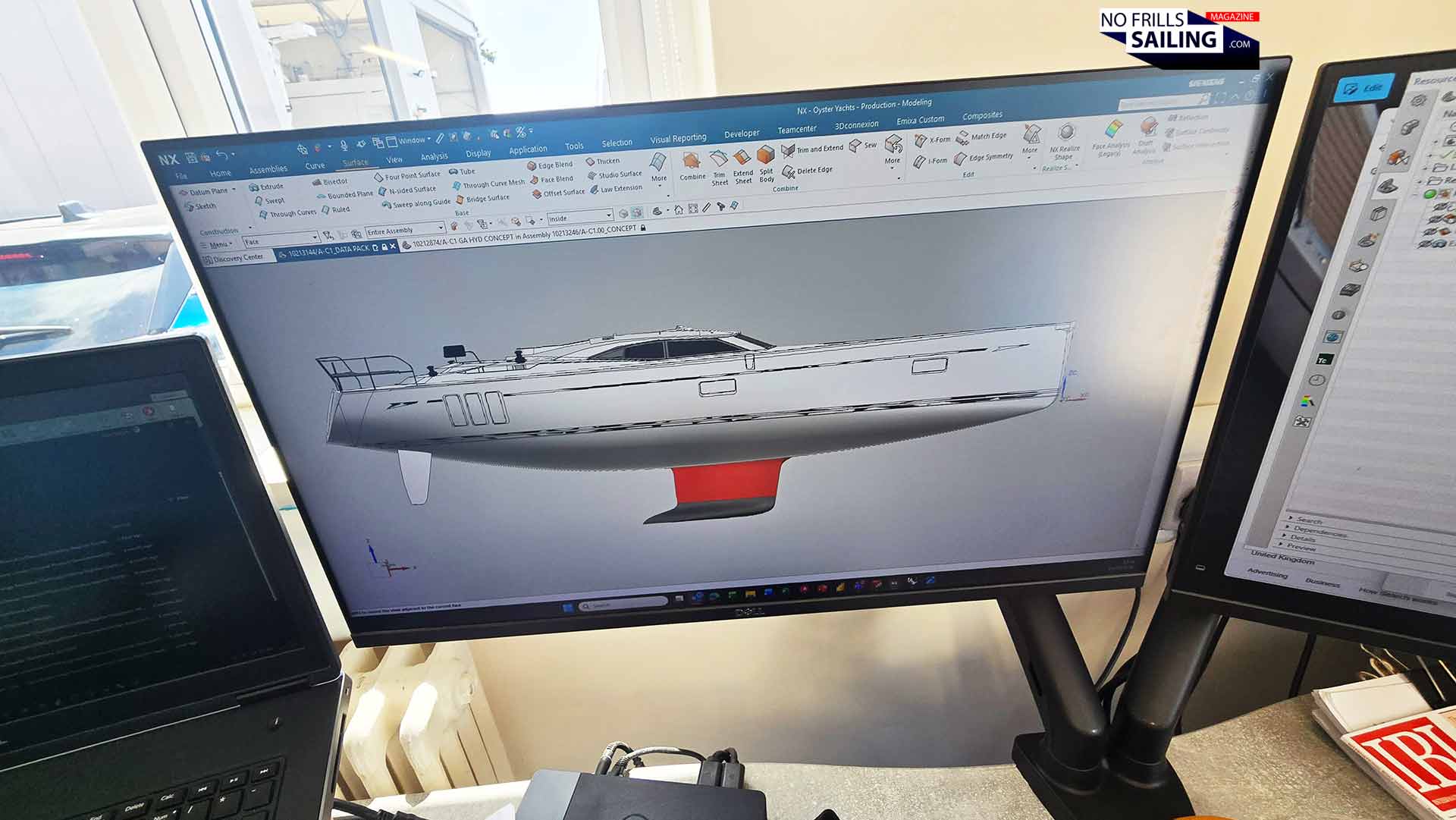
Being a pretty successful yacht with over 20 units sold, it came with a few compromises, especially stowage capacity, which has now been addressed. The new entry-level Oyster will offer better solutions in many areas whilst keeping the attractive compact size, amazing sailing performance and handling advantages for a crew of two (and even single hand sailing). In this, it is interesting to note that Oyster did not re-invent the 50-footer completely from scratch, but this time re-designed the 495. Pretty efficient and only possible because any Oyster yacht is digitalized. Well, that´s nothing new, you shall think now, and you are right: CAD or CFD models as well as VPP predictions are a common thing in boatbuilding. Richard introduces me to the head designer of Oyster´s own design office. On his screen the digital model of the new Oyster 515.
That´s one beautiful Oyster again!
Showing me the literally dozens of layers, we can visualize any aspect of the yacht´s construction. Any. Single. Aspect. That´s the structural stuff like glass fiber-layup, load distribution and such. That´s the joinery in any detail, wiring, plumbing, the big and small installations and even the tiniest detail, like screws or panels. Everything is digitalized. Literally. Everything! But with Oyster, it´s much more than just pre-designing everything in the digital world: If you order your Oyster, these guys will make a “digital twin”. That´s a copy of the standard model, but containing all the specs, individual choices of your configuration, changes you make and customizations you ask for. Terrabytes of data to make sure that your Oyster is meticulously planned and thought through in every conceivable detail before even one working step has been started in the real world. This “digital twin” makes sure that the boatbuilders don´t have to figure out things during production, adjust to your special wishes or – the worst – come up with workarounds to fit your wishes. Amazing! Surely, the amount of data for any digital twin Oyster must be so great that it won´t fit on your home computer´s hard disk drive …
Hand layup and meticulous craftsmanship
After having met the inhouse designers, we proceed to the first workshop. As we have high summer´s season now, the huge factory gates are wide open: 28 degrees Celsius is well within the temperature range in which GRP should be processed. I can see two big molds on the shed. Somewhere music is played, a team of workers in protective coveralls works within one of the molds. Richard tells me that Oyster exclusively utilizes hand layup lamination techniques as it ensures the best outcome for the hulls in terms of manufacturing quality. This is the first surprise for me as I am used to seeing vacuum infused hulls in most series production boat shipyards. For Oyster, relying on hand-lamination is testament to their craftsmen, specialists for layup, application and preparation of the hull.
Entering the lamination workshop
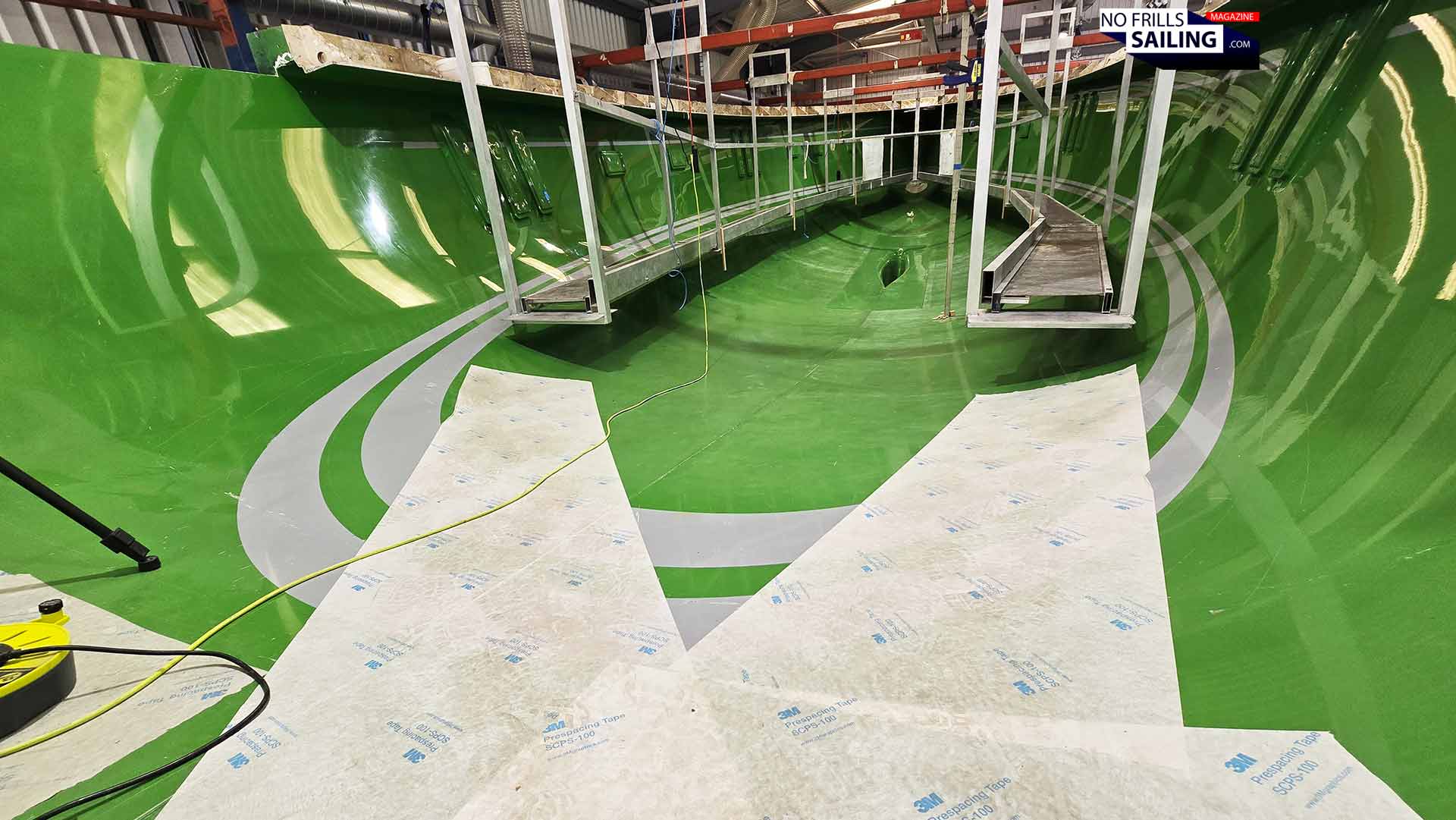
I take a look into one of the empty molds. As with any hull mold, the surface is green. This makes sure that any imperfection, possible damage after demolding up to the tiniest scratch in the mold can be detected by the boatbuilders and removed. If it would have been a white surface, discovering those spots would be much harder. After a freshly laminated hull had been removed from the mold, it will be refurnished right away and meticulously polished so that the following hull will come out as smooth and perfect as the previous. This way, dozens if not hundreds of boats can be made using just this one mold.
An empty mold
I can take a look from the stern into one of such freshly prepared molds: The green surface of it is polished, protective sheets cover the entrance area. Here´s a specialty in how the hulls are actually laminated, one that sets Oyster apart from every other shipyard I have visited so far: The boats, no matter how big they are, will apparently be laminated as a single whole unit within the molds. Typically, series production boatbuilders will laminate the hulls for boats larger than 50-55 feet in two halves, just to bring these halves together after they are dried. Obviously, Oyster prefers to make the hulls as one uniform, rigid part right away, minimizing potential weak areas along the centerline.
Polished and ready for some wet work
In this, laminating takes place “inside” the hull with workers standing on a metal rigging that is suspended within the mold. You can clearly see this working platform in the picture above. From here, the staff can walk all the way up to the bow and easily reach any area of the boat, from the stem in the front to the ship´s sides as well as deep down into the bilge where the keel flange is located. I have never seen a production process like this, so I am very excited to check out the neighboring mold where the lamination work is in full progress.
The Ace of Spades
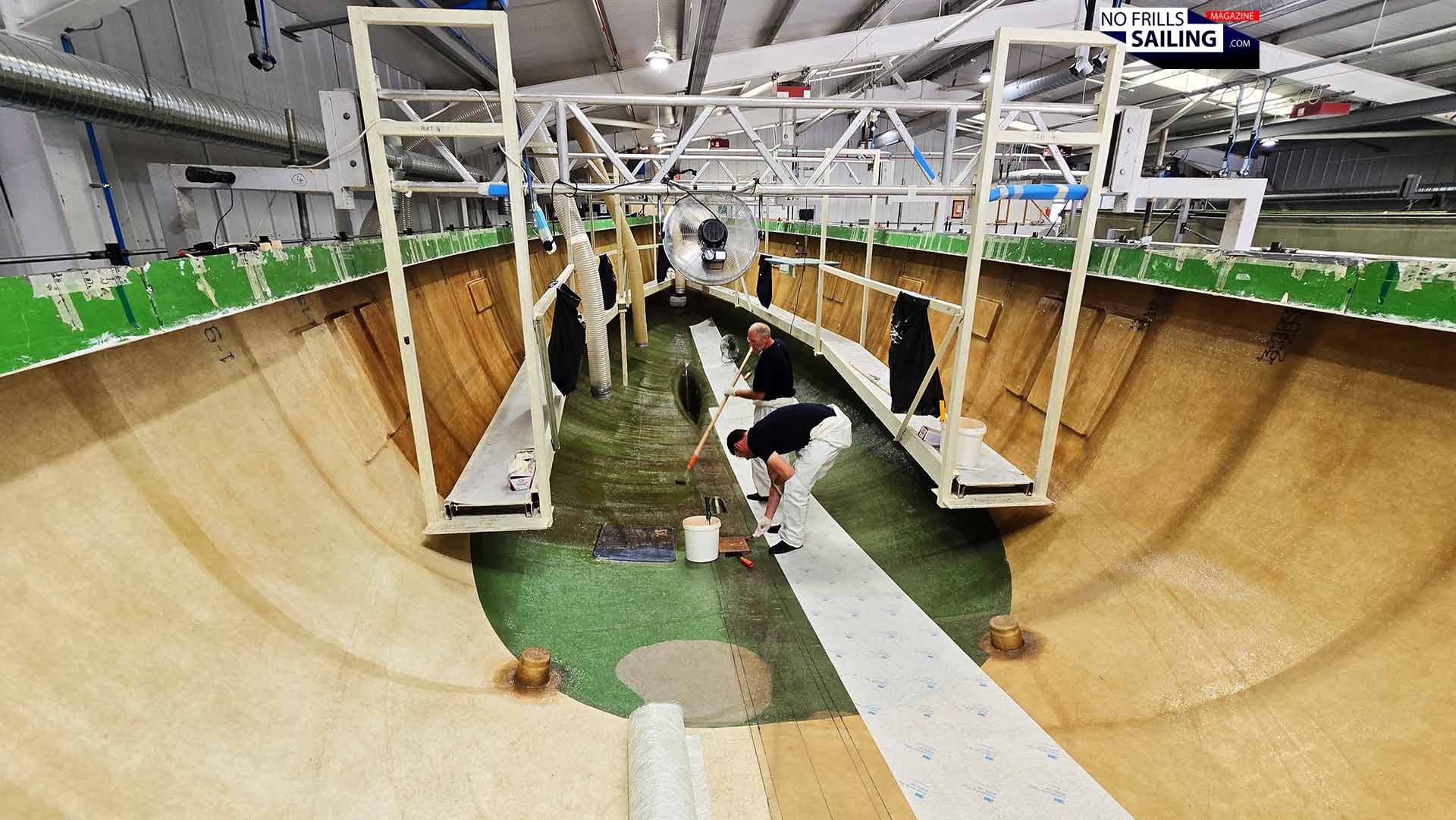
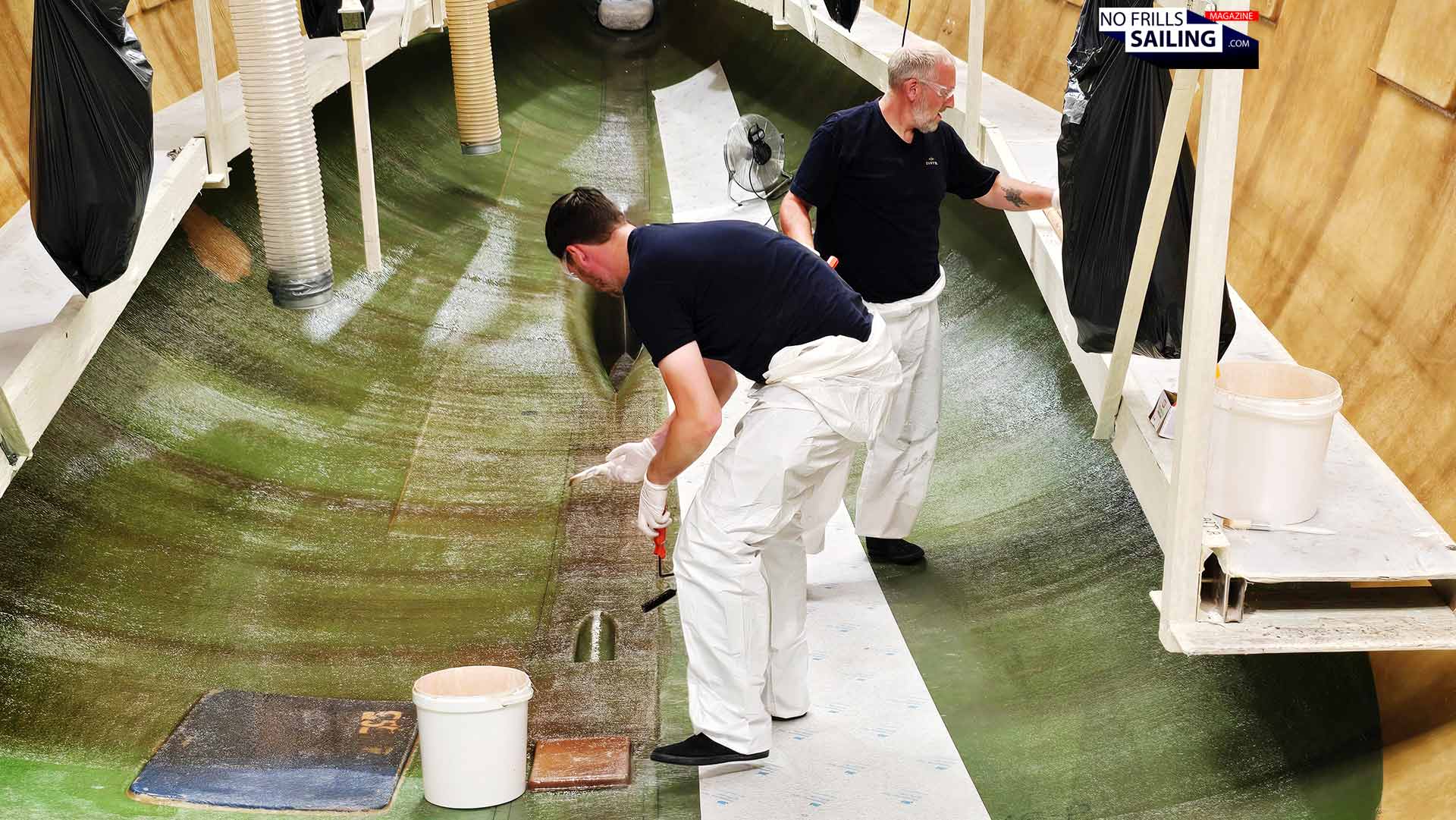
Now it gets interesting: Within another mold the workers are concentrated, music has been toned down. There´s the distinct smell of resin in the air, the lamination process of a new Oyster 675 is in full progress. Apparently, works have just begun. Richard explains how an Oyster hull is made here, starting, of course, with spraying the gelcoat. Oyster exclusively uses plain white gelcoat and does not mess around with different colors. If you want your Oyster with a dark blue hull or any other color, you could have it painted of wrapped. Another nice detail are the waterline markings, which in case of Oyster are two thick stripes, which are not painted but gelcoat – therefore part of the structure.
Hand lamination here at Oyster
This hull shows the gelcoat above waterline, with a first layer of glass fiber attached. The workers are currently laminating layers from the bow to the stern. As you can see in the picture, one is putting the resin-soaked glass fiber mats into the hull, attaching them with a small roller, whereas his colleague is then rolling out all of the remaining air bubbles and finishing the said new part within the layup. I can clearly see that the layup is monolithic in the bottom-area where most of the structural forces from hull and rigging will converge, whereas Richard explains to me that PVC-core foam will be used for a sandwich-structure above the waterline and in areas not structurally important. This monolithic “backbone” of the boat forms the shape of a spade, the guys explain to me.
No gelcoat underneath the waterline
Starting at the bottom of the bow, the monolithic “spades” will widen towards the mid-section of the hull, only to come around and become narrow where the engine room will be placed later, just to widen out again towards the stern to take on the loads of the rudders and the weight of the dinghy garage and its contents. I can imagine how this shape forms a figure of spades, maybe the structural ace up their sleeves here? Looking closer I can distinguish the later openings for the stern thruster, the prop shaft and of course the iconic seascape windows. In those areas, there´s either more layers of GRP or less, when cut out later anyway.
Placing the right fibers where they need to go
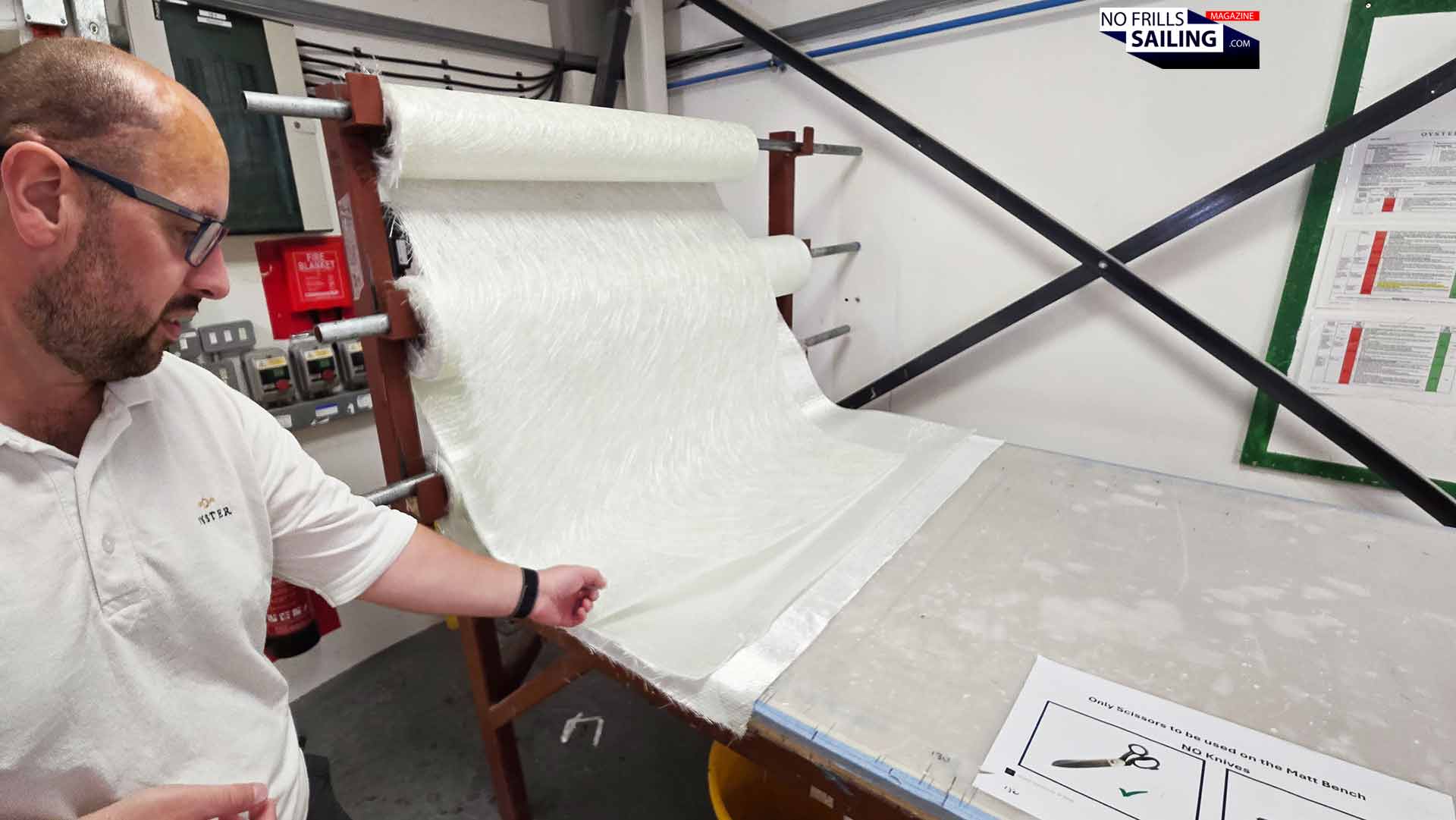
Of course there´s a detailed layup plan of where the glass fiber mats need to be placed. Apart from the actual size and shape of each mat that is put into the hull, the type of glass fiber and their arrangement within the mat is a deciding factor. Richard introduces me to the chief of production who shows us around. Arriving at a workstation, we delve a bit deeper into the materials. At this flat cutting table, three rolls of glass fiber are ready to dispense the mats, cut to size with scissors when and where needed.
The different kinds of glass fiber mats
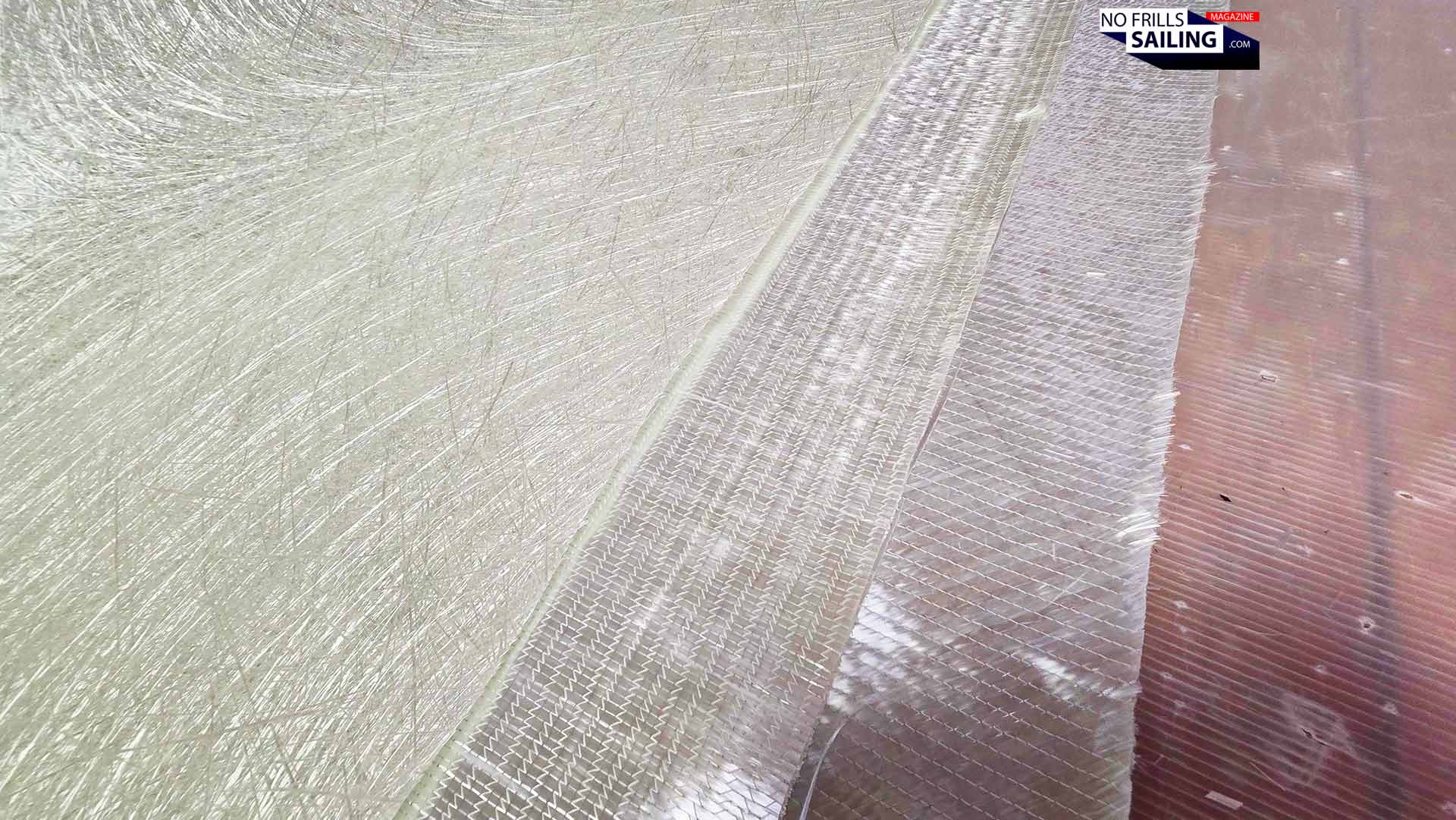
The production managers shows the different kinds of glass fiber mats utilized to make an Oyster. First there´s the so-called “chopped strand mat”, or CSM glass fiber, which feels very soft. It consists of shorter fibers which are randomly oriented. Below you will get to see a picture showing the first layer of a new Oyster´s hull: The CSM-mats usually are the first layers in a mold because they are perfect for achieving a smooth, even surface as these nicely fill gaps or wrap around irregular shapes. Then there are two more types of wovings: A thicker mat that consists of continuous fibers woven in a fabric with either 45 or 90 degrees orientation. The other one, the thickest, is primarily used for single layers in high-stressed areas of the layup. Uni-directional fibres are used in high load areas.
That´s what an Oyster is made of …
It is fascinating to acknowledge that those big, big yachts are essentially made up of different weights of these fabrics if you will. Knowing that back in the design office each and every detail of the boat has been conceived beforehand, I am well aware of the fact that each single layer and each single glassfiber mat exists in these digital files as well. Can you imagine? Richard emphasizes that here at Oyster yachts, despite the fact that the hulls are hand-laminated, only high-grade vinylester is used as resin – this is no place for osmosis-prone polyester hulls for sure. But, indeed, it´s not all hand lamination here …
Hull production specialties at Oyster Yachts
Looking at the outer edges of the mold, I can clearly determine the first layer, the sprayed gelcoat, and the CSM-layer of glass fiber. What I find particularly interesting is the huge overlap of the hull: Even after removing the excess offcut areas, this creates a large overlapping contact area with the deck in terms of hull-deck joint. As you may have seen in my article documenting the “marriage” of hull and deck in my Omega 42, having a large surface contact area where hull and deck can bond is good for the strength and stiffness of the later bond. As with Oyster, hull and deck are glued and bolted together, forming an inseparable unity. But, indeed, it´s not all hand lamination here …
Large overlap for the hull-deck joint
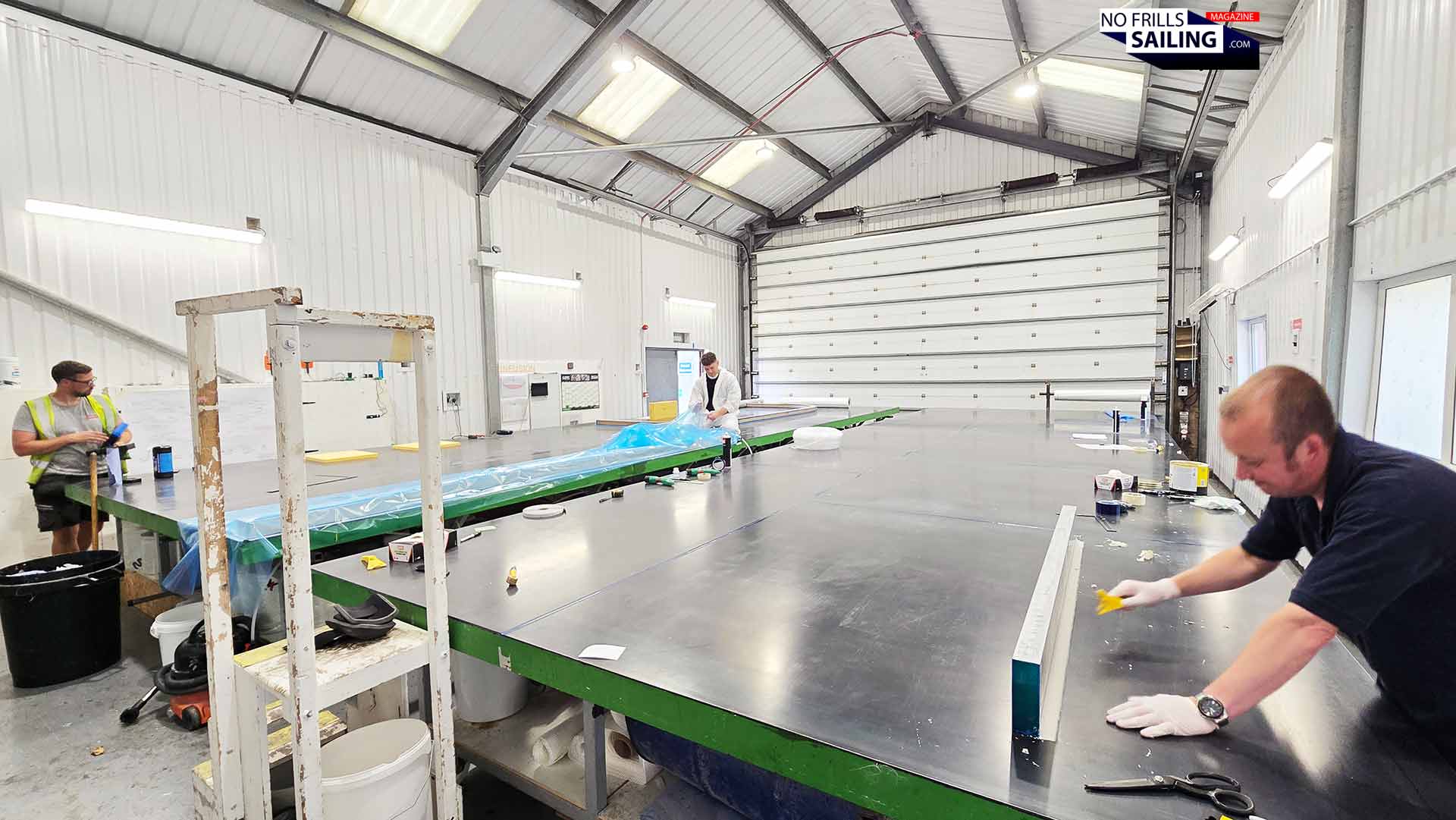
We enter a small workshop next to the big lamination hall. It´s the infusion shed. Two large metal working tables with perfectly even surfaces, are nearly eating up all of the room´s surface. Two workers are preparing different parts either due for vacuuming or freeing already infused parts from the plastic wrap, making them ready to go into the hull. So it´s apparently not everything hand-laminated: Girders, stringers and other structural parts of the hull are made here in this workshop, utilizing vacuum infusion technology.
The infusion workshop
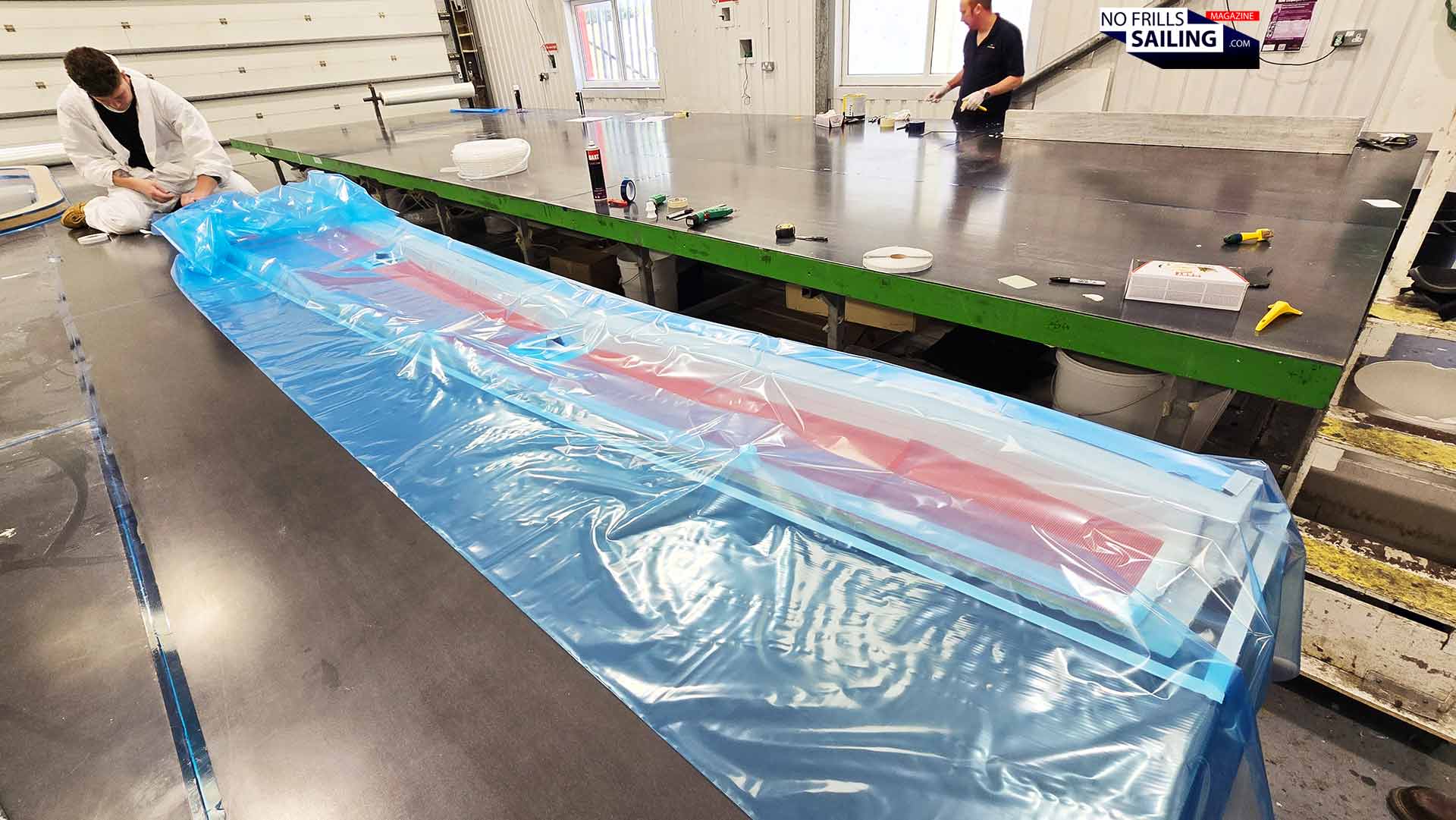
Again, each of these infused parts is individually manufactured. Each single part will be cut to size, laid up within its mold or around a foam core before infusion. In the foreground I can see a straight, simple part being prepared, whilst in the background two workers are just covering an part in plastic wrapping, only to later install the vacuum suction pipes and the resin filling ducts. In the upper left part of the picture above you might determine a larger part: That´s a frame for a boat´s hull for strengthening it against lateral pressing forces.
A new girder is prepped for infusion
Apparently, Oyster uses the best of two worlds. Hand lamination for most part – if done properly by skilled and experienced workers – can indeed achieve a very stiff, rigid and robust hull. One that will stand the test of times as well as cope with the challenges of the oceans. Of course, weight is always important, extreme lightweight is not a prime objective for an oceangoing cruising vessel. Therefore, saving weight with vacuum infusion and potentially sacrificing ruggedness is out of question for Oyster. At the same time, they don´t hesitate to utilize latest technology – but only where it makes sense. The outcome of this approach are hulls which are exceptionally sturdy and durable: I will later get to see ten, even twenty years old Oysters. All with spotless hulls.
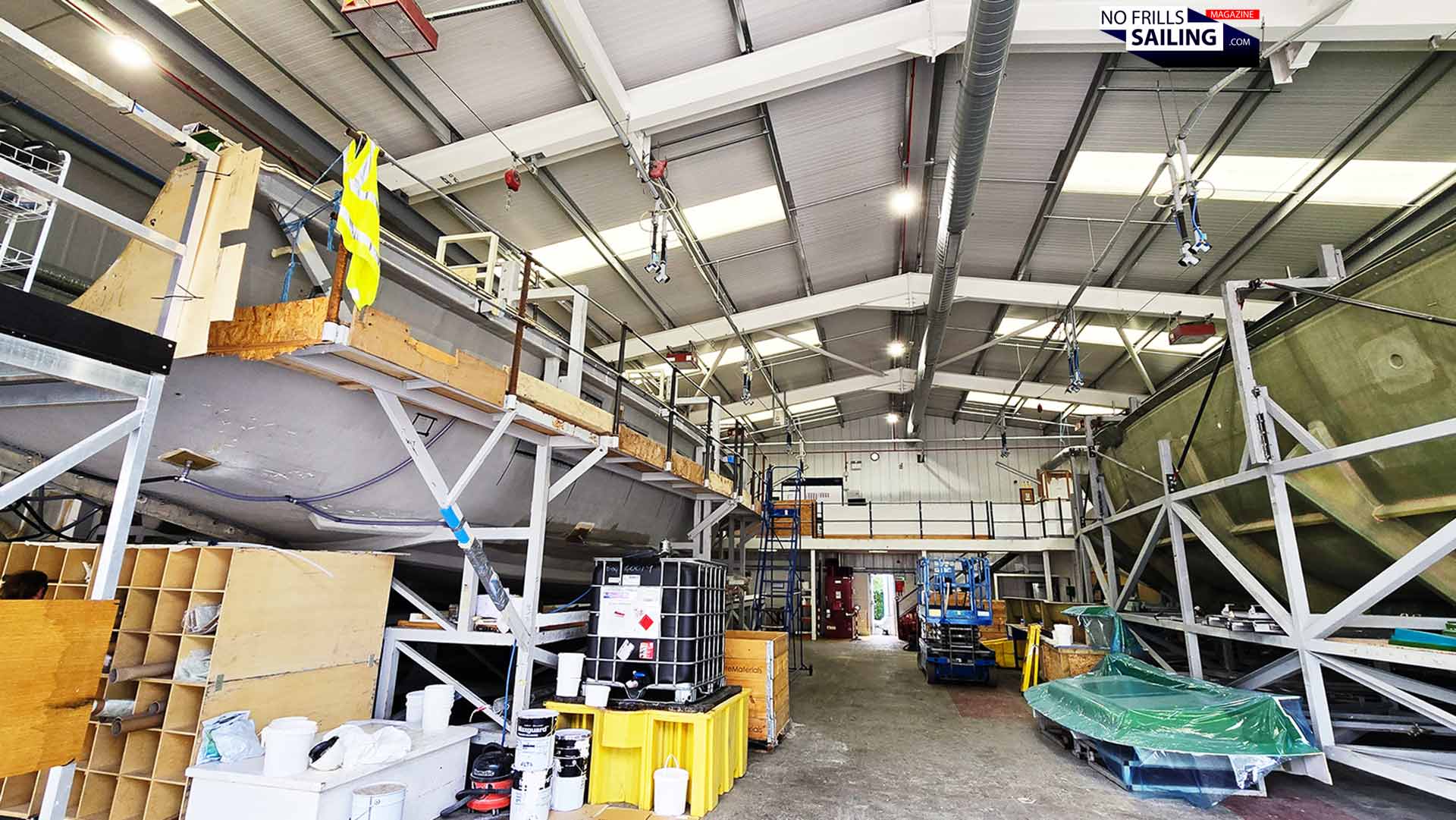
A busy shipyard …
As we enter the bigger workshops again, I wonder why it is so busy in here. I mean, I´m happy for the shipyard as each single production slot available within these halls appears to be occupied by boats in various stages of progress, but that´s unusually busy given the current state of the market. Which is, honestly, in a deep crisis. With most brands having downsized their capacities to around fifty percent of pre-Covid volumes, it appears that Oyster is … sold out? At least, I cannot spot mothballed areas or places with suspended activities. As Richard confirms, business is going quite well for the shipyard, which is a good thing indeed.
Closed mold, works ongoing
Of course, headwind got stronger, it´s much harder to persuade potential customers to signing a purchase contract and the usual suspects like inflation, high energy prices and labor costs have driven budgets for Oyster yachts as well. In any case, “niche” products and the high-end luxury part of the business have not suffered as much as the bulk of the market, which is low- to medium-priced series production boats. In crisis, people tend to insist much more in high quality and trustworthy brands. “No experiments” is a motto, as well as value retention and having lowest possible depreciation. As Richard puts it, it´s even weirder sometimes: When owners decide to upgrade to the next bigger boat, they sale their one or two years old Oyster at prices which often are higher than the initial purchasing budget was. It is indeed a weird situation, which I can confirm: Back in the day I had sold my GEKKO for a higher price as well than I had originally paid.
Every building lot is active & busy
It´s around noon and most of the staff is enjoying their well-deserved lunch. I am happy and a bit relieved for Oyster for their healthy sales. Richard confirms that their annual output is around 20 to 25 boats, with three to five of their biggest units, many 675 and a lot of 595, which can be considered the backbone of Oyster´s offer: This 60-footer is the ideal yacht for a cruising couple or sailing family, combining sailing agility and performance with lush luxury, even for visiting guests. This shuts down the occasional chit-chat I come across, painting a rather dark picture. As Oyster is currently closing down their production site in Southampton, this has nothing to do with crisis or poor sales. They are consolidating the spread of their offices, limiting organizational and overhead-costs, focusing on one center of activities and of course simplify the production, in order to invest in one centre of excellence.
Let´s talk about the keels
Yepp, we have to. Every now and then, when speaking of Oyster, the keel-issue is brought up. Here in Germany we have a saying: “If you have shit on your shoe – you have shit on your shoe!” Meaning, it will stick for a long, long time. The catastrophic keel loss back in 2015 did a lot of damage to the company and the brand. It is their “poo under the shoe”. After the POLINA STAR 3-incident the company was spinning into bankruptcy and it was thanks to Richard Hadida and his clear vision, a thorough cleanup and straightforward focus on safety that this brand did not just only survive, but thrived again.
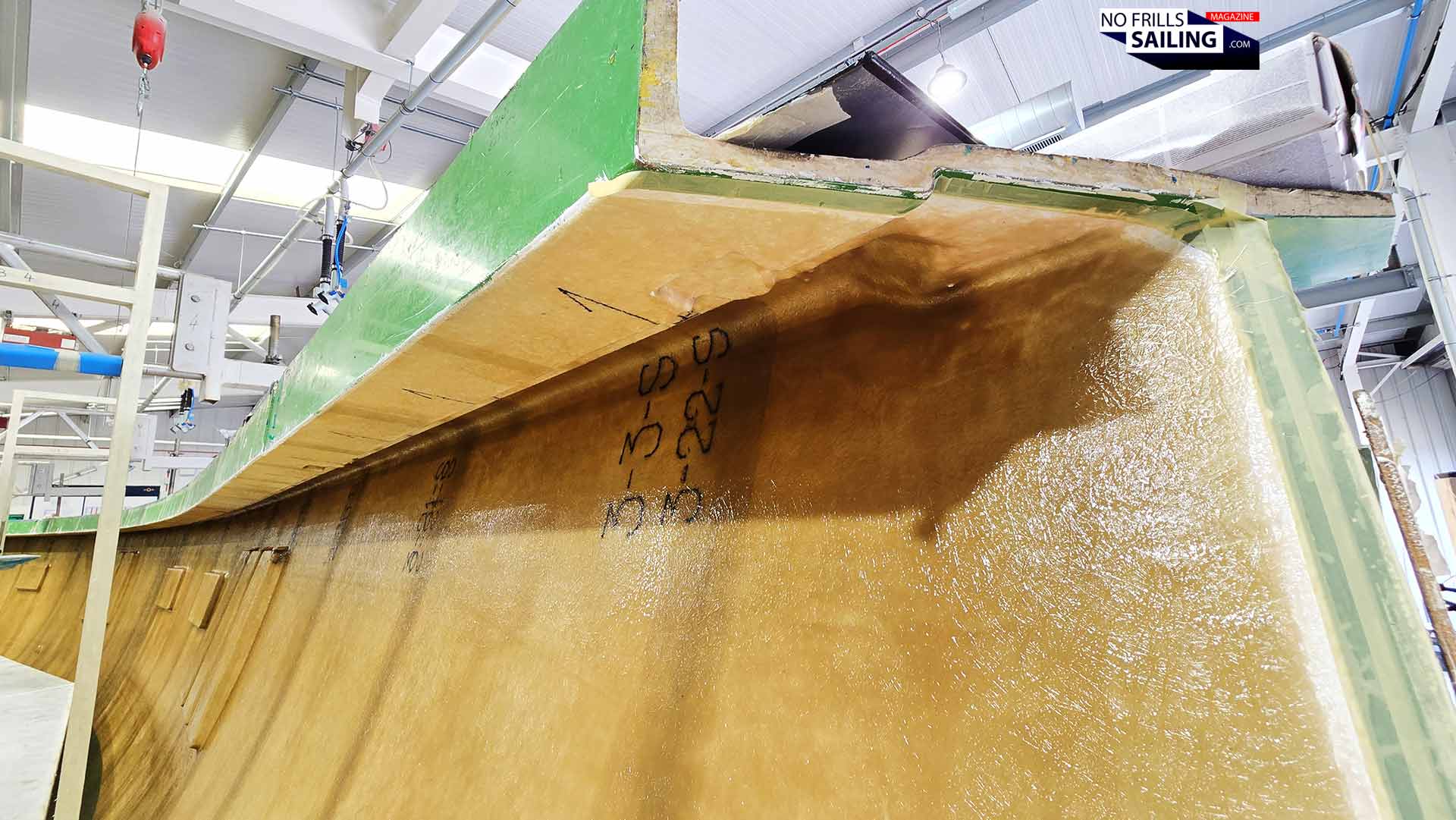
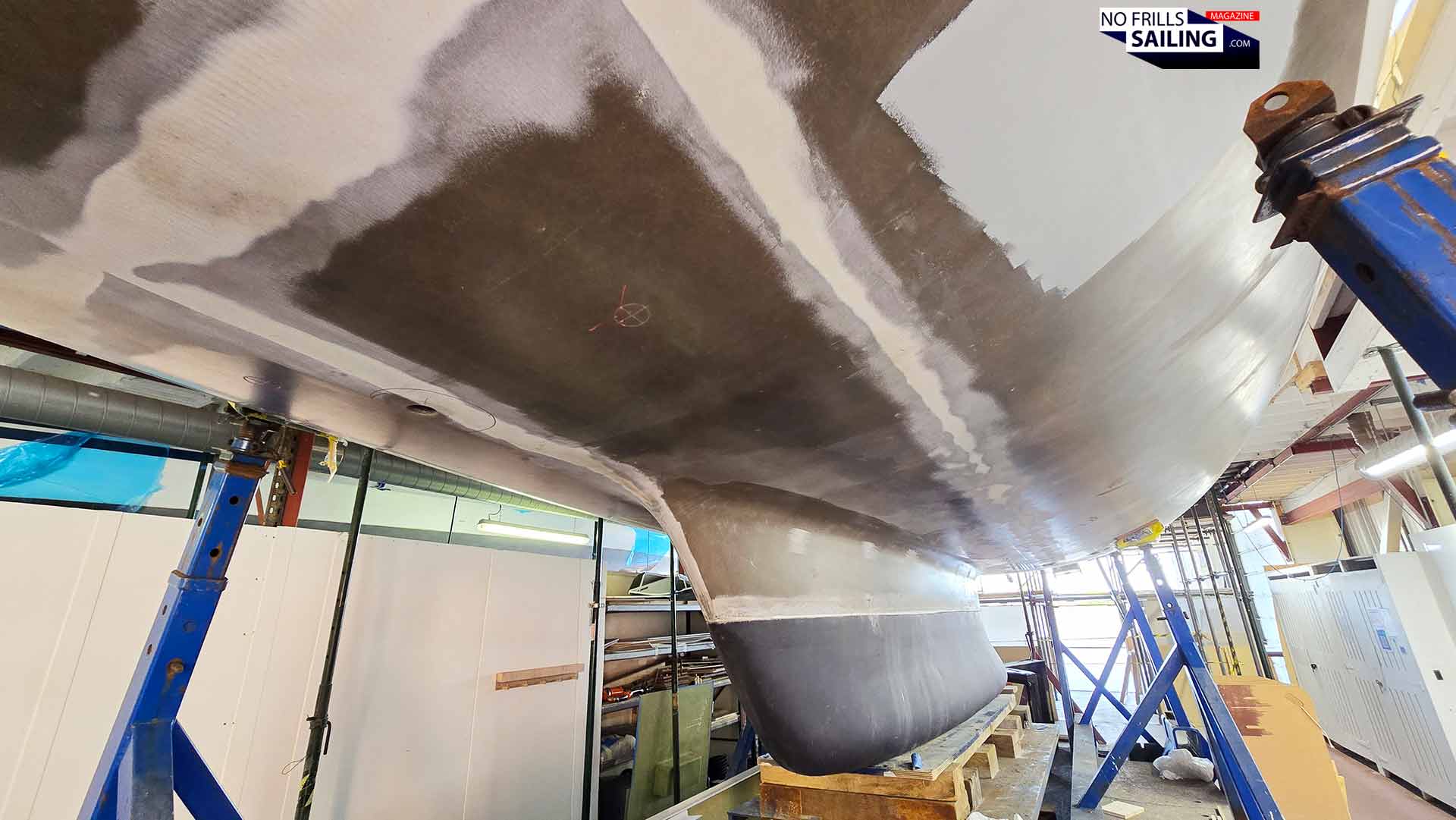
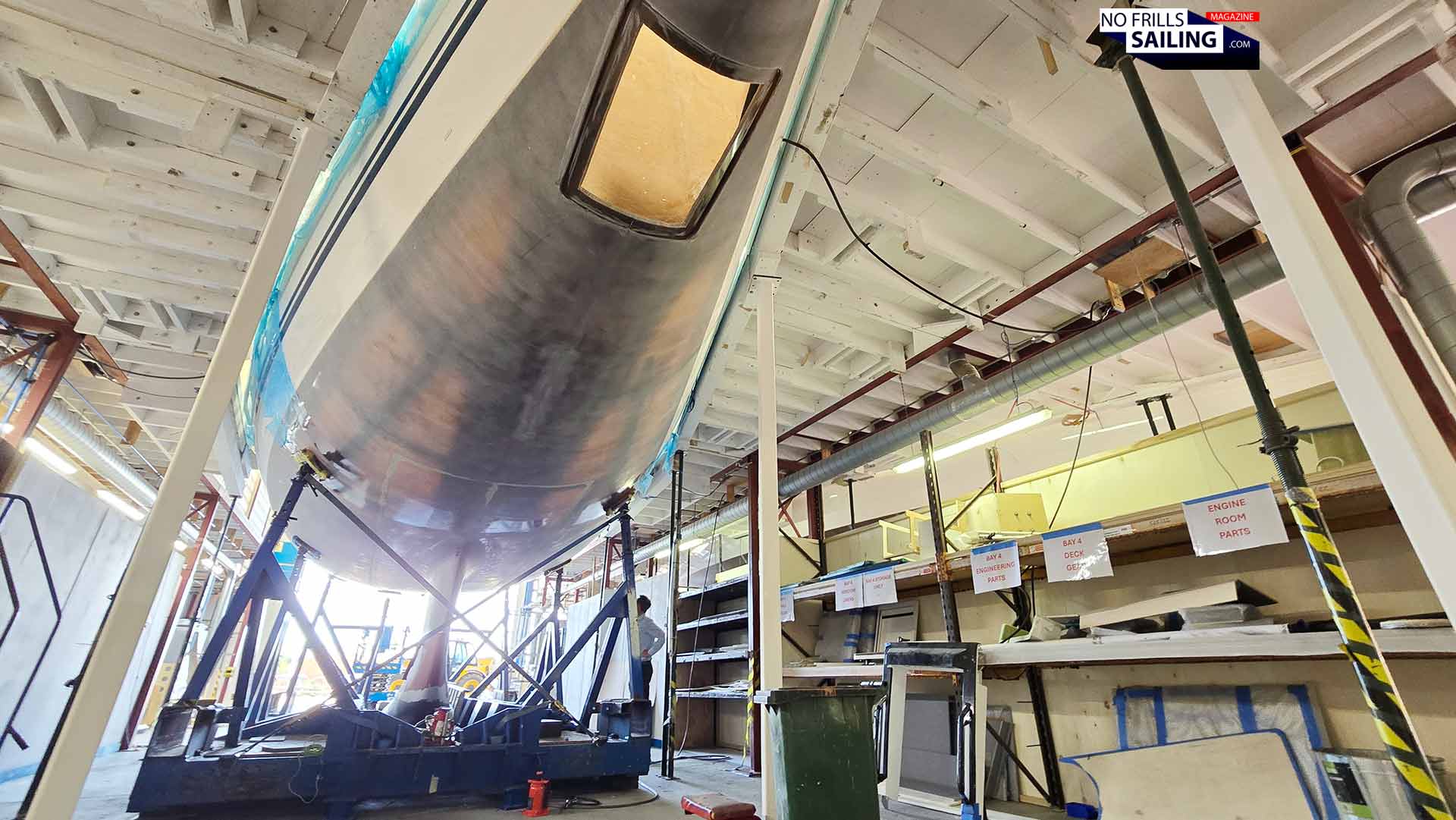
The underside of an Oyster: Smooth
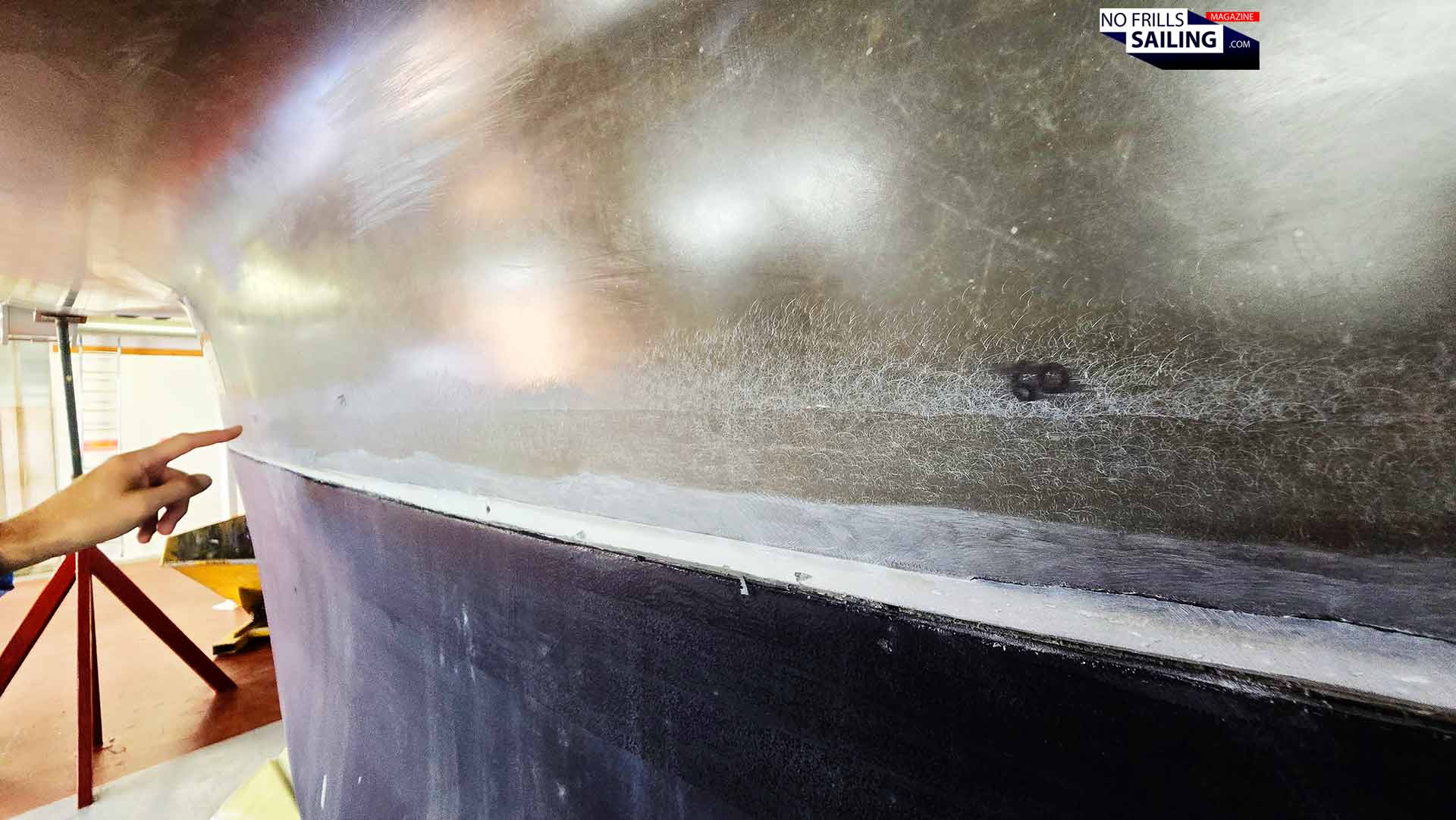
So here we are: After a freshly laminated hull had been drying through thoroughly, it will be demolded and brought to the next production step. As you can see in the picture above, first of all the hull under water has not received a gelcoat area. You can see the glass structure. Where the individual parts of the mold had been located, imperfections in these areas are sanded down and treated with filler to achieve a perfect smooth surface. This was, the workers can spot even the tiniest imperfections and treat them accordingly. Then the keel is stepped, a delicate procedure and one of the big time milestones for any sailing yacht – still waiting for my keel to be fitted, by the way. Here´s an interesting detail:
Material thickness: Thick keel flanges!
Richard takes me right underneath the hull next to the keel-flange. Handwritten notes with an Edding appear on the keel-seam every 30 or so centimeters. Ranging from numbers as his as “75” to lower figures around “55”, these indicate the thickness of the laminate in this exact spot of the keel. This means, for the boat we were inspecting right there sporting a shallow keel with centerboard, the flange-thickness is way beyond figures I came across so far. 75 millimeters, this is really some rigid structure the keel is mounted to in an Oyster. That´s for the keel issue – stuff like POLINA STAR 3 cannot happen ever again, I am sure.
A freshly demolded deck arrives
That´s for the hulls here at Oyster shipyard in Wroxham. But what about the decks? Being an integral part of any boat, the deck shape with its large “cat eye” windows and the raise deck saloon approach is one of the most striking details and deciding design features of any Oyster, so naturally, a lot of effort goes into their design as well into their construction. By chance, I can identify a deck mold outside in front of the building – the deck had just been freshly demolded, which gives me the opportunity to take a proper look at a raw new build deck.
One of the deck molds
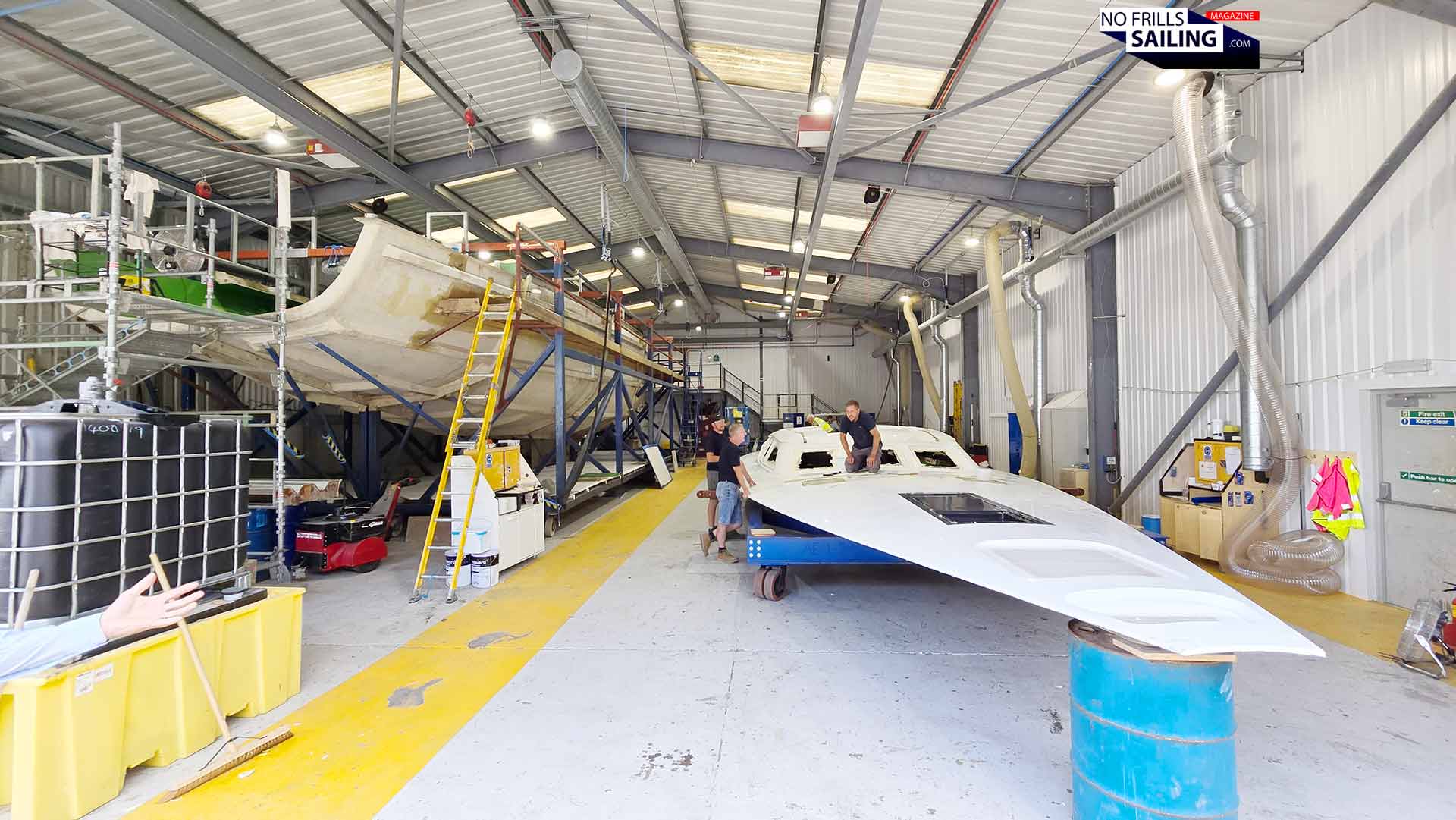
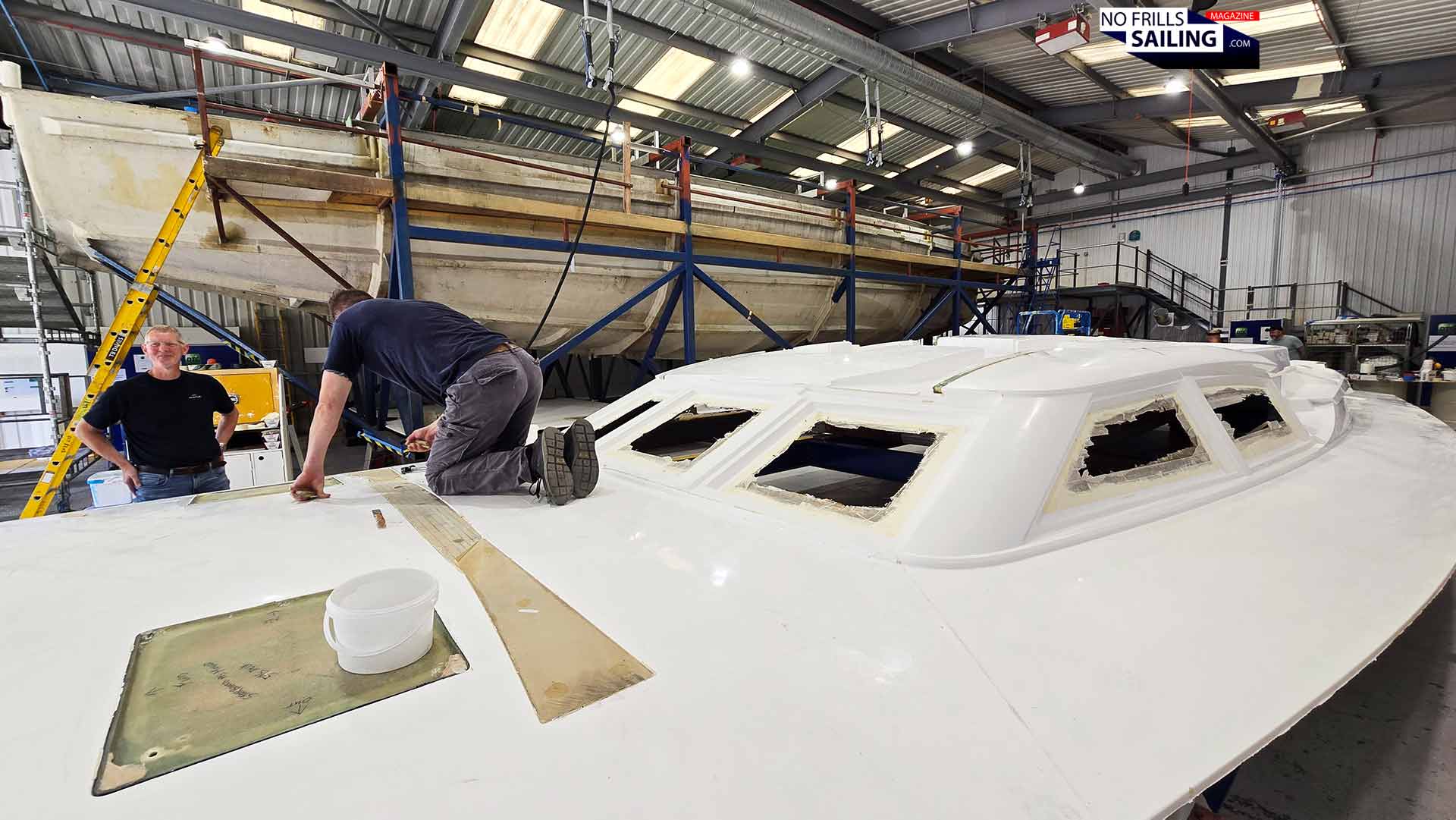
They have placed the deck on a temporary stand for inspection: A three person crew determines the quality of the deck and will thoroughly look at this second biggest part of a yacht with strict eyes, following the quality specifications. As with almost any other Oyster, there are several customizations incorporated as the owner had wished for. For example, as Richard tells me, this is indeed the first ever produced 595 deck with a self-tacking jib. I can clearly determine the recess for the jib-traveler mount just in front of the windows. The guys are closely checking for material strength, marking an any minor imperfection in the gelcoat.
Freshly demolded: Quality control
Some of the areas show no gelcoat. This goes for the locations where hatches or skylight portholes will be installed later. Here, the laminate is covering the “hole” in full strength. Other openings aren´t laminated at all, like the saloon windows. There´s just a bit overlapping laminate that will be cut away and sanded down smoothly in a next production step. I guess the decisions where to have continuous laminate and where not depends on the structure underneath and the specific area. Maybe it´s also sometimes easier and less time-consuming to just laminate a whole area and cut it out later than to intricately laminate “around” a recess or opening.
Note the are for the custom self-tacker
In any case, what surprises me, is the fact that there are comparably few markings indicating errors, a faulty gelcoat surface or demolding damage apparent. Yes, the guys had just started their inspection, but I´ve seen decks and other formed components coming out of molds in other shipyards with considerably more defaults and markings. This speaks for the production quality in the first place: Less stuff to correct, less filler, less work to do. Great!
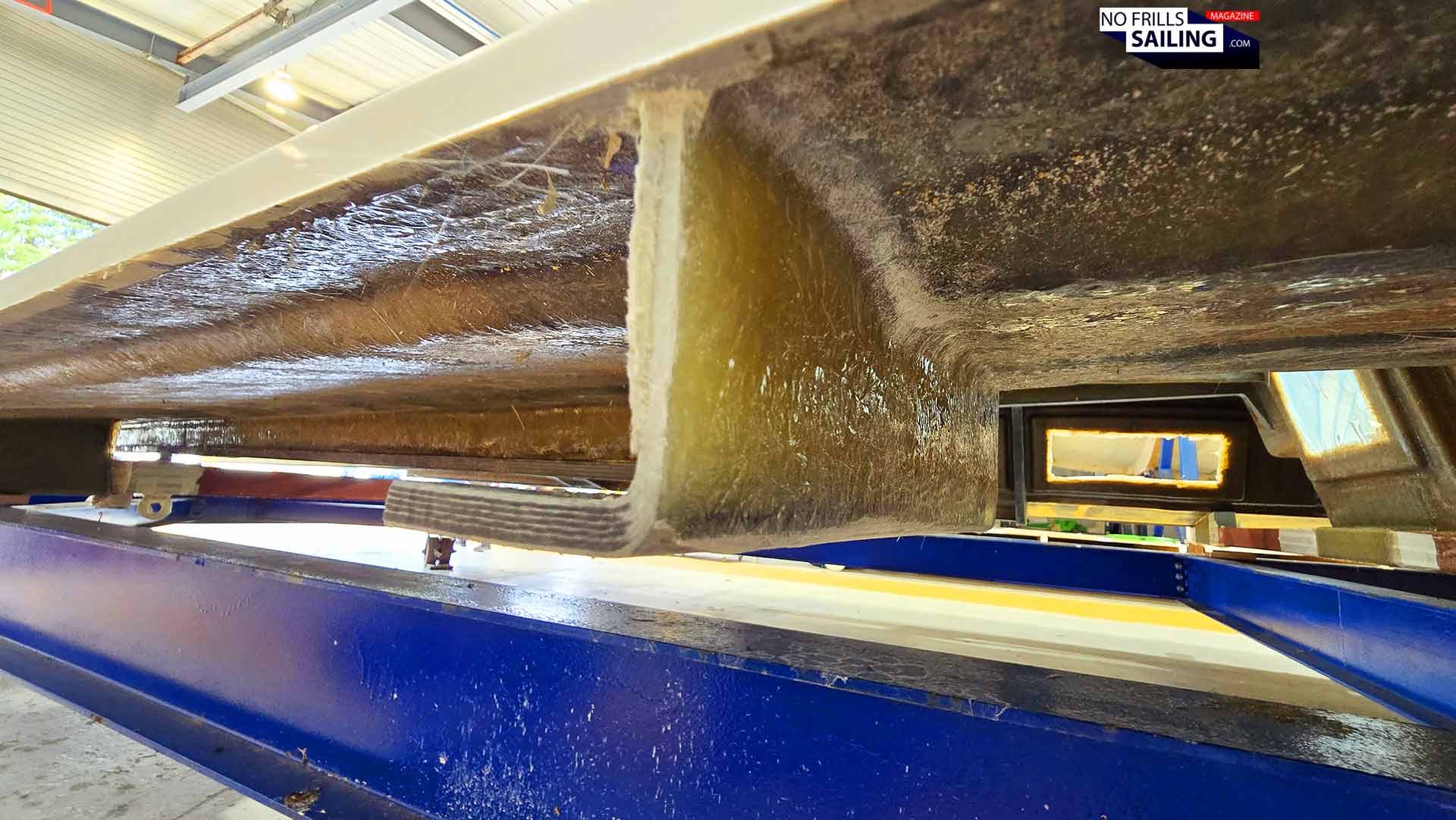
Nicely shaped L-beam
The decks are also hand-laminated here at Oyster Yachts. Other shipyards which have a similar approach to hand-laminating their hulls may have switched to infusion even injection when making their decks, citing a lightweight end-product, less material usage and fast production times. Again, Oyster insists on manufacture-quality. In this, their decks aren´t simple “lids” for the hulls, but intricate and complicated parts. Going down on my knees and taking a look at the underside, I can spot a number of L-beams, at which you can see how accurately they work here to produce clean layups even for parts which will never again be visible in the later boat. The complexity of the detail on Oyster decks mouldings means that hand lamination is the more suitable production method. In a later article we will take a more detailed look at the deck´s undersides, no worries.
Preparing the hull for the next construction phase
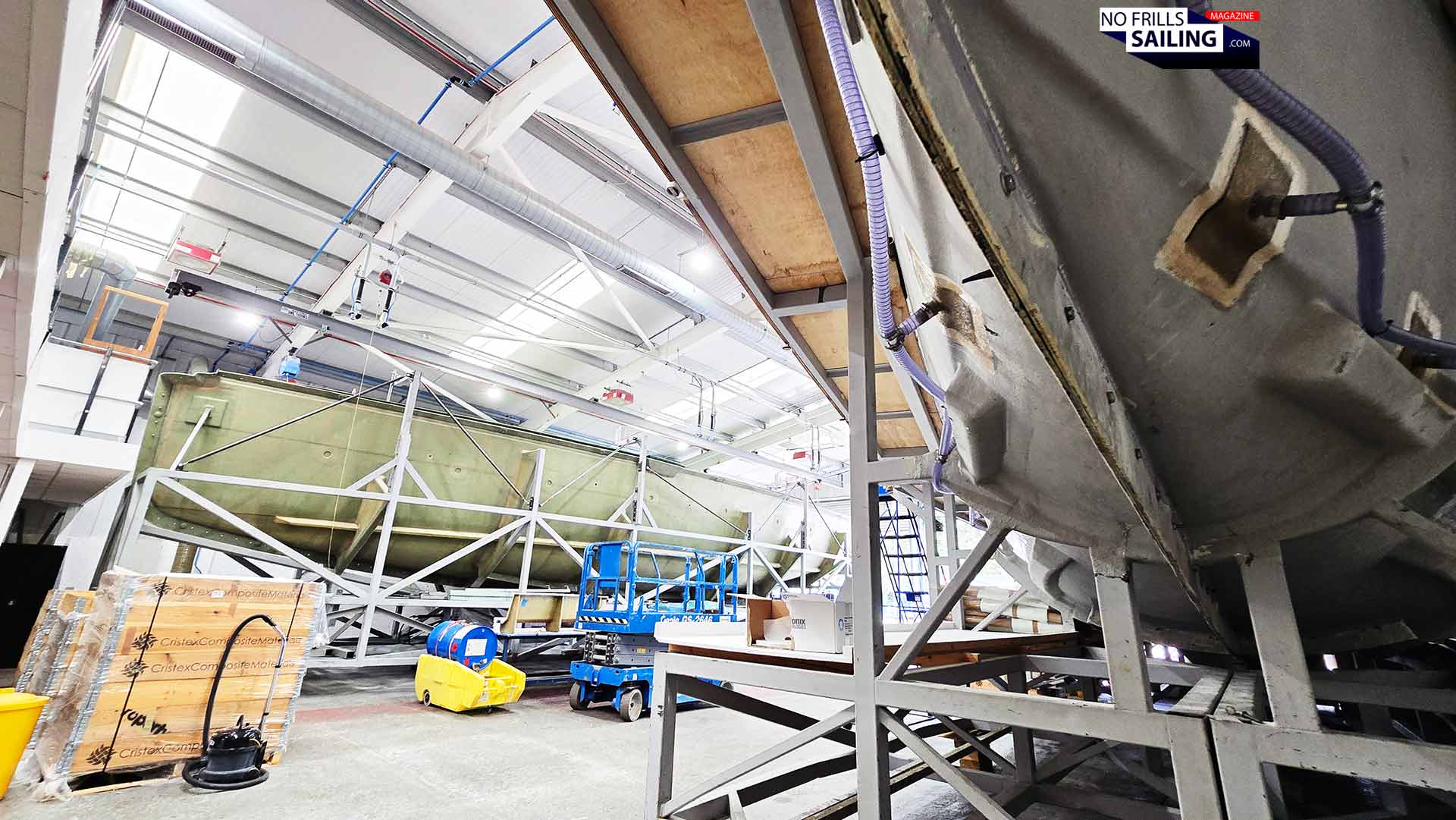
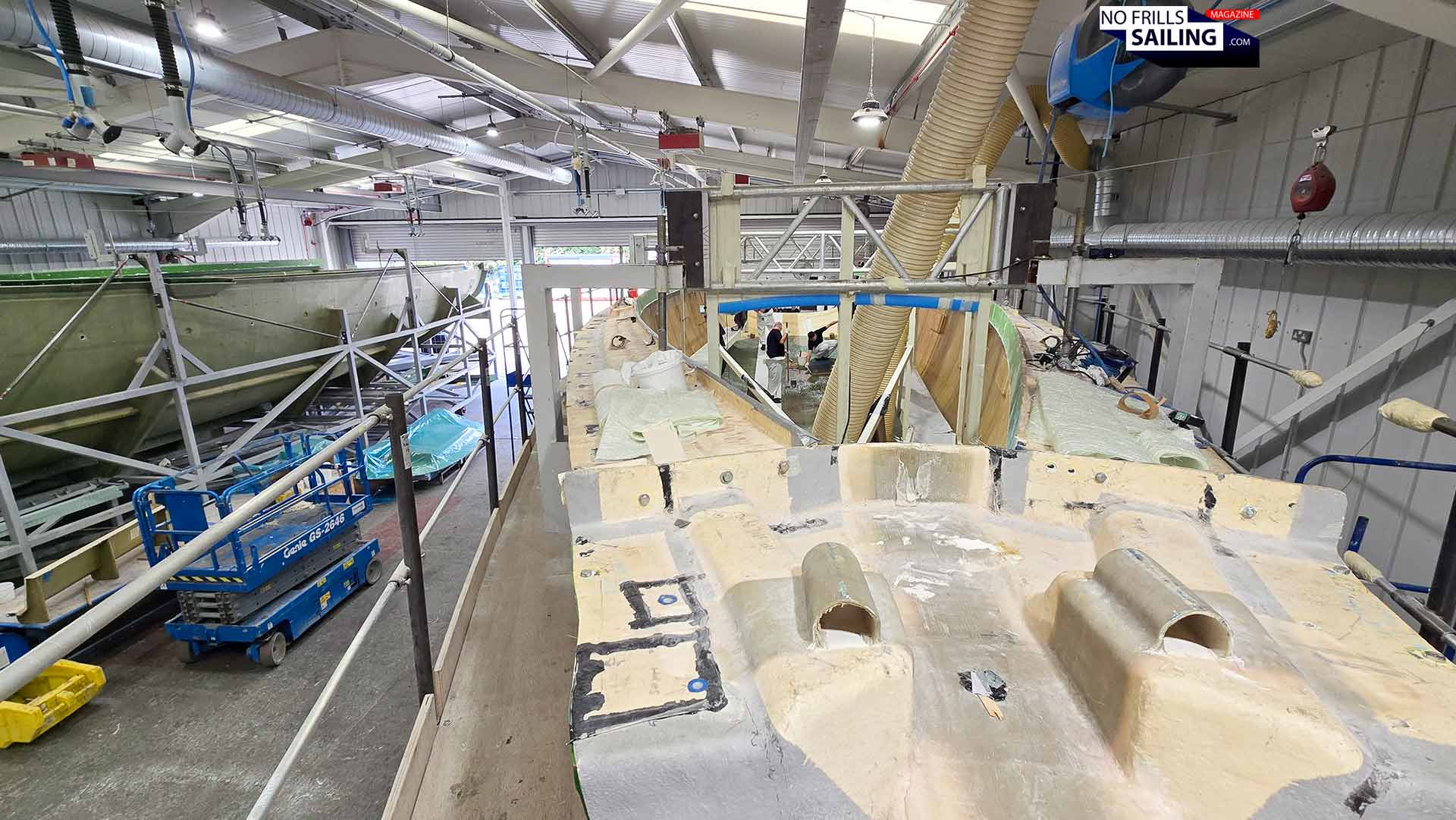
After the hulls and decks had been laminated, dried through and refurbed for the next production step, they usually are put on a cradle and transported to one of the production workshops. All boats are laminated in Oyster´s facility at Ashmanaugh, just four kilometers north of their main facility in Wroxham, later hauled to Wroxham, where fitting out takes place. This is where the main shipyard facilities are located and the Oyster yachts had been born originally back in the day. Before bulkheads or any other parts are put into the boat, the raw hull had received the girders and stringers (the vacuum infused parts we´ve seen in the workshop earlier) and also the big hull-throughs are fitted, especially the ones for bow and stern thrusters.
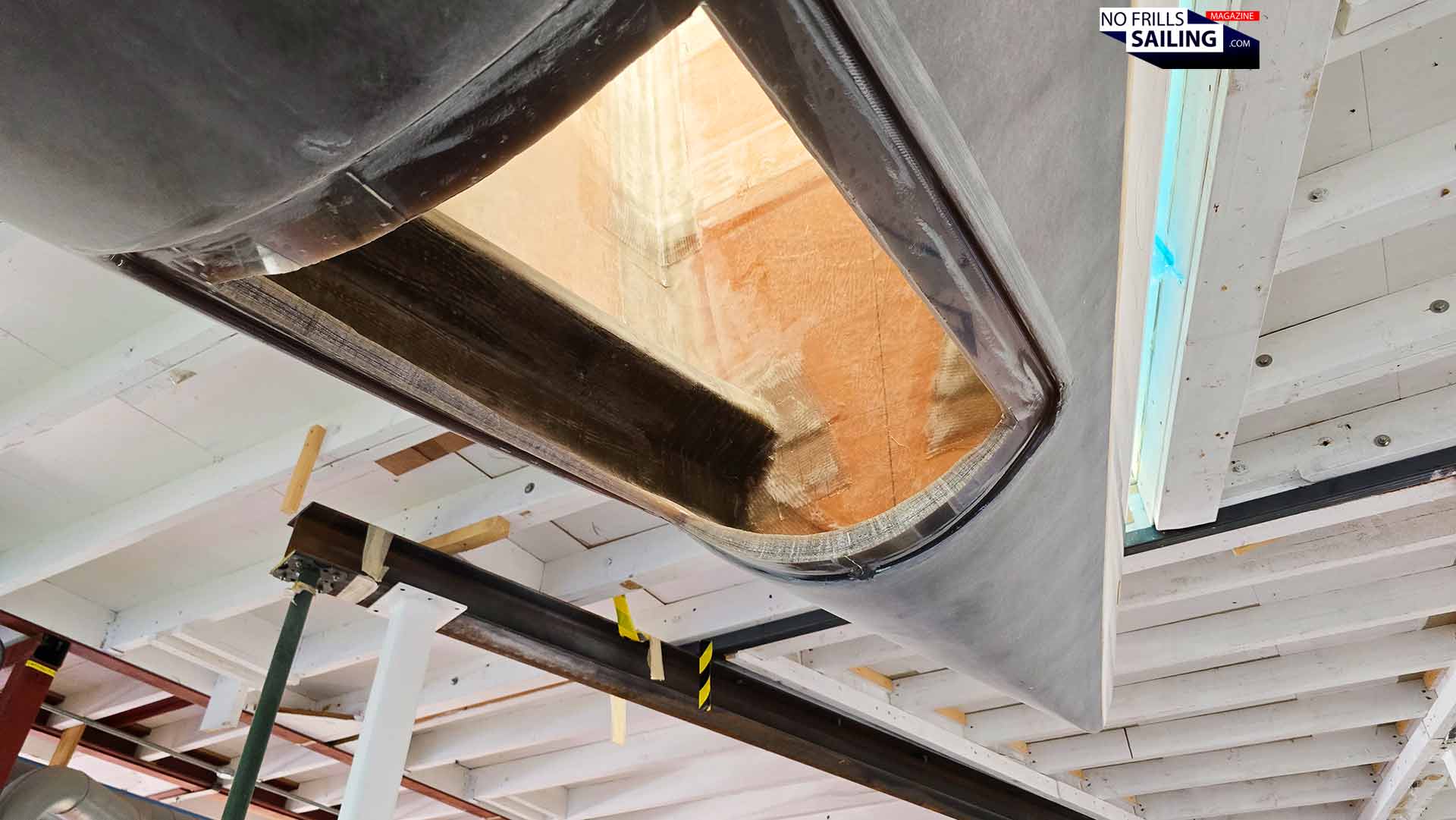
Large front cutout
Each Oyster comes with both bow and stern thruster, something they insist to do and it also makes sense. I place myself underneath a freshly cut bow thruster opening and Richard shows me the thickness of the hull laminate in this area. On the two pictures you can clearly distinguish the different layers of GRP and admire the strength of the material in this area. By the way, not having foam core in the bow and bottom-areas of a boat does increase collision resistance because sandwich-GRP tends to open up in large triangular holes when submitted to a hard hitting force. You can also clearly see one of the collision bulkheads from here – of which an Oyster has two in the front part of the boat.
This is where the bow thruster will sit
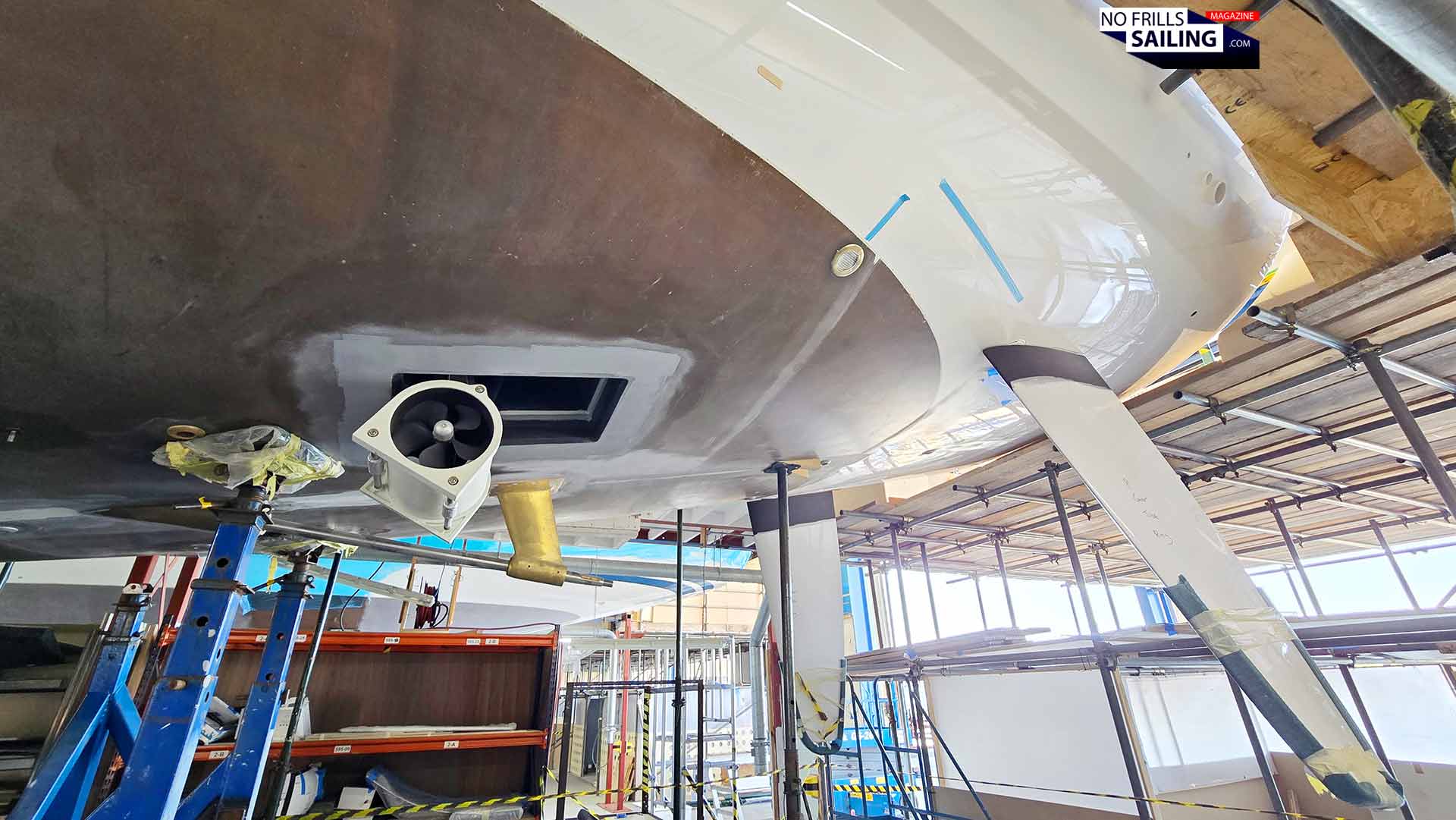
Oyster fits only extendable thrusters to their yachts. These may require larger hull openings, are much more complex in terms of moving parts and maintenance, but the advantages over tunnel thrusters are apparent: First of all, when retracted, the thruster unit and the props aren´t submitted constantly to the water and marine growth. Hence, clogging isn´t an issue. Secondly, when retracted, the hull forms a smooth hydrodynamic perfectly balanced shape going through the water – tunnel thrusters can increase the drag of a hull by 1 to 4 percent, lowering speeds between 0.1 and 0.2 knots. That´s just modest, you´d think, and you are right: But it´s a real loss!
Safety has prime priority here at Oyster
On the other hand, retractable thrusters are generally more powerful than fixed tunnel thrusters. This is because of a shorter or effectively no tunnel hampering the thrust, much better mounting positions at strategic positions in the hull to exert best leverage and, when lowered, they reach deeper below the waterline. Yes, more budget and definitely more maintenance intensive, but definitely advantageous, if you ask me. By always fitting bow and stern thrusters, handling capabilities and maneuverability is superior – which also increases the safety significantly.
Quite a thick bottom!
Not only since POLINA STAR 3 has safety become the one big-time priority here at Oyster. As those people ordering an Oyster are usually skilled and seasoned sailors, more and more first-time buyers are attracted to this brand. At the same time, Oysters usually aren´t used for just sitting around in their berths to only go out for an occasional daysailing experience, most yachts are utilized as true blue water cruising yacht, oceangoing vessels which are taken to the most remote areas of our planet, many taking part in the Oyster World Rally, that Oyster runs every two years – a 15 month odyssey circumnavigating the planet. Either way, they travel to areas where repairs are barely feasible and mistakes can quickly amount really big problems.
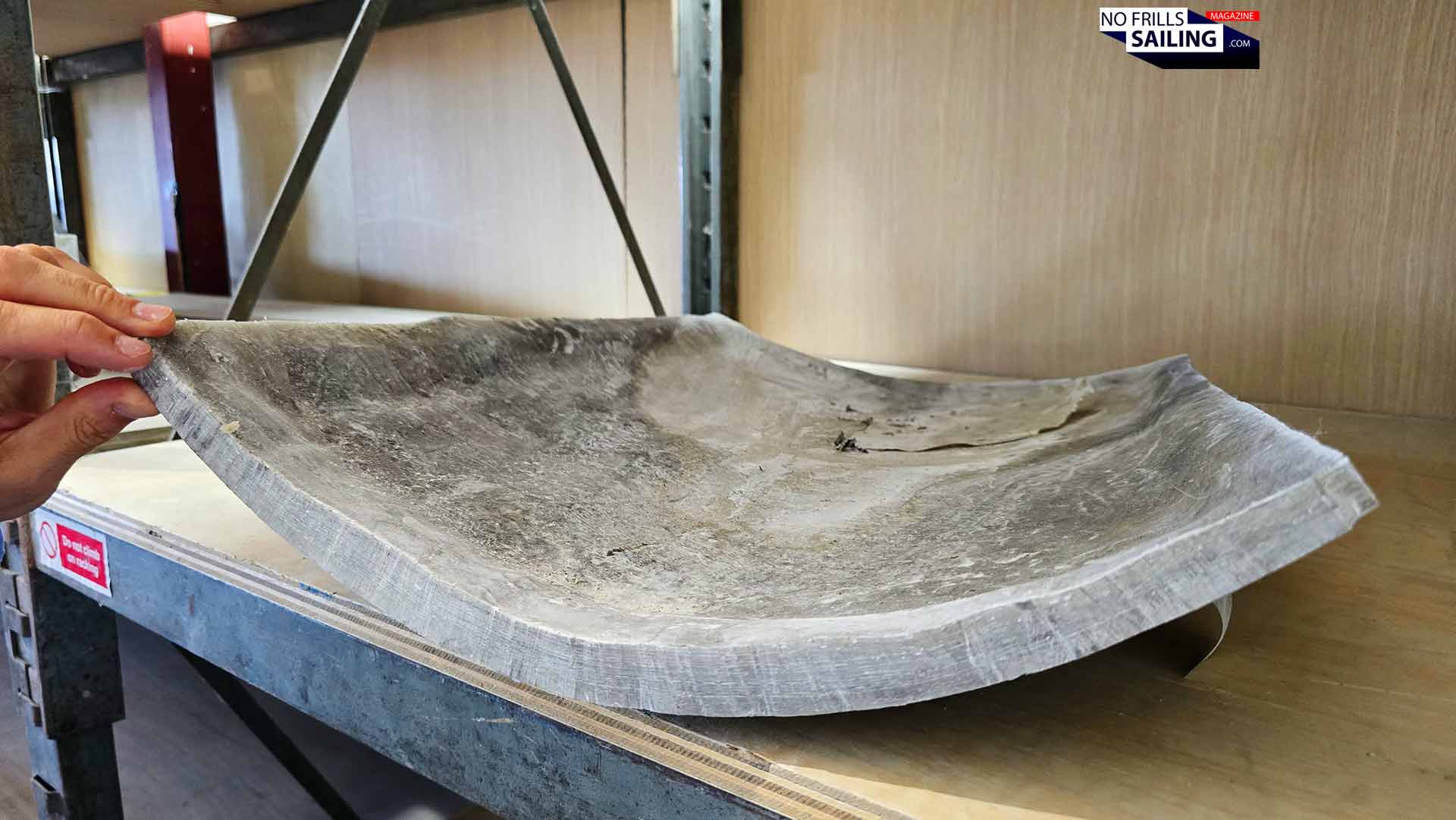
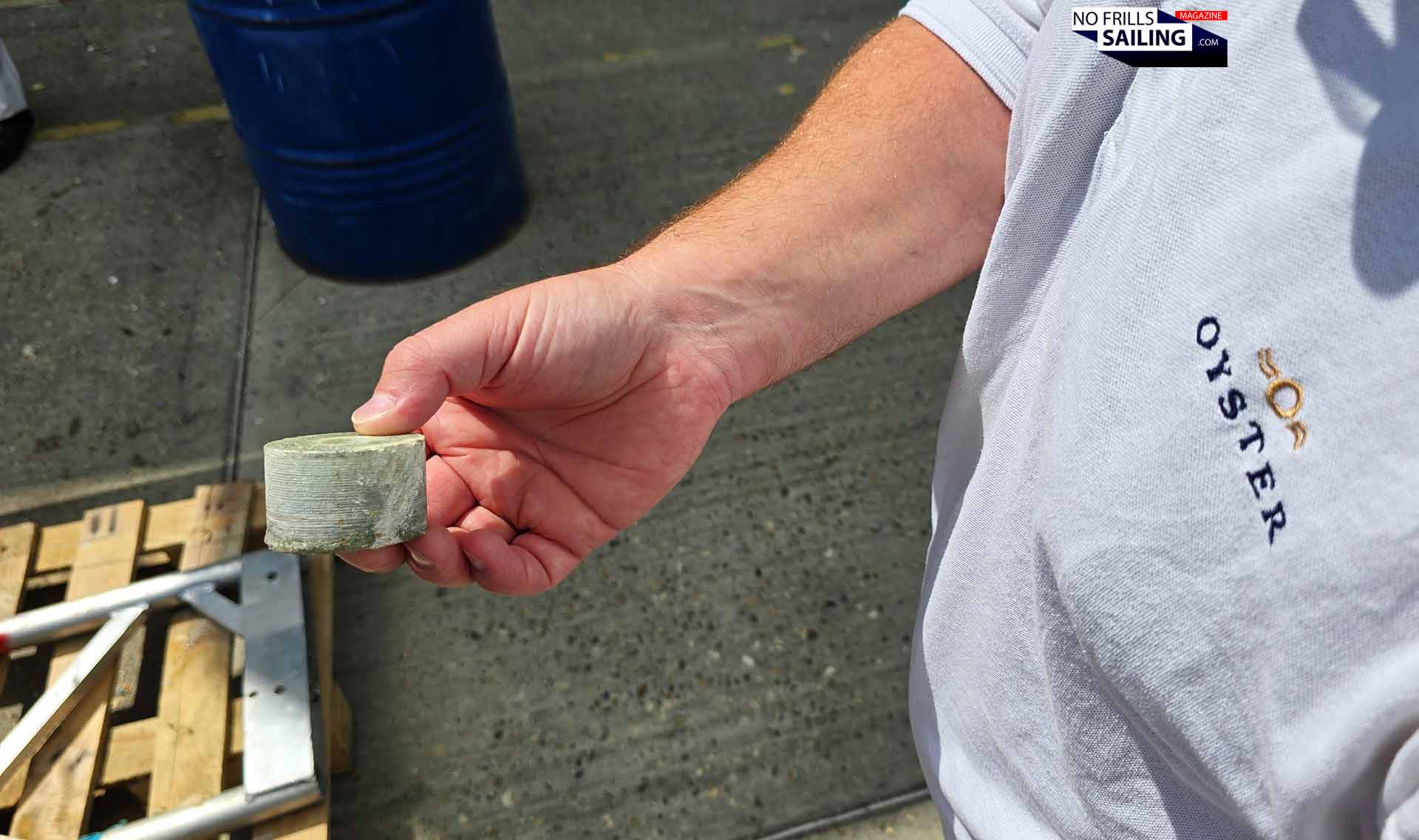
Material probes for thickness and quality control
Showing some cutouts, Richard Gibson emphasizes the fact that here at Oyster a Lloyd´s of London representative officially checks the whole structural production. Every second week! Just think about this: Every 14 days a professional from Lloyd´s is coming over and meticulously checks – and certifies – the work-in-progress of every single boat in production. By that, not only the boats themselves but also these little and big cutouts will be examined, but also the paperwork and documentation of the production. It doesn´t stop there: Lloyd´s also certifies the raw materials, from resin to glass fiber mats, essentially everything that goes into making of the hulls and decks. This is to make sure that only certified parts can make their way onto and into a yacht. I am not aware of any other shipyard running such an elaborate, complex and close-meshed independent safety program!
Advertisement
Next up: Interior fitting and appendages
So here we are – having seen the molds, the hull and deck lamination and the manufacture of vacuum-infused parts. I´ve been shown how the keels are fitted and first structural parts are mounted to the boats here at Oyster. I am happy and astonished by the fact that neither Sales & Marketing Director Richards Gibson nor Sales Director Stephen Parkinson, who will “take me over” to show around the next day ever asked me not to take a photo of anything. I was free to go and take a look at whatever and where ever I wanted, taking pictures completely unhampered.
What are the next production steps?
That´s new for me. Usually, every shipyard has their little dirty corners here and there. Or even production-secrets or proprietary specialties they rightfully want to protect. I mean, it would have been perfectly fine for me if there were things Oyster wouldn´t want me to disclose. Richard commented that nothing they do can realistically be hidden for all too long anyway. And copy is the highest form of flattery, right? So that was awesome for a start – very interesting indeed! If you want to see more, there are at least two more articles coming up showing the complete production process here at Oyster.
So you either stay tuned and check in the coming days for part 2, which will cover mostly the interior fitting, Oyster´s world class joinery and insights into technical details, and the final part 3, showing the meticulous efforts to finish these yachts for commissioning. Or you just subscribe to the monthly newsletter right away: Receiving an email, you may choose from the articles that interest you the most and click the shortcut to this content. Either way: Thanks for accompanying me to Wroxham this time, I´m excited to show how these yachts are completed over the next steps of their production.
If you like to read more about Oyster Yachts, here´s some great stuff to check out: