There´s only a handful of brands offering “real” ships in terms of ruggedness and go anywhere-qualities. Alubat is one of the long standing names in this market niche and for many hundred skippers the words “Alubat” and “Ovni” are synonymous for rugged sailboats capable of oceanic travel. The company mastered a complete turnaround, changed the design of their products profoundly and re-defined what aluminum boatbuilding is about. This article shows the current situation of the shipyard and why Alubat retains its high profile at the forefront of offshore-yacht building. Disclaimer: Take your time, this is a very, very long one!
Travelling to Les Sables d´Olonne is always a big occasion for me. I´ve been here many, many times and I only have good memories of that lovely town at the Atlantic ocean: Yacht deliveries, customer meetings and shipyard visits on the professional side, roaming the pontoons looking at the latest Imoca, Class 40 or other yachts for pleasure.
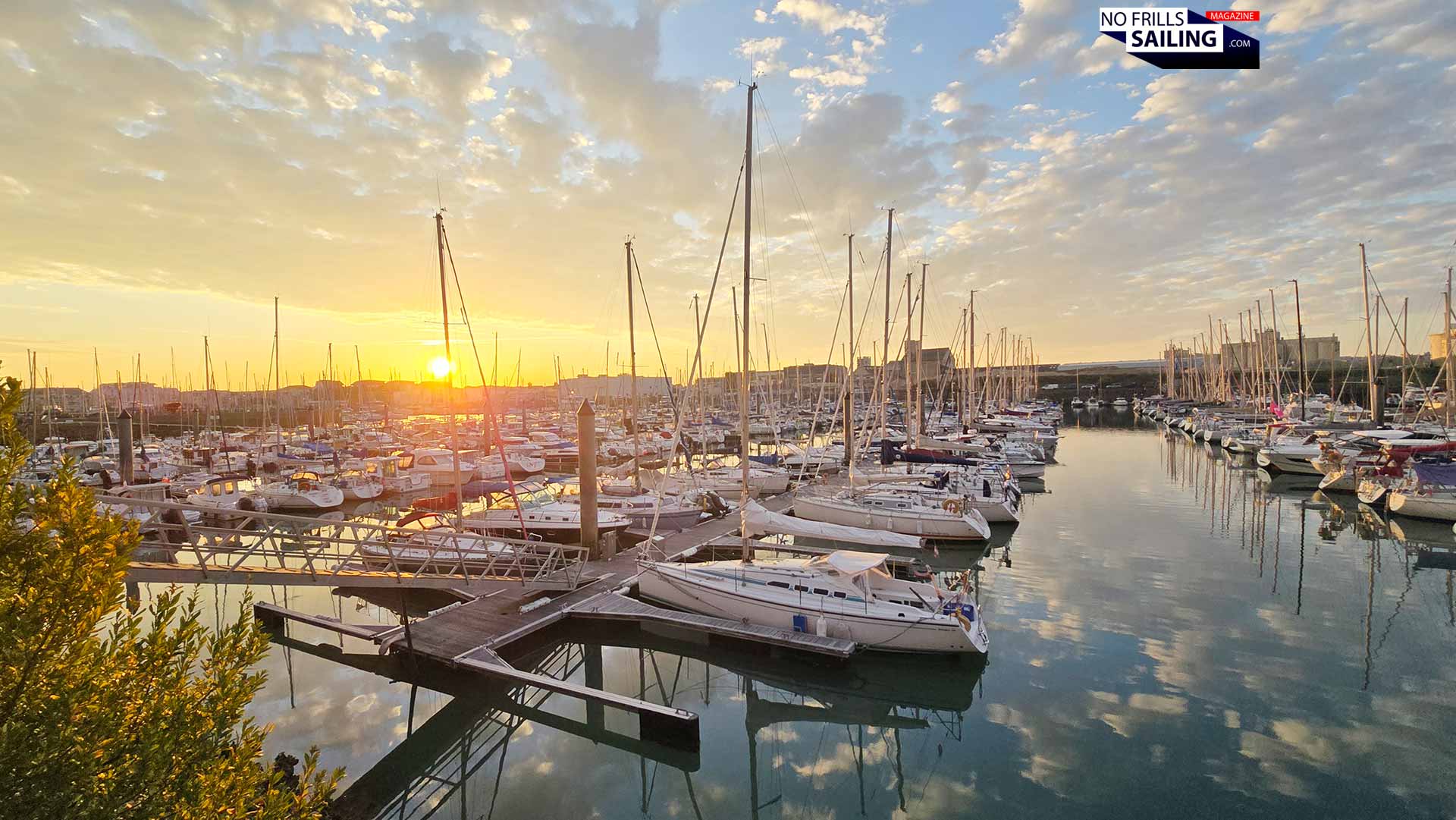
What a glorious October day in Les Sables!
After some 11 hours of driving through nightly France – simply to avoid the traffic craze of Paris – I arrived at dawn. Directly above Port Olona, where Privilége has its premises and the Imocas are docked, there´s a public parking lot (free of charge!) and this is where I stopped the car, got out to take a walk along the awakening town and bought a fresh coffee with an even fresher Croissant. Salty air, still mild 19 degrees Celsius (in October!) and the sun plunging the scene into this breathtaking explosion of color … what better harbinger for the coming two days could there be?
Meeting Luc Jurien: As real as it gets!
Advertisement
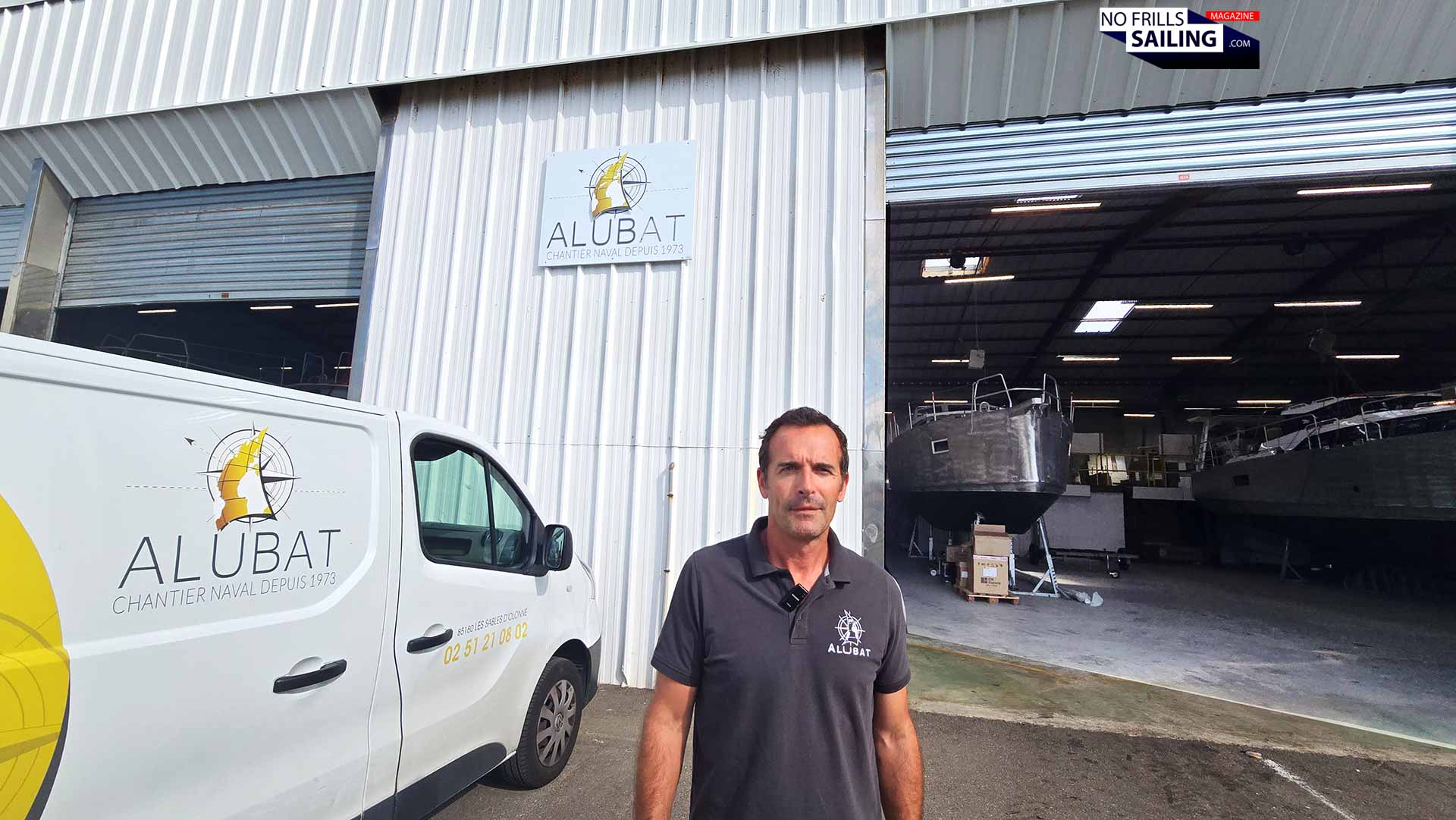
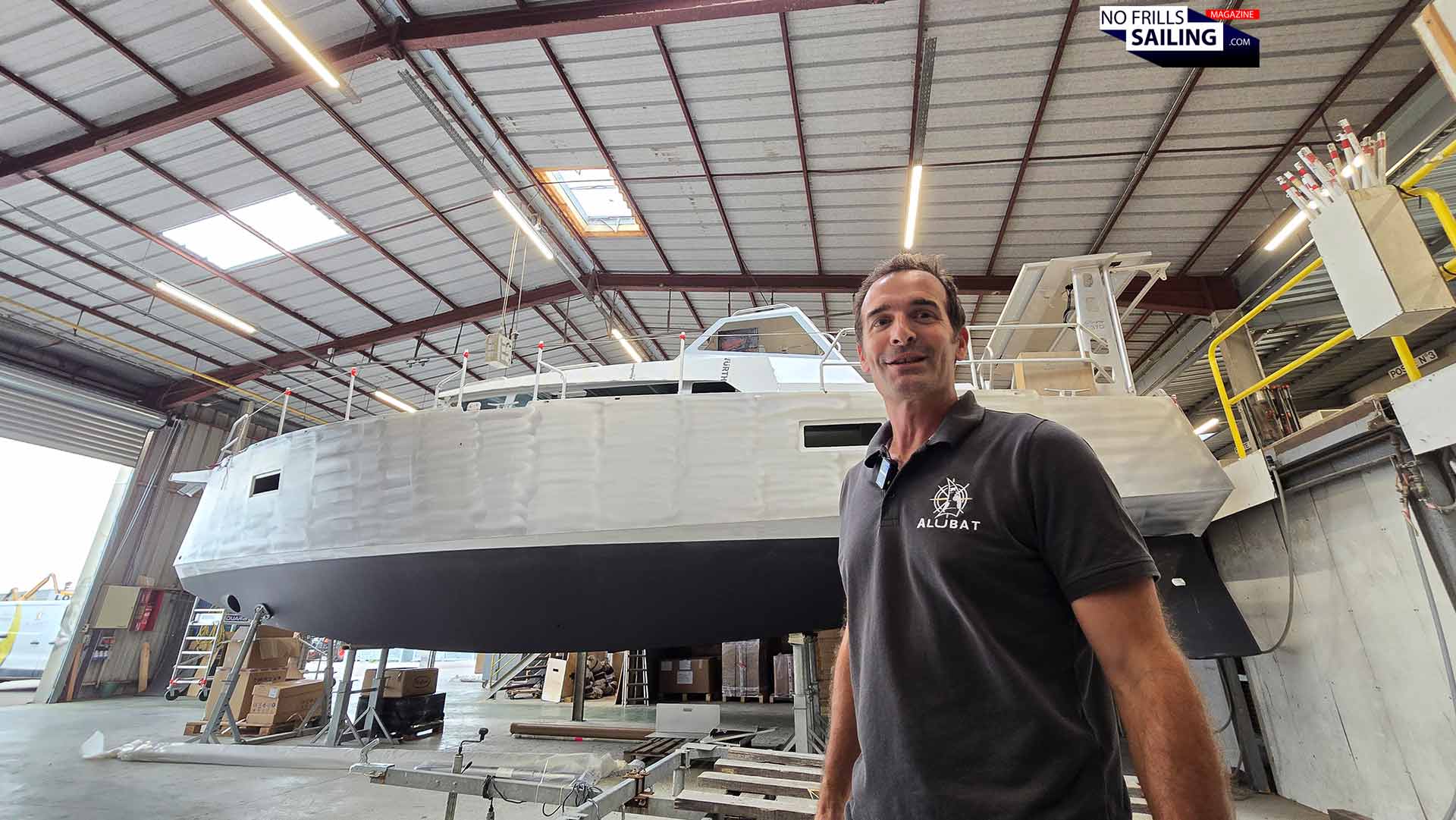
Of course I needed a good portion of sleep before I was fully functional again. This time the occasion of driving down here was an invitation by Alubat. You know that I have a crave for aluminum yachts and that is why Alubat is of course a brand I am constantly watching. This company, through good and bad, luckily came back on track after filing for bankruptcy in 2012, they have turned around business and – much more interesting – re-defined their whole product range inside out. 2021 their new CEO Luc Jurien joined the company – a stroke of luck, I shall say. Because it cannot get any more credible as Luc, if you will. This guy did, what most of us are only dreaming about for most of our lives. For once, he literally grew up aboard a sailboat. Even back then, little Luc was already “infused” with aluminum, because the Maxi-style yacht of his parents was made of the very material that defined his life. Spending a large part of his childhood aboard sailing, he later took over command of this vessel from his father, sailing her back all the way from New Zealand to France.
Meeting Luc Jurien, CEO or Alubat
He started a career as an engineer, realizing infrastructure-projects and working for the aerospace industry. Then the cut. Circumnavigation! Sailing around the Hoorn with his family on a 40-footer, he traveled two years around the globe. Then, they bought their Ovni and refitted the boat by themselves from scratch. Starting another eight years of sailing from the Arctic to the Tropics with his family, seeing his two kids growing up. Can it get any better? Yep! Returning from this awe inspiring voyage, then-Alubat boss Michel Berson hired him because of his vast knowledge and talents. Luc took over the shipyard by Management-buyout in 2021, isn´t that just an awesome story in itself!? Who could lead best this factory than a guy who had refurbished their vey product and intensively sailed it around the world?
Making an aluminum hull – Alubat style
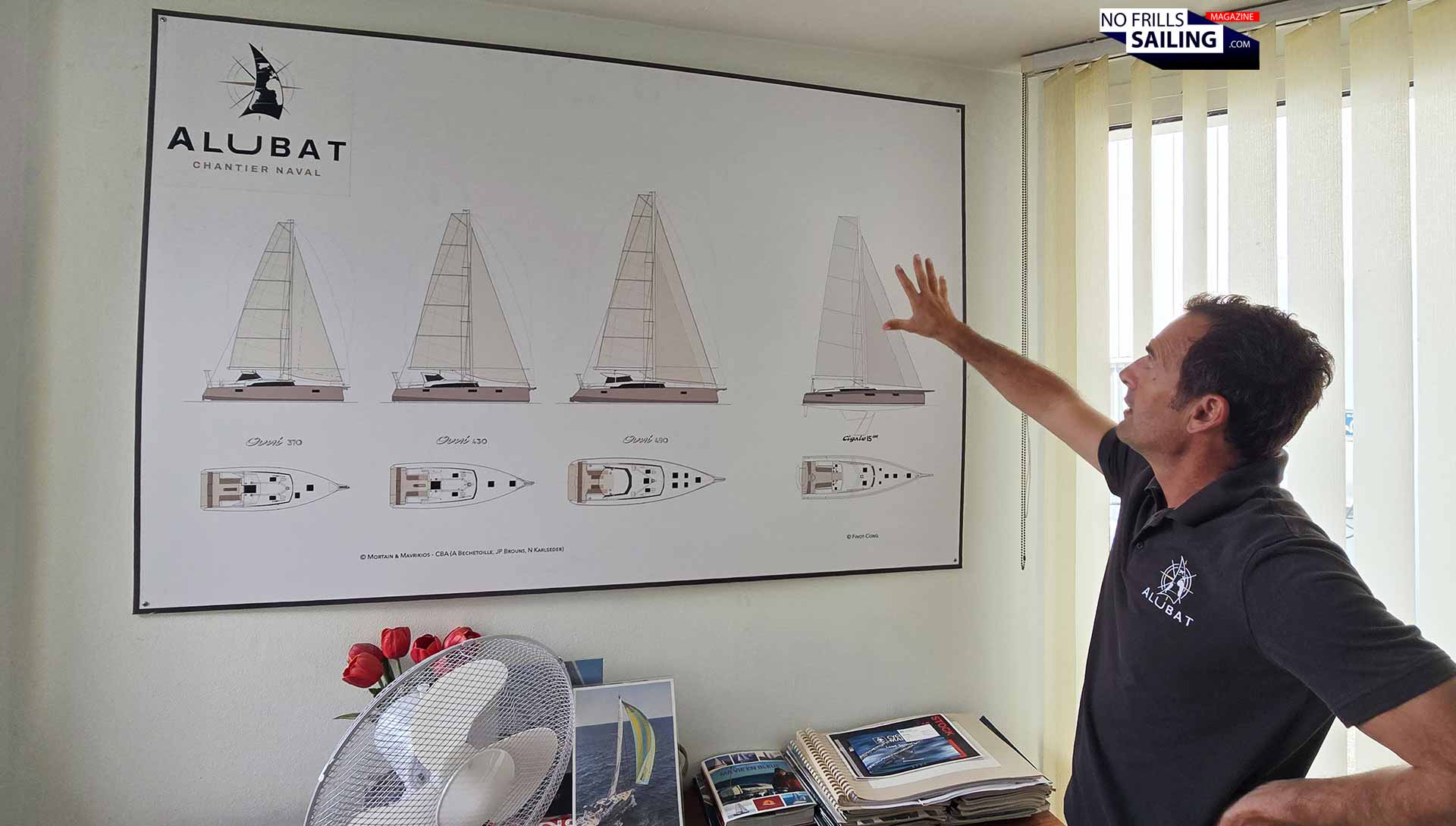
Last time I was here, the focus was on the then-new Alubat Ovni boats, a generation of I´d say “intermediate” designs that is now ousted by the current team of Alain Mortain and Yiannis Mavrikios and CBA (Jean-Pierre Brouns). In this, the shipyard managed to not only relaunch the famous alu-brand of cruising yachts but also to give it a completely new, fresh and very modern look. So, we start our tour at the very basic first step: The frame.
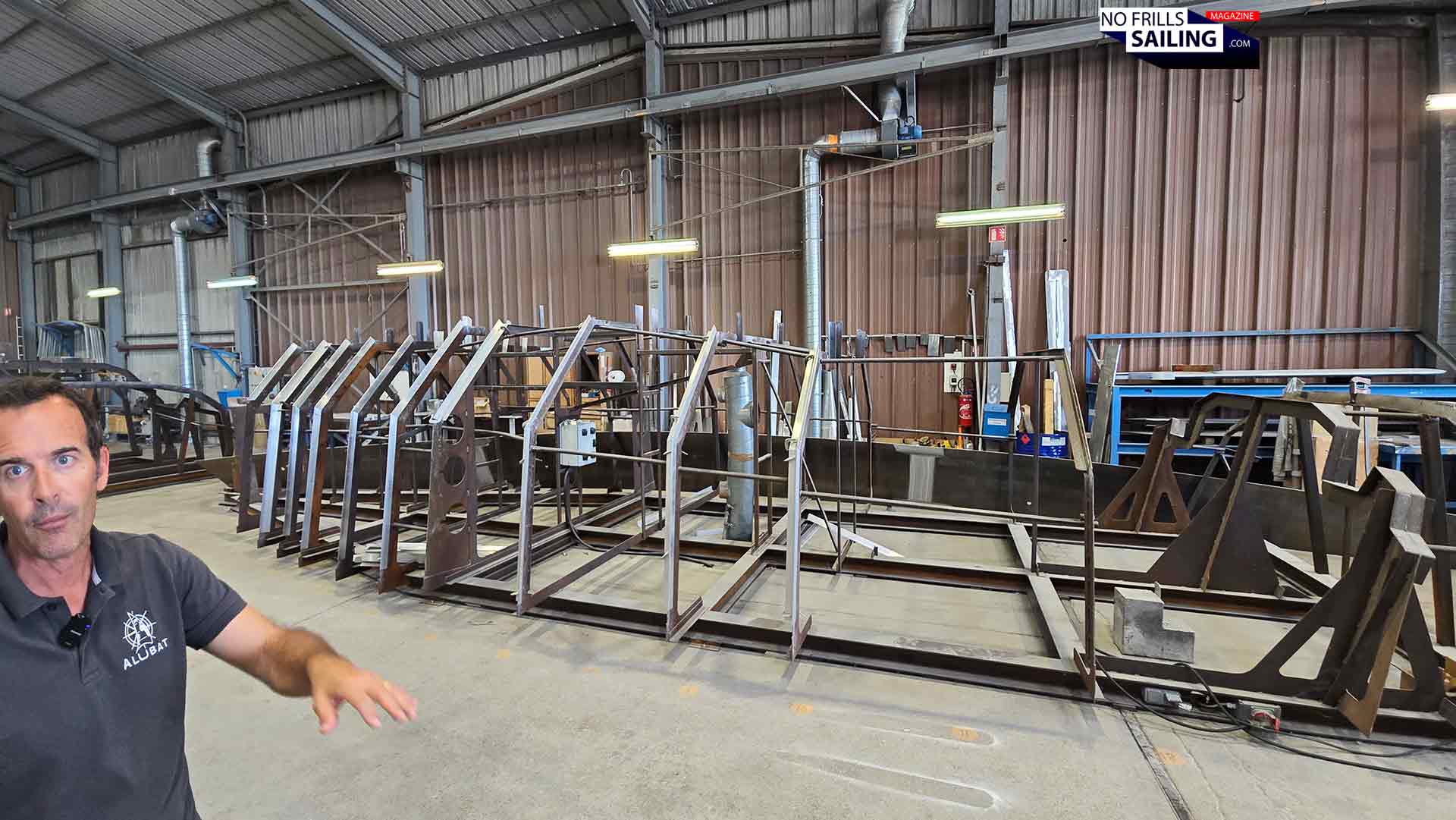
We start with the steel jigs
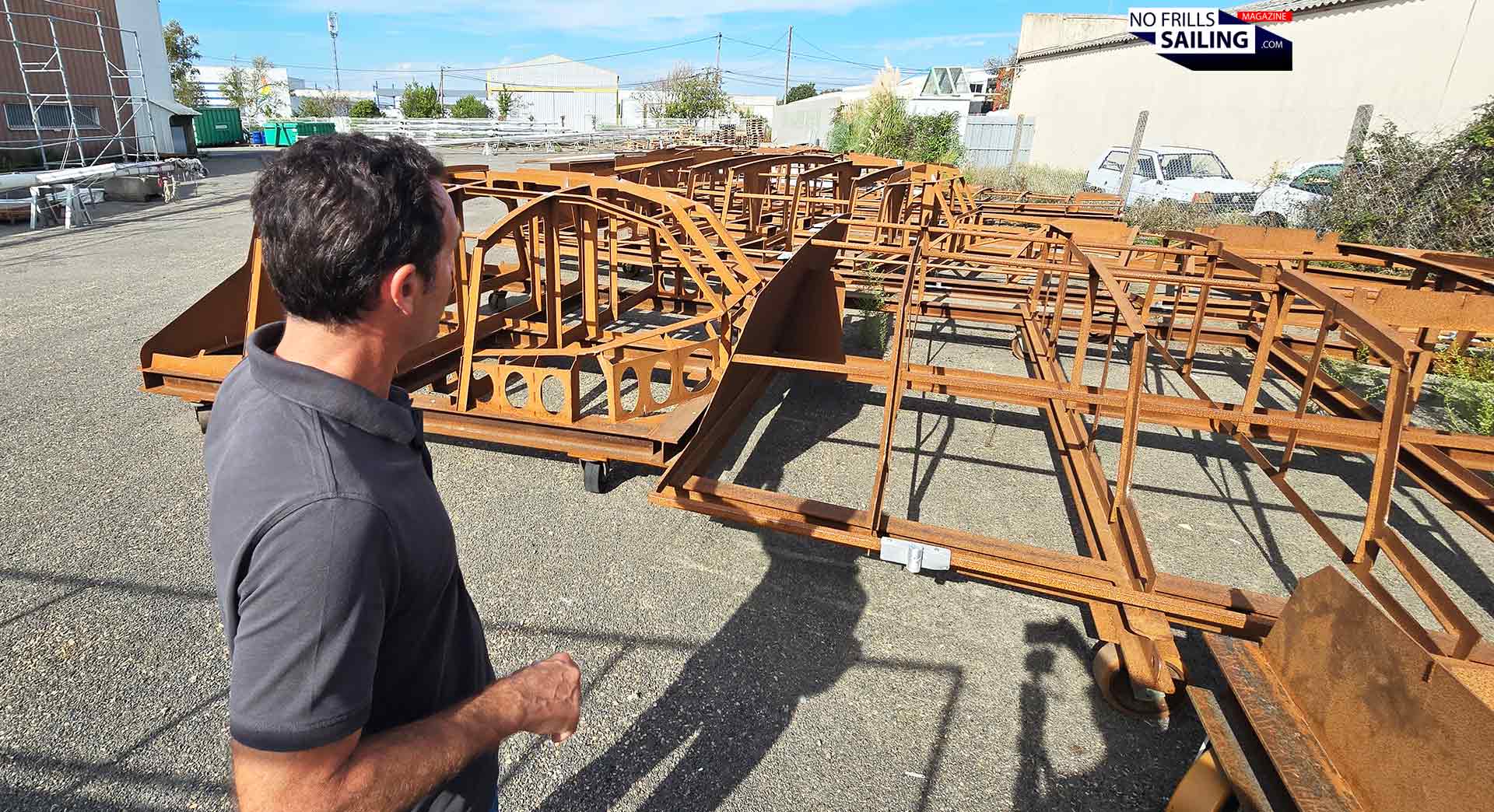
Here at Alubat the hulls are built utilizing the so-called cold molding system. This is a traditional building technique where the hulls are mounted on top of a rigid frame that works as the “male” mold for the “female” hull body. This is utilized heavily in prototyping, for one-off yachts, in wooden boatbuilding and for example at RM-Yachts, to name another big brand. Here at Alubat, I can inspect the frames behind the large production halls.
Upside down: This is how it starts.
Those frames are made of steel. These are very heavy and rigid structures, because for the later hull it must be insured that the dimensions, the symmetry and the overall quality of the hull that comes out of it is always the same – from the first hull to the … hundredth and more. Other than in GRP molding, where the hull is usually made the “right” side up, in cold-molding the hull is made turned upside down. Something that we can see now …
From the frame to the planks
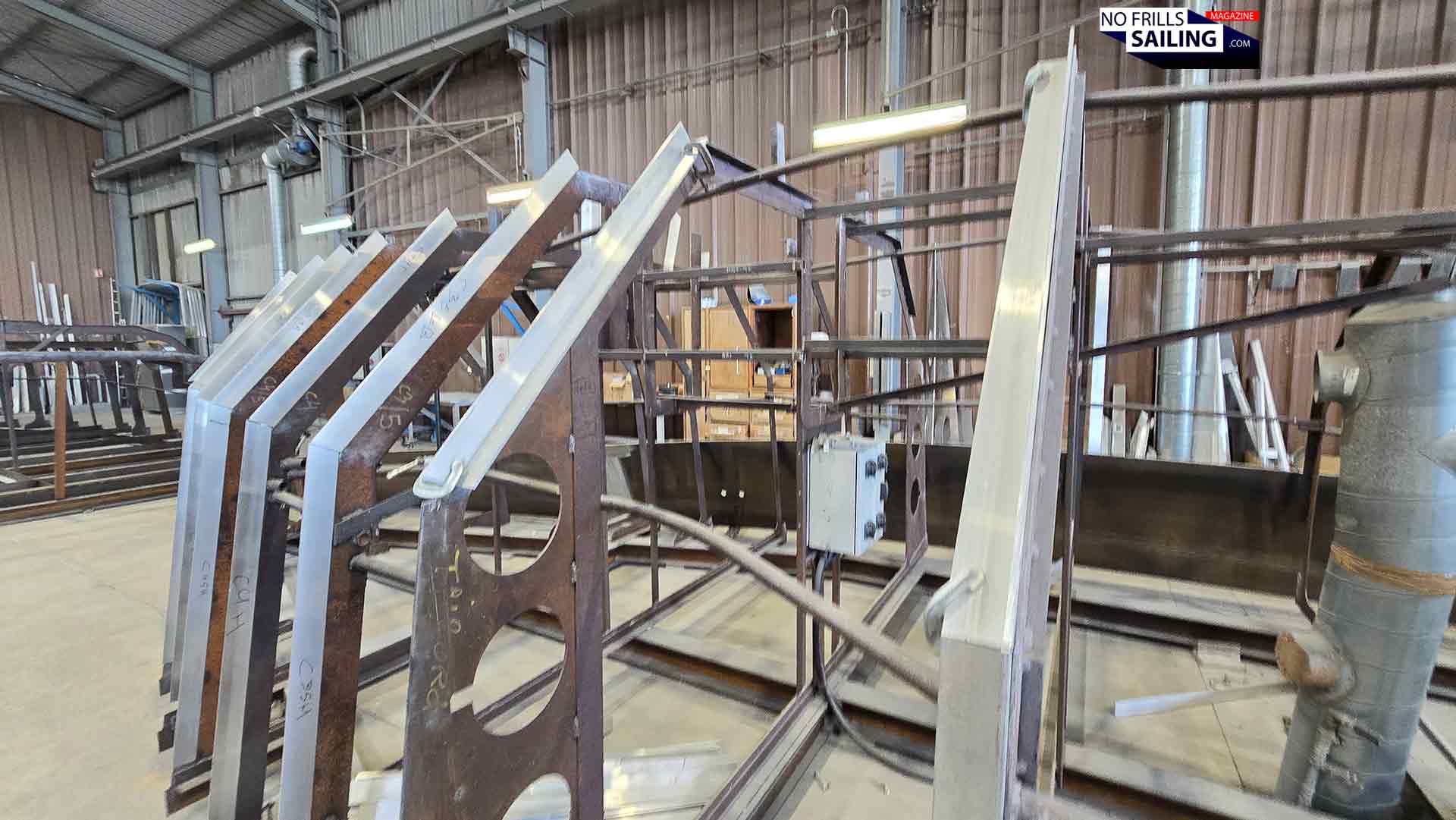
Inside the factory we inspect a frame where works on a brand new hull have just started. You can clearly see the rust-colored steel frame. If you look closely, you can see that the first L-shaped aluminum parts have just been positioned all along the frames, starting at the bow, running down to the stern. This is how it all begins: Thin alu-frames fixed to the frame by screw clamps first, and then partially spot-welded.
Can you spot the alu-frames? the nucleus of your boat …
But before this work can start, Luc points to the floor of the factory. For once, there are hard points driven into the thick concrete floor, connected to rugged steel fittings. These are fixed mountings where the frame will be positioned and fitted to. Large nuts secure the frame in place. By turning these nuts, the frame can be adjusted in its height over ground: That way, for each hard-point, the frame will be accurately aligned in a perfect horizontal position. Also, it will be insured that the longitudinal axis is perfectly straight and that there´s no torsion within the frame. And then, the frame will be welded to railroad tracks which are also flush-sunk into the concrete floor: I will later feel myself how hot the metal gets when welded – and hence also the frame. By connecting it semi-permanently to the factory´s floor, the frame cannot bend or distort when the hull is welded, resulting in accurate and symmetric raw hulls.
Cutting the plank to size
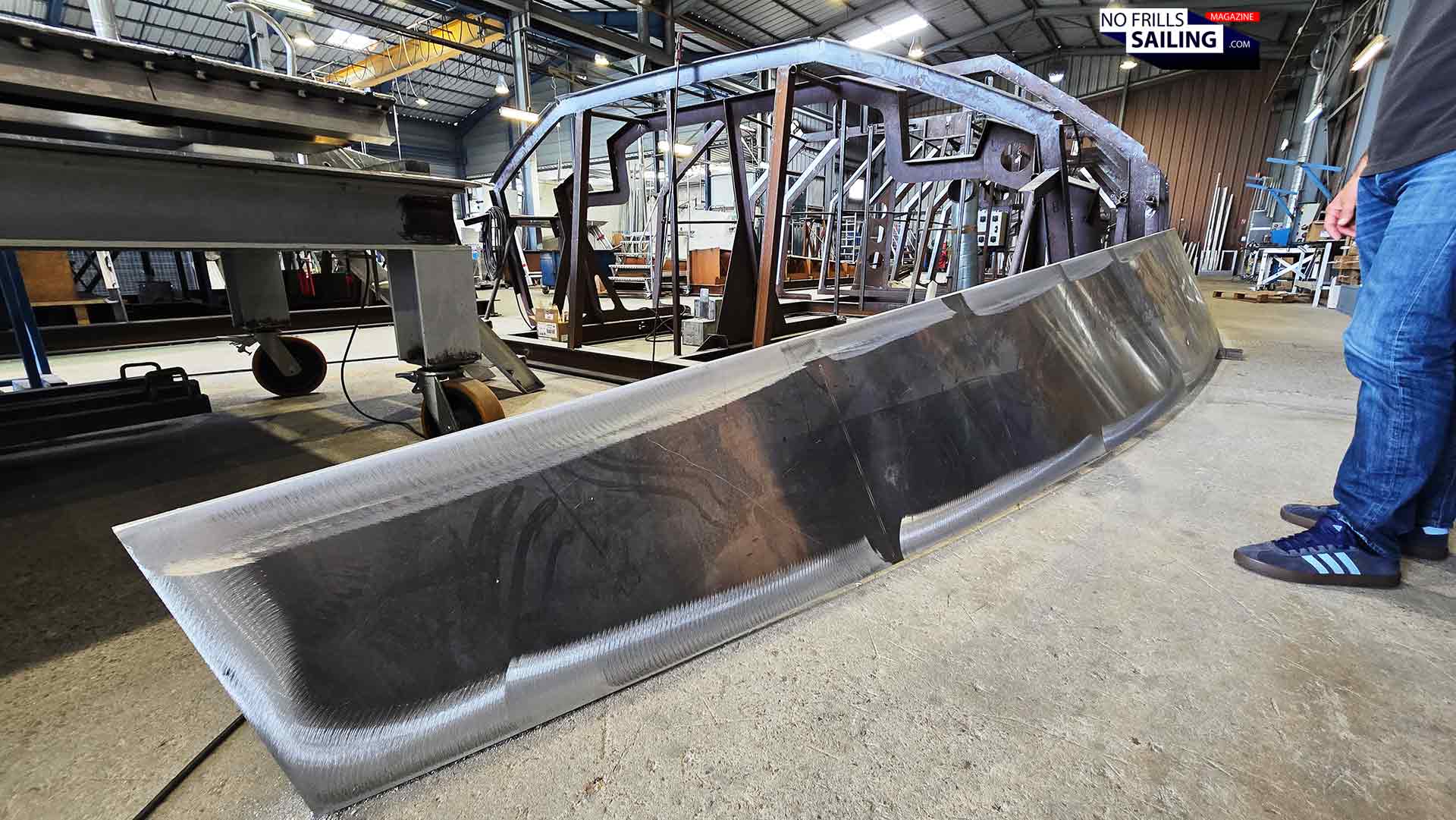
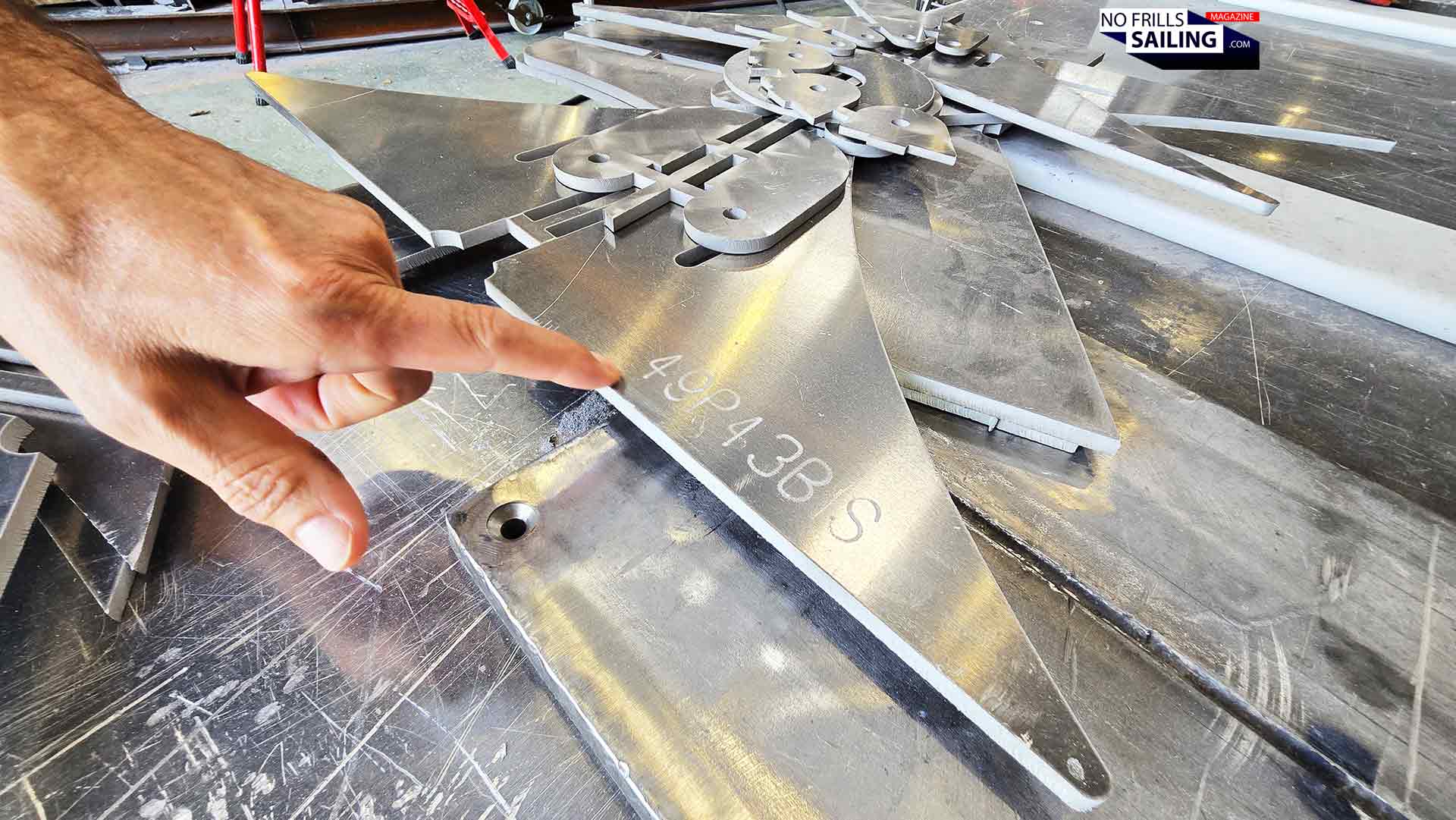
At one side of the new frame one large aluminum plank had already been begun to be worked with. It´s essentially a huge puzzle, put together by craftsmen, pre-cut by robots. This way an accuracy is achieved that is second to none – as each part is pre-fab with utmost precision by computers, based on ultra-precise CAD-models. It is handcraft, 100 percent, but also here, computers and state-of-the-art software have long taken over, achieving the best outcome.
The advantages of hard-chined aluminum hulls
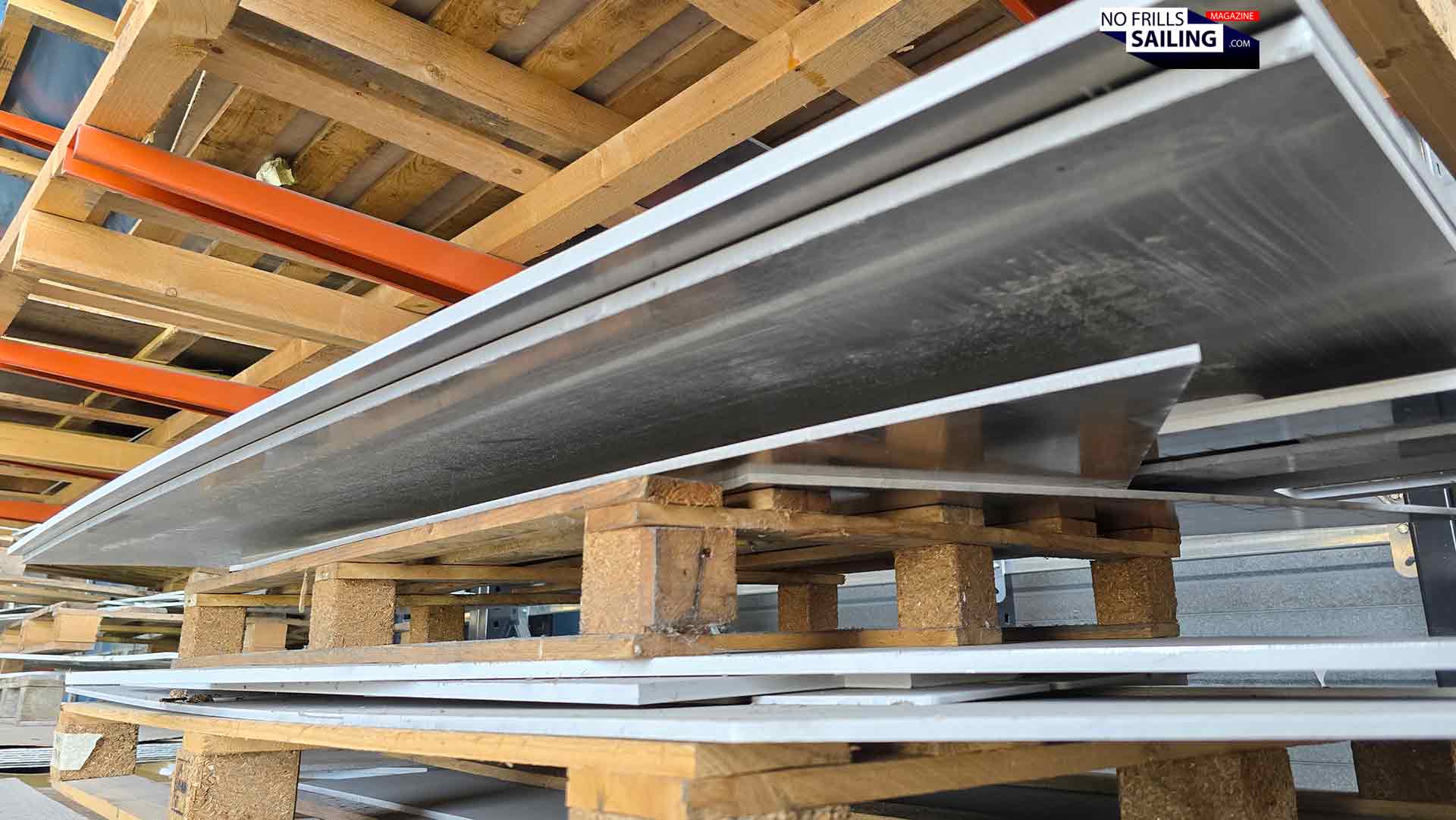
Luc shows me the commissioning storage for the aluminum planks. Here, raw aluminum sheets of all thicknesses are stored. This is the raw material that will be cut to size by large CNC-like robots which in this case cut the metal. With water-pressure! In order to cut for example five millimeters of aluminum, a pressure of 3.500 t0 4.800 bar. That´s a three thousand times more than atmospheric pressure here on earth. Can you believe that?
That´s some serious strength material!
So here´s the thing: Alubat makes hard-chined hulls. This means that the hull is not curved, but consists of long sheets, or planks, of aluminum metal, which later form the hull. In past times, an Alubat hull would be consisting of seven of such sheets, the current models only need five sheets to form a proper hull. It´s an ideal building method as it is comparatively easy, quick and also cheaper to make than classic round-chined hulls. Also, these chines will act like, well, chines, when sailing – further contributing to stabilizing the heel and sailing characteristics of the later boat.
Every part has its unique number
Boreal is also utilizing this manufacturing method, whilst Allures, Garcia or KM Yachtbuilders fancy the round-chined hull. Each has is advantages and challenges. Luc assures me – and will later show me – that sailing-wise and from a structural standpoint there´s no disadvantage between both. It´s a simple, well-proven method that comes with many pluses. In the end, a hard-chined Alubat can easily beach and will hence always be standing perfectly upright, thanks to this. As for some round chine is a must, many, if not most, of Alubat´s owners only see the advantages. This hard-chine approach is a deliberate choice that prioritizes robustness, interior space and form stability over pure hydrodynamic refinement.
No need for keel ballast: Centerboard yachts
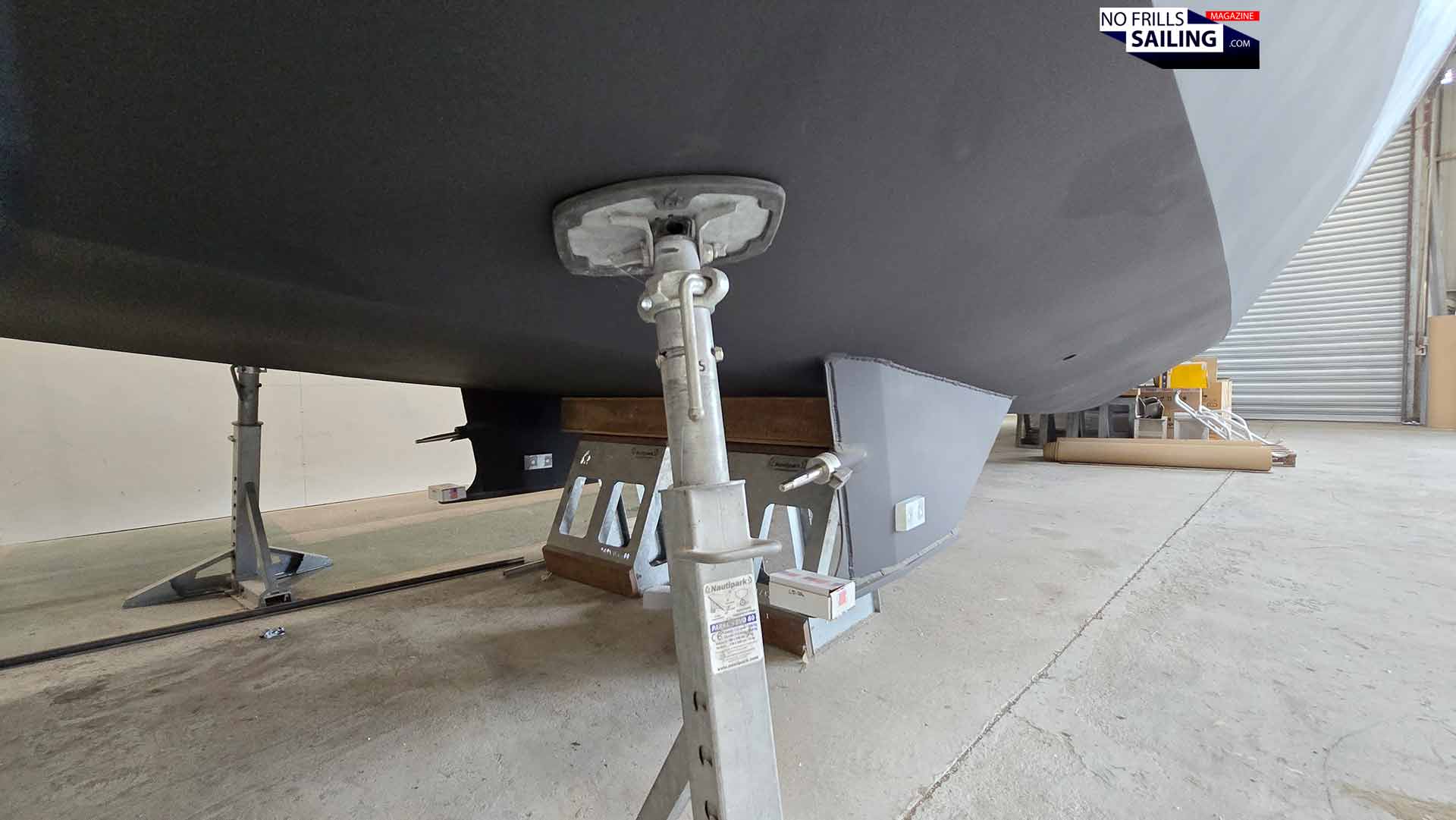
Another remarkable feature of these yachts is the centerboard configuration. Many still don´t know or haven´t realized, that for these yachts, the ballast is not in the keel. It´s within the hull, concentrated at the lowermost location of the hully deep, deep down. The centerboard – whilst of course naturally having a certain weight and hence contributing a bit to lowering the center of gravity – isn´t there for ballast or the righting moment.
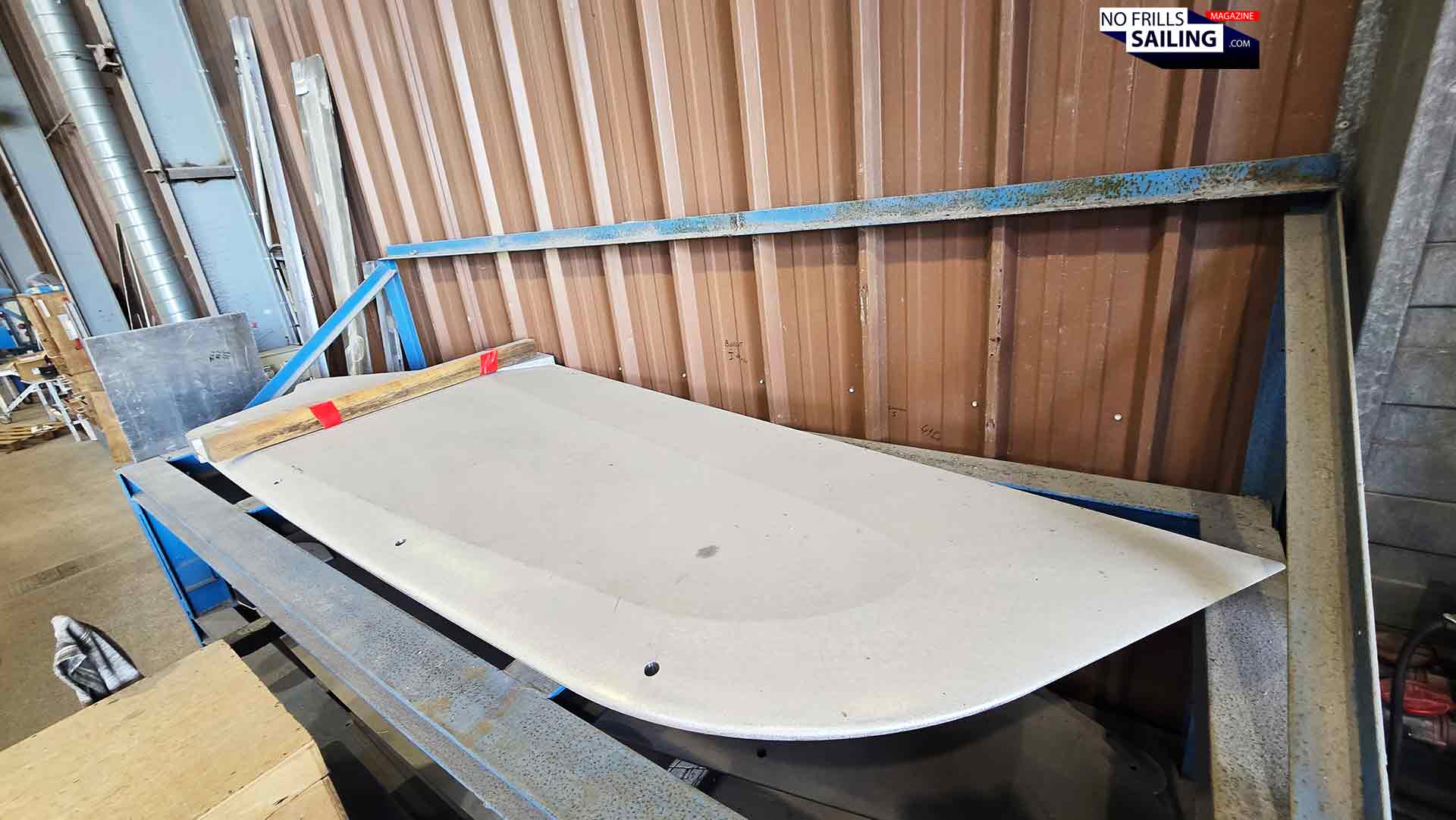
One massive centerboard!
The centerboard is, just as it was in your first Optimist, a measure of reducing leeway when sailing from broad reach to upwind points of sail. It will increase the directional stability of the yacht manifold and is a major factor in boosting the helming capabilities of the boat. But it´s not ballast! In theory – and many skippers do it – you could raise the centerboard when sailing dead downwind to reduce drag and it won´t affect the boat´s stability in any way.
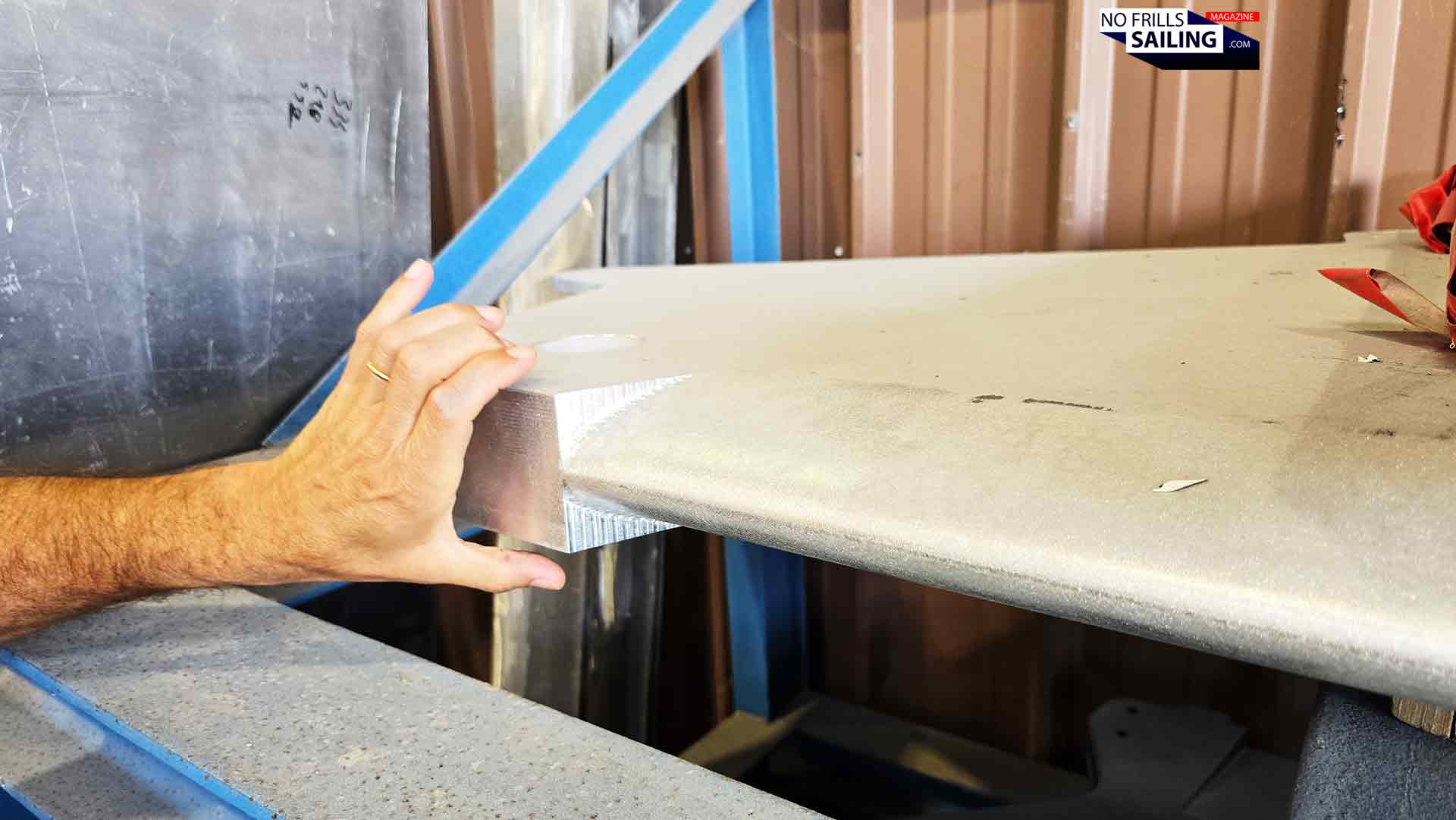
Look at the thickness …
Here at Alubat, these huge centerboards are CNC-milled out of one single massive piece of aluminum. It´s really huge! These parts are already delivered to the shipyard and made nearby by a metallurgic specialist, a company that owns the intricate and expensive machines to achieve such a products quality. As a matter of fact, the centerboard is one of the first parts that is already fitted to the boat at a very, very early stage. Such a part can be as thick as fifteen centimeters, weighing in some 370 kilograms for the smallest Ovni and can reach a weight of 480 kilograms for the Ovni 490. Impressive.
Steel is real …
… well, it´s aluminum, of course, but what I want to emphasize is the building material itself. I´ve written about it many times here and I would still always opt for an aluminum yacht if my sailing program would lead me to most remote places on earth, to sailing areas where freezing temperatures could make for a ice cover or possible growlers. Also, sailing for very long periods of times in faraway areas where repair opportunities are either rudimentary or must simply improvised. Welding, or simply patching, aluminum is mostly a no-brainer.
Spot-welding the planks to the frame
That´s the thing: Fiberglass boats are super convenient and make a fantastic job for most use-cases. But it takes quite some expertise to repair GRP-damage, I´ve experienced it myself when my last boat had a comparatively minor damage, it was quite an act to make it look like before. With aluminum, repairs “only” need TIG or MIG welding equipment, some argon gas and someone with some experience. You could patch up even larger damages pretty easily – something that may be done successfully even on a remote island. And reality proves, that´s how it´s done.
Safety first. Always!
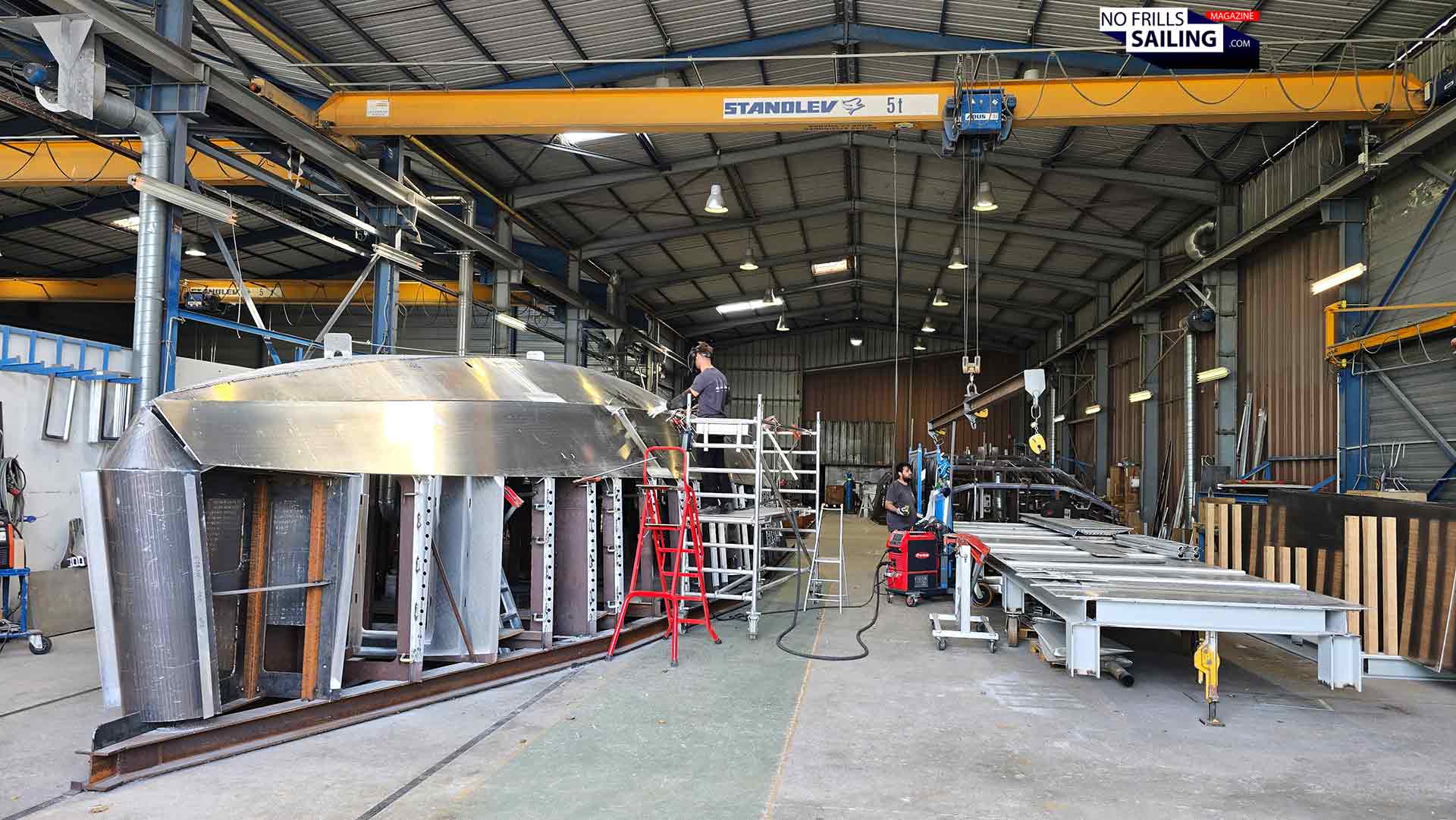
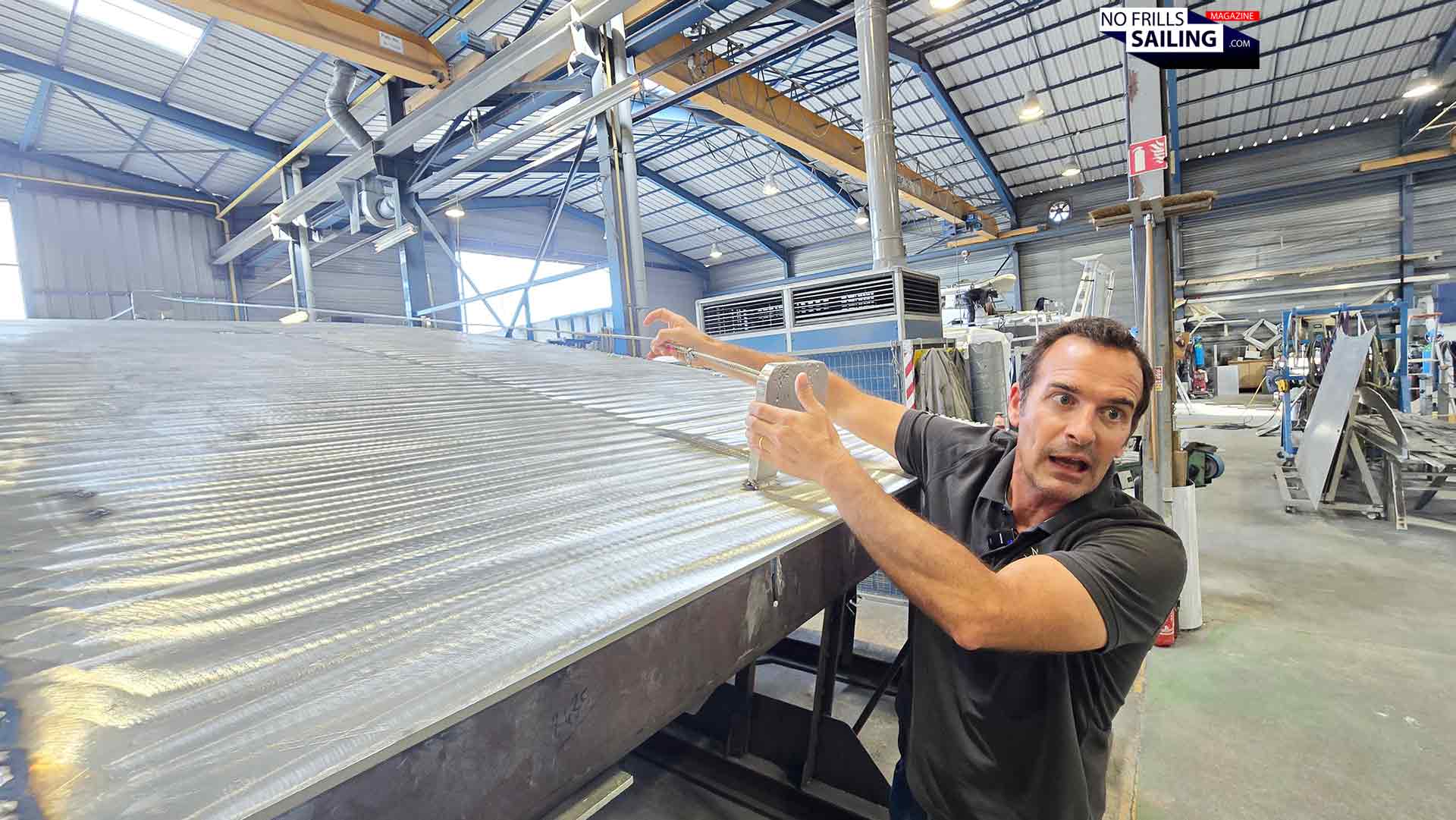
Luc shows some interesting details. This particular Ovni hull is still on the frame, or jig, with the workers spot-welding the planks onto the framework. After spot-welding, the seams are closed both from the inside of the hull and from the outside. The thing is – working in these conditions on a curved hull high up in the air, at least three meters above ground, poses a safety risk for the workers. But the nature of the material allows to add temporary precautions: Two massive aluminum eyes had thus been welded to the stern and the bow with a steel cable in between. It functions as a lifeline into which the welders have to fit their tethers. When falling, this prevents them from getting seriously injured. Afterwards, this rig can be cut off, sanded evenly and that´s it.
Massive. This is a proper ship. Not a boat!
This is a huge advantage over fiberglass: Such makeshift eyes, attachment and hard points or alu-loops for lifting can be temporarily put onto the hull whenever needed. They will later removed and nobody will ever see that they ever were there. You can´t do this with a fragile GRP hull, let alone a fragile GRP-mold. That is the reason why roaming the Alubat factory feels much more like being inside a “proper” shipyard – the sound, the smell, the noise. No chemical odors at all. Proper metalworks including lightning, fire and sparks instead.
Rugged alu: Safety as a priority
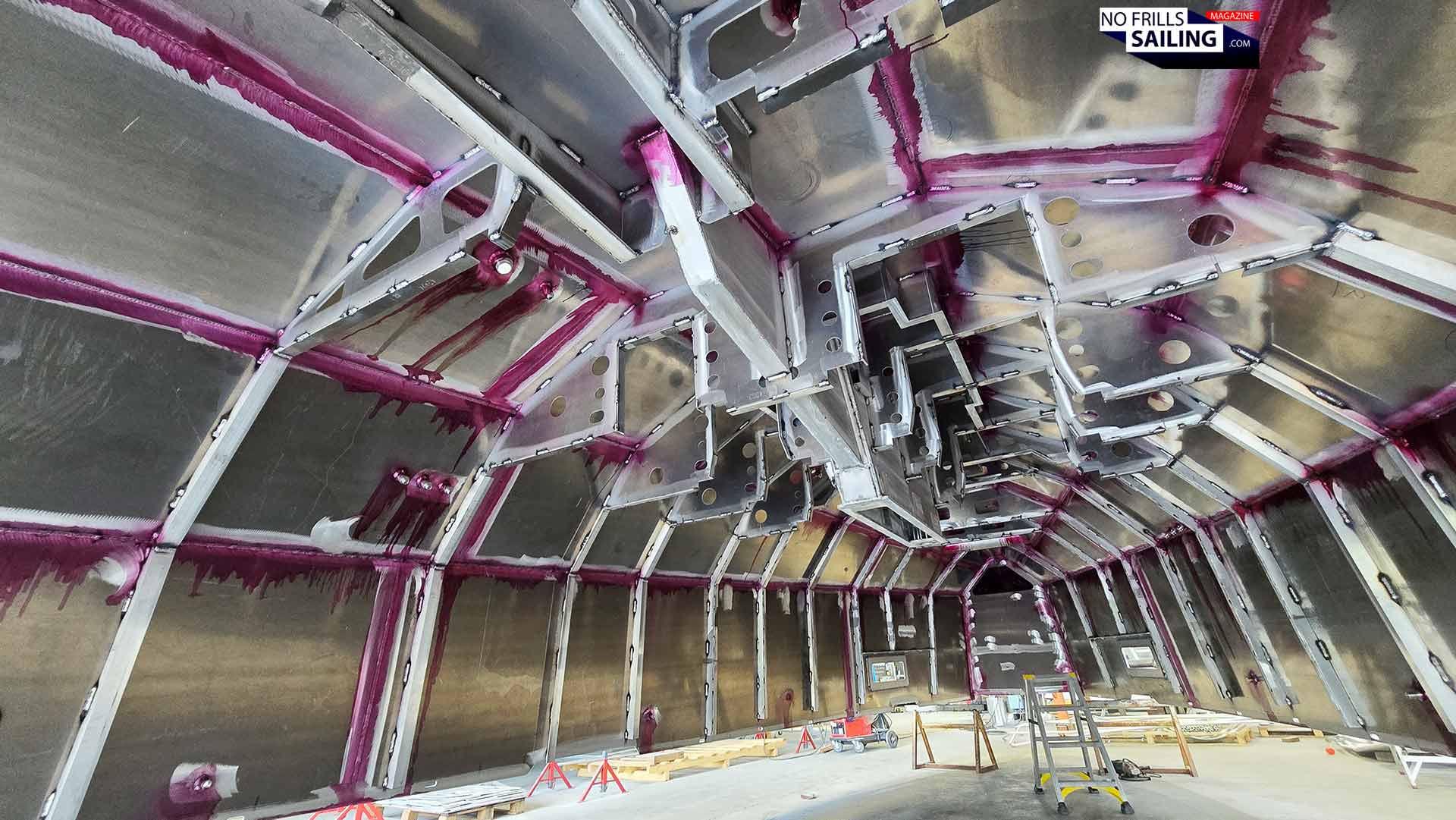
We proceed to another production step where one Ovni hull has been finished welding. The hull is still upside down, meaning, it hasn´t been turned the right way up for now, bit the jig had already been removed. We duck down and crawl underneath, inside we can stand upright again. Here I can clearly see and admire the intricate construction, the framework of the Ovni in its full beauty. There are the frames, the planks and many supporting parts, like the forward or aft watertight crash boxes or raised supporting frames for the floor of the boat.
Inside the (still upside down) finished hull.
Up in the air in the middle of the boat I can clearly distinguish the centerboard box – closed now – with the centerboard already inside. It is secured by two bolts so that it cannot slide out when the hull will be flipped. You notice this purple color spread all over the place? This is an indicator-fluid that is applied to the welding seams. When visible on the outside, the seam is faulty at that point and must be redone. This is the production step when a thorough check of the whole hull is done. Meticulously, centimeter by centimeter, before the hull is cleared for the next step.
A big-time puzzle …
You might think that making an aluminum yacht is a step-by-step procedure where part by part is adding. The sum of all the parts will later make the whole boat. In this, Alubat has worked hard to make the building process more efficient. That means, saving time and space eaten up within the factory is a premise: By raising efficiency, more boats can be built at once and in a shorter time period. Hende, more annual output is possible. As for now, the shipyard can churn out some fifteen Alubat yachts per year. That´s roughly 1.2 boats per month.
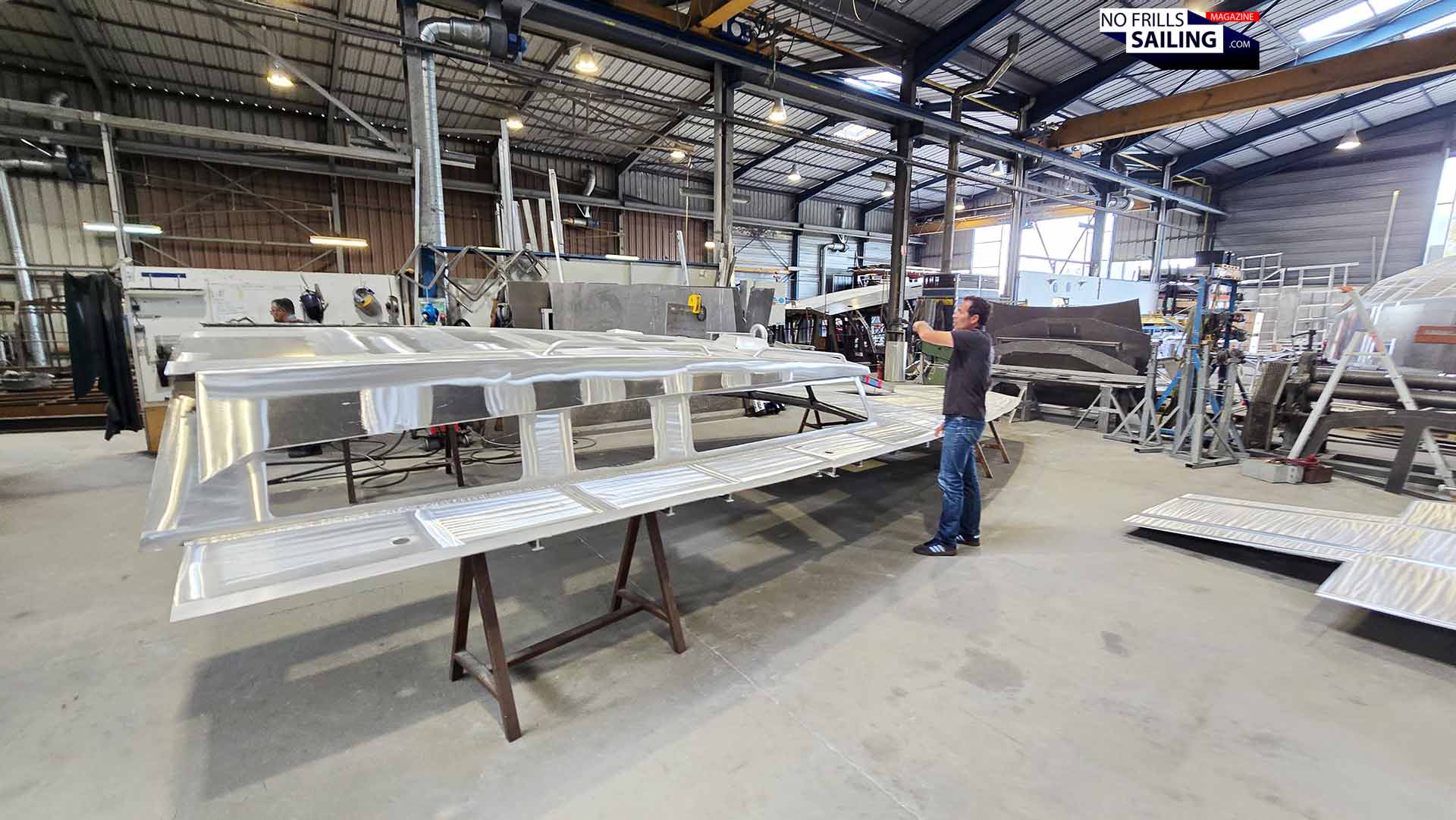
Module of an Ovni-deck
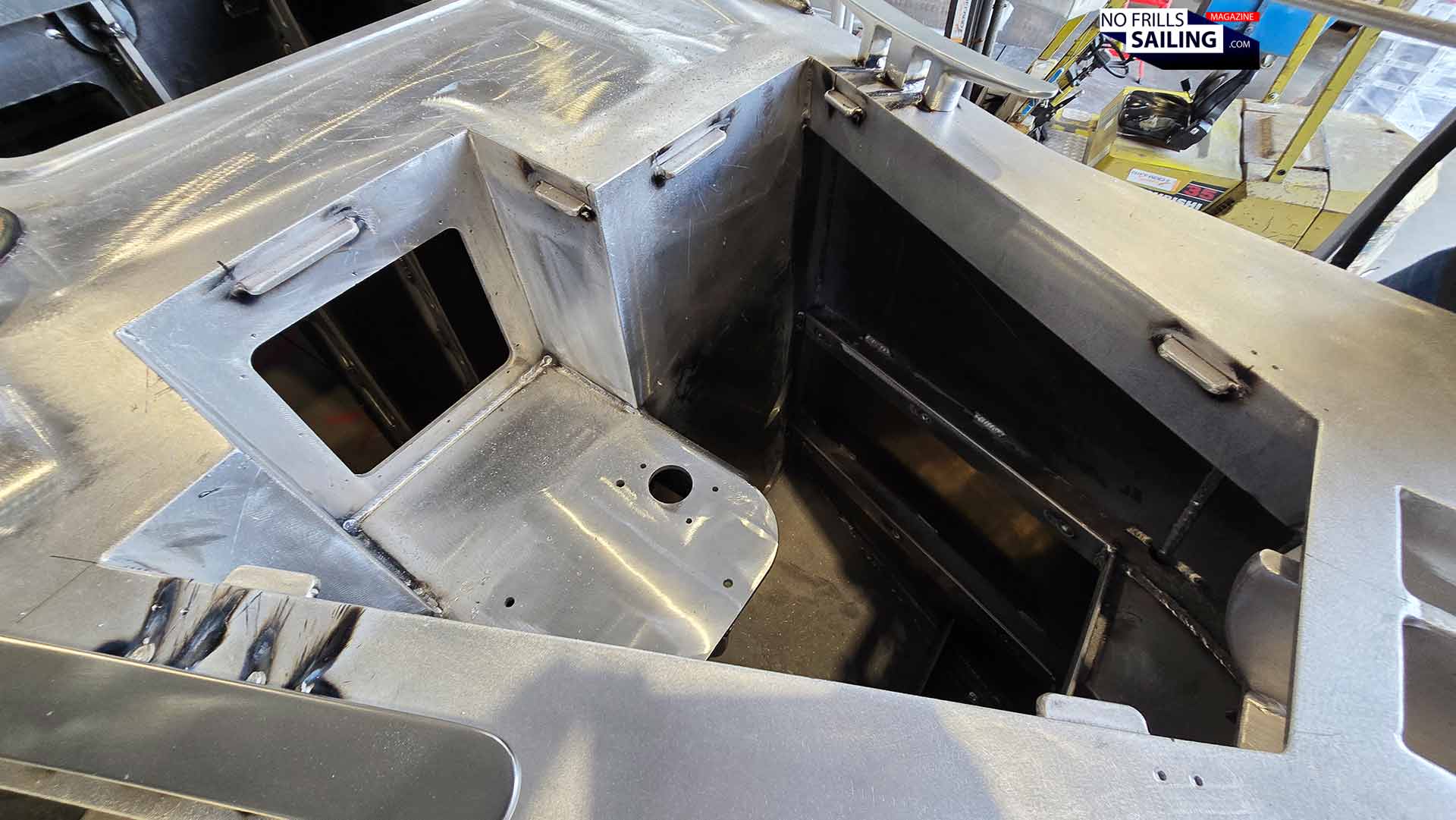
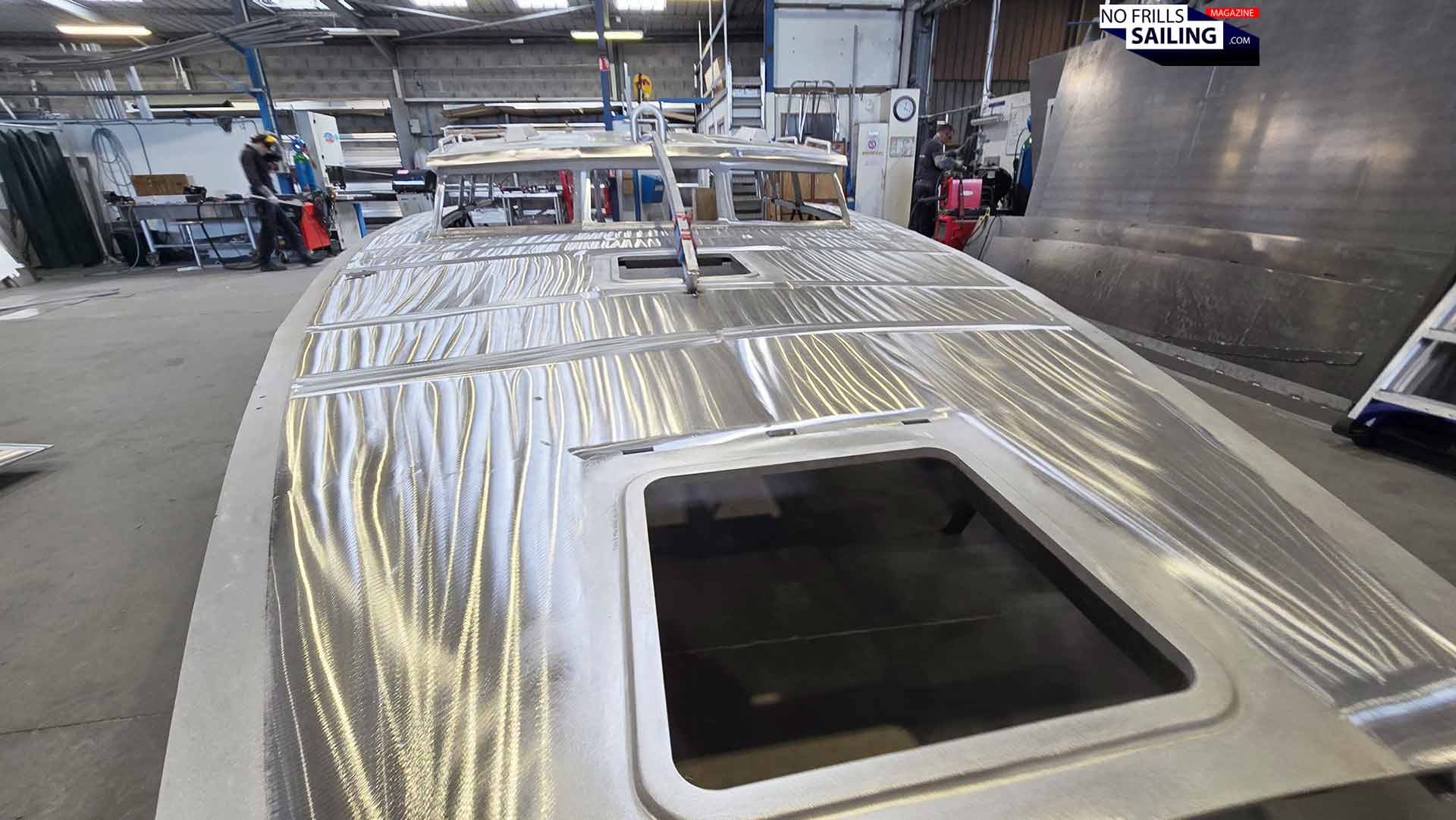
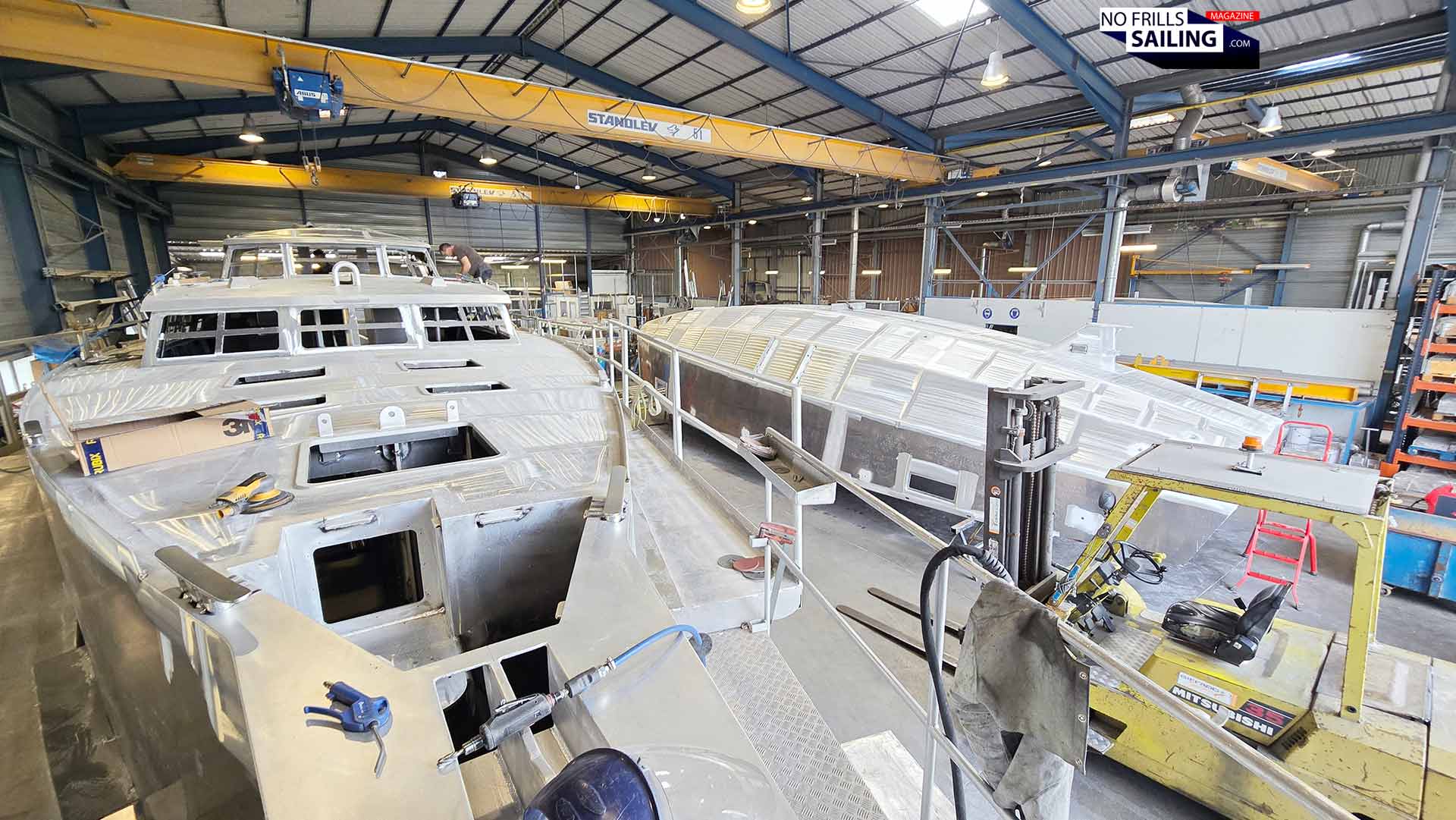
To achieve this, the boat itself is divided into larger sections. As you can see in these pictures, for example, next to the hull, a boat´s deck can consist of two larger parts. These can be made on separate spots within the factory and will only brought together when “married” with the hull. That means that each one of the now smaller parts can be worked upon by different people, maybe specializing in different details of the very part they are making. It´s indeed a big puzzle. But since parts are robot-cut, they will fit afterwards with utmost precision.
Time-saving & efficient.
This production method also means, that Luc and the crew have to plan well ahead. They never make two of the same types at the same time. They always try to mix the small, mid-sized and big boats, alternating in between. That´s because there´s only one jib-frame for the hull available anyway and when there´s a big boat under construction, the space it eats up only allows for another small boat being produced at the same time. And vice versa. And that´s one of the reasons why the waiting time for your Alubat can be sometimes one and sometimes up to two years.
The intricacies of aluminum welding
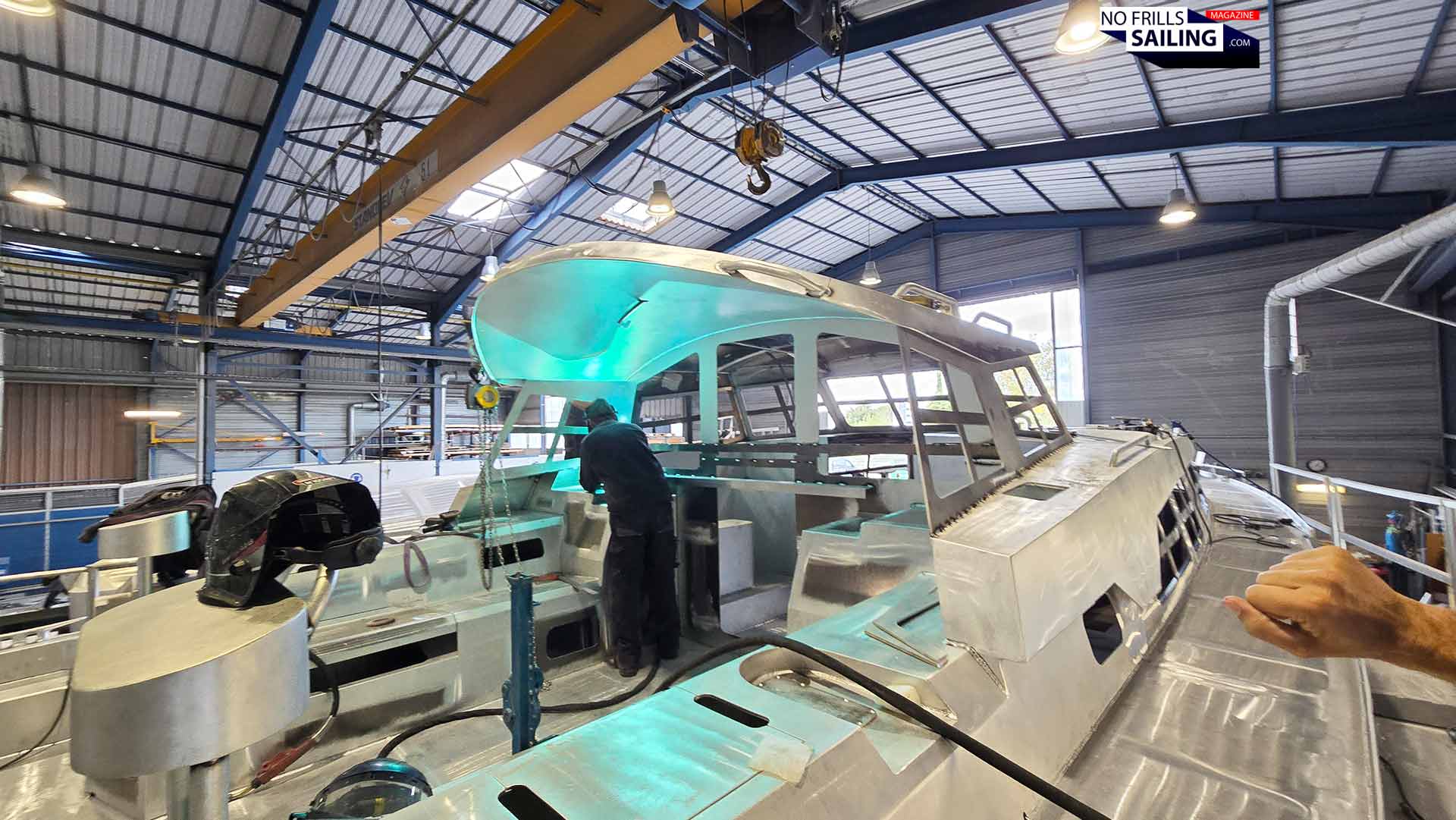
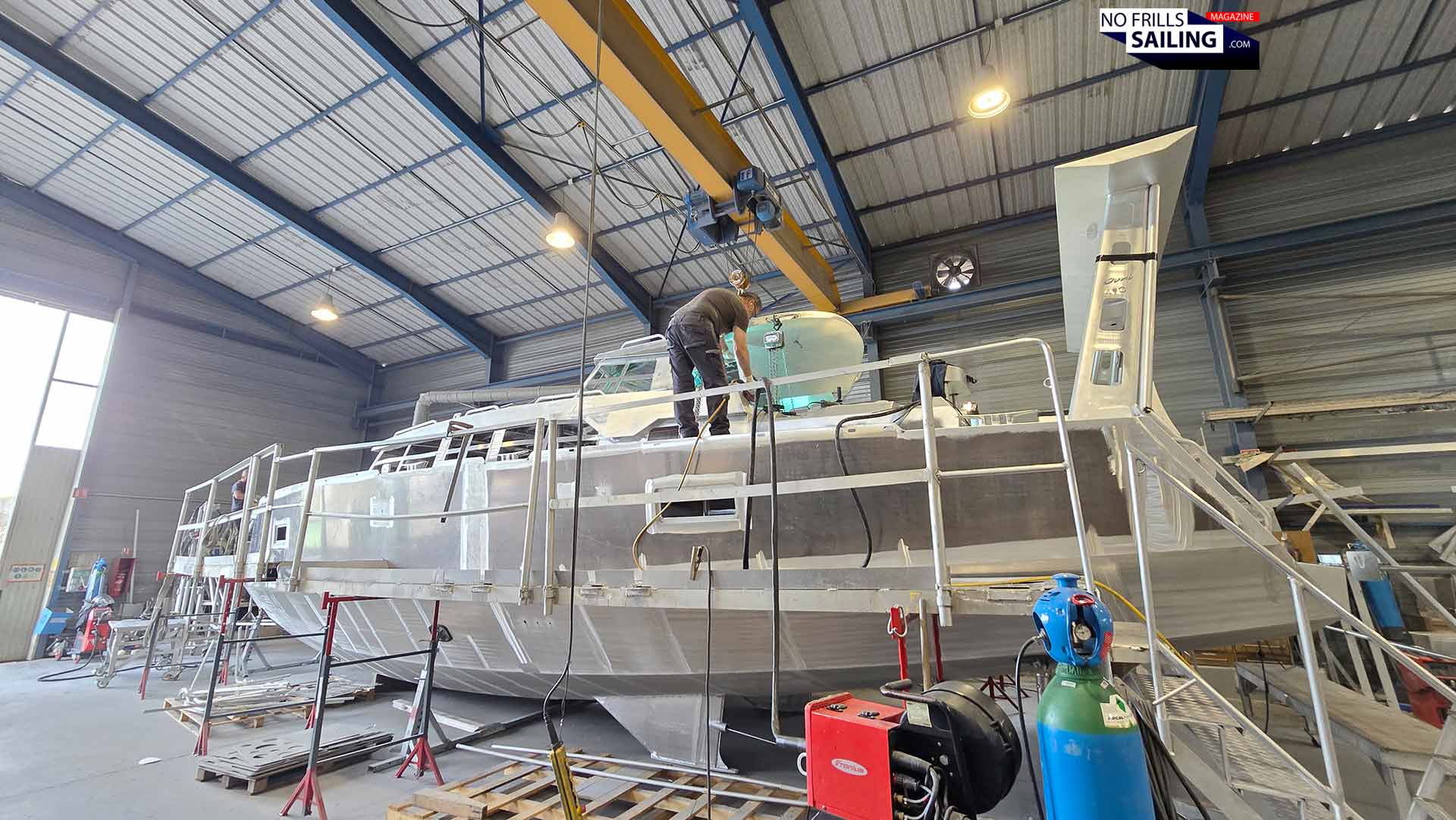
Checking an Ovni 490 in the making, we proceed to the production step where the deck-sections are welded to the hull. Before, of course, the guys will have fitted the bulkheads and other structural parts into the hull. This particular boat just received her two deck-sections which are now being welded together.
Welding the deck to the hull
When I boarded the yacht – apart from protecting my eyes from the intense light of the welding – I could really sense the heat produced by this process. In fact, when roaming the bow of this yacht where the guys had put on the rugged mooring cleats, I grabbed onto one of them, just to be slightly startled: They were still burning hot! This was a clear reminder of what this is all about. Real stuff, real melting of metal, real rugged shipbuilding!
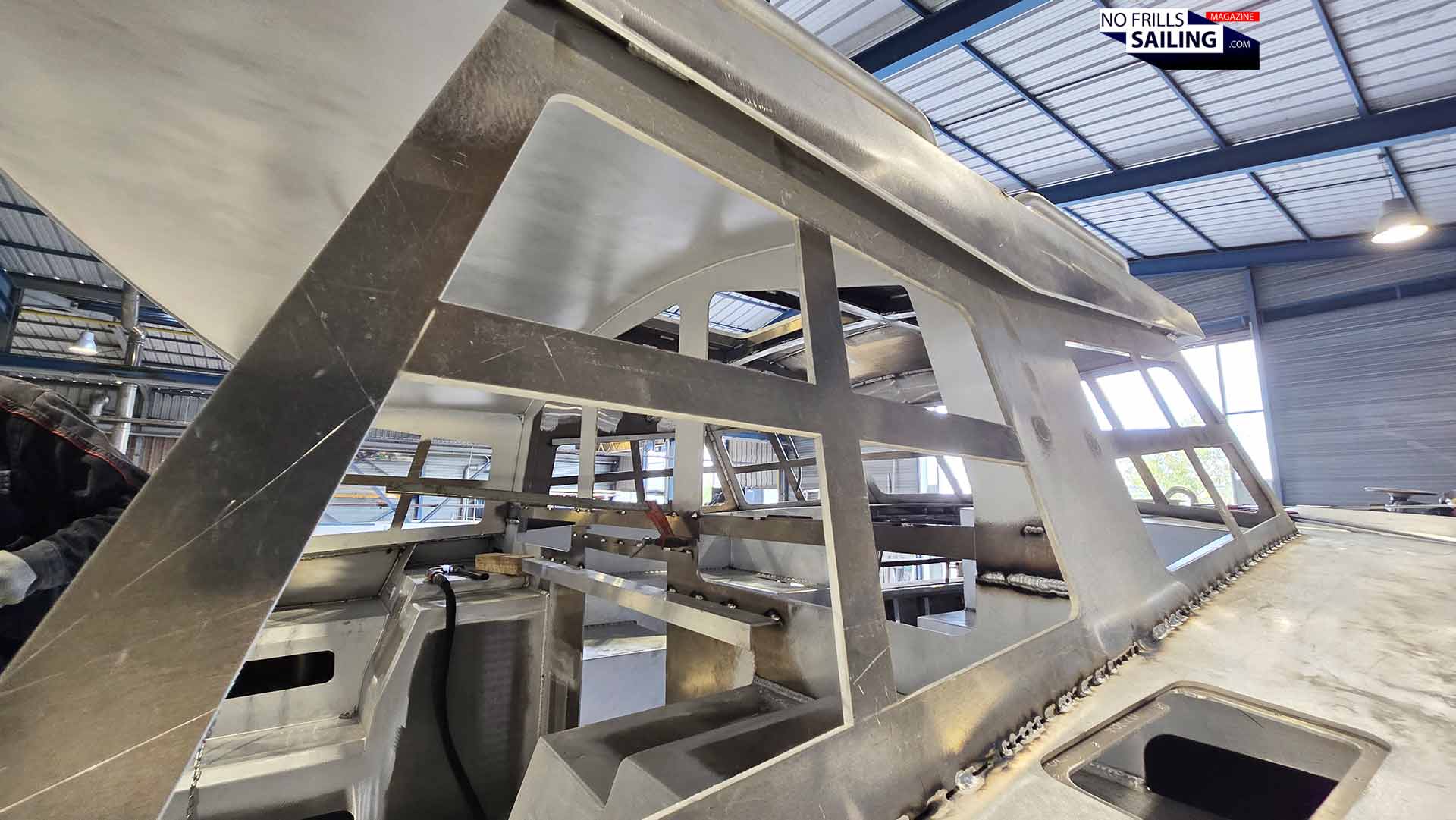
Mark these “crosses” in the windows.
In this, the welders of Alubat – well, of every single shipyard producing that way – are the backbone of the workforce. It takes some serious skills to weld aluminum. Generally spoken, welding aluminum is more complex and demanding than welding steel. When starting to work with this soft alloy, even experienced welders often struggle for a nice outcome. That´s also because with alu, much more “power” (amperage) is involved in welding than with steel.
Bit by bit, everything comes together.
In essence, a welder must be very careful in balancing the settings of the process – amperage, travel speed, gas flow and AC – to achieve a nice outcome. The thinner the sheets, the more sensible they become to burn-throughs, the thicker they are, the more they need, hence more risk. And then there´s the aluminum oxide that forms quickly. If not properly removed, it will change melting properties manifold, further complicating the process. It´s an art, really, to not only connect different sheets of aluminum, but to also make the welding seam look “nice”.
Sustainable boatbuilding: 70% recycled aluminum!
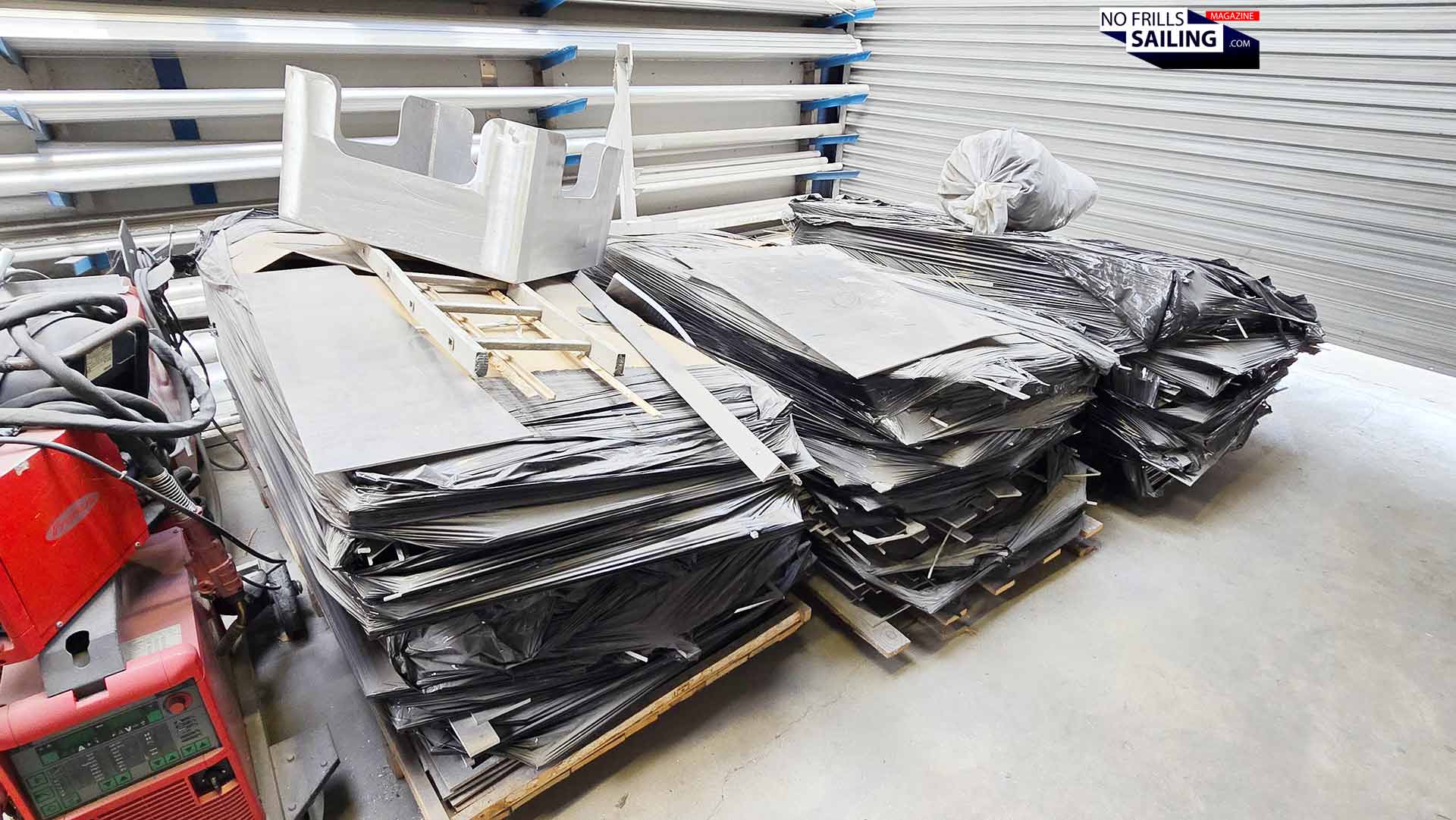
Have you seen the “crosses” in the pictures of the last chapter in the windows? Many of the large windows and other openings aren´t cut out completely for most of the building process. In fact, the “window crosses” will only be removed after the welding of the deck to the hull is completely done. Why? Because they further stabilize the section when during welding and prevent the whole part of being bend or distorted by the huge amount of thermal energy. Only after it is done, these crosses and other, temporarily attached beams, will be removed. And here´s the thing: There´s literally no waste here.
Valuable offcut! Everything is recycled.
For once, when Alubat receives the raw material for the yachts, this is delivered by a French company that is under strict certification. The aluminum Alubat is buying from them is certified to be consisting of more than seventy percent of recycled alloy. I jokingly say that all my beer cans end up sailing around the world at some point. Luc laughs and nods: Albeit high-grade aluminum for shipbuilding is not the same as for making beer cans, but in essence, the idea is right: For a GRP boat, precious crude oil must be refined into the different materials needed – fibers, resins and hardeners, gelcoat and plastic wrap for the infusion and many more. For an aluminum yacht, they just need … well, aluminum.
It´s so fascinating!
Remember these “window crosses”? Every single offcut, every cutout, every splinter of metal is collected. Larger parts will be checked if smaller parts can be made of them. The rest is collected. The picture above shows three pallets of scrap metal ready for shipping back to the aluminum company. Luc explains that these three mountains of metal is the leftover offcut of two new Alubat yachts. Along with aluminum, they also collect every other raw material, even the cutoff ends of electric wires. Nothing is lost here.
Focusing on the core values at Alubat
This also means that buying an aluminum yacht is much more sustainable in every sense then going for a plastic boat. The energy needed to produce the raw materials may roughly be the same, but since GRP cannot be recycled by now (except for some spearhead projects, like this), this is a dead end. After their service lives – which can last up to 30, 40 years – GRP boats usually will be shredded and … burnt. The material is lost. Not so with aluminum. These hulls, if treated properly and protected from galvanic corrosion can last literally forever. This is a point we will talk later about in more length.
The new Ovni-generation: A success.
Alubat is a traditional Les Sables-based brand that was founded back in 1973 here in the Vendée, launching their first model, the VODKA, which lead to the first ever Ovni in 28 feet, launched in 1978. Still back then it was a hard-chined centerboard boat, something that still defines the yachts today. From the beginning on the shipyard tried to remain independent. Although growth and commercial success is naturally the aim for any enterprise, these guys never focused on this. It was rather their aim to develop their products, become better and secure their place within the industry. In this, Ovni grew and so did the product´s quality. Utilizing the help of such renowned names as Philippe Briand, Jean-Marie Finot or Marc Lombard, Alubat was also always open for surprises.
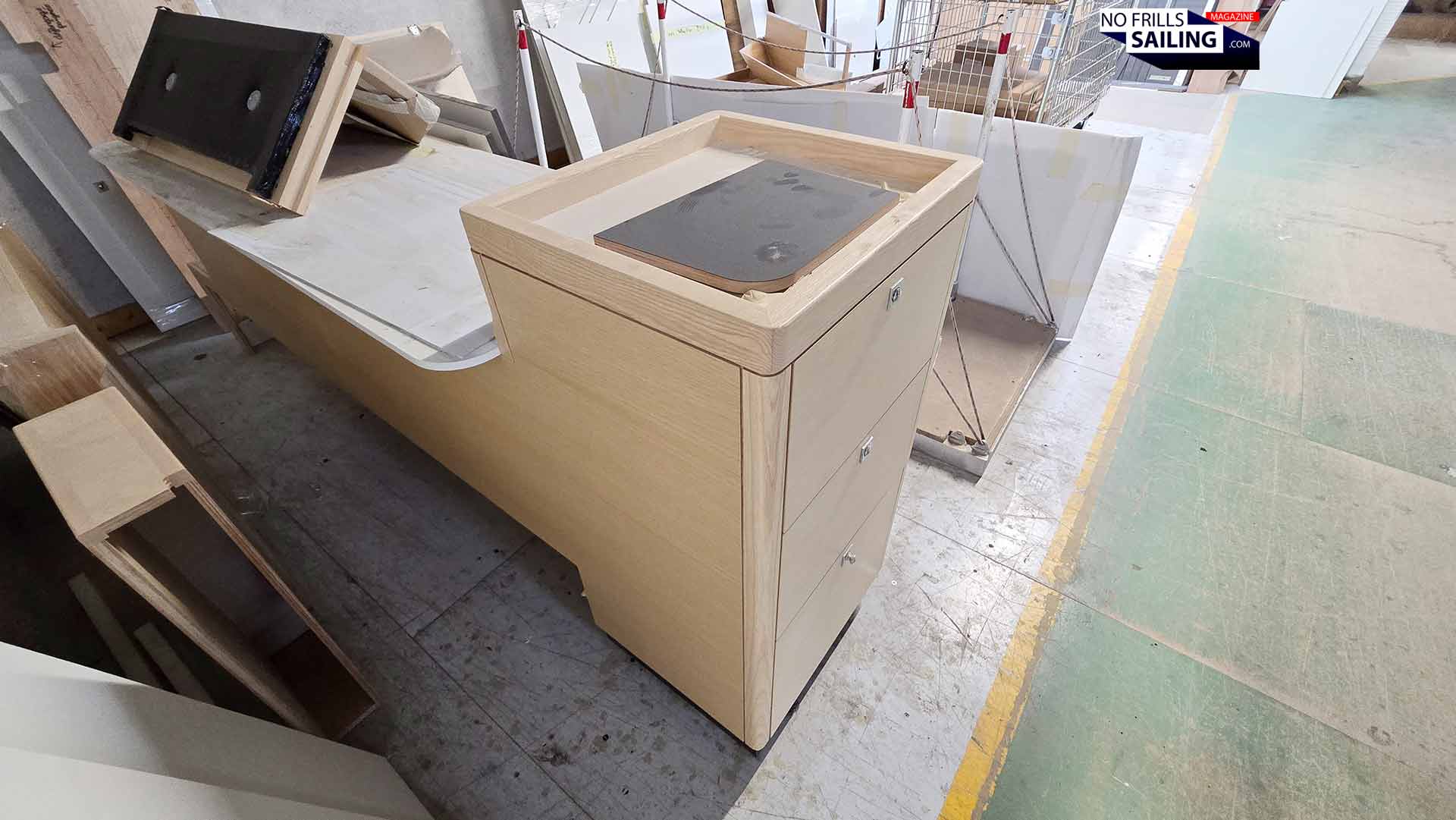
High-quality furniture module for an Ovni.
The launch of the Cigale ultra-light performance-range, back then initially designed by Finot marked one of these highlights. Later Marc Lombard would join in and renew the concept. Following a deep existential crisis in 2013/14, it was because of a total of fourteen individuals who rescued the shipyard from filing for bankruptcy. They bought the shares and made it possible that Alubat could start its second life. And they did with a bang: First it was the Marc Lombard design bureau to refresh the range, later the duo Mortain & Mavrikios + CBA radically reshaped the Ovni-range.
There´s still a lot of capacity to do it inhouse.
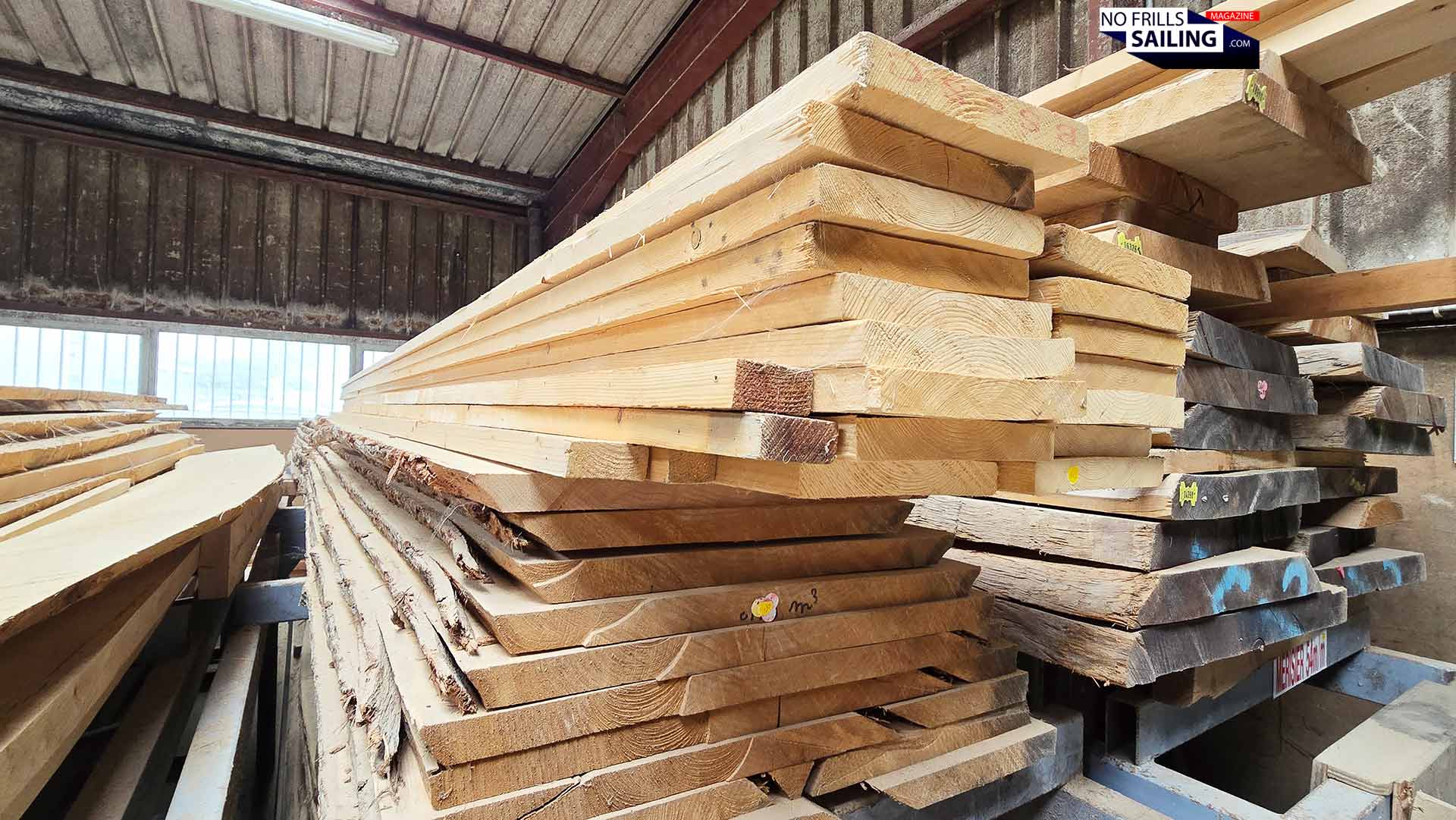
Also, the company focused on its core: Aluminum! As Luc shows me around, the carpentry and furniture-making capabilities had been significantly reduced. They shifted to outsourcing the joinery to special companies in the vicinity, because making these inhouse was no longer sufficient. Nowadays, tools and materials (and skilled craftsmen) are still here, but are only utilized for prototyping, for heavy individualization or refit projects. Almost all of the carpentry is now outsourced: This results in better quality for the woodworks on the one hand and more space for their core activities, which is shipbuilding, on the other.
As less paint as possible
Another change was the outward appearance in details for the Ovni boats. In the early years – and one can see this often in used Alubat boats – most of the deck an partially also the hulls had been painted. The problem with anything applied onto aluminum is that … it doesn´t stick all too well on its surface. This is naturally something that comes with the material properties of aluminum. First of all, there´s the oxide layer. Even if sanded and cleansed properly, the bare “pure” aluminum surface will form such a layer within hours and even minutes.
Let´s have them with least possible paint!
This layer is chemically inert and kind of “block” the sticking of any other material on it. Even if done most cautiously with utmost care and special paints, even if it looks nice at first, eventually, the paint will come off. Secondly, aluminum is very, very, very smooth. It needs mechanical or chemical abrasion to make it “rough” so that primer or paint could stick. This is arduous and expensive work. Usually, aluminum has a high thermal expansion rate than paint. When subjected to large variations in temperature, it can cause the paint to form cracks or peel off. Last not least, especially when copper-based bottom paints are involved, due to the less “noble” properties of aluminum, the alu-copper-exchange can cause corrosion forming underneath the paint. That said, Alubat now refrains largely from painting the boats.
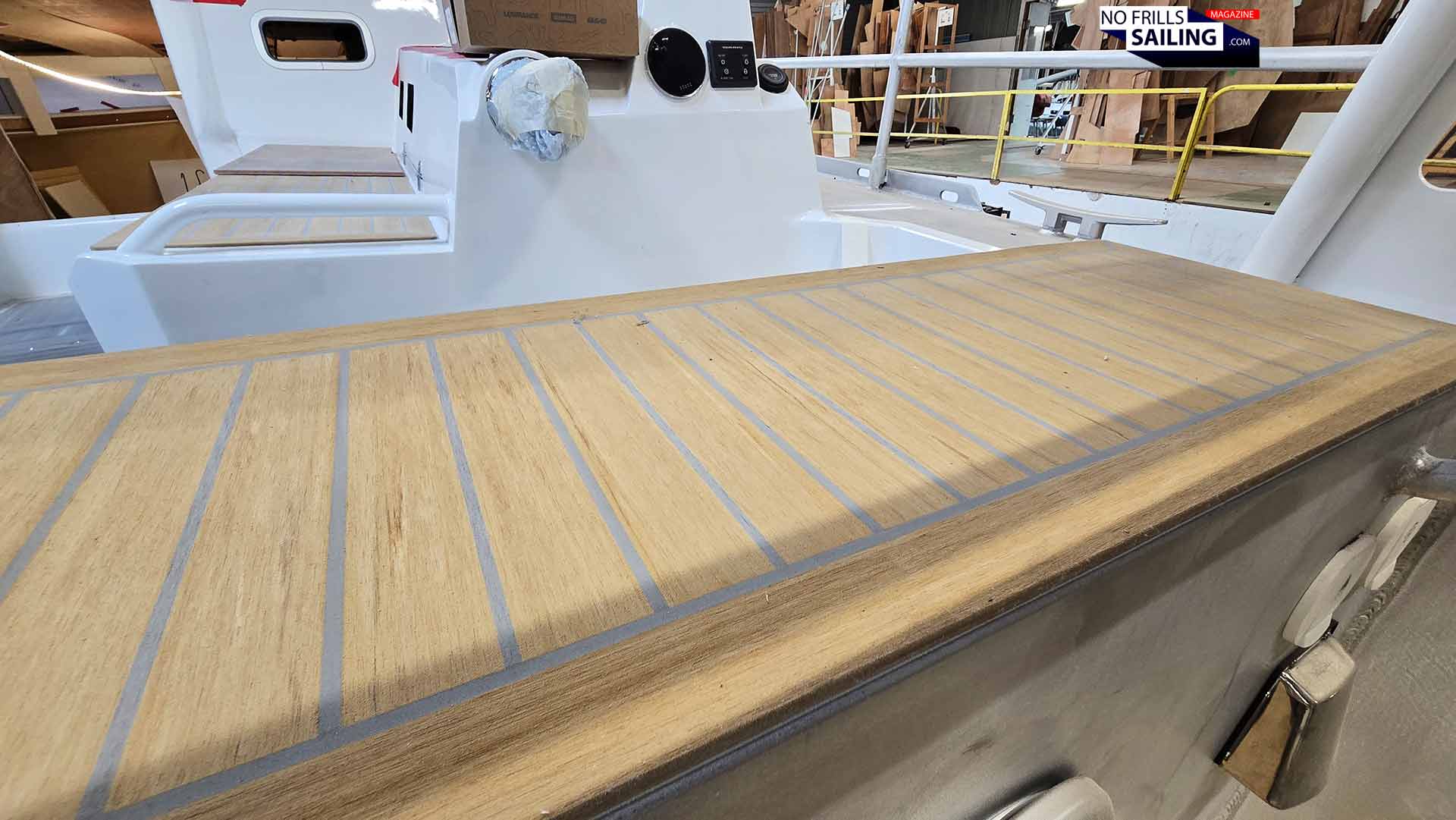
PVC-decking: New standard at Alubat.
It´s “natural” look now, as Luc explains. Of course, if customers want their boats to be painted, they do it, but the guys suggest to just take the yacht as she is: Naturally beautiful because of the aluminum looks. That also goes for other materials, like teak: Alubat refrains from offering real teak since years, instead opting for PVC-synthetic teak which, with grey caulking, looks absolutely amazing and really fits the alu-looks, I think.
Being innovative
For many brands, becoming sustainable or “green” is a major marketing hype nowadays. I´ve also written in length here about different approaches of the players in the boating industry in terms of resourceful operations, sustainable materials, recycling or waste reduction. “Blue boating”, meaning fitting the yachts will either all-electric or hybrid propulsion is also a huge topic. For Alubat, as Luc shows me next, this has always been a focus, long before it became fancy to announce or legally binding through EU law.
The twin-engine 490!
In the fitting hall, where the new boats receive their interiors and final touches, we crouch underneath a nearly finished Ovni. To my surprise, the yacht has twin engines! Instead of fitting one large Diesel, this one features two mid-sized engines. This has many advantages, from maneuverability to weight-distribution. Luc says that most Alubats are really utilized for “go anywhere”-sailing adventures. Meaning multi year long voyages to the remotest places of the earth. Redundancy in engines is of utmost importance for many of their customers: As rugged and reliable the good old Diesel engine may be, they can indeed fail! For the Ovni 490, the twin engine is standard. But here it comes: You can have it fully electric as well!
Electrification: Not just marketing at Alubat.
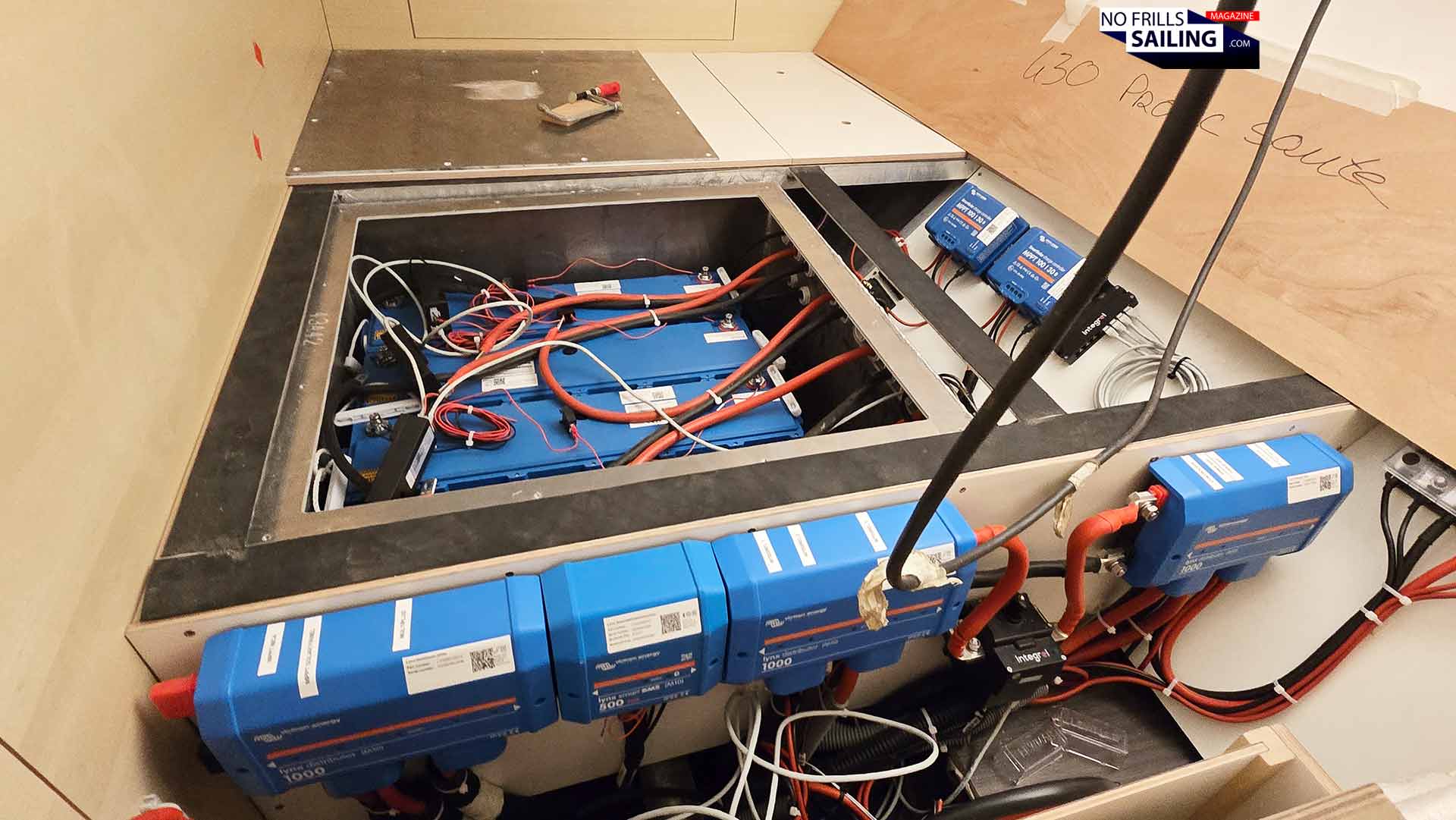
Luc tells me that a few weeks ago two of these new hybrid Ovni 490 sailed up north to Norway, other electric boats sailed as far as New Zealand. “Without any failure or problem!”, he insists. It´s possible to fit a large solar-panel array on the coach roof, the deckhouse and on the aft panel so that constant recharging by the sun is possible. The twin electric engines are recuperating whilst sailing very efficiently as well. Fitting big-time lithium-batteries will also have a nice side effect of contributing to the weight-distribution. “No problem with high latitude sailing fully electric whatsoever!”, he confirms.
The “secret” backdoor. Ingenious.
Now that´s interesting, isn´t it? I must admit that after my 2-years of experience with an all-electric boat I happily and gladly opted for a proper Diesel-engine for my new yacht without hesitation. In my eyes, the range-problem, reliability, dependence on digital stuff and the largely incompatibility of different brands and manufacturers make all-electric solutions for boats nowadays a two-sided sword. It´s really amazing talking to Luc who is so convinced – and proves it – that this is the future. It certainly makes sense to delve a bit deeper into this topic, right?
Quo vadis, Alubat?
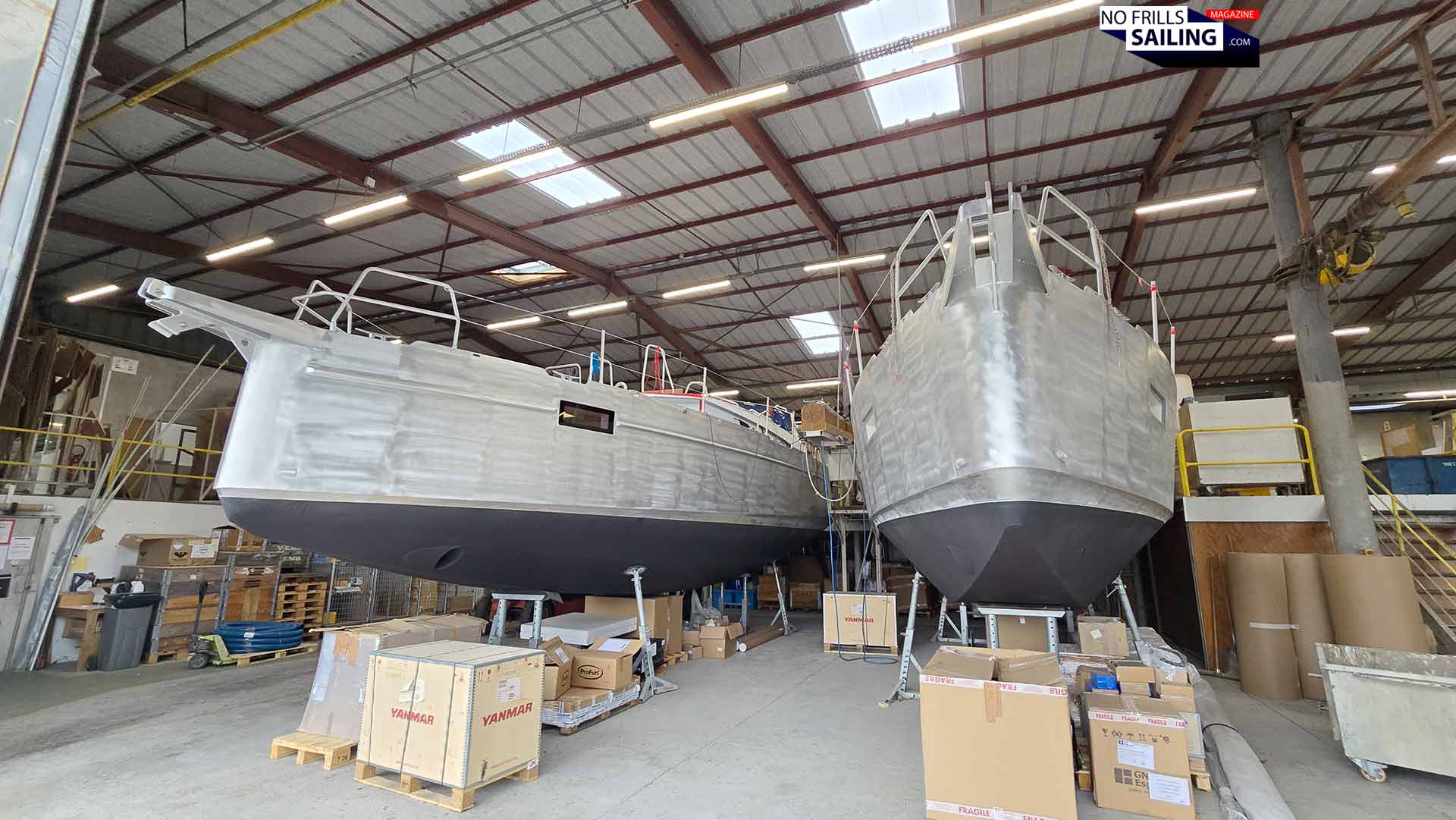
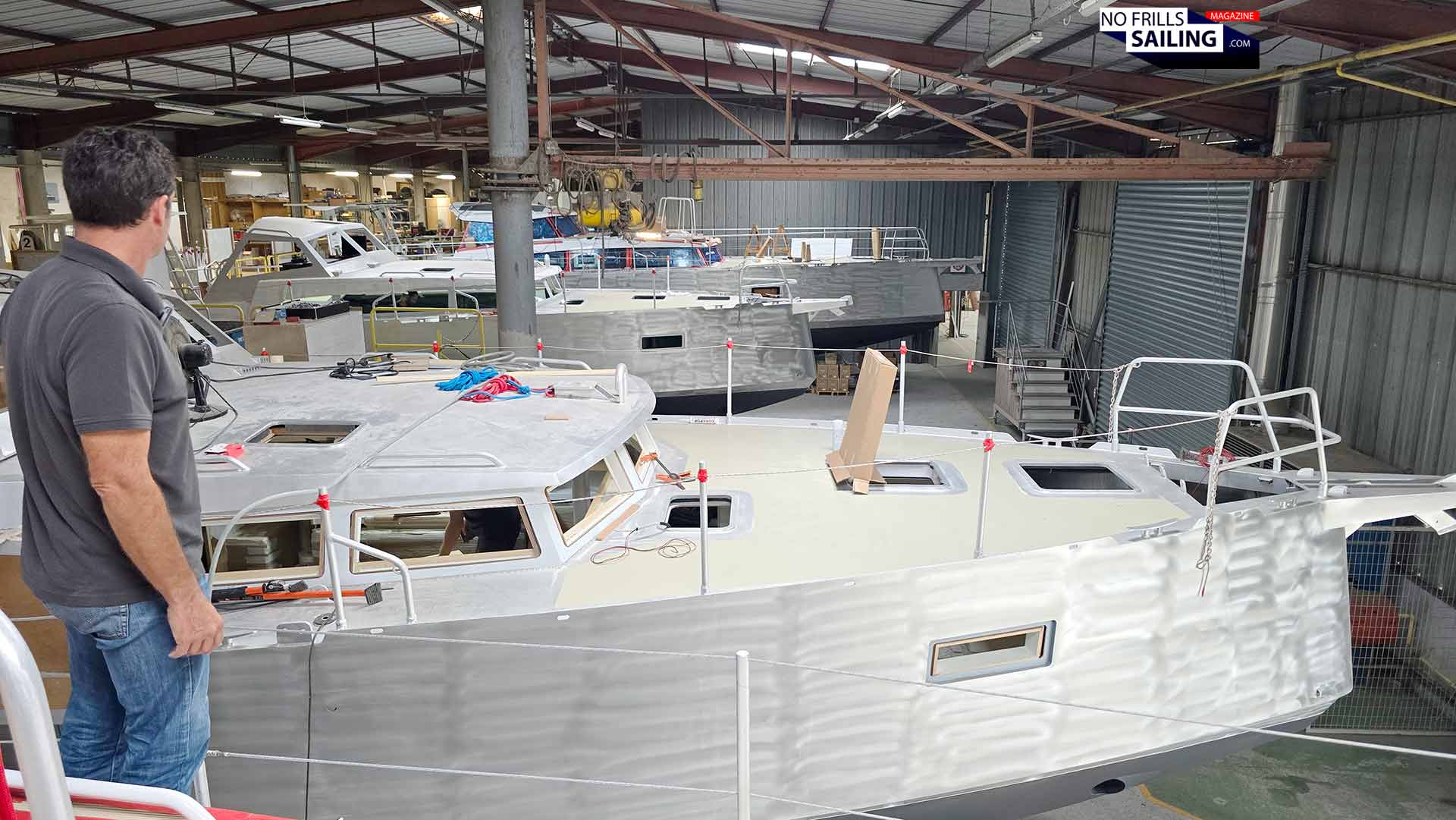
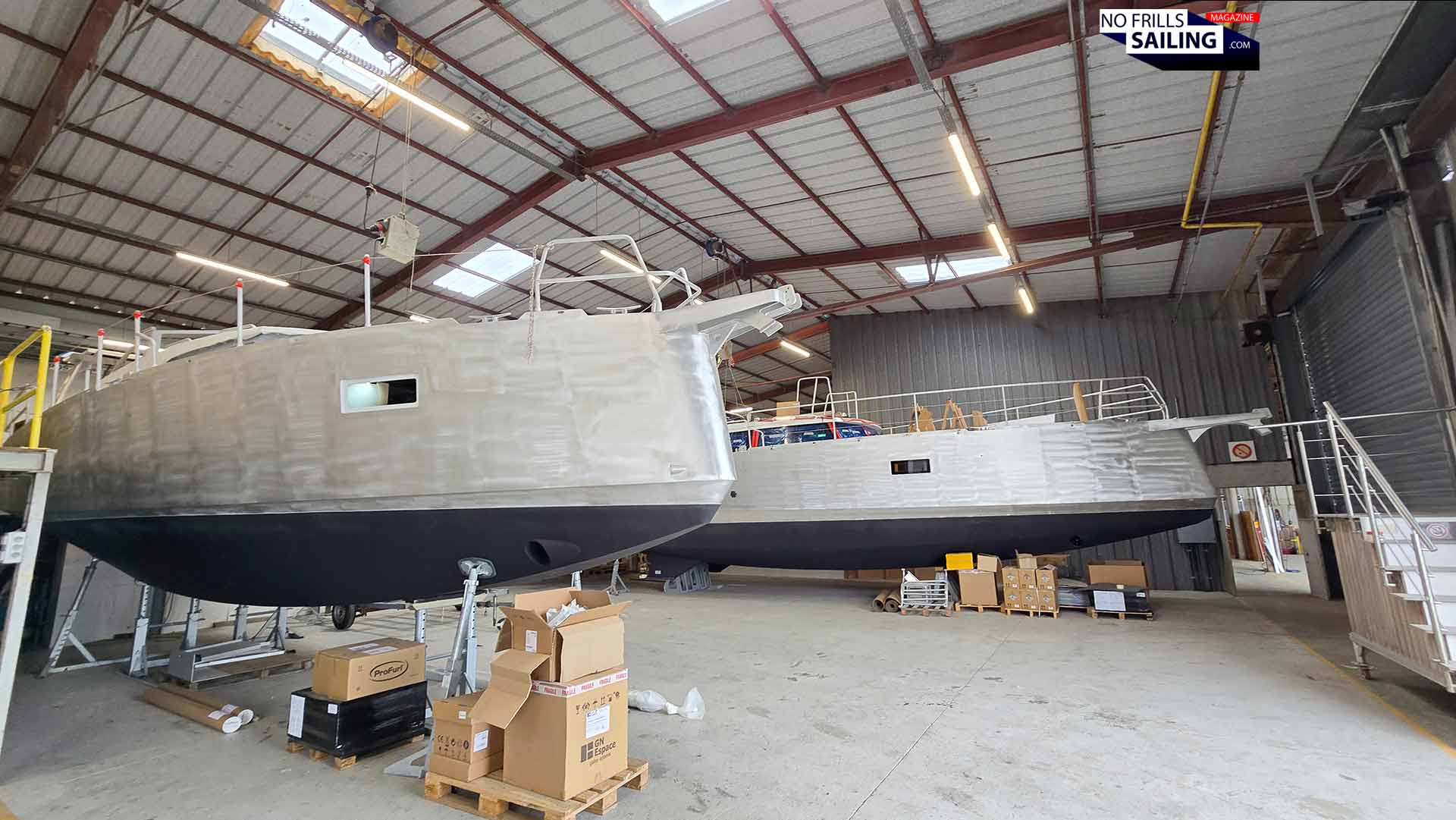
We climb onto the deck of one of the Ovnis in the end-finishing here. The hall can take on up to five yachts, currently four are in the making here. I ask Luc about the current state of the shipyard. I mean, the business is in a crisis right now since years with many boatbuilders suffering from decreasing demand, especially the series production brands who report a decline of 50 percent of capacity, I´ve heard from sources of up to 70 percent. So, does the current bad state of the boating business affect Alubat in any way? As usual, the answer isn´t a “yes” nor a “no”. Luc points toward the factory hall and says that I´ve seen the production with my own eyes: At every stage of the process, the shipyard is currently in full operating grade. That´s a good news, to start with.
They can be proud of their work, indeed.
As the capacity for the annual production is either way below twenty units, there´s no need for hundreds of customers, such as Jeanneau, Beneteau or the other big brands have to strive for now. Finding fifteen or sixteen or eighteen people to sign a purchase contract indeed does not appear to be an impossible task, even today. Alubat boats are very, very niche products: That´s for people who really want to cast off, who really want to seriously sail around the world. “Of these, there will always be some around”, Luc says, no matter what the situation currently may be.
Alubat Ovni: A bestseller, still.
That said, even today – and personally I´d say we haven´t even have hit rock bottom with the current crisis – waiting time for a brand new Alubat may exceed two years. “It depends on the model you want”, Luc specifies. Remember when we were talking about the “mixing” of the different types of boats? It´s just not possible to accept, let´s say, five Alubat 370 in a row. They have to mix big and smaller units. So currently, bigger boats are virtually sold out – ordering an Ovni 490 flagship today? Receive it by late 2028! “We could use a few 370 or 430 now”, Luc says, as there´s still some capacity. And here we have it: Today – every boatbuilder says this! – it´s the smaller units where orders have plunged.
Luc shows the complete current range.
Although the company is healthy, running with full staff and not having to scale down or – worst! – lay off, Luc as the CEO has some battles to fight. But isn´t that the normal way? As a caring boss, you always strive for solving problems and you simply have to be very valiant and cautious. Luc assures me that it is their main intention and biggest target to secure and foster production, to keep all members of his staff employed. Growth? Of course, any company shall grow, but not in terms of size or units, he says, but in terms of revenue. Further intensifying their strive towards more flexibility, but also modularity and efficiency. “There´s always something to make better, right?”
“Our biggest competitor? Ovni!”
Naturally we also talk about the aluminum market. And other brands. You may know that I have a very close relationship to Garcia and Allures as well, that I fancy the new German brand Pure Yachts and have done some pieces about Boreal, KM-Yachtbuilders and my beloved Berckemeyer Yachts. So, where´s Alubat at and how would Luc see his company and products line up in between these contenders? I ask this, and his answer totally surprises me!
Up to 10% refit-business.
He says: “Lars, looking at all the aluminum yachts currently made, I´d say that every product, every brand has found its special area or niche. As for Alubat, you are either an Alubat-guy, or you are not. If you fancy Allures, you´d refrain from Alubat. If you love the Dutch products, you despise the French approach. And that´s totally fine.” And then it comes: “You know what? Our real competitor, the only one that is of real concern to us, is … Ovni!” We pass another workshop. Two ships are in the making here. Used boats. “Our company has made approximately a 1.800 (!) hundred Ovnis up to now! Most of them are still underway!” He shows me the refit-workshop and says: “Right now, some 10 percent of our turnover is made with refurbishments and refits of our old boats!” And the tendency is increasing. A two-sided sword: These yachts last a lifetime.
Awwwwww … I like this one so much!
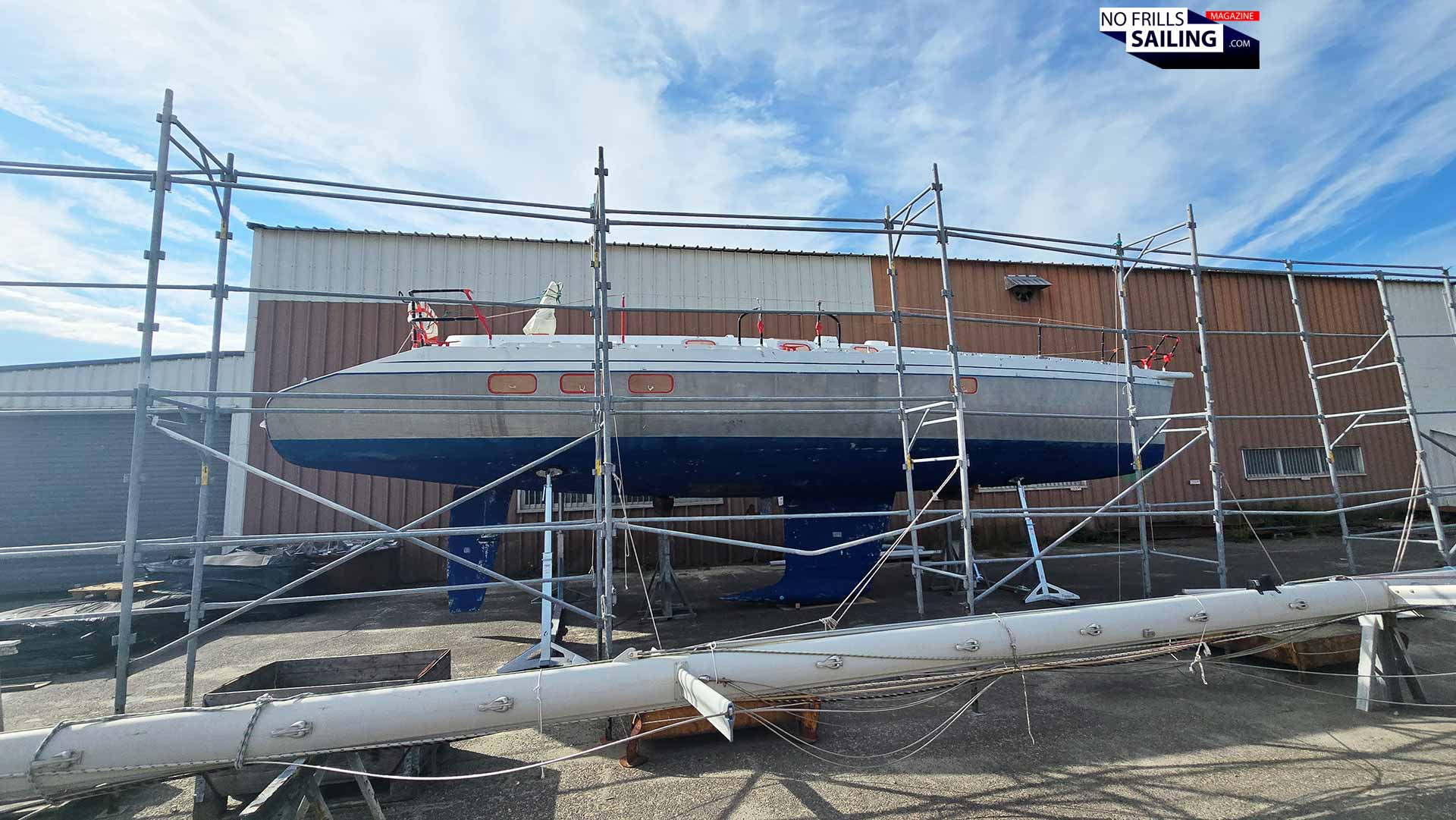
Behind the shed is a classic Finot-designed Cigale 14, the one I love so much myself and have nearly bought as well! Built in the Nineties, the owner bought her and brought her to the yard. The woodwork and joinery is in perfect condition: Sanding, lacquering and new fittings. That´s it. The hull will be sanded and treated, new wires and electronics: A big project, afterwards she will be like brand new. “And we have a lot customers buying the used boats – and bringing them here for refit.” Now I understand the “problem”. The product is so good that it lasts “too long” essentially, killing at least a chunk for the new boat-sales. But isn´t that kind of cool?!
Advertisement
Things to look forward to
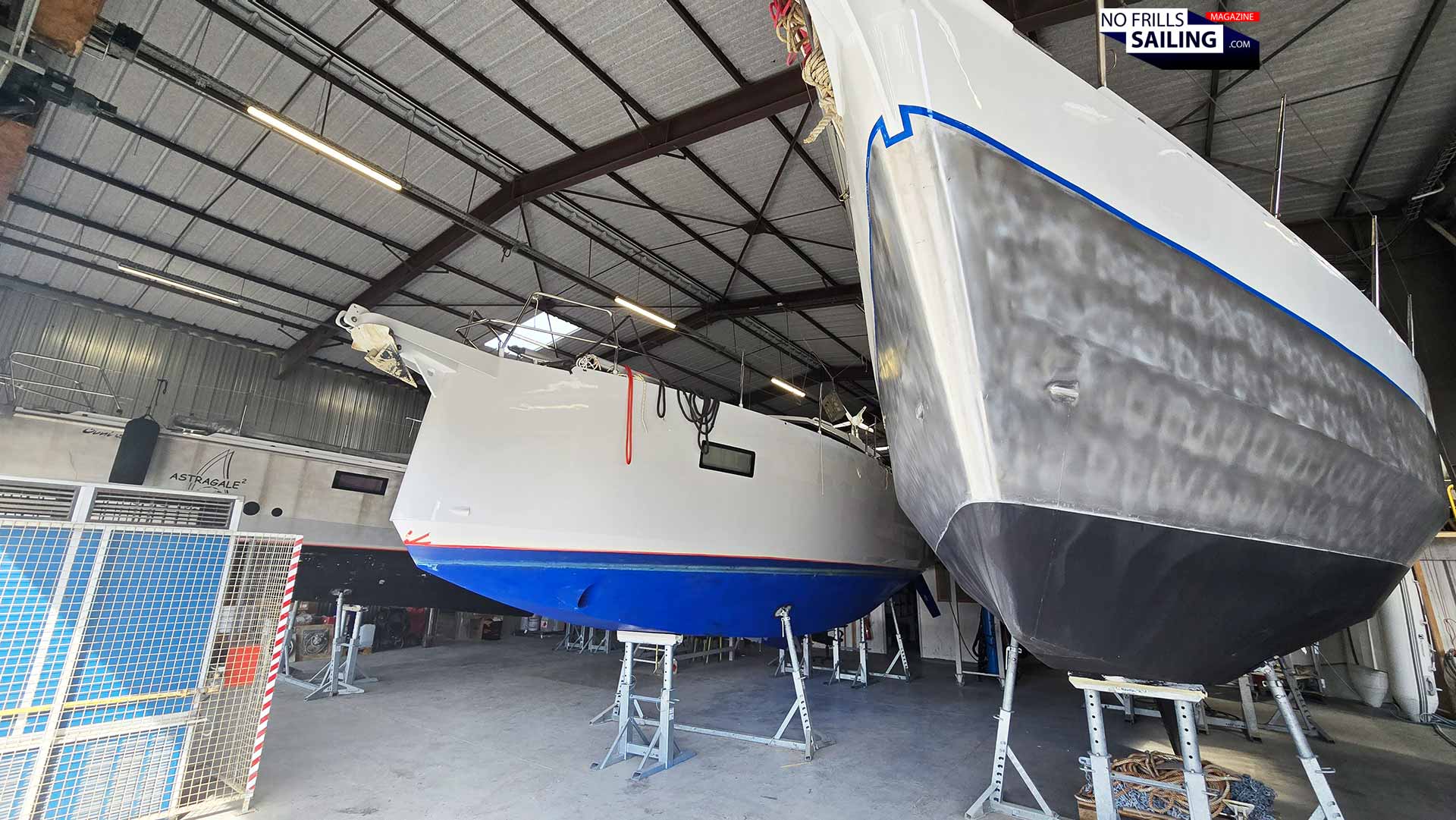
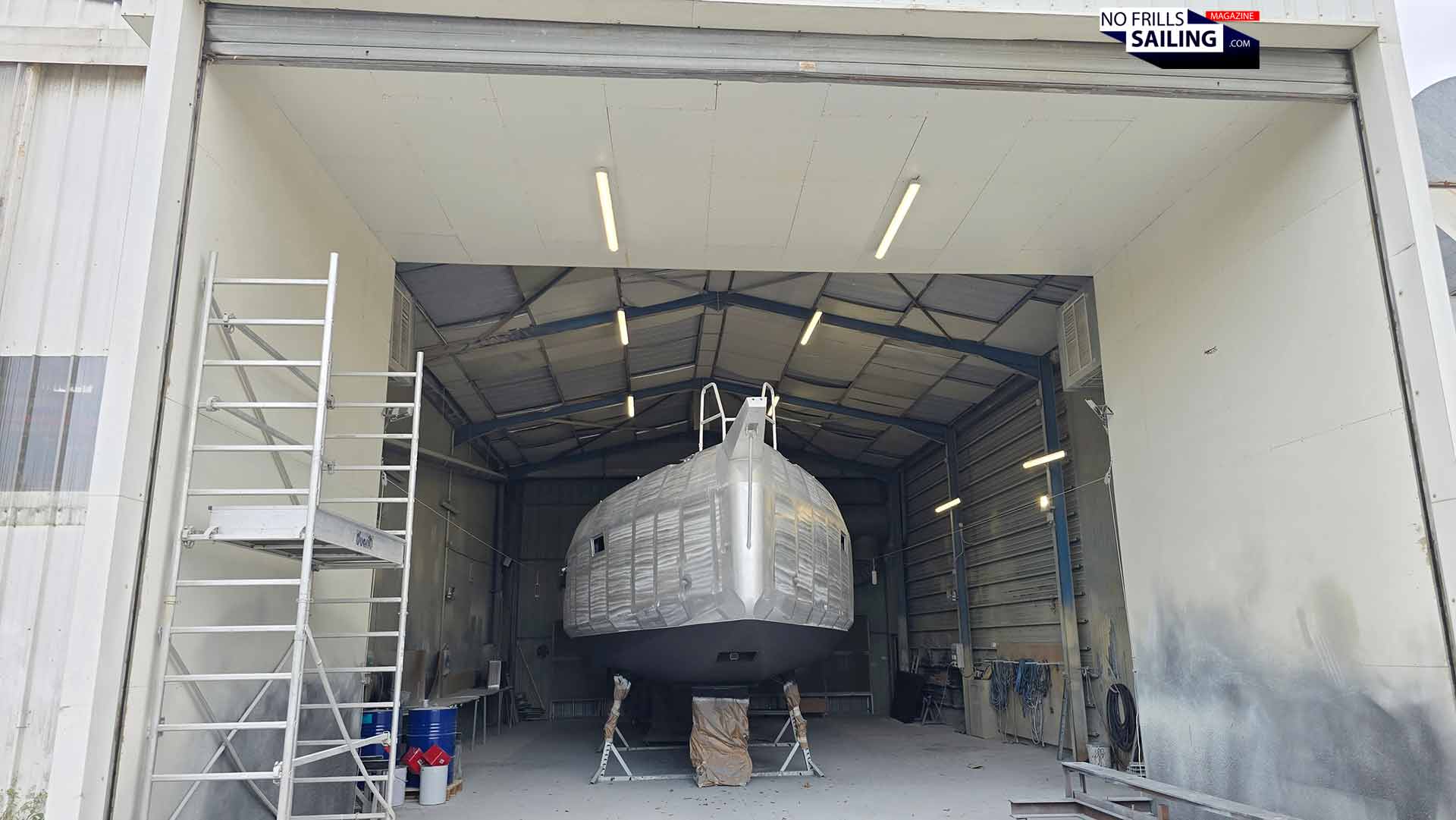
And then there´s the things Luc so much looks forward to. After years of designing, meetings and lots of brain power invested, eventually, the first new Cigale 15 is in the making! We pass the shed and I can shoot the impressive hull of that new yacht. I´ve initially wrote about this legendary brand coming back to life again when it was announced back in the day, now I was able to see the boat with my own eyes.
Sneak peak: The brand-new Cigale 15!
As this article approaches a length that far exceeds average acceptable reading time for most of you guys, I cannot and will not write more on this new yacht today: But be sure that after I was allowed by Luc to board the boat that I took a couple of dozen detailed-pictures and roamed her deck, cockpit and interior. This is one amazing new Finot-Conq design and you can absolutely look forward to the in-depth article about this yacht!
Why don´t you just quickly invest five seconds and subscribe to the NO FRILLS SAILING newsletter? That way you will receive just one single email per month, presenting all of the up to ten articles and new videos published. It´s convenient and easy, so you don´t have to browse the blog and frequently check. Why not? Having spoken about this, back to Alubat …
We will sail her … in another article.
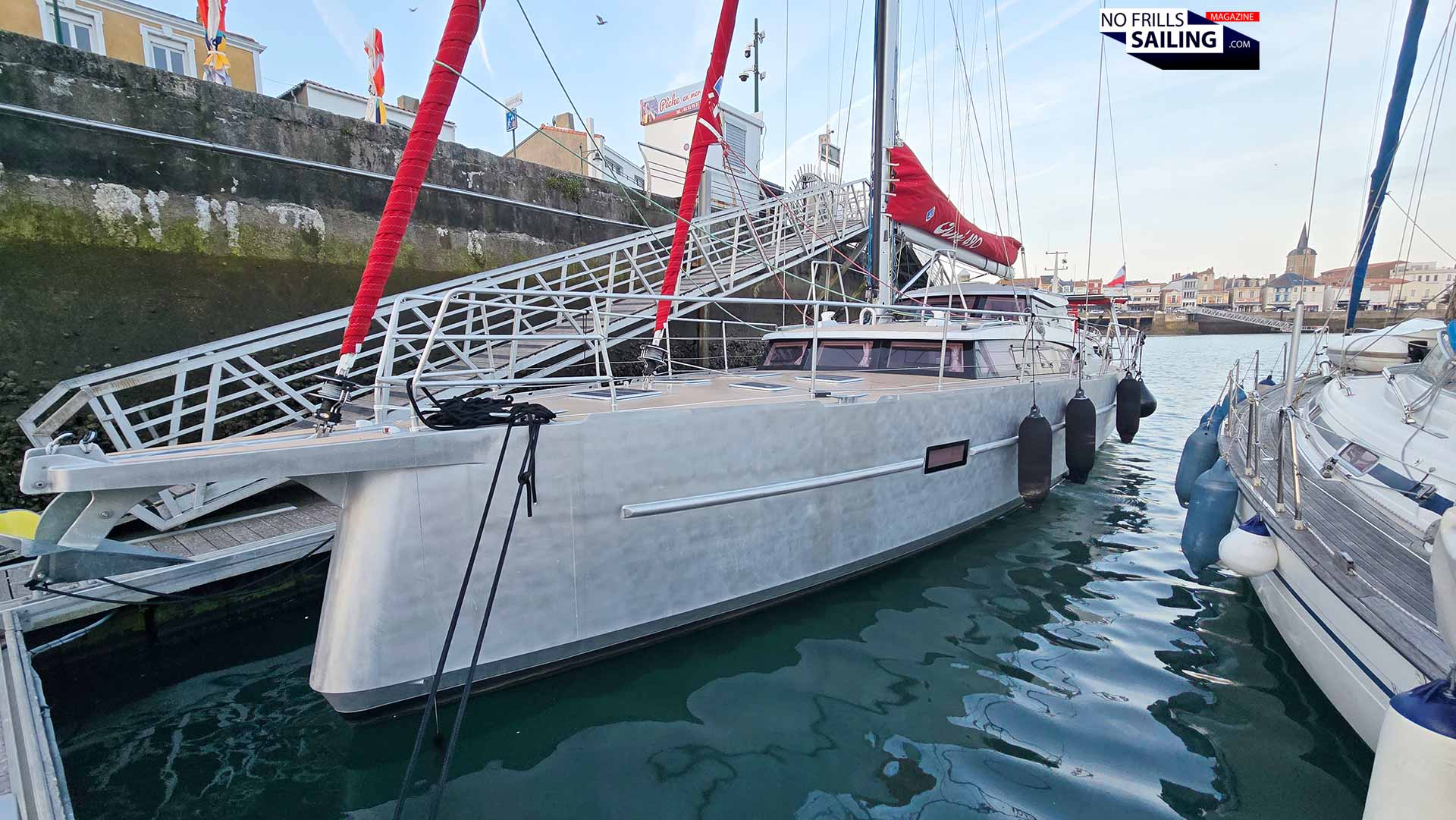
We conclude our shipyard tour, that lasted far longer than expected. Most of the employees had finished their day´s work and said goodbye, standing underneath the bow of the Cigale 15, I thank Luc for the intense day and we shake hands. But that wasn´t it at all: For tomorrow we are appointed to meet in Les Sables harbor, where a new Ovni 490 is docked. Because, of course I´ll have to sail one of these, right? Answering the question of how does a hard-chined aluminum yacht sail, how does she feel at the helm and how comfortable – and fast – such a go-anywhere yacht can go.
… now I understand!
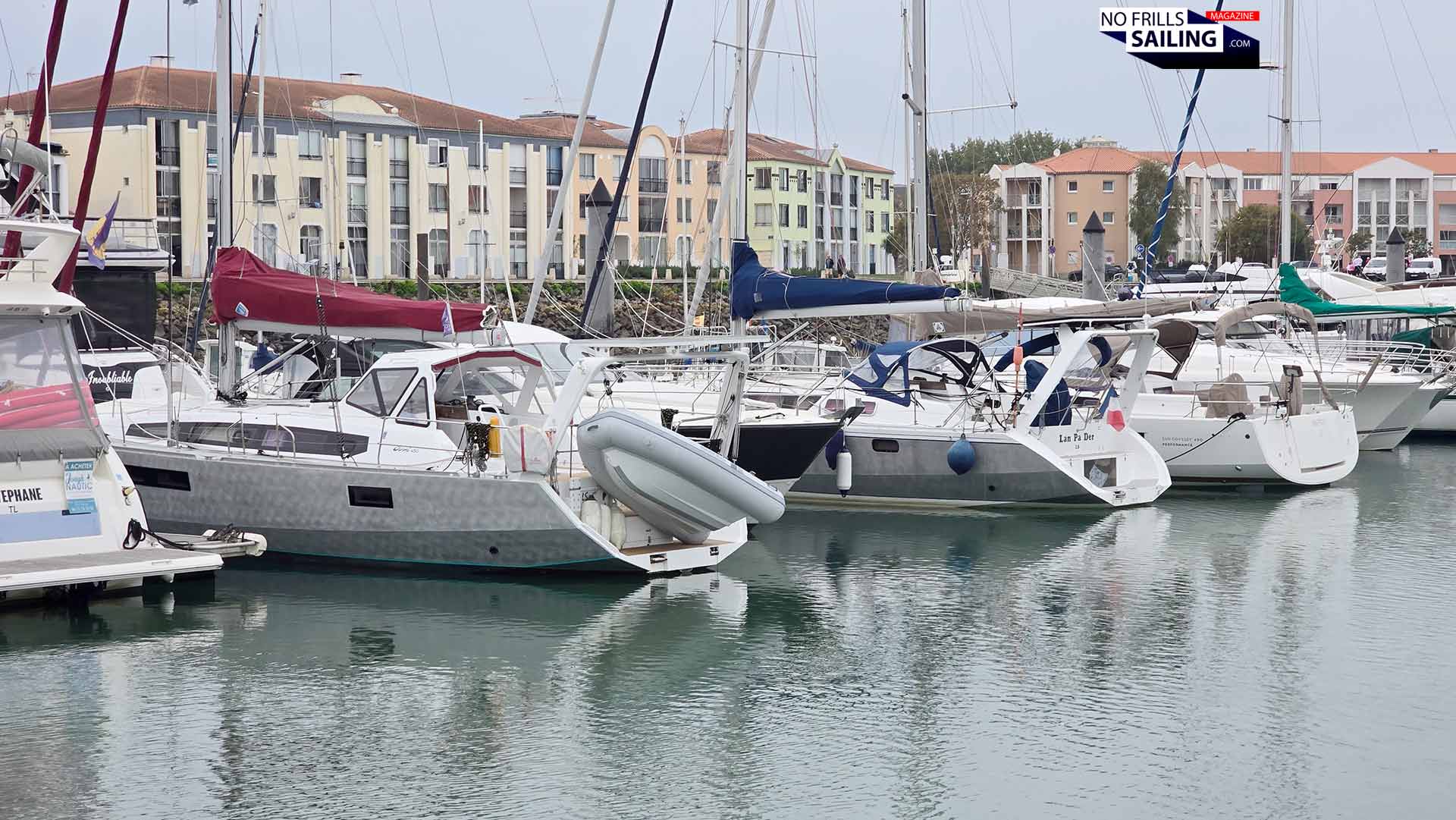
So stay tuned for this upcoming article, it will be really interesting too. Ah, and by the way: As we were coming back from our little forenoon sailing adventure in the choppy seas of the Biscay, steaming towards the pontoon and passing the boats moored in Port Olona of Les Sables, I finally understood what Luc meant: I could count at least seven Ovnis here. Case made …