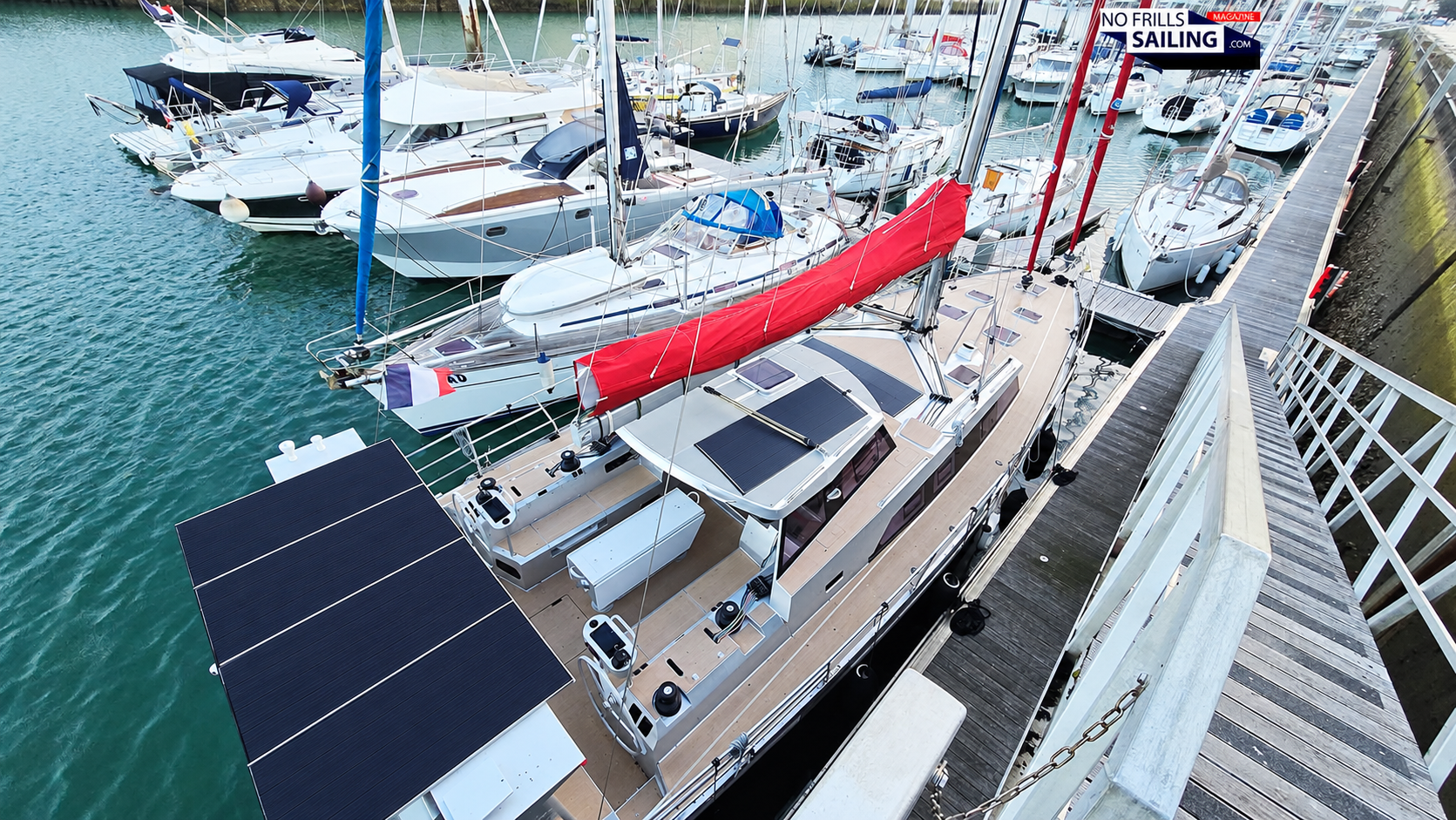
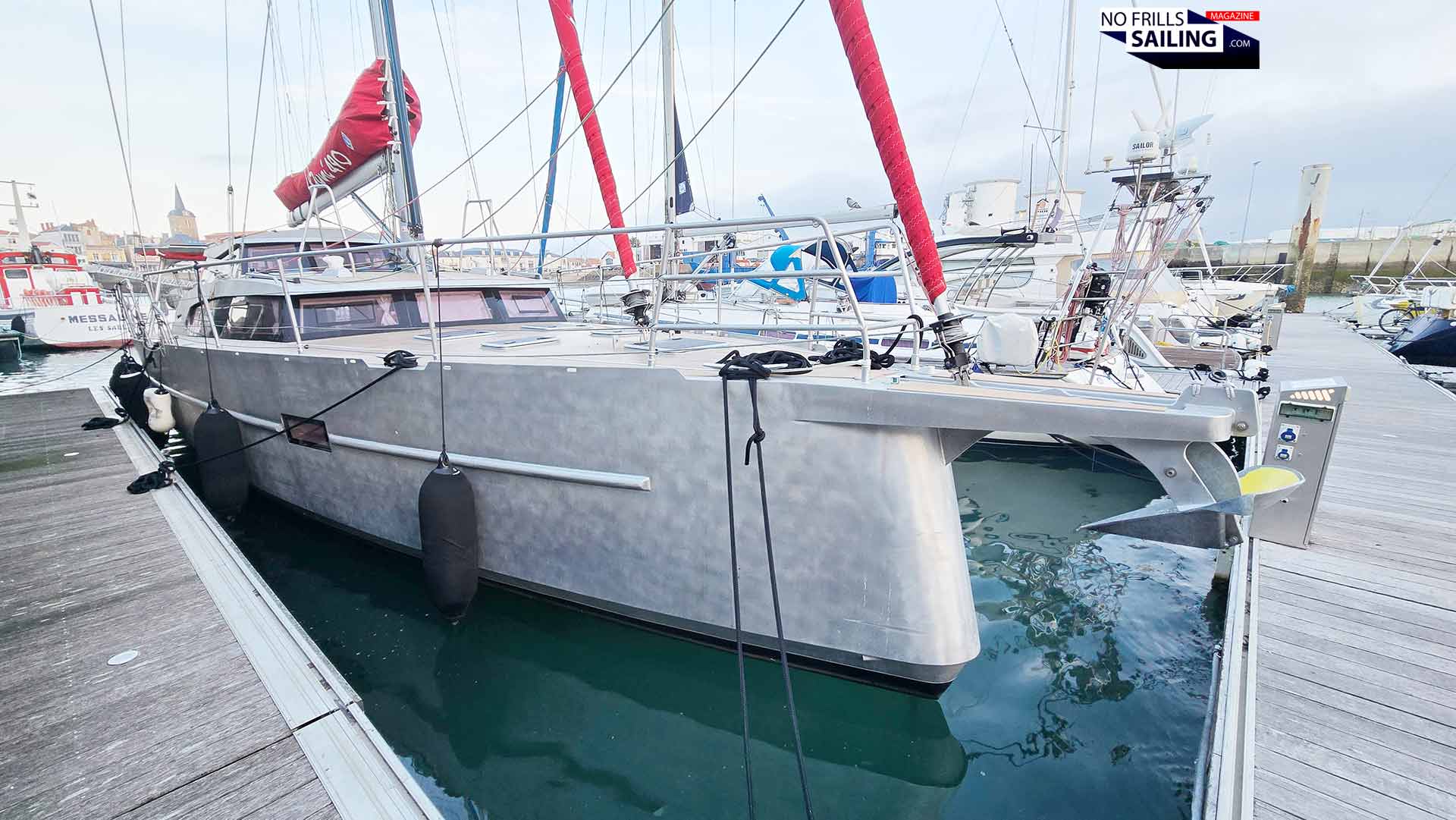
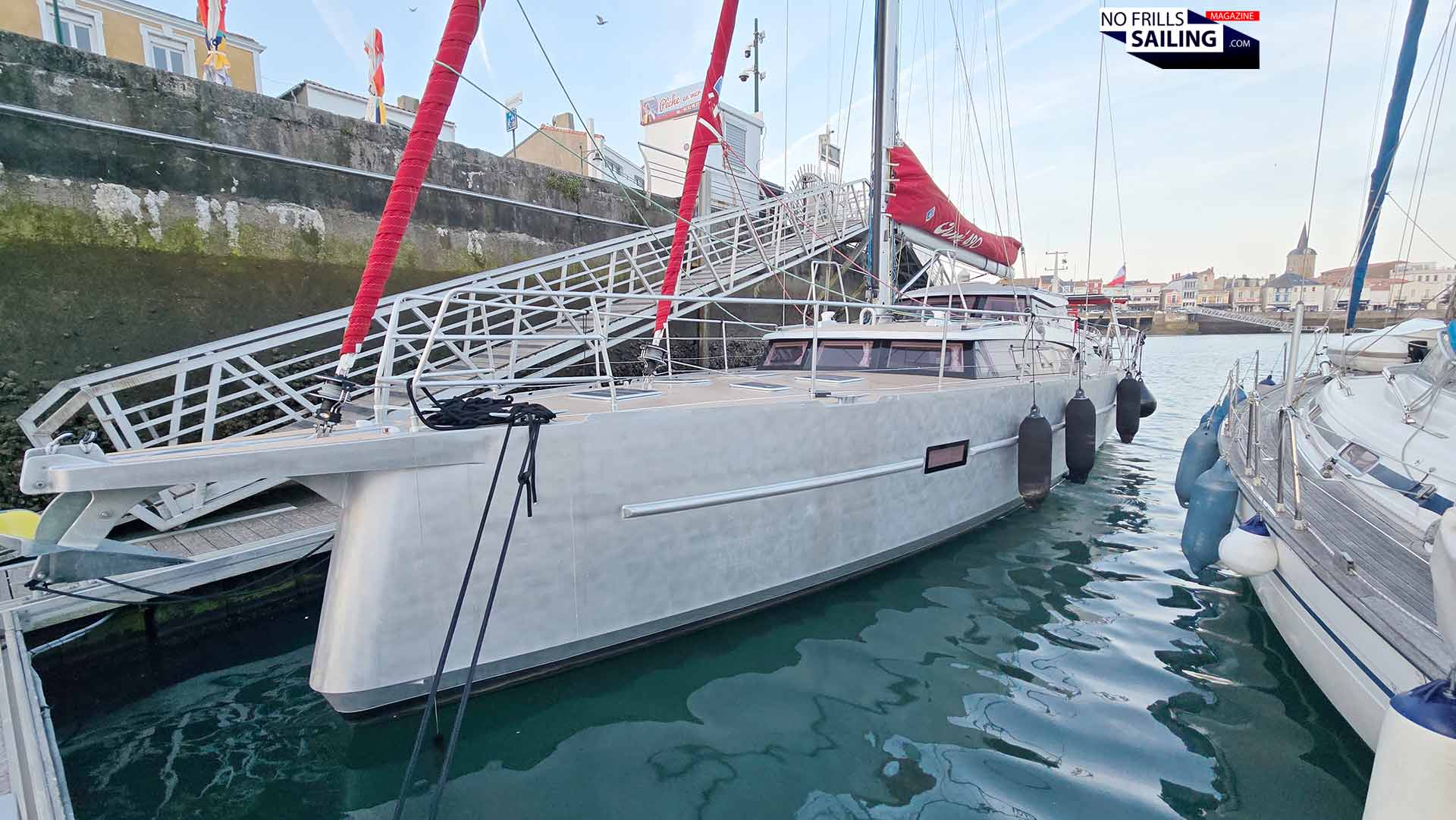
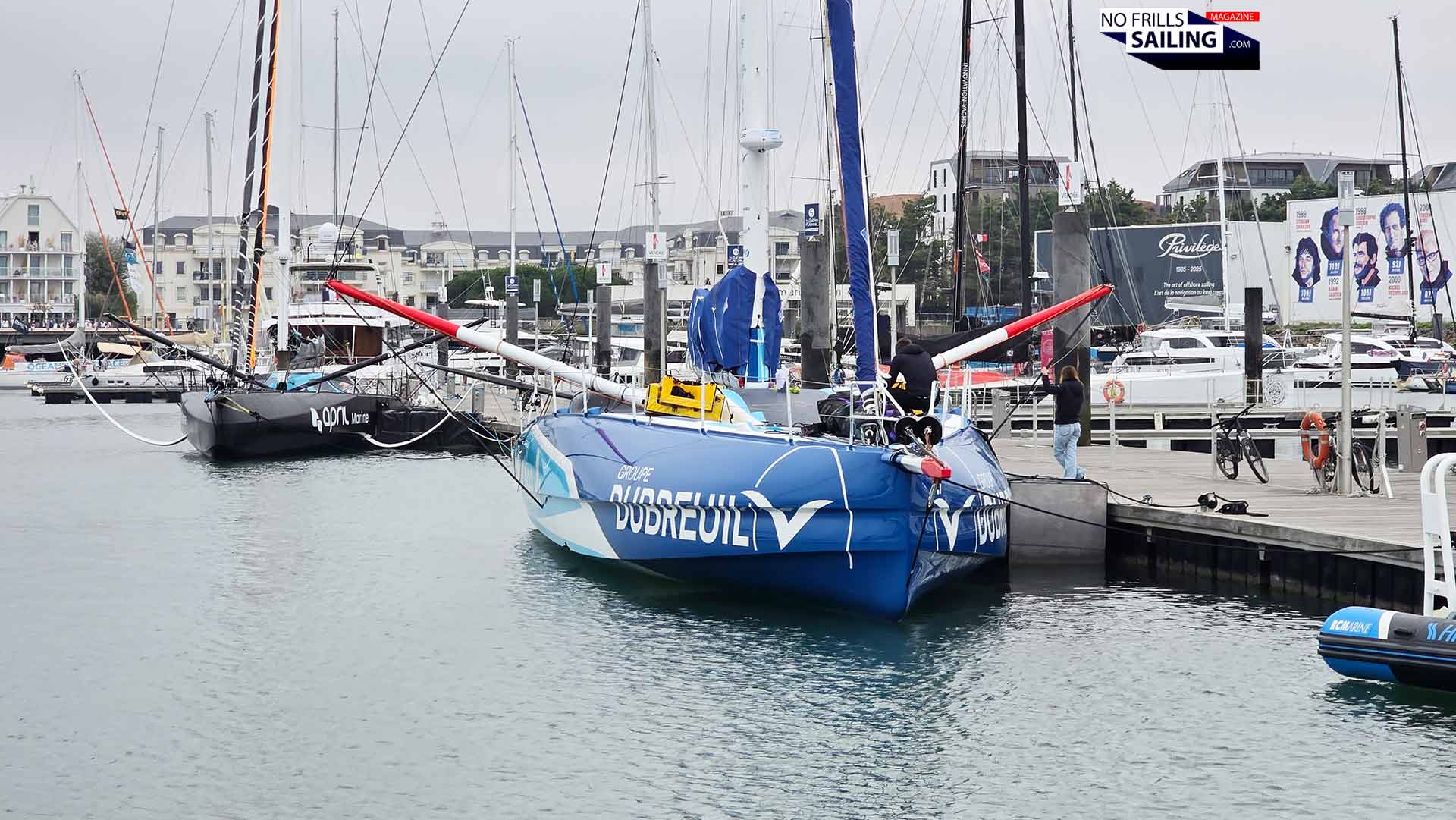
When talking about Alubat Ovni boats, often people despise these yachts as “tin cans”, referring to their hard chine construction and “bulky” appearance. Apart from the fact that pontoon-talk is often trash-talk and that probably most of these guys never sailed an Ovni, the questions whether round-chined hulls perform better than hard-chine hulls is still vivid, and noteworthy. I´ve test sailed an Ovni 490 in the choppy, gusty Biscay off Les Sables – let´s check how these boats really perform!
Yep, it´s always the same, isn´t it? There are only a few other communities – cars maybe as well – where gossip, hearsay and bias is so strong and people seem to fight for the last to defend their argument, than in sailing. Talk to ten guys on the pontoon, you´ll get ten opinions on boats. That´s because yachts are purely emotional. I mean, we give them names, we spend the last dime for their upkeep and people often spend their whole lives trying to acquire their dream yachts. On the other hand, there´s a lot of amateurism and outright ignorance, when it comes to boats.
There she is: My boat for the day!
One of these “victims” used to be the Ovni. It seems that people either love her or hate her. Despite the fact that most of them just judge by the looks from afar, few have sailed them, let alone sailed them properly. Which is funny, because with over 1.800 units (!) built since 1973, this may be the single most successful aluminum range to date! Yet, still the sight of an Ovni stirs up strong emotions in people – I personally know a lot of. Sure, beauty is in the eye of a beholder …
A bulky design that makes sense
Advertisement
Since Alubat collaborated with the designers Alain Mortain und Yiannis Mavrikios and the team of CBA Architects, the style of the current range had changed dramatically. Which, in my eyes, was the best thing they could do after the bankruptcy trouble and not-so-nice headlines, commercially. These boats are true head turners in any harbor – if you like the design or not. In a market where looks and emotions matter a lot, a bold, but consistent and logical step. If you have read my last article about how the Alubat hulls are made you´ve probably read this too: The shipyard is prospering.
Her rugged design is a head turner in any marina
I saw every single building lot within the different workshops of the factory occupied by new Alubat yachts under construction. Tis shows that “the market” – which is a pretty un-emotional word for you, the sailors – does not just accept the new design, you seem to pretty much love it! For certain models of the range, waiting time right now after signing a purchase contract may be as long as two years! That said, from an objective standpoint, these boats are damn successful!
Made to literally go anywhere
So what about their sailing capabilities? I heard this so often that I cannot even count it: Aluminum yachts, especially the explorer-type boats, are said to be bulky, slow and somewhat “sluggish” or inert, when it comes to sailing agility. It´s also said that hard chine hulls, such as these utilized with Alubat, but also at Boreal, are slower than their round-chined counterparts. Whilst it is a fact that hydrodynamically smooth, round shapes are always less dragging and more performant, it is also said that hard chines help a boat to sail stable on course and add to its form stability. This is why hard chines have become a fancy add-on in literally all sorts of boats, from Imoca racers to GRP family cruisers. Well, I´m about to find out now, right?
Preparing the sea trial
After an almost sleepless night in my rented flat directly adjoining Port Olona in Les Sables (during the day it was 28 degrees hot, early October! I was expecting some cold or fresher autumn weather, so I lay awake, seating …) it took a double coffee and two pain au chololat to get back some life into my body. I was scheduled to meet Luc Jurien, CEO of Alubat, and Cecilia Edeline, responsible for the marketing at Alubat and one of the six company shareholders of her own.
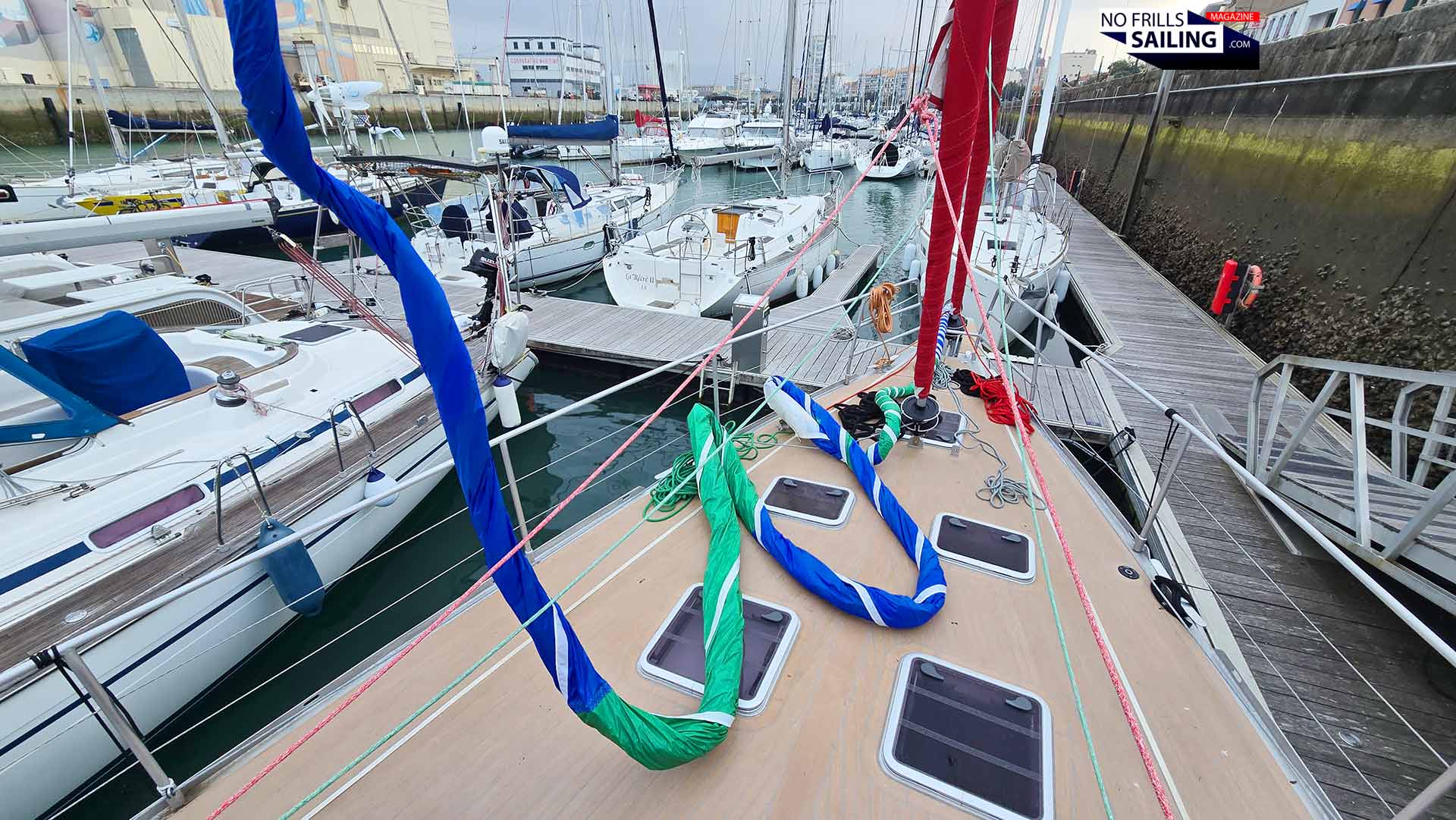
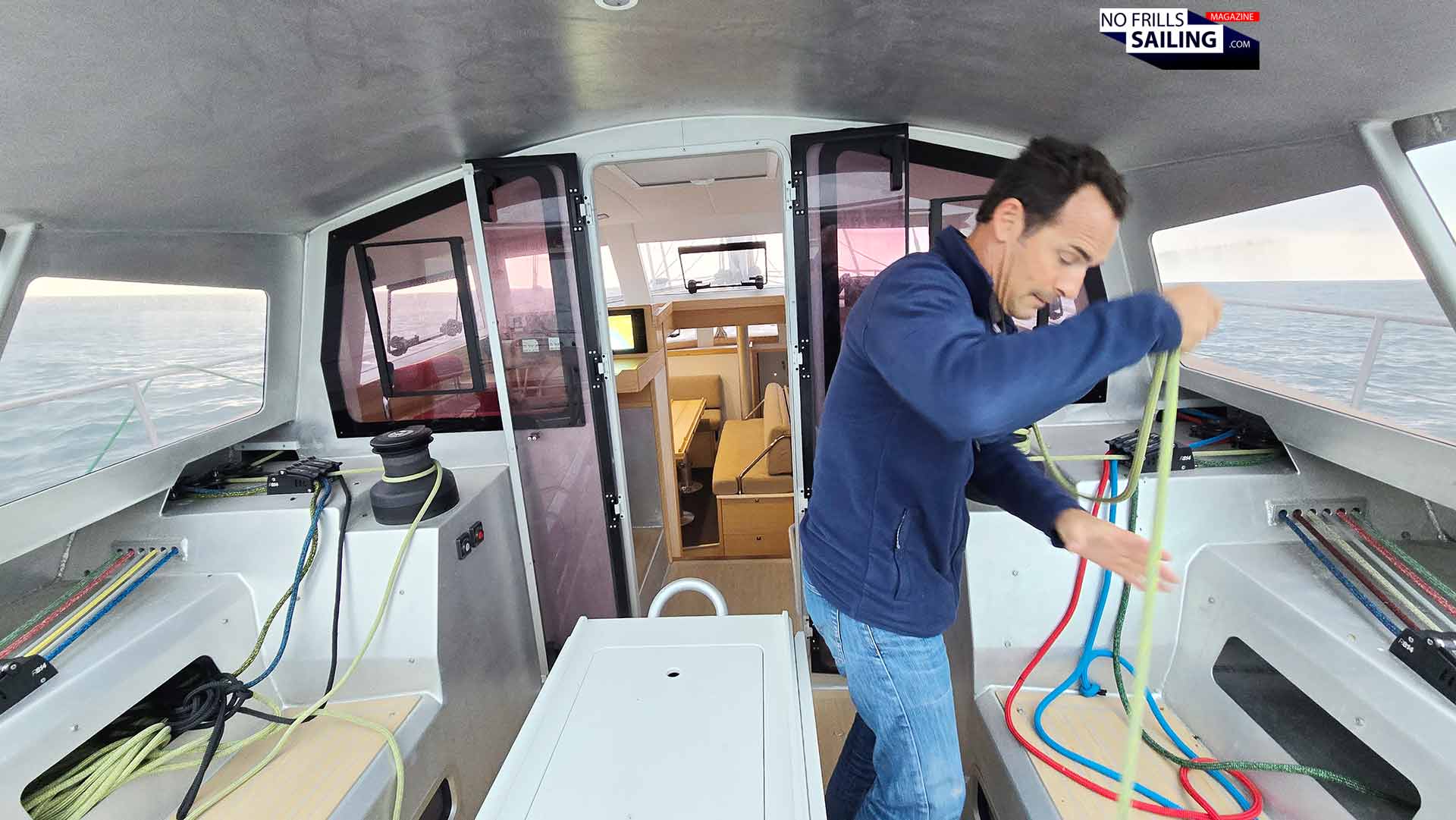
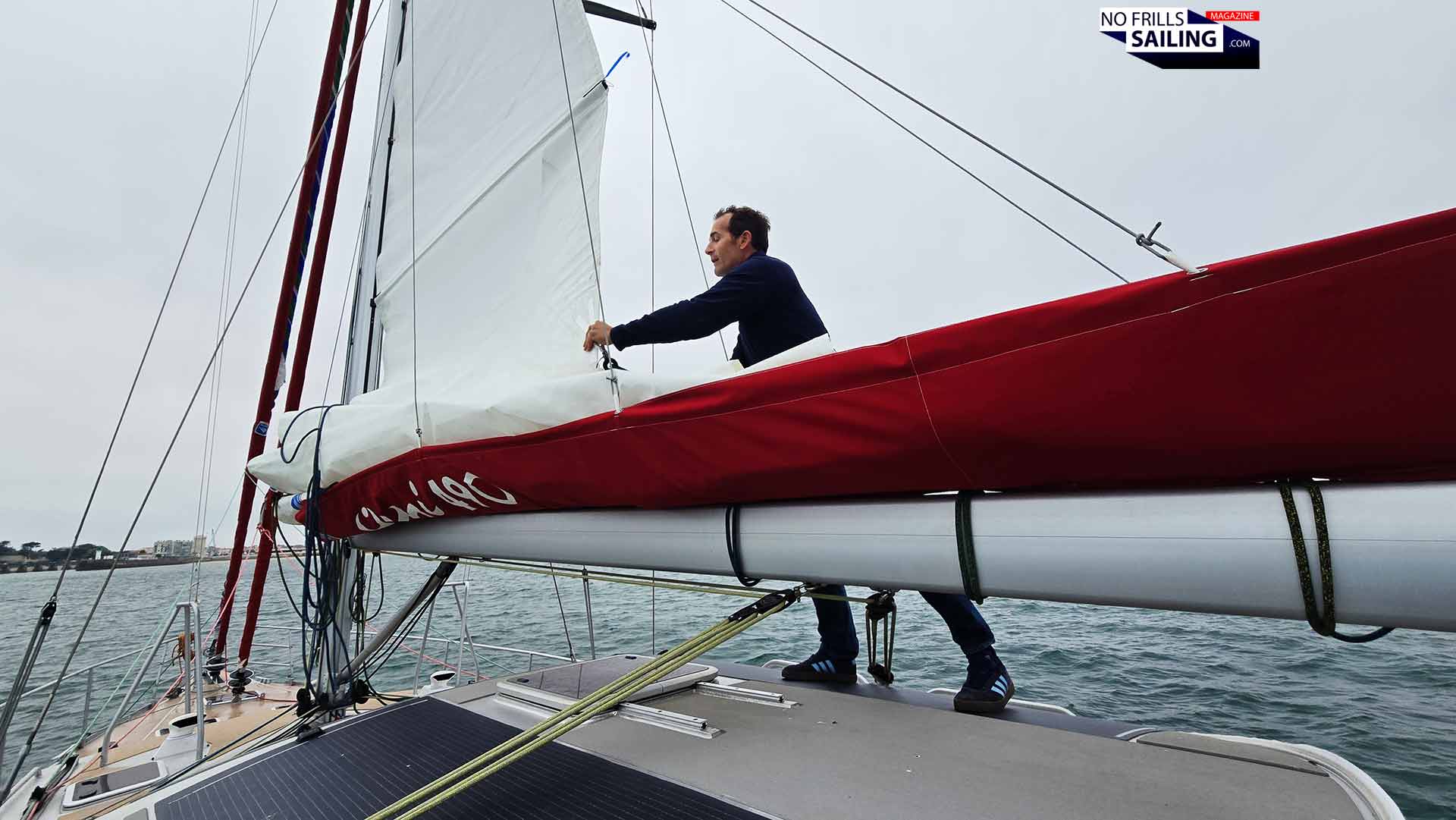
Luc is preparing the Code D light wind sail
The OVNI 490 we were about to sail had been launched a year ago with her owners granting the shipyard the right to take her out with buyer prospects and guys like me. I was happy to being offered this chance, because the OVNI 490 is the current flagship of the Ovni range. Although, wind was pretty gusty that morning with a depression coming in, the prospect of worsening weather and sea conditions made it especially exciting, because at the end the Ovni is a “go-anywhere” boat that should cope with these (and much worse!) kind of conditions.
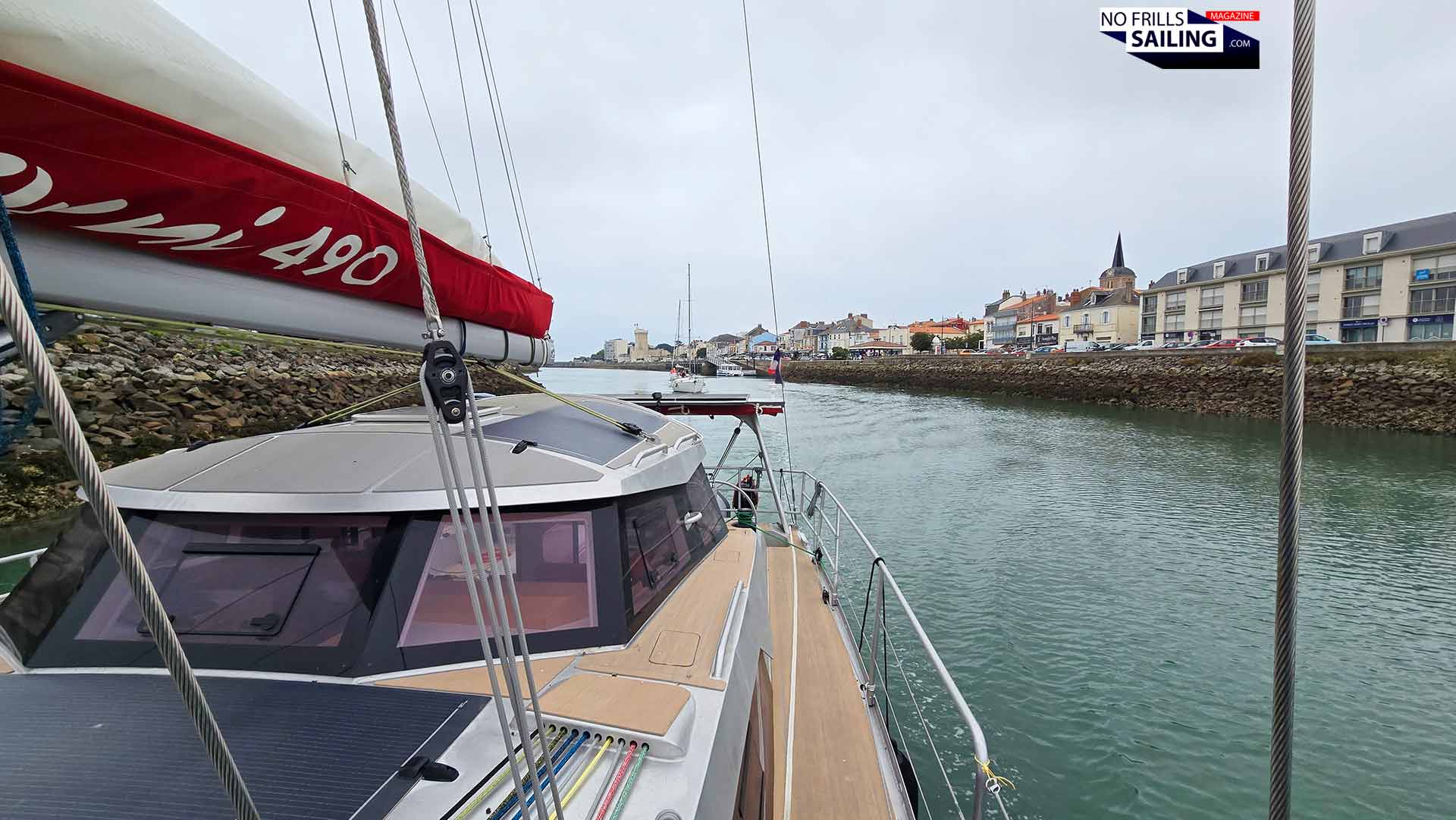
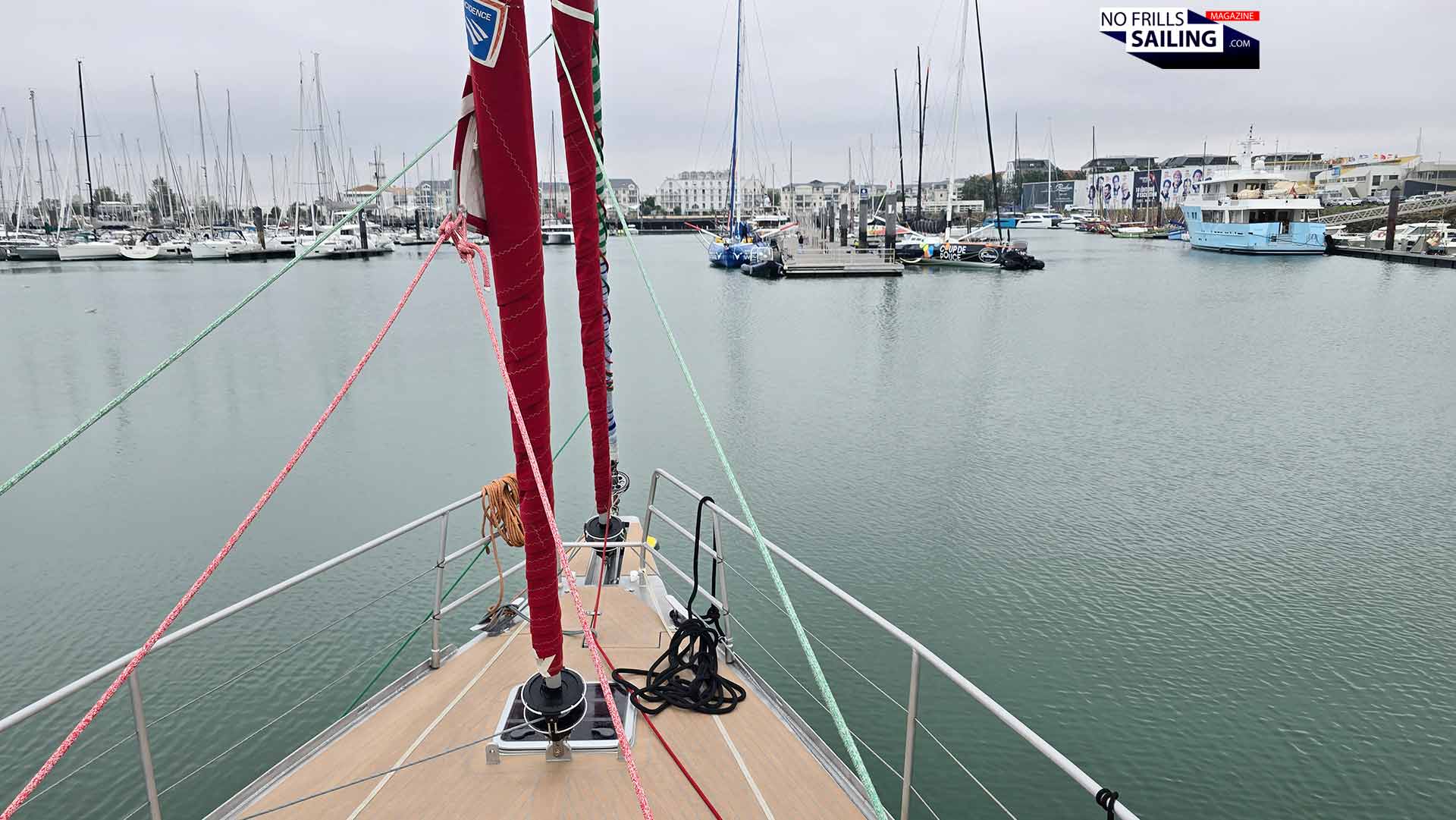
Steaming out of Les Sables … it´s a bit foggy
Luc started to take out the Code D light wind sail as we wanted to utilize this one before it would get too rough. The engines were running in idle to get some heat into the system. Yes, you´ve read it right, engines! The Ovni 490 comes with a twin engine configuration as standard. You can either have two Volvo-Penta D5 with 50 horse power each or switch to electric drive, which then would be two Bell Marine Evo drives. These operate at 48 Volts, being fed by a large lithium battery bank. When motoring a lot at high speeds, the 20 kWatts engines (each) are pretty “hungry”. That said, a 22 kWatts gen-set can recharge the battery bank quickly or you choose to fit 2 kWatts solar power for constant replenishing. Ah, by the way, the Diesel tank can hold 1.000 liters …
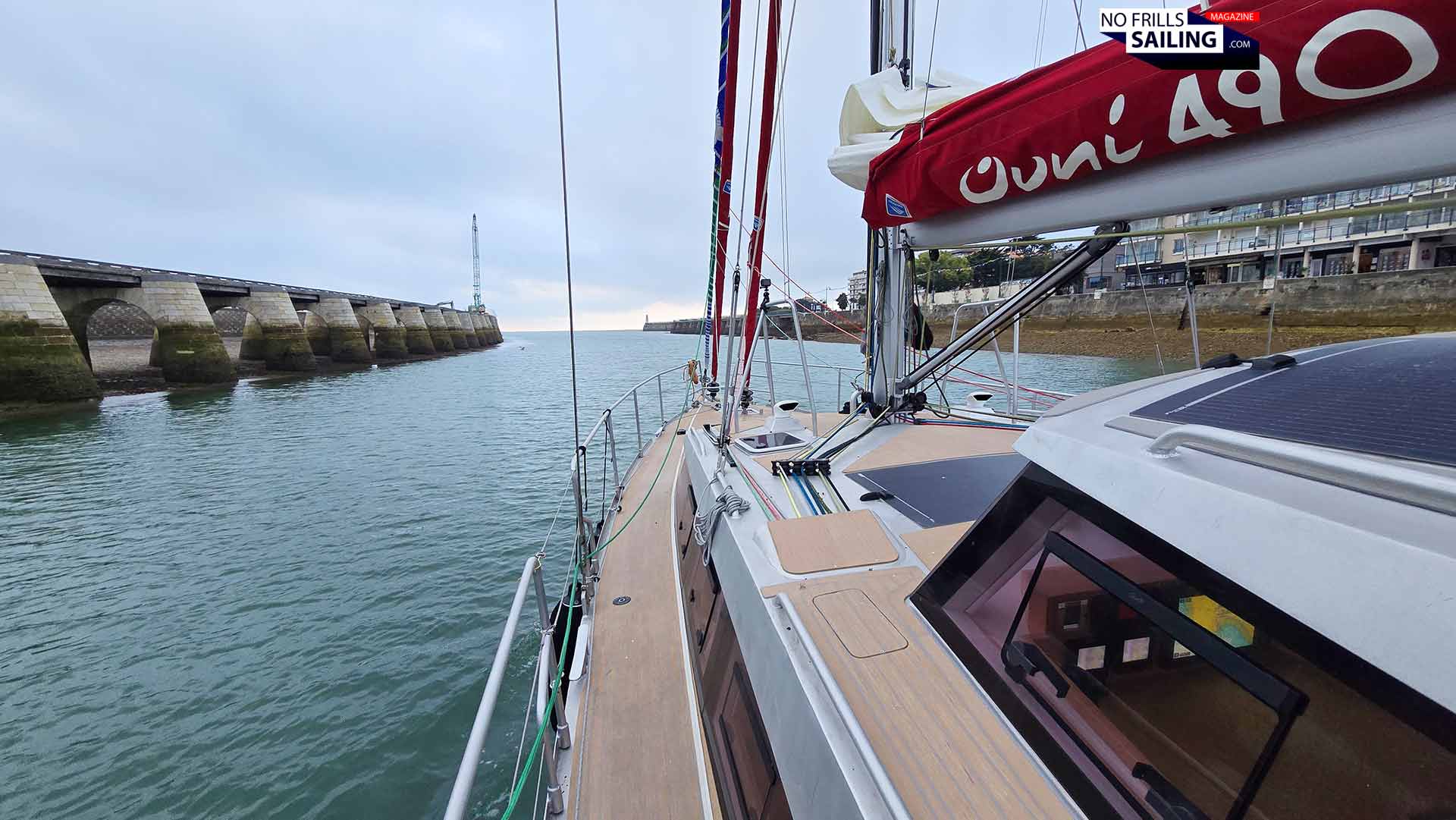
A legendary way out though …
So, we casted off and the Diesels – only quitly humming thanks to the good sound insulation – pushed us through the famous Les Sables channel into the Atlantic Ocean. How often did I sail out (and back in) here? How often had I watched the Titans of Sailing in their Imoca-racers leave for the most spectacular circumnavigation and returning as heroes? It´s truly a very, very special place and I absolutely love coming to Les Sables d´Olonne anytime!
(Not so) surprisingly easy to handle
Having cleared the shallow water and portside cardinal buoy of Les Sable breakwater, Luc started to hoist the sails. This turned out to be surprisingly easy – or maybe not so surprising? After just a few seconds getting the ropes right, putting her nose into the wind, the strong electric halyard winch pulled up the mainsail. In this, the boat remained very calm, although we were steaming dead ahead into the choppy, often breaking, waves. That´s a clear first indication that the “bulky” hull may not be as bulky as it looks …
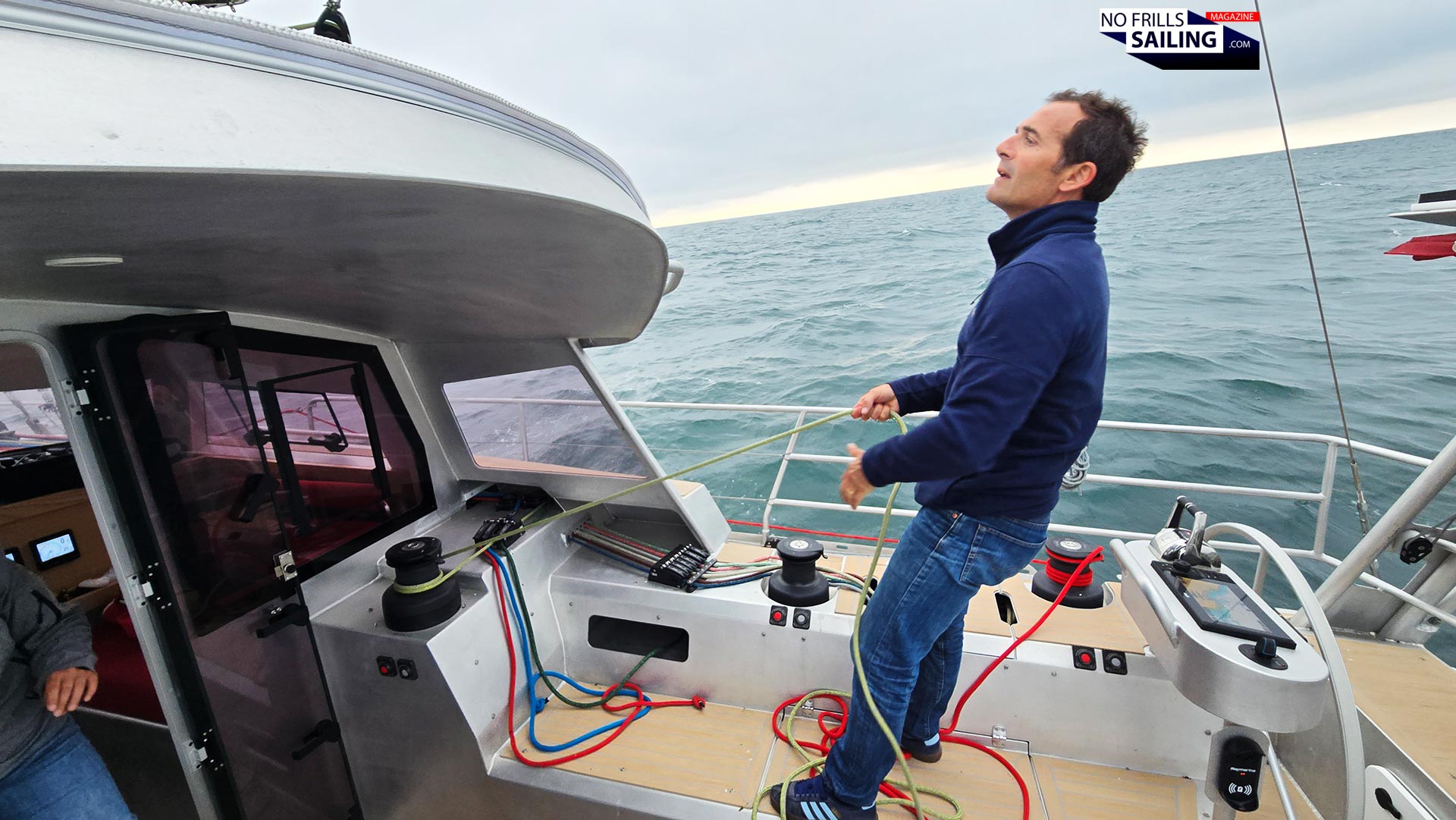
Note the winch layout
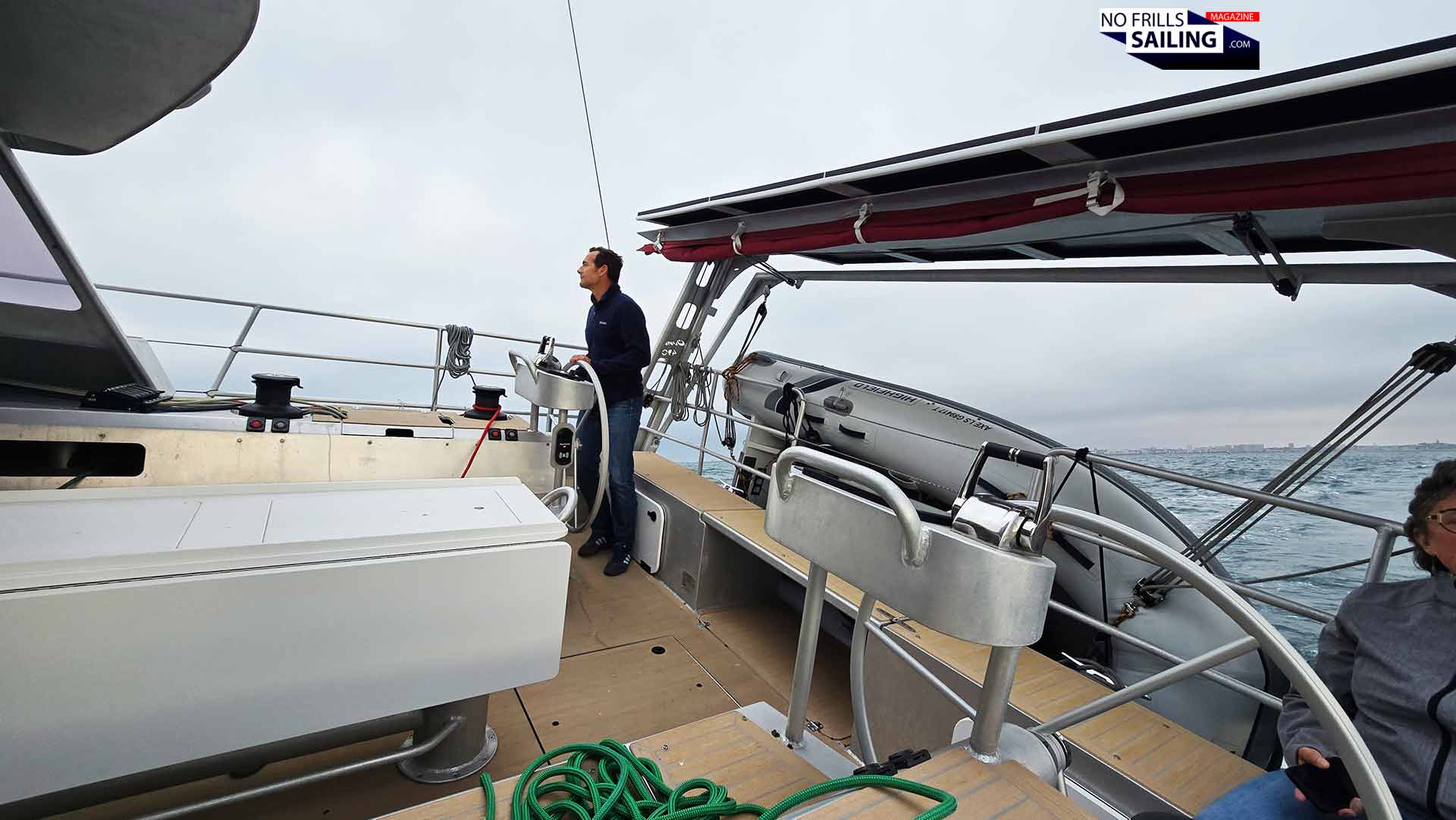
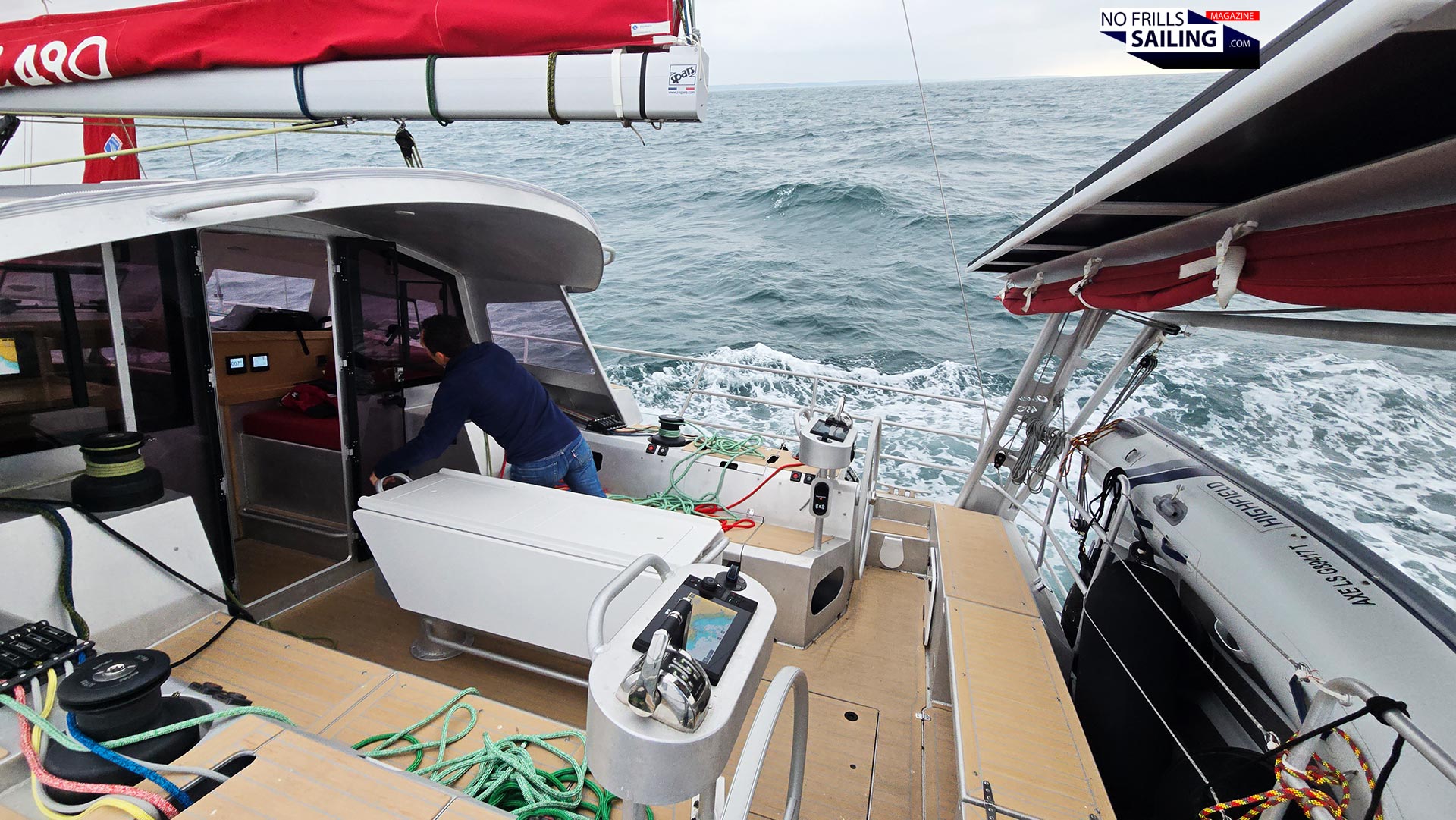
Ease of handling is a precondition for boats like these, in my mind. Because these are yachts predominantly operated by the classic “sailing couple”. That’s him and her, maybe one or two kids as well, heading out to discover the world. Any designer who understands this assignment would come up with a winch layout that provides short distances between each work-stations, quick movements and a safe surrounding. Look closely: The mainsail, be it the halyard, the reefing and other trim lines or the sheets (German Cupper system here) are operated from the safest possible point in the cockpit.
Everything can be done super protected
Very protected underneath the hard dodger, behind the doghouse, jammers and two main winches are located. That means that even in heavy seas, the nastiest of downpour or in the middle of the night you can work the mainsail from the safest spot of the cockpit. No need to go back to the wheels, just open the heavy door, step out, do the trim work and return to the protected, dry and warm watch post inside the doghouse. That’s pretty clever and this is how it should be on a boat, that is destined to sail everywhere, including the ice-cold Arctic or Antarctic. By the way, the centerboard – entirely operated with ropes, no hydraulics here! – is put down and raised at this station as well.
She´s quick, man!
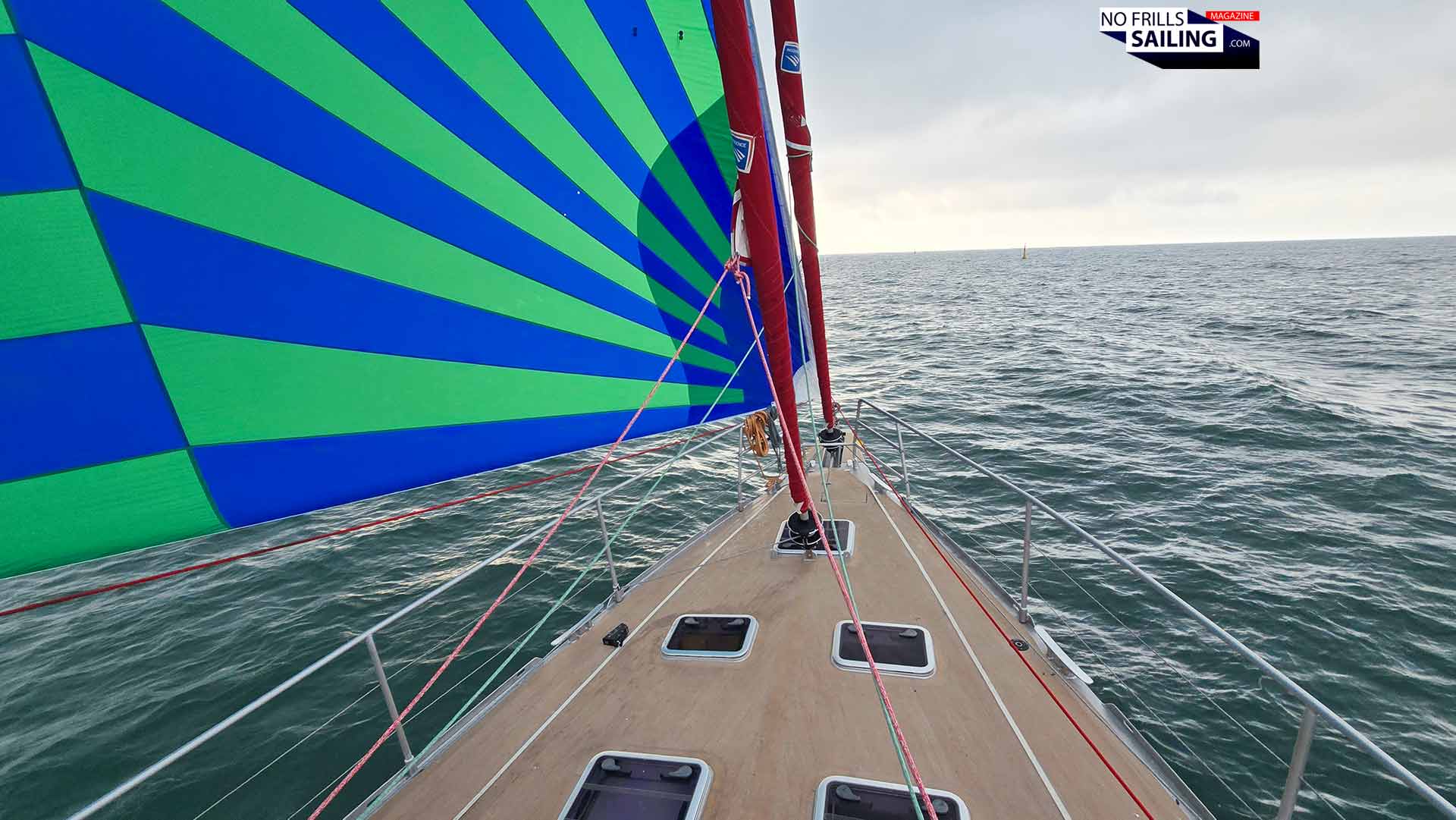
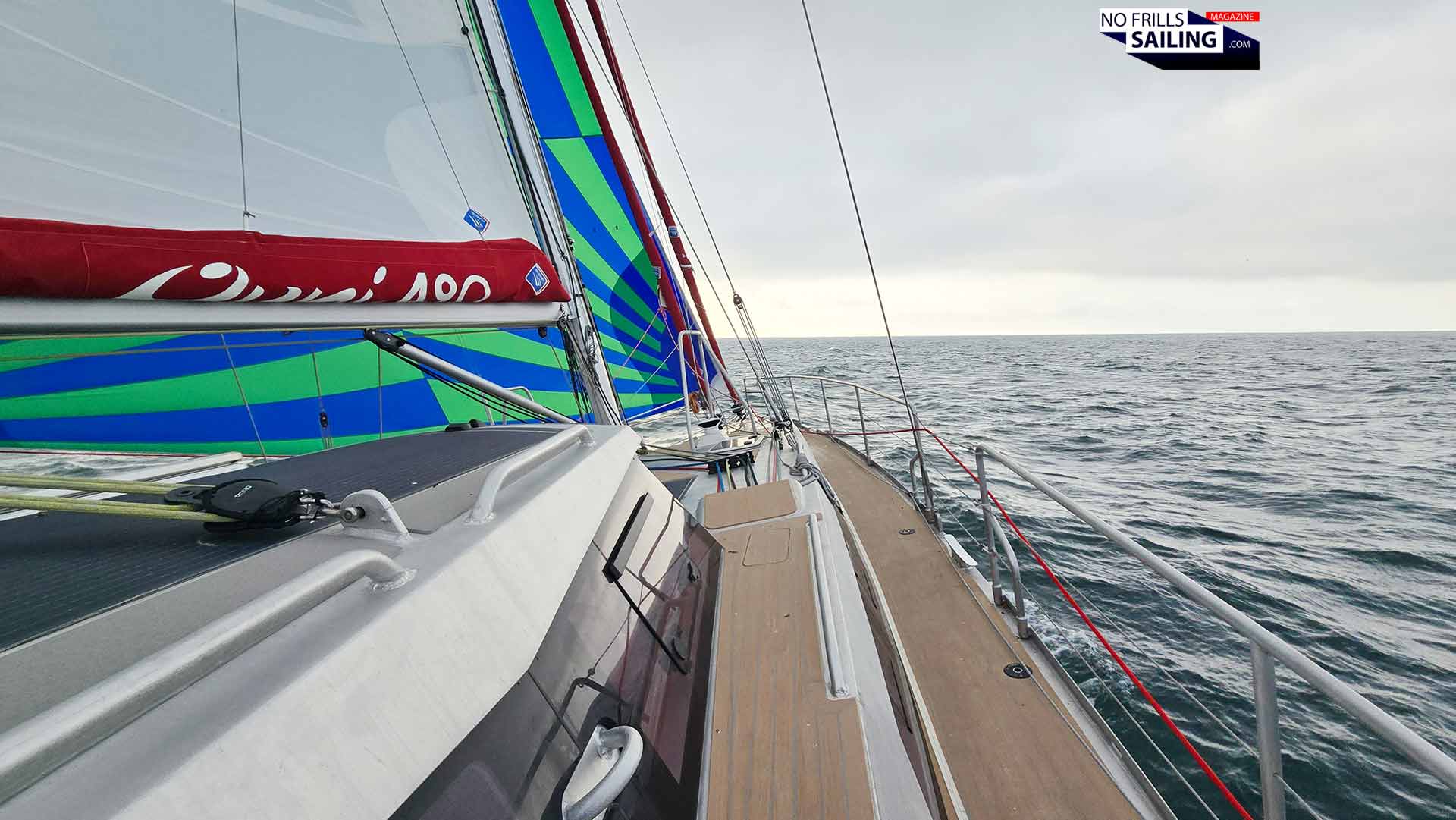
After having put up the main, we veered off to a broad reach and at last sailed away from the coast. Luc killed the engines, adjusted the autopilot – which is a big, big, big must have on boats like these! – and unfurled the large Code D sail. Believe me or not, the Ovni at an instant heeled over a bit and sprung to life! No joke, I could hear the roar of the water washing along at our hull turning up the volume. And forward she went.
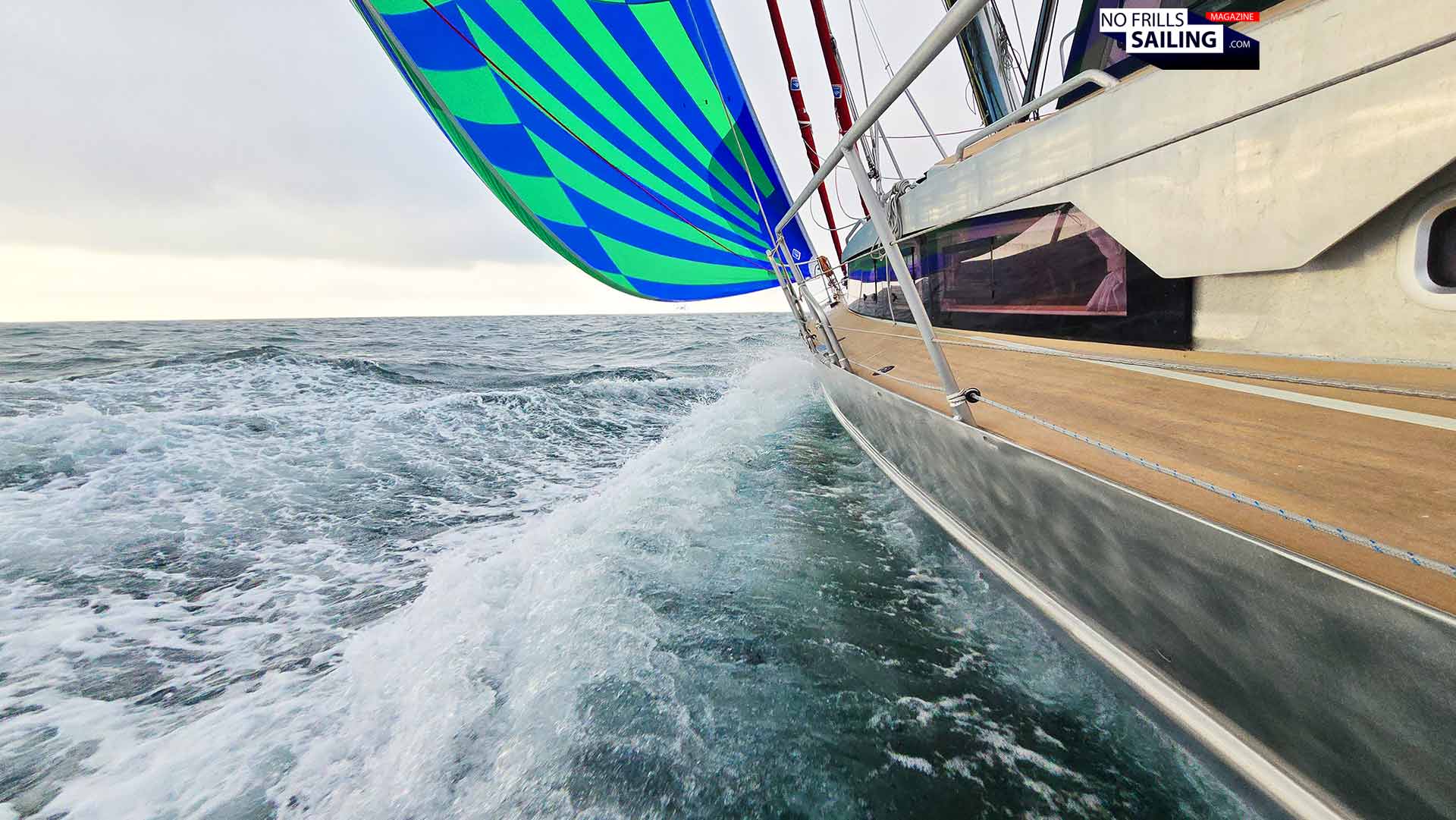
The Code D is unfurled … let´s go!
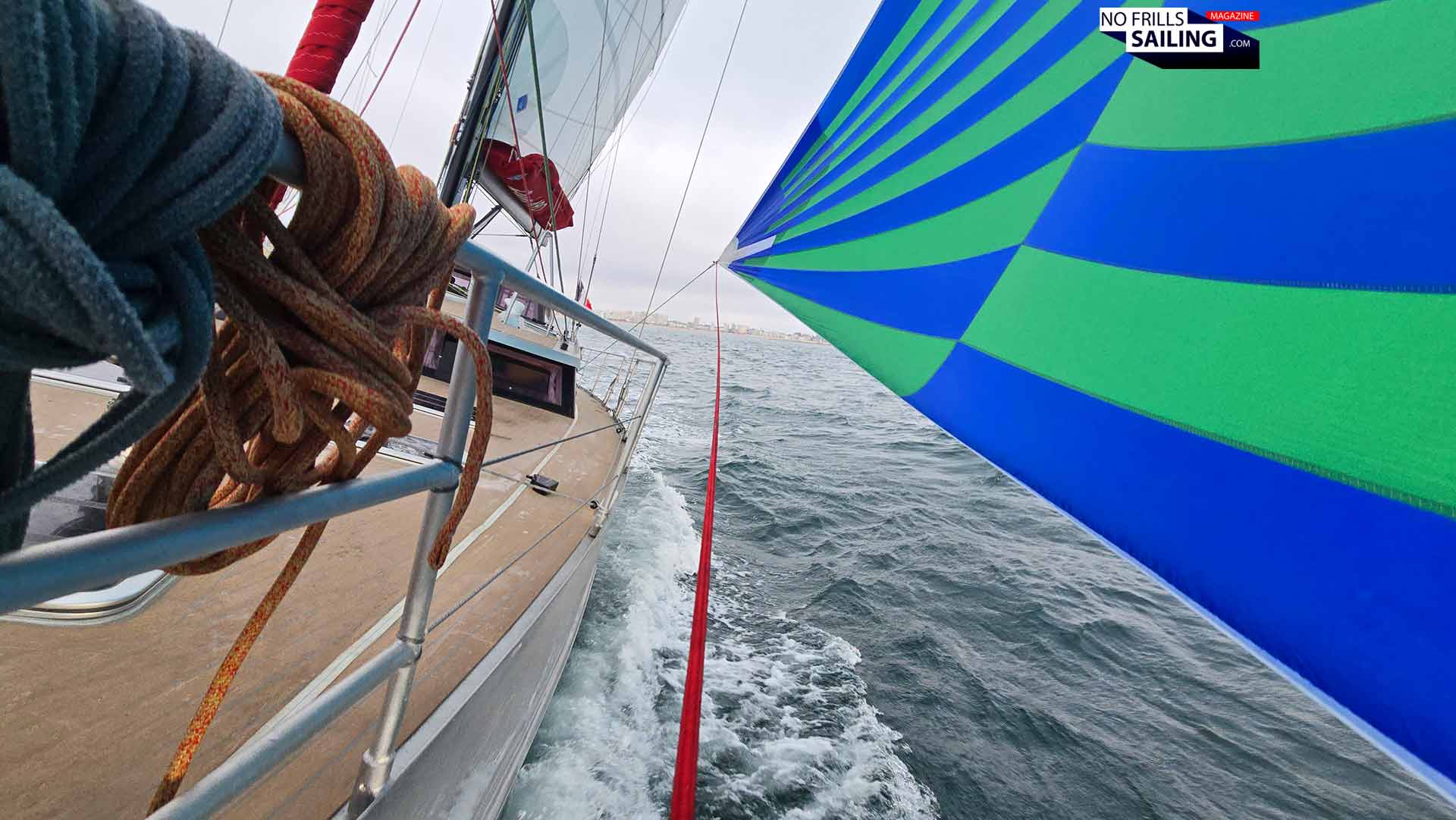
The Code D for the Ovni 490 has an impressive sail area of 100 to 115 square meters. I quite like the blue-green design pattern of this particular sail, which also created a nice new light and atmosphere on deck when the sun broke occasionally through the clouds. For more downwind passages, the Ovni 490 will be equipped with a 140 to 160 square meters gennaker or asymmetric spinnaker, which will surely put the impressiveness up a notch here.
She accellerates pretty impressively!
Sailing 90 degrees to the apparent wind, the Ovni 490 was hitting 7.5 to 8 knots easily in this sails configuration. The wind was blowing with 10 to 13 knots with some occasional puffs. As I mentioned earlier, the weather was to degrade only later. I would say that in those pretty “light” conditions, this is a very respectable speed on a broad reach. Going at this rate, the Ovni would cover to 180 to 190 nautical miles in 24 hours. That´s a great day´s run time for a cruising yacht!
Rigged to go anywhere
But of course, speed isn´t everything aboard a cruiser. I mean, I started my own “sailing career” on the Pogo 40. This was pretty awesome, as even the first and oldest of these yachts is a planning beast. I enjoyed the speed very much, the thrill and also the opportunity, to learn about physics in sailing, sails trim, coping with gusts and holding a due course. But! Sailing fast almost inevitably always also means to sail hard. Comfort is a word rarely heard aboard a Pogo 40. But its essential on cruising yachts – moreover, on yachts that sail legs which last for days or weeks.
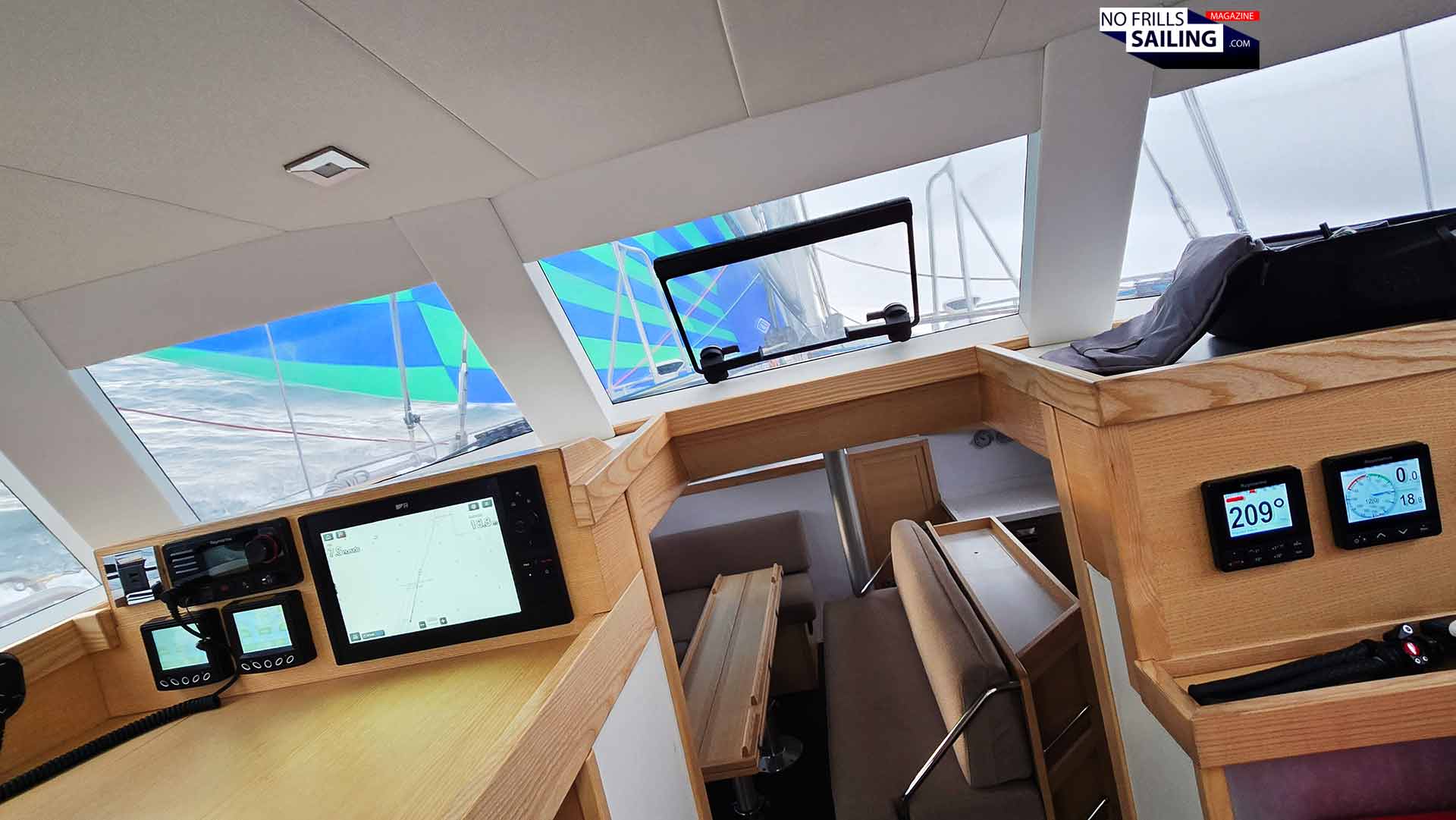
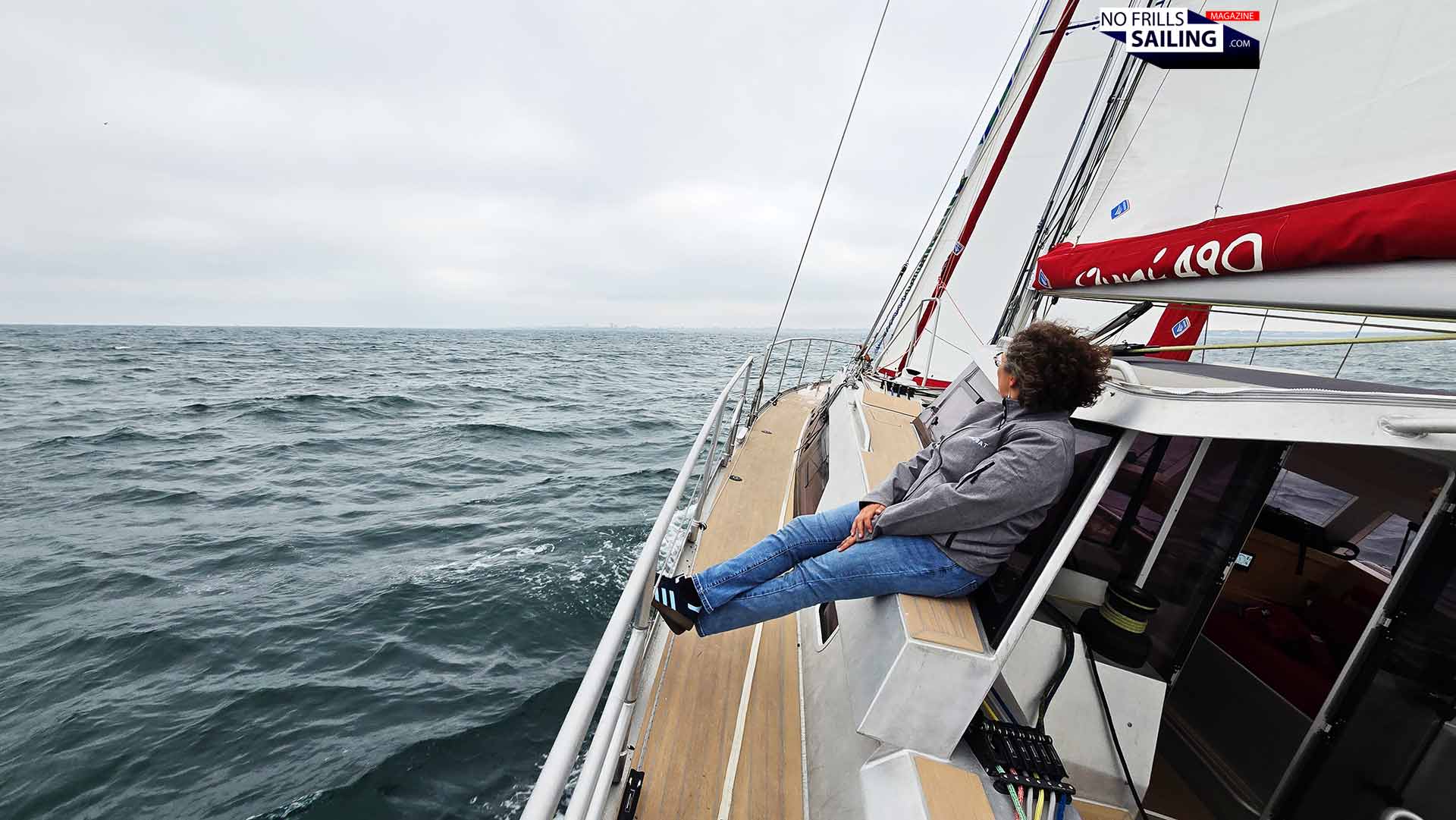
Favorite position for night watches
Speed becomes secondary, even tertiary or less important, the longer the distance a yacht has to cover. Because other factors increase their significance. Factors like seakindness and ease of movement. A truly oceangoing hull that has to cope with oceanic waves must behave different, compared to a racer and even a cruiser meant for occasional, vacational cruising. It must be kind and soft, so to allow the off-watch to find a good night´s sleep or the chef to cook a decent meal for the crew.
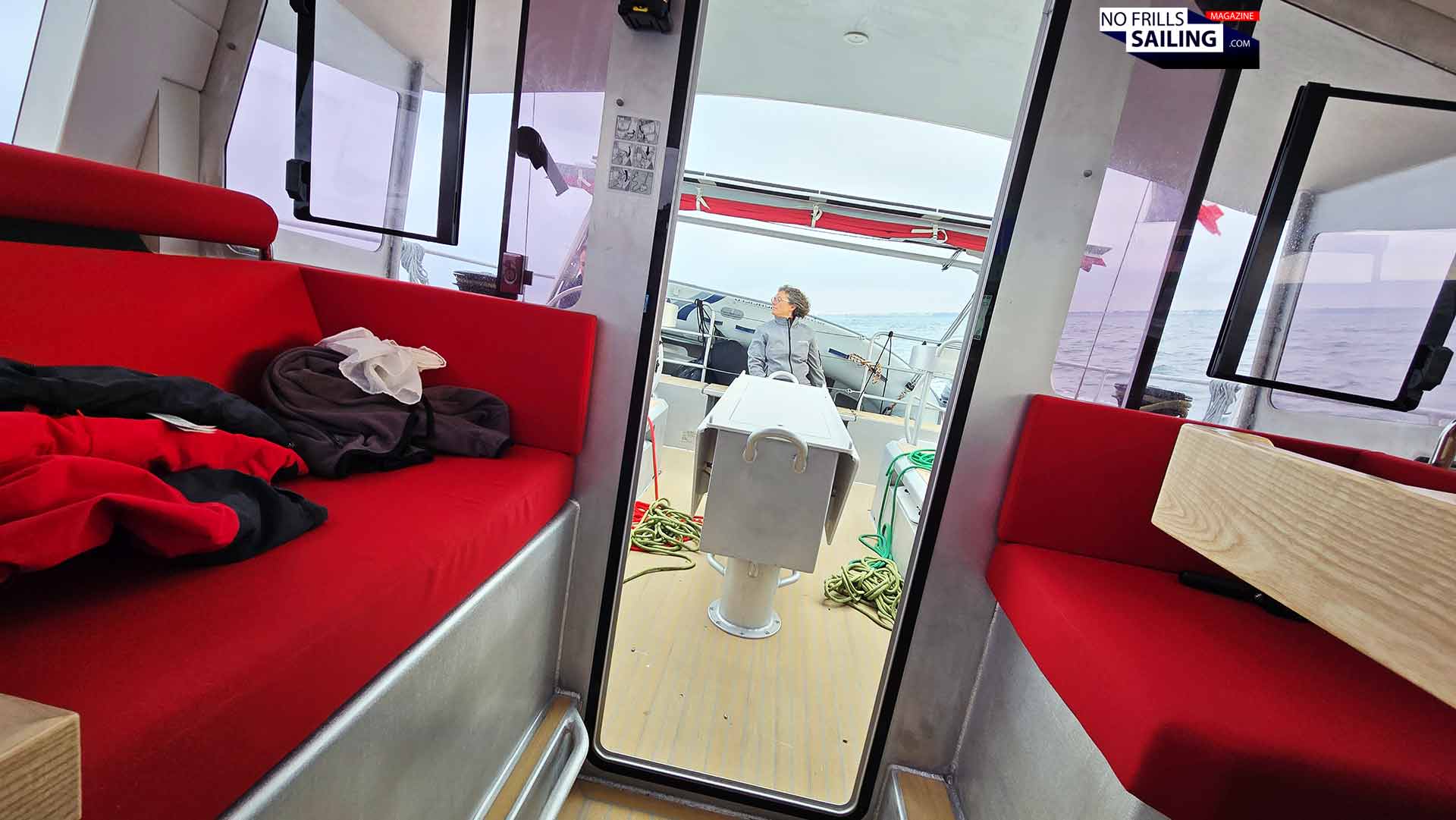
It´s very warm & protected in here
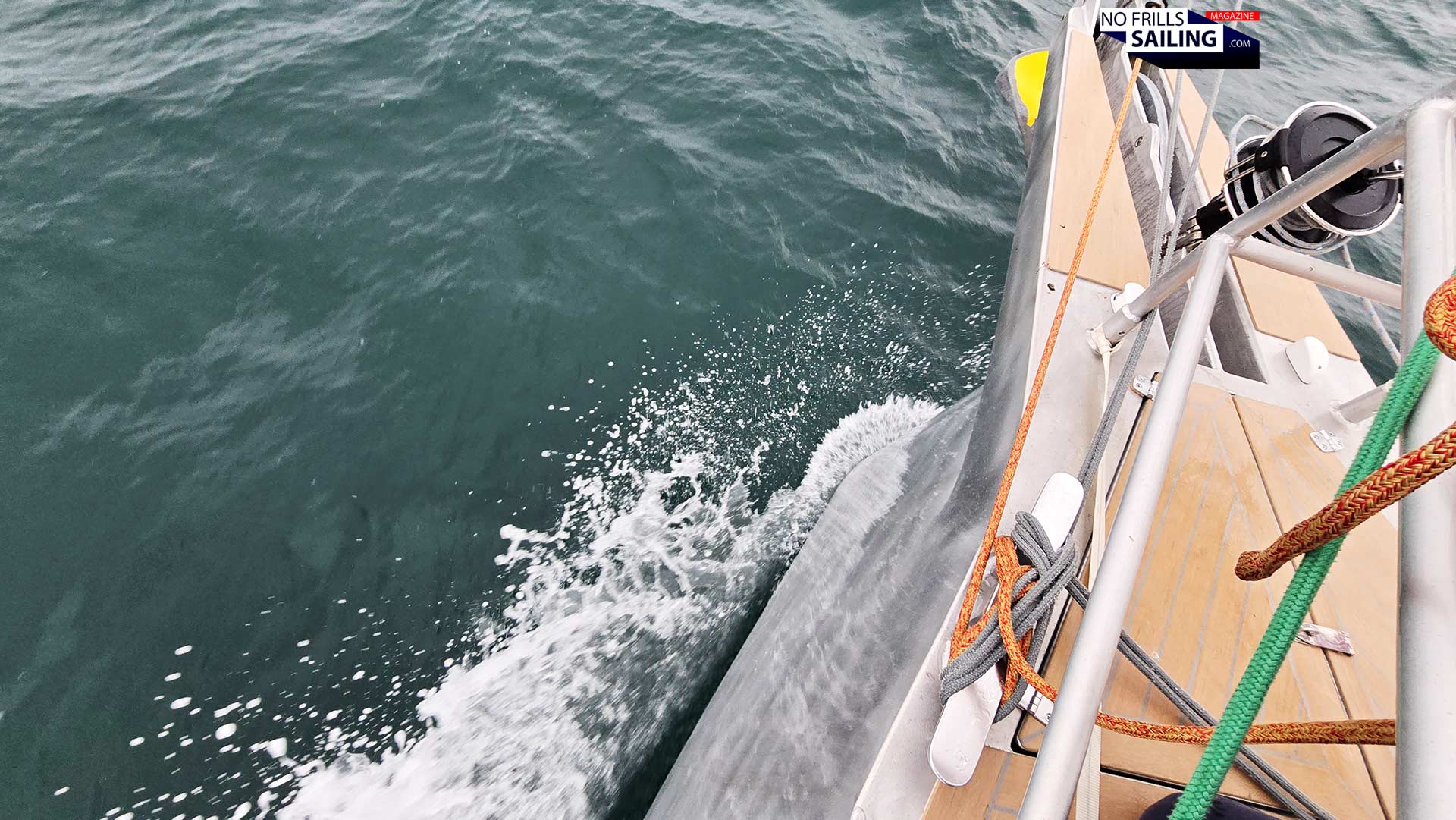
That said, comfort and a nice motion through the water is often traded in for speed. An Ovni does not have to go fast! That´s the same for your Boreals or your Garcias. She must respect the wellbeing of the crew. A good oceangoing hull will have a soft entry into the waves, a nice steady absorption of the energy on the bow´s way down into the sea. Without slamming, without rocky motions. This is what kills your off-watch. This is what will take away your sleep and recreational phase and will ultimately drain your energy. Let alone the wellbeing of your family and possibly your kids.
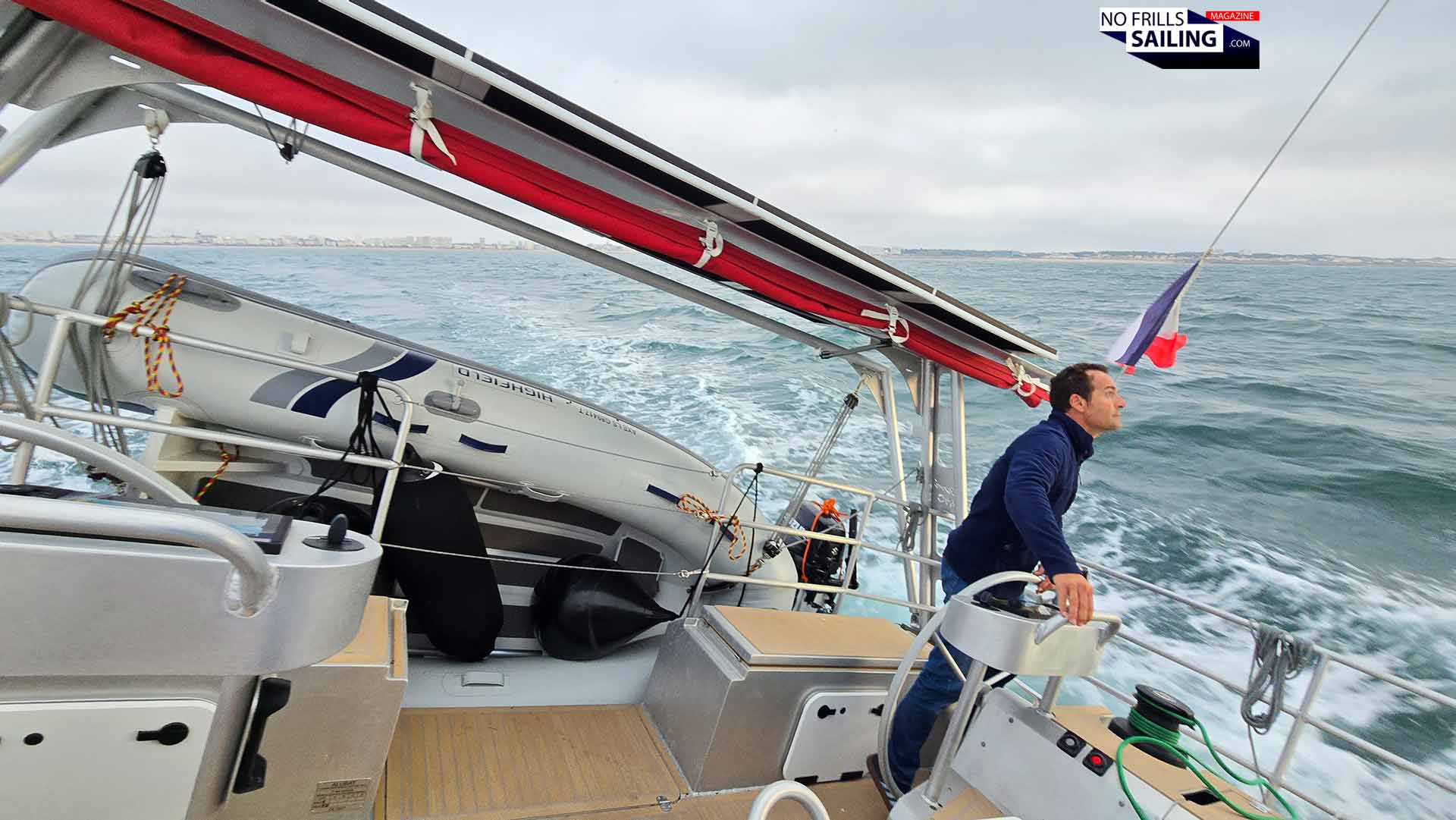
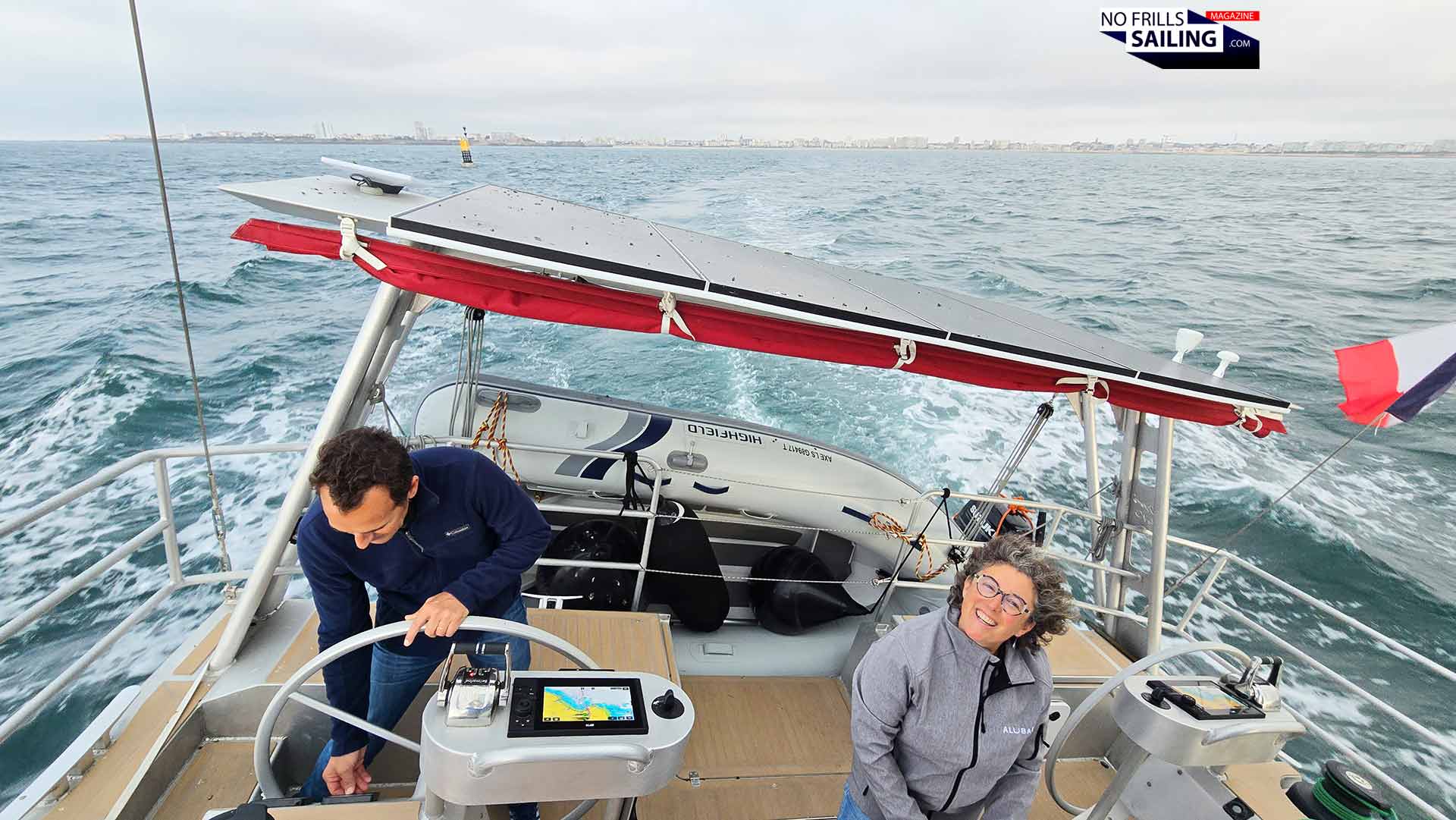
Luc seemingly enjoys sailing the 490!
In this, although the Ovni had to deal with pretty steep waves rolling in from the mighty Atlantic Ocean, I found her quite nice motion-wise. I sat down in the warm and cozy doghouse and even went down into saloon and cabins to get a feeling. There´s no slamming at all – that´s for the hard-chine hull! – nor any rocky, harsh movements. If you´d had taken me aboard with blindfolded eyes and asked me now whether this was a hard or soft chine hull … honestly, I could not have guessed it. Of course, you have the rolling and the movement, the pendulum between the waves. But that´s sailing, right?
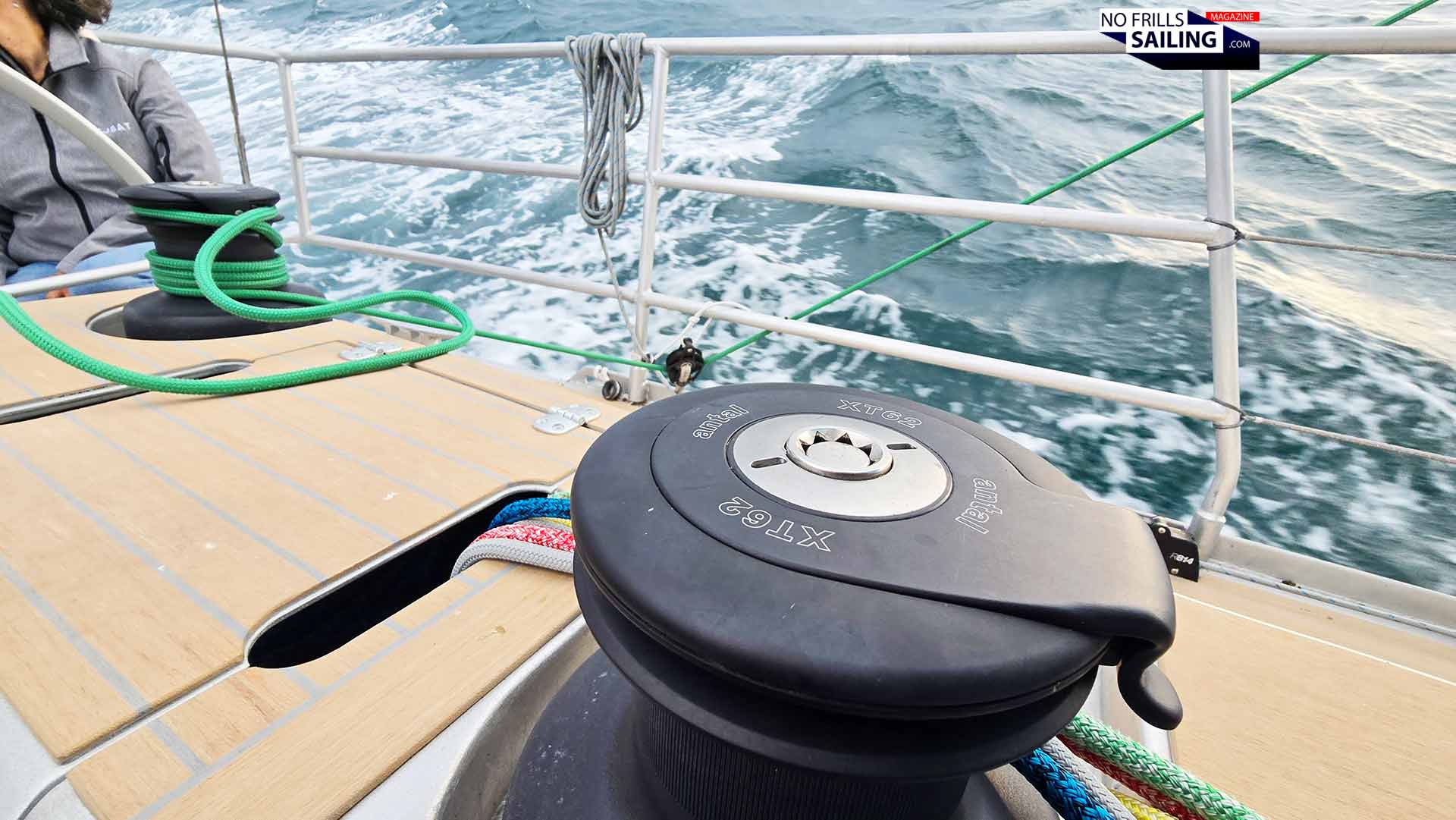
Antal is standard on Alubats
Up on deck, everything is rigged to make you long passage as comfortable and easy as possible. In this, equipment- and fitting-wise, the shipyard doesn´t leave anything up for luck. For example, the winches and other fittings for sail handling and trimming are all Antal. As a standard. No fiddling around with cheaper plastic stuff – this should be holding up against the testing of the elements and over time. Another point taken: An Ovni is by far not a “cheap” boat, neither in terms of building quality nor in terms of outfitting. That´s for the “cheap” hard-chine manufacture …
Let´s check the Ovni on different points of sail!
After roaming her interiors, I went up on deck and talked with Cecilia and Luc. Facing the fact that the boat was literally sprinting along here, the fun and pride was in their faces. Trying out the steering properties myself, I was surprised how vivid and responsive she was on the rudders. I never would have guessed that a proper behemoth like this one would be so agile. In this, there wasn´t any hard pressure on the wheel, even when the occasional gust would fall in.
What a joyride!
So, dashing down at 7.5 to 8 knots, what´s her performance on other points of sail? As I said, we wouldn´t really test her downwind speeds as there wasn´t an asy-spi available. But Luc veered off under Code D as far as he could drive it, to 120 degrees AWA, and she´d still be running at 6.5 to 7.5 knots. That said, on a running course, we could have raised the centerboard to take away some dragging force, which would have added maybe 0.2 to 0.5 knots. Again, this is not a racer!
Decent cruising speeds with the Ovni
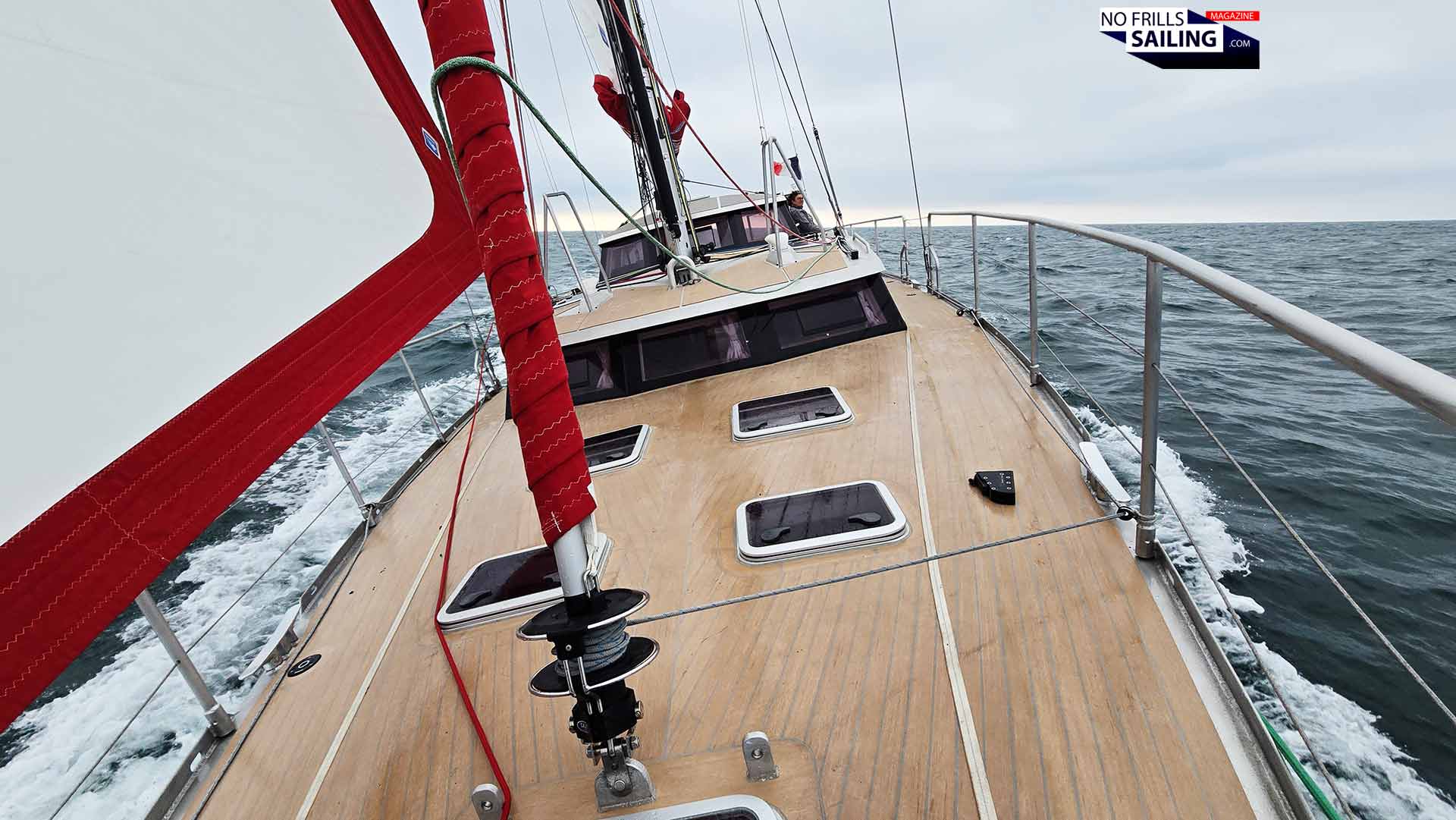
Then we furled in the Code D as I wanted to check the sailing performance of the Ovni 490 under standard sails. This again was a matter of seconds: Cecilia would ease the Code D-sheet ever so slightly, whilst Luc was pulling the retrieving rope. This demonstrated very nicely as well how important it is to invest in high-grade equipment, this time the furlers, to make sure everything runs with ease and speed. Luc secured the Code D, luffed the boat and unfurled the Genoa. Again, as a true blue water and go-anywhere yacht, the Ovni is equipped with a whole setup of different foresails. She comes with a cutter rigging in standard, sporting a smaller solent jib for strong winds and the slightly overlapping Genoa for moderate wind speeds, which we had at that day.
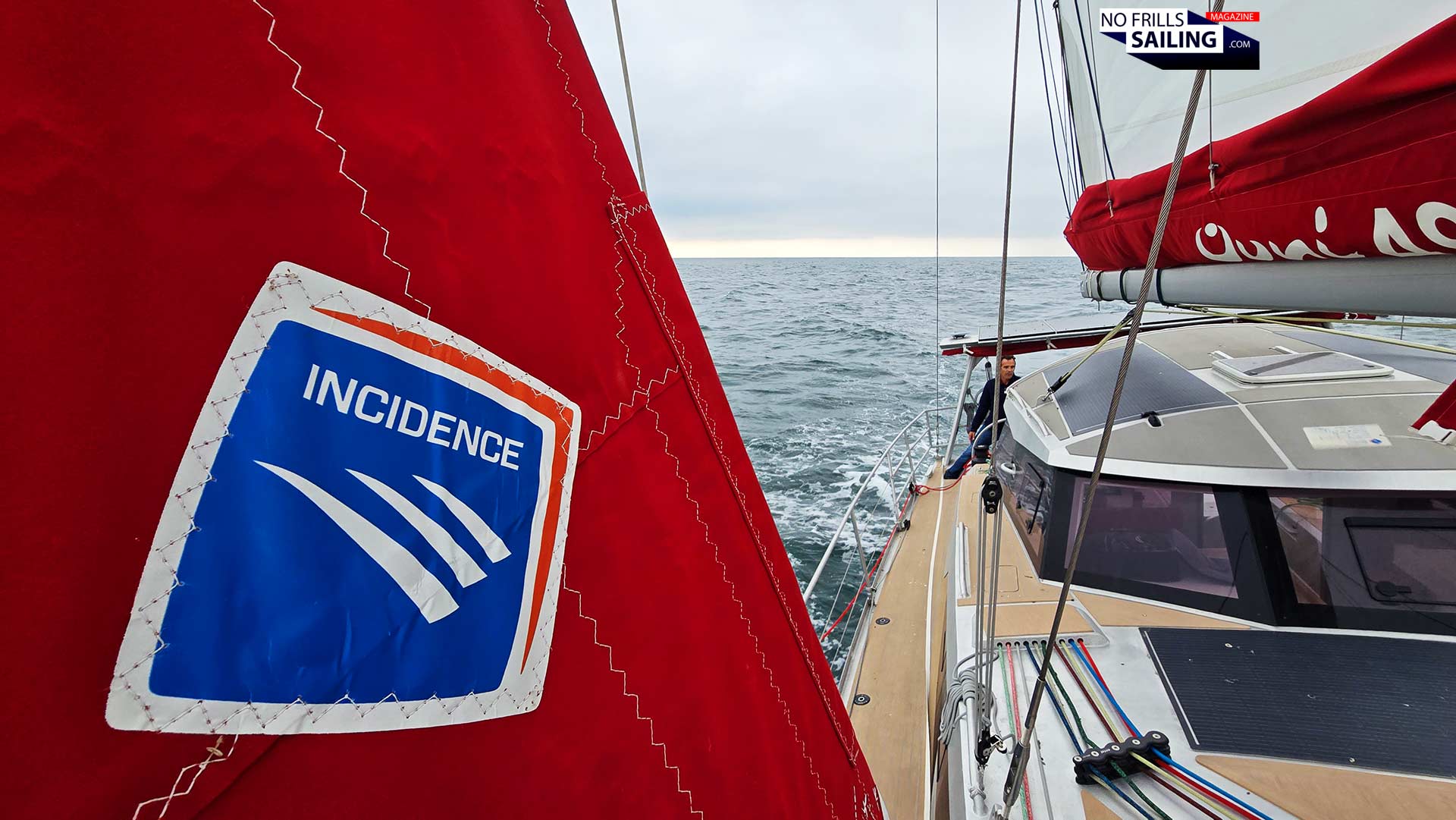
Incidence Sails is France´s #1 sailmaker
The Genoa has a sail area of 64 square meters. Principal sailmaker for Alubat is Incidence Sails, a brand that has been founded in 1988. It is the undisputed number 1 on the French market and said to rank number 5 in worldwide sails sales. It is said to be one of the very few brands manufacturing their own filament and membrane sails whilst other brands utilize Challenge or Dimension Polyant-garments. Anyway, Luc luffed and brought the Ovni to a close-hauled point of sail.
Upwind – no problem for the 20 ton boat!
Again, a bit surprised that the boat didn´t heel all too much, we still cut into the waves again with 6.5 to 7 knots SOG! And believe me or not, Luc was pushing her so much, that we were pointing upwind at 35 degrees AWA! I mean, you´d rarely sail that “crazy” close to the wind on your world-trip, but this just shows how capable the hull and sail plan of this Ovni was! Luc smiled, and almost casually dropped this sentence: “She is fully loaded with everything! Including water maker, gen-set, dive compressor and lots of equipment … she weighs 20 tons!” Let that sink in. 20 tons!
A true long haul cruising yacht!
So, here we are. I guess, the point has been proven – at least to me – that there is no disadvantage whatsoever in sailing capabilities, speed or comfort if you opt for a hard chined-hull. I know, I know, all the old salts, couch-captains and would-be naval architects out there are tearing their hair reading this. But honestly, from what I´ve seen here today, I cannot tell even a tiny bit of difference.
Steering capabilities are quite nimble
Let´s not forget that the Ovni is by definition not a boat that should “perform” in terms of speed. As I said, as long as you can have day´s runs with 150 to almost 200 nautical miles, who cares? The comfort-part is much more important here, the style of living, the practical sides of the boat like how to stay fed, warm and clean. With more than 1.800 units build and literally hundreds of them having reached – and still reaching – the farthest areas of the planet, I think it´s safe to assume that an Ovni is a safe bet when it comes to long haul cruising.
Cecilia enjoys her favorite place
She may not be a beaty in your eyes. Sure. As Cecilia tells me, there are aluminum-people who would never opt for an Ovni and prefer the Allures. Likewise, there are Ovni-owners who´d be offended if offered the Garcia. “That´s the nice thing about the boating market”, she says: “There´s a boat for everyone. We tend not to look all too much to what the others do, although it´s always interesting to see which solutions they may come up with. But be rather look to ourselves and how we can improve our boats, rather than to copycat or come up with “me too”-solutions.”
She performs better than most might credit her!
This is another detail I strongly notice. During my two intense days here with Cecilia and Luc, roaming the shipyard and now sailing off Les Sables for a couple of hours, it is really kind of “hard” for me to prize out any comments or information of the two guys related to the other aluminum-brands. They never comment on the other. Let alone speak a bad thing about them. That´s something you seldom encounter. Usually, off-record of course, people would make a statement on their competition. But not here: On the contrary, Luc seems to really appreciate the work of his competitors! Knowing how hard it is to make boats – and sell them – it seems as if he sees it like a kind of “brotherhood”. And it´s really like this: Sometimes a customer would prefer the Garcia. And sometimes he would opt for the Ovni. This is how it goes. I find this so incredibly humble, so likeable! As a prospect buyer, I´d surely appreciate this kind of communication.
Is this the go-anywhere yacht for you?
And so we headed back, beating our way towards Les Sables again. I am astonished how far we had been sailing out. The distance covered during this little dash out is a testimony to the fact how quick the Ovni really sails. Remembering my own yacht deliveries out of here, I´d rather turned her around and set a course for A Coruna, believe me!
Going back into Les Sables
But of course this is not a dream and we all have to get back to work. And so we rather enjoyed the nice sailing today and the last couple of miles back home. With the mighty Atlantic waves now rolling in from abaft, the Ovni 490 once again had to prove how stable she could sail and hold a due course. I smiled watching Luc working at the helm, trying to dance with the crests and control the boat surfing down. Maybe he as well was a bit daydreaming back to his eight year Pacific-adventure with his own Ovni? Who knows …
Ovni or not? This is my conclusion.
As we had reached Les Sable breakwater again, they started the Diesels, we put her nose up into the wind again and Luc released the main halyard. The sail fell down into its lazy bag – another reminder to invest in high-grade sail-sliders, as reduced friction of the ball-bearing slugs will help bring down the sail even in rain or through salty slits much easier. Also, it helps that when packing the sails, you can walk on Ovni´s coach roof, the doghouse´s roof and on the rugged cockpit table all the way up to the end of the boom. In this: They have though about everything here, it seems. So what´s my conclusion?
Luc takes down the mainsail
I must say that the initial questions for this article, namely if a hard-chine hull brings disadvantages in terms of sailing, is clearly answered for me. It´s not. As far as I have witnessed today, there wasn´t any slamming, any rocky motion nor any other uncomfortable aspects detectable. Sure, we were sailing in comparatively moderate conditions, but honestly, in a grown up storm, I am sure, you care about a lot other stuff than your hard-chined hull. Again, I noted nothing. What I noted on the other hand was a pretty vivid and surprisingly agile boat. 13 knots of wind isn´t much, nevertheless, this 20-ton-behemoth proved to be a pretty quick sailboat, light and nice on the helm, making decent speed. Case closed.
A last trick out of the hat … turning on a dime.
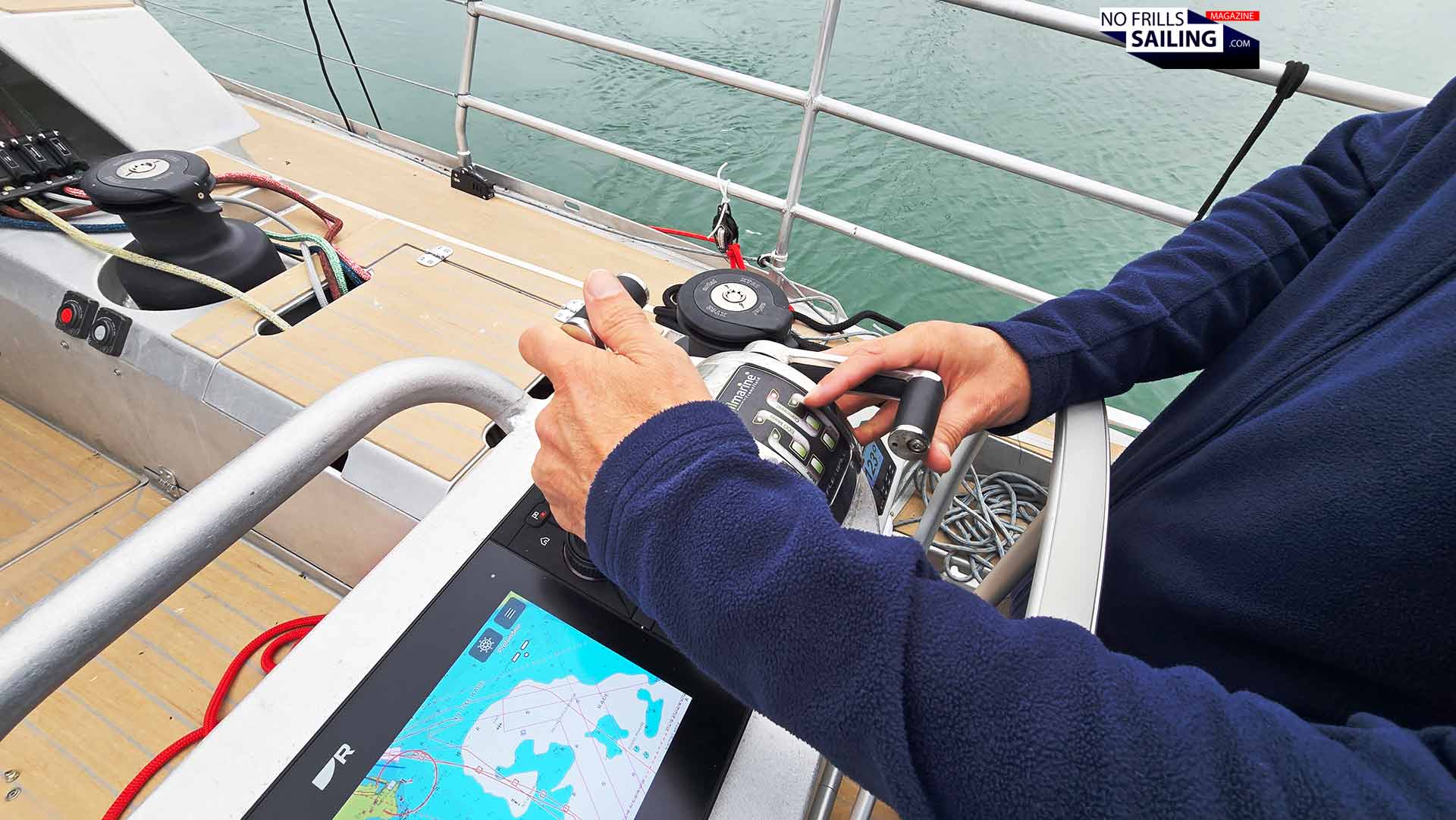
Heading back into Port Olona, where Alubat has its commissioning pontoon for every new yacht coming out of the production, Luc had one ace left to show up his sleeve. He asked me if I would fancy to check the twin-engine maneuverability of the yacht. And of course, I would like to! As the Ovni is equipped with electronic thrust levers to control the engines, operating these can be done with two fingers.
But there´s one last trial before landing the boat …
He put both in opposing directions, with port side engine going forward, starboard engine pulling backwards. And she indeed began to turn on the spot. Right in front of Sebastien Simon´s brand new Imoca our Ovni completed a 360-degrees turn with the easiness of a ballerina. The efficiency of the two counter-rotating screws may not be as high as on a catamaran, because the engines are not as much apart from each other, but seeing her turning effortlessly on a dime is a nice reassurance that even in very crowded or narrow ports this bit 50-footer can be maneuvered with confidence and ease.
Easy as a catamaran
And sure, if the twin engines aren´t enough, there´s always the tunnel bow thruster and optional stern thruster you can use in order to bring her back to her berth safely. Which is what Luc did, and a few minutes later we tied her up only a stone throw away from the Imocas, preparing for their new offshore adventures. In a sense, even though the conceptual distance couldn´t be farther between the Ovni and the foiling Imocas, both boats kind of belong to this pontoon: Where the great offshore adventures start!
Advertisement
Is the Ovni your next adventure-yacht?
And this is what these boats are truly made for. The Ovni is definitely not a yacht you would use for coastal cruising, your annual thee-week sailing vacation or as a bathing platform. These boats are made to take you anywhere in the world. Their rugged hulls can take a punch, can even withstand certain amounts of ice, they can fall dry and can even be dragged into the shore for repairs thanks to their flat, thick bottom plates. This is a yacht für circumnavigators!
We are turning in front of the Imocas
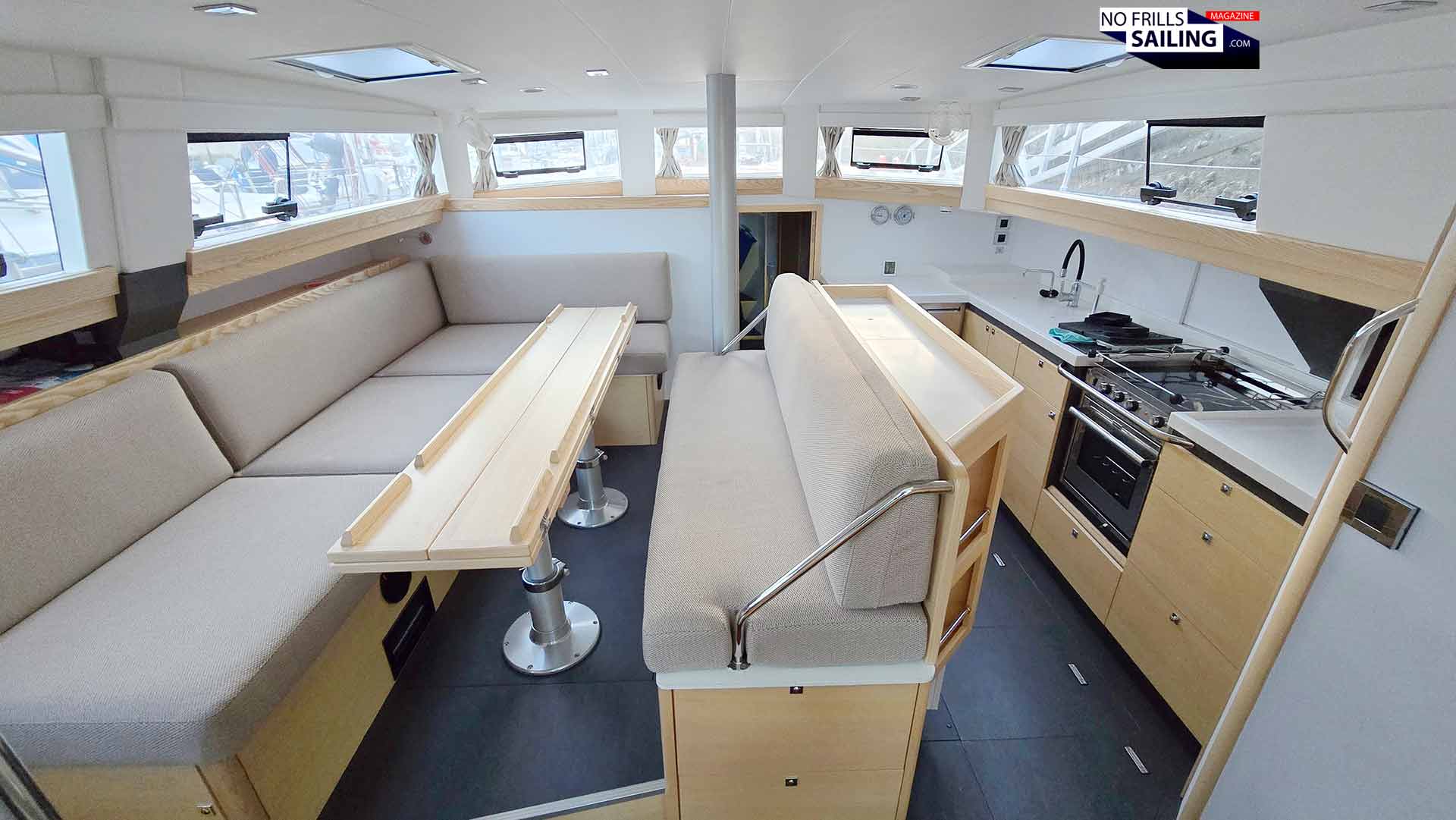
Just like the Imoca, but slower. And considerably more comfortable. Speaking of which: As a brand new Ovni 430 will become the Alubat showboat for the upcoming edition of Boot Duesseldorf, I didn´t take all too many interior shots today. The article would have become unbearably long. You may either check out this one showing the interiors of an Ovni 450 which is only available as a young timer-used boat now, or you ae a bit patient till End of January, when I will have the complete interior walkthrough in the said brand new Ovni 430 in Duesseldorf ready.
More on the Alubat interior in a later article!
That said, maybe you quickly subscribe to the NO FRILLS SAILING newsletter? That way you will stay informed about the contents of this blog and never miss any new of the up to 10 articles per month! You will receive a simple email at the end of each month, showing all the articles and new videos available – it´s easy and convenient.
Thanks so much, Cecilia and Luc, for the amazing two days at Les Sables! It was a true pleasure to take a detailed look at the production in the factory and also at last sail the boat. Perfect! And you, dearest readers, don´t miss the upcoming articles: I was allowed to fully shoot the current state of the build of the all-new Cigale 15, which is an upcoming article, as well as detected an amazing detail in the aluminum production I´d love to disclose to you. So stay tuned!