
I really like the title shot: It reminds me somehow of the freemason´s symbol as it stands for craftsmanship and proud craftsmen. A nice opener to this story, as it also portrays the quality and care of real craftsmen. As I promised to focus a bit more now on the building process of my new Omega 42 and here we go: Another topic, another front where steps are taken towards finishing this project. Last week when I was in the shipyard I met with Marcus. Marcus is not only a rocker by heart, but also a professional upholsterer. His workshop is located just over the street, vis-à-vis the shipyard where my new yacht is currently under construction.
The boss of the shipyard emphasized that I´d award the contract of making the custom cushions and mattresses for the yacht with Marcus. Not solely because “buying local” should be a matter of course to support “our” people in the region, adding a true character of “homemade” to the end product, but also because the shipyard has already accomplished countless smaller and bigger projects in terms of boat cushions with this little manufacture. So, after getting to know Marcus and his workshop a couple of weeks ago, I agreed.
A number of very important decisions

Usually I am a friend of the big brands because I feel that their products are less prone to defects or manufacturing margins. There are indeed a lot of companies offering their services of making custom-shaped bedding and boat cushions via online-services: You just punch in the measurements, set your clicks to the preferred materials and the product will be delivered conveniently a few days or weeks later. But the intricate and very detailed consultation I received from Marcus this day convinced me that it was better to talk to a real human – and meet aboard the boat. Why?
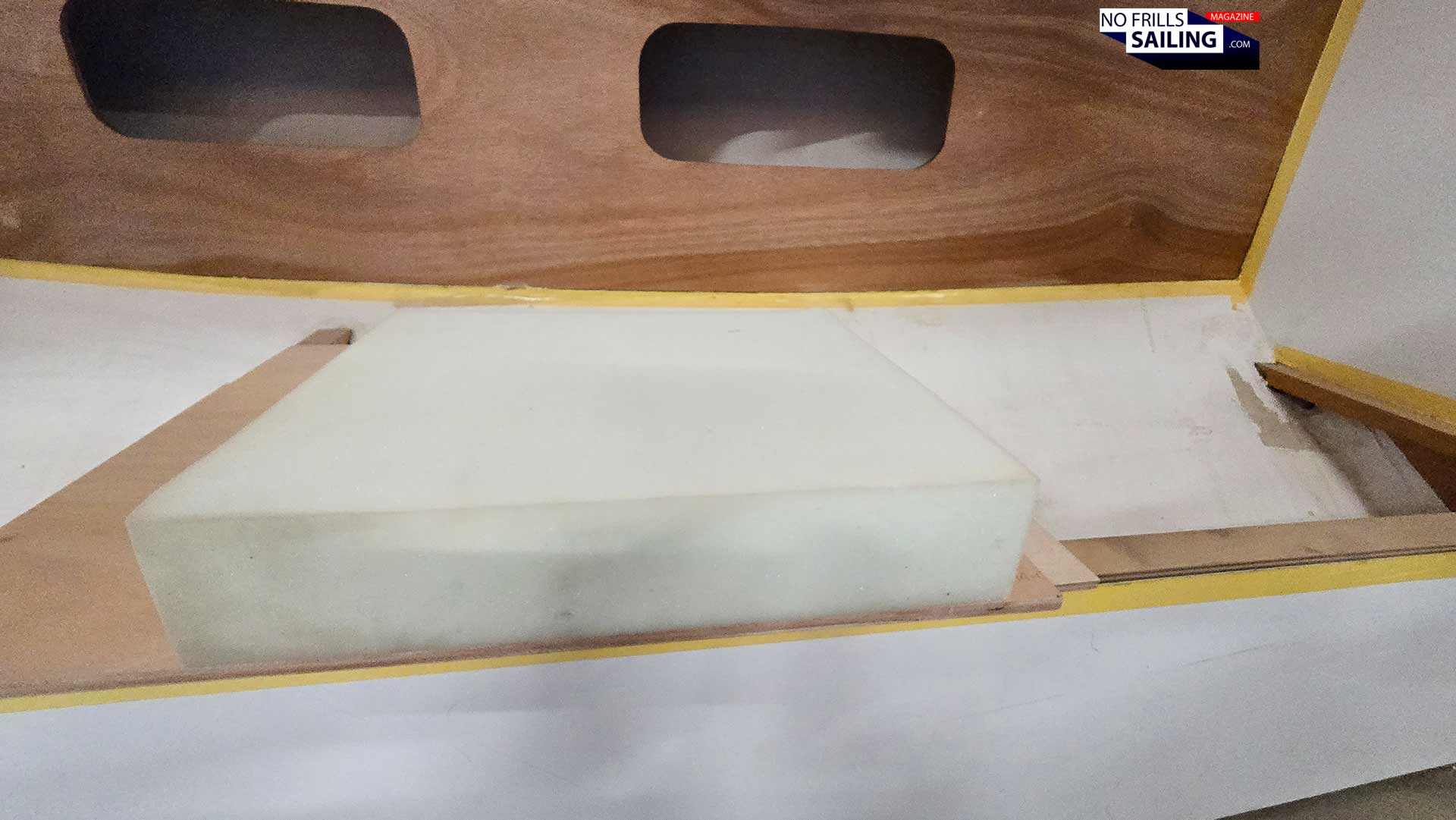
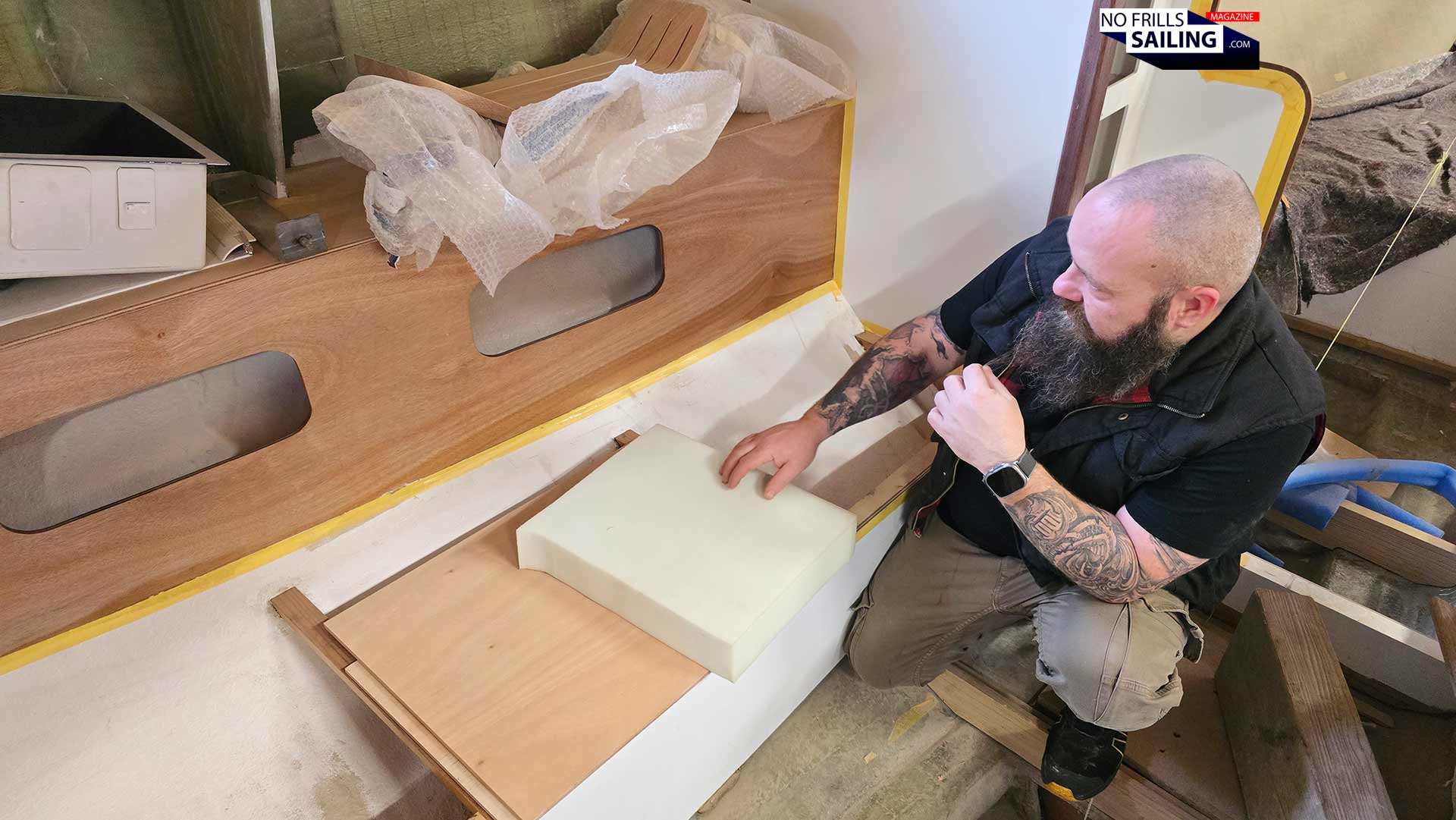
Because that way Marcus was able to show with little pieces of foam and a multitude of pattern books the rich variety of choices I as a customer have when it comes to deciding every detail. Online resources, of course, in order to make it easier, more convenient and faster for the client on the one hand and easier, faster and cheaper for the manufacturer, offer only a limited range of options. So we started by sitting down in the saloon, talking about the cushions here. How thick should they be? Are people going to use the bench for sleeping regularly or not? How many people will be sitting here? Questions upon questions Marcus asked me, narrowing down the choices to a few suggestions.
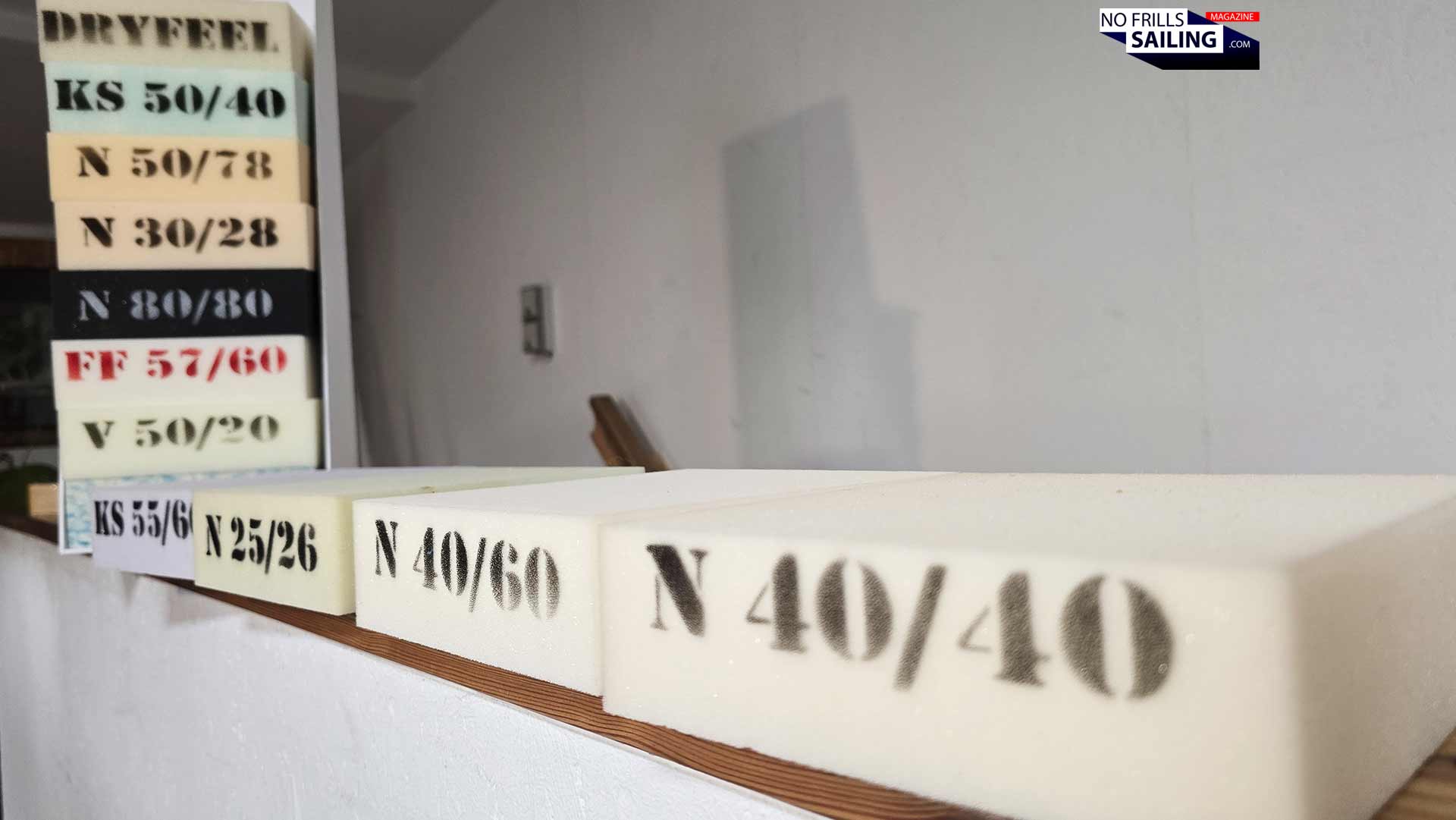
In the end we opted for a mix of cold cured foam and FlexQ-foam for the seating cushions and agreed on a wedge-profiled form for the backrests. To save money and make things easier – hence: In any handcraft working hours are among the most expensive factors – Marcus emphasized to have just one big seating cushion for the saloon benches, but two backrests, as there is some stowage behind them. It´s his experience and knowledge about boat practicality, which leads to those advantageous hints. The ordinary online-form just can´t do this.
Cushion colors and fabric decisions
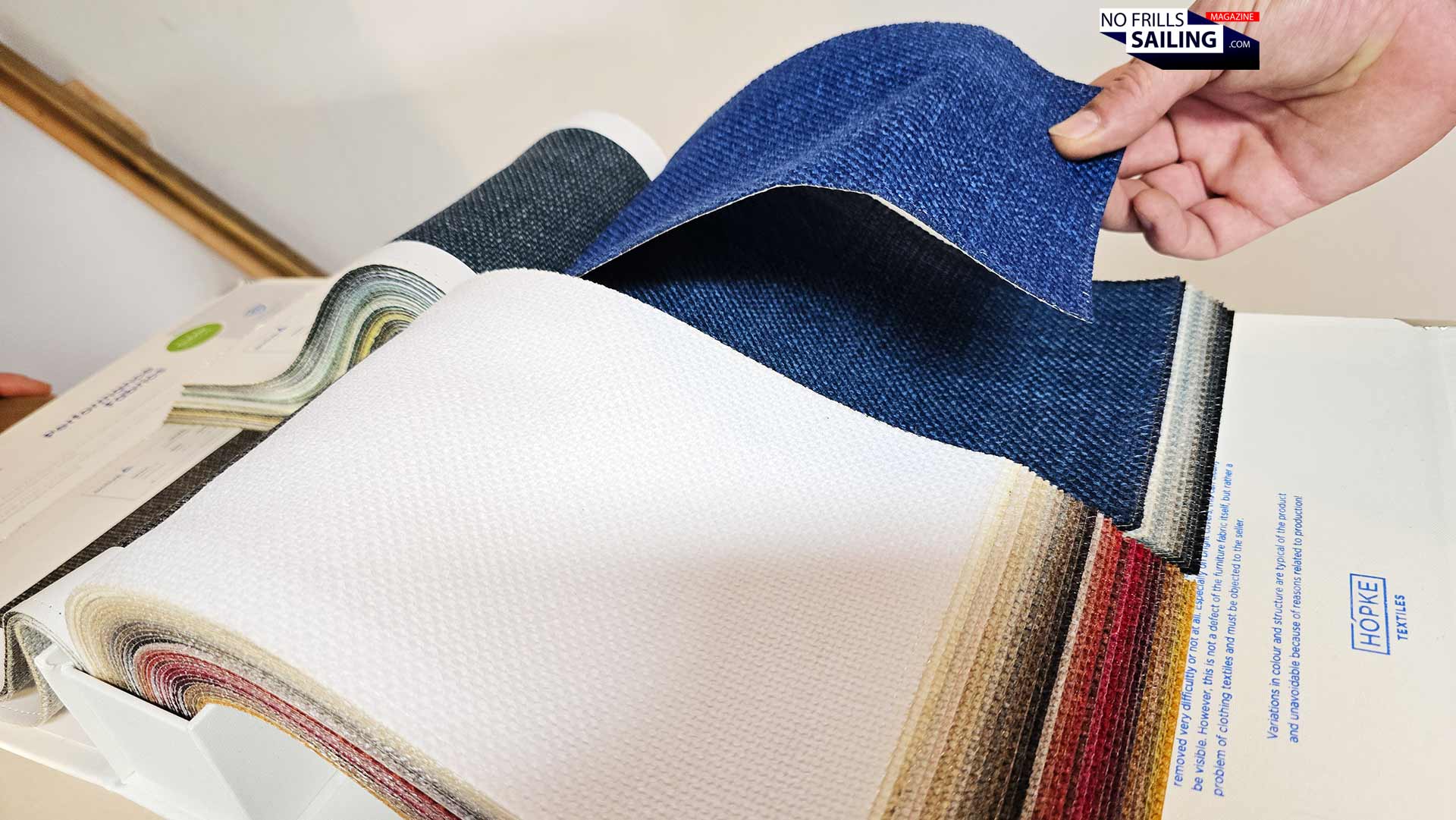
Another big thing is the colors. When I was meeting the shipyard-guys for the last time, I arrived together with my fiancé. The idea was to have her incorporated into those decisions because … well, you know … women have a special connection to beauty and the setup of interiors. Going through the various pattern books of Marcus, we narrowed down the palette of possible colors and also homed in on three different styles of fabrics. From a “classic maritime style” to just “a bit extravagant” in terms of cloth-pattern and garment. Today, meeting with Marcus, we went through our “top 3”-fabrics with Heiner, boss of the shipyard.
Although this boat is my yacht, I feel a bit “obliged” to have him incorporated into the decision process. This how story of reviving Peter Norlin´s legendary yacht and bringing back this sailboat icon was only possible thanks to his determination and vision. He has seen dozens of Omega 42 when researching and retro-engineering the yacht, he has build the first brand new Omega 42 a couple of years ago: It would be stupid to skip his experience and also sense for what´s appropriate and what´s not.
X
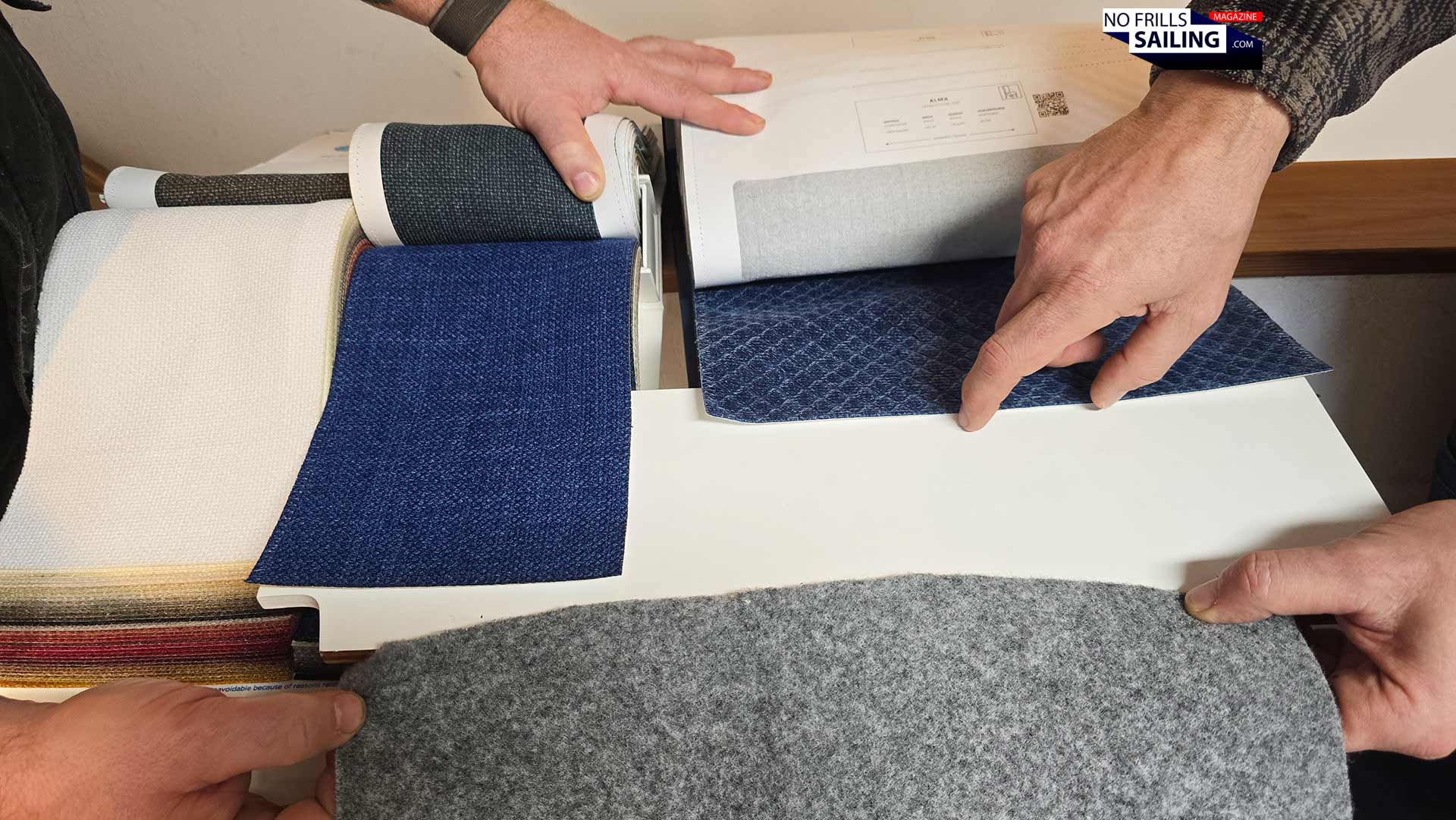
Bringing together pieces of the material later used inside the yacht, like glossy painted white furniture, the light-grey felt and the bamboo-surfaces, we discussed the fabric options and colors. After a couple of minutes we went for a classy, but rugged and very soft fabric called “Vivo 652” in a nice, contrasting maritime blue. I really like this choice! It will be fresh and modern, yet fitting the performance and sailing oriented character of the yacht. Again: Your online form doesn´t care for the boat´s ensemble and overall looks.
Taking measurements: A 3D-Puzzle
That was the fun part. What followed was the first step of the cushion production. Basically, boat cushions are for almost every part, complex non-square shapes. Apart from the saloon cushions, where the guys where able to maintain quadrangular forms, every single shape for any mattress inside a yacht is either a rhomb or a triangle. It´s even a bit more complicated, as you will see.
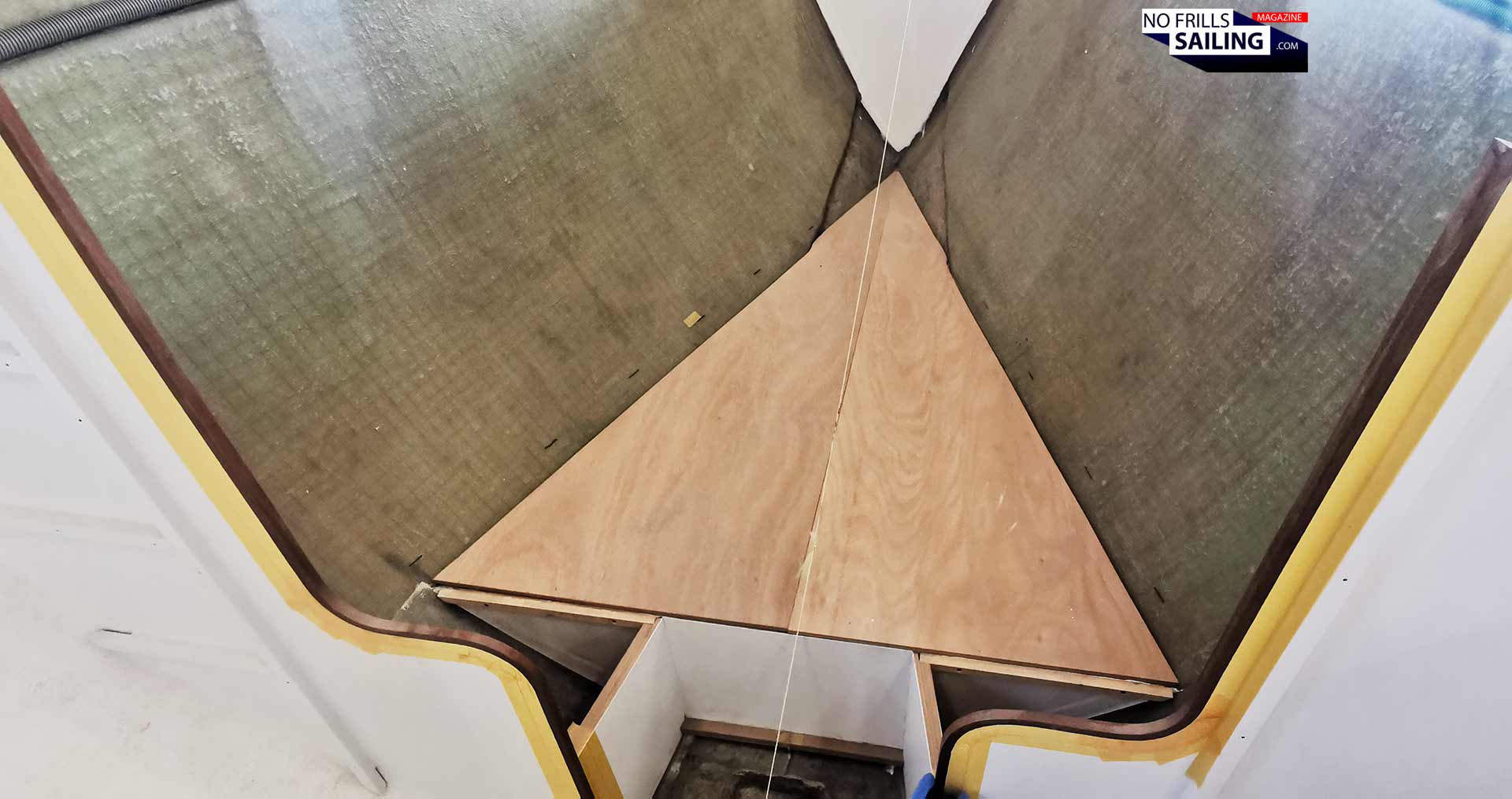
We start at the bow of the yacht: The V-shaped owner´s cabin in the forepeak. One of Heiner´s boatbuilders cut off a large part of a thick plastic film and began to spread it out evenly in the forepeak. For Marcus to being able to cut the raw pieces of cold foam into size, he of course needs a model, a gauge, for every single part. This could be done by means of electronic equipment, mostly the Prodim Proliner is utilized for that matter. But a Proliner is a very expensive tool and investing in this only makes sense when you use it regularly. For all purposes and matters – and if you know your job – plastic film is faster and cheaper.
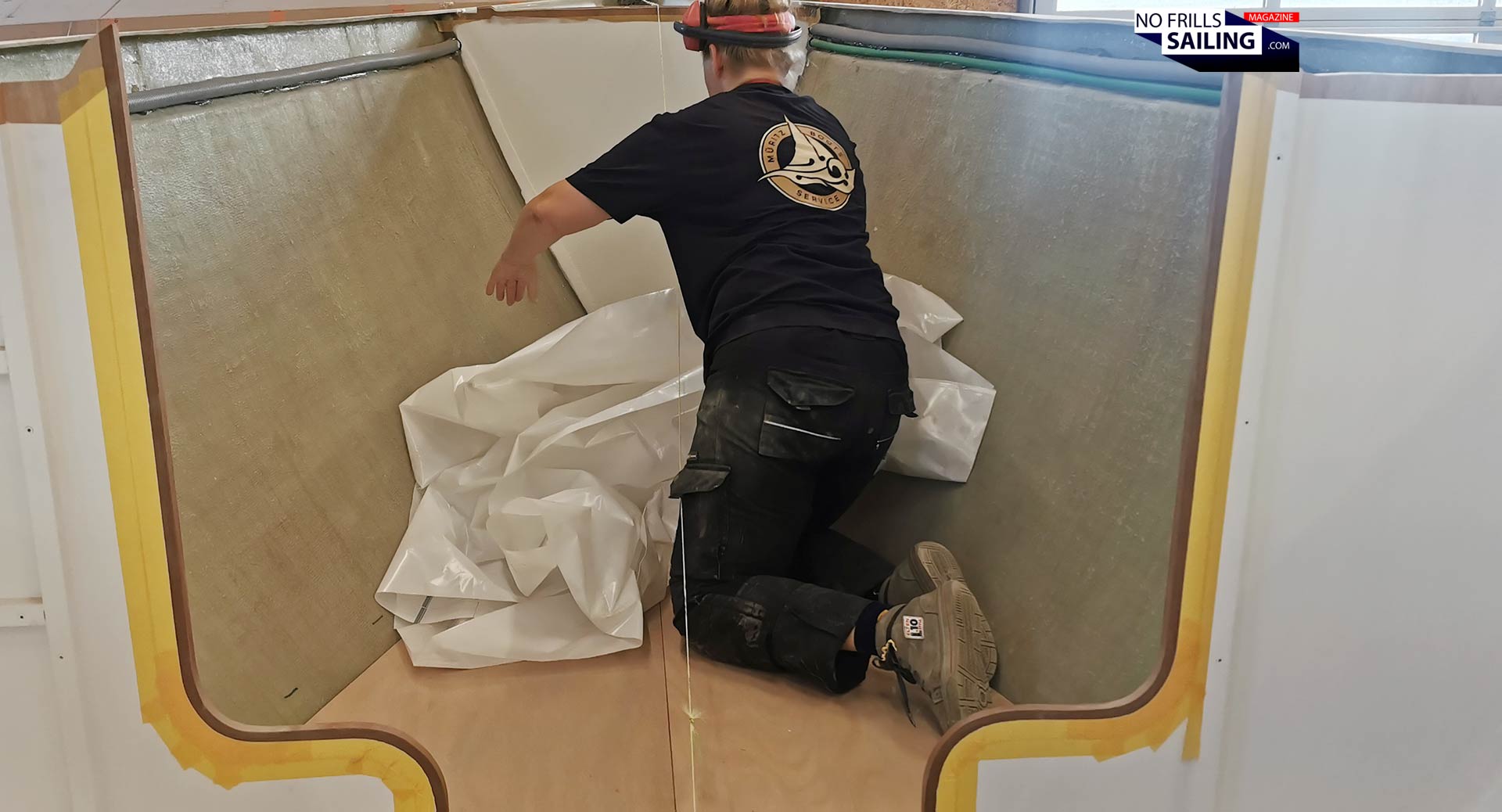
And here the “problems” start: As in almost every V-berth of any boat´s fore cabin it´s not only “just” one triangle, but two. Along the central axis of the boat, it makes sense to have the mattress cut in halves. It´s not only more convenient for taking them out for winter storage, but also when you need to dry them or for access into the underbed-stowage. But even this is not enough, since – that´s the case for my boat and almost every mid-sized classic sailing boat I know.
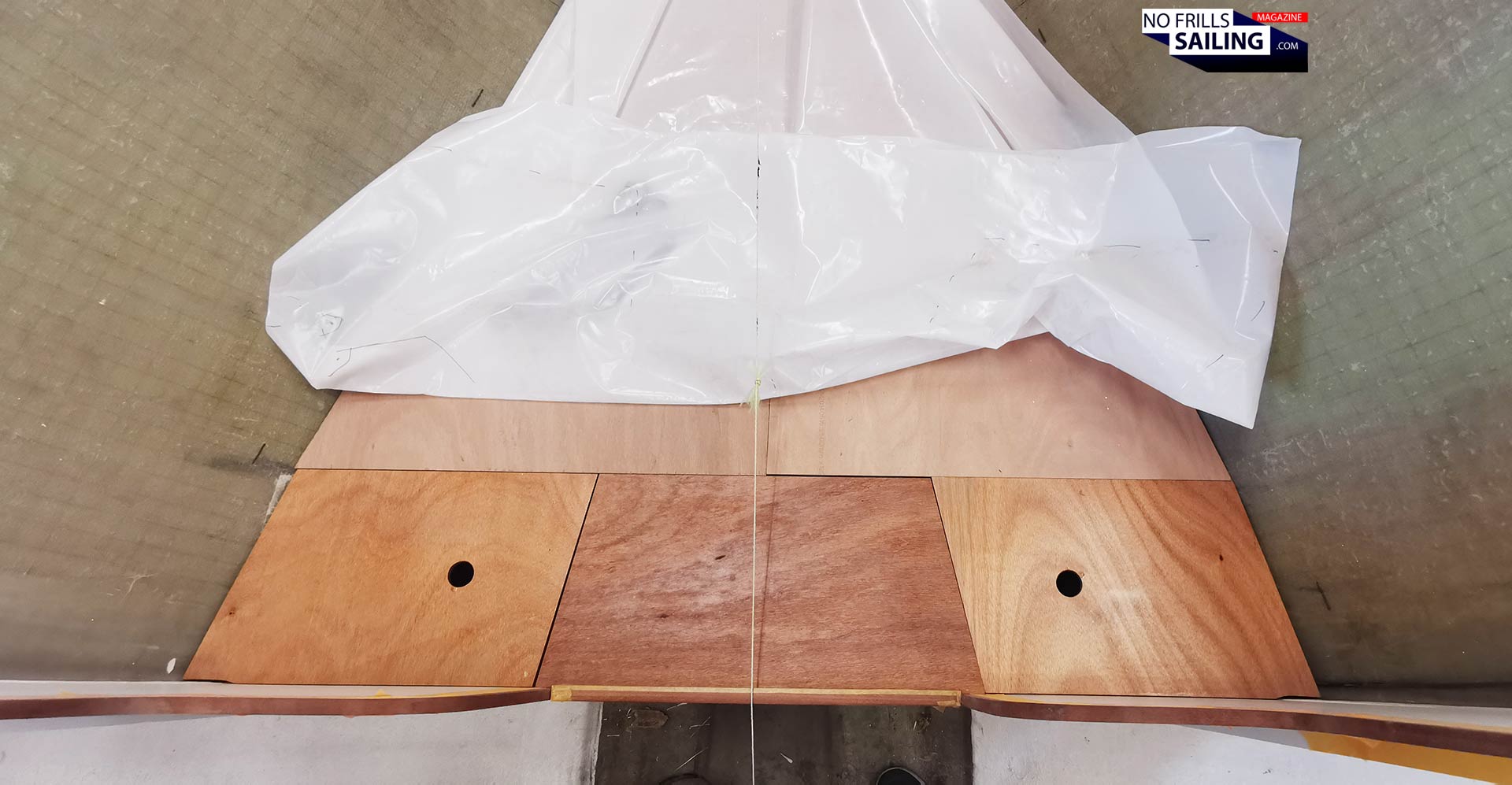
As you may see in the picture above, there´s a little recess in the central part of the fore cabin´s bed. This is due to regulations how the emergency escape hatch above it should be set up. There´s an inlay that will “complete” the V for the bedding, but you ought to take it out in order to get out a sinking or burning ship from here fast. In my old King´s Cruiser 33 it was the same: Here, I had the two large V-sized mattresses for the berth and a little one to fill the central “escape” gap when taking out the inlay. But again: Every shape that makes a form more complicated, more elaborate, will add significantly to the projected working hours of the craftsmen producing it. And as I am a great fan of making things simple, the decision on that one was fairly easy …
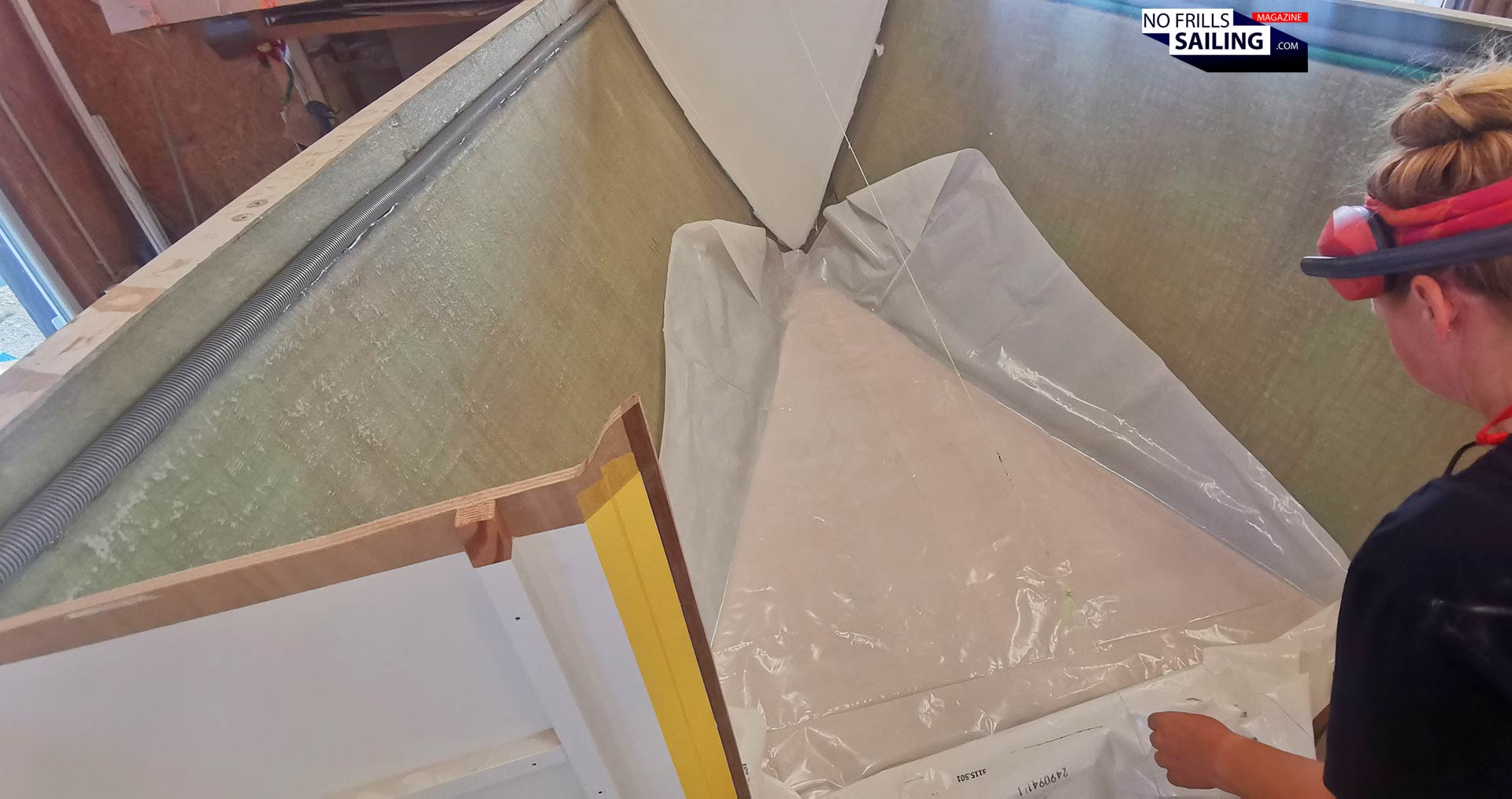
We just ignore the recess. We will have two same-sized triangles. In case of a real emergency, I will just rip apart the two mattresses and get the fuck out of the boat. When real shit hits the fan, it will work just as fine, I am sure. That way Marcus won´t have to incorporate the intricate recess into the two mattresses and neither have to manufacture the little inlay. I am sure this saved a lot of working hours and a lot of Euros from my budget …
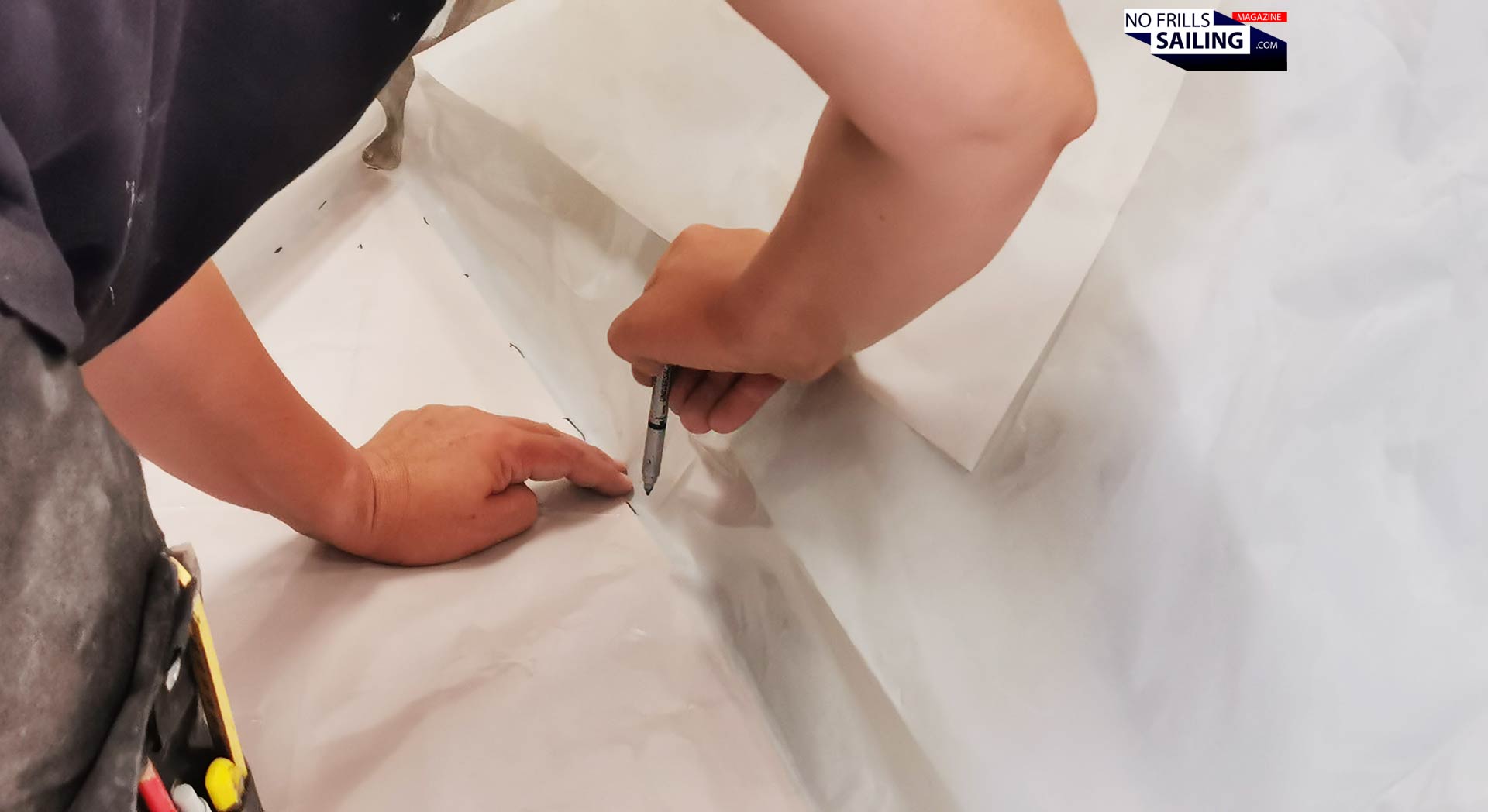
What followed was pretty easy: Fixing the plastic wrap so that it stays right on the surface, the boatbuilder started to mark the outline of the later underside of the mattresses. She put in a little mark every five centimeters or so. One large outline all around the whole V-berth of the cabin. Bit by bit, marking by marking, the form was transferred onto the gauge. It took her a few minutes and she regularly stood up to check if the wrap was still in place.
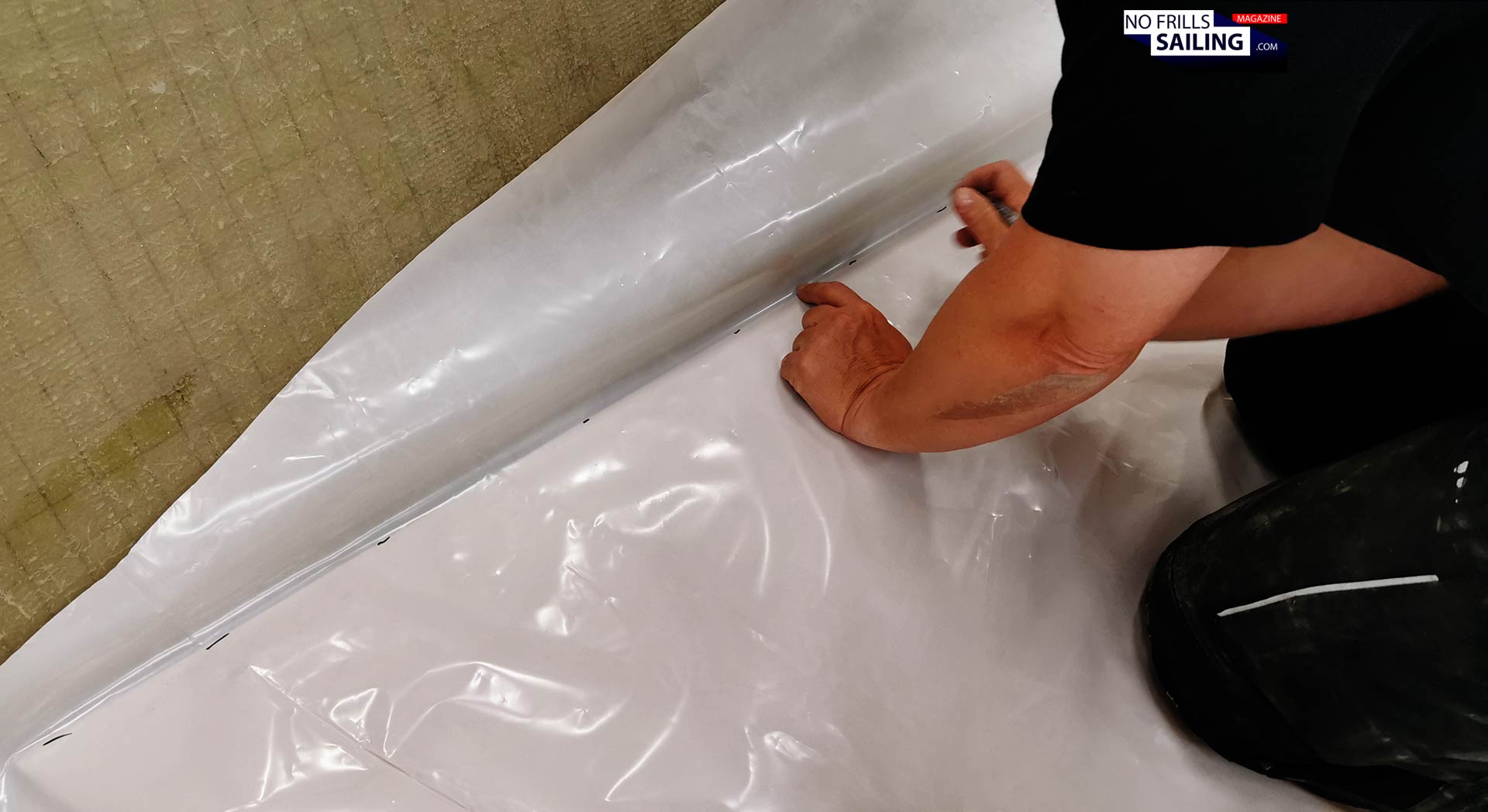
After completing the gauge model of the forepeak´s mattresses, when went into the aft cabin, which in the case of my Omega 42 is just a single pilot berth, and started all over. Applying the plastic foil, making sure it doesn´t move and marking the outlines of the underside of the mattress. Sounds easy? It is. But here´s the thing that makes it so complicated: The outline just marks the underside of the mattress! Do you already imagine the problem? Yep, we´re talking tapered forms here …
Angled edges: Beveling the mattress
In modern yachts, especially in those wide-sterned and a bit “bulky” hull forms, the boats become almost “normal” and upright above the waterline. This means that the mattress used in a cabin has the same measurements on its underside and its upper side. But not in those classic, more V-shaped hull forms like the one of the Omega 42: As the ship´s wall is extremely angled, of course, the underside´s covered area is smaller. So, how can we achieve the beveling of the mattress?
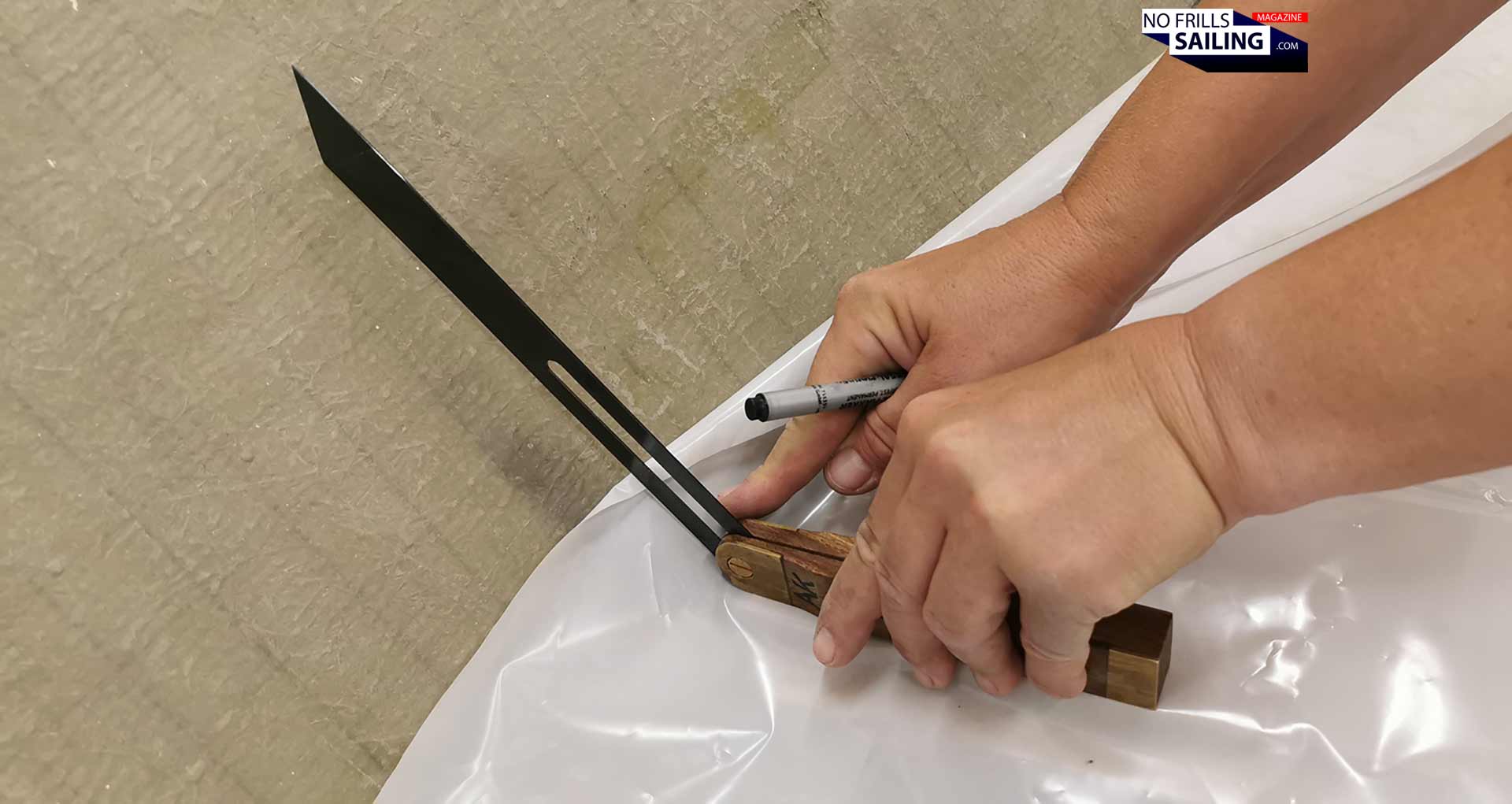
Skilled boatbuilders have a simple tool for that: This bevel is very effective to taking the measurement of an angle between two surfaces. Putting the wooden part onto the horizontal area, she adjusts the pivoting metal part in such a way that it matches the ship´s wall. Now a little wing-nut at the hinge is set so that the angle is preserved. She now has the exact beveling angle the mattress should have at this very location.

All that is left to do is to transfer this angle onto the gauge. This is repeated every 10 to 15 centimeters now. Because the more to the bow we get the more extreme the “V-“shape of the boat becomes. This way Marcus, when transferring these marks into a real three-dimensional object, can be sure that the sloping and tapering of the mattress´ side will exactly match the shape of the bow. We decided to go for a multi-layered “luxury”-setup in H3 for the front mattresses and a more basic setup for the pilot berth, since I am sure that this won´t be used so frequently. We also opted for a “drainage” underside to make sure that the mattresses are constantly vented to prevent mold and mildew.
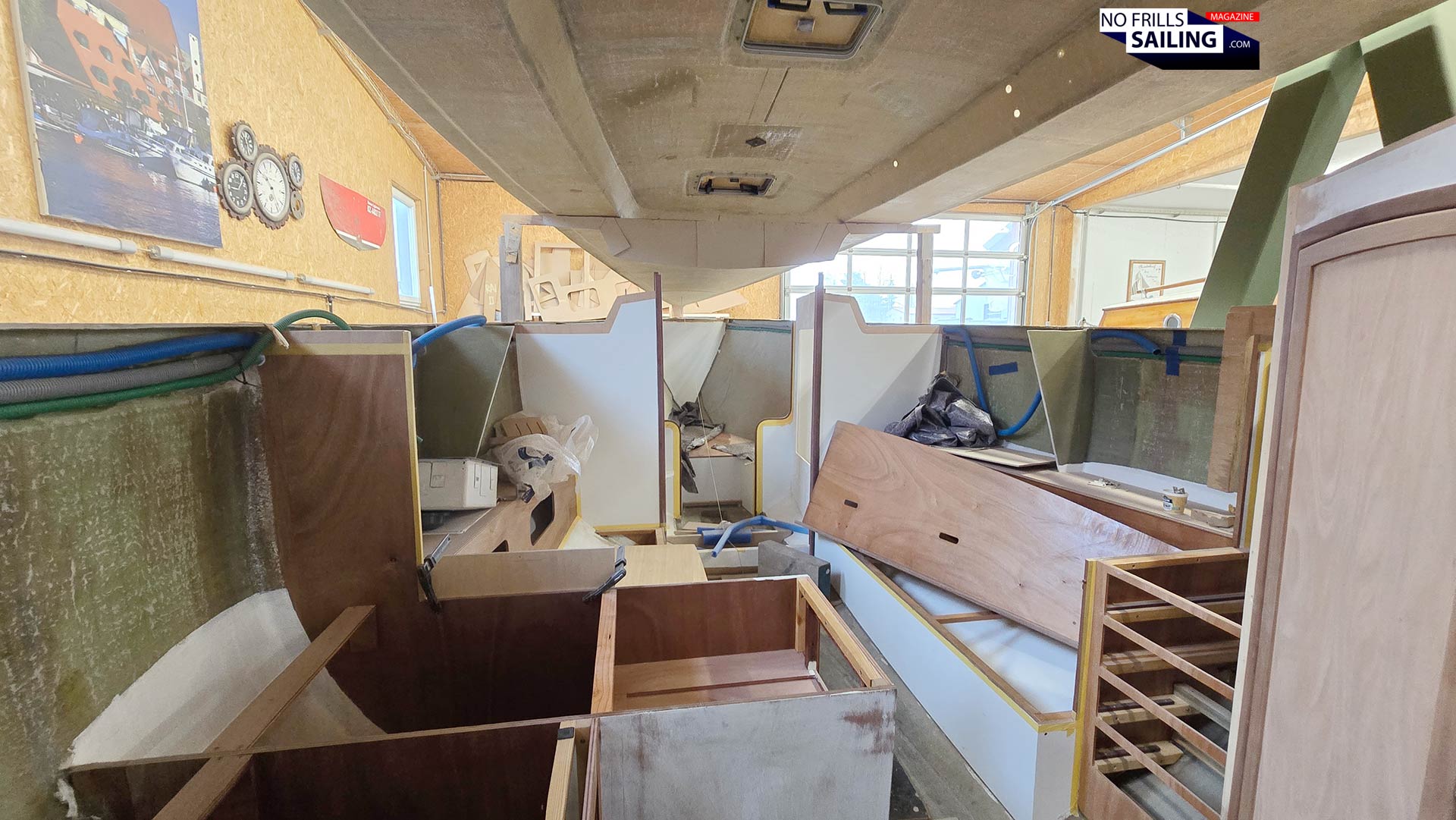
It may look a bit chaotic …
It was a very exciting day at the shipyard with Marcus, Heiner and the boatbuilders. We have made some very important decisions and now production of the boat´s bedding and saloon cushions can start. It´s all a bit chaotic since in those last and final months of the building process there are so many areas in which the guys are working, that the whole boat looks very chaotic. But don´t be fooled: In a few weeks, at least when pointing the furniture and putting it all back together is done, it will all add up to a beautiful whole.
Marcus is now ordering the quantities of raw materials for the cushions. Production of these will take place in March, because that´s the traditional “boat cushion-month” in his manufacture. I am really looking forward to document how the gauges are transferred into real 3D-forms and how it all will become one beautiful end product. 40 to 50 working hours are projected in his offer. Let´s see where we land in the end. That said, I just can´t wait to take a seat for the first time on the new saloon cushions though!
If you are interested, there´s more:
The complete building archive of the new Omega 42
Cushion hustle: How to deal with luxury yacht´s cockpit comforts
Never miss a new article – sign up for the monthly newsletter