Electric energy on a sailboat is a top priority topic. Because, even though modern yachts are indeed propelled effortlessly by the wind, many boats are bug current consumers. Electric winches, comfort appliances, autopilot or cooling requires a lot of power. But how to keep a “healthy” balance between over-speccing your yacht and caring for minimum necessities? Here´s what I did for my new Omega 42 sailboat.
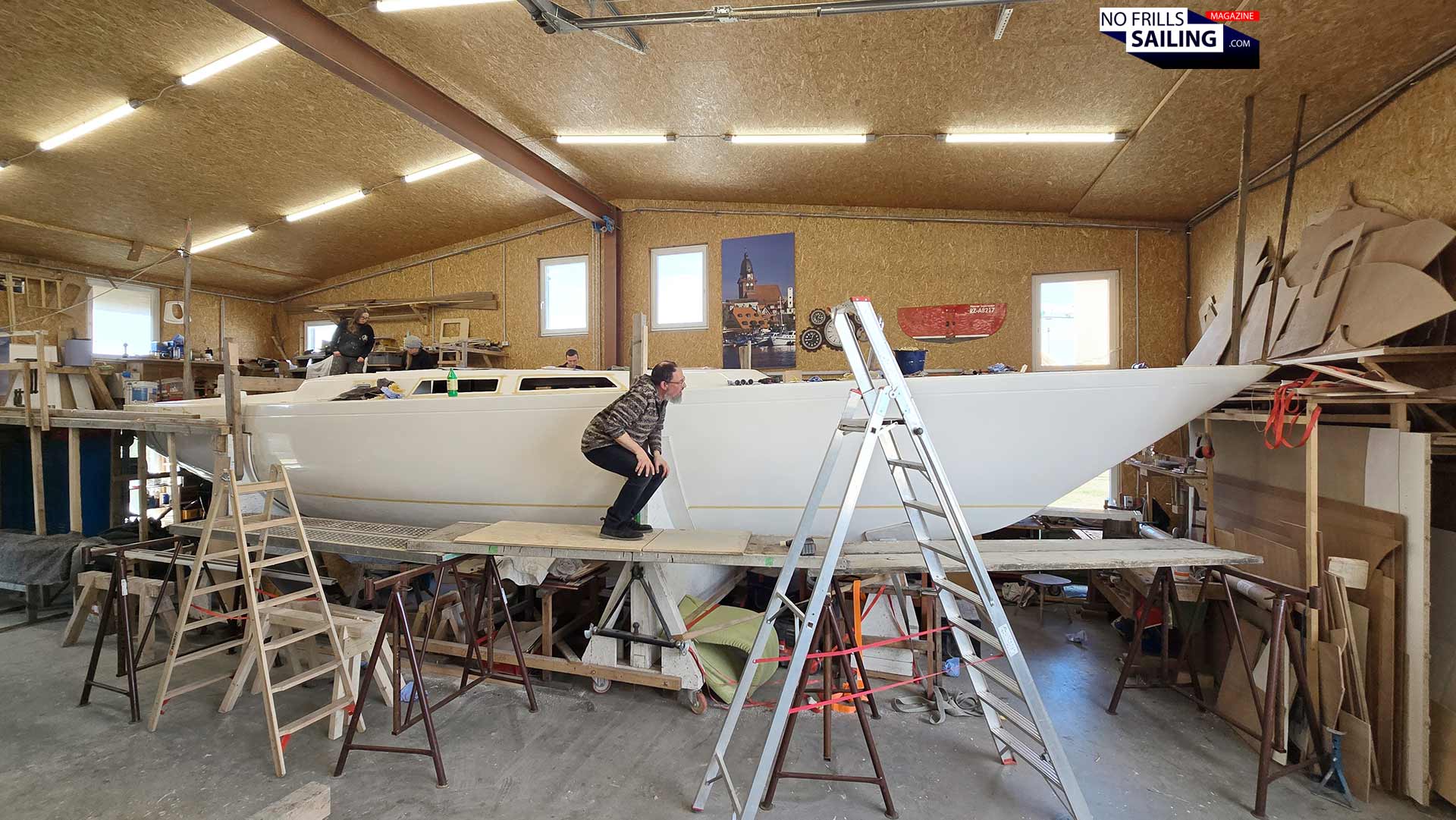
It´s really quite an exciting phase my yacht is entering into here in the shipyard: With the mating of deck and hull finished, her deck in production and also the upholsterer going full throttle to make the cushions and mattrasses, it´s literally a new thing to report about per week. Nice!
Exciting weeks ahead!
But apart from the stuff that´s happening inside and within the boat, there are also interesting stories besides it, just as you are about to read now. We are talking the electric setup for my new sailing yacht today, and of course, this is a very “hot” topic for many reasons: First, every boat is a new individual case. That said, what I am presenting you here is a solution viable for me, not necessarily for you. As every use-case of every ship is different, so are the needs, necessities and wishes of each owner. Secondly, there are a myriad of approaches to design your individual energy-setup. So again, my approach works for me, it might work for you as well, and it might not. So, what´s the premise for me?
“Keeping it simple” should be paramount
Advertisement
I am a simple person, when it comes to sailing. If you are a loyal reader of NO FRILLS SAILING, you may know from my previous boat that I really don´t need much to feel happy aboard. I learned a lot from embracing the “micro cruising”-style of sailing, especially to appreciate the advantages of having less. The next big motto of the Omega 42 is KISS – keep it simple and stupid. I just don´t want to over-exaggerate the utilization of electronics (which is why my Garmin-setup is minimalistic). I also want the use of digital network-stuff limited to a minimum, be it NMEA-2000 or digital, app-based equipment.
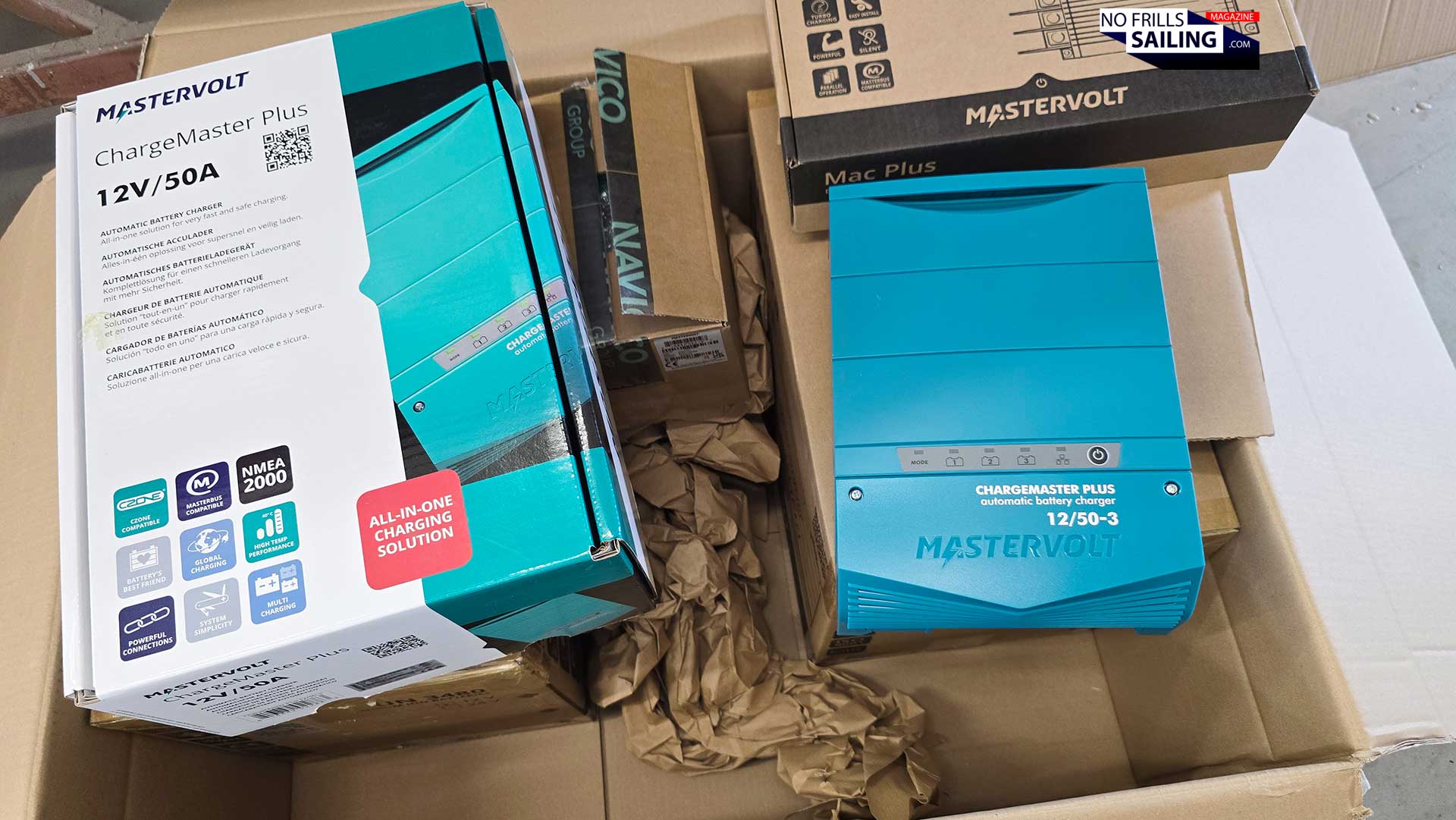
Mastervolt´s shore power charger
“Keep it simple and stupid” diffuses into every part of the yacht: Be it the simplest possible solution for my bathroom or for the galley, the lighting (later more on that) and even general, structural things like the overall internal layout of the boat, meaning, the skipping of cabin-doors for example. This boat should be comfortable, but as easy as it can get. Because: Anything that is aboard, can and will eventually break, develop errors or fail. And lastly, of course, it´s a matter of budget: Building a yacht, especially this sort of semi-custom boat, is a very expensive adventure, so I´d love to keep cost down.
Don´t go for cheap stuff: Why I chose Mastervolt!
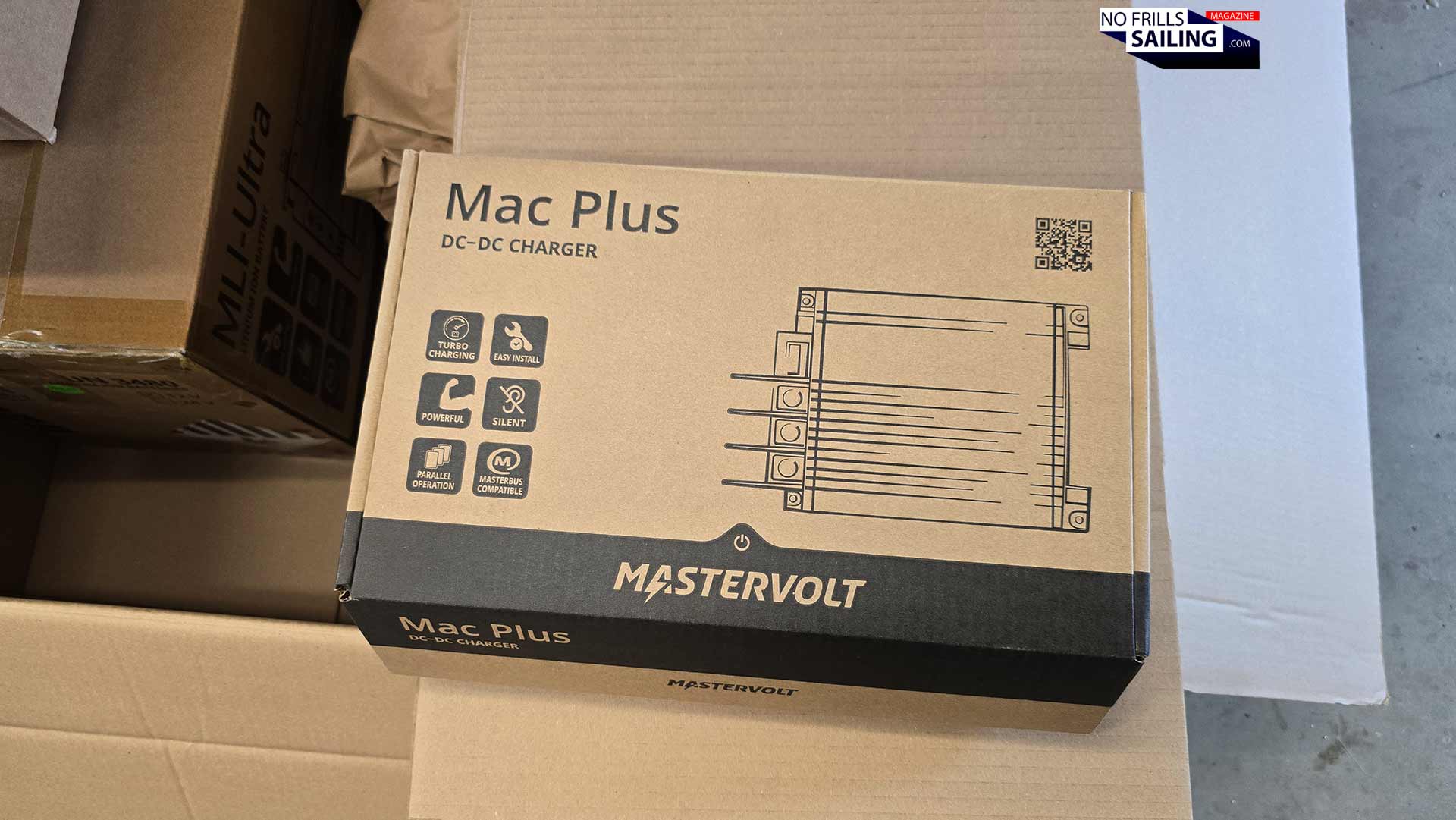
Having said that, saving money should never come at the expense of safety, that´s a must, and it should never sacrifice for quality. I´ve made some very bad and stupid decisions myself in the past, just as many of you did as well, I´m sure, which had cost me a lot of money or time. So, in case of the electric setup of my new yacht, I opted for the high quality manufacturer brand of Mastervolt. Last week, when I visited the boat for the sake of getting a thorough measurement of the standing rigging before the mast enters production at Seldén, I discovered a large parcel containing most of the boat´s hardware.
Unboxing the hardware components
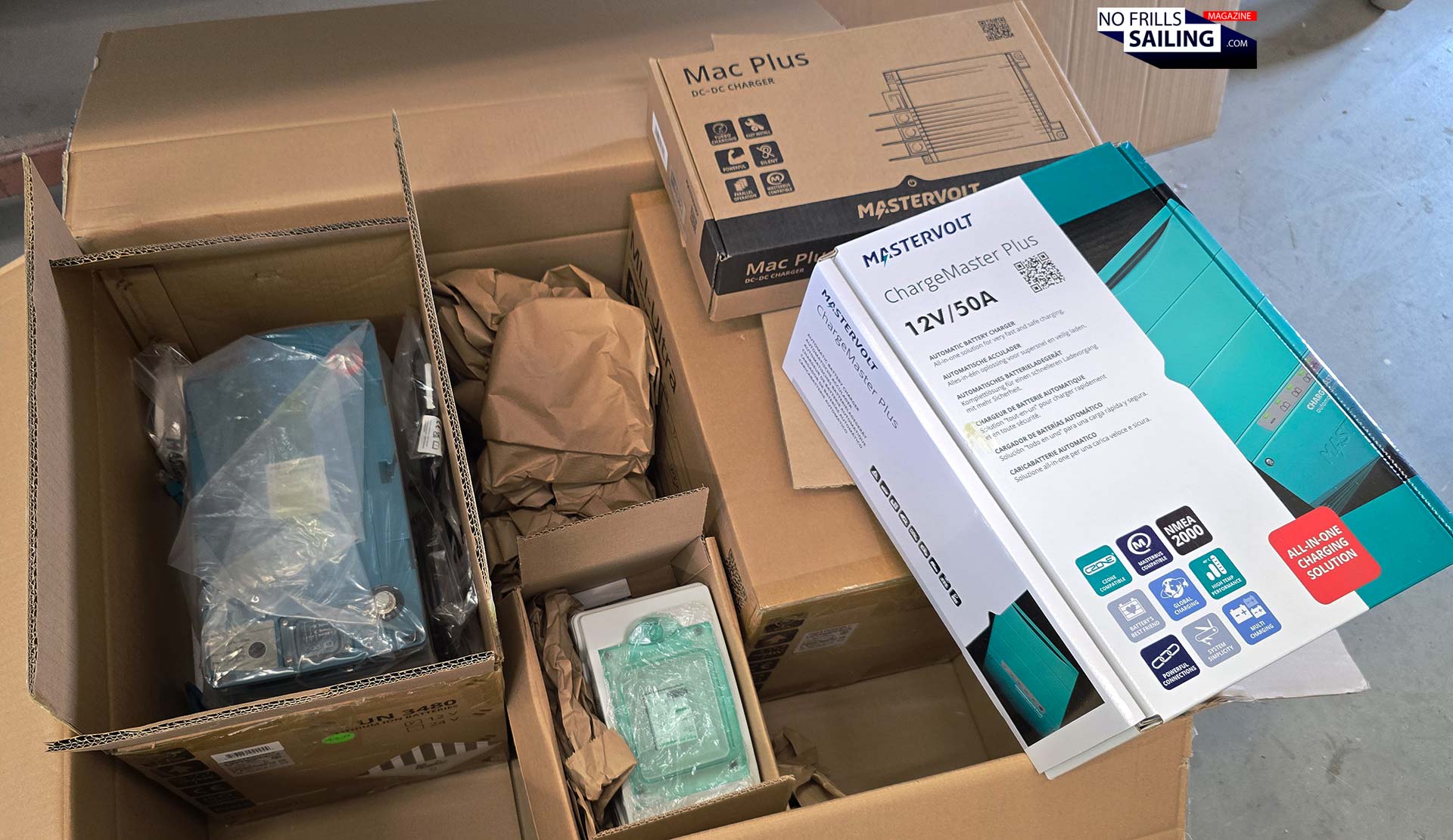
I took that for a trigger to make this article. This parcel, sent by the German importer Gotthardt, contained all hardware parts for the electric system of my boat. Those will be combined by the small parts I already received from German premium-brand Philippi by the shipyard´s electricians. Mastervolt has a flawless track record as one of the leading brands in this area. It belongs to the Navico Group (we know them from brands like B&G or C-Map), which itself is owned by the Brunswick Group, the world´s leading leisure-marine producer. As big (and heavy) as this package was, in the end, it is fairly small for a 42-footer! I´ve seen much, much more cardboard boxes delivered to a yacht, than these … only five in here.
Modern lithium batteries on sailboats – a no brainer?
Let´s start with the yacht´s batteries. You would say that lithum-ion-batteries are a no-brainer, right? Are there any skippers at all fitting gel or even lead-acid batteries to their boats at all? Well, as it turns out, yes! Me, for example: As we are strictly watching the overall weight of my yacht, that should not be heavier than 7 tons dry (with rigging!), any surplus kilogram will hamper sailing performance, weight-balance and -distribution throughout the yacht. This means, we are looking for lightweight, small-sized batteries primarily.
Modern LiFePo batteries – a no brainer?
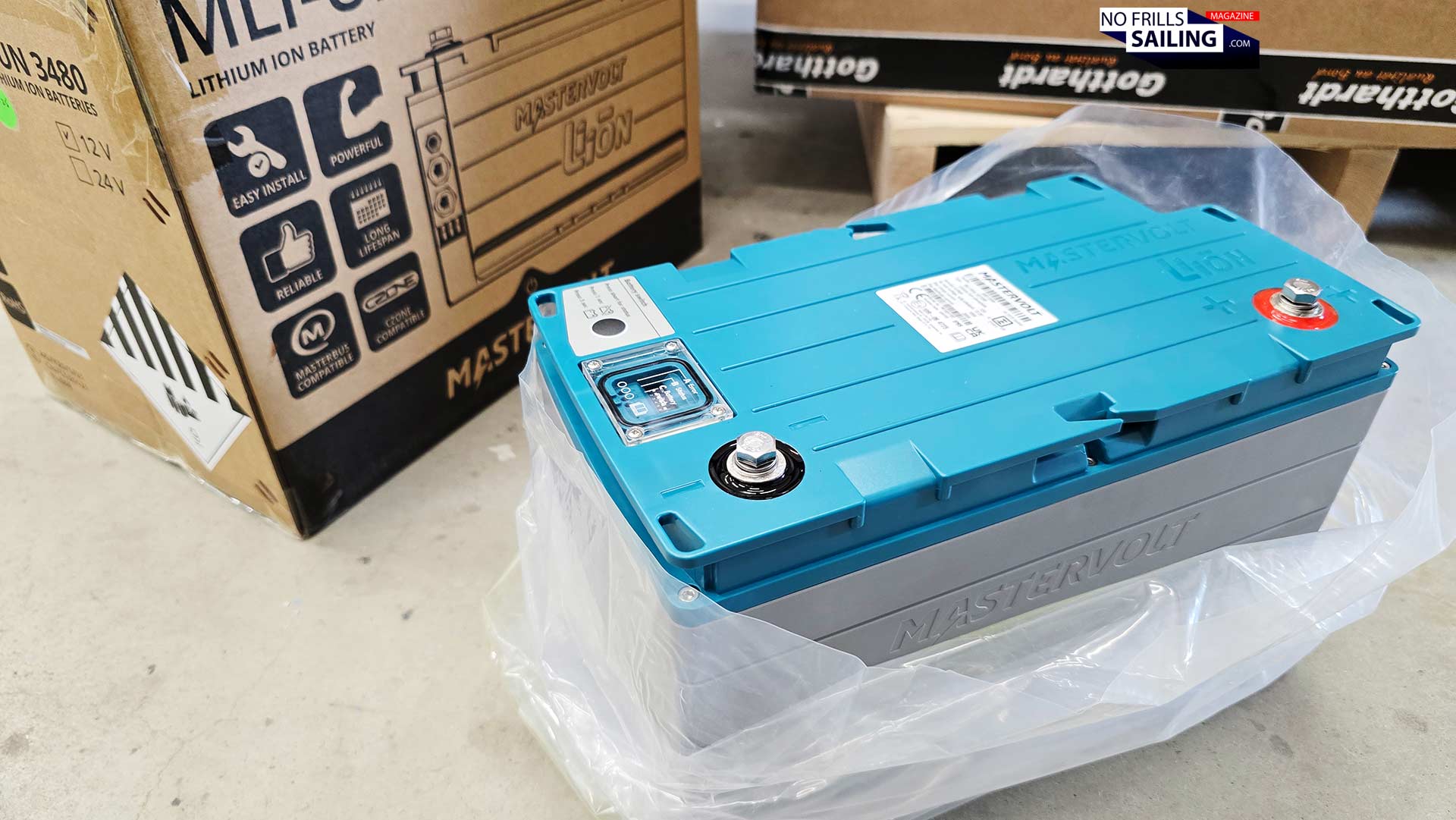
Of course I am seeking the most powerful solution here. But most of the constraints come from the limited space in the battery comportment of my boat, which is located right behind the read bathroom bulkhead in the starboard-aft locker-cabin. In this, we went for the latest Mastervolt, modern LiFePo4-batteries. There will be two MLI Ultra 12/1250 Lithium-Ion batteries put into the boat, forming the power bank for all domestic appliances and navigation, including the autopilot. Both come with roughly 100 amp-hours, later more on that.
Essential for my boat´s configuration: DC-DC-charger
But as their surge currents are way below what´s needed to start the Diesel engine, this setup will be completed with an ordinary AGM battery as starter-battery. But here´s the thing: Charging lithium-batteries is different from charging gel, lithium needs a specific head curve. To make sure that the Diesel´s alternator charges both batteries the right way, I went for the Mastervolt MacPlus DC-DC converter/charger as well. Which, in theory, is the main battery setup and electric power concept for my boat.
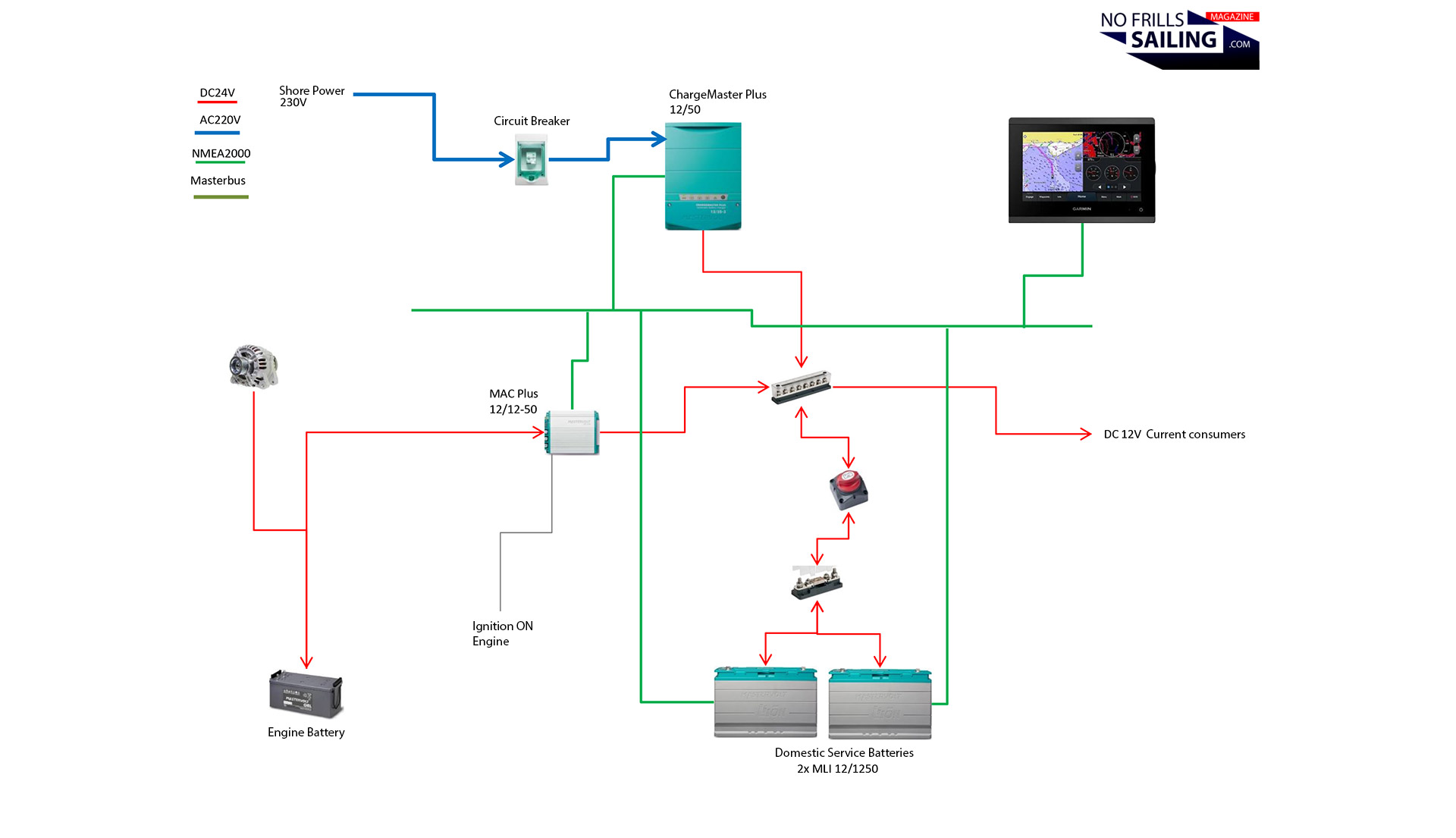
Wiring diagram for my boat´s battery management system
To explain the beauty of it´s simplicity, you may check the circuit diagram below which has been created by the Gotthardt-specialists during our conversations. It all starts on the left hand side, where either 240 Volts shore power enters the boat via the Mastervolt ChargeMaster Plus (the big greenish thing) or the 14.2 Volts current created by the Volvo Penta´s alternator. As for the shore power, it goes directly into the batteries and/or the current consumers aboard the yacht.
KISS: Simple & beautiful
The more interesting part is the current made by the Diesel engine when underway. This goes first directly into the AGM starter battery, from which a part is lead into the MacPlus DC-DC charger. Here, the head curve of the current is transformed into a “lithium-approved” or safe modulation. Thanks to the digital options, the charger can be programmed to, for example, first “wait” until AGM is charged before firing into the lithiums, or to adjust current and amperage to fit the lithium batteries, preventing the alternator from possible damage. It´s a nice and beautifully easy system, I am thankful for Gotthardt´s counseling in this matter.
The need for more power on board…
But can this be all? Of course not! 200 amp hours is a lot of electric energy potential though, even more if you consider that my boat does not have traditional 12 V lighting (again, I will show you my lighting concept later when we fit it to the boat), I don´t have a hot water boiler nor a fixed fridge or freezer. So, basically, the “hungriest” current eaters will be the autopilot. But even if I run just the autopilot, all 200 amp hours of the batteries will only last for 30 hours, if there´s a lot of steering, presumably up to 70, 80 hours, if there´s just light wind. For my calculations, I take 48 hours as a median.
Delivery of the surge battery
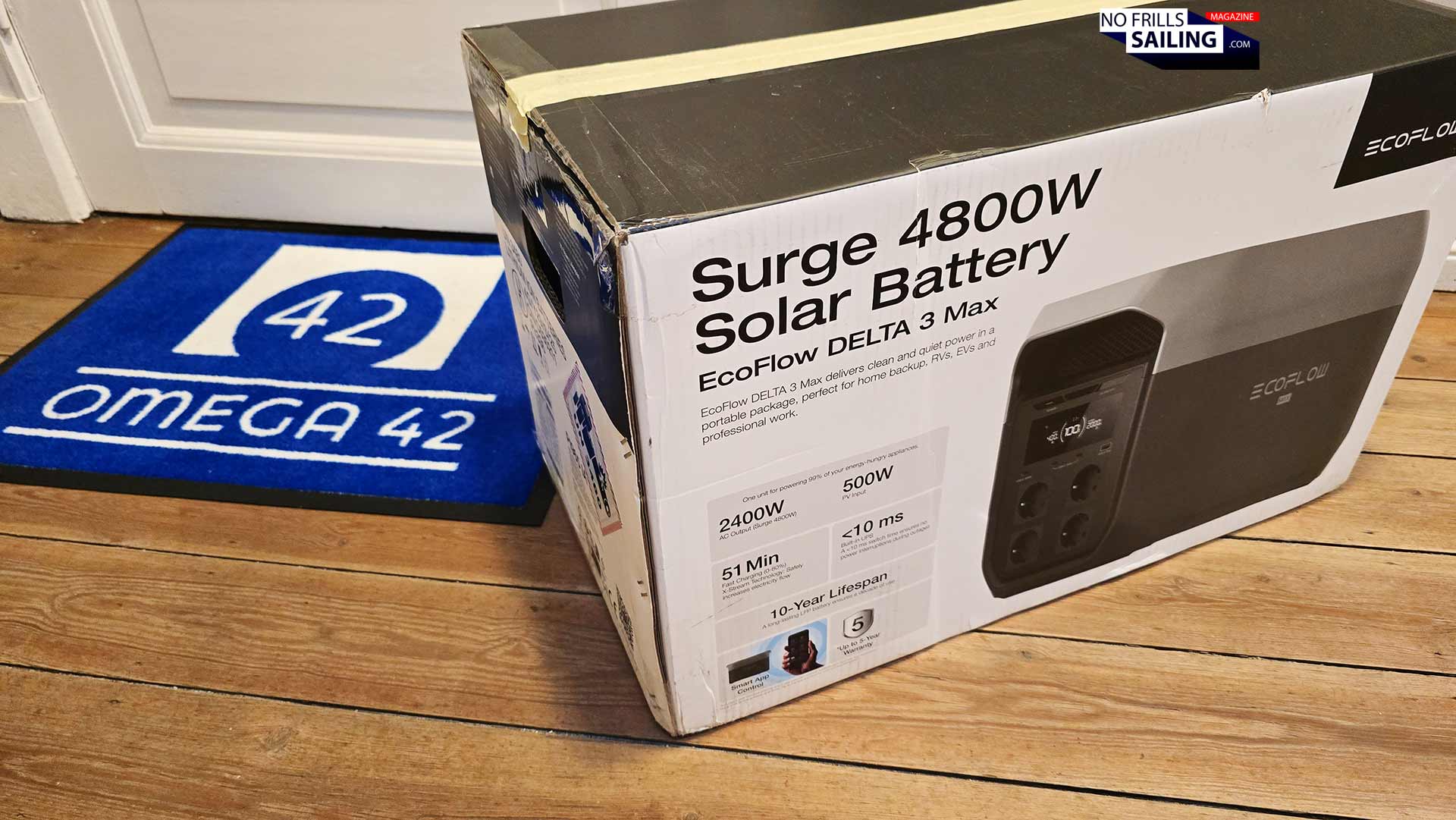
But what if I need to sail longer than two days? How will this figure change, if I add the current appetite of the navigation equipment, if I want to recharge my phone or enjoy an ice cold Coke out of a portable fridge? Probably less. And here´s what I came up with: The EcoFlow Delta 3 Max surge battery! It is a simple, easy add-on for my setup that has so many advantages. Two days after order was placed, it got delivered to my home flat, where I was eager to unpack and check-test it. But first: What is a surge battery at all?
Surge power supply by the EcoFlow Delta 3 Max
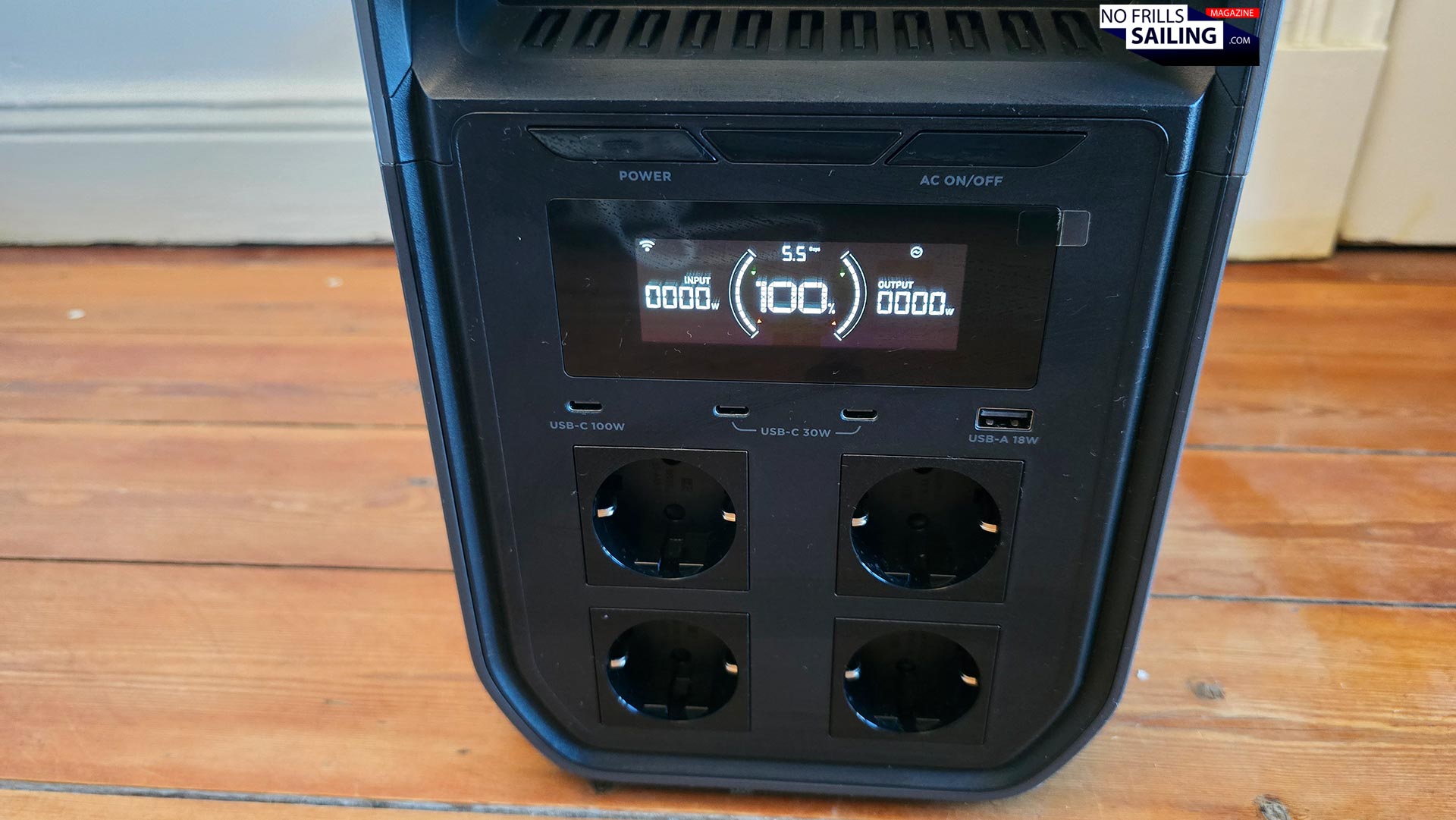
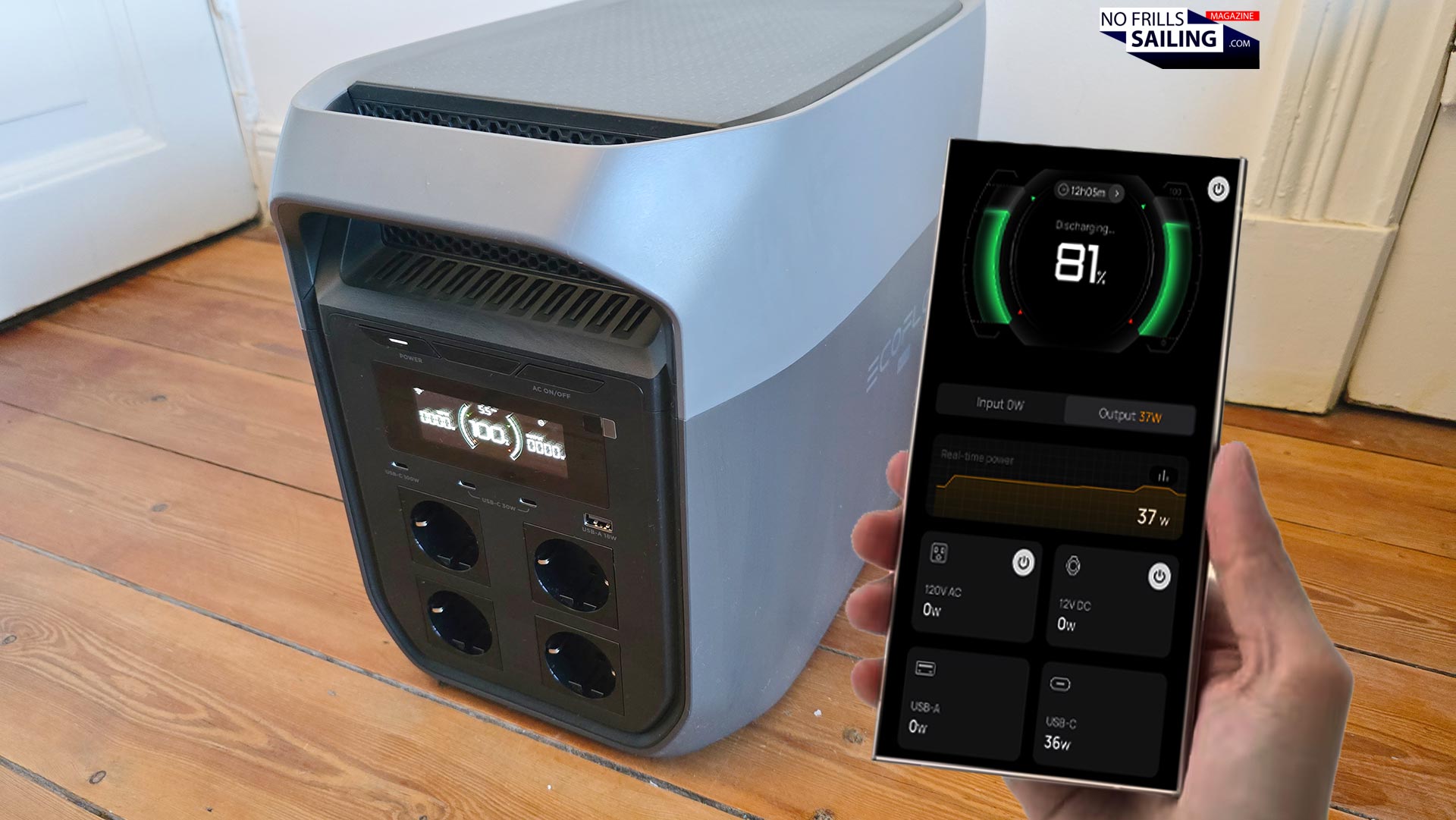
Again, it´s a learning from the caravaning industry, which had already brought me to discover the awesome solid-separation toilet. It´s basically a lithium battery and a lot of practical equipment to charge it and to draw electric power from it. As you can see in the picture below, there are no less than four 230 Volts (or in America, 110 Volts) plugs for appliances in it. As the max power would be around 2.400 Watts, that´s quite some juice in here! For a thorough vacuum cleaner, for example. There are also plugs for USB-devices. But again, the most important feature for me is the AC-current generation.
As easy as ABC, really!
Because this way, I don´t have to include an inverter into the boat´s “fixed” arrangement. The cost-effectiveness is staggering: A good inverter, let´s say the Victron MultiPlus with at least 2 kWatts will clock in at some 1.500 Euros, presumably more. Mastervolt´s MassSine for example has a price tag of just under 2.000 Euros. And that´s just the hardware. You´ll need special wiring, massive fuses and surplus working hours of the electricians. For me, the integrated inverter in the EcoFlow does the job just fine. It´s price? I got it for 970 Euros …
Everything in one App
Sorry for the shitty montage in the picture above, but I wanted to show how easy and convenient this thing really is: Downloading the EcoFlow-App and connecting it (via Bluetooth) to the battery, you have everything handy under control: Status of the battery, alarms, input and output. I played around with it at home and it´s really super easy. Charging it up from 30 percent (as delivered) to 100 percent took less than 40 minutes. Best part: If for whatever reason I should need to have electric power ashore during a sailing trip, I just take it out. It´s weighing some 20 kilograms and comes with solid carrying handles – set up at a BBQ site or where ever, and voila, there shall be light!
Why this is a good solution (for me)
Recharging of the EcoFlow is equally easy: I can plug it into the 230 Volts circuit once in harbor and it will keep its volume for many weeks. In the end, this is also intended to work as back-up for homes cut off from the grid during storms or other severe weather situations. And there´s even more – later. For now, why should I go for a surge battery in the first place? Well, we all know and I cannot stop to emphasize this, of how much of a great importance our smartphones have nowadays. Even in sailing.
USB-device charging, check!
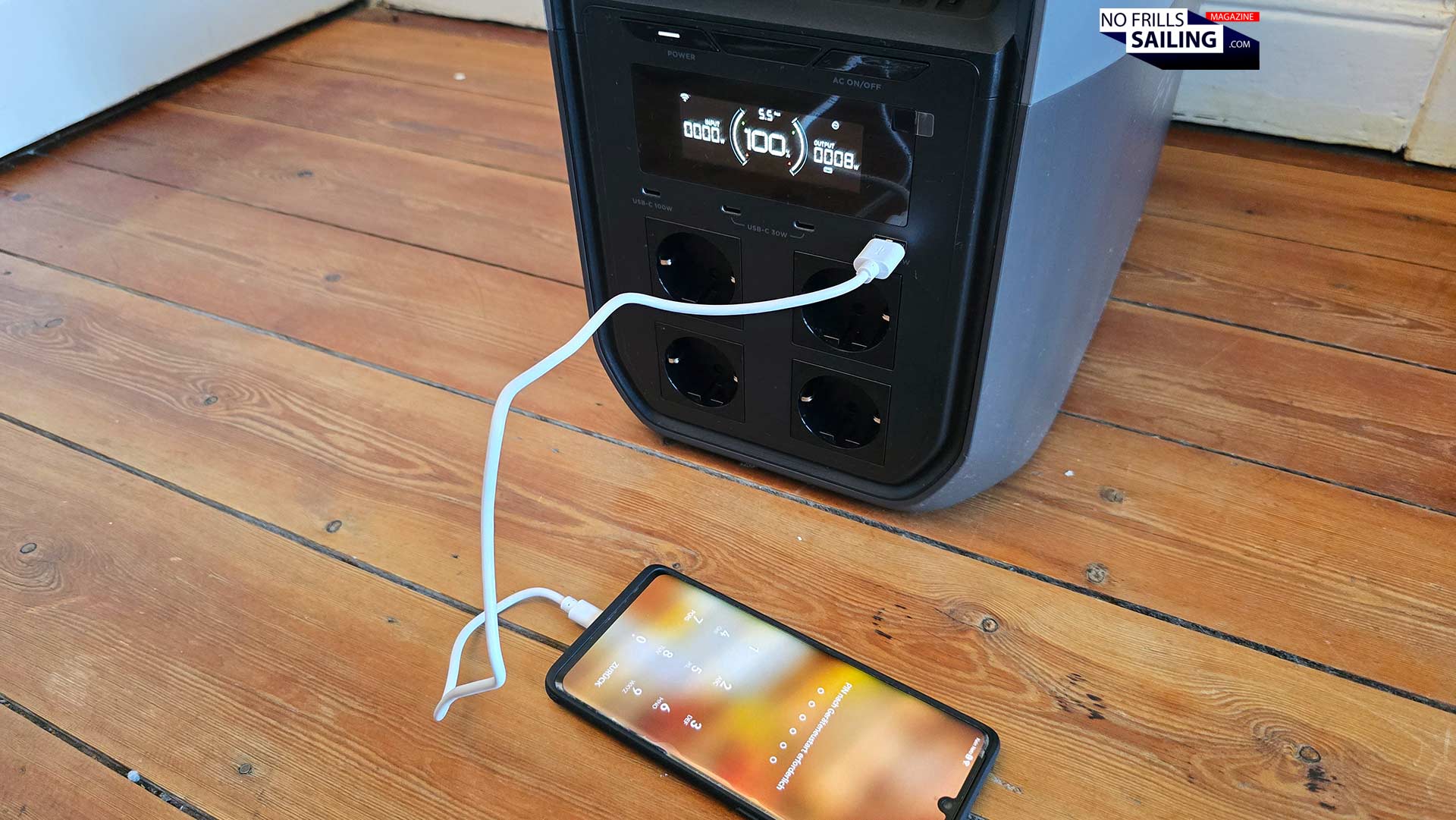
We take pictures, we send messages, we facetime. We check weather, we book a berth in advance or we search for the best restaurant in the marina vicinity. To keep my onboard smartphones charged at all times is a priority. Of course, my main switchboard has some USB-plugs, but as I said, the Mastervolt´s juice is for navigation and autopilot primarily. But smartphones don´t eat up so much, don´t they? Why all the fuzz. Well – because of the laptop!
230 Volts charging, check too!
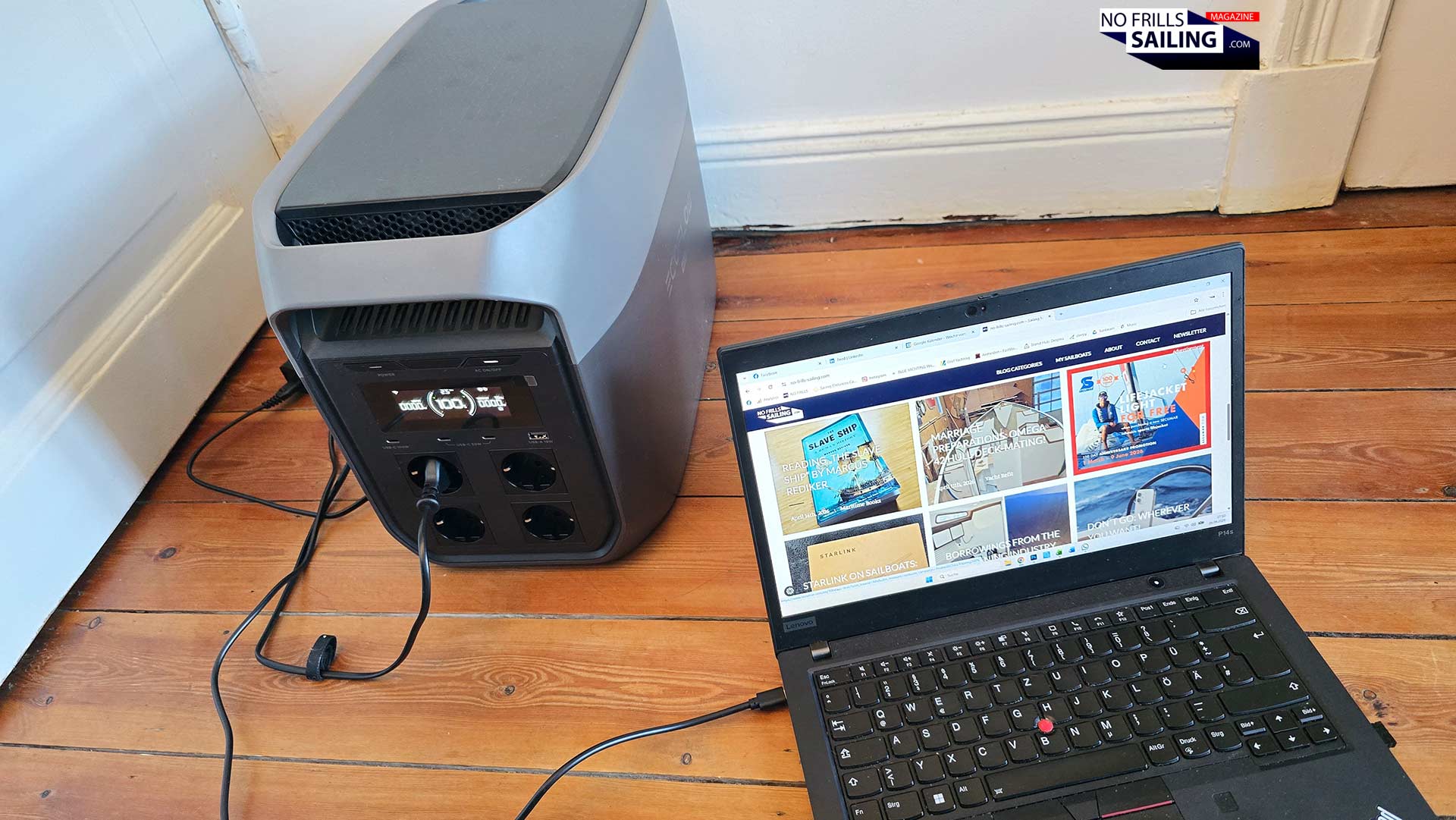
As a “digital nomad” will confirm any time, if you earn your money whilst underway, recharging your laptop is paramount! But laptops cannot recharge via simple 12 Volts and (most) USB-connection. This is why I absolutely need an inverter, to plug in and recharge my computer! That´s 60 to 70 watts in recharge-mode, 15 to 30 Watts in trickle charge. The EcoFlow for that can recharge my ThinkPad fully for 30 times, before it would be empty. That amounts to some 160 hours I could be able to work with it – almost a full month! It will, in reality, be much less since Starlink is also a bit hungry, amounting to up to 20 hours of internet connectivity, if used solely.
Where to install all that hardware?
Back in the shipyard, the guys agree with my plans: Many of the boatbuilders are sailors themselves, already sporting such a setup of fixed domestic batteries flanked by a surge battery. The simplicity, the complete range of many different application-scenarios, the easiness of use, its price and the mobility of the setup are advantages, no fixed installation can compete with. But where to put it?
Running around with a mock-up
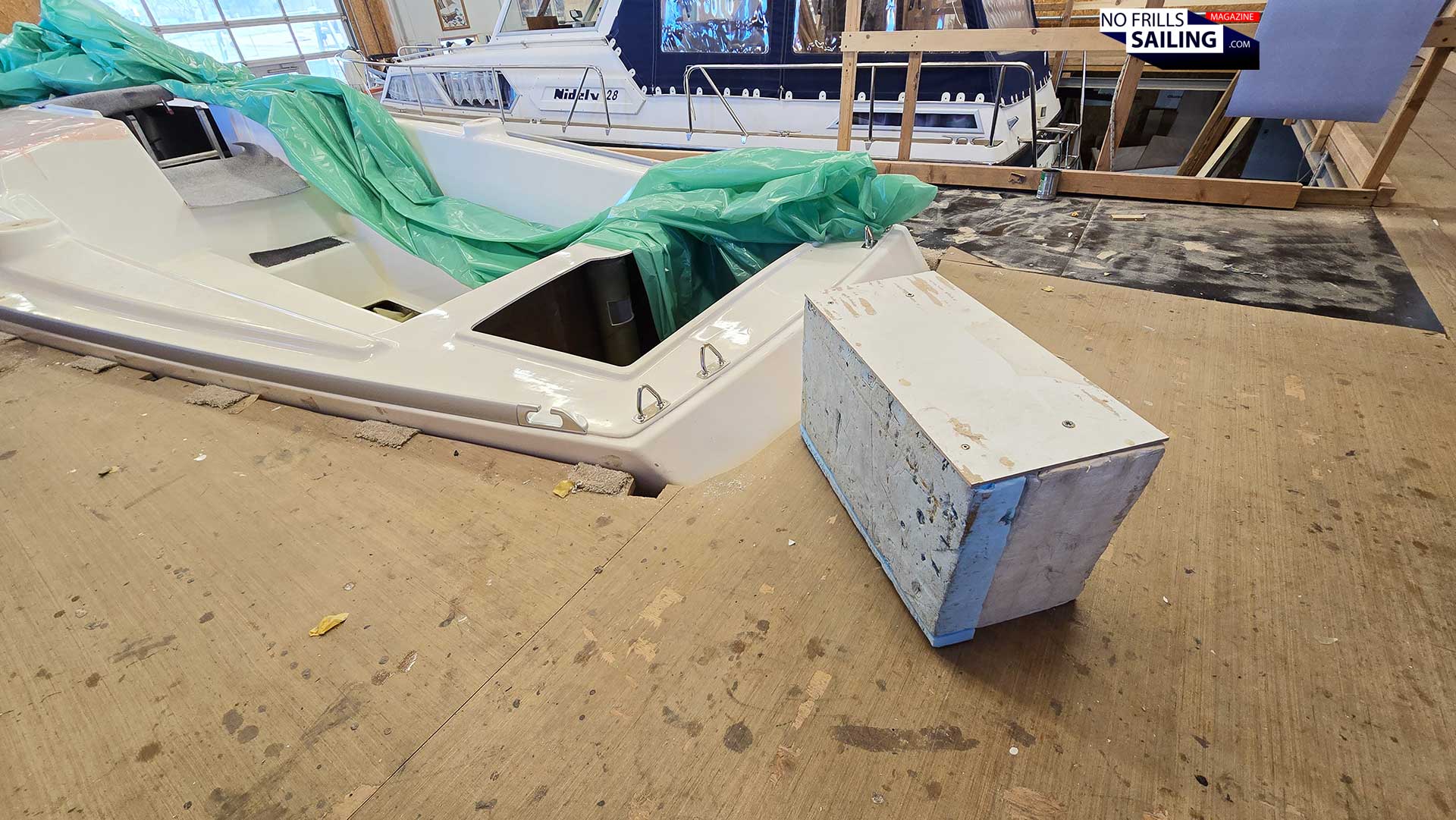
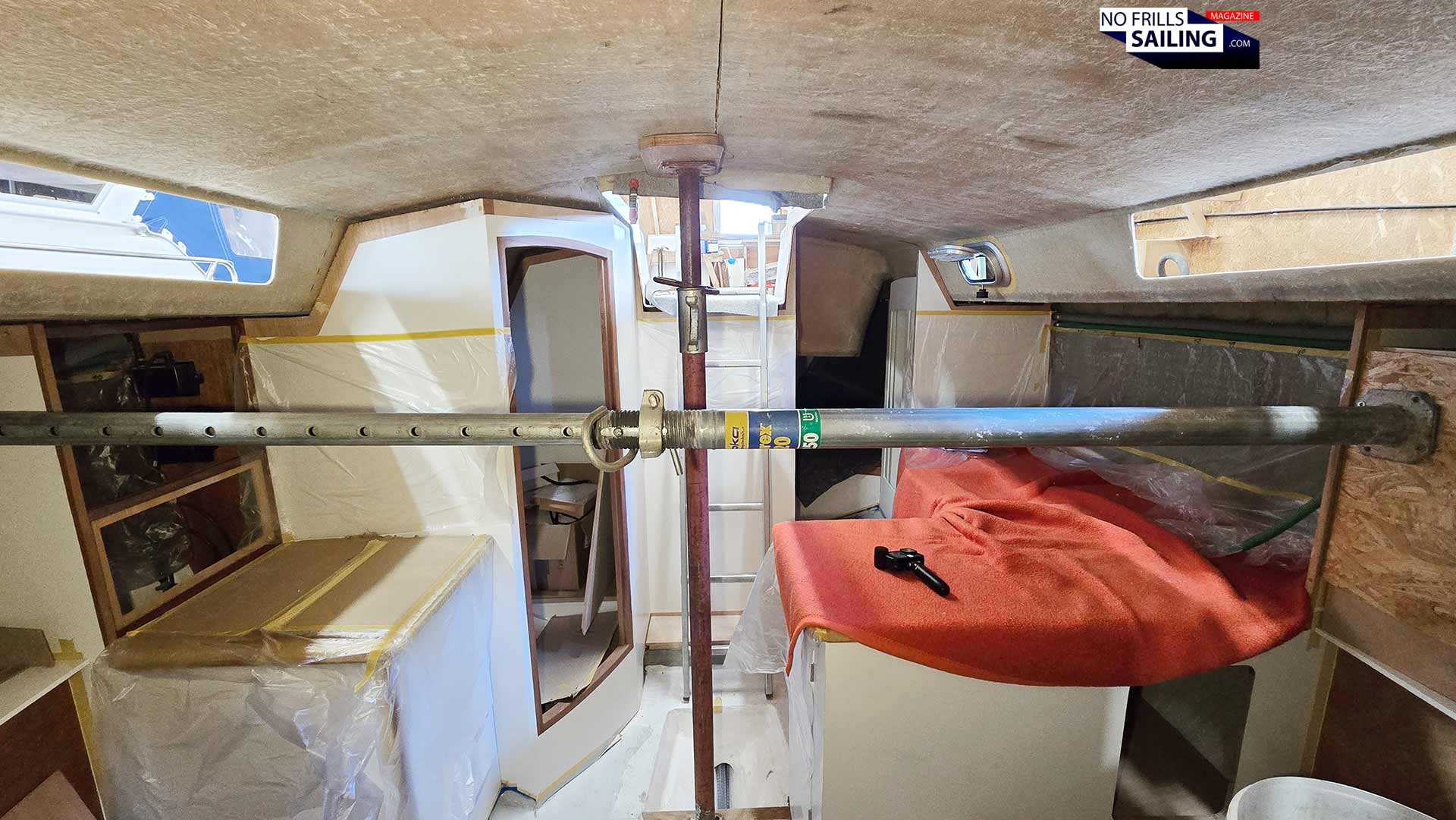
The boatbuilders in the shipyard produce a quick and dirty foam-model, bearing the exact dimensions of the EcoFlow: I am invited to crawl into the belly of the boat to see where it might fit the best. As you can see in the picture below, the boat´s interior is still a bit barred by the installations of last week´s marriage. The framework, c-clamps and tie-downs have to remain in place until the Sika-adhesive has vulcanized completely. So I have to dance around like a gymnast, looking for a nice place. Most of the things I want from the EcoFlow take place in the salon, so putting it here is logical.
Where to put it down here?
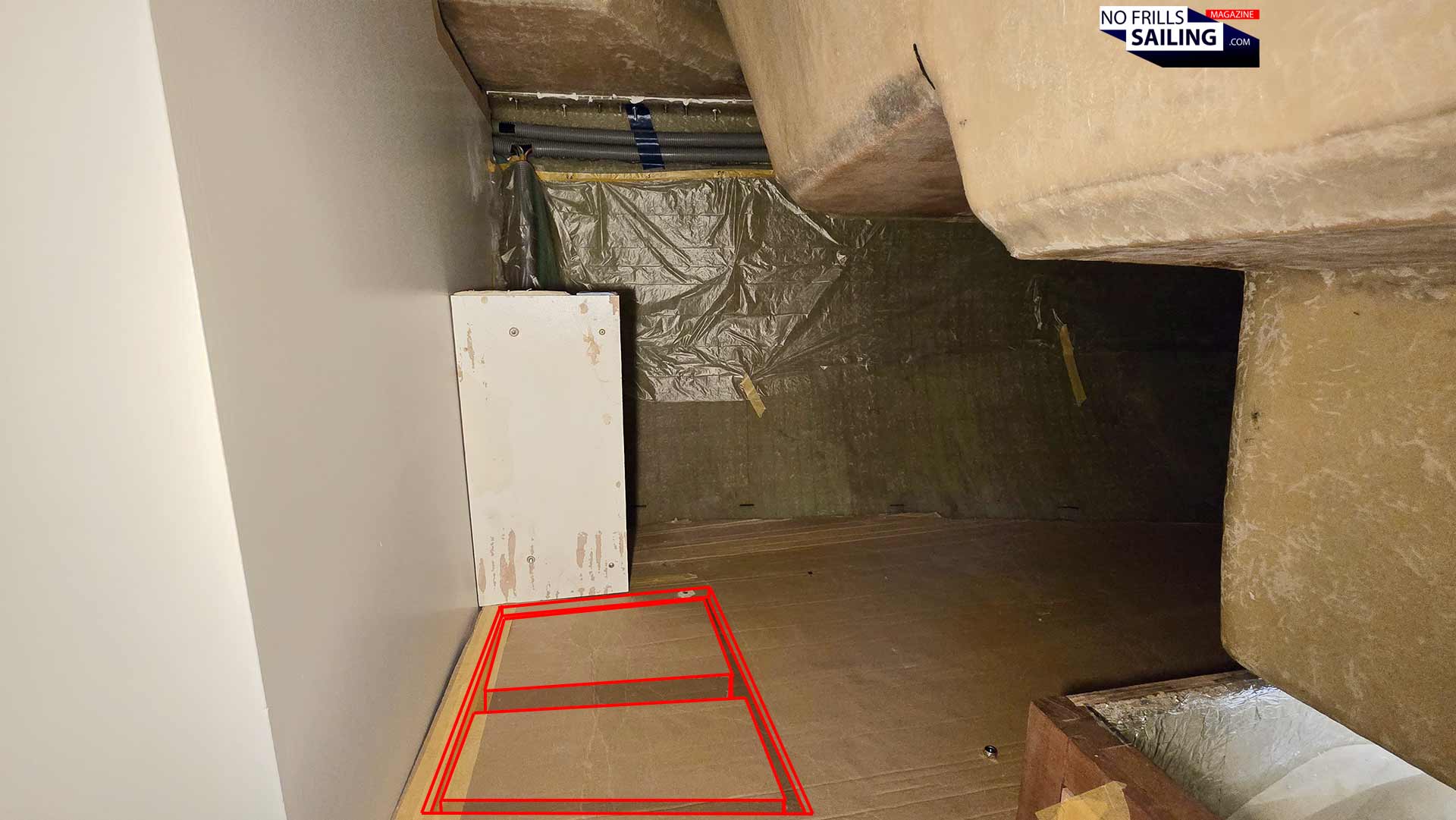
Yet. There is no space. It would eat up precious stowage underneath the seating benches (where 2 x 40 liters of fresh water is located as well), for putting it into the galley I´d need to cut large openings into the nice furniture, which is a no-go for me. So all that´s left is the huge, still empty, starboard side stowage (cabin sized!) in the back. It would be handy to strap it to the bathroom´s bulkhead, as seen above. This way, it´s just a short way to the domestic batteries below and a possible future connection of the EcoFlow to the primary circuit.
Near the domestic batteries?
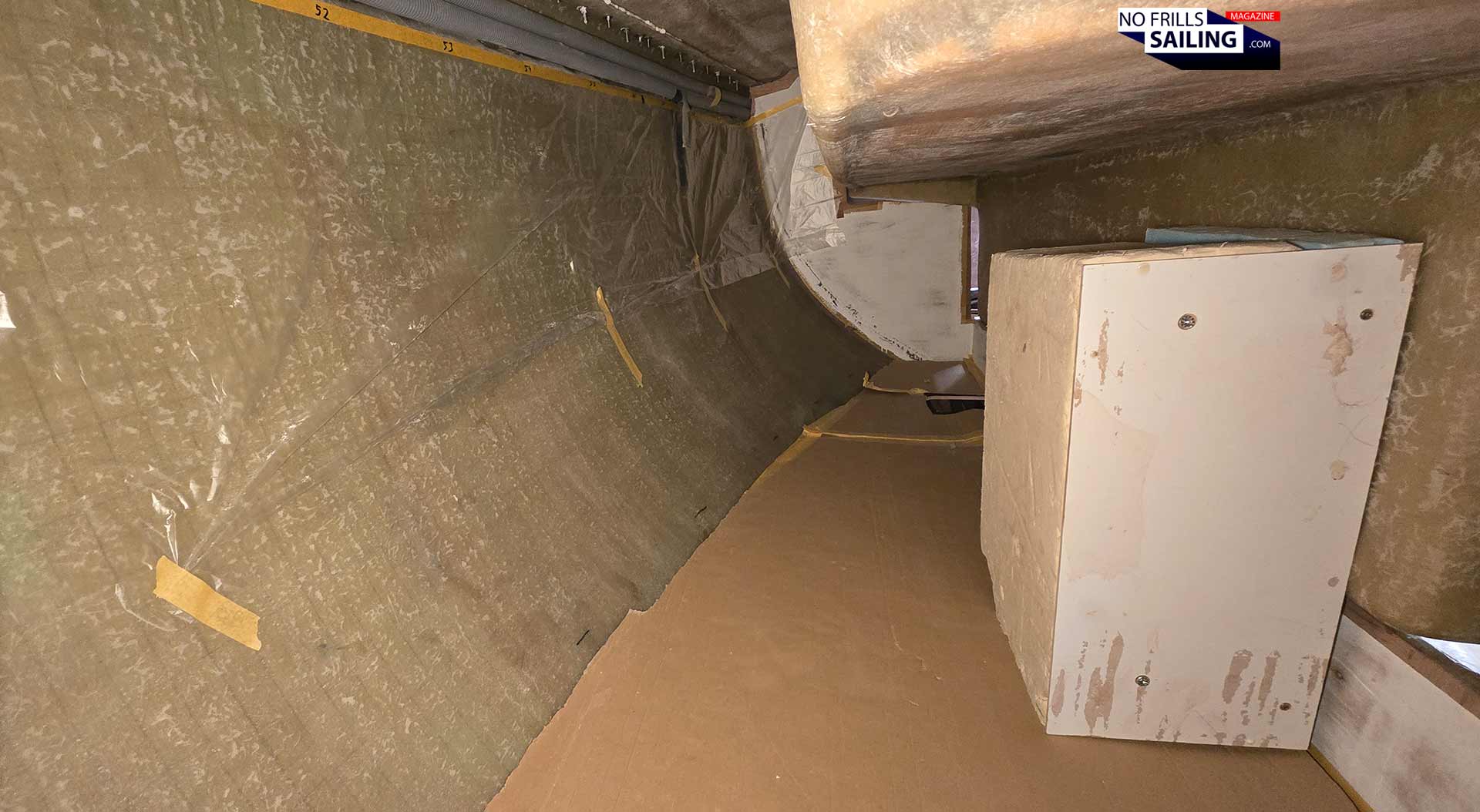
On the other handy, I guess, I will need to access a fridge much more often. And this position is a prime location for which both appliances compete. So I try another location “around the corner”, adjoining the cockpit and engine-compartment. This would also have the advantage of having the surplus 20 kilograms of this battery nearer to the centerline – weight distribution, center of mass and balance of the yacht is an important thing to consider as well.
… or more in the back?
As for now … we honestly don´t know. We will find a solution, sure: I just wanted to show to your how one decision has consequences and triggers the need for many more to follow.
Alternative recharging methods: Solar for sailing yachts
“But what about solar?”, you might ask. It´s by far the most convenient method for recharging your sailboat batteries without any need for anything. As a precondition, you need a high-quality installation and charging architecture, of course! I´ve made my own experiences with sailing a “solar” boat myself, extensively upgrading my First 27 SE with Solbian panels and I know very, very many skippers how have nothing but praise for their sun-powered “free of charge” electric energy. And of course, that´s a very interesting solution for the Omega 42 as well! But, to be honest, I am not so sure about my approach this time …
Easy, simple – plug & charge solution
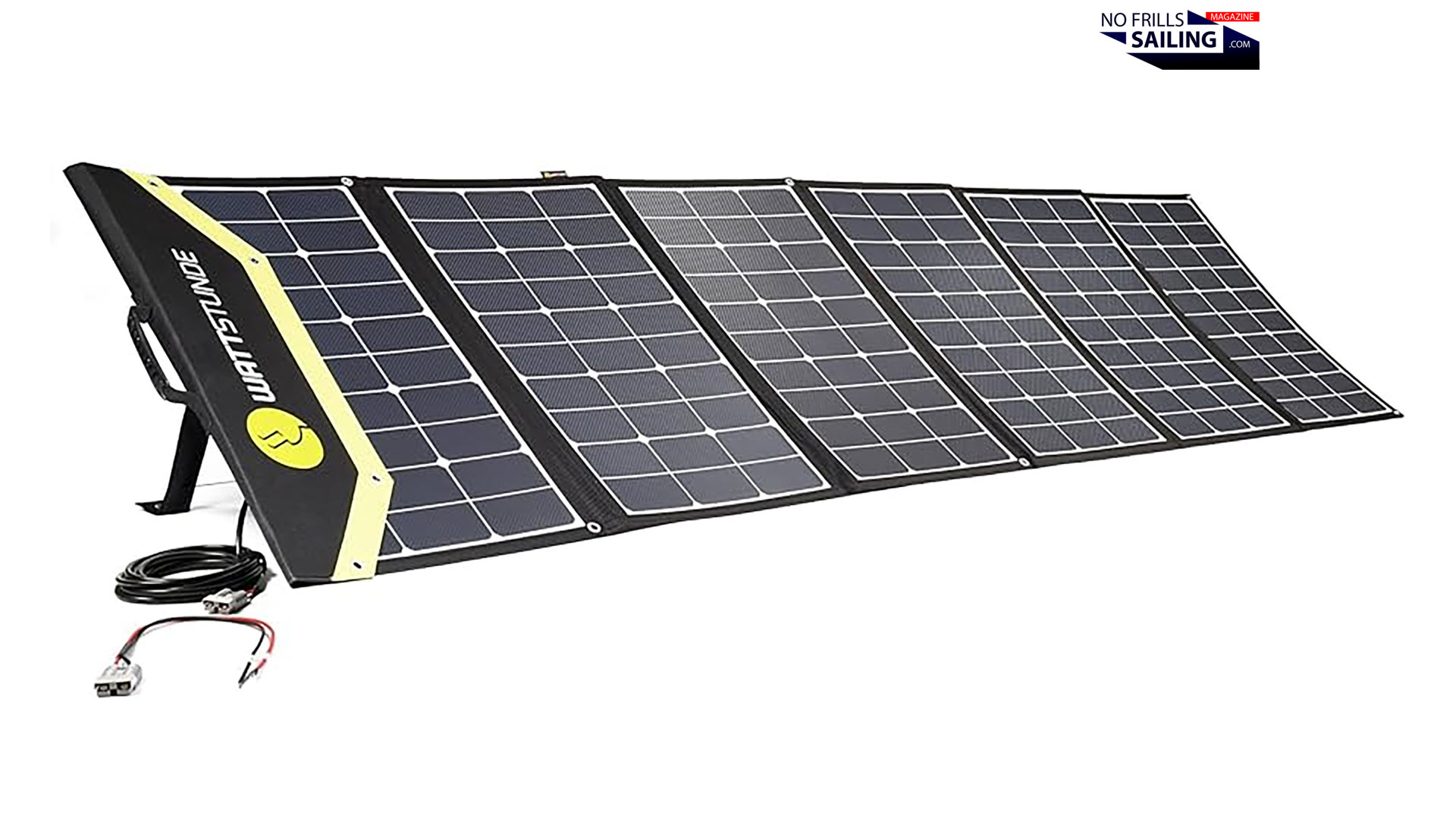
Let me explain. Adhering to my “keep it simple”-motto, I really embrace the idea of just buying one of the practical folding solar-panels. You can put them (for example when at anchor) where you want, plug it into the EcoFlow and that´s it. Simple, easy. The lugs in these folders allow a fitting to the railing or to the boom, lazy bag … whatever. The cable is long enough to reach down into the locker. Plug and play. Bam! But on the other hand I still have this much free surface area on the yacht´s coachroof:
There´s plenty of solar-potential …
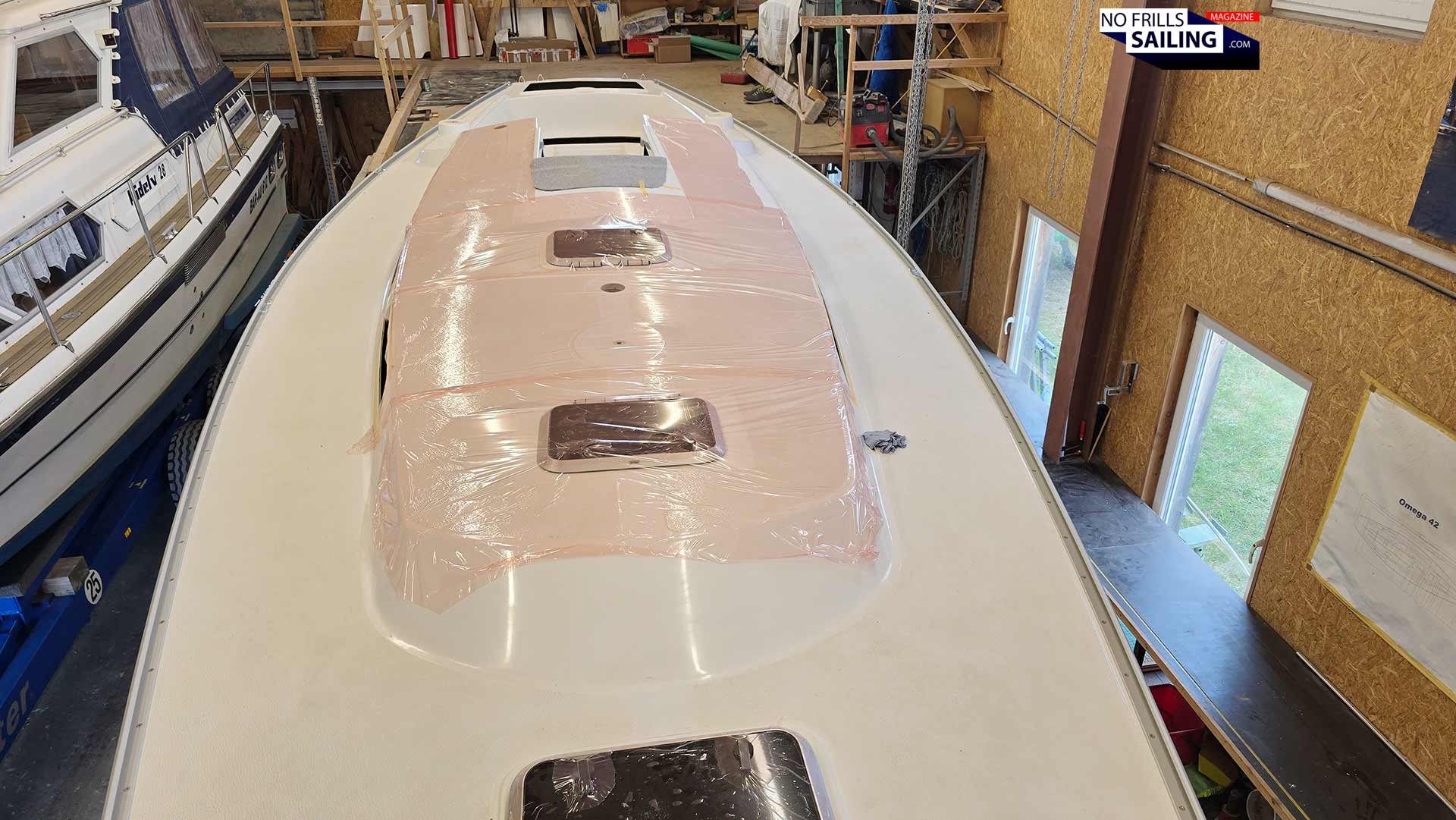
I won´t cover it with synth-teak (partially because of the undecided, still open solar-question). Everywhere you can see the pink protective wrap in the picture above, custom made solar panels could be fixed. Something that worked nicely on my last boat and looked very sick too. But this would be the (much) more expensive and elaborate solution, calling for more wiring inside the yacht, a number of solar chargers and working hours. Not so KISS anymore, right? As I said, I´m still not sure, what to do here. The good thing is, I don´t have to rush: Either of both solution can be easily retrofitted after launch of the yacht.
Advertisement
Why you should get professional help for your sailboat´s BMS too
Having arrived at the end of this article, it´s probably like I stated at its beginning: As each yacht is different, so is her skipper and the use-case in which the boat will have to perform. There is no grand solution for everyone, even not for the mass-produced series production yachts. I would always suggest that you discuss your individual case, your needs, the appetite for current of your boat with a professional. Order the minimum at the shipyard, fit the rest to fit your needs with a professional. The range for electric setups is too wide, as to rely on the standardized average. At last, it´s the wellbeing, comfort and safety of you, your crew, your family and your guests aboard.
What´s your take on onboard appliances, battery management and solar? Do you have hints, own ideas and alternatives? Feel free to comment. And please: If your did not already, sign up for the monthly newsletter and don´t miss any of the weekly three articles.