While most sailors own 30 to 35 footers, the biggest sailboat they´d ever be helming themselves could be a charter yacht between 45- or 50-foot. Admiring the beauty and timelessness of maxi-sized yachts, it´s a dream to stand behind the steering wheel for many. How does it feel? Are luxury yachts placid, slow behemoths? Or is it actually fun to helm such a tidbit? This article tells the story of my intense sea trial of an Oyster 675 luxury yacht, trying to answer all of these questions.
During my two day visit to the Norfolk and Suffolk counties of the UK a few weeks ago, I´ve had not only the pleasure of touring the complete Oyster production in Wroxham, but the guys also invited me to actually sail one of their precious boats. Which, of course, has to take place somewhere at the sea. That would be the little town of Ipswich, located a good two hour drive south of Wroxham.
Here we are: Ipswich, Orwell river. Oyster time!
I was very lucky because that early in the year weather up here usually isn´t that nice. But I was greeted with nice 20 degrees Celsius and a perfectly clear blue sky when I arrived. Spending the night in a local hotel gave me the chance to sort my impressions after the tightly packed factory tour. Once I got up, after the traditional rich Full English Breakfast, Stepen Parkinson picked me up and we drove to the nearby marina.
A word on Ipswich
Advertisement
Although this mid-size town with it some 140.000 inhabitants isn´t usually part of any UK-travelers itinerary, Ipswich is indeed the one place of England that has the longest history of being permanently inhabited. That´s a staggering 1.500 years of people living here. After arriving the other day I walked up and down the waterfront and caught a glimpse onto the Spirit Yachts workshop, where they´ve just rolled out one of their newest wooden beauties. Apart from that, and vivid small boat yachting community and Ed Sheeran, there wasn´t much to see. A nice, sort of quiet town.
Second story: Oyster office
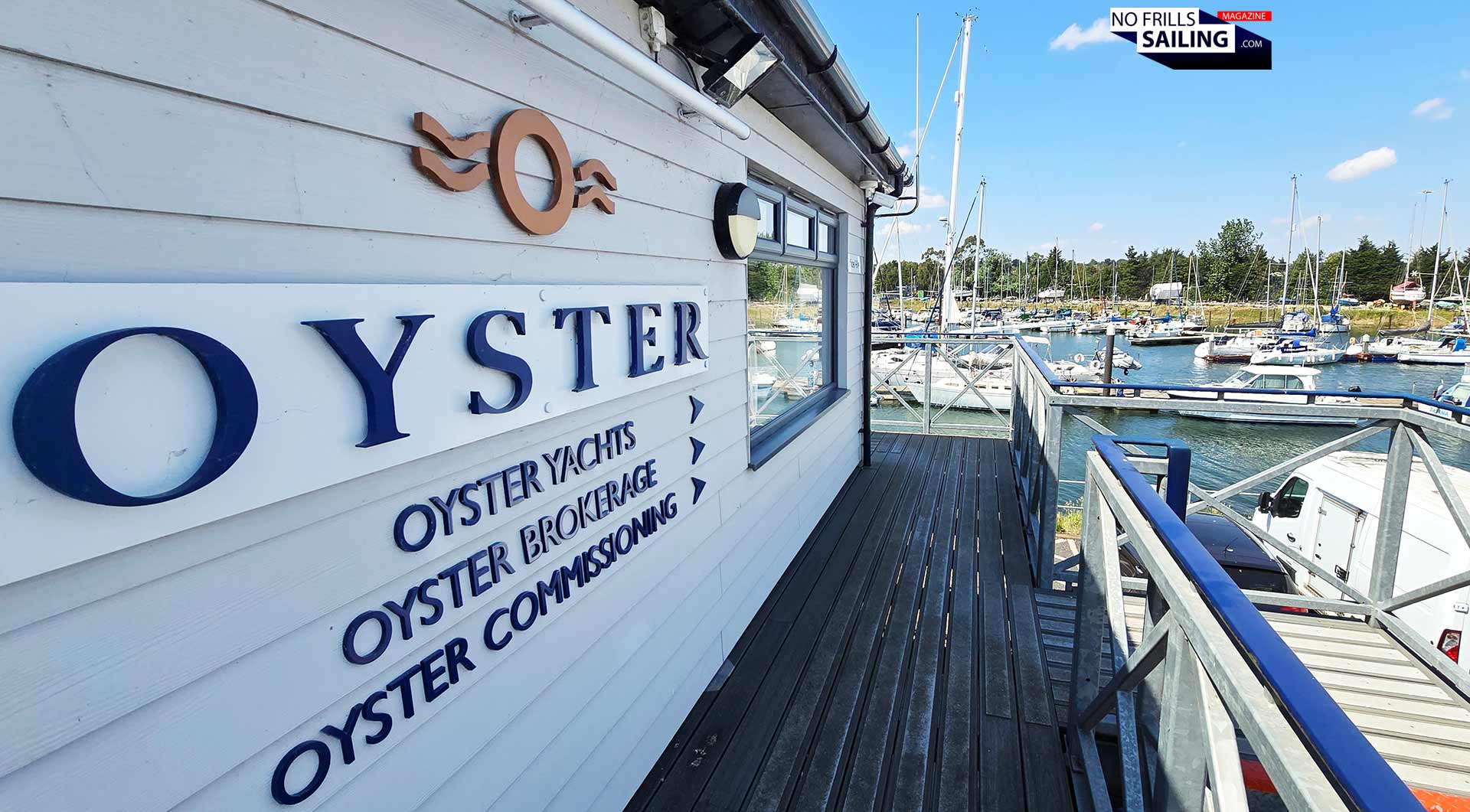
Stepen Parkinson, Sales Director at Oyster Yachts, picks me up and we drive five minutes to another marina: Fox´s Marina. Here we enter the Oyster office, which is located on the upper floor, overlooking the whole premises. As traditional and conservative it may seem from the outside, as welcoming, light-suffused and modern it appears upon entering.
Let´s meet the makers!
After greeting the staff, Stephen and I take a seat in one of the two large meeting rooms. The opaque glass features the familiar shapes of the continents of our earth, depicting the most important landfalls of the Oyster World Rally – a topic we will talk about later as well. After the bustling activity in the shipyard yesterday, the scents and sounds of a busy shipyard, this all somehow felt a bit unreal. Coffee served. Nice chat. Am I dreaming?
Fox´s Marina – home of the Oyster
Stephen tells me a bit of the back story about this place. Fox´s Marina could be seen as one of the most important locations for the Oyster history. From the earliest days – back then with founder Richard Matthews – the company sort of was based here. Here, his legendary Ufo II and later the Ufo 34 cruisers were based and sold. Nowadays, some of Richard´s private boats are still based here and he is a partial owner of the marina as well.
From a dream …
Fox´s Marina, as Stepen Parkinson tells me, works as the principle commissioning and launching place for new Oysters. The boats arrive here from the shipyard in Wroxham, will be put into the water and thoroughly tested before handover. There´s a whole technical team of own Oyster staff as well as professional service providers on the premises to take care of anything connected to yachts.
… to reality.
Fox´s Marina is also the go-to place for Oyster owners if they wish for the “original” service: Certainly, it´s the Mekka for any Oyster. And I will later see a number of older boats moored here: Some stay for some seasons, some for only a few weeks. If Oyster takes a used boat into their brokerage, there´s a good chance she will be taken care of here at Fox´s Marina.
Any Oyster is first splashed here in Ipswich
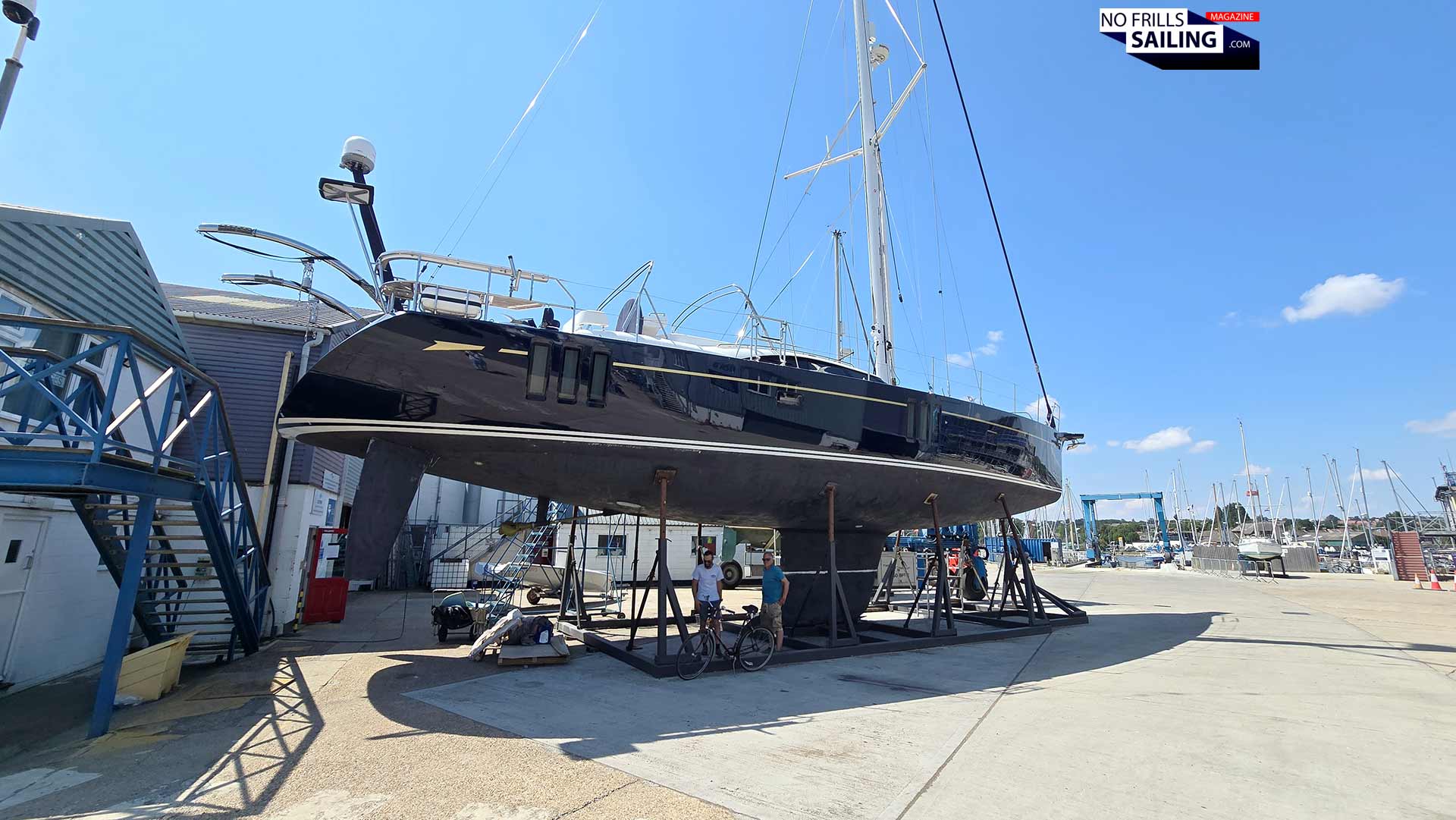
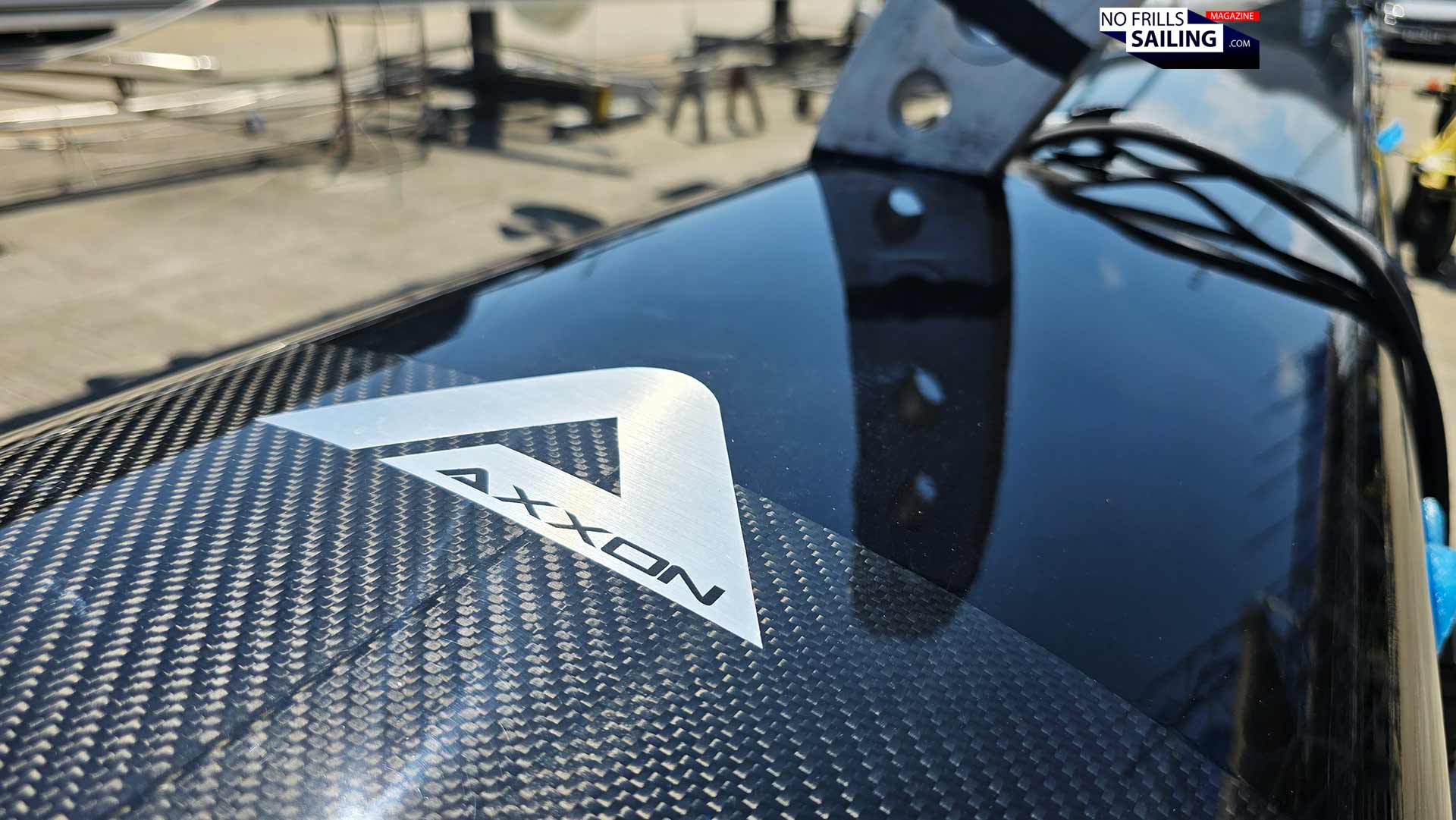
Stephen takes me on a little tour around the place: Currently, there´s an Oyster 675 on the dry for a check-up and in the yard the rigging for two bigger Oysters are currently being prepared, one of which is a nice full carbon mast from Axxon. I think, if Wroxham is the place where these yachts are made, this is the place where they are truly born and brought into this world. Nothing here feels “British”, maybe that’s because of the unusually sunny and warm weather? I rather have the feeling of being somewhere in the Med, Southern France maybe? I am pleasantly surprised, and we´ve only just started …
At the Oyster jetty
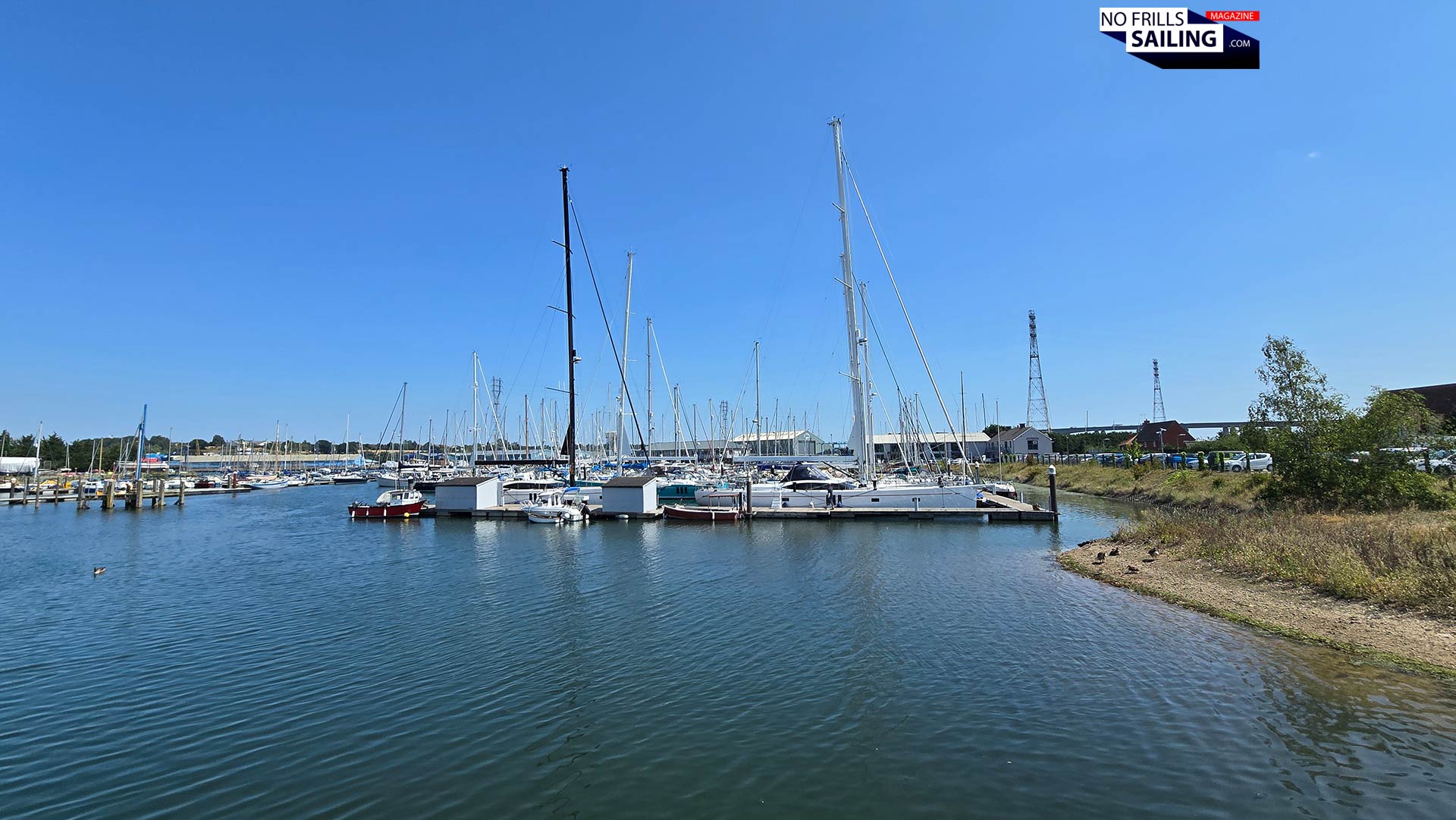
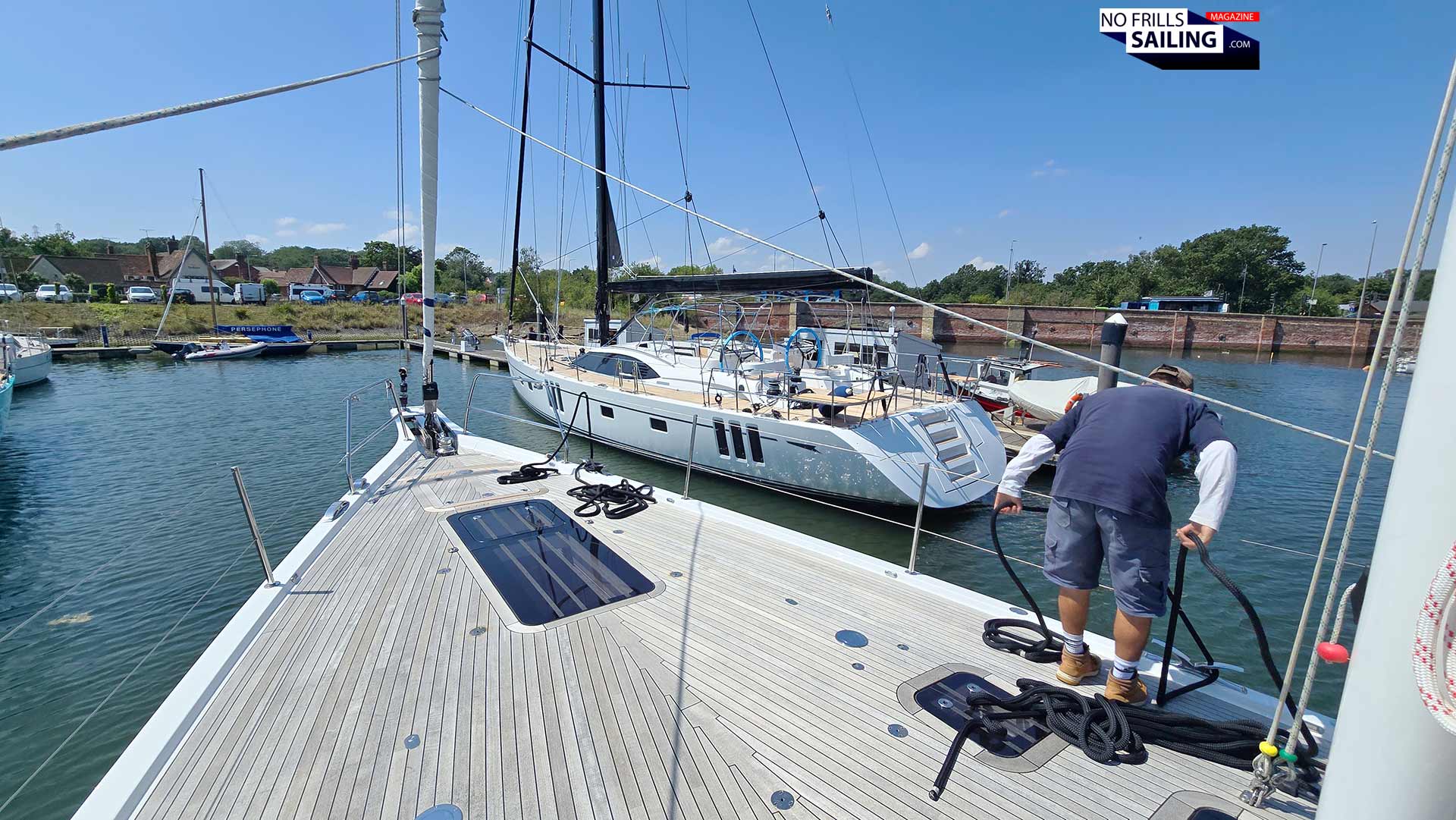
Collecting our sailing waistcoats, we set off for the jetty. Passing a security gate, we proceed into the last corner of the marina, just next to the shoreline of the harbor basin. It was low tide at the moment and I looked a bit concerning – is there really enough water underneath our keels? Apparently, yes.
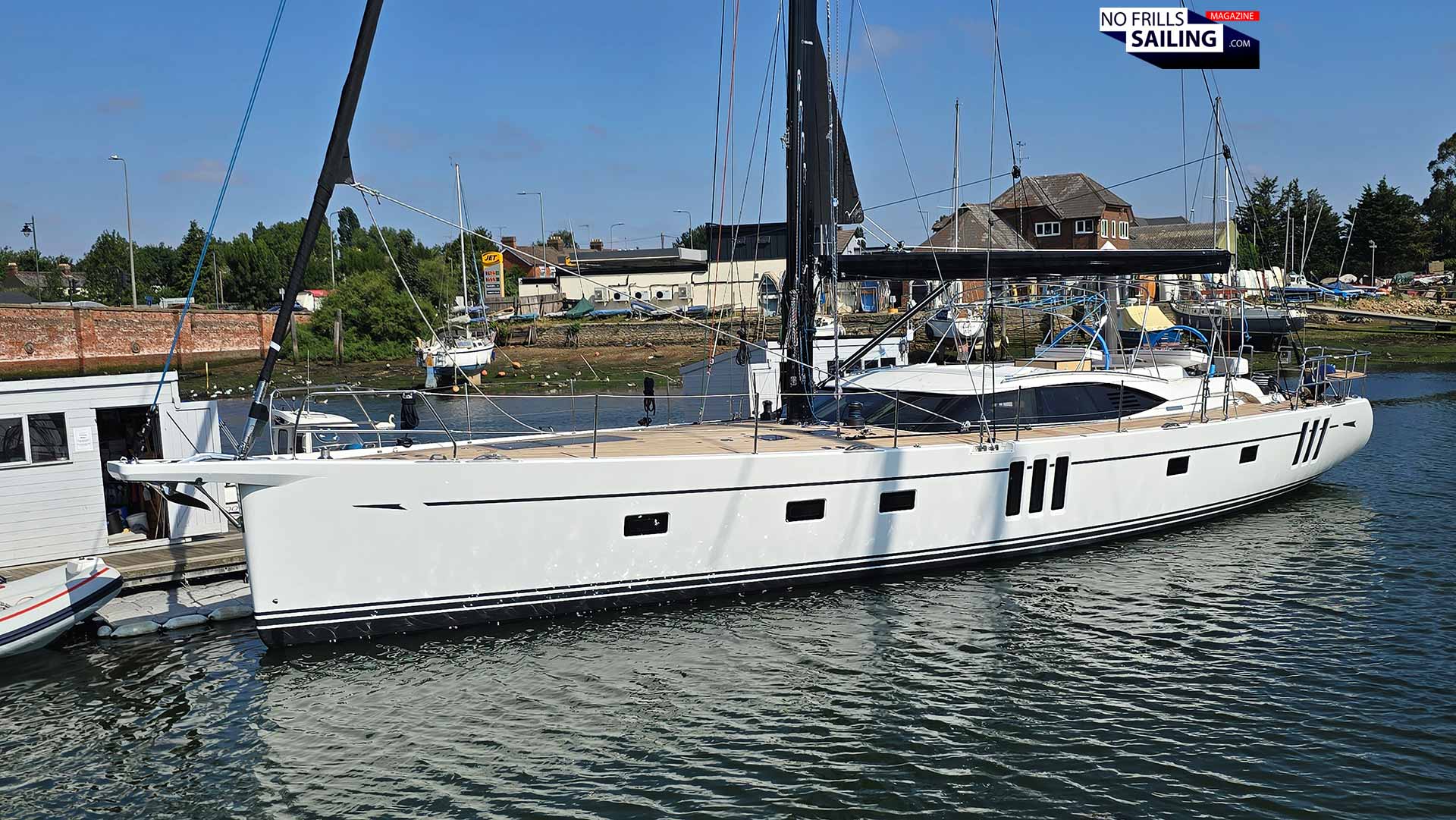
One of the best sellers: Oyster 675!
Stephen had asked which boat I´d fancy to sail. To be honest, I am personally not really into big yachts. For me, 60 feet is like a threshold, everything above is pure luxury, will need a crew or even a steward – not so much my world. If I could choose, I´d be voting for the Oyster 595, which would be my choice if I´d had the budget, or the smallest, the Oyster 495. Both of which – sadly – hadn´t been available. With a smile he asked if it would be okay if we´d sail on a 675. Well. Of course!
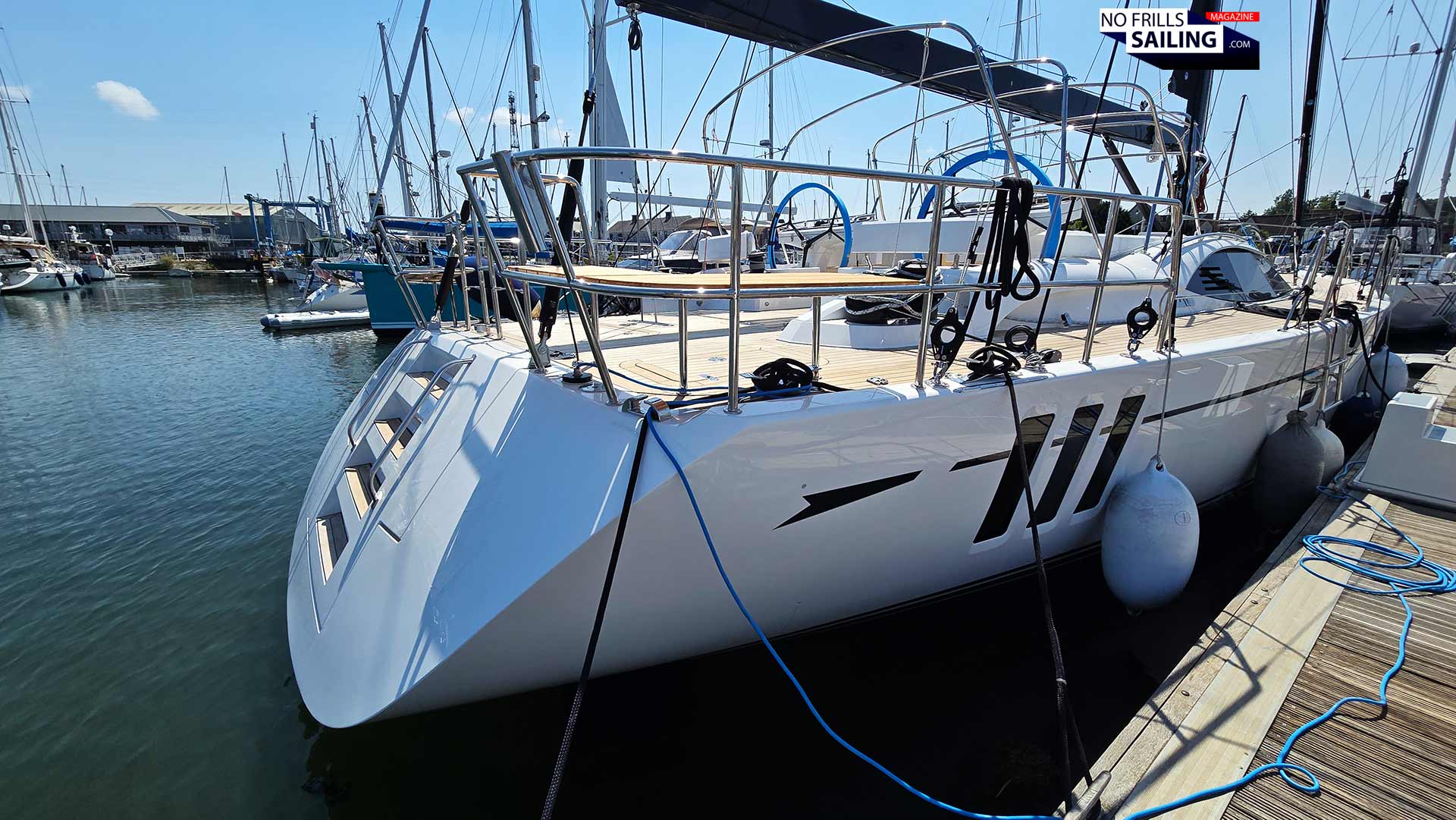
Are you the standard stern type?
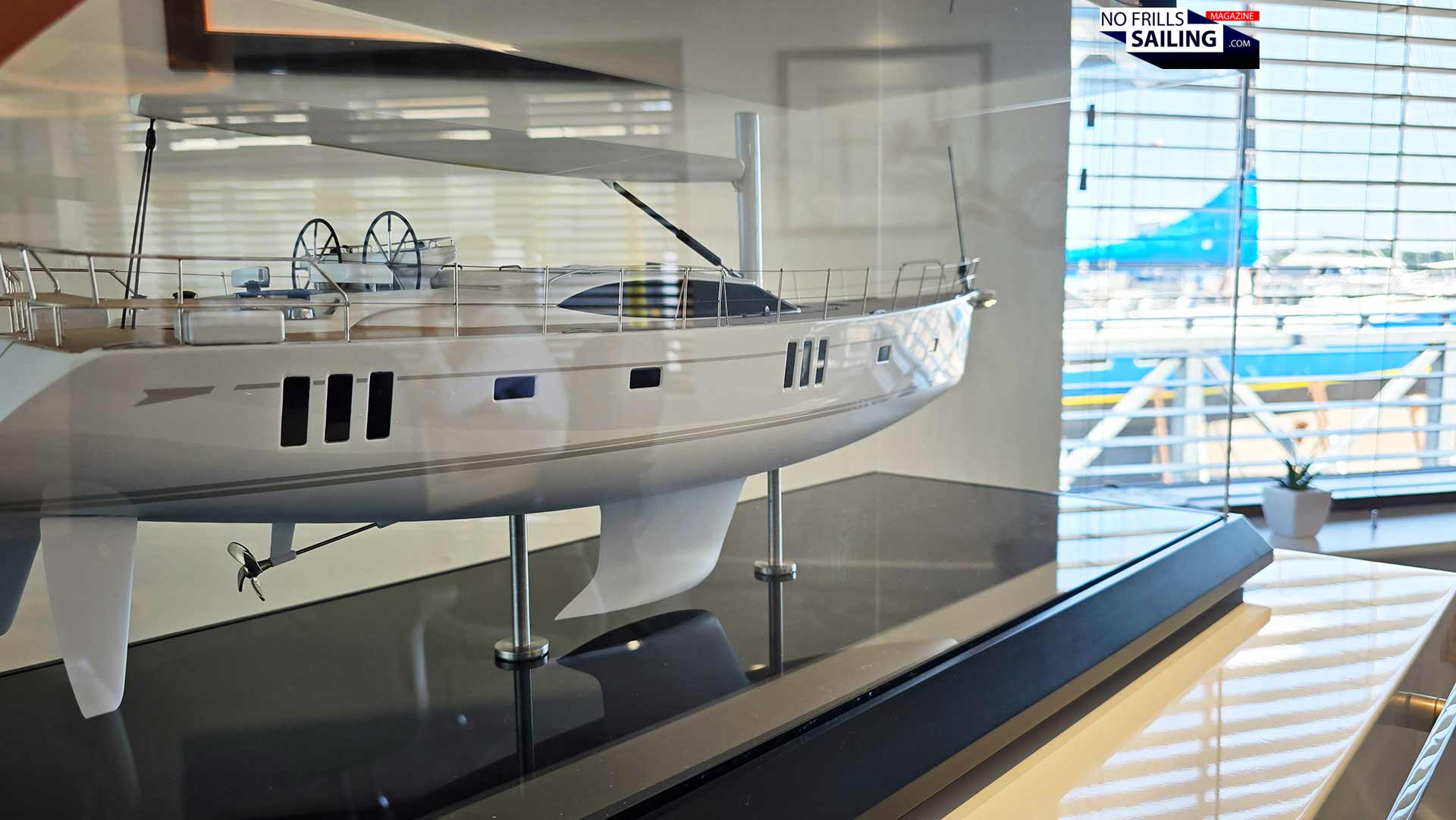
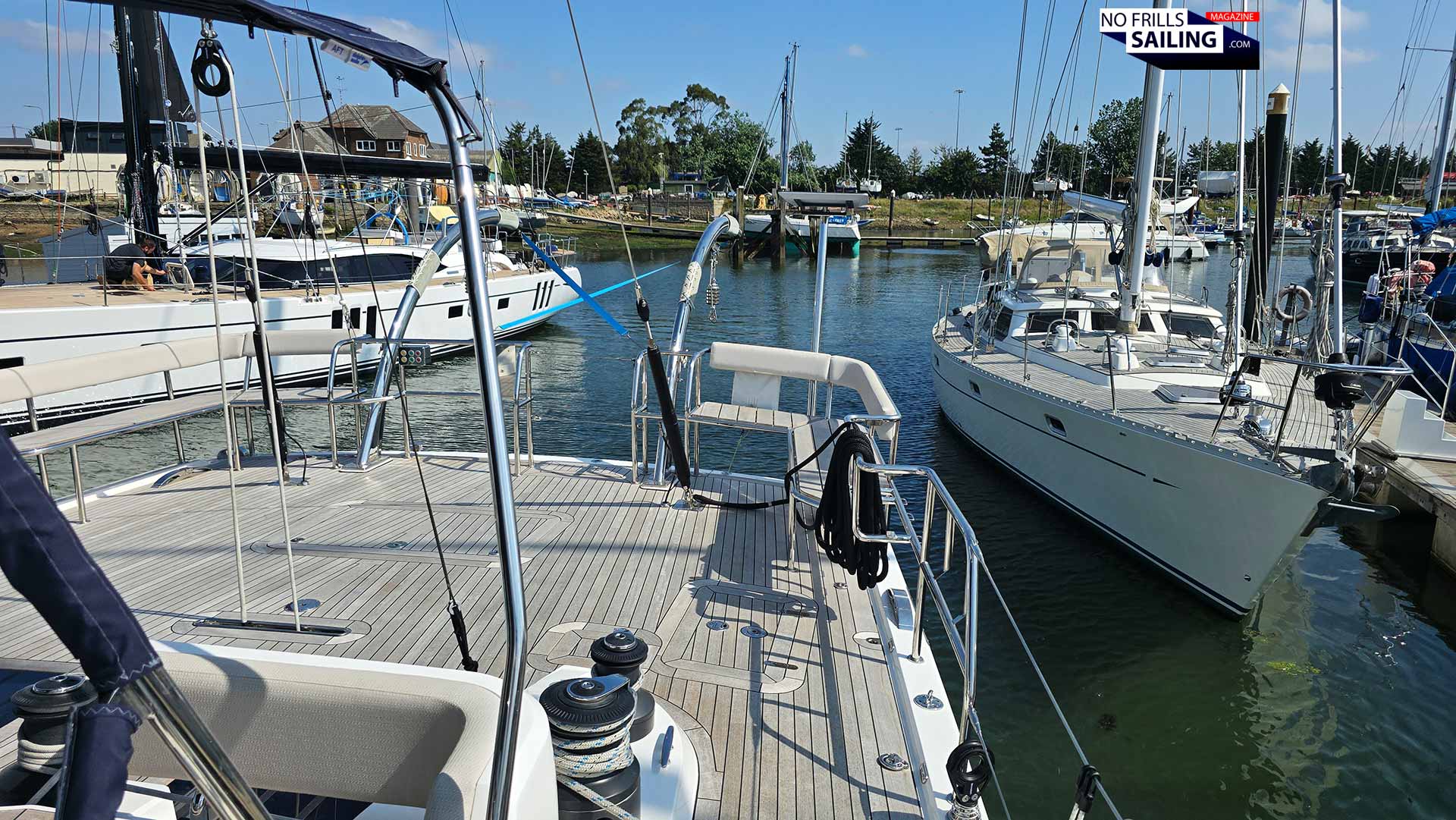
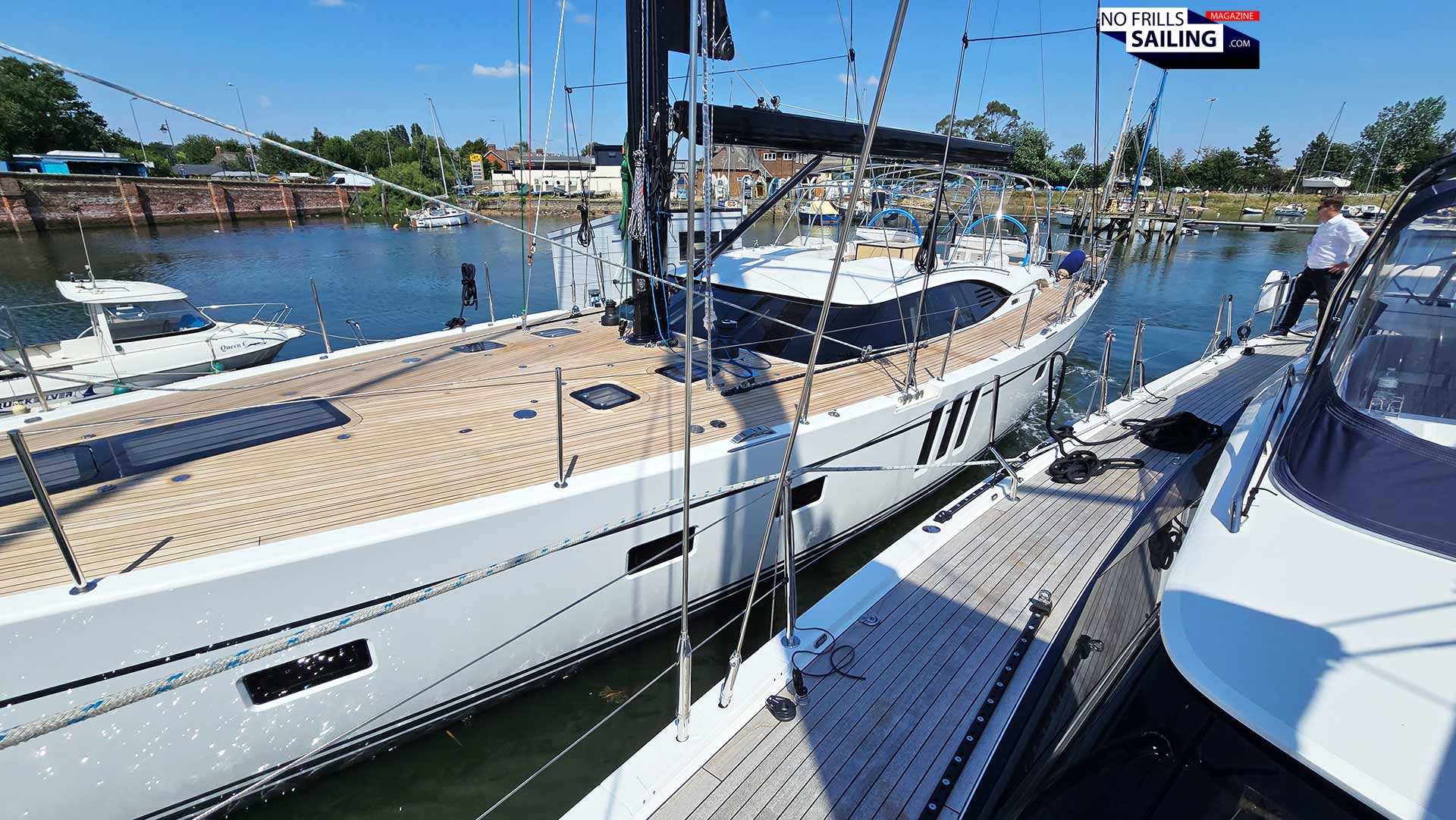
For some reason, just at this moment, there were a number of 675s moored to the commissioning jetties. Which was a great chance for me to check out the different choices their owners had made. First of all – if you plan on getting one of these – there is this one big question to take care of: Classic transom or extended version? Whereas the latter undeniably does come with very significant advantages regarding the size of the dinghy garage and improves lazarette stowage capacity significantly, I must say, I´m the classy guy.
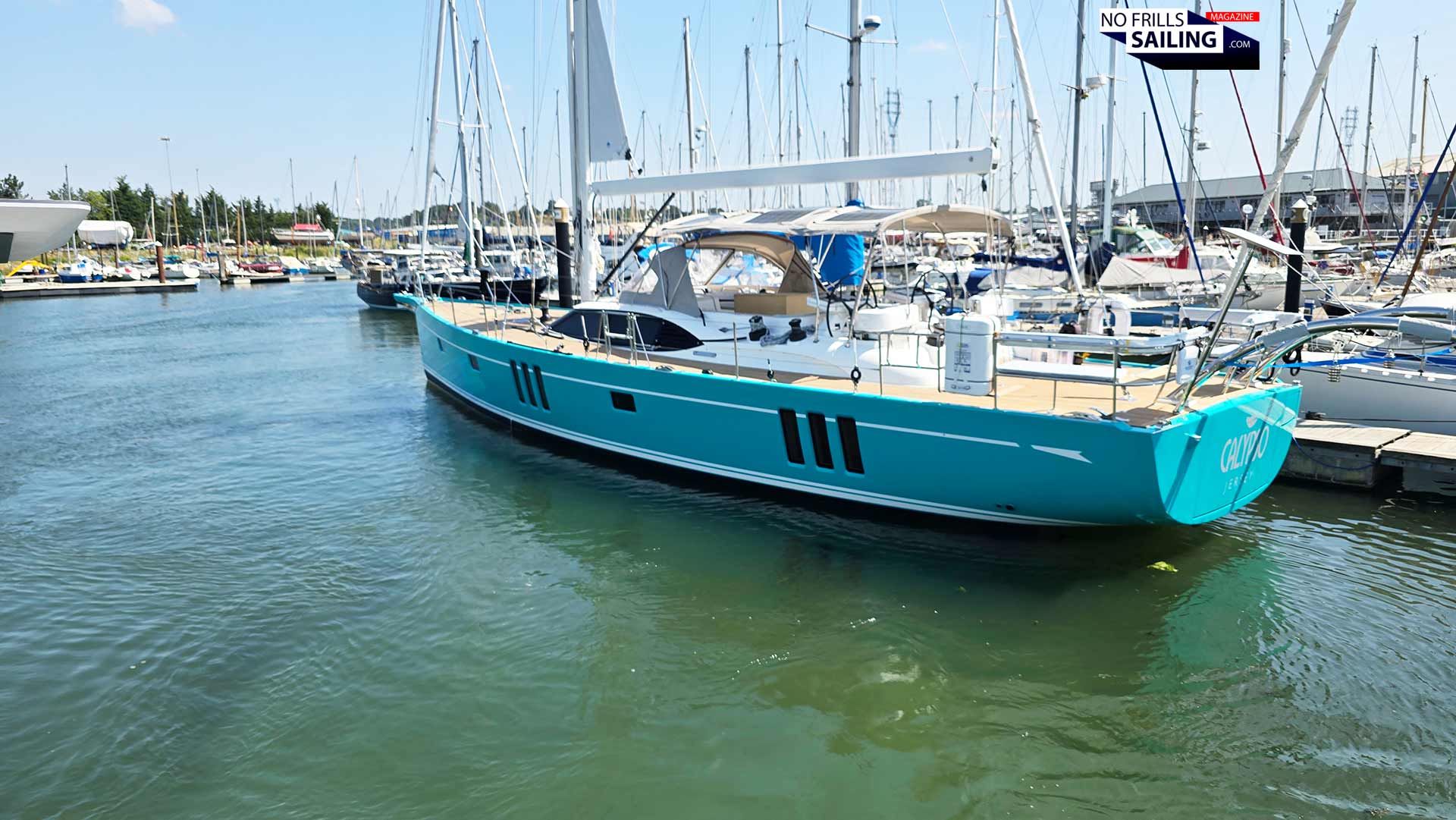
Or do you prefer the extended stern version?
She´s in my eyes just so much more beautiful, so much more “Oyster”, that I´d rather opt for less stuff on my voyage than to choose the long stern version. But that´s in the eye of the beholder and you may decide differently. Stephen says that it´s roughly 50/50 when it comes to this decision. But now – let´s cast off! It all happens so quickly and we are underway suddenly. Time for my first time sailing an Oyster yacht!
Let´s cast off, shall we?
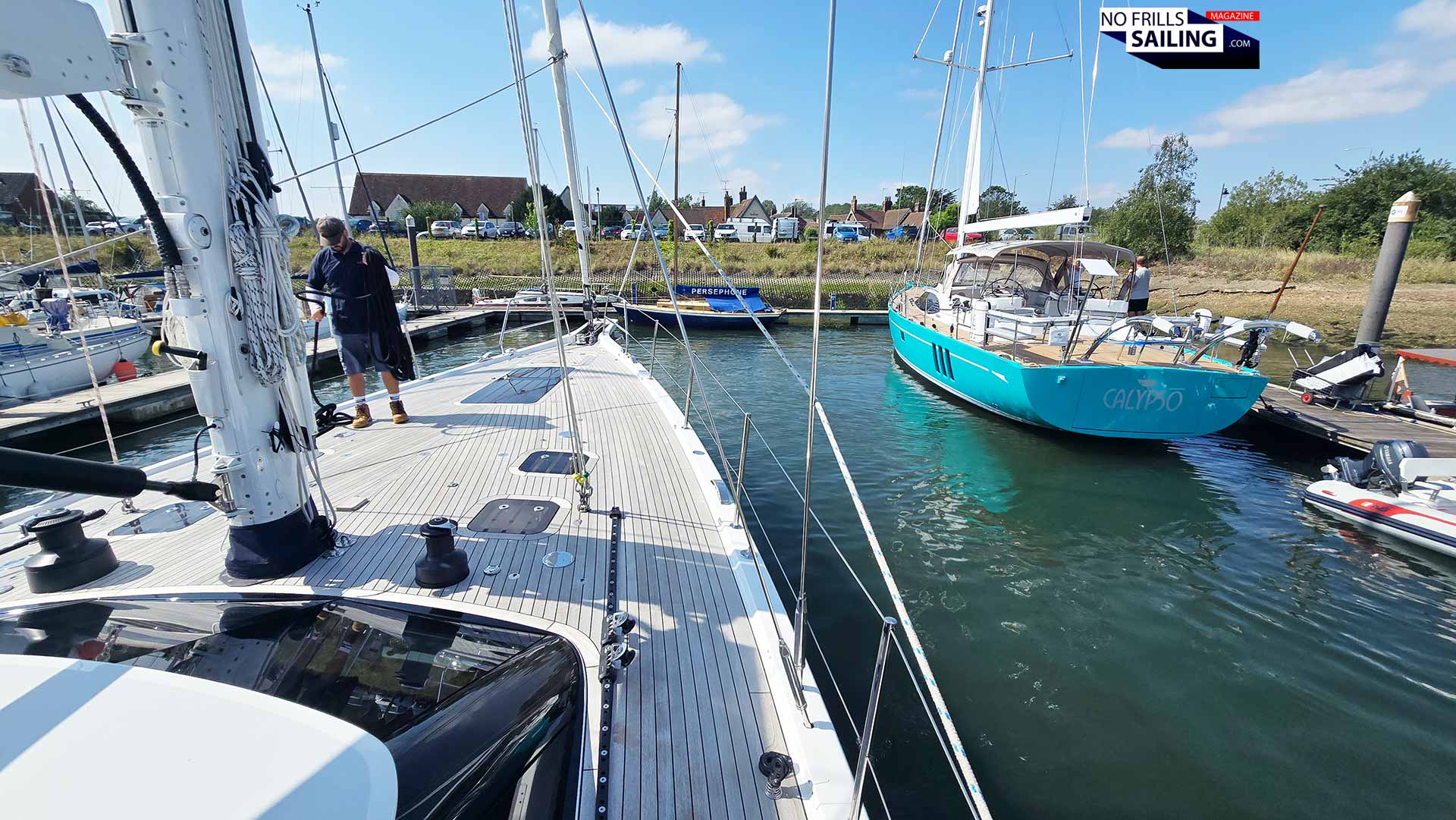
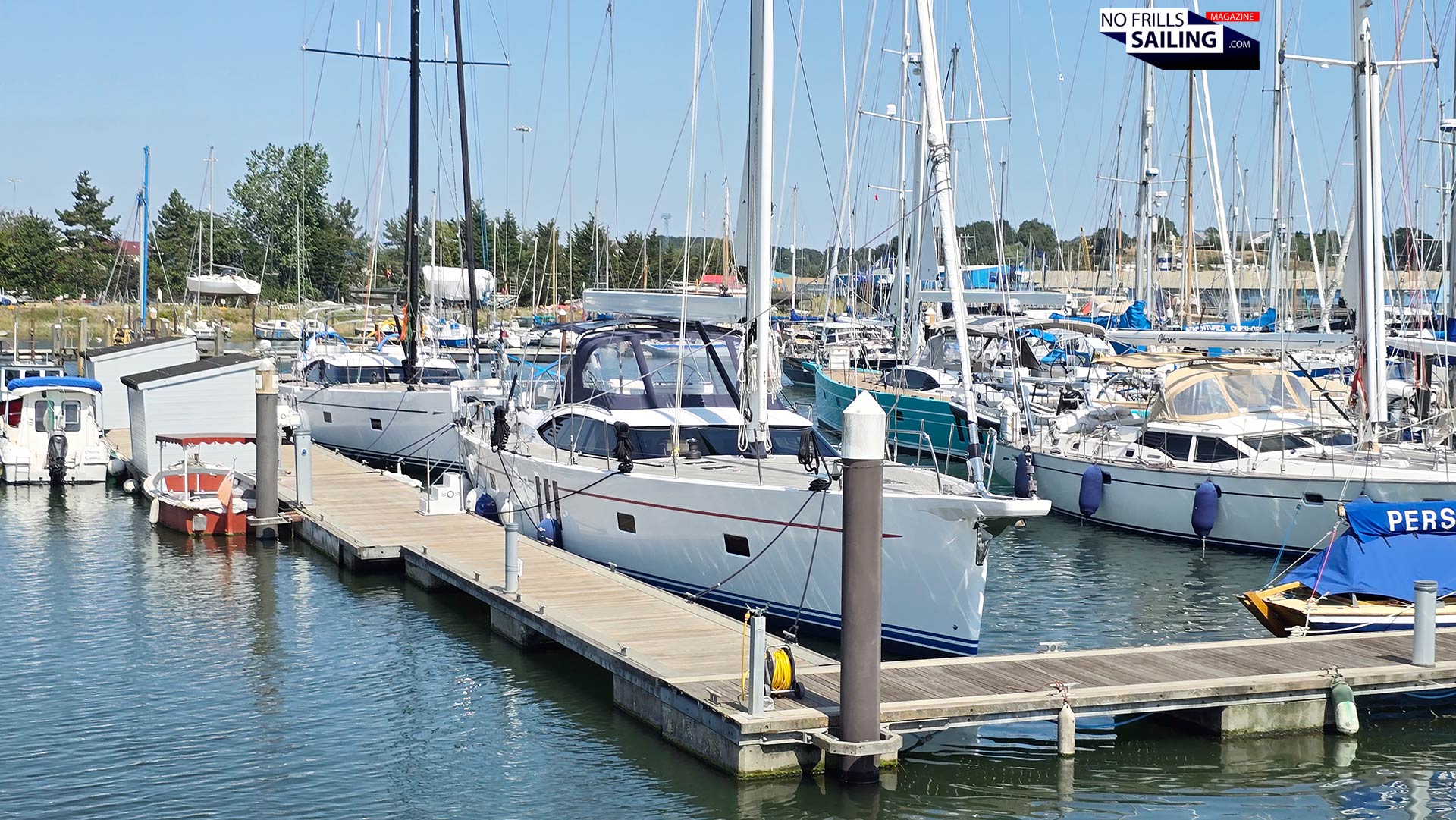
Let me just quickly describe the location in which I found myself: This is the farthest, last corner of Fox´s Marina – the very last jetty. Next to our pontoon, there´s literally land. With low tide, the water levels are even lower and next to the wet mud I can see grass, little garden cornflowers here and there and I can still read the license plates of the parked cars in the parking lot vis-à-vis comfortably.
Backing off out of our berth
There´s also a fresh wind going on – later more on that because it had direct impact on our sailing – and so I thought this would be a kind of tricky situation for our skipper to handle. Well, it was not. Apart from the fact that these guys not only know their Oysters inside-out and would probably manage to safely handle them even blindfolded, there´s another aspect which made maneuvering this behemoth so easy. You´ve already guessed it: Bow and stern thrusters, of course!
That´s pretty narrow!
This Oyster 675 was fitted with both bow and stern thrusters. Weighing in some 38 tons, it´s hard to imagine to try to juggle this Oyster 675 out of her cramped berth by the help of ropes, leverage and gentle pushes of the wind. Of course, our skipper had the stern and bow trusters deployed. With only a few pushes needed, the boat gently floated away from the dock – in parallel – and then slowly glided in between the other Oysters – stern first – out of the area. Once cleared, she would spin on a dime and proudly leave the marina into the River Orwell.
Full push-button-sailing
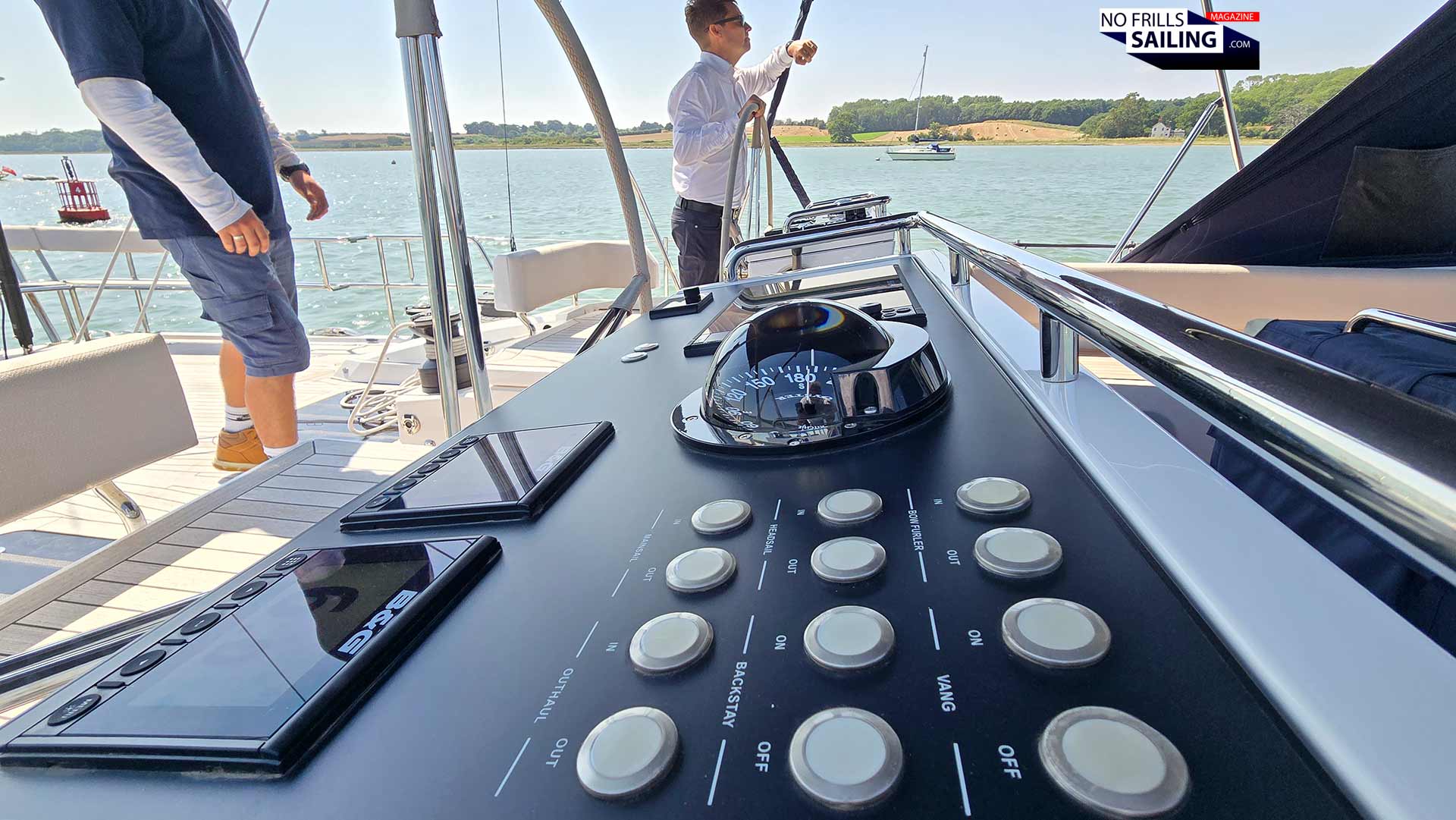
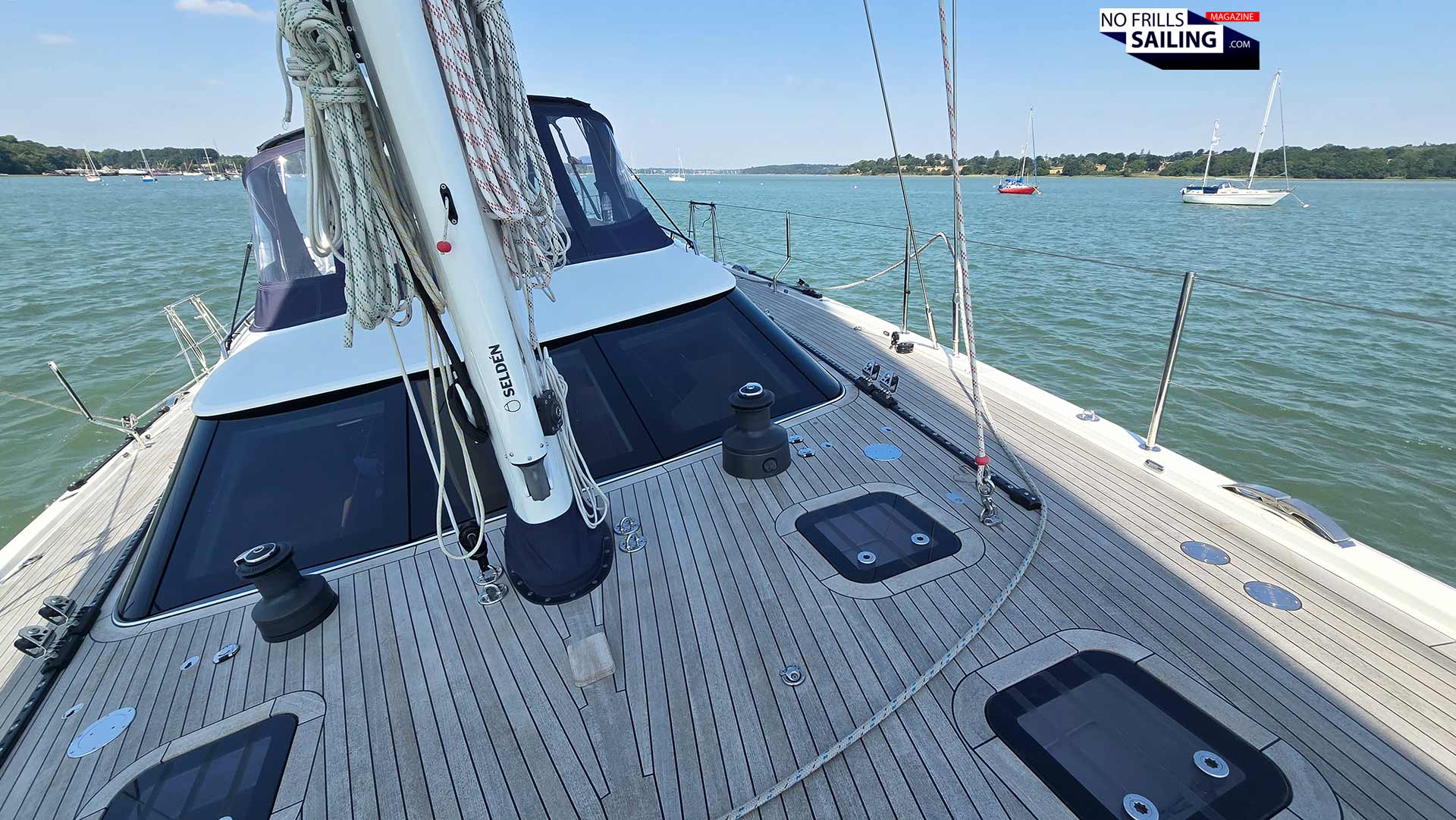
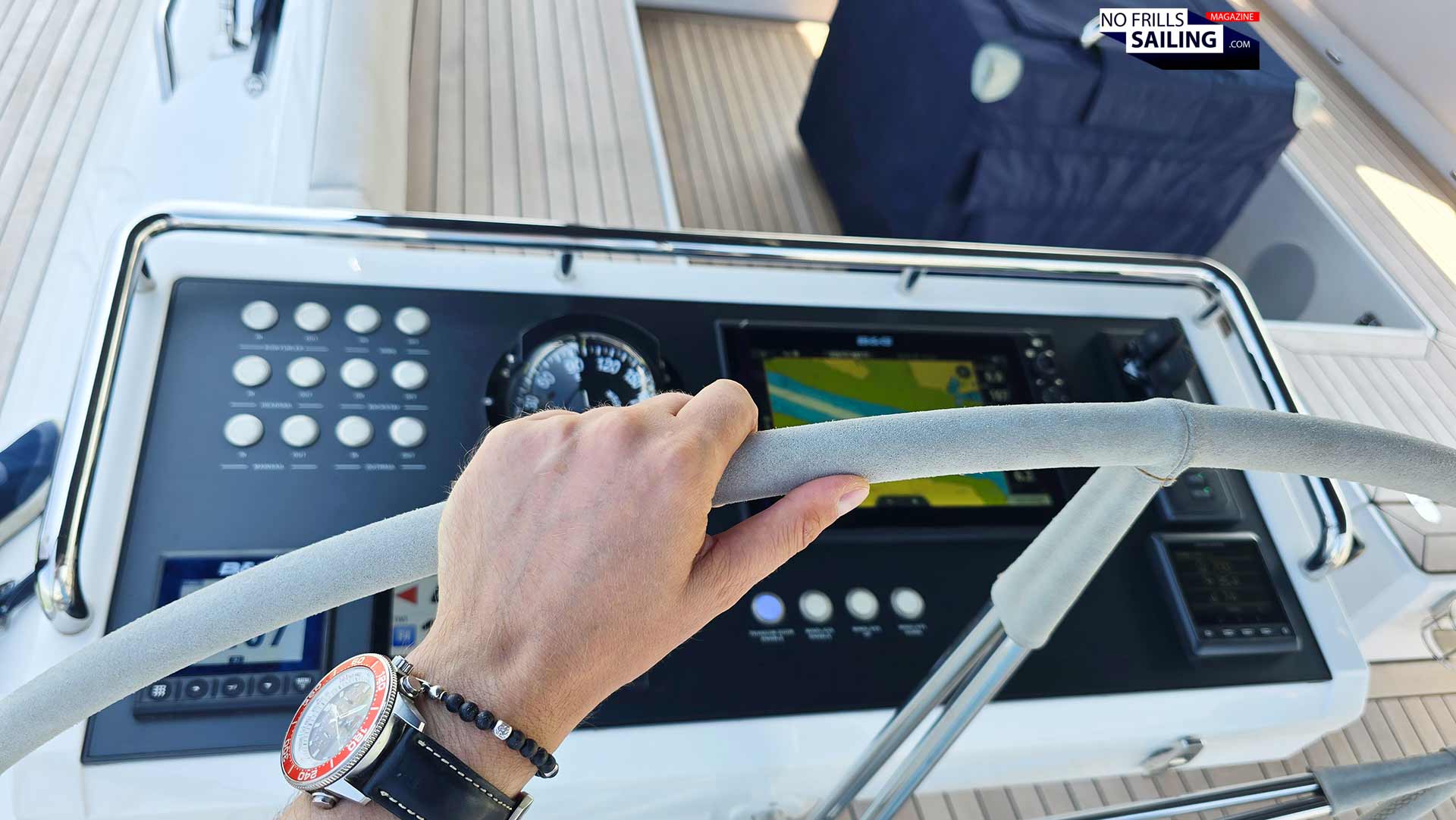
Larger Oyster models can be equipped with sophisticated hydraulic sail-handling systems which, together with powered winches, make the considerable sail area easier to manage. Looking onto the control panels at the helm stations, you initially understand that this is a full push-button sailing yacht. Are there any winches aboard anyway?
Out on the river: Push button sailing
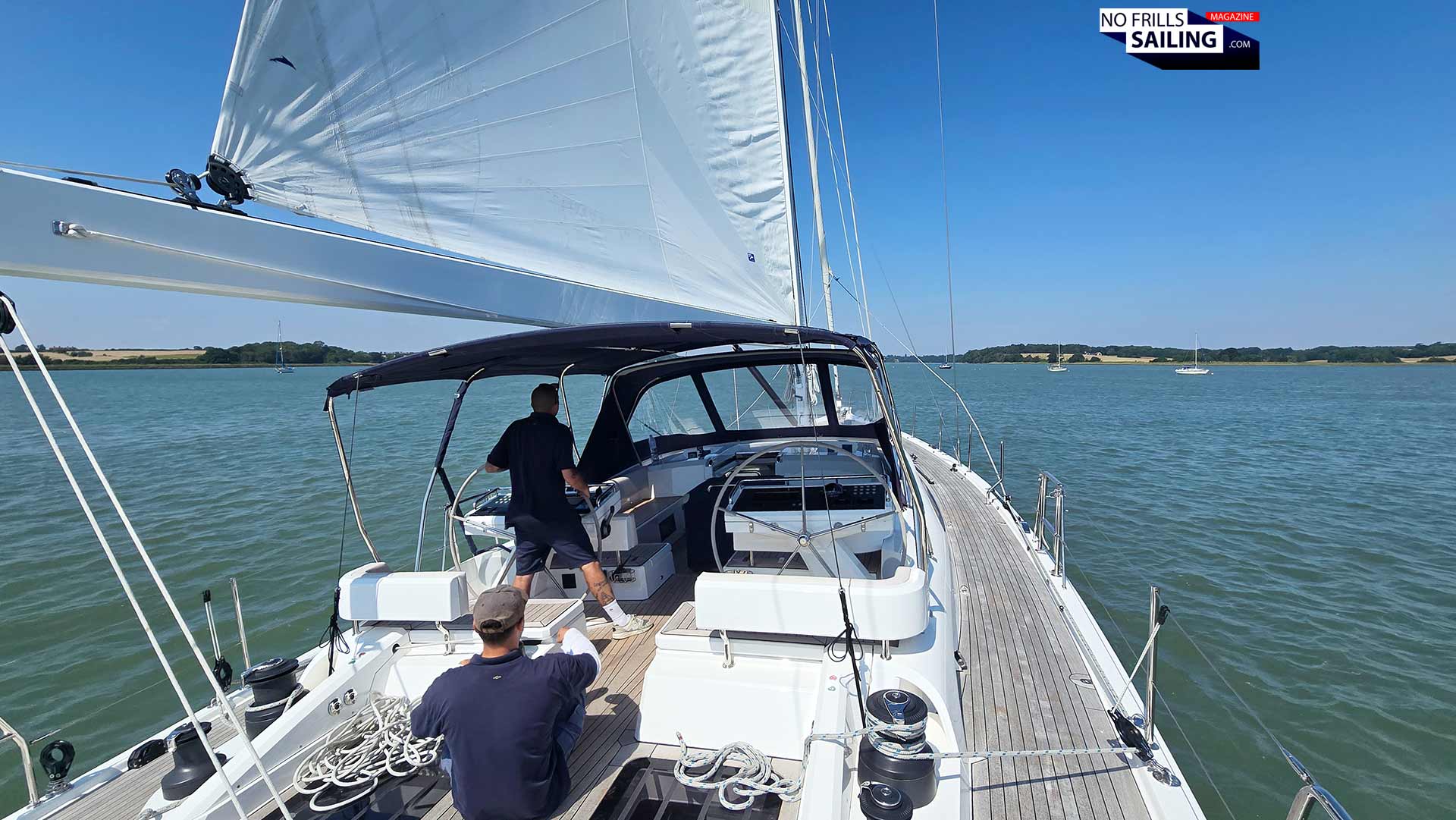
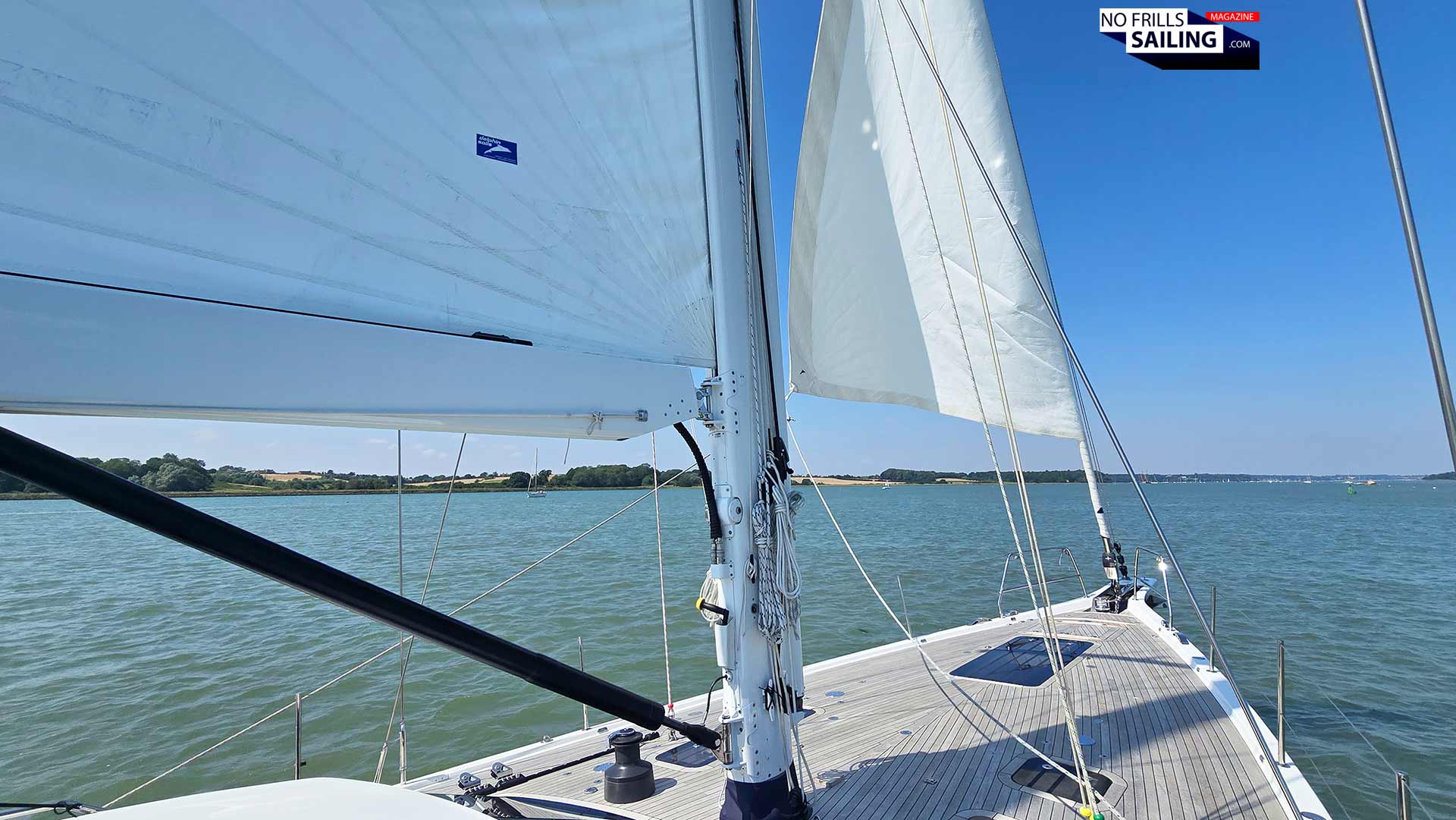
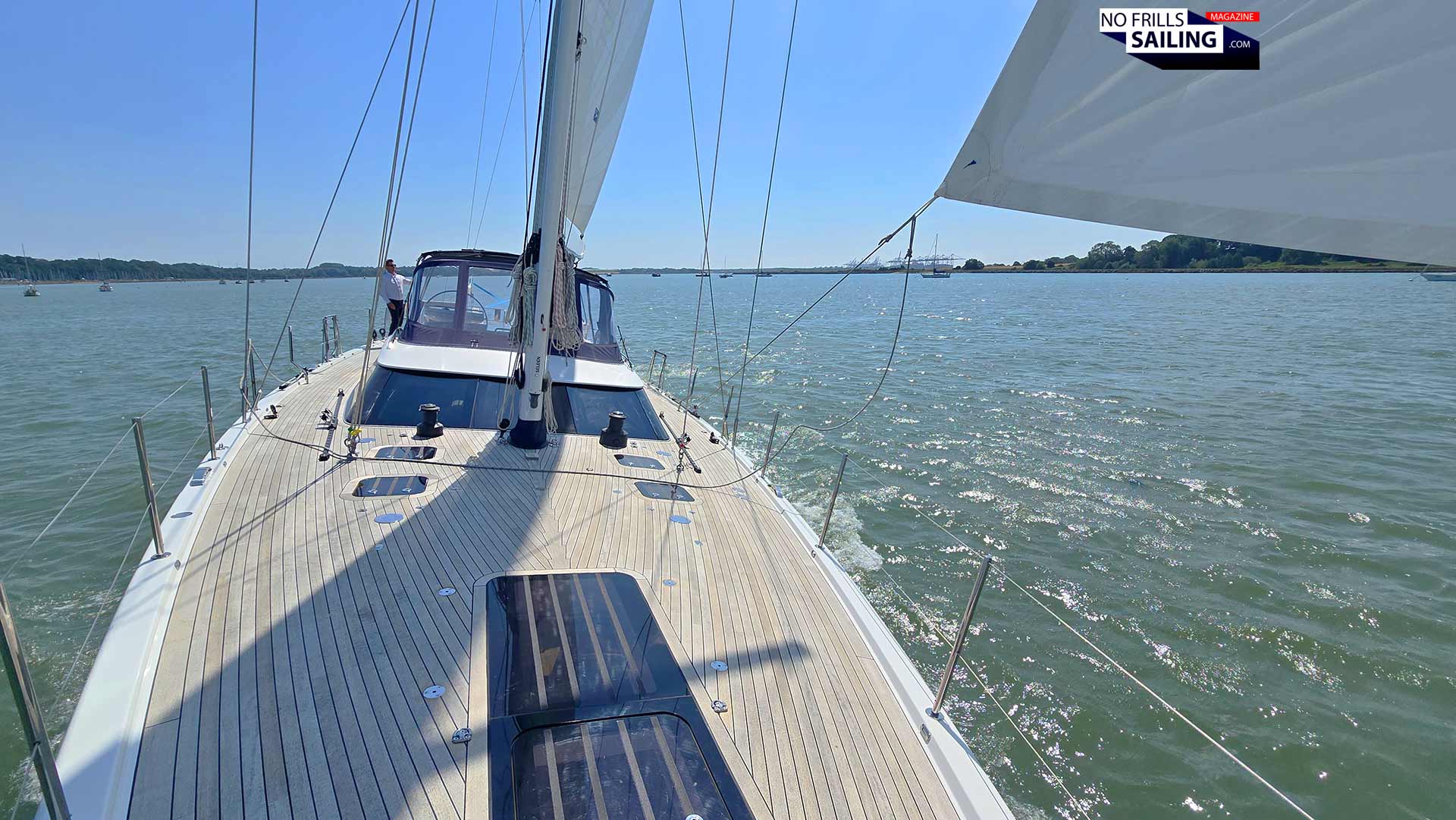
Leaving the marina, which is the Ostrich Creek, we turn the boat´s bow into the wind and follow the Orwell south-south east downriver. Time to set sails, folks! First would be the mainsail, with vertical-batten inmast-furling. Easing the vang, bringing the boat slightly upwind, the guys just pushed the button and the white canvas slowly slid out of the mast. It may not look like it in the pictures (for whatever reason pictures never truly capture the sea state, especially when its windy!) but we´ve had a pretty stiff breeze and even with this little sail area in the wind, I could easily feel the impact of the gusts.
Hoisting the mainsail
The mainsail of an Oyster 675 brings staggering 117 square meters of sail area to the wind. That is a lot! I mean, by my measures. The Oceanis Yacht 60 is up until now the biggest yacht I ever sailed with myself. And this 60-footer is pretty impressive too, sporting “just only” 77 square meters. In this, I perfectly well understood why it took the guys so long to unfurl the main. I am used to a more “sporty” hoisting process, getting put the mainsail up (or “out” in this case) took them nearly a minute. I guess they really focused on doing it right, not damaging anything and do it according to the wind situation.
First reef, for it is quite windy
In the end, we´ve had the mainsail out in the first reef, which, as Stephen and the skippers assured me, would be more than enough to sail the boat properly. In the meantime we´ve had cleared underneath Orwell bridge (the A14 highway) and had a breathtaking sight onto the rolling hills to either side of the boat. Up in the sky the wind pushed whatever little remainders of ripped apart clouds with phenomenal speeds from left to right, an indicator for the weather outside in the North Sea, which lay ahead of us, just less than 10 nautical miles downriver.
On the river Orwell – lots of wind
As nice, sunny and warm the weather presented the county of Suffolk that day, Poseidon, the God of the Winds, did actually blow quite agitated: There were some 15 to 20 knots of true winds with occasional gusts reaching 23, 25 in times. Stephen, after consulting the two skippers, told me that unfortunately they had only the large genoa ready for sailing for the yacht, originally wanting to hoist the smaller jib which would of course be much better suited for these conditions.
Now let´s get out the foresail!
We sailed along gently, but the skippers let the engine push a bit as well: Not that we couldn’t have sailed with wind power exclusively, but because of the very narrow waterway we´ve had to follow, quite a few sailboats coming up towards us and a lot of moored yachts at the buoys along the river banks. In this, the true wind angle was almost exactly in line with our due course – depending on the little turns we´d have to make, we would often go too much upwind so that the sail wouldn’t create sufficient lift. It was simply safer to being able to immediately correct any situation with the aid of the powerful Diesel engine.
Reckmann, nice furling!
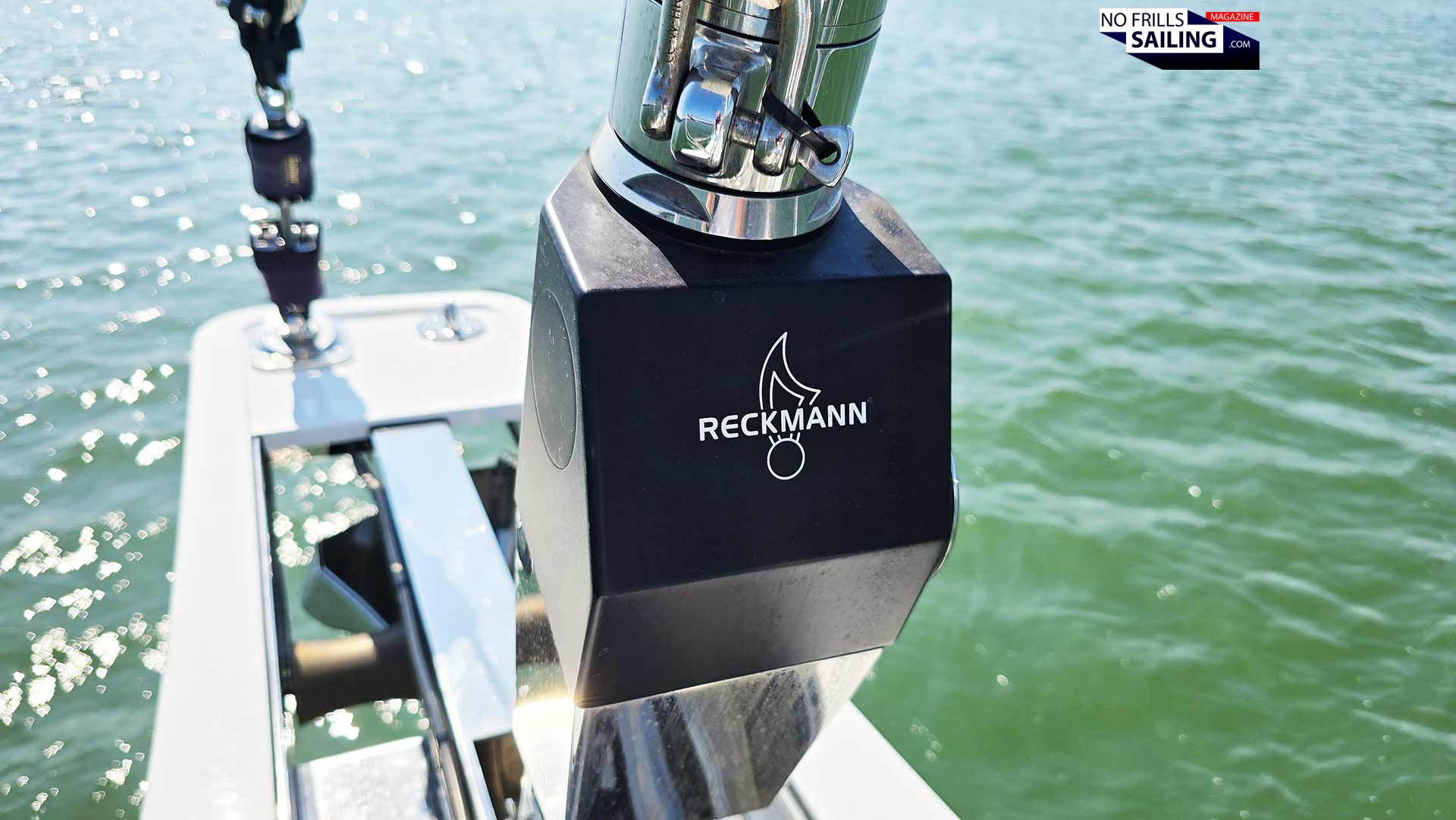
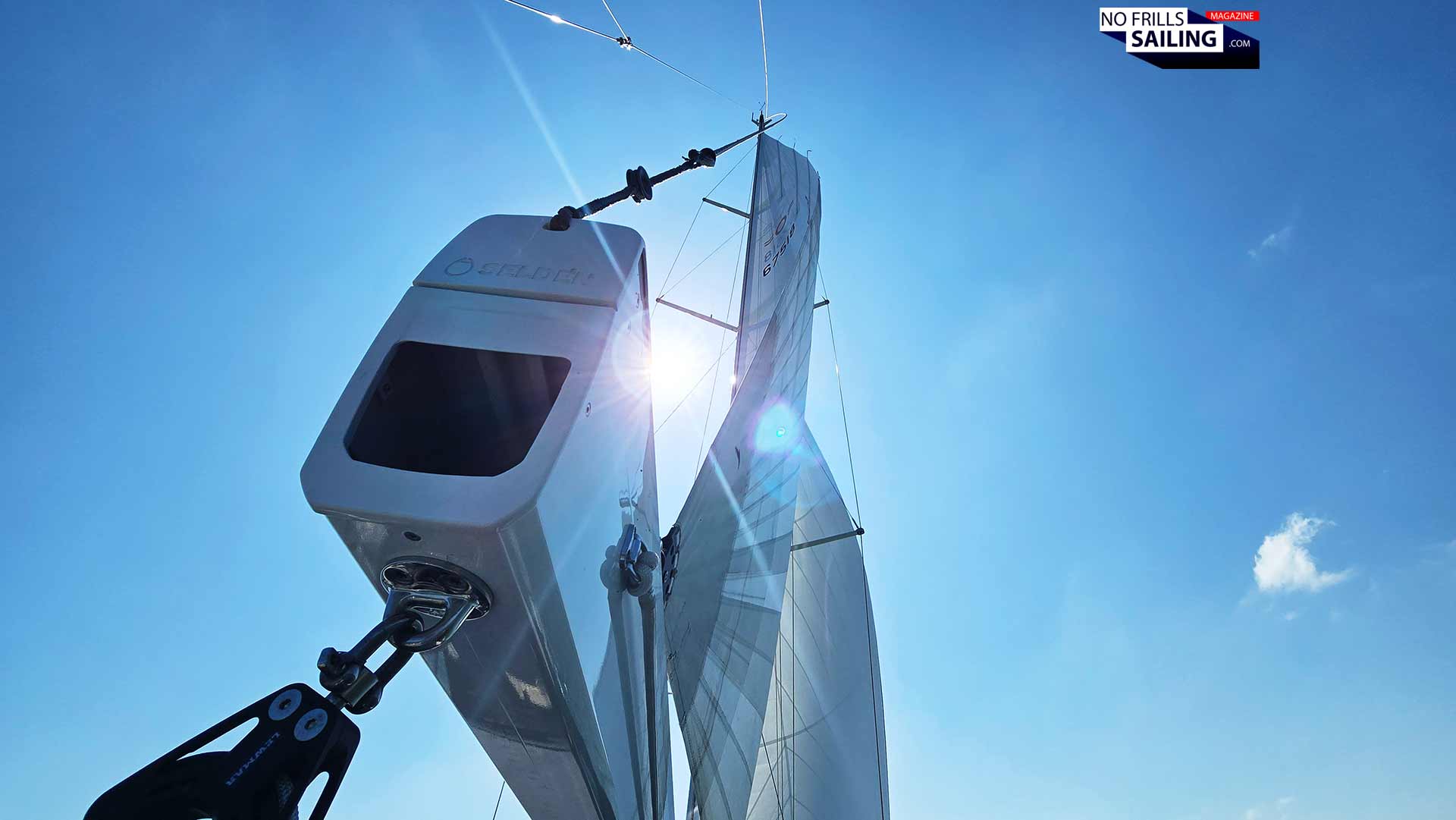
Then the genoa unfurled just as gently. Aboard this Oyster 675, the headsail furling system is hydraulic of course, manufactured by the top quality supplier Reckmann. For large sailing yachts of this size, hydraulic sailing systems, operating big areas of canvas in strong winds are particularly well suited to managing the considerable loads involved. This particular furler can operate at much higher pressure than competing products and features a number of interesting fail-safe options.
Working the large drums
Reckmann is really a fascinating piece of equipment. Although I am personally not a fan of hydraulic systems, as they are maintenance-intensive, the big advantage is that this installation includes manual back-up options in case of pressure loss or power failure: Just look by just looking for a winch handle and crank it! And of course, these are said to be better in damp/wet marine environments. Anyway, the guys unfurled to the first (or was it the second?) reefing point and – voila – we were sailing!
Nimble, light-footed – it´s a fun boat indeed!
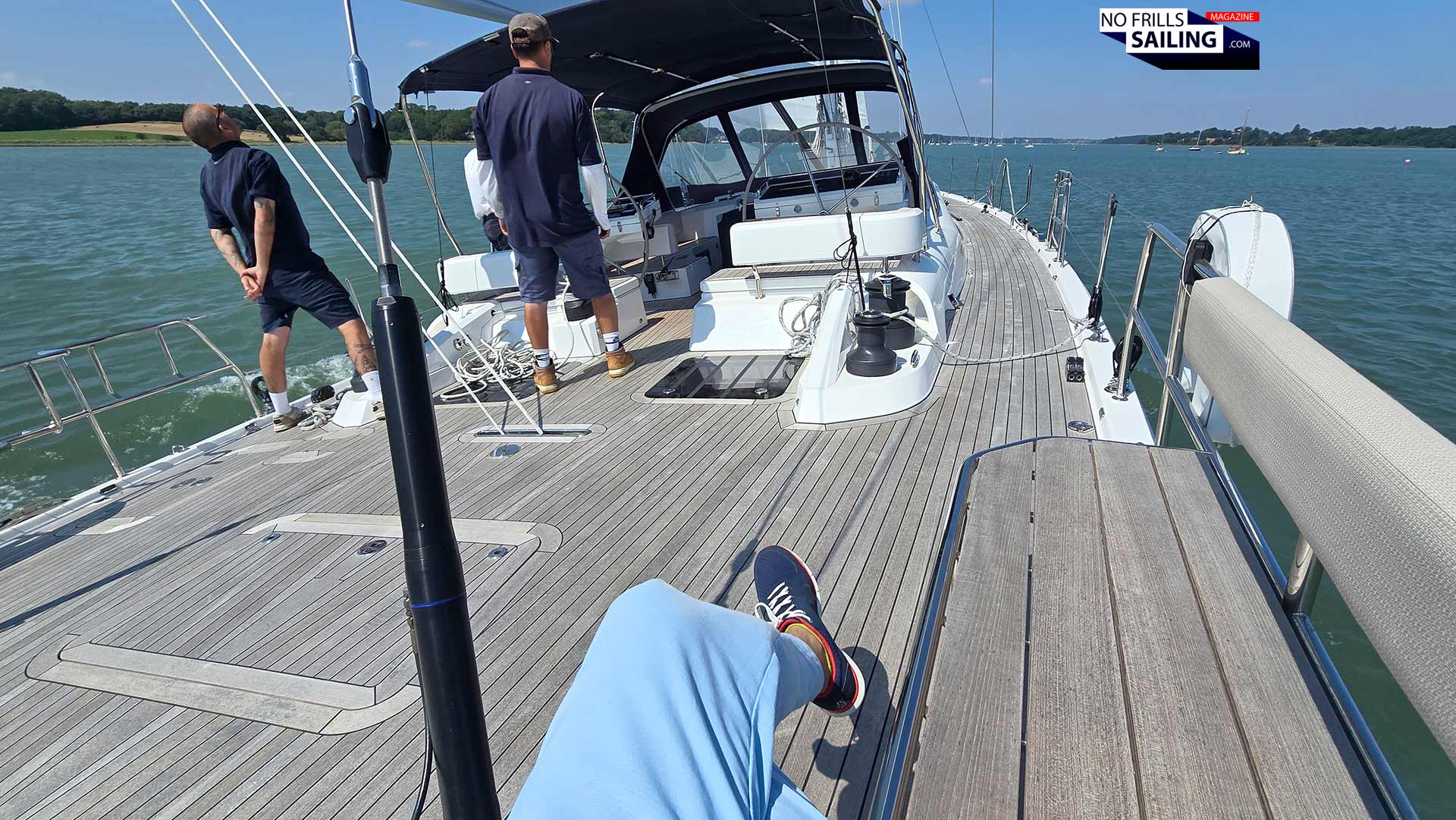
You may acknowledge on the picture below that we did not had the free room to maneuver that day. Left and right from the waterway, which was clearly marked on the electronic sea chart displayed on the plotters, rows and rows of mooring buoys kept on going for miles. Dozens of sailboats secured to them, with their sailing clubs and little harbors on the shore. It was a pretty unusual view for me, as we do not have such mooring in Germany or – as far as I know – continental Europe. Quite exotic …
And off she goes!
That meant that the Diesel engine remained running, albeit idling, whilst we tried to point her bow as much as we could. This was the first learning: Even a yacht like the Oyster 675 as heavy and voluminous as she was, could go upwind with ease! Sometimes we would sail her well below 40 degrees AWA and still would be pushed-on quite nicely. In this, she would transform steering commands from the wheels almost instantly into course corrections. Very nimbly, I had the feeling.
What a joy of sailing it is!
It was especially revealing when a gust hit us. Sometimes these gusts would increase to 25 knots, yet the guys very rarely eased the main or trimmed the sails accordingly. Then the boat would heel – and instantly start to accelerate! With heeling angles hitting 20 degrees, for half a minute or so the sound of the bow wash would start its overture of the winds, exceeding speeds of 8 or 9 knots easily.
Precise sail trim – with pushing buttons
Then it would blow out, she´d return to her normal heel and sail on with nice 6, 7 knots downriver again. All the while the skippers had to perform some tacks, following the geography of the Orwell river. Although I personally don´t like river sailing all too much (once bitten as Hamburg-based River Elbe sailor myself), I began to quite like it. Maybe that´s because I was neither steering nor in charge? But this would soon change.
Reefed, but powerful
This particular Oyster 675, Stephen told me, was a brand new yacht, yet almost a year old. The owners, apparently from abroad, had asked the shipyard to keep her after her completion. This explains why the boat felt and smelled so new. With the owners now ready to take over the yacht, she had just been commissioned and made sail-ready by the commissioning skippers.
Frequent gusts accelerate the boat!
By the way, the act of buying an Oyster, having her built and delivered is also different here at Oyster, from the buyer´s perspective. It´s really interesting: Any Every customer is assigned a project manager by Oyster who will act on their behalf for the whole duration of the building process. It´s actually worth its own dedicated article, I think … anyway, back to the boat: What´s these sails about?
Dolphin sails, prefered sailmaker at Oyster
Although you can of course bring your own sails or opt for any sailmaker brand you want, Oyster also offers to equip the boats with their “house brand” – Dolphin Sails. I´ve never heard of these the same way, you´ve never probably heard of CO-Sails, right? Stephen tells me, Dolphin Sails is a Harwich based traditional sailmaker, one of UK´s most regarded, actually. Partnering up with Oyster Yachts since almost 40 years now, their relation goes far beyond a simple supplier-state. They not just provide the sails, but also everything fabric-made: Sprayhoods, biminis, lazy bags, covers and such.
At the helm myself
Once cleared of most of the mooring buoys and the somewhat cramped narrow waterway, Stephen offers me the helm, which I gladly accept. Now, at last, I can have a go myself and steer an Oyster. There´s still not much room really to check out the yacht´s steering capabilities, her vividness or performance, but on the other way this kind of “restricted” sailing makes me thoroughly test the precision of her helm. Remember: Low tide and the banks of the Orwell are somewhat shallow …
Now I´m at the helm …
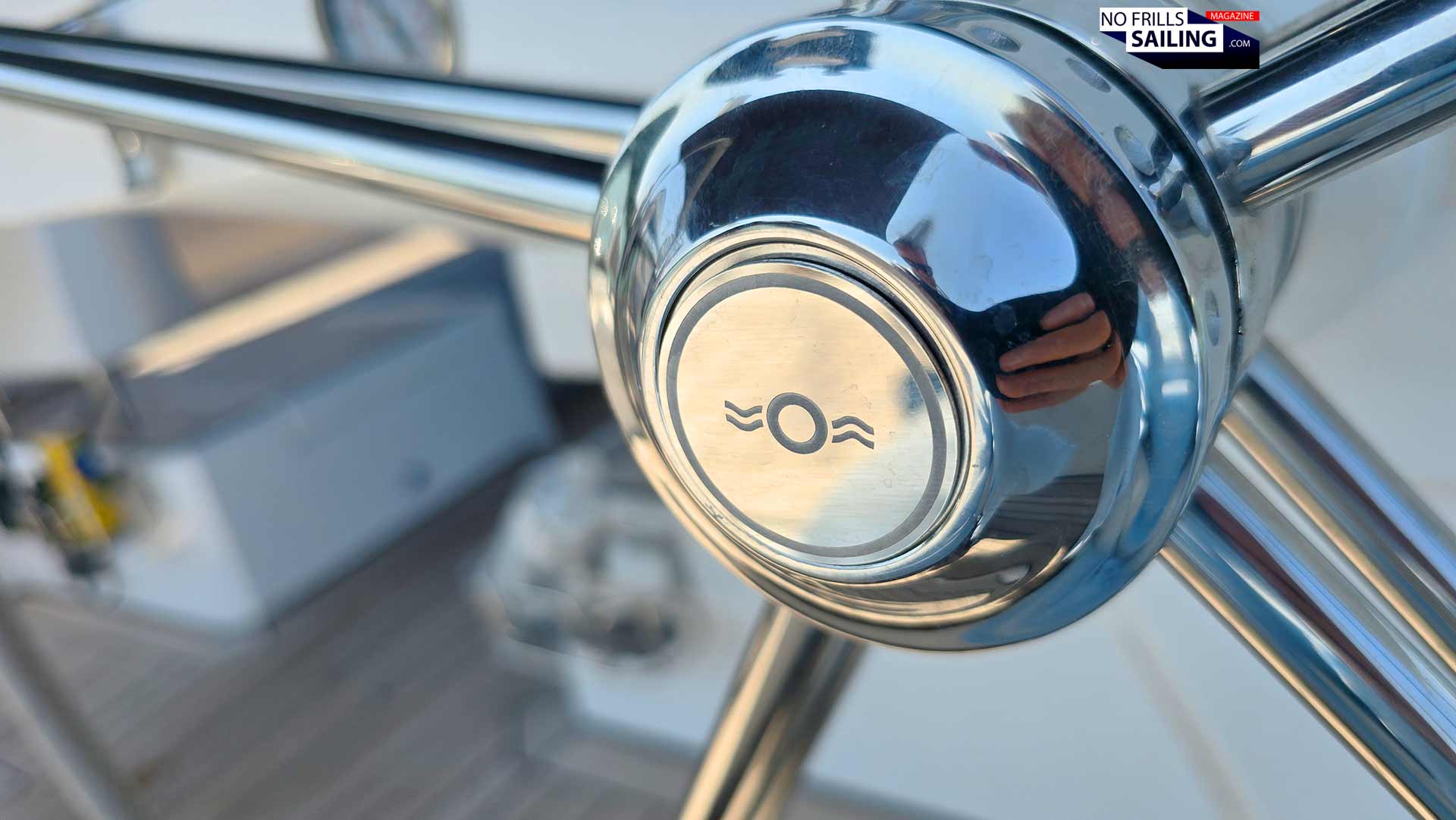
I first bring her to the wind as close as I can. We are still sailing close hauled, wind is blowing at a steady 15-20 knots. I find it very easy to determine where the edge was. Having seen the intricate steering system back in the shipyard a day before, I know that there are many pulleys/gear boxes and deviations in the steering mechanism from the rudder blades up here to the wheel. Yet I could literally feel feedback in the slight movements of the wheel which helped to determine what was going on below me.
What a great feeling this is!
In fact, this feedback was so good that I quickly got a feel for the edge and was able to sail her exactly on the spot. Which is exciting because I initially thought – and that´s my impression from other bigger yachts – the more a boat grows in size, the less feel there is in her steering. I guess it helped that we were sailing upwind with increased pressure on the rudders, so I´ve made a remark in my head to later check rudder feedback when we´d go upriver again, downwind back to the marina …
Everything is digital here
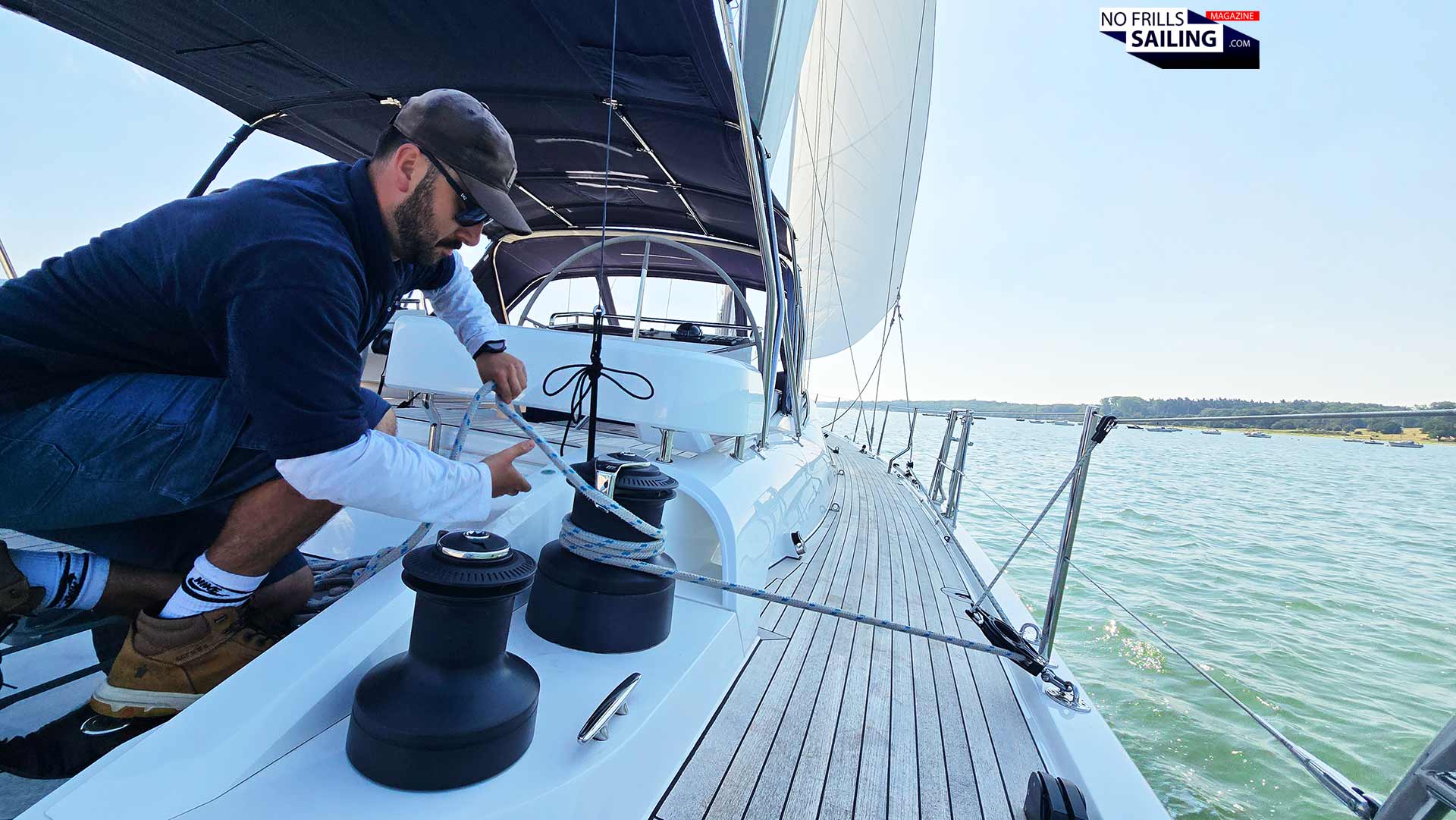
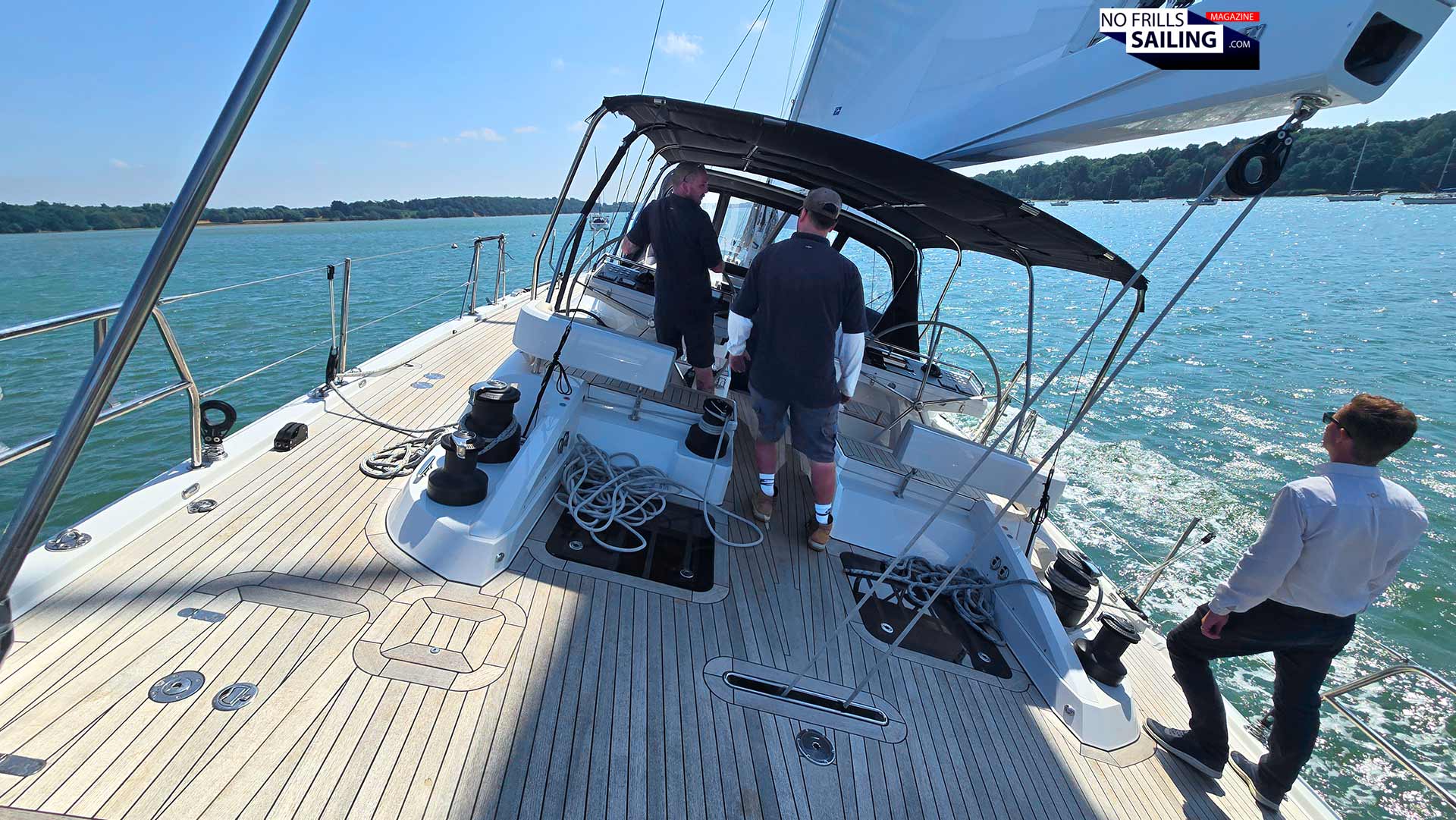
I performed two or three tacks, which was a no-brainer. Of course, the skippers worked the genoa´s sheets so that there literally wasn´t much left for me to do than just work the wheel. Nevertheless, by observing how they did it and judging from the clever winch-layout in the open cockpit, it would have been no problem for me to do it myself: The tack could be performed by the autopilot system while I´d do the sheet behind the steering seat. Easy peasy.
Imagine a real blue water trip …
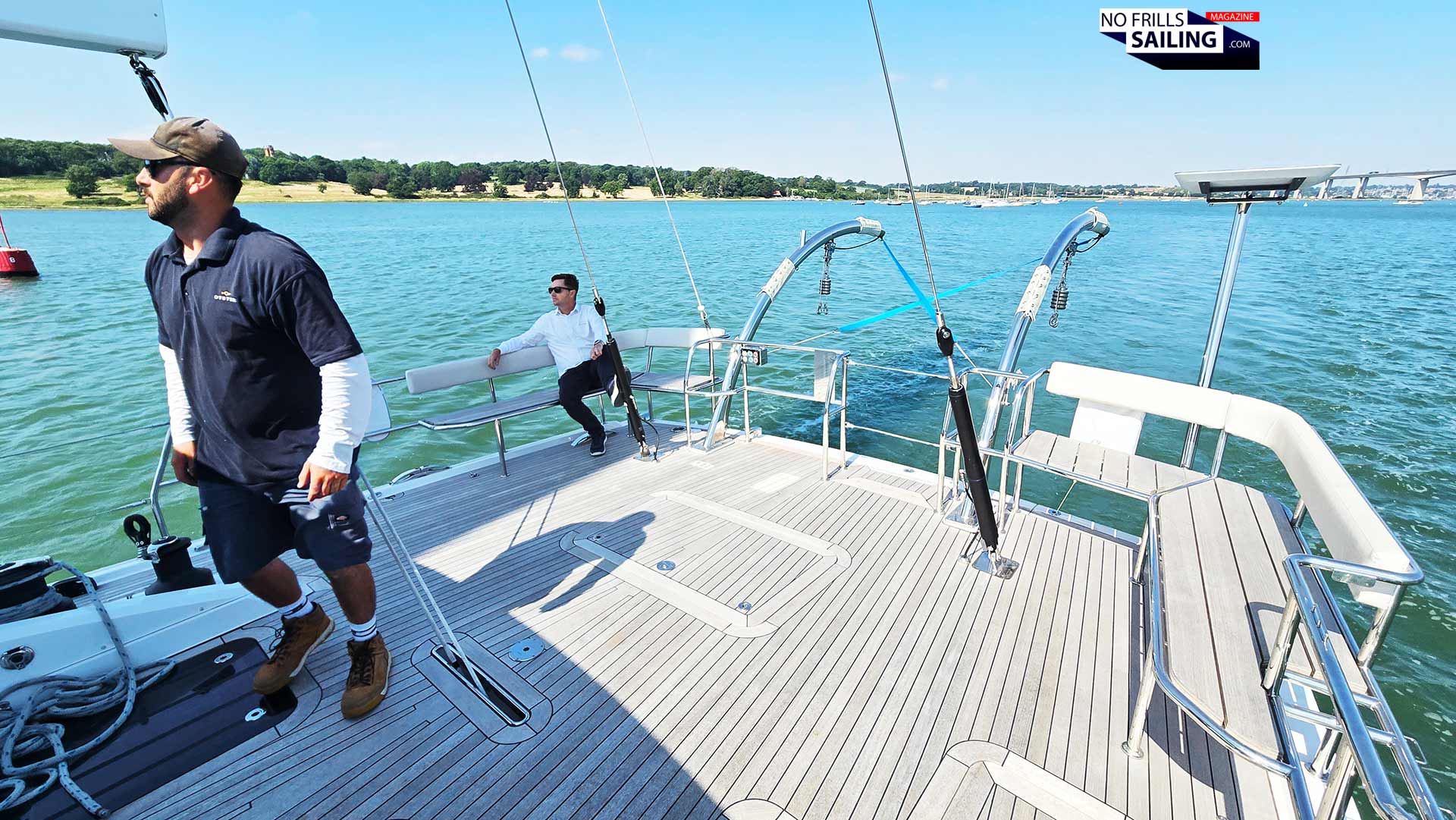
Now, a word on the sailing comforts. Remember my remarks about the decision between the extended-transom and classic versions of the Oyster? Well, here we are on the extended version. And now please take a thorough look at this literal dancefloor-like space aft of the cockpit available on the 675´s extended transom! It is just mind-boggling:
What a great chill area back here!
I have to switch to fisheye-lens mode in my camera to fully compress this section into one picture. It´s that large! I mean, I don´t know how many square meters this transom area covers, but surely more than the living room of my flat at home for sure! The amount of free space is staggering – and so is the variety of possibilities to utilize it. When at anchor or moored, this is a perfect spot for sunbathing or chilling out (as well as on the bow), but when sailing, this becomes even more attractive.
I could sit here forever …
I sit down myself on the pushpit-seats which are available all around this aft-deck area. It´s awesome! I have a wonderful view onto the whole boat from here, can watch the crew act and work the yacht, but also onto take-in the surroundings, the nature and the sea. These seats instantly become my most favorite place aboard that yacht: All that´s missing is a nice cup of hot tea now … imagine sitting here on a lush morning, watching the sun going up in the Pacific? I breathe in and out, batting my eyelids into the sun. And smile. Now, this is pure sailing luxury!
Big boat, but also big fun.
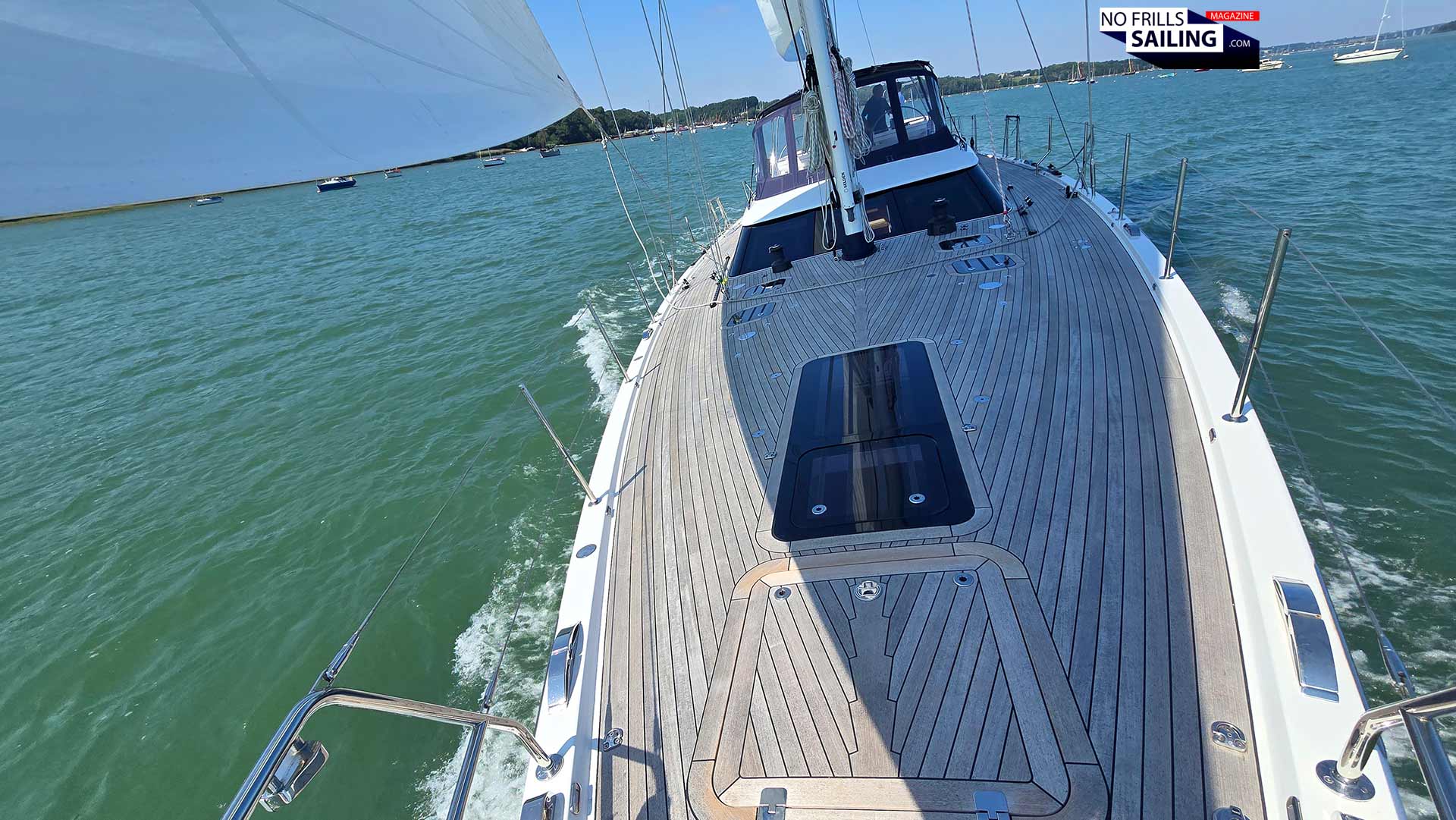
The boat ploughs gently through the choppy little waves of the Orwell river. Although we have a pretty fresh breeze here, because of literally no wind fetch, there´s seldom any true waves. Nevertheless, the hull of the Oyster moves in an absolutely sublime way, smoothly going up and down. There´s no abrupt nor any unpredictable, sudden movements. I can walk freely without grabbing to one of the handles, even in gusts she moves in such a way that you can easily adjust your walk to the ever changing surroundings. I am sure this will change once subjected to real oceanic waves, but it´s a good sign for seakindness anyway.
Comforts under deck while sailing
I´ve done a number of articles containing detailed walkthroughs in various Oyster yachts up to now: There´s the absolutely stunning Oyster 745, the smallest Oyster 495 then the most-built model, the Oyster 595 and some older models which are only available on the aftermarket now, like the Oyster 575. Nevertheless, these are all done during boat shows. I´ve never seen how an Oyster feels below deck when she´s underway. So, here we go …
Under deck: So, so nice!
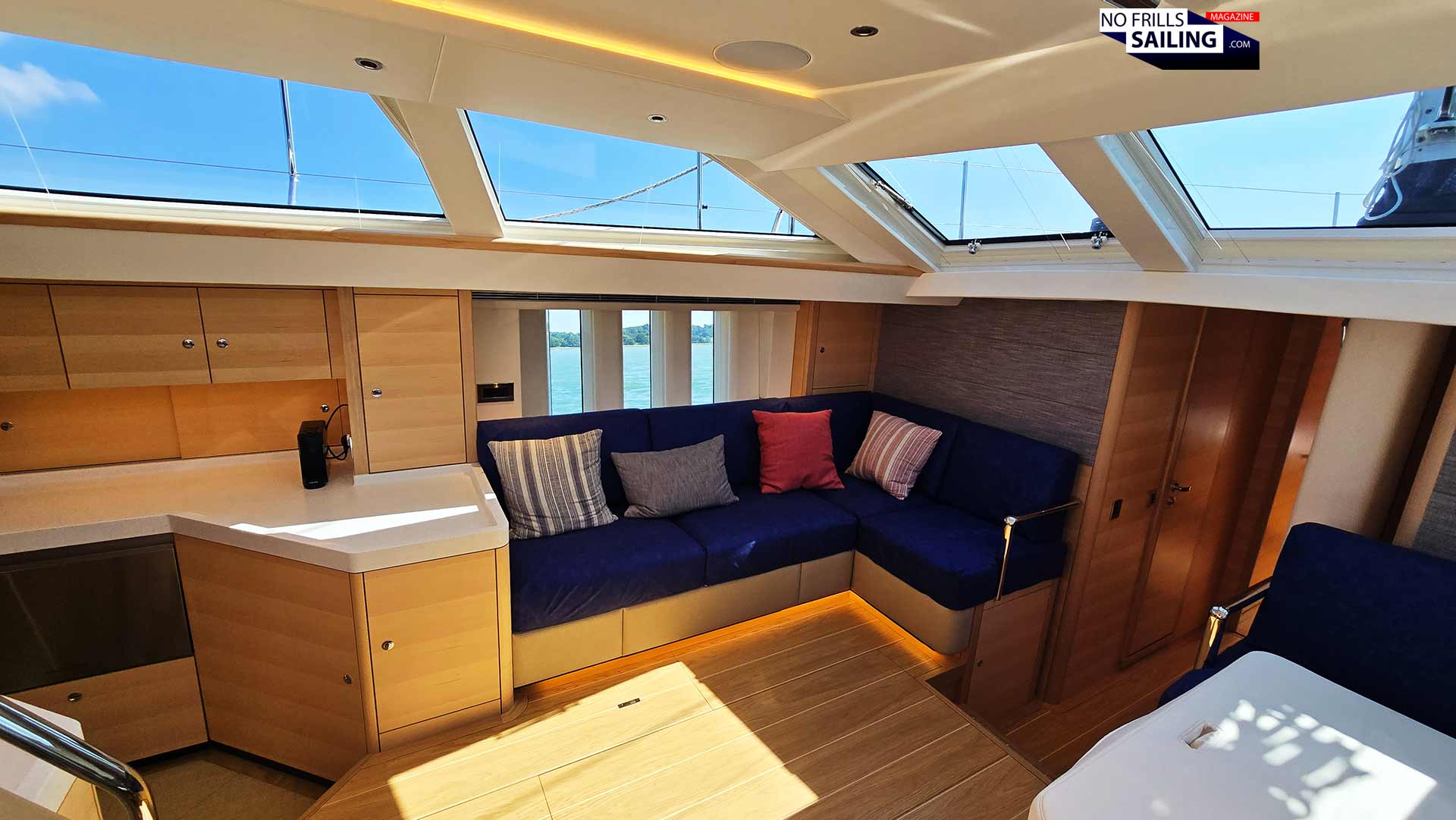
I hand over the steering wheel to Stephen again, checking out below deck. There´s a lot written already about the pros of a raised saloon or true deck saloon yachts, and once more I am realizing how much truth there is: Boats in such a configuration offer vastly more interior comforts than “classic” boats, it´s mind-boggling. The amount of natural light literally floating the whole ship is staggering. You simply do not need any artificial light source whatsoever once the sun is up.
Owner´s paradise …
This also helps to cope with sea sickness, which I am sure is a major problem for many sailors, crew and guests. I myself do suffer from sea sickness every time I cast off for the first 12 to 24 hours till I get my “sea legs”, my fiancé is cursed with a heavy disposition for sea sickness, which really impacts how we sail. But being able to see the horizon in virtually every cabin and location here aboard the Oyster will have a positive impact, I am sure. Apart from that, it´s absolutely beautiful!
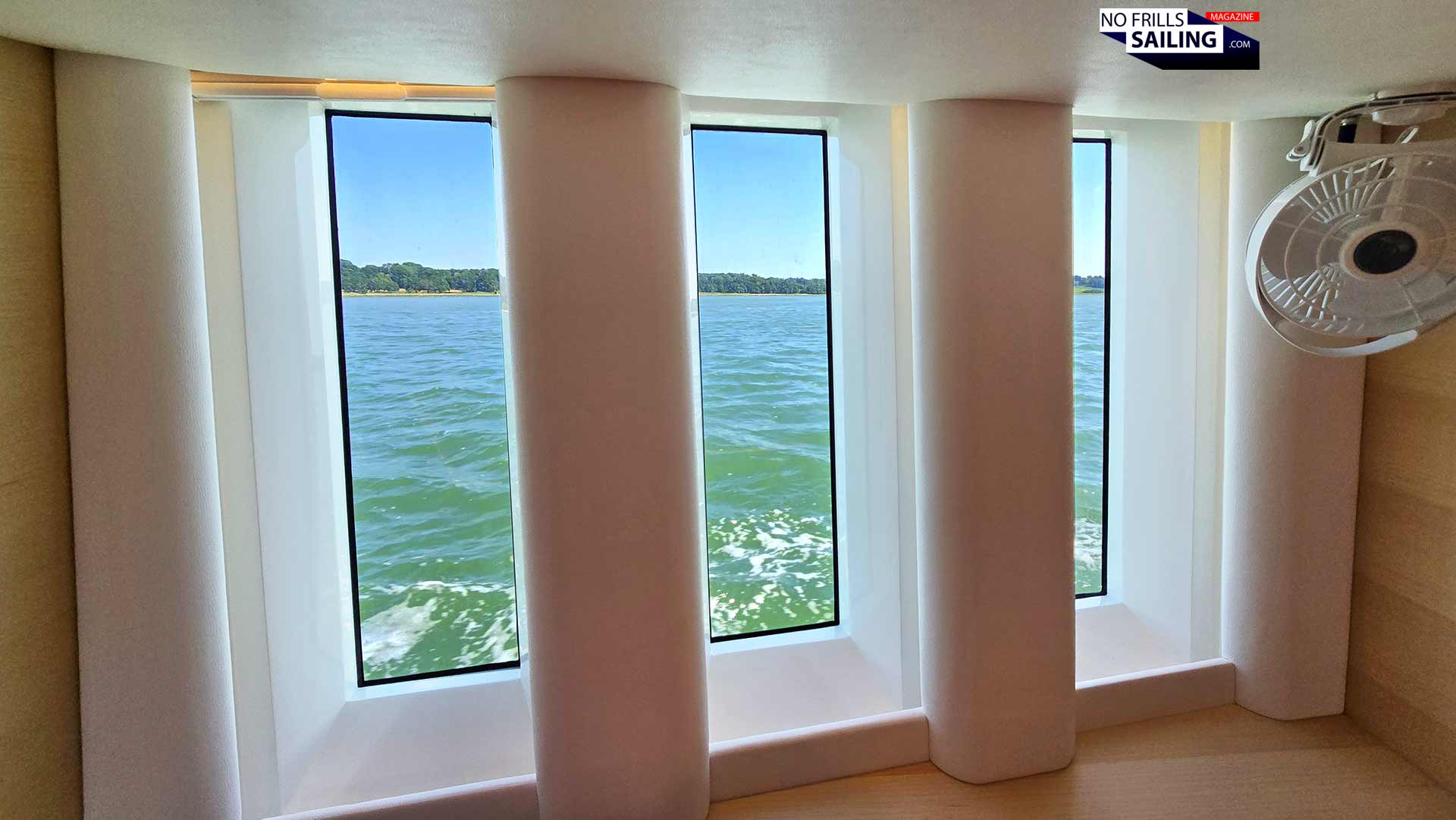
The wonderful seascape windows
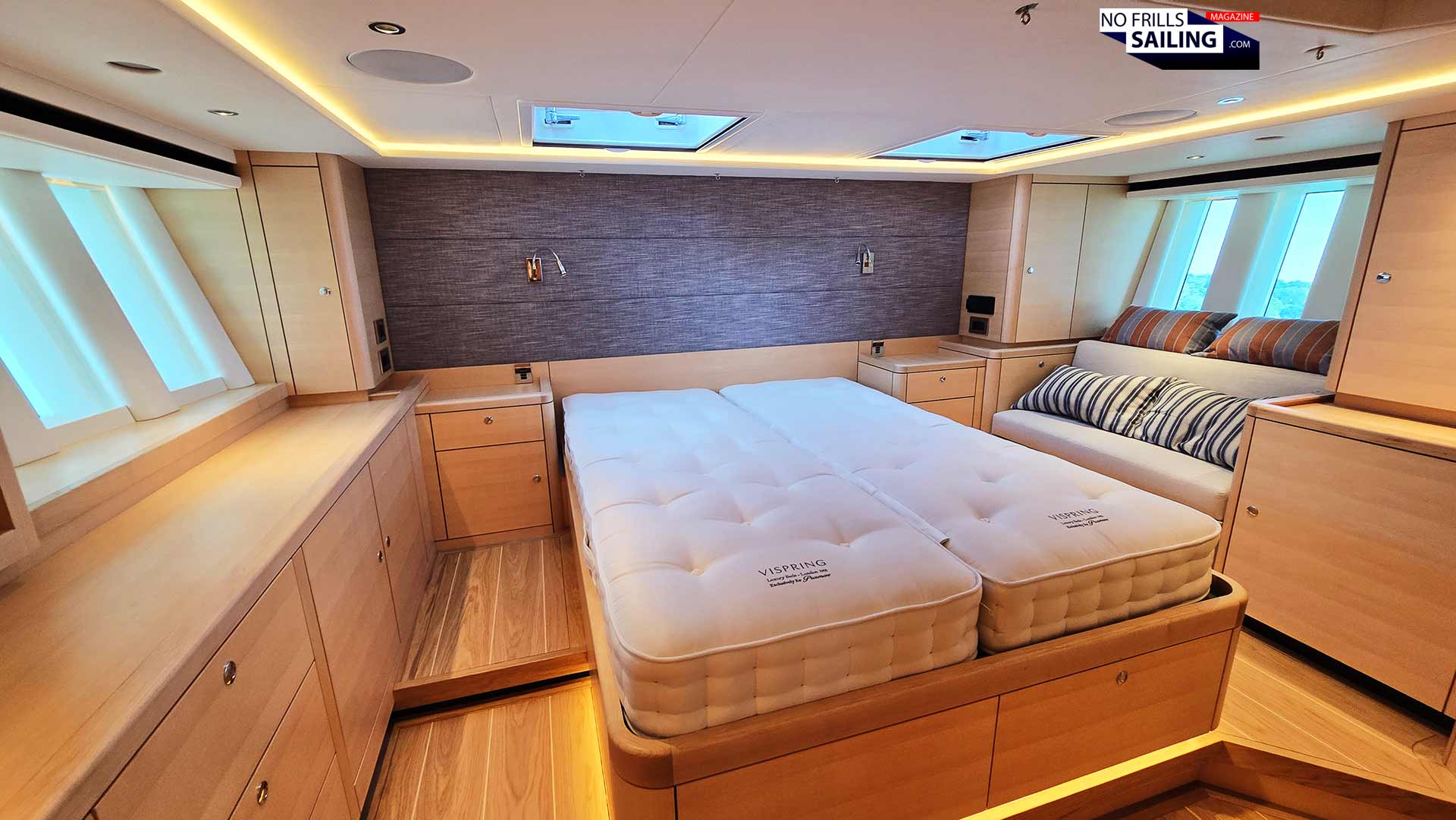
Especially Oyster´s signature “seascape windows”, both apparent in the saloon and in the lush owner´s appartement in the back of the yacht make for this very, very special Oyster-atmosphere. I remember sailing an Oceanis 46.1 a few years ago with my then girlfriend, to Greece: Waking up in the owner´s cabin and being able to see the outside anchorage because of the big windows was always a very special moment: It cannot compared to anything on shore. Now, standing back here in Oyster´s owner´s suite, and imagining myself in here … is a notch up in luxury!
… sleeping like a king.
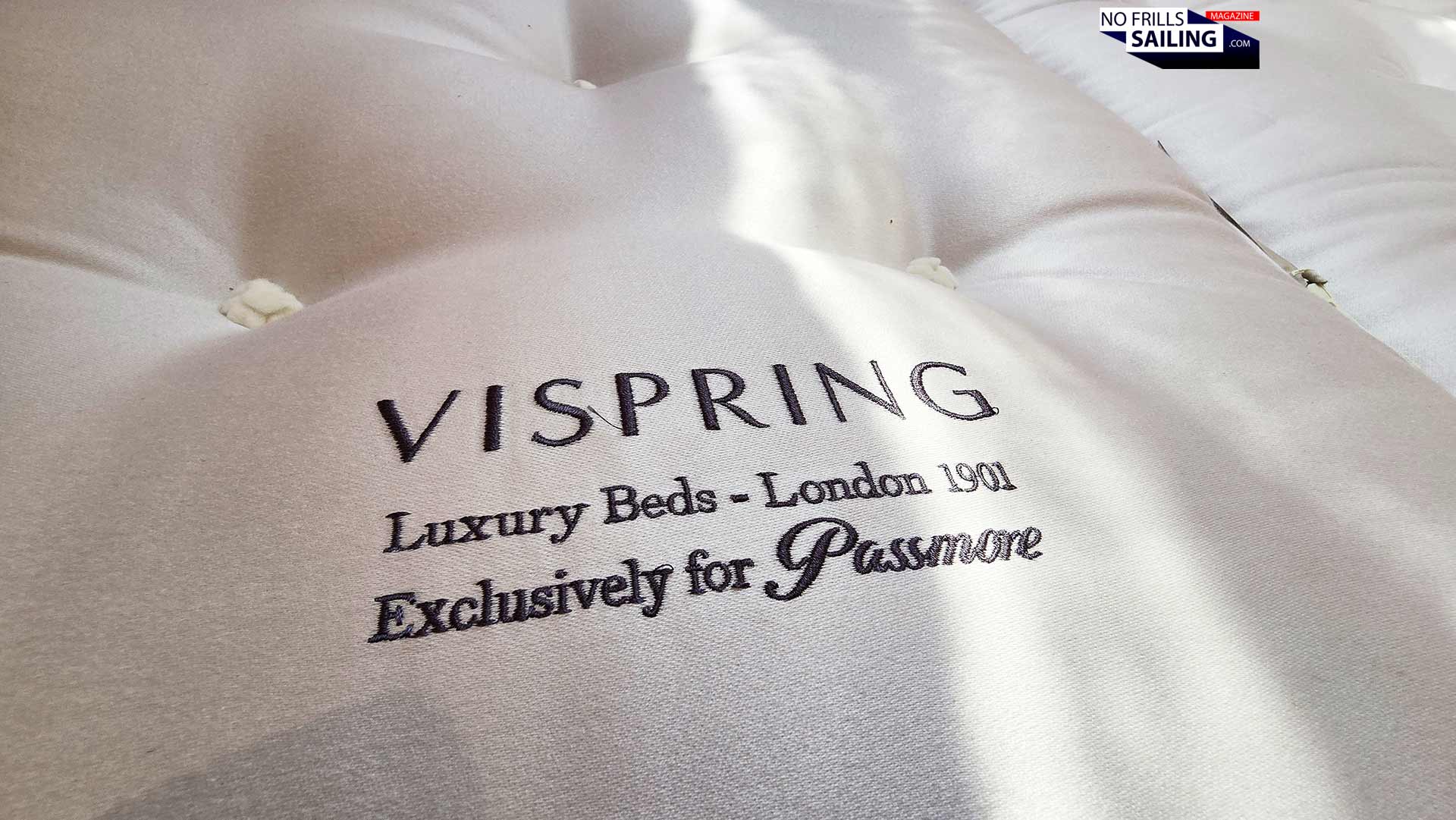
For which these yacht are made in the first place, right? The aim of an Oyster is not to pursue performance figures at the expense of comfort, but to combine rewarding sailing with exceptional comfort and bluewater capability. It´s a sailing loft that will bring you to the most adorable places you can imagine – hosting you with the highest possible comforts. I mean, an Oyster can be equipped with Vispring mattresses. That is the legendary ultra-luxury bed manufacturer of Great Britain, worldwide renowned for inventing the pocket-sprung mattress more than a century ago! This is widely considered to being one of the world’s premier mattress makers. Any more questions?
Going back to port
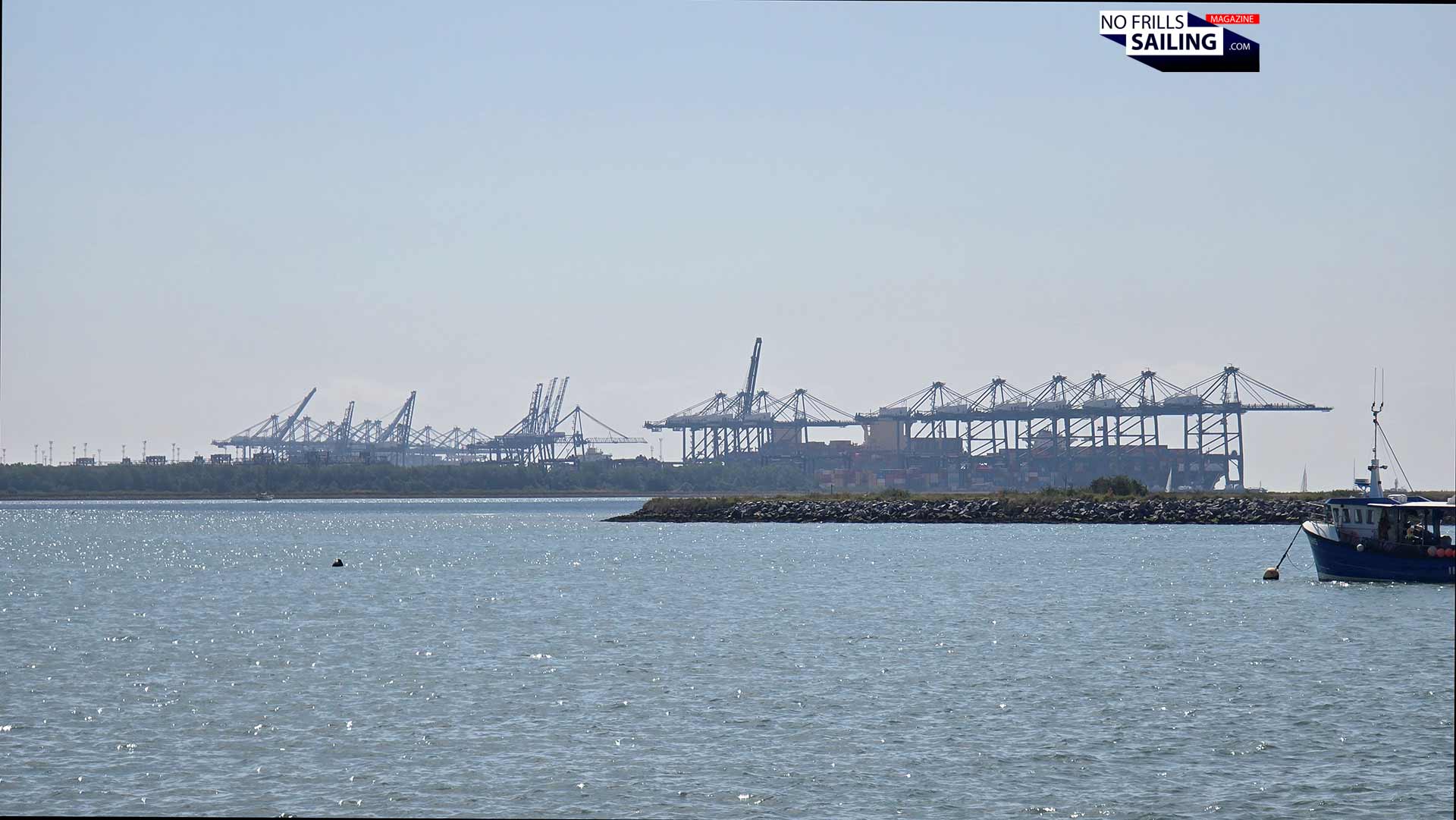
Almost one and a half hours into this nice forenoon sailing trip we were about the arrive at the estuary of the river Orwell. I could clearly distinguish the impressive quays of Felixstowe port. Stephen asked me whether I´d wanted to sail out onto the North Sea as well, but I figured not to stress his and the skipper´s time all too much – in essence, I had seen and experienced what I wanted for now.
Felixstowe in sight, time to go back.
So we gybed the yacht, which is a no-brainer with hydraulic inhaul, the gentle steering of the autopilot and skilled easing of the mainsheet by one of the guys. Just off Suffolk Yacht Harbour, which is the first marina to starboard side after securing the calmer waters of the Orwell coming from the seaside, the Oyster started her sprint home. And indeed, it was to become a proper sprint! Not that we shook out the reefs – in the end this is a sold boat belonging to private owners – but because of the downwind point of sail now fully unfolding its power. Even reefed the yacht´s speed hovered around 8 knots SOG, with occasionally hitting two-digits when gusts gave a little extra push.
Is this a dream job? It is!
Hoisting a gennaker or the spi would have been a bit crazy in wind speed like these, nevertheless, the skippers emphasized that this would be possible with the right type of sail – none of which was aboard today. Anyway, I took my pleasant seat in the back of the boat and really enjoyed having the sun directly on my nose. It´s always such a difference between the movement, heeling and at times more “violent” motion of a boat that is sailing upwind – and the gentle, almost “windless” calm serenity of sailing downwind.
Speaking of serenity: If you don´t want to miss any new article published in NO FRILLS SAILING, why don´t you just invest a few clicks and subscribe to the monthly newsletter? That´s one single email in your inbox at the end of every month, containing the shortcuts to all articles and new films ready to explore on YouTube. I am happy with every new subscriber! Now, back aboard the Oyster …
As easy as ABC
We reached Orwell Bridge in no time. The nice thing about inmast-furling mainsails is that you can hoist, reef and retrieve them without really having to put the boat´s bow into the wind. So the guys put some revs on the Diesel and simply furled the main gently back into its mast, same for the genoa that went back onto the forestay in a matter of minutes. Then it was time to land the yacht, not after circling her back into the bringing her into the most rearward corner of Fox´s Marina again.
Parking the big lady: Easy.
This time our berth had changed over to the left hand side, so we quickly remodified the fender setup and mooring lines from portside to starboard side. All the while our skipper very skillfully and slowly maneuvered the fat yacht in between the other boats. This might look hair raising – and it truly would be if been subjected to this for the first time, I am sure – but he did it with such a confidence and concentrated focus that it was a masterclass in boat handling. Again, a hooray to the bow- and stern thrusters, which, in the end, he didn´t had to utilize all too often.
Literally 1 meter to either side …
The nice thing about bigger (and heavier) yachts is that they are not as easily subject to a gust pushing as lighter boats. With a meager meter to either side of the yacht, and 4 million Euros on any side, there was indeed no margin for error. That said, the boat behaved just awesome, as if she was running on tracks or something.
Thanks to bow and stern thruster
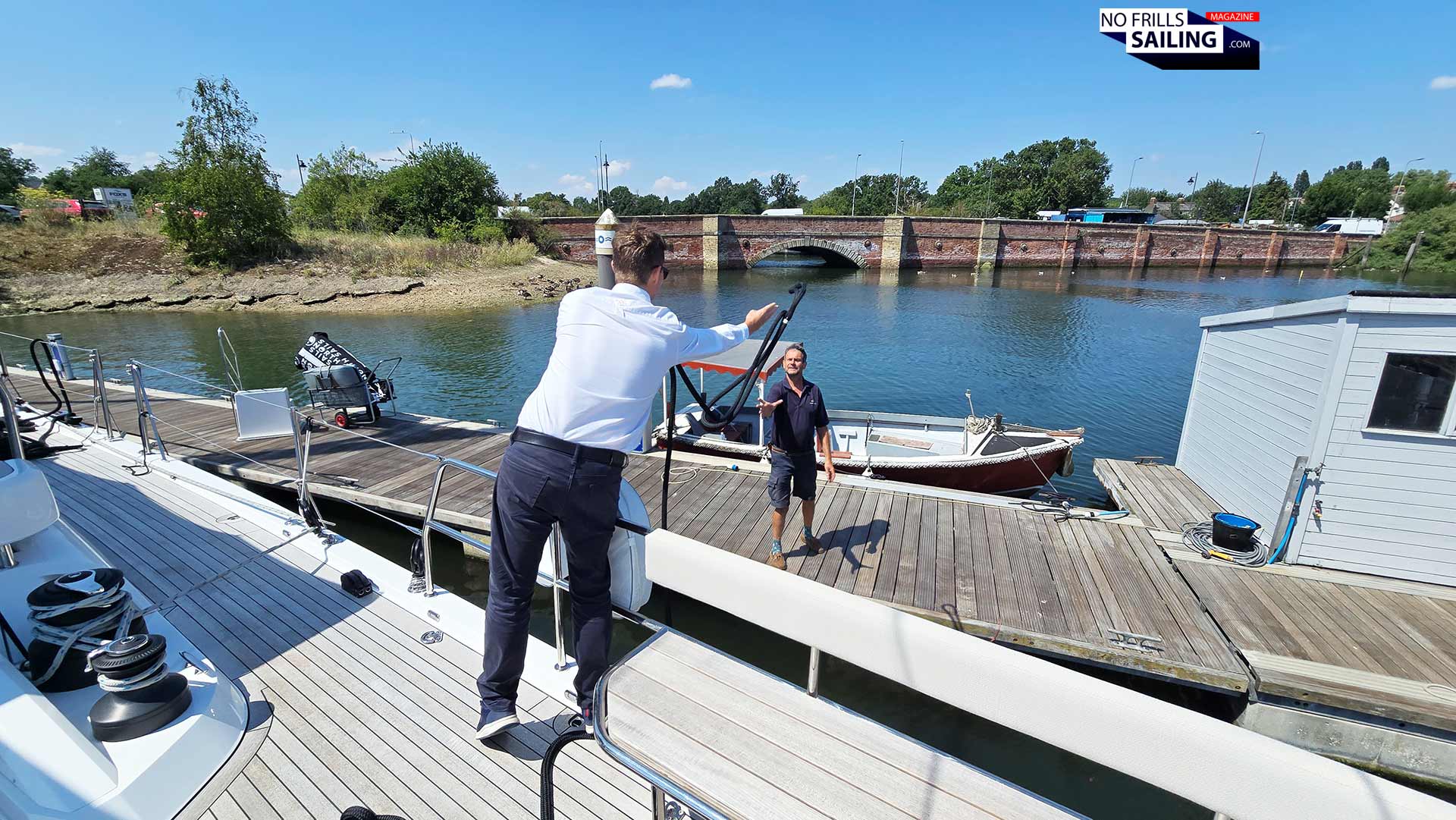
Once our transom had cleared the boat, we stopped and the skipper pushed the boat onto the pontoon ever so gently. Stephen threw the mooring line to secure the yacht and in under half a minute the boat was tied up again alongside the pontoon. We´ve been out for about four hours and – honestly – I could have moved on forever. 70 feet, that´s really a boat size that feels like a proper “home” on the water, for me, even the Pullman cabin would have done it!
Advertisement
What have I learned today?
So, what can I say about sailing an Oyster? In the end, it was everything I dreamed of and hoped for – and so much more. We all know that “length is running”, so it was no surprise that her sailing performance speed-wise was pretty good. Even for a high-volume cruising yacht, I would say. I was surprised about how nimble she felt on her rudders, especially her reaction time to steering input was impressive. Not quite, but a bit like a dinghy. Really! What I also found quite revealing was the ease of handling: She is a big damn yacht, yes, but with a bit of training I am sure a dedicated couple can easily handle this boat without a need for a skipper, let alone a crew. Maybe this is the “last” boat size you could handle as a couple?
If I´d had a wish …
What I also learned – not so much whilst sailing, but over the course of my whole 2-day trip here to Wroxham and Ipswich – was that this luxury sailing community is by far not as elitist and … how to put it? … arrogant as one might think. Every single person I´ve had the pleasure to meet here, from the Oyster staff to the skippers, the owners and also the people from Fox´s Marina turned out to be quite lovable! Nose up high? Class consciousness or bourgeoise attitudes? None. Whatsoever. Instead, it´s a vivid, thriving and very pleasant bunch of people. “Family” is the next closest word to describe it, I think.
Calming down at Fox´s Bisto
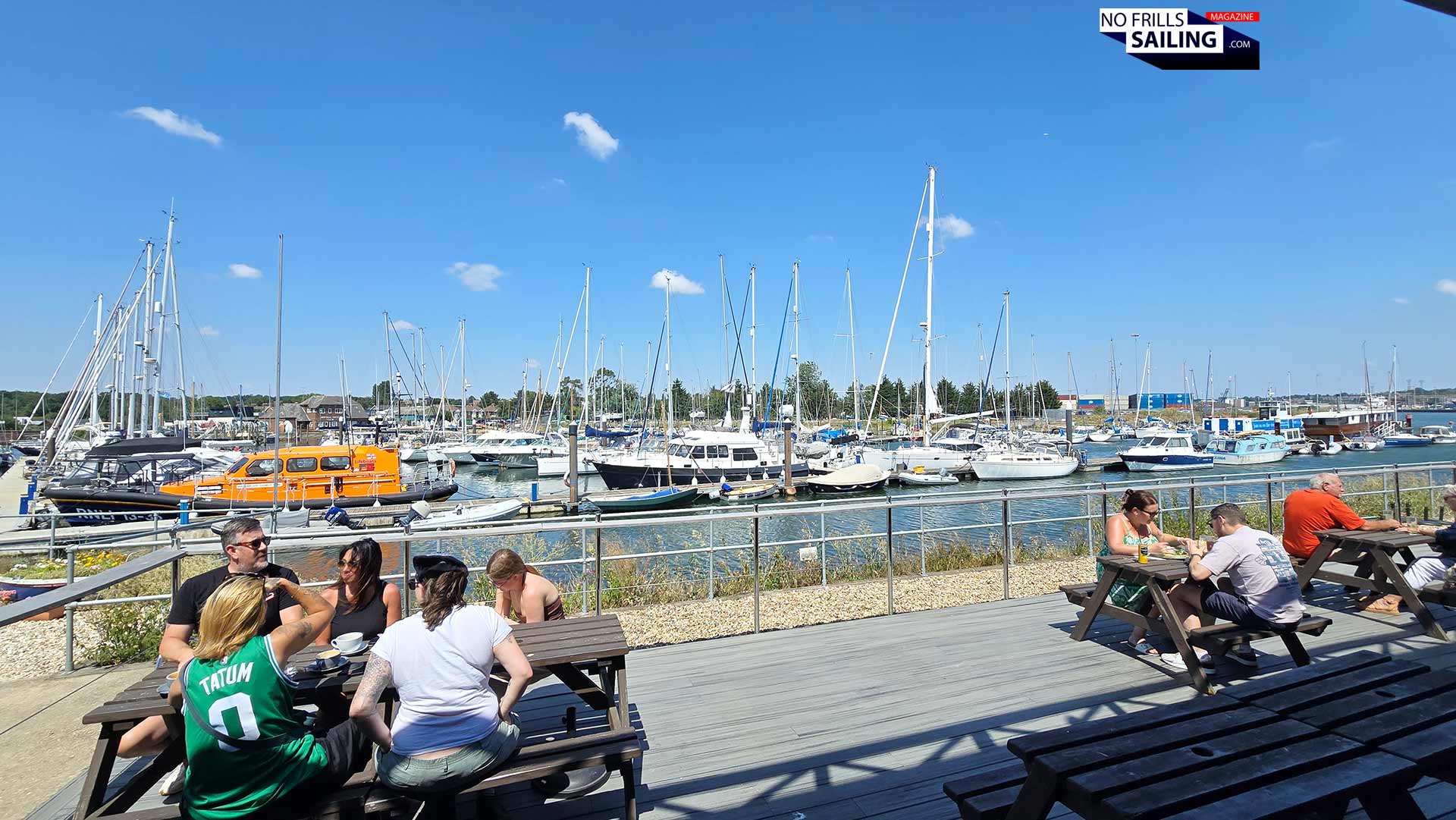
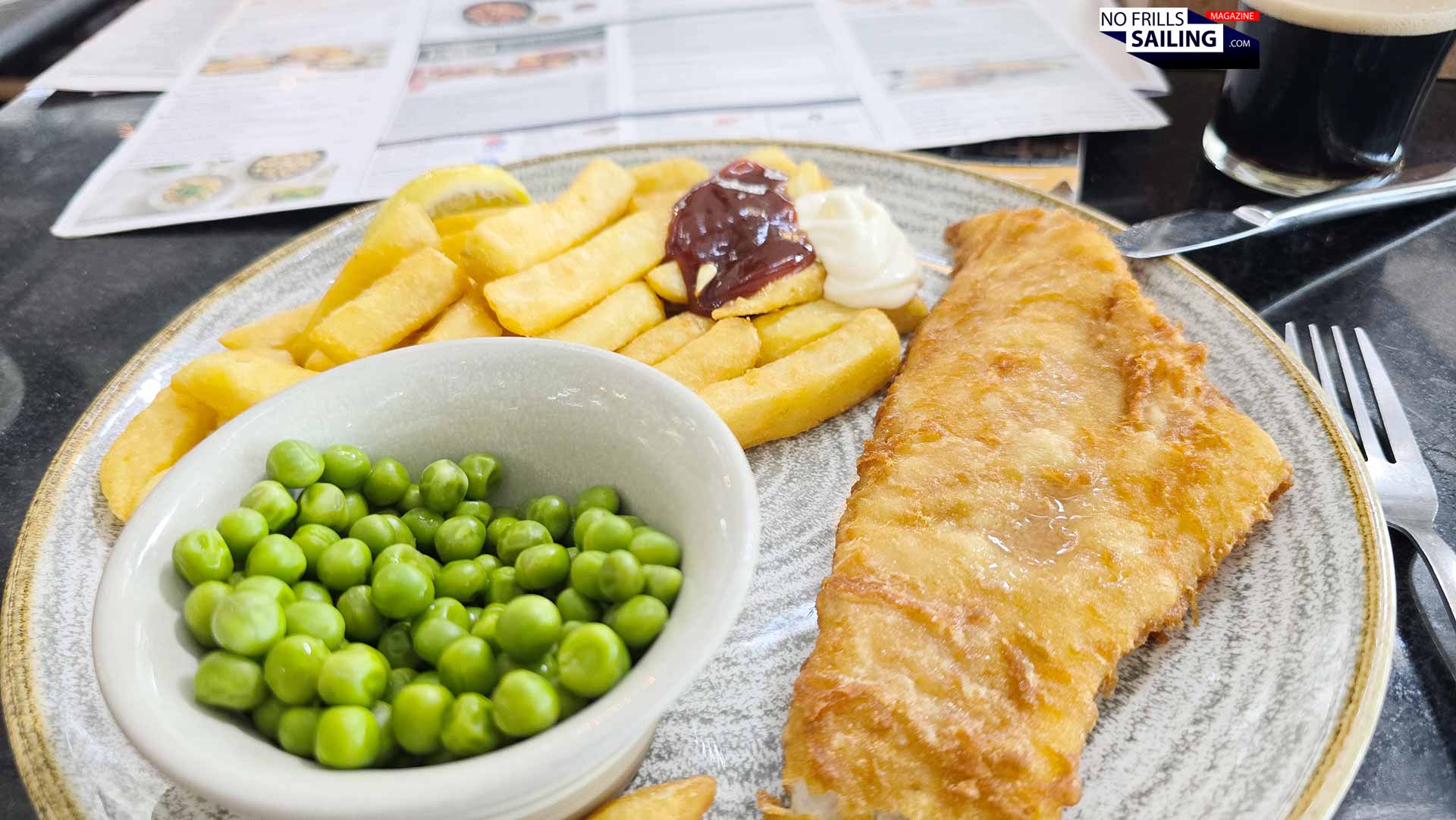
So whatever impression you might have from Oyster, maybe seeing them at Cannes or Monaco boat shows – it´s not the real thing. These are very, very cool guys, who are absolutely proud and passionate about what they are doing. Be it the carpenter in Wroxham or the CAD-engineer, be it the skipper commissioning a yacht or the managers representing the brand. I felt welcome. And I am sure, so does everyone knocking at their doors wanting to learn more about their marvelous boats. I mean, after the trip we just met up at the little bar downstairs directly underneath the Oyster office to enjoy, of course, a nice and fresh lunch of fish and chips alongside an ice cold local brew. How much more English can it get?
It won´t get any more British than Oyster.
Yes, sure, I am biased. You know it: I have come out as an Oyster fanboy many years ago. But honestly, what I´ve seen in the shipyard as well learned here during my day in Ipswich convinced me once more that if money would be there, if time wouldn´t be a problem and my sailing route would lead me to all the nice locations the Coconut Route can offer, I am 100 percent sure that my boat, would be an Oyster. Your´s too?
You might check out these related articles as well:
Roaming the Oyster shipyard in Wroxham, parts 1, 2 and 3