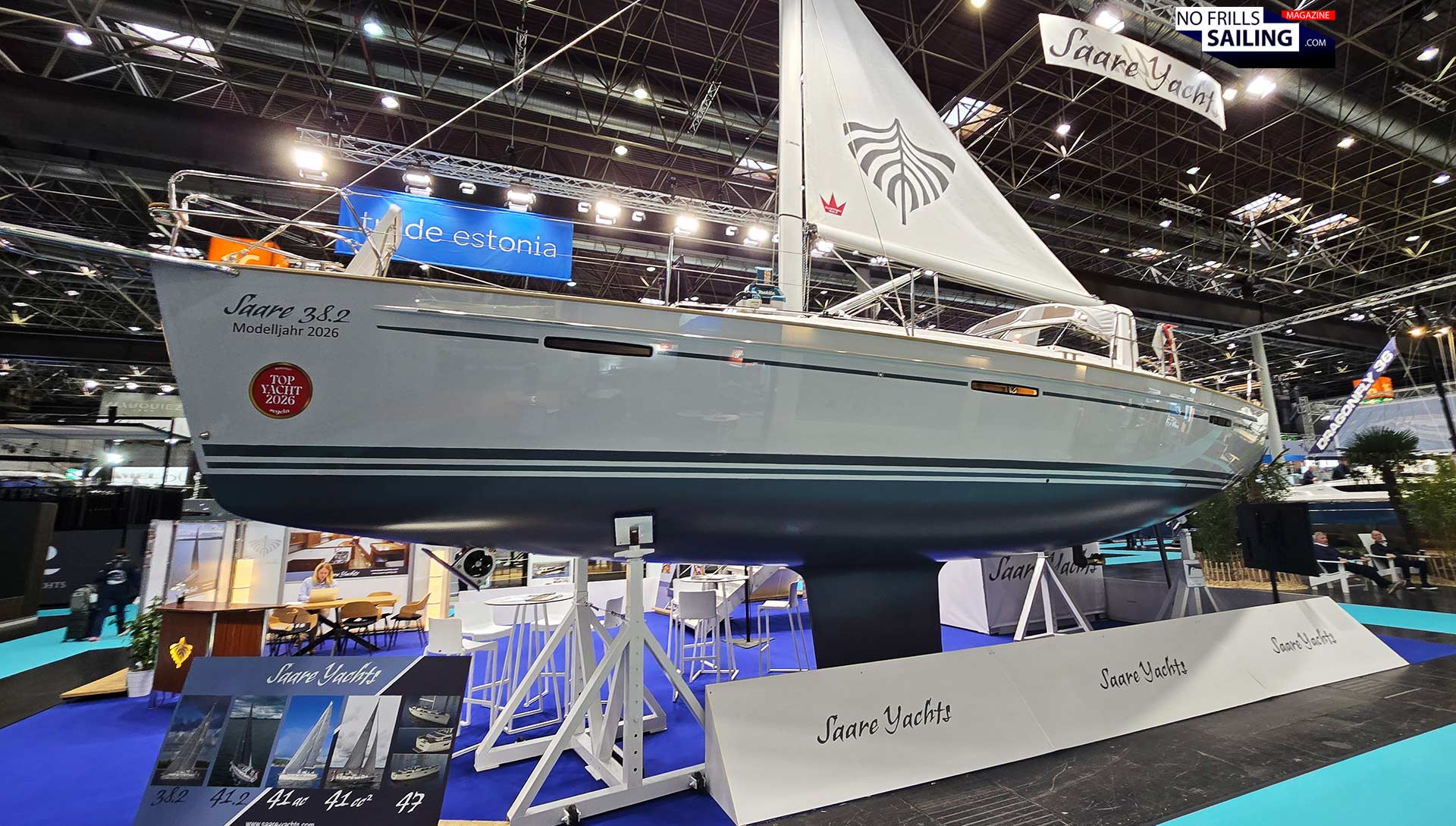
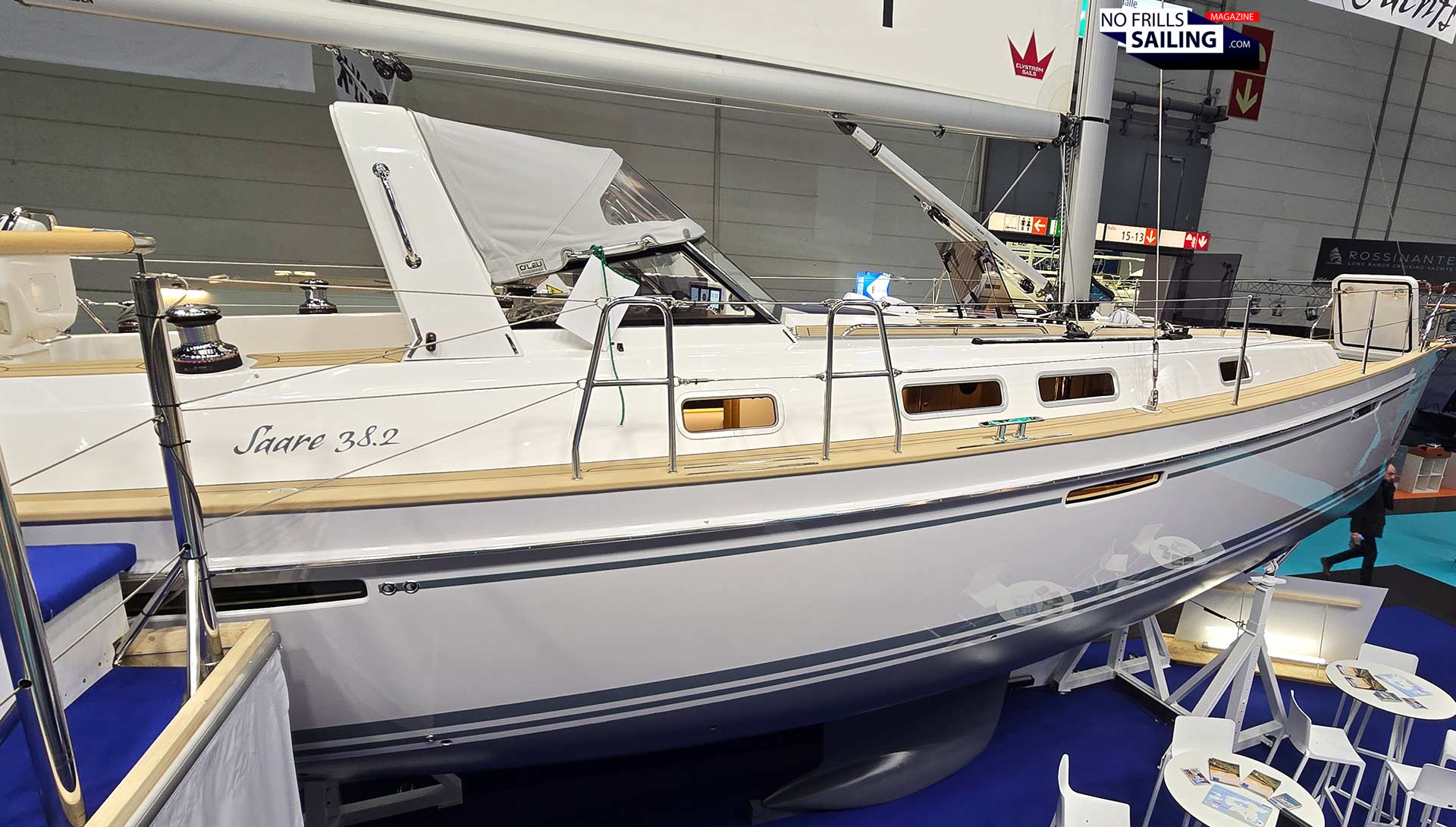
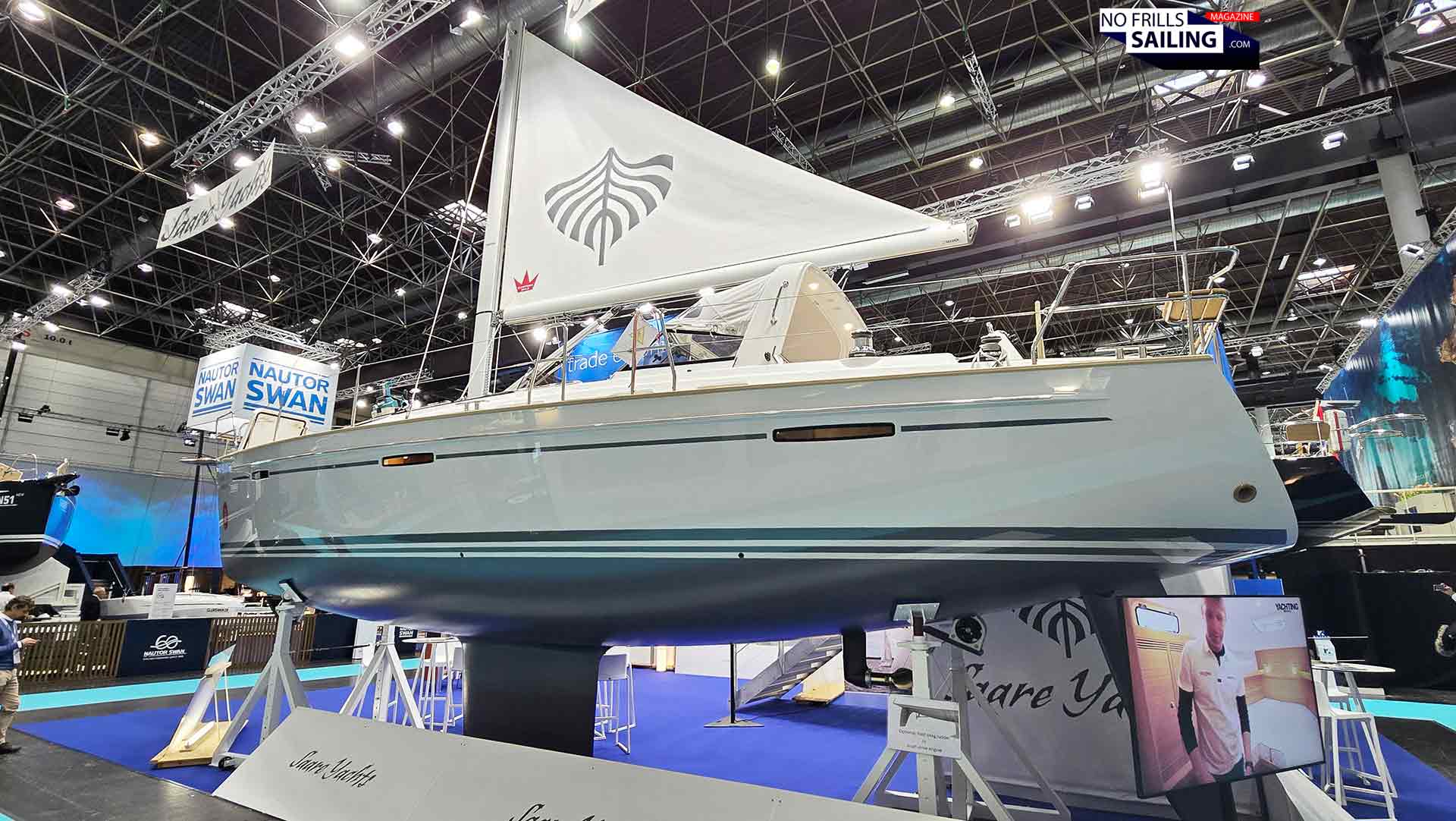
As the seventh boat brought to you from this year´s edition of Boot Duesseldorf I went for a brand you´ve probably never heard of. And yet, these yachts belong to a very, very special breed, considered a little gem amongst those who know. Saare Yachts is a brand which belongs to a German company, the shipyard, which was founded back in the days after the Cold War ended on the Baltic Island of Saaremaa. Strategically well positions in the triangle between Stockholm to the West, Helsinki to the North and the newly formed Baltic states with Germany in the East and South.
Classy lines, sturdy and sleek: A Saare!
Starting in 1997 the shipyard build boats for the very, very renowned and beloved brand Finngulf, a Finnish brand that sadly disappeared in the aftermath of the 2007/2008 crisis. Since then, a German sailor and entrepreneur took over and started with a brand new brand: Saare Yachts. They didn´t simply went on building the Finngulfs (this had been tried a few years later at a different place, but it did not work out). Instead, they employed the Finngulf-designer, the Finn Karl-Johan Strahlmann, and as such the new Saare-style was born. It´s really a fascinating story, part of the rich Scandinavian sailing heritage, and I will later come back to this in more detail. But at first, let´s board this new Saare 38.2!
Let´s start below deck …
Advertisement
To be honest, the boat was evaporating such a tempting odor of fresh Teak wood and other timber scents that I immediately followed the enchanting aromas and went down below straight away. As you may have already seen, the Saare 38.2 (and all the other boats of their range starting at 38 up until 47 feet) are not “modern” or trendy in the sense of those Med-style, wide-sterned cruiser designs. The Saare rather follows a very classic “Scandinavian” design approach – and so does her interior.
What an entrée!
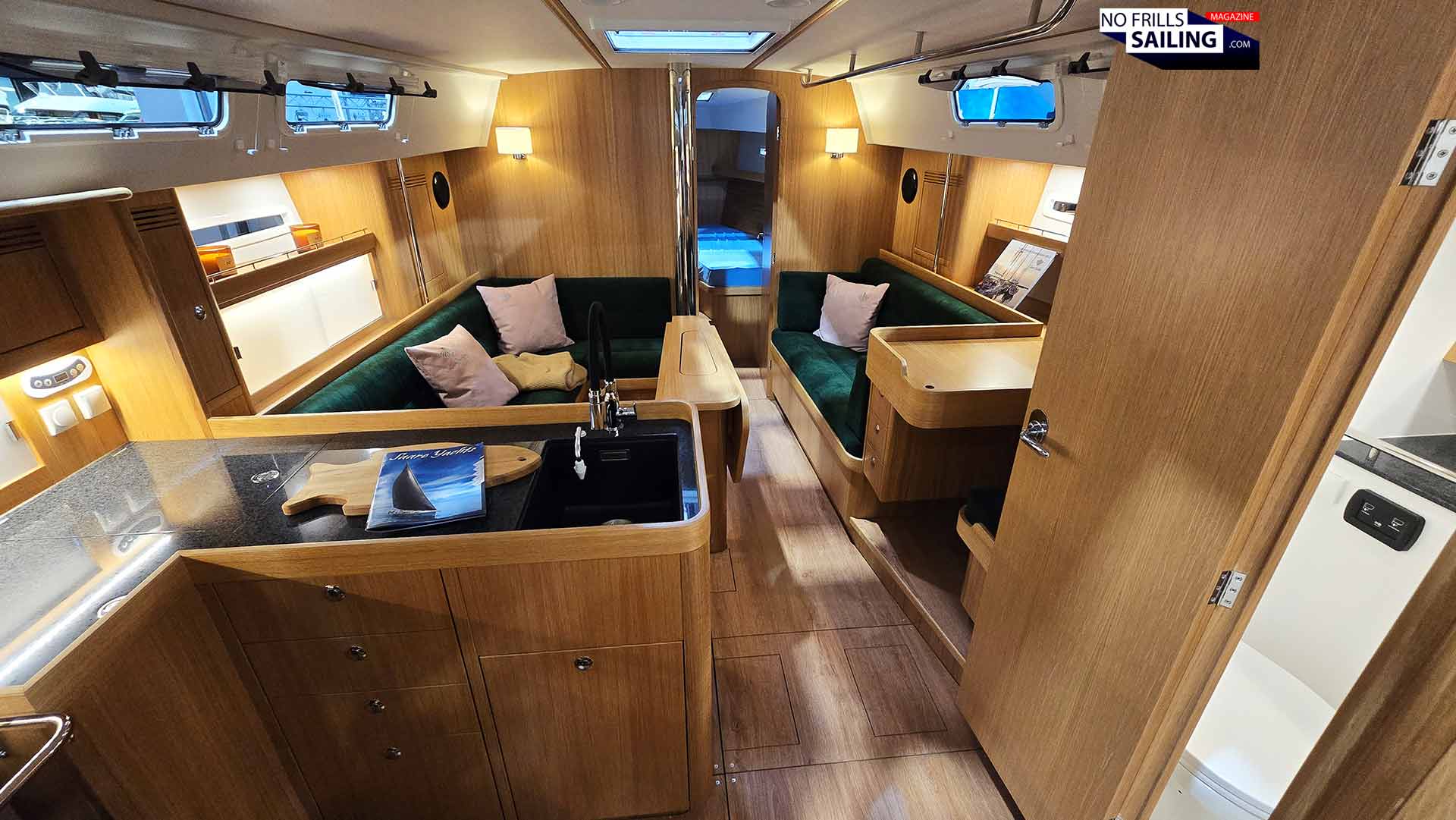
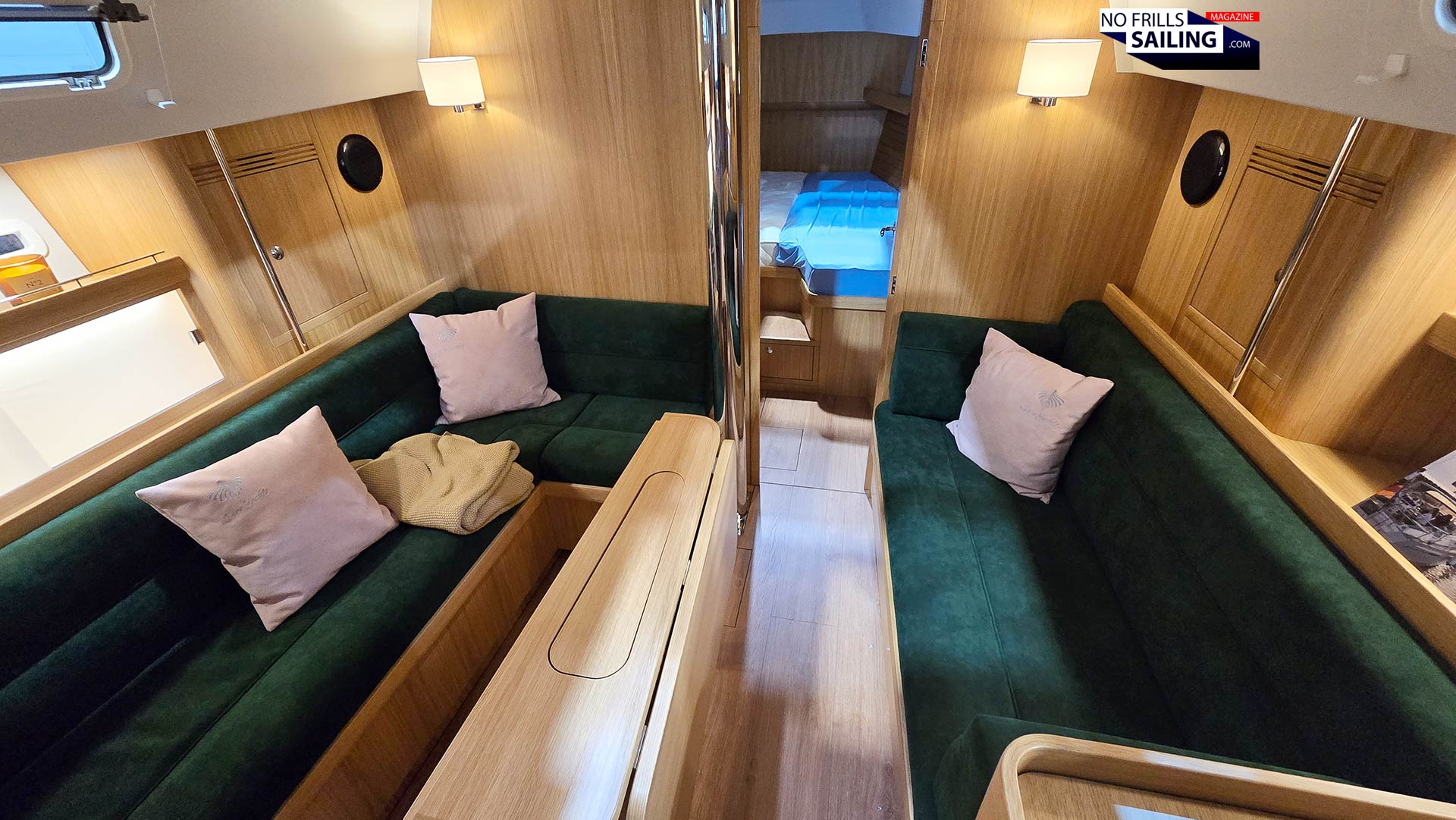
I am welcomed by an all-wood interior. Really, there is not a single square inch of bare GRP plastic left free. It´s a boat you only see seldom these days. She must have been launched only days, if not hours ago as the scent of fresh joinery and real wooden parts was absolutely mind boggling. In this it became much more apparent to me how much new GRP boats stink, really, when they are launched fresh out of the shed: Styrol and other fumes will more or less torment your olfactory system. Not here, of course.
Very spacious & comfy: Cushions!
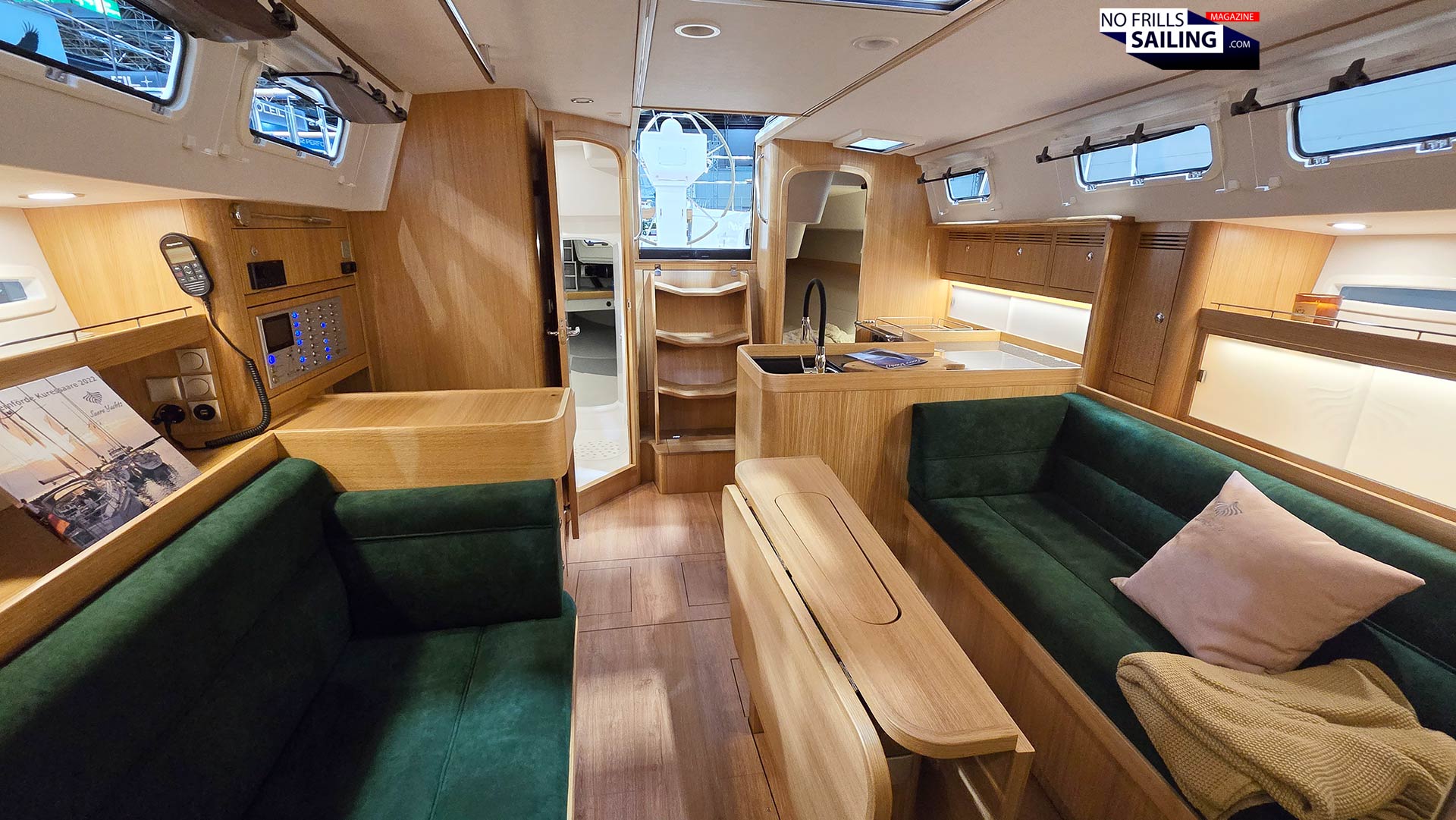
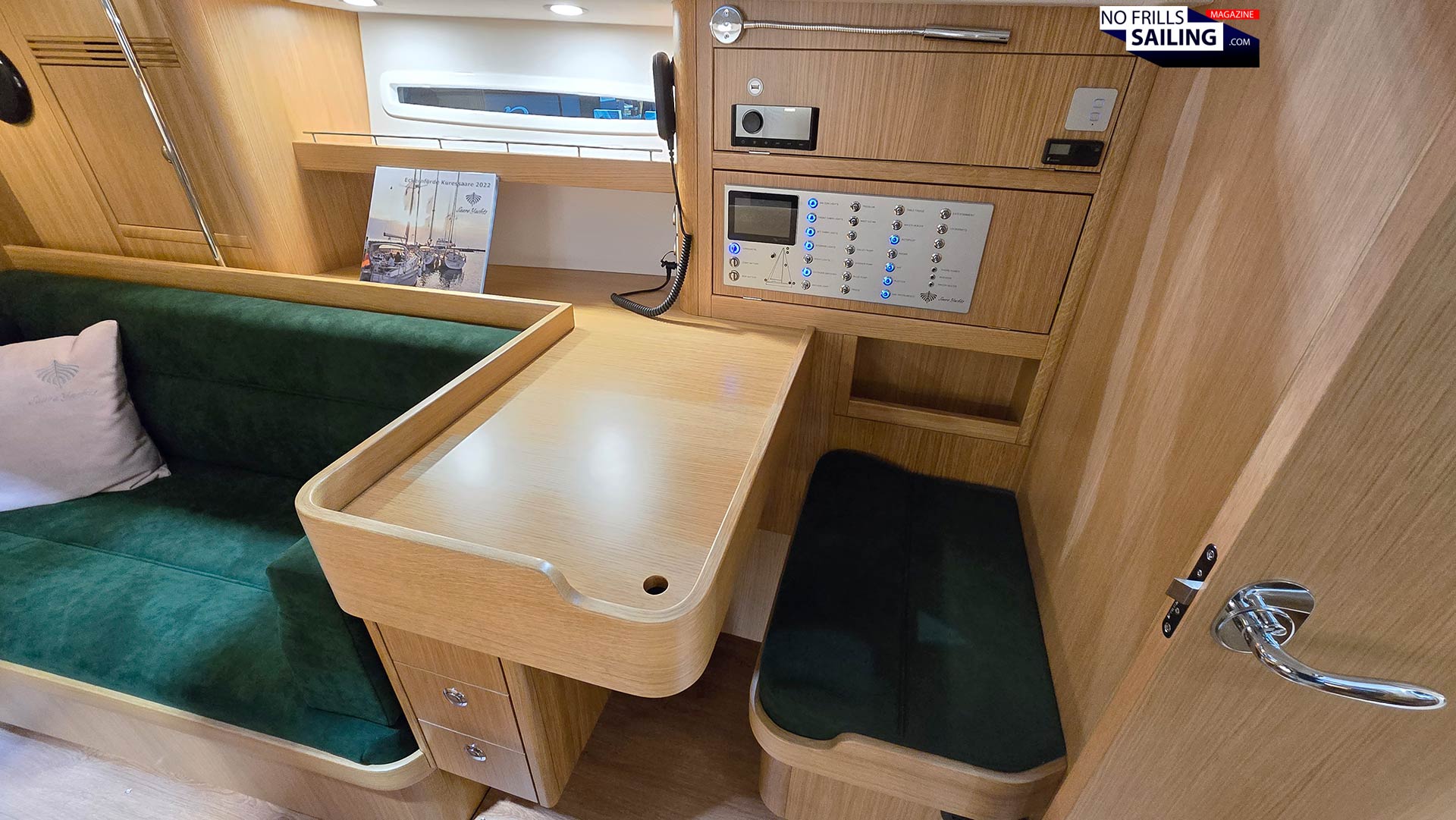
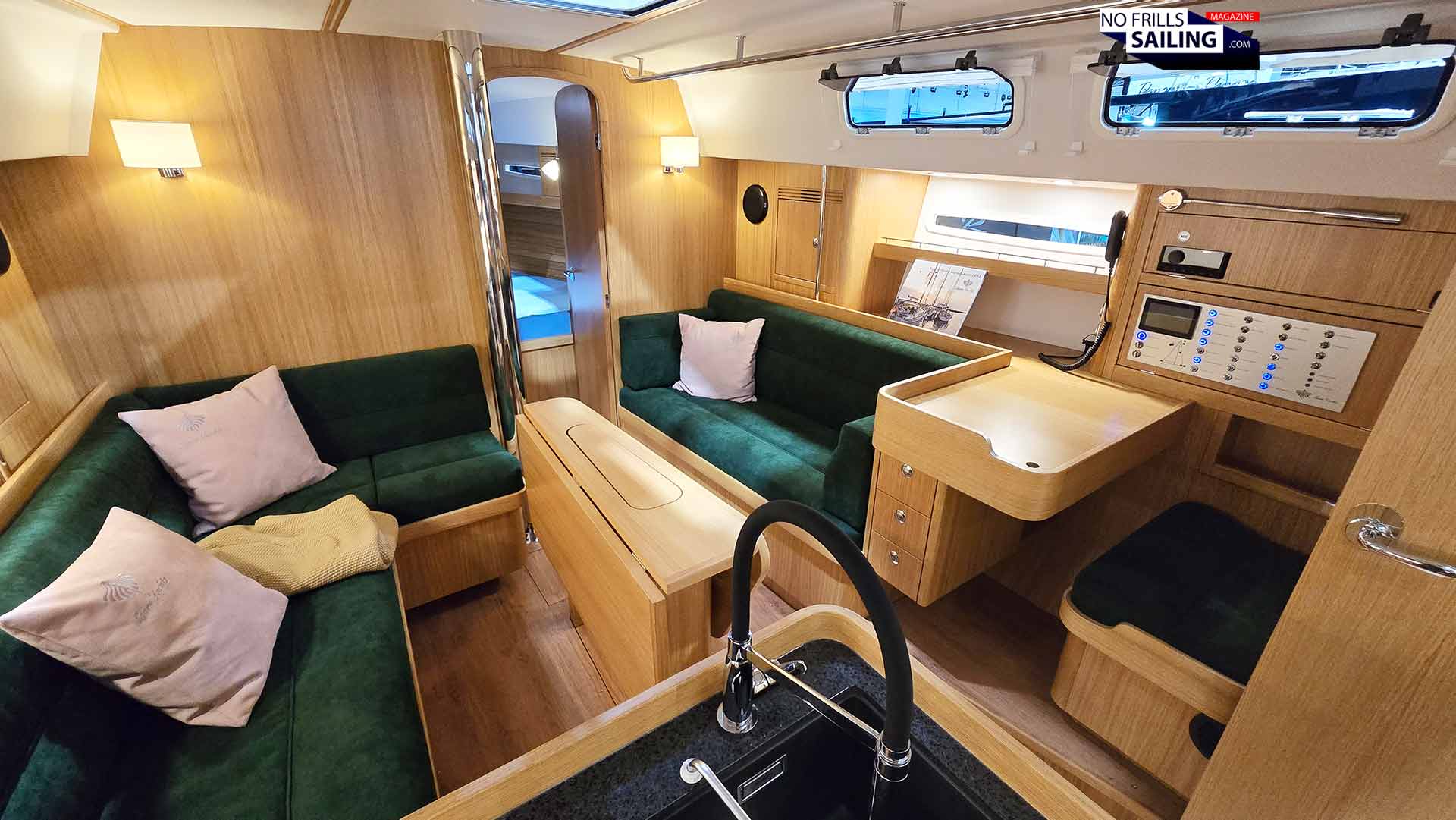
The salon welcomed me with a very well known, classic layout: Day-bath (in fact, the only heads) with an adjoining nav-station to my right, an L-shaped galley to the left. Further into the salon two large sofas are facing each other with a modular cockpit table in between. The mast is deck stepped, thus a nice shiny chrome-plated mast-stand added the only “bling” to the room. A large wooden main bulkhead featured two stylish lamps. That´s it.
A classic, timeless and practical layout
It´s a proven layout, I shall say, one that has been sailing around our planet in countless boats and many iterations: It´s the same classy layout my own new boat will have. Why is it so effective? Boats like these are made for “real” sailing – the time under sails is what counts, not the time at anchor or in the marina. In this, first of all, every single component of the boat´s interior has been placed within the volume of the interior where it makes the best sense. Starting with the galley, which of course must be located (almost) directly above the keel. That´s done so that it doesn´t move all too much when the ship is sailing, because it´s position directly on the boat´s pivot point. Same goes for the chart table where the skipper needs to be concentrating on his logbook, the naval charts or the VHF-announcements.
A layout proven by decades
The salon´s settees on the other hand serve as bunks when underway or swell becomes too much. These, as well, are positioned near the pivot point of the hull. Also, when she is heeled, the backrests work perfectly fine to wedge into. I´ve tested this myself intensively on the Atlantic Ocean a few years ago: Plagued with heavy seasickness, I bunked in the salon for the whole trip from Lisbon to the Canary Islands, “saved” and partially cured from motion nausea by these “seabunks”. Cabins, in this respect, become secondary – so we´ll look at them later.
Spotless joinery and craftsmanship
On second glance I start to appreciate the level of craftsmanship of the woodworks aboard the Saare 38.2 – it´s really on a very, very sophisticated upper level. Saare Yachts are making far less then ten boats (tending more to the five units mark) per year. As they state, they don´t want to become the biggest, but the best shipyard they can be. It may be this humble approach to an otherwise very aggressive, unforgiving and hard business, that makes them so special too.
Beautiful & spotless joinery!
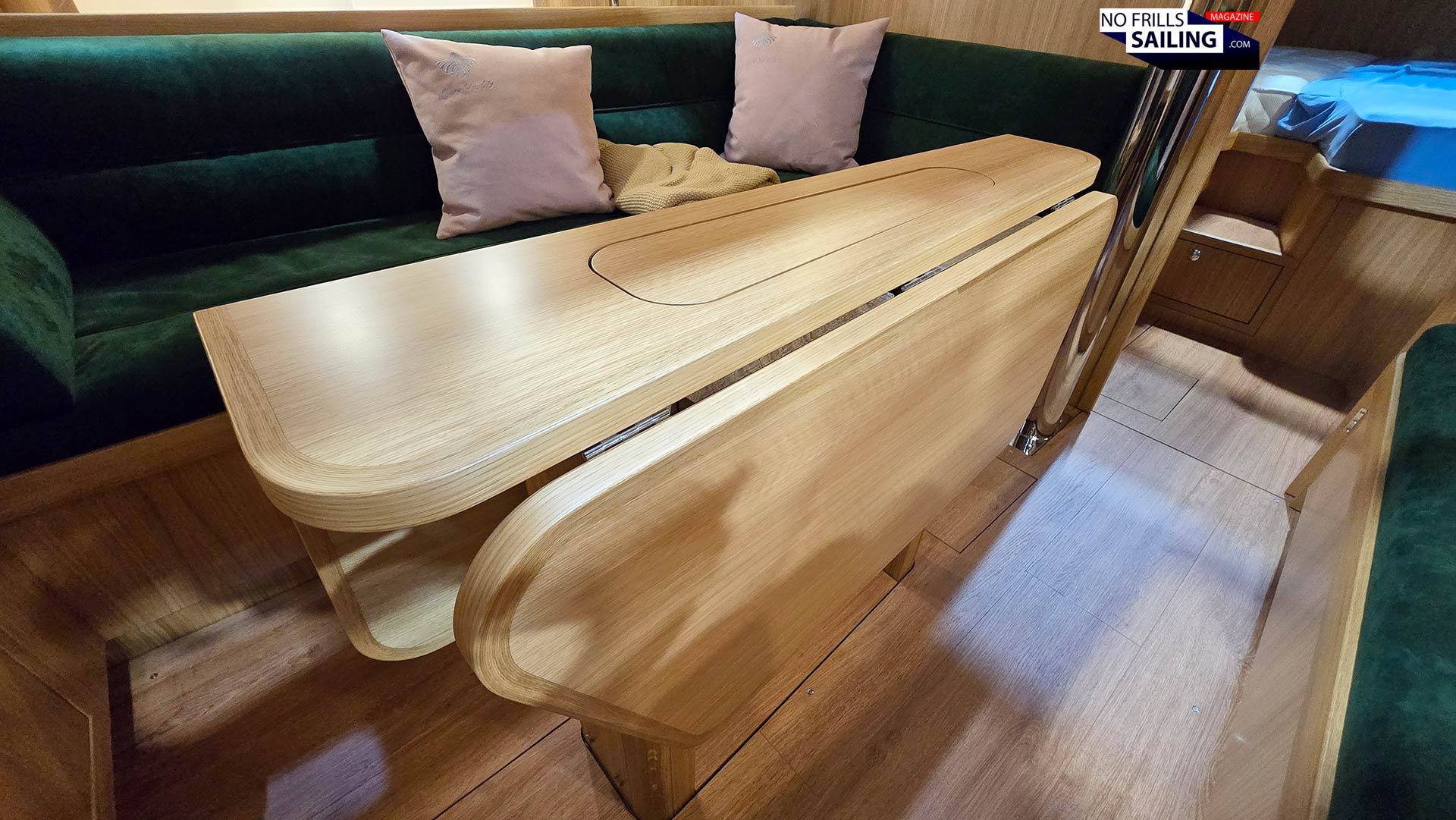
Aboard this Saare 38.2 a nice light Oak interior is set up. There´s a lot of very thick and significant real Oak veneer going on, crowned by lots of nicely laminated details. I mean, check out the skirting of these tabletops! Making, meaning bending, glueing and laminating layer by layer to achieve a relatively complex and multi-bent part like this shows the attention and level of dedication of Saare´s craftsmen. There are many of those fine, very beautiful wooden parts, many of which are massive chunks of wood as well.
That´s true craftsmanship
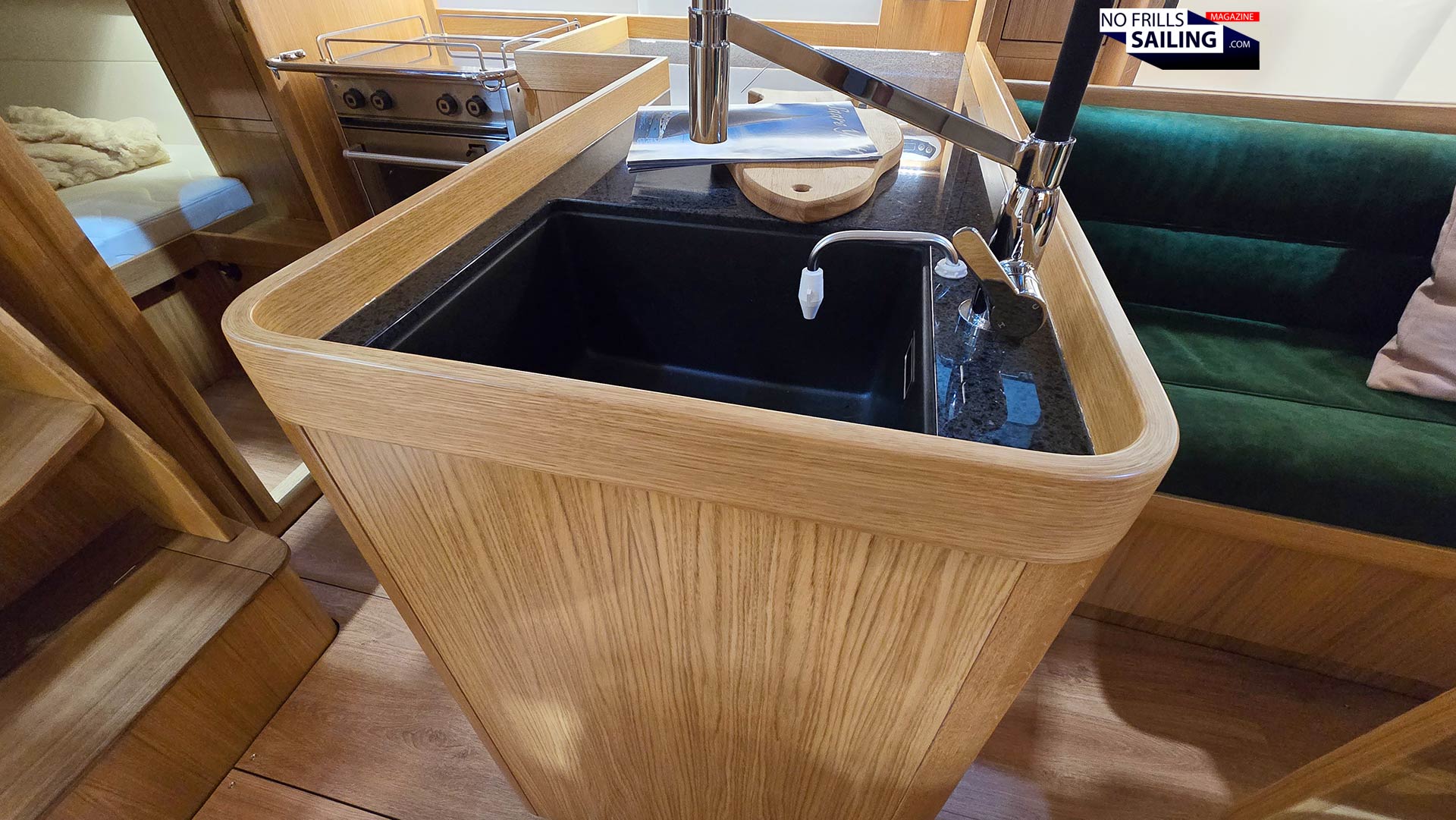
Even the design of the grain within the wooden structures has been carefully chosen. It seems as if these guys are not just putting together the individual parts of a component, like, let´s say this galley you see in the picture above. It´s more like if they check before fitting, if the design and pattern of the grain of each single part fits to the others so that the whole will display something beautiful and balanced. Imagine the time that goes into such a production depth, imagine the experience needed to pull this off. There aren´t all too many brands left with such a focus on details: Faurby, Luffe for sure, Linjett of course and maybe some others, like Solaris, Hallberg-Rassy or Oyster. You see, it´s strictly upper shelf. This is neither an ordinary yacht, nor your bargain boat. Saare is considered a hot candidate for “your last boat” to buy.
L-Pantry: Best design for its purpose
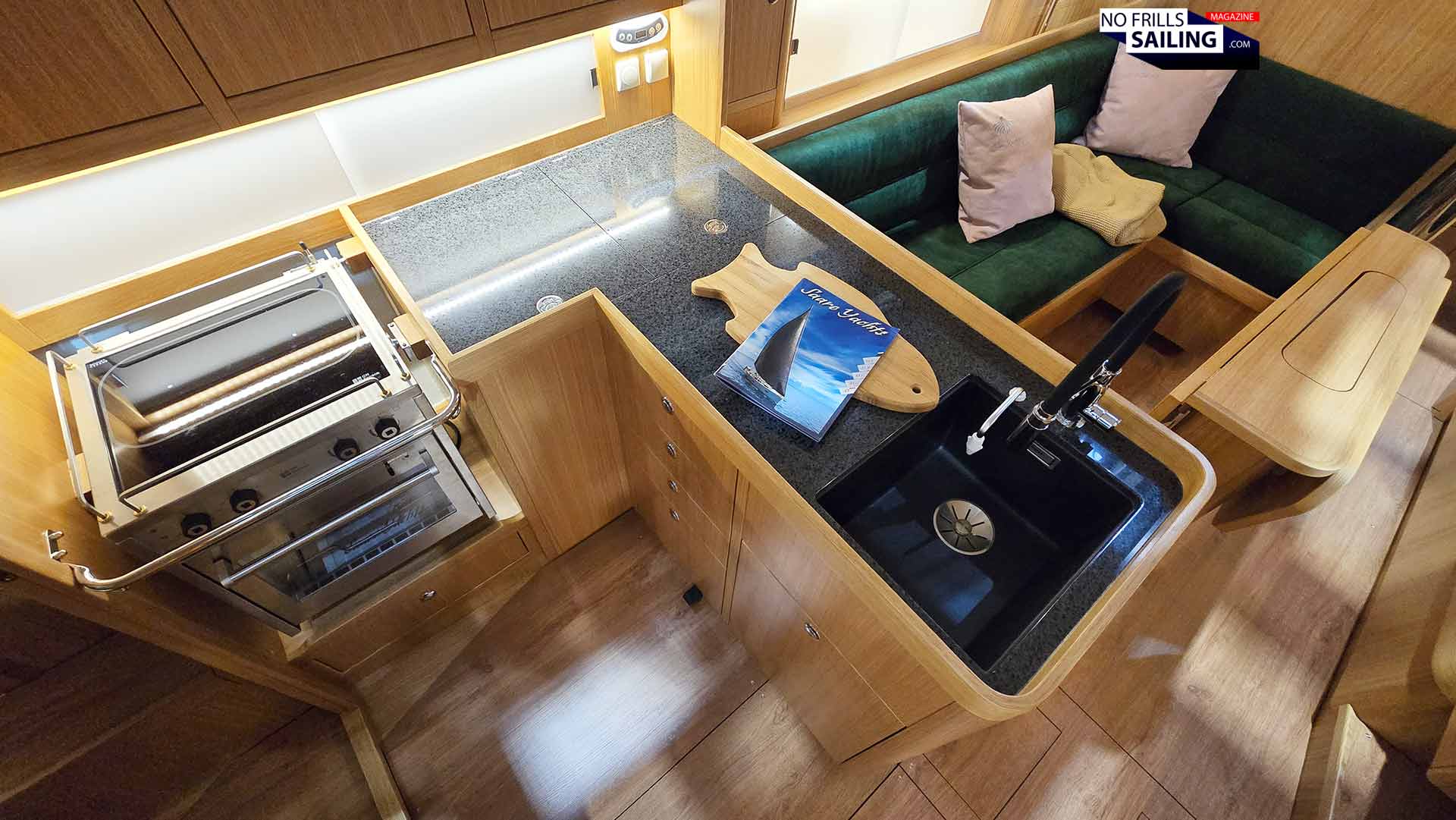
Let´s stay a bit in the galley. That´s something the guys back in the shipyard where my Omega 42 is built are currently working on too. As I stated before, a good galley is located preferably near or on top the pivot point of the boat. This is especially valid for the operation of the gimbaled stove as well as for the sink. Why is this so important? Well, imagine sailing in a 1.50 or 2 meter wave with a 38-footer like this, there´s so much motion within the boat so that bringing a pot of water to boiling point may pose the risk of spilling and causing severe burns. Same goes for the sink (without the burns, of course). There are indeed “bad” sink positions on boats where the up and down of the boat in the water could end up “pumping” seawater up the drain. Well, not here, obviously.
The galley: Classy. It works.
The galley of the Saare 38.2 is equipped with everything you need: The before mentioned sink (perfectly well placed to the mid-most point, which is also nice for a secondary aide responsible for drying the cleaned crockery), lots of stowage, a 92 liter fridge and a “hidden” trash bin. There´s of course your foot pump for sea water (Spaghetti are cooked best in fresh, pre-salted Atlantic water) and options for the color and appearance of the work top. It´s a decently sized galley, let´s not forget we are aboard an 11 meter-yacht. The version on display was fitted with an electric induction stove, standard would be a 2-flame gas stove.
Saare is a bluewater-oriented long-range cruiser brand
How to characterize a Saare? First of all, it´s an upper brand definitely. The price tag for a Saare 38.1 demands for a budget in a range of 550.000 to 650.000 Euros, so she´s definitely not a cheap bargain. Judging by the technical data and sheer numbers, I´d say that the Saare is a long-cruising oriented boat, very seaworthy, optimized for a good allround sailing performance. She´s a little less performant and lively than the Linjett, maybe a bit more sturdy in foul weather and heavy seas.
Never without: Nav station
One of the main signs for this cruising orientation is the nice chart table and nav-station integrated to starboard side in front of the heads. There is indeed a second interior layout where there´s just a simple chart table mounted to the backside of the heads, sporting a bit longer reclining area of the starboard side settee. I like more the version shown in the picture above: As a cruising skipper, you definitely need a place where to do the Captain´s work: Keeping the log, planning the next legs of your trip and do the weather research. Also, all the stuff from flags to the cruising kitty need a place to be stowed away: This is the most logical.
You´ve got to love this!
All in all I quite like this layout! The portside settee is slightly L-shaped as well so that in case of many guests a total of five people could easily sit around the dinner table and enjoy a nice meal. There´s stowage underneath the seating, behind the backrests and in little cupboards overhead. Quite classy, don´t you think? This goes as well for the cabins.
Classy cabin comforts
Basically, the Saare 38.2 can be ordered in two layouts. The first is strictly “owners only” with just the front cabin fitted, the other layout (which was on display in Duesseldorf and shown here in this article) features a portside secondary guest cabin as well. If you choose the “owners only”-setup, be aware that the front cabin may be rendered unusable in heavy seas when the up and down (mostly upwind) will kill a good night´s sleep. Then you may utilize either of the bunks in the salon. In this configuration the portside aft cabin is essentially empty, being used for stowage mainly.
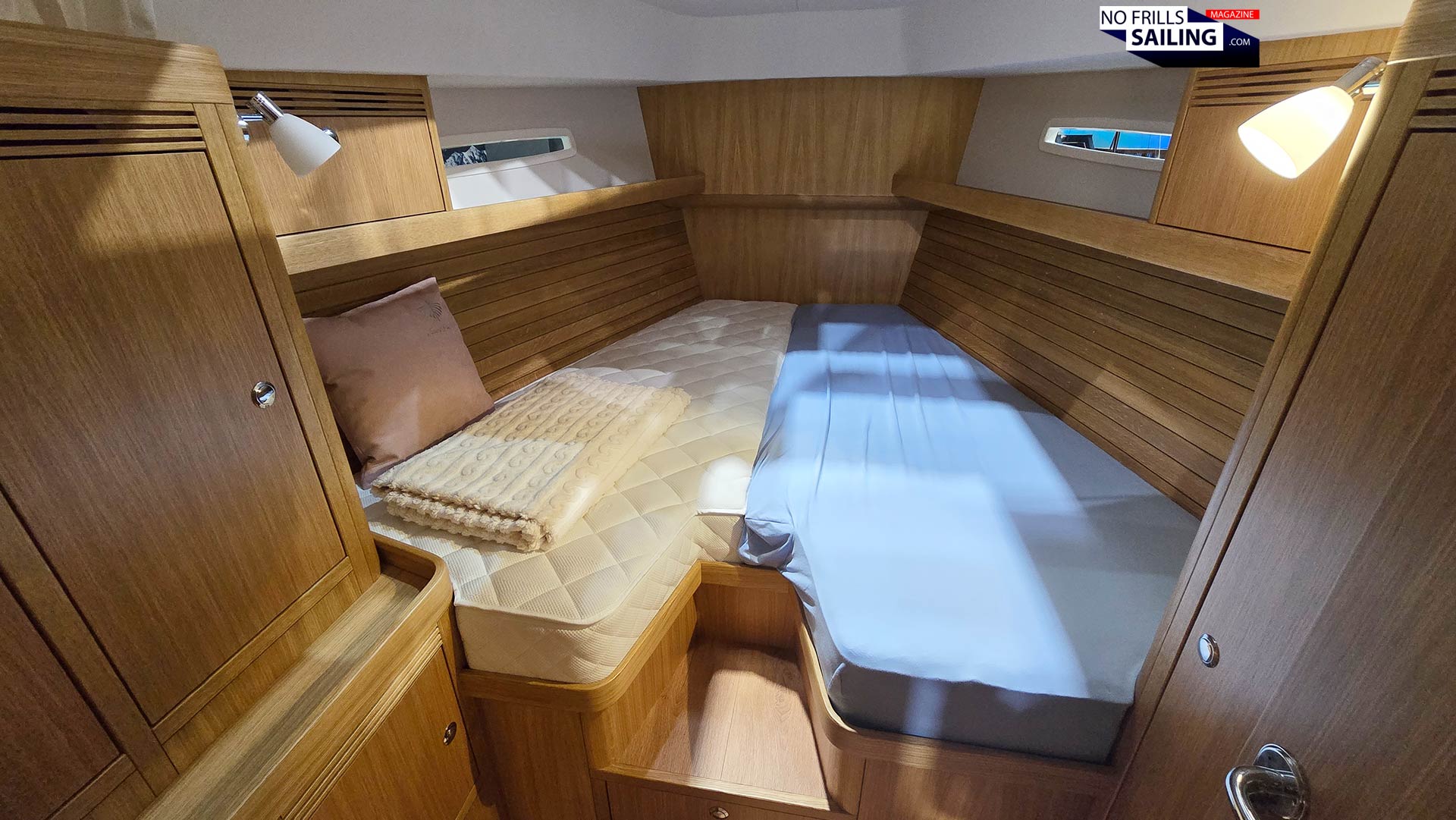
A modern forepeak with a classy touch
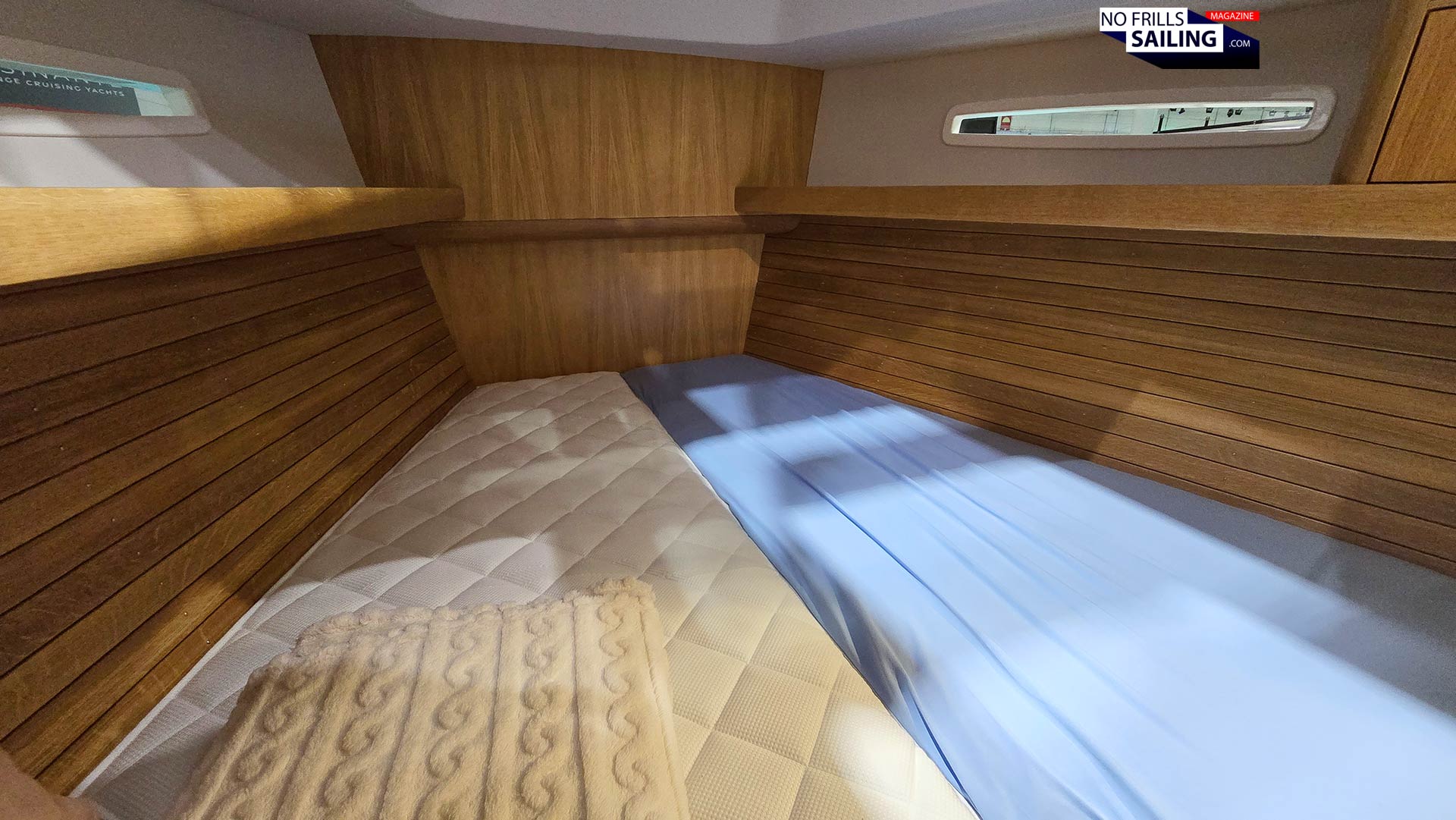
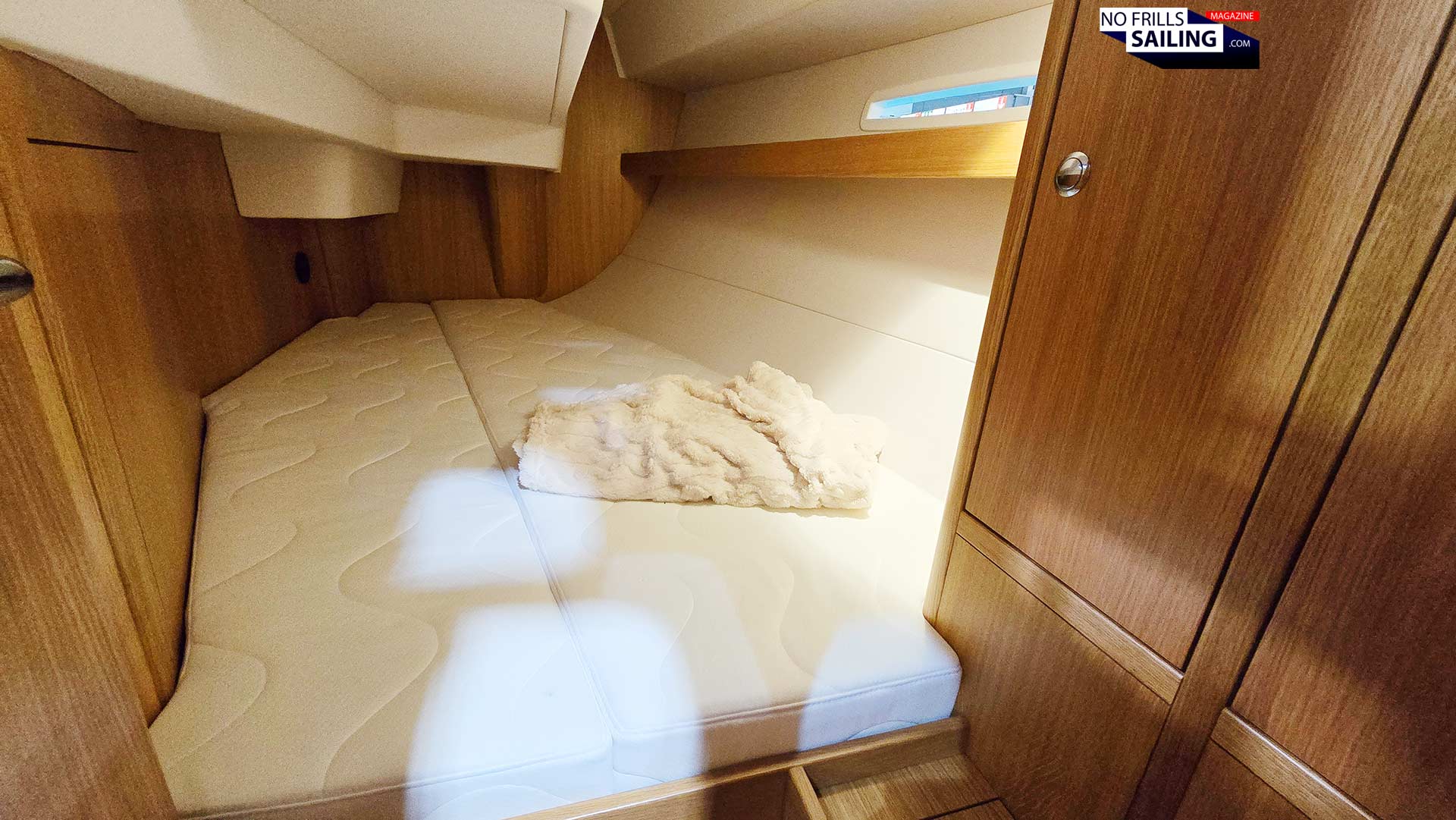
The front cabin of the Saare 38.1 offers a V-berth with 205 centimeters length and a width of 90 centimeters at the shorter and 200 centimeters at the wider “end” – you may sleep with your head at the forward crashbox/anchor-locker or “backwards” towards the salon. Again, there´s lots of stowage in this front cabin. I like the fact that Saare does not sacrifice any of this for a layout-version that offers a second bathroom: This is often seen in series production yachts and results in tilted beds, loss of the feeling of width and luxury and of course, loss of so much stowage capacity. Well, not here.
Exceptional woodworks
Again I am very pleased acknowledging the nice woodworks and quality of the joinery here. I know from my own steep learning curve and experience in refurbishing my first boat, the King´s Cruiser 33, how hard it is to make and fit a spotless ceiling – it´s a pain in the ass, to be honest. And by looking at the high quality of the Saare´s ceiling, I appreciate even more the skills of a trained and experienced carpenter and ship´s joiner, of which this shipyard clearly employs a lot of back there in Estonia.
Cozy and spacious aft cabin
What is a bit of a “pity”, let´s say, is the fact that “Kamu” Strahlmann´s design is a bit dated in terms of hull windows. Specifically, the size of the hull windows. This is especially apparent here in the front cabin. These hull windows are barely visible, matching the size of a medieval arrow slit. This results in less natural light coming through and prevents the owners from enjoying a breathtaking view outside. Modern adhesives and other materials permit larger windows without gambling with the boat´s structural integrity and safety nowadays. In this, the Linjett 39 is examplary, whereas the Arcona 385 doen´t even feature a front cabin hull window.
I miss my gratings …
The aft cabin, if ordered, is either “warped” around the aft longitudinal bulkhead that separates it from the large aft lazarette/stowage area or a bit slimmer, if behind the engine compartment another compartment for auxiliary machinery is needed. The bed size here is 200 by 120 centimeters. But, as I mentioned, it´s a bit “bent” to match the round shape of the hull and utilize all the space behind the engine compartment box. Again, there´s a small hull window back here as well, at least providing for some additional natural light.
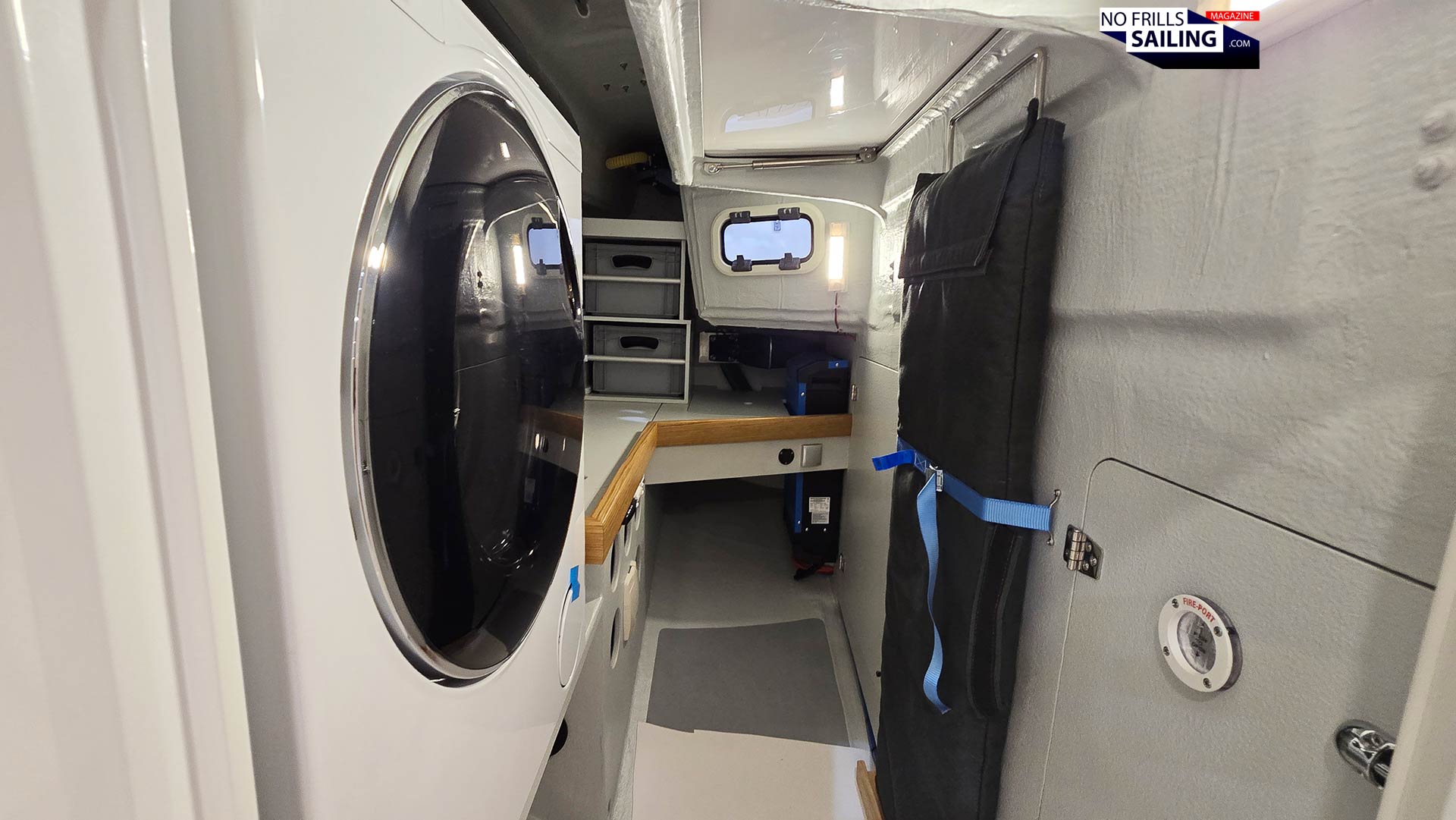
Huge aft lazarette
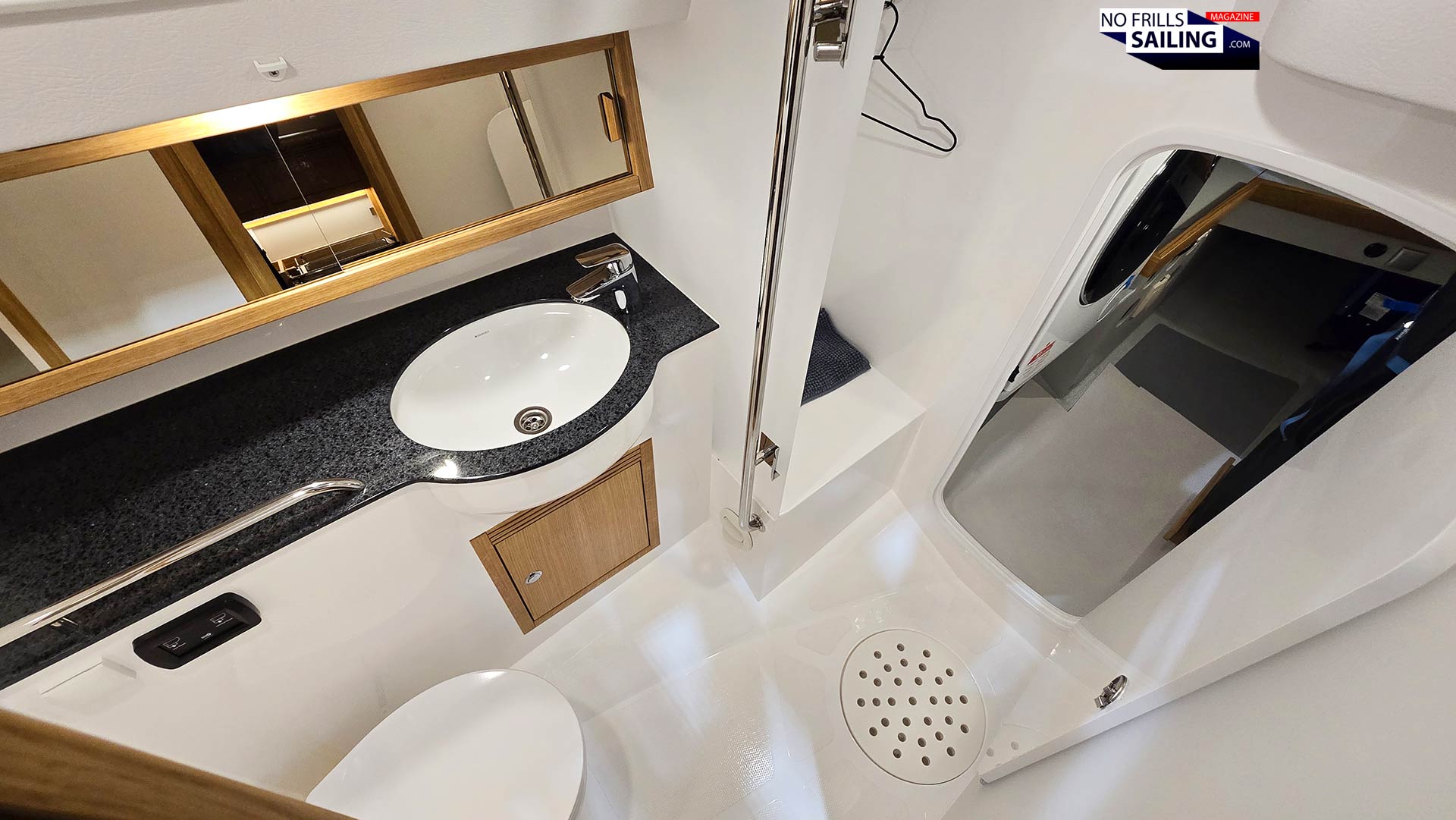
Let´s take a look into the bathroom. Here it´s most apparent that the basic design of the Saare 38.2 dates back to the year 2011 when the first Saare 38 had been built, second design after their iconic inaugural Saare 41 CC. The elliptic shape of the sink seems a bit out of date, also, installing the toilet the other way round facing backwards is a bit odd. On the other hand, this way the shower area can embrace the full volume of the backside of this wet-cabin and also provide a decently sized door into the aft lazarette. And, you guessed it by now – I muss a proper bathroom grating, at least for the shower. This little plastic thingy looks a bit cheap, sorry.
Other than that, the bathroom comes with a nice size and has everything you´ll need underway. I like the fact that they went rather sparsely on wooden fittings, which is a good decision for a wet-room.
A cockpit layout for sailors
That´s for the Saare 38.2 down below. She is a very, very, very nicely crafted classic sailboat, material- and joinery-wise on the highest level of craftsmanship you could wish for. The people know what they are doing: Execution, even behind panels and in corners where people seldom take a look at it´s just spotless. Nice! So I leave the inside – also to give way to the staff cleaning the boat before the boat show opens again – to take a look at her cockpit, its layout and her sailing properties.
Single rudder, single wheel steering
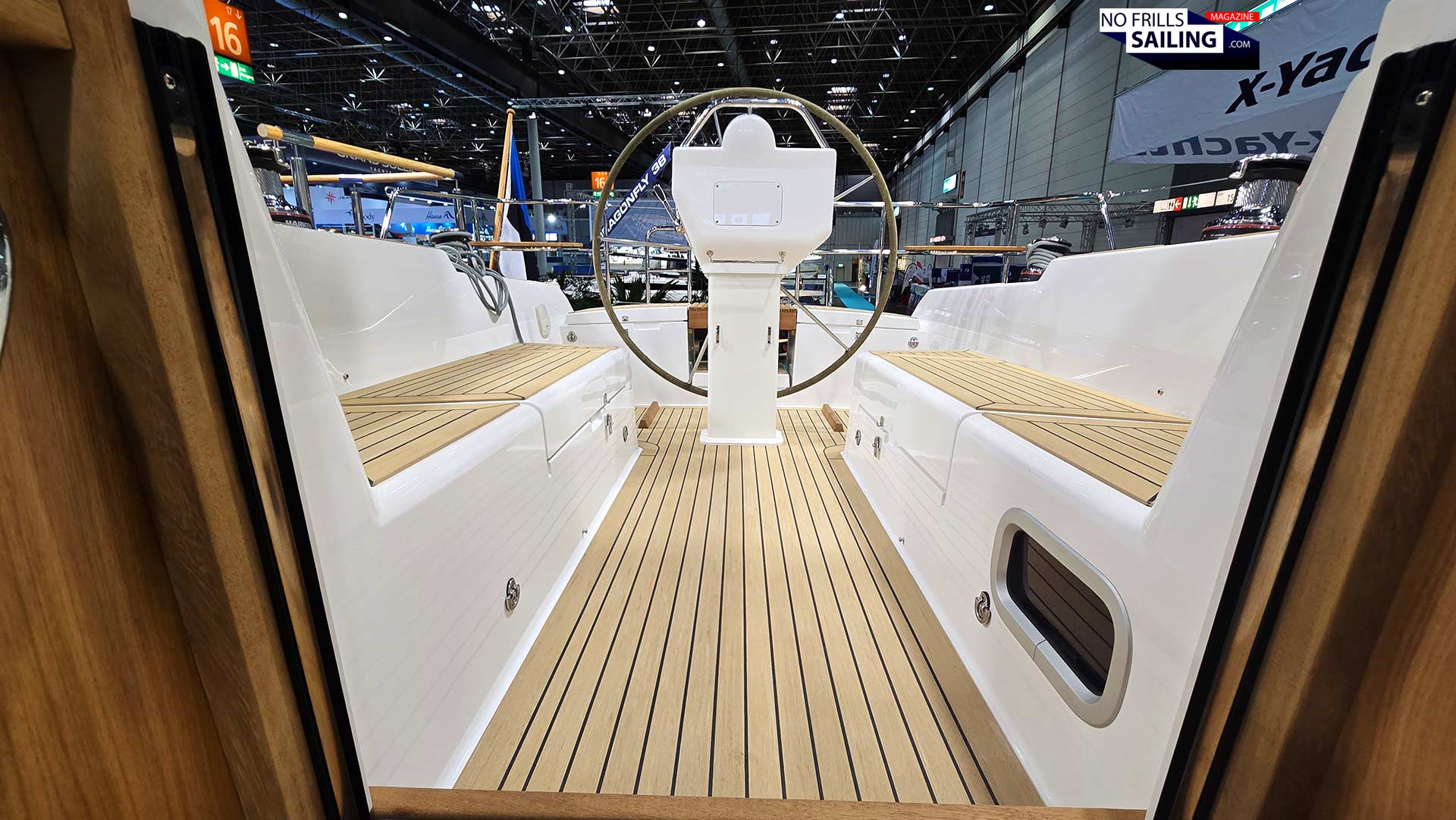
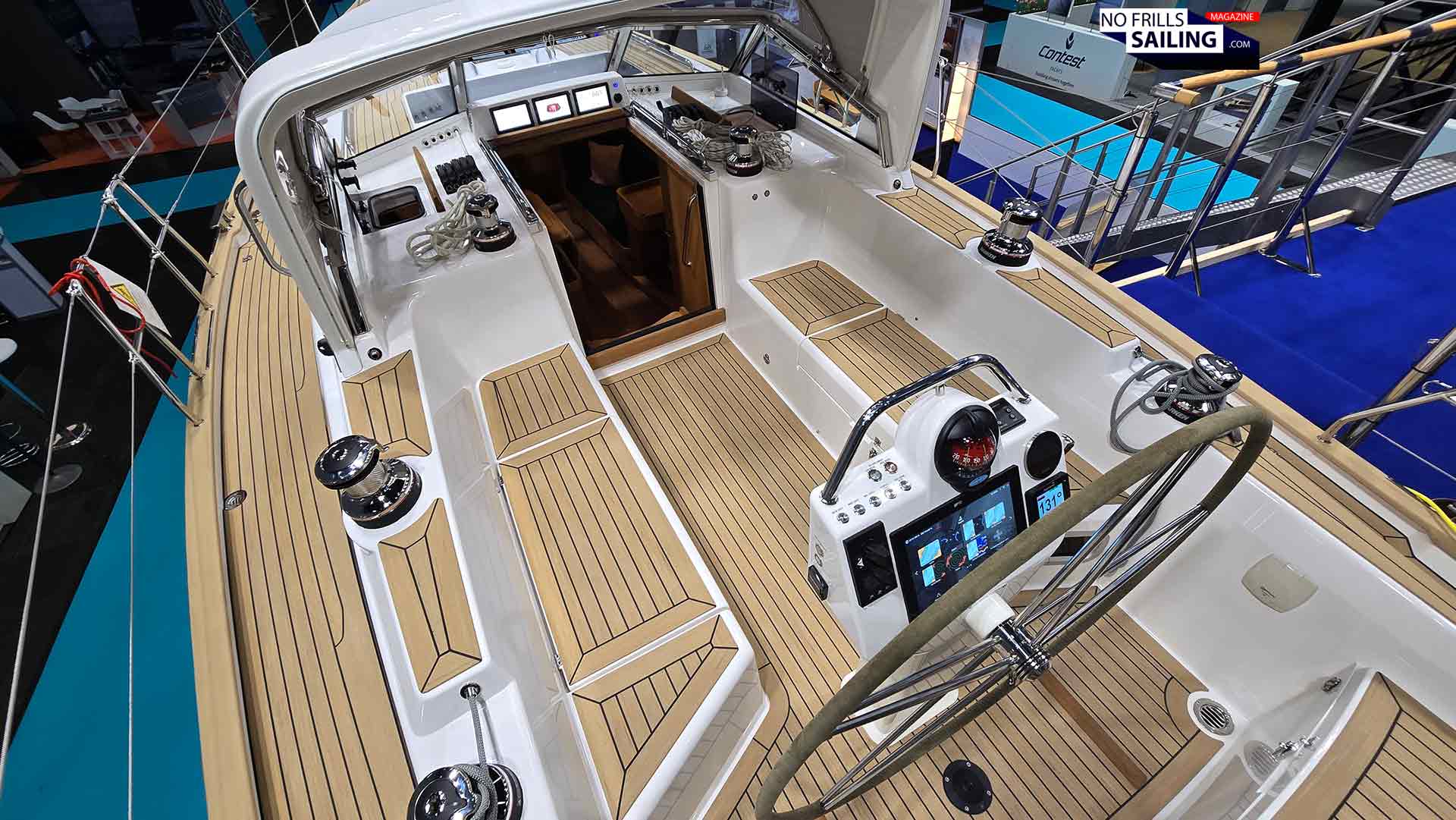
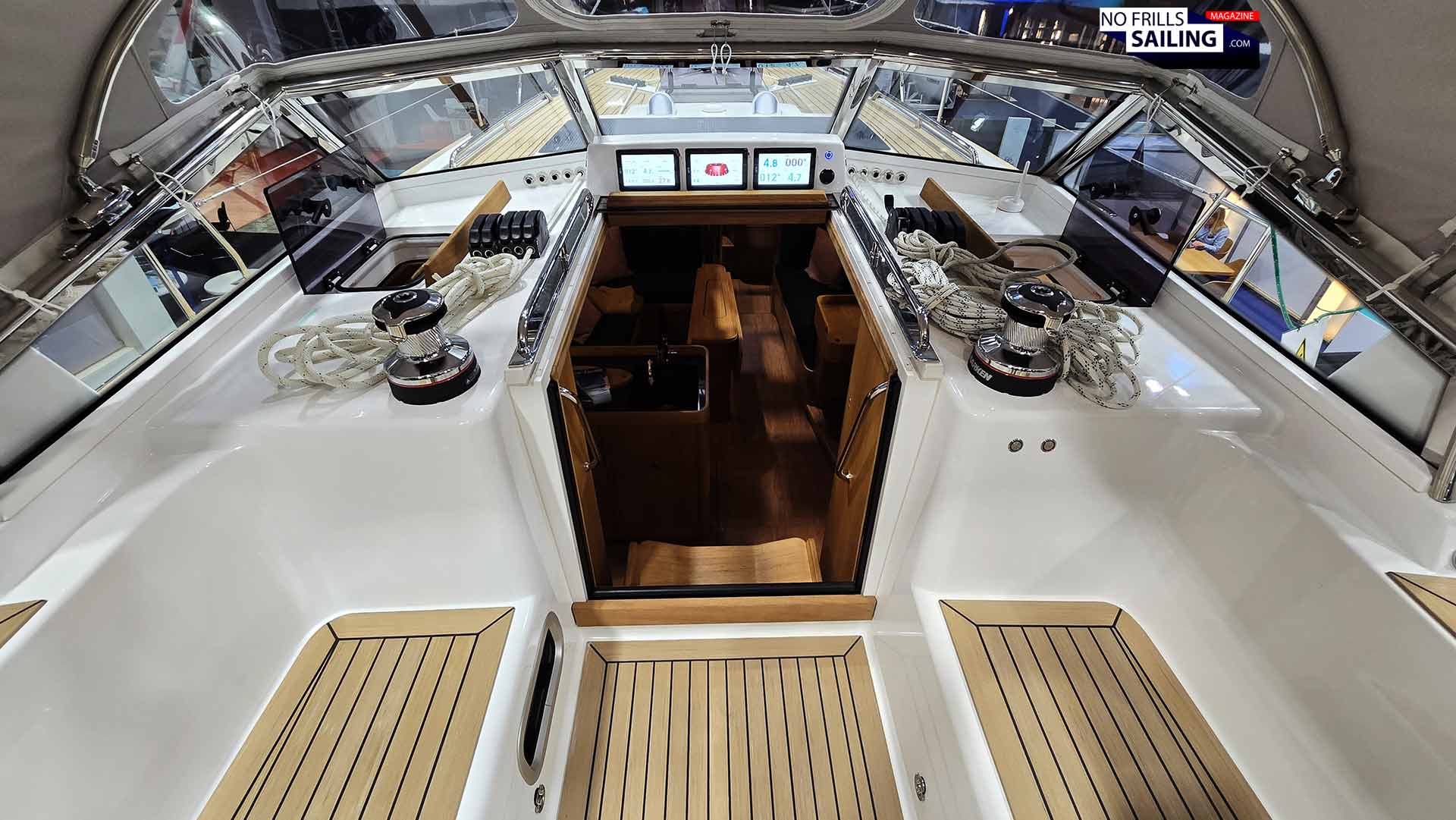
As you may see, this boat does not follow the Med-style cruising design principles. Her aft section becomes narrower again, her coamings are higher and everything seems to being set up for active sailing, even for sailing in more “serious” conditions, rather than being optimized for 3 Beaufort and no waves, as many recent vacational-designs are. Working winches for halyards, reefing lines and trimming devices are placed to either side of the entrance. This way, for most part of the sailing, working the lines can be done from the most stable and most protected position in the cockpit.
Layout for serious sailing
The Saare 38.2 is a peculiarity and rare occasion when it comes to steering as well. The single skeg-free spade rudder is connected to a central single steering wheel. This is again a nod to the “old fashioned” style the Saare employs: Nowadays, almost every single sailboat out there is equipped with a double helm station. Saare´s setup comes, as everything else on a boat, with advantages and some trade-ins. Weight-saving, simpler mechanics and only one single setup of displays and electronics is on the pro-side, as well as the central, safe position for the helmsman. Closing off a fifth of the already limited cockpit area and limiting the obstacle-free walkway to the (very small) bathing platform is another.
Most running rigging is protected
But again, bathing and swimming-fun or elongated BBQ-parties is not what the Saare 38.2 is made for in the first place. She is a boat for active sailors, so this setup makes quite some sense. And then it struck me: There was a detail I didn´t even recognize in the first place. One which sets the Saare 38.2 really apart from the other Scandinavian classic boats – one that might be of particular interest for long-haul sailors.
It´s in the details!
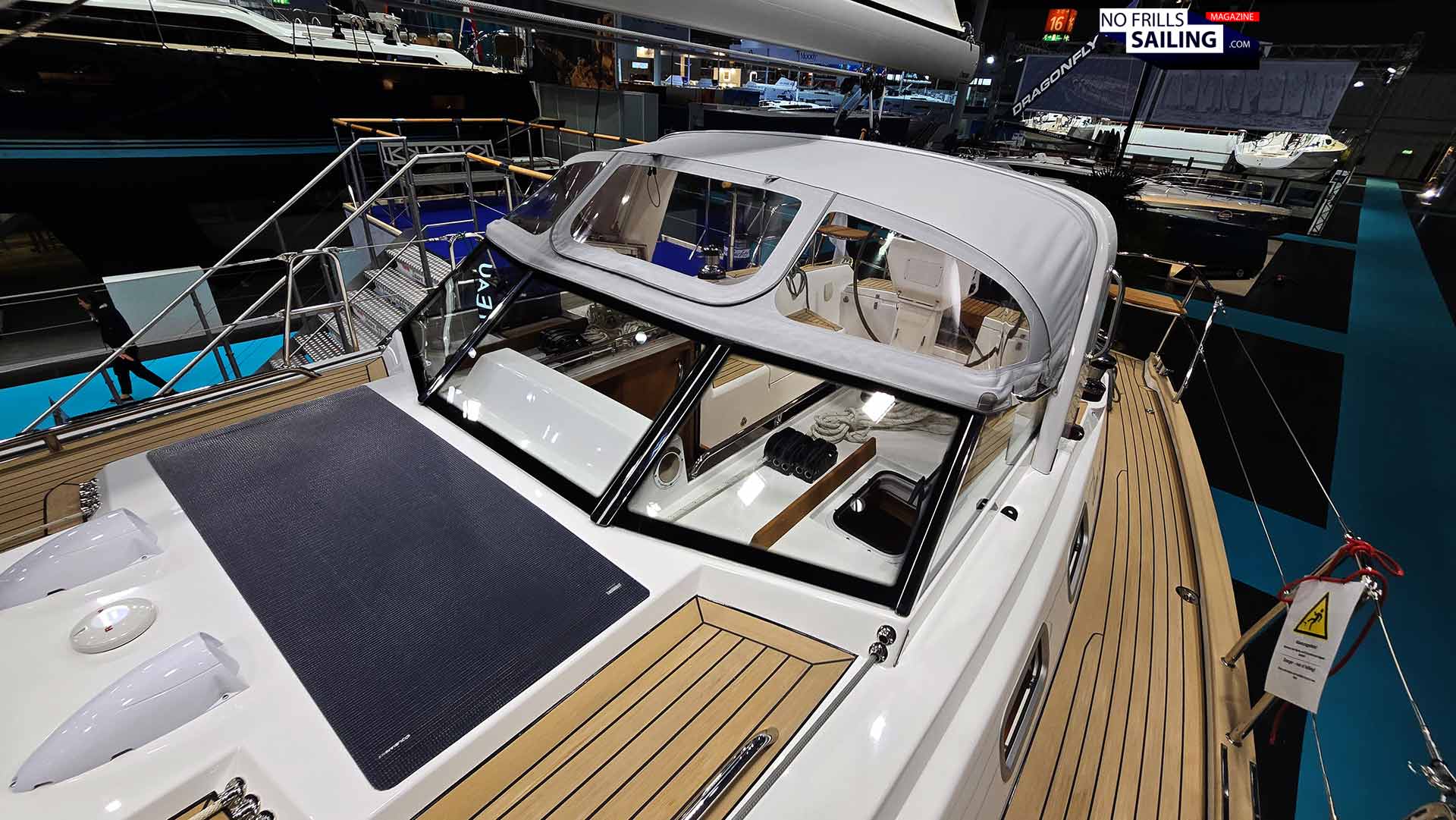
So, first of all, standing amidship, I noticed that the Saare 38.2 comes with a fixed windshield á la Hallberg-Rassy or Najad. Maybe this is an option, but having this makes sense in a sail area where you often have to sail upwind or where there is frequent swell, resulting in spray. The rest of the canvas sprayhood can be set up and taken off when weather is nice and you like to let in fresh air or the sun.
Fixed & partial spray- & windshield
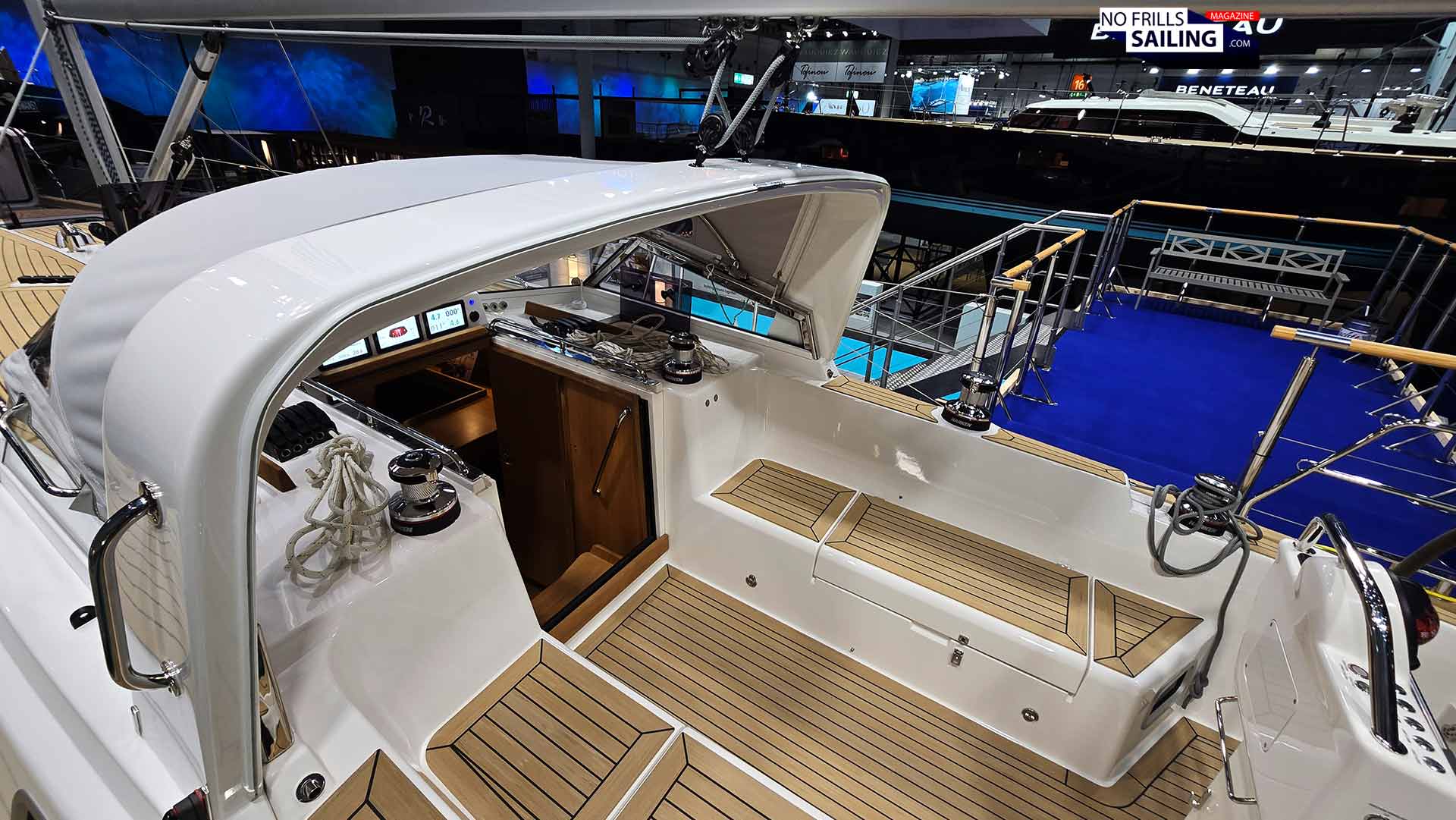
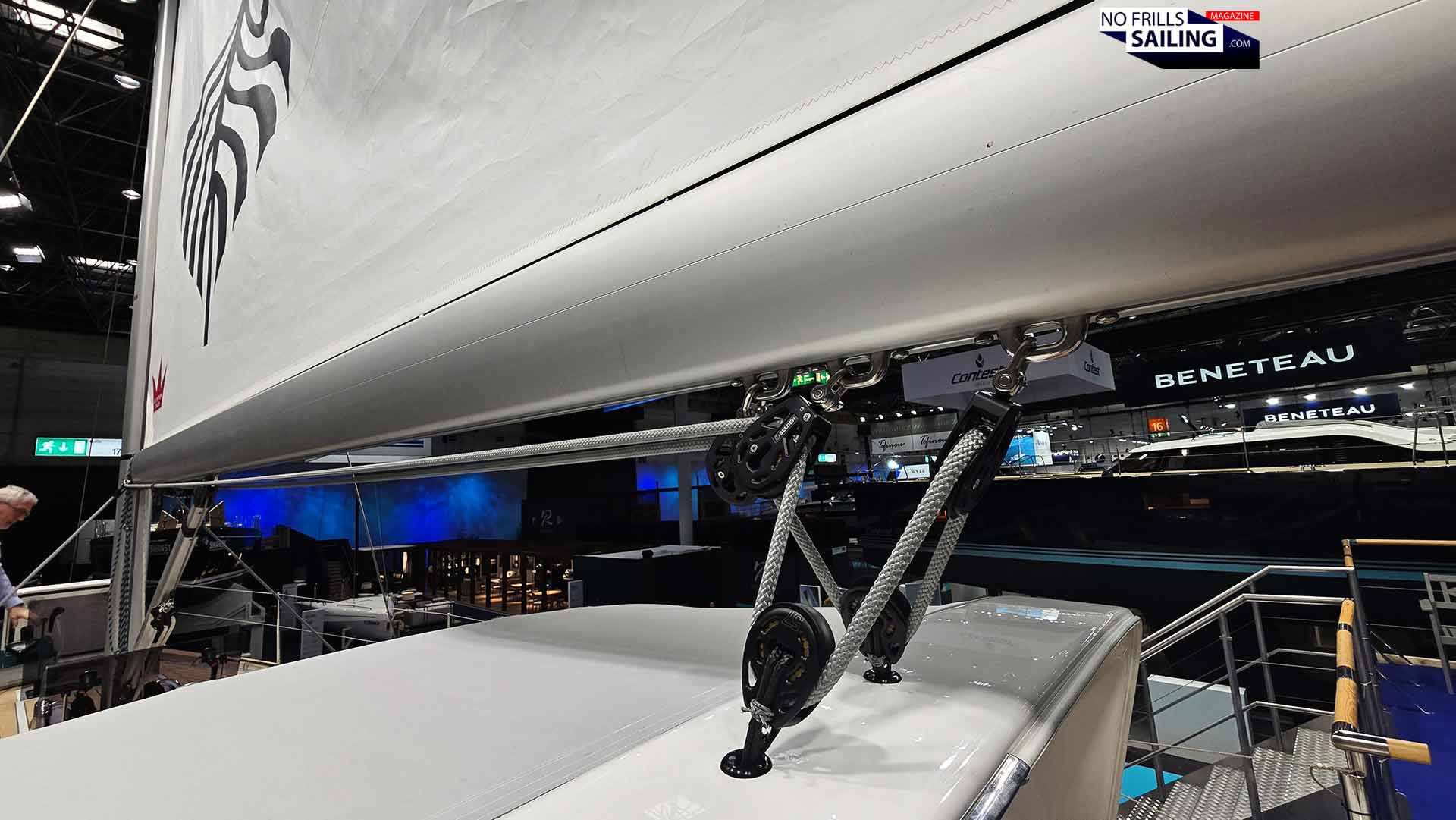
But the real deal is the mainsheet arch, which is barely noticeable when the sprayhood is set up completely: It´s nicely integrated into the spray-front and does less “harm” to the boat´s nice design than on many other boats, where such an arch is often regarded as looking ugly. Well, not here, it´s simply visually cleverly “hidden”. In this, the Saare 38.2 indeed solves the mainsheet-problem many cruising yachts have – where to put the damn mainsheet?!
On second glance: Fixed mainsheet arch
Essentially, there are only three solutions: The first is to have a mainsheet arch like the one seen here. It often sparks lively discussions among sailors (and sailor´s wives) because those are often regarded being ugly. A second solution is the “hard way”: Just lead the mainsheet from the aft end of the boom straight down onto a pulley in the middle of the cockpit (as I do it on the Omega 42). This is mostly done in performance-oriented yachts, because cruising-crews would never accept the rope salad in the middle of their nice “dancefloor” cockpit. And last, but worst: Lash the mainsheet the “German” way to the aft. That´s the worst because attachment points of the mainsheet is often very much in the front of the boom, resulting in high loads due to the leverage.
Keeping the rich heritage of Finngulf alive
And here´s where “Kamu” Strahlmann, at least I read it this way, incorporates both the rich heritage of his Finngulf designs into the kind of bluewater-ish approach of the Saare yachts. Seaworthiness, sturdiness and practicality meets ocean safety and proven concepts. It may not be looking very trendy or stylish, but that´s no problem as it doesn´t even have to: Saare Yachts by its own accounts does not want to appeal to a broader mass of people. With 5, maximum 10, boats built per year, they are rather seeking “real” sailors.
Keeping the mainsheet out of way
I appreciate this philosophy. That’s the cool thing about the boating industry, right? You can choose your dream yacht from a wide range of brands and builders. You may choose precisely, so that the boat neatly fits exactly your sailing program, your ambitions, the main sailing area and usage. The Saare 38.2 is a boat that, from my point of view, perfectly matches the demands of the “Northern” sailing area of the Baltic Sea, the North Sea all up to Norway, the waters around the United Kingdom including Scotland and Ireland. She is sturdy, well built and capable to deal with foul conditions.
A bluewater design?
It´s reassuring and good to know that there are still some boatbuilders and designers upholding the “old” values of the golden age of Scandinavian-style sailing. People like Pelle Petterson, Peter Norlin or Hakan Södergren have come up with immortal, beautiful designs of which many are cherished, nursed and kept afloat until today. It´s even more satisfying, that people like Strahlmann continue these classic approaches to this day, alive in boats like the Saare 38.2.
A timeless yet practical design
She is definitely not everybody´s darling. And in many respects she does not bother to at least partially make some concessions to “modern” style to attract more, like Linjett, Arcona or X-Yachts do: The Saare 38.2 is indeed built utilizing most modern production techniques like vacuum infusion, but she refuses to give in to trends. Like double wheel steering. This makes her likeable and odd, in the best sense of the word.
Traditional overlapping Genoa
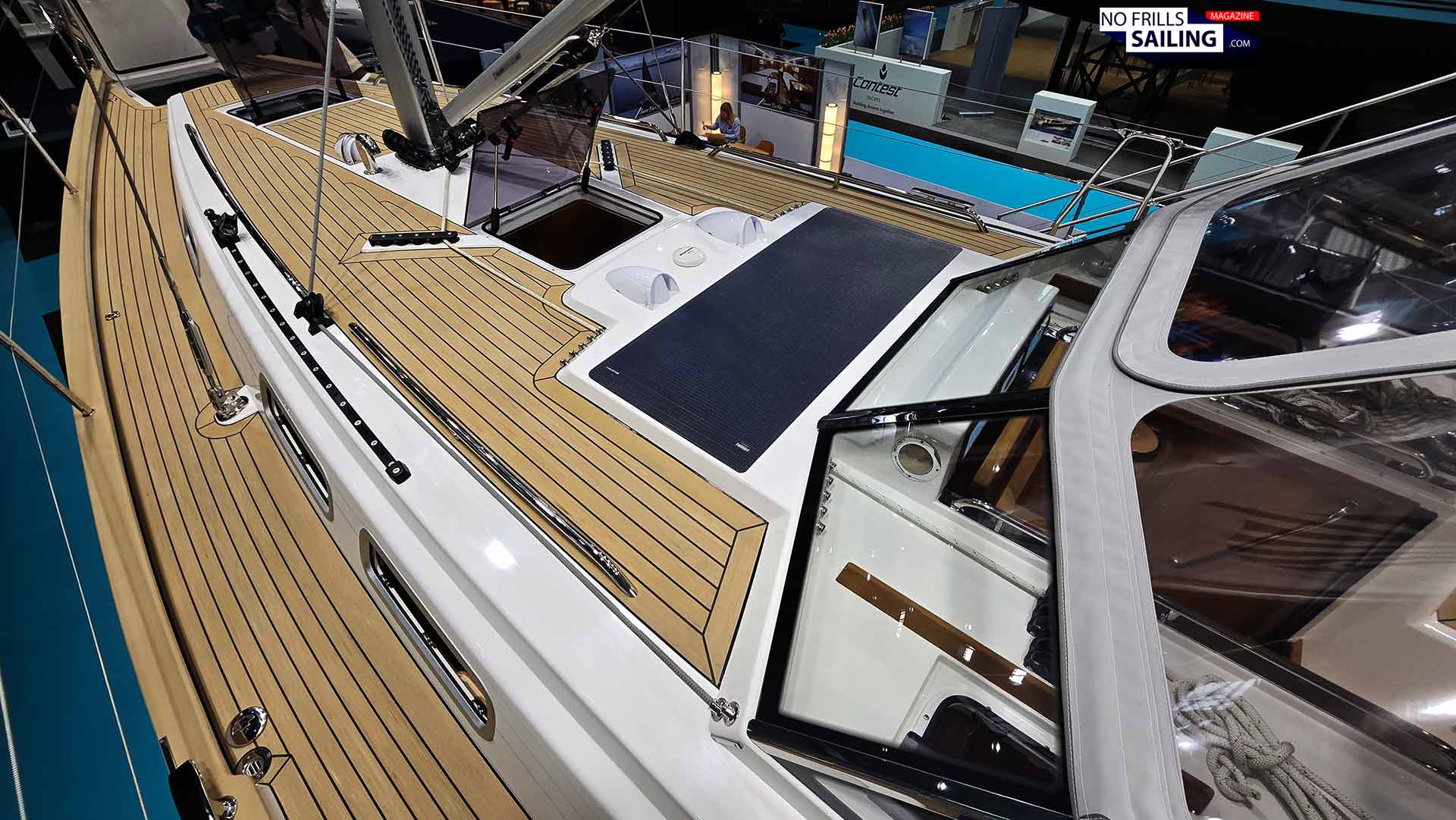
Make no mistake: She is not a “dated” or “old” design: Of course you can have your Saare 38.2 with a large solar panel by market leader Solbian, of course the latest inverter-technology, NMEA 2000-network and other high-tech equipment can be fitted to the yacht! Flush skylight hatches, electric winches for push-button-sailing and much more is common sense here, as a matter of course.
This looks … real
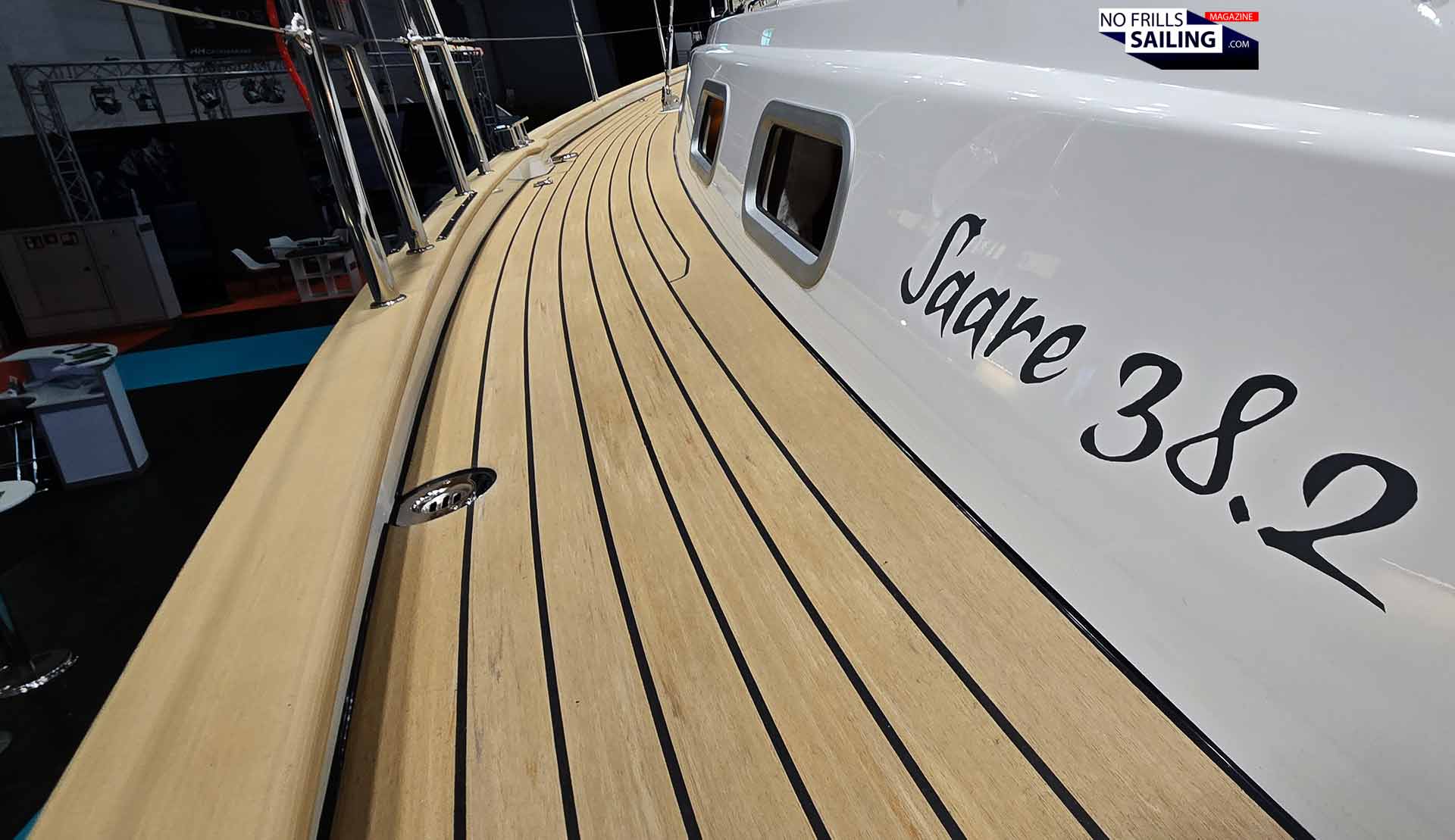
In this the shipyard gives in to modern style and modern stuff where it makes sense. Take the deck for example: As much as we all might love a nice Teak deck, it´s for many reasons something that feels really dated, unnecessary. Apart from the fact, that the best teak for boat use is under sanctions for many years now. As for the Saare 38.2, you may get a nicely done synthetic decking material which doesn´t look like plastic at all! It´s even arranged very elaborately, featuring a classy “fish” in the middle and nicely done enclosing bindings.
Deep, huge front locker
It´s all done and made in the most trustworthy way possible. Look at the front locker: It´s a work of art. Two decks, spotlessly made, no impurities, no loose screws, perfect clearance even here. This boat is a joy to look at – as she is to sail, of which I am very sure. With the cleaning staff coming up to apply last efforts to make her client-ready for another boat-show day, I finally leave her deck. Standing next to the boat, admiring her nicely done, waveless and spotlessly nice laminated clean hull, I say Goodbye and Thank you to the guys from the shipyard.
Advertisement
Maybe one of the most underrated sailboat brands in Europe
The Saare 38.2 certainly is a very special yacht, not made for everyone. If you are looking for a mid-sized cruiser that fit the needs of two going on long-haul cruises, she is worth a serious look. Purpose-built for active, by all means “high seas”, sailing in demanding conditions, she brings everything with her a proper yacht for a serious sailor should have. Is she “blue water”? Well, maybe the Saare 40-footers, especially the center cockpit-designs, are more suitable for oceanic sailing. But I´d always prefer a boat like the Saare 38.2 over even larger series production boats, for sure.
Looking for your “last” yacht? Consider Saare!
All that´s left to do now, as usual, is to sail one of these. I try to arrange something for the coming sailing season: As my first destination once the my Omega 42 is floating will be the Swedish archipelago, I might alter the route a bit to the South to make landfall on the Island of Saaremaa as well to check out the shipyard as well as maybe sailing one of these wonderful boats myself. In this, Saare, together with the bit more “sporty” Linjett, might be one of the best kept hidden gems and most underrated North-European sailboat brands – definitely worth checking out if your are seriously interested in a proper “last” yacht.
As well interesting:
The other best sailboat brand you´ve never heard of: Linjett!